
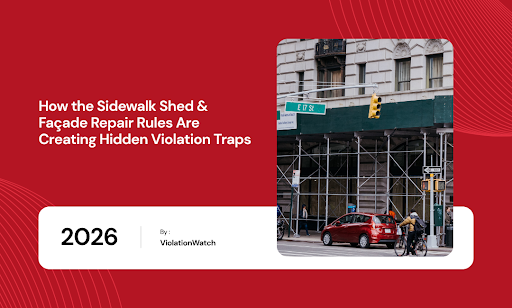
NYC property owners are getting hit with violations they never saw coming. The city’s sidewalk shed and façade repair rules have quietly shifted, and what worked last year could land you a hefty fine today.
The problem? These regulatory changes roll out with little fanfare. Your contractor might not know about the latest shed height requirements. Your permit timeline just got shorter. That containment system you’ve used for years? It might not meet new standards anymore. Property managers across the five boroughs are walking into violation traps without knowing it.
Here’s what we’ll cover:
- The specific rule changes hitting NYC buildings right now are from alternative containment options to compressed permit windows
- Why contractors, inspectors, and property owners keep missing these updates (and how violations pile up fast)
- Common violation scenarios that catch even experienced managers off guard
- How to spot regulation changes before they turn into expensive citations
- A proactive compliance strategy that keeps you ahead of NYC’s shifting requirements
These aren’t minor tweaks. The Department of Buildings has fundamentally changed how sidewalk sheds work, what materials you can use, and how long you have to complete repairs. Miss one update, and you’re looking at violations that compound daily.
Let’s break down exactly what’s changed and how to protect your properties from these costly surprises.
The New Rules Reshaping NYC’s Sidewalk Shed Requirements
Property owners face a completely different regulatory environment than even a year ago. The changes affect everything from basic shed specifications to permit timelines, and catching up requires understanding each new requirement.
Permit Duration Gets Slashed
The days of extended façade repair permits are over. You now get 90 days for sidewalk shed permits, a sharp reduction from the previous one-year allowance. This compressed timeline forces property owners to coordinate repairs with military precision.
Extensions exist but come with stricter requirements. The NYC Government has made it clear that prolonged sidewalk coverage disrupts pedestrian flow and local businesses. Every extension request now faces heightened scrutiny and requires a detailed justification for the delay.
Alternative Containment Methods
Traditional sidewalk sheds no longer represent your only choice. The city has approved several new containment systems that can replace conventional scaffolding setups.
Approved alternatives now include:
- Netting systems with reinforced frameworks – Must meet specific tensile strength requirements
- Cantilevered platforms – Ideal for narrow sidewalks where traditional sheds won’t fit
- Hybrid solutions – Combining partial scaffolding with alternative materials
Each option comes with its own compliance checklist. Netting installations require certified installers and specific mesh ratings. Cantilevered systems need structural engineering reports before approval.
Design and Aesthetic Standards Tighten
Sidewalk sheds can’t look like construction afterthoughts anymore. New regulations mandate specific design elements that blend with neighborhood aesthetics.
Key design requirements:
- Minimum 8-foot clearance (increased from previous standards)
- Maximum 12-foot height without special permits
- Improved lighting – One foot-candle minimum maintained throughout
- Graphics and coverings – Must display on lightweight, fire-resistant materials
Color restrictions now apply in certain historic districts. Some neighborhoods require commission approval for shed exteriors, adding another layer to your permit process.
Lighting Standards Become Non-Negotiable
Inadequate lighting under sidewalk sheds triggers automatic violations. The new one foot-candle requirement applies across the entire covered area, no dark corners allowed.
Property owners must maintain lighting levels 24/7. Burned-out bulbs or damaged fixtures lead to immediate citations. Smart owners install redundant systems and schedule regular lighting audits to avoid surprise violations.
Enhanced Safety Measures Add Complexity
The Façade Inspection Safety Program (FISP) now demands more rigorous documentation. Buildings taller than six stories face the strictest requirements, with façade inspections required every five years.
New FISP requirements include:
- Technical façade reports filed with the Department of Buildings after each inspection
- Immediate repair mandates for any “unsafe” classifications
- Enhanced documentation for all maintenance activities
- Stricter timelines for addressing identified issues
Properties with previous violations face even tighter scrutiny. The city cross-references past citations when reviewing new permit applications, and repeat offenders encounter additional hurdles.
Enforcement Penalties Hit Harder
Fines have increased across the board. Non-compliance penalties start higher and escalate faster than before. What used to be a $500 citation might now cost $2,000 or more.
The city has also expanded its inspection force. More inspectors mean more frequent site visits and less room for error. They’re particularly focused on:
- Expired permits (even by a single day)
- Inadequate pedestrian protection
- Missing or damaged signage
- Lighting violations
- Structural deficiencies
Companies like Design 2147 have adapted their shed installation services to meet these stricter standards, but many contractors still operate under outdated assumptions about what’s acceptable.
Shortened Grace Periods Change Everything
Gone are the courtesy warnings and extended correction periods. When inspectors issue violations, property owners get minimal time to respond. Most violations require action within 30 days, with some safety-related issues demanding immediate attention.
The accelerated timeline affects your entire approach to façade maintenance. Waiting until problems become urgent no longer works; the new rules punish reactive management strategies with hefty fines and potential legal complications.
Why the Industry Keeps Getting Blindsided by Regulation Changes

The disconnect between new rules and industry awareness creates a perfect storm for violations. Even experienced professionals miss critical updates, and the consequences compound quickly.
Information Gaps Hit Every Level
Regulatory changes often get buried in dense government bulletins that few people read thoroughly. The NYC Government publishes updates across multiple platforms, but there’s no centralized alert system that pushes notifications to affected parties.
Where information gets lost:
- Official notices – Posted on agency websites but rarely promoted
- Industry newsletters – Cover major changes but miss technical details
- Professional associations – Share updates sporadically with members only
- Permit offices – Staff may not know about recent changes themselves
Contractors working across multiple boroughs face an even bigger challenge. Each area might interpret rules differently, and what passes inspection in Manhattan could fail in Brooklyn.
Contractors Operate on Outdated Knowledge
Many shed installers learned their trade years ago and haven’t updated their practices. They continue using methods that worked fine last year but now trigger violations.
The certification process for contractors doesn’t require ongoing education about regulatory changes. Once licensed, professionals can operate indefinitely without proving they understand current requirements. This gap between certification and current knowledge creates massive liability for property owners.
Common contractor knowledge gaps:
- Using old permit application forms
- Installing outdated containment systems
- Following superseded height specifications
- Missing new documentation requirements
- Applying expired safety standards
Inspectors Face Their Own Challenges
Building inspectors juggle massive caseloads and constantly shifting priorities. New regulations roll out faster than training programs can keep pace, leaving even well-intentioned inspectors confused about current standards.
Different inspectors might interpret the same rule differently. One might approve your shed design on Monday, while another issues violations for identical work on Friday. This inconsistency makes compliance feel like hitting a moving target.
The inspection workforce also experiences high turnover. New inspectors might strictly enforce rules that veterans overlooked for years, catching property owners completely off guard.
Property Owners Rely on Incomplete Advice
Most building owners trust their contractors and property managers to handle compliance. This hands-off approach worked when regulations remained stable for years, but today’s rapid changes demand more direct involvement.
Critical oversights by property owners:
- Assuming last year’s approved plans still work
- Trusting contractors who claim “we’ve always done it this way”
- Skipping permit review meetings
- Ignoring “minor” violation notices
- Failing to track regulation update cycles
Professional management companies sometimes fare worse than individual owners. Large portfolios mean less attention to individual properties, and standardized procedures don’t adapt quickly to new requirements.
Violations Multiply Through Compound Effects
A single missed update triggers a cascade of problems. Your initial violation might seem minor, perhaps your shed sits two inches too low. But that height violation means your lighting no longer meets minimum standards. The lighting violation creates a safety hazard. The safety hazard leads to an emergency stop-work order.
How violations escalate:
- Initial citation arrives for a “minor” infraction
- Grace period expires while seeking clarification
- Daily fines begin accumulating
- Additional violations get added during follow-up inspections
- Legal complications arise from non-compliance
- Work stoppage freezes all façade repairs
Each step multiplies your costs and extends your timeline. What started as a $1,000 fine becomes a $25,000 problem within weeks.
Technology Adoption Lags Behind Requirements
While regulations modernize rapidly, the industry’s tools and systems haven’t kept pace. Many contractors still track permits on paper, and property owners manage violations through scattered spreadsheets.
Firms like Design 2147 have invested in digital compliance tracking, but they represent the exception rather than the rule. Most industry players lack systems to monitor regulation changes or track violation patterns across their projects.
Communication Breakdowns Amplify Problems
The chain from regulators to property owners involves too many links. Each handoff from city agencies to inspectors to contractors to property managers creates opportunities for critical information to get lost or distorted.
Nobody takes responsibility for ensuring everyone understands new requirements. City agencies publish rules. Industry associations might share them. Contractors might hear about them eventually. Property owners find out when violations arrive.
This fragmented communication system guarantees that someone, somewhere, will miss important updates. The only question becomes who pays the price when violations surface.
Violation Scenarios That Blindside Seasoned Property Managers

Even veteran managers with decades of experience find themselves caught by these specific violation patterns. The following scenarios represent the most costly and surprising citations currently hitting NYC properties.
The Permit Extension Trap
Your 90-day permit expires tomorrow, and your contractor promises they’ll finish by week’s end. You file for an extension, assuming approval will come through before expiration. Wrong move.
The city now requires extension applications 30 days before permit expiration. File late, and you automatically receive violations for operating without valid permits. Those “few extra days” cost thousands in fines, plus potential stop-work orders that halt your entire project.
The violation cascade includes:
- Expired permit citation ($5,000 minimum)
- Operating without valid permits (additional $6,000)
- Daily accumulating fines until resolved
- Mandatory re-application for new permits
- Project delays extending weeks or months
Lighting Measurement Misunderstandings
You installed brand-new LED fixtures under your sidewalk shed. They look bright; everyone can see clearly, yet you still get lighting violations. The problem? Brightness perception doesn’t equal compliance.
Inspectors use light meters to verify the one foot-candle requirement at specific measurement points. Your fixtures might produce adequate light at installation height, but measurements taken at ground level, where pedestrians walk, fall short. Shadow zones near support posts or uneven light distribution trigger automatic violations.
Many managers also forget that lighting requirements apply 24/7. Timers that shut off lights during daylight hours to save energy create compliance gaps that inspectors catch during early morning rounds.
The Heritage District Design Disaster
Your standard gray sidewalk shed worked perfectly on your Midtown properties. You use the same design for your Greenwich Village building and get slapped with aesthetic violations you didn’t know existed.
Certain neighborhoods enforce strict design standards for temporary structures. Your utilitarian shed needs specific colors, decorative elements, or screening materials to meet local requirements. These rules aren’t posted prominently; you discover them through violation notices.
Hidden design requirements include:
- Color specifications matching neighborhood character
- Banned materials in historic zones
- Mandatory decorative screening
- Required signage fonts and sizes
- Prohibited structural designs
Weekend Work Window Violations
Friday afternoon arrives, and your contractor’s team keeps working to finish before the deadline. Saturday morning, violations appear for unauthorized weekend work.
Recent changes restrict construction activities during specific hours and days. What counts as “construction” has expanded, too. Even minor façade work or shed adjustments might require special weekend permits. The rules vary by borough and even by specific blocks near hospitals, schools, or residential areas.
The Netting Specification Switch
You opted for containment netting instead of traditional scaffolding, a choice the city encourages. Yet violations arrive claiming your netting doesn’t meet specifications.
Approved netting materials must meet exact technical standards for mesh size, tensile strength, and flame resistance. Last year’s approved products might not meet this year’s standards. Your installer used netting they’ve used successfully before, but specification updates made that material non-compliant overnight.
Inspector Interpretation Inconsistencies
Monday’s inspector approves your shed modifications. Thursday’s inspector cites you for the exact same setup. You’re not losing your mind, you’re experiencing the reality of subjective enforcement.
Different inspectors emphasize different aspects of the code. One focuses on structural elements while another obsesses over documentation. These varying interpretations mean perfect compliance becomes nearly impossible, especially during shift changes or when regular inspectors take a vacation.
The Multi-Building Permit Maze
You manage several buildings undergoing simultaneous façade work. Each has proper permits, compliant sheds, and scheduled inspections. Violations still arrive because you exceeded area-wide construction limits.
New regulations limit how many active construction sites can operate within specific zones. Your individual permits remain valid, but collectively they violate neighborhood construction density limits. Nobody mentioned this during individual permit applications.
Documentation Format Failures
Your contractor provides all required documentation, structural reports, safety certifications, and insurance papers. Violations arrive for “missing documentation” anyway.
The city now requires specific digital formats for certain documents. PDF versions of paper forms no longer suffice. Some reports need authenticated digital signatures. Others require uploads to specific portals before inspection. Your paperwork exists, but in the wrong format or location.
Critical documentation errors:
- Submitting scanned copies instead of native digital files
- Missing timestamp requirements on reports
- Using outdated form versions
- Incorrect file naming conventions
- Uploading to the wrong city portals
The Adjacent Property Interference
Your sidewalk shed stands perfectly within your property lines and meets all specifications. Violations arrive because your shed interferes with the neighboring building’s façade access.
New regulations consider cumulative effects on city blocks. Your compliant installation might block necessary access for adjacent properties to conduct their own façade work. These “interference violations” catch managers off guard because they require coordination with neighbors who might not communicate their plans.
Post-Completion Inspection Delays
You finished façade repairs, removed your sidewalk shed promptly, and filed all completion paperwork. Months later, violations arrive for “failure to maintain required protective structures.”
The city now requires final inspections before shed removal, but inspection backlogs mean waiting weeks for appointments. Remove your shed without official clearance, even after work completion, and face retroactive violations plus potential requirements to reinstall protective structures for re-inspection.
Your Early-Warning System for Façade Compliance
Staying ahead of NYC’s shifting sidewalk shed and façade requirements demands more than occasional bulletin checks. You need a systematic approach that catches changes before they become violations, especially in city streets where foot traffic and exposure create operational pressure.
Building Your Compliance Foundation
The most effective strategy combines automated monitoring with expert guidance. Manual tracking simply can’t keep pace with regulatory updates across multiple city agencies, particularly when long-standing sidewalk sheds complicate visibility and access. Smart property managers now rely on specialized tools that watch for changes 24/7.
ViolationWatch has emerged as a comprehensive solution for this exact challenge. The platform’s AI-powered monitoring engine specifically tracks façade-related regulations, violations, and compliance updates across all relevant NYC agencies, including the latest measures introduced by the New York City Council to strengthen oversight.
How Automated Violation Monitoring Works
The system operates through a straightforward four-step process that requires minimal setup but delivers maximum protection. This helps owners comply with evolving sidewalk shed design criteria and maintain accurate construction documents that meet updated standards designed to improve sidewalk shed design across the city.
Step 1: Property Portfolio Setup

You start by signing up and adding your properties to the monitoring system. The platform pulls existing violation history and creates a baseline compliance profile for each address. This initial setup takes minutes but establishes comprehensive coverage across your entire portfolio, keeping every local law requirement front and center.
Step 2: Continuous Multi-Agency Surveillance
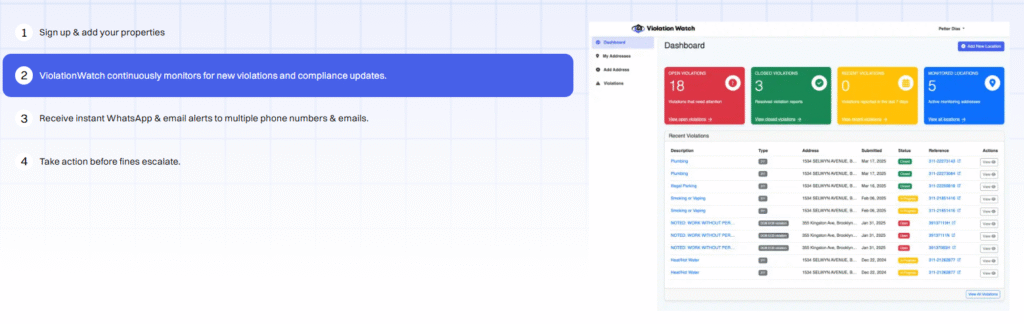
The AI engine continuously scans for new violations and regulatory updates from DOB, ECB, FDNY, and other agencies. Unlike manual checking, this monitoring never stops. The system tracks not only active violations but also pending regulatory changes that could affect your façade maintenance plans, something construction workers and managers struggle to keep updated in a timely manner without automation.
Step 3: Multi-Channel Alert Deployment
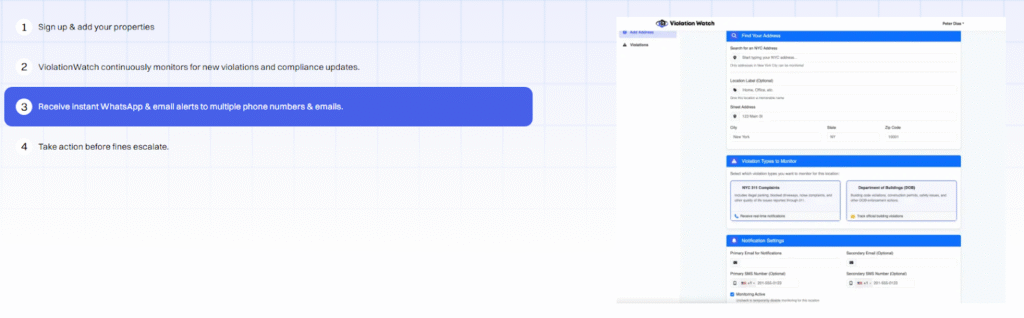
When the system detects issues, it sends instant notifications through WhatsApp and email. You can configure alerts to reach multiple team members simultaneously; your property manager, contractor, and legal counsel all receive the same real-time information. This redundancy ensures critical updates never get missed because someone’s on vacation or switched phone numbers, helping you maintain pedestrian safety around buildings over six stories and new buildings entering their first FISP cycle.
Step 4: Strategic Response Implementation
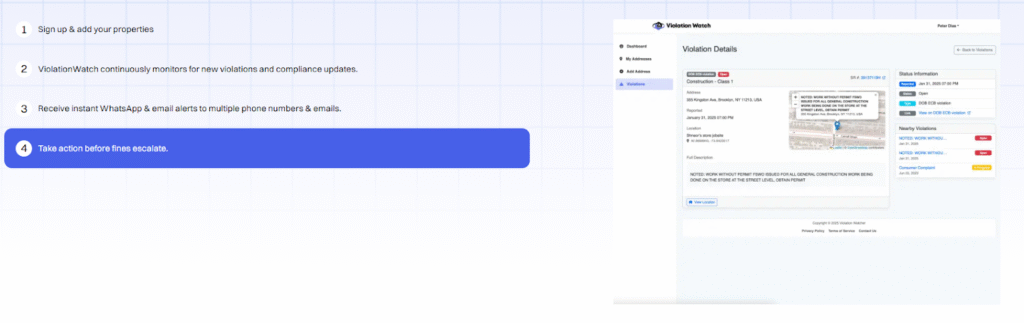
Armed with early warning, you can address issues before fines escalate. A permit expiring next week becomes a routine renewal rather than an emergency. A new lighting requirement gets incorporated into ongoing maintenance rather than triggering violations, especially important with new penalties tied to missed deadlines and difficult access agreements in older buildings.
Transforming Reactive Management Into Proactive Control
The shift from fighting fires to preventing them changes everything about façade compliance. Instead of discovering violations through citations, you spot potential issues days or weeks in advance, critical for planning inspections along every linear foot of façade and coordinating with design professionals.
Key advantages of proactive monitoring:
- Permit tracking – Know expiration dates across all properties
- Regulation updates – Receive plain-English summaries of technical changes
- Violation patterns – Spot trending issues before they hit your buildings
- Contractor accountability – Verify compliance claims with real-time data
- Budget planning – Anticipate compliance costs rather than face surprise fines
This approach particularly benefits managers overseeing multiple properties. Rather than juggling spreadsheets and calendar reminders, you get unified oversight through a single dashboard, especially powerful when new local laws shift inspection timing ahead of cycles in ways that other regions or other cities are now beginning to mirror.
Cost-Benefit Analysis of Automated Compliance
ViolationWatch offers a free trial that lets you test the system with your properties immediately. The full version runs $9.99 per address monthly, less than the cost of most parking tickets and a fraction of any façade-related violation fine.
Consider what you’re actually buying: continuous monitoring that would require a full-time employee to replicate manually. The system watches for violations and regulatory changes around the clock, sending alerts the moment anything affects your properties, including requirements tied to new construction, façade classifications, and early indicators of unsafe conditions.
For portfolios facing regular façade work, the math becomes even clearer. Catching one permit expiration early saves thousands. Preventing a single escalating violation covers months of monitoring costs. Automated oversight also helps you plan needed repairs well before official FISP reports uncover deficiencies that trigger new legislation.
Integration With Existing Management Systems
Modern compliance tools must work with your current processes, not replace them entirely. ViolationWatch integrates violation monitoring into your existing workflow through customizable alerts and reporting.
Your team continues using familiar communication channels; the system simply adds a layer of intelligent monitoring that catches what human oversight might miss. Property managers still make decisions, but now with complete, timely information, something licensed architects and engineers appreciate when dealing with stricter enforcement tied to minimum safety thresholds, such as minimum height adjustments or requirements signed off by a registered design professional.
Beyond Violation Tracking
While the immediate benefit focuses on avoiding fines, proactive monitoring delivers broader advantages. You build a compliance history that demonstrates responsible management to lenders, insurers, and potential buyers.
The system also helps you identify problematic contractors through violation patterns. If specific vendors consistently trigger certain citations, you spot the trend before it damages your portfolio.
Additional strategic benefits:
- Insurance negotiations: Prove proactive compliance management
- Contractor vetting: Track violation history by vendor
- Portfolio analysis: Identify buildings with recurring issues
- Regulatory relationships: Show good faith compliance efforts
- Transaction due diligence: Provide a comprehensive violation history
ViolationWatch also simplifies planning when agencies impose a specific timeline, for example, when façade conditions must be corrected within two years of initial discovery or when you aim to resolve issues at the first place of concern to avoid reopening inspections.
Getting Started With Smarter Compliance
Beginning your free trial requires only basic property information. Within minutes of signing up, the system starts monitoring your addresses and building your compliance dashboard. You’ll immediately see any existing violations and upcoming permit expirations.
The platform’s learning curve stays minimal because it focuses on delivering actionable information rather than complex features. You don’t need technical expertise if you can check your email; you can use ViolationWatch effectively.
Start with your highest-risk properties or those with active façade work. As you see the value of early warnings and preventing violations, you expand coverage across your entire portfolio. The monthly per-address pricing makes scaling straightforward and predictable, an operational improvement upgrade many owners take right after confronting the dangers of missed inspections or the financial hardship caused by unexpected penalties.
Property managers who’ve shifted to proactive monitoring report not only fewer violations but also reduced stress. Knowing that an automated system watches for compliance issues 24/7 lets you focus on strategic property management rather than constantly worrying about surprise citations. The free trial eliminates any risk in testing this approach. See firsthand how automated monitoring converts façade oversight into a stable, predictable system, precisely what modern compliance frameworks now expect.
Stop Playing Violation Roulette With ViolationWatch
You’ve seen how NYC’s façade and sidewalk shed regulations create expensive traps for even experienced property managers. The shifting requirements, compressed timelines, and harsh penalties make manual compliance tracking a losing game.
The smartest property managers have already moved beyond spreadsheets and calendar reminders. They’re using automated systems that catch regulatory changes before violations hit, track permit expirations across entire portfolios, and send alerts when action is needed.
The results of proactive compliance monitoring:
- Zero surprise violations – Early warnings give you 30+ days to address issues before fines hit
- 90% faster permit renewals – Automated reminders mean no more last-minute scrambles
- $10,000+ average savings – Preventing just one escalating violation pays for years of monitoring
- Complete contractor accountability – Real-time tracking ensures vendors follow current regulations, not outdated practices
- Portfolio-wide peace of mind – One dashboard replaces dozens of spreadsheets and sticky notes
Start by checking your properties’ current violation status with our Free NYC Violation Lookup Tool. Instantly see all open violations, including façade-related citations, for any NYC address.
ViolationWatch transforms façade compliance from a constant worry into a managed process. Instead of discovering violations through citations, you’ll know about potential issues weeks in advance. Your contractors can’t claim ignorance about new requirements when you’re tracking every regulatory update.Those surprise fines that used to blow up budgets become rare exceptions rather than monthly expectations. Start your free trial today and see why property managers across NYC trust ViolationWatch to keep their buildings compliant and their violation costs under control.