
Mayor Zohran Mamdani’s sweeping enforcement plan puts every NYC property owner on notice. The city’s new approach to building code violations transforms minor infractions into major financial threats, with fines doubling, tripling, and the city is ready to take control of properties that fail compliance standards.
This shift affects you directly. Open violations that once seemed manageable now carry consequences that can spiral out of control within weeks. The Mayor’s Office to Protect Tenants (MOPT) gains expanded powers to track, enforce, and escalate action against properties with unresolved violations across DOB, HPD, FDNY, and other city agencies.
The stakes have never been higher. Properties with hazardous violations face immediate intervention. Buildings with repeated safety issues risk city takeover. And landlords who delay repairs now face a system designed to act fast and hit hard financially.
Here’s what we’ll cover to help you protect your property:
- The specific changes in Mamdani’s enforcement plan and what triggers city intervention
- What “property takeover” actually means and how the city can legally seize control
- Which building types face the highest risk under the new enforcement priorities
- How accumulating violations creates a pathway to losing your property rights
- Practical steps to assess your current violation status and exposure level
- A 10-point readiness checklist to prepare your properties for stricter enforcement
- How automated violation tracking helps you stay ahead of enforcement actions
Your building’s violation history determines its future under this new system. Let’s break down exactly what you need to know and do right now.
What’s Actually Changing Under Mayor Mamdani’s Enforcement Plan
The new enforcement system transforms how NYC handles building code violations. Unlike previous administrations that relied on warnings and gradual fine increases, Mamdani’s approach accelerates consequences and expands city powers significantly.
Core Changes to Violation Enforcement
The Mayor’s Office to Protect Tenants (MOPT) now operates as a centralized command center for NYC building violations. This office consolidates enforcement data from multiple agencies like DOB, HPD, FDNY, DOHMH, and DEP, creating a unified tracking system that flags properties with violations across departments.
Key enforcement shifts include:
- Double and triple fines for hazardous violations and repeat offenses
- Shortened compliance windows from 30-60 days down to 14-21 days for critical issues
- Automatic escalation protocols that trigger city intervention after second notices
- Cross-agency violation tracking that creates comprehensive property risk profiles
- Expanded city takeover authority for buildings with unresolved safety violations
City Intervention Triggers
The city now intervenes based on specific violation patterns and thresholds. Understanding these triggers helps you anticipate enforcement actions before they escalate.
Immediate intervention occurs when:
- Class 1 (immediately hazardous) violations remain open beyond 14 days
- Multiple agencies flag the same property within a 90-day period
- Tenants file verified complaints about unaddressed safety issues
- Fine amounts exceed $25,000 in aggregate across all violations
The Enforcement Escalation Timeline
| Days After Violation | City Action | Owner Consequence |
| 0-14 | Initial notice and fine | Standard penalties apply |
| 15-30 | Second notice with doubled fines | Increased financial burden |
| 31-45 | MOPT review and site inspection | Potential emergency repairs ordered |
| 46-60 | Legal proceedings initiated | Court appearances required |
| 60+ | Property takeover proceedings | Risk of losing management control |
Expanded MOPT Powers
The Mayor’s Office to Protect Tenants received unprecedented authority to coordinate enforcement actions. These powers extend beyond traditional violation management into proactive property oversight.
MOPT can now:
- Access violation data across all city agencies instantly
- Order emergency repairs without court approval for certain hazards
- Bill property owners directly for city-performed repairs at premium rates
- Place properties under administrative oversight before formal takeover
- Create public “worst landlord” lists based on violation patterns
Financial Penalties That Compound Fast
The new fine structure creates cascading financial pressure. A single unresolved violation can trigger multiple penalties across different categories, turning manageable fines into significant financial burdens within weeks.
For example, a heating violation that previously carried a $500 fine now starts at $1,000. If unresolved after 14 days, it doubles to $2,000. Add daily penalties of $100-$250, and a simple heating issue can cost $5,000+ within a month. When combined with other violations, total fines can exceed $25,000 rapidly, triggering more aggressive city intervention.
Tenant-Driven Enforcement Mechanisms
The plan emphasizes tenant reporting as a primary enforcement tool. New protections and incentives encourage tenants to report violations directly to MOPT, bypassing traditional complaint channels.
Tenants gain access to:
- Direct MOPT hotlines with guaranteed 48-hour response times
- Protection from retaliatory rent increases after reporting violations
- Legal support for organizing building-wide complaint initiatives
- Public dashboards showing their building’s violation history
This shift in tenant empowerment means violations you might not know about can trigger enforcement actions before you receive formal notice. Properties with active tenant organizations face particularly intense scrutiny under the new system.
Breaking Down “Property Takeover” and NYC’s Legal Authority to Seize Control

The term “property takeover” sounds dramatic, but NYC already possesses multiple legal mechanisms to assume control of buildings. Mamdani’s plan expands and accelerates these existing powers, making confiscation of property for code non-compliance in NYC a faster, more streamlined process.
Legal Foundations for City Control
New York City’s authority to intervene in private property management stems from several established legal frameworks. These powers exist to protect tenant safety and maintain habitability standards across the city’s housing stock.
Primary legal mechanisms include:
- 7A Administrator Appointments under Article 7A of the Real Property Actions and Proceedings Law
- Emergency Repair Liens that create super-priority claims against properties
- Receivership Proceedings through Housing Court for chronic violators
- Tax Lien Foreclosure expanded to include violation-based liens
- Nuisance Abatement Actions for properties creating public safety hazards
How Property Takeover Actually Works
The process begins long before the city assumes control. Each step creates opportunities for owners to correct course, but the timeline now moves much faster than traditional enforcement.
- Phase 1: Violation Accumulation (Days 1-30): Properties accumulate violations across multiple agencies. The centralized MOPT system tracks these in a unified database, creating risk scores based on violation severity, frequency, and owner response patterns.
- Phase 2: Formal Warning Period (Days 31-60): Owners receive consolidated notices listing all open violations and required actions. This phase includes mandatory compliance conferences where owners must present remediation plans with specific timelines.
- Phase 3: Legal Proceedings (Days 61-90): The city initiates formal takeover proceedings through Housing Court. Owners can contest the action but must demonstrate good faith efforts to remedy violations and financial capacity to complete repairs.
- Phase 4: Court-Appointed Management (Day 91+): If takeover proceeds, the court appoints a 7A administrator or receiver who assumes complete operational control. The owner retains title but loses all management rights until violations are resolved and costs are recovered.
Financial Implications of City Control
When the city takes control, property economics shift dramatically. Owners continue paying all expenses while losing rental income and facing additional administrative costs.
| Cost Category | Who Pays | Typical Range |
| Existing mortgage | Property owner | Ongoing obligation |
| Property taxes | Property owner | No relief provided |
| Administrator fees | Property owner | $3,000-$10,000/month |
| Repair costs | Property owner | Market rate + 20-40% |
| Legal fees | Property owner | $15,000-$50,000+ |
| Lost rental income | Property owner | 100% during takeover |
Types of Properties Most Vulnerable
Certain property profiles face higher takeover risk under the expanded enforcement regime. Understanding these risk factors helps owners assess their exposure level.
High-risk property characteristics:
- Buildings with 10+ units and multiple open violations
- Properties with repeated heat/hot water complaints
- Buildings where violation fines exceed annual rental income
- Properties with lead paint or asbestos violations affecting children
- Buildings with structural issues classified as immediately hazardous
The 7A Administrator Process
The 7A process represents the most common form of property takeover in NYC. Once appointed, the administrator gains sweeping powers that effectively remove the owner from all decision-making.
7A administrators can:
- Collect all rents directly from tenants
- Hire contractors without owner approval
- Make capital improvements deemed necessary
- Evict tenants for non-payment (to the administrator)
- Sell property assets to fund repairs
- Remain in control for years until all violations clear
Owners cannot terminate the administrator or interfere with their operations. Any attempt to circumvent the administrator’s authority can result in contempt charges and additional penalties.
Preventing Takeover Through Compliance
The expanded takeover powers create urgency around landlord code compliance in NYC. Properties with clean violation records face virtually no takeover risk, while those with mounting violations enter dangerous territory quickly.
The key lies in addressing violations before they trigger formal proceedings. Once the city initiates takeover actions, stopping the process becomes expensive and difficult. Owners who track violations actively and respond within initial notice periods maintain control over their properties and avoid the devastating financial impact of city management.
Recovery After Takeover
Regaining control after a city takeover requires clearing all violations, paying all accumulated costs, and demonstrating ongoing compliance capacity. This process typically takes 18-36 months minimum and costs significantly more than preventing a takeover initially.
Owners must satisfy:
- Complete violation remediation verified by city inspectors
- Payment of all administrator fees and costs
- Settlement of repair expenses with interest
- Demonstration of financial reserves for future maintenance
- Court approval based on sustained compliance record
The total cost often exceeds the property’s annual income for multiple years, creating severe financial strain that some owners never overcome.
Building Types Now Squarely in the City’s Enforcement Crosshairs
Not all properties face equal risk under Mamdani’s enforcement priorities. The new system targets specific building profiles based on violation patterns, tenant demographics, and property characteristics that historically correlate with habitability issues.
Pre-War Rent-Stabilized Buildings
These properties top the enforcement priority list. Buildings constructed before 1940 with rent-stabilized units face intense scrutiny due to aging infrastructure and deferred maintenance patterns.
Why they’re targeted:
- Lead paint violations affect most pre-1960 construction
- Outdated heating systems are prone to winter failures
- Electrical systems that haven’t met modern code updates
- Plumbing infrastructure is reaching the end of its useful life
- Higher concentration of elderly and vulnerable tenants
Pre-war buildings with 20-50 units draw particular attention. This size range often lacks professional management while housing enough tenants to generate multiple complaints. The combination creates perfect conditions for rapid violation accumulation.
Mixed-Use Properties in Transition Zones
Buildings combining residential units with commercial spaces face unique enforcement challenges. The city now coordinates violations across both residential and commercial enforcement divisions, creating compound risk for these properties.
Commercial tenants often mask residential violations through separate entrances and divided systems. However, the new unified tracking system connects violations across all units, exposing previously hidden residential issues. Properties with ground-floor restaurants or dry cleaners face extra scrutiny due to ventilation, pest, and fire safety concerns affecting residential units above.
Portfolio Properties Under Single Ownership
Owners managing multiple buildings through various LLCs now face portfolio-wide enforcement. The city’s enhanced tracking connects properties under common ownership, even when held through different entities.
Portfolio red flags include:
- Pattern violations across multiple properties
- Shared management companies with poor track records
- Common contractors cited for substandard work
- Financial distress indicators affecting maintenance capacity
A single problem building can trigger enhanced inspection schedules across an entire portfolio. This multiplier effect turns isolated issues into systematic enforcement actions affecting all properties under common control.
Recently Converted Buildings
Properties converted from commercial to residential use within the past decade face heightened inspection activity. These conversions often involve complex mechanical system retrofits and structural modifications that create ongoing compliance challenges.
The city particularly targets:
- Office-to-residential conversions in Midtown and Downtown
- Warehouse conversions in Brooklyn and Queens
- Former hotels operating as apartment buildings
- Industrial buildings converted to loft-style units
These properties frequently struggle with inadequate fire separation, ventilation deficiencies, and electrical systems not designed for residential loads. The enforcement push specifically examines whether conversions met all requirements and maintain ongoing compliance.
Buildings with Basement Dwelling Units
Properties containing basement apartments, legal or otherwise, face aggressive enforcement under the new priorities. The city’s focus on basement dwelling safety creates an automatic high-risk designation for buildings with these units.
Enforcement teams now conduct proactive inspections of buildings suspected of having basement units based on:
- Water usage patterns indicate additional occupants
- Multiple Con Ed meters suggesting divided units
- 311 complaints mentioning basement conditions
- Tax records showing unusual unit counts
Multi-Family Buildings in Gentrifying Areas
Properties in rapidly changing neighborhoods receive extra enforcement attention. The city monitors these buildings for harassment tactics and maintenance neglect aimed at pushing out long-term tenants.
High-scrutiny neighborhoods currently include:
- Bushwick and Bedford-Stuyvesant in Brooklyn
- Inwood and Washington Heights in Manhattan
- Jackson Heights and Corona in Queens
- Mott Haven and Melrose in the Bronx
Buildings in these areas face surprise inspections and expanded violation reviews when any complaint is filed. The city assumes potential bad faith in violation corrections and applies stricter verification standards.
Properties with Expired Certificates
Buildings operating with expired or missing certificates of occupancy, electrical permits, or elevator certifications automatically enter high-risk categories. The new system flags these administrative violations as indicators of broader compliance problems.
Critical expired documents triggering enforcement:
- Certificates of Occupancy not matching current use
- Elevator inspections are overdue by 30+ days
- Electrical work permits are never closed out
- Boiler inspections lapsed beyond grace periods
- Fire suppression system certifications have expired
The city now treats administrative non-compliance as seriously as physical violations, recognizing that paperwork problems often indicate deeper issues.
Buildings Under HPD Alternative Enforcement Program
Properties previously enrolled in HPD’s Alternative Enforcement Program (AEP) remain under enhanced scrutiny even after program exit. The enforcement system maintains historical risk scores that flag these buildings for continued monitoring.
This “once troubled, always watched” approach means a building’s past violation history creates a permanent elevation in risk profile. Even after completing all repairs and exiting AEP, these properties face more frequent inspections and lower tolerance for new violations.
How Automated Monitoring Protects Your Portfolio Before It’s Too Late

Manual violation tracking failed property owners long before Mamdani’s enforcement escalation. Today’s accelerated timelines and cross-agency coordination make automated monitoring essential for protecting your properties from sudden enforcement actions.
Understanding Your Current Exposure
Assessing violation risk starts with comprehensive visibility across all city agencies. Properties accumulate violations from DOB, HPD, ECB, FDNY, and other departments simultaneously. Each agency operates independently, but enforcement now views them collectively.
ViolationWatch solves this fragmentation through unified monitoring. The platform’s AI-powered engine continuously scans all agency databases, creating a complete violation picture that manual tracking simply cannot achieve.
The Four-Step Protection Process
Getting ahead of enforcement requires systematic violation management. ViolationWatch streamlines this into four straightforward steps that transform how you handle NYC property manager violations risk.
Step 1: Sign Up and Add Your Properties
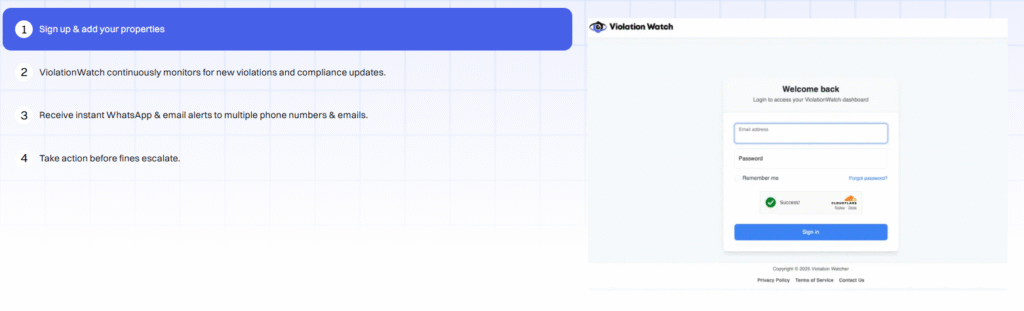
The setup takes minutes. Enter your property addresses into the system, and the AI immediately begins scanning historical and current violations across all city databases. You’ll see existing violations within seconds, often discovering issues you didn’t know existed.
Step 2: Continuous AI Monitoring Begins
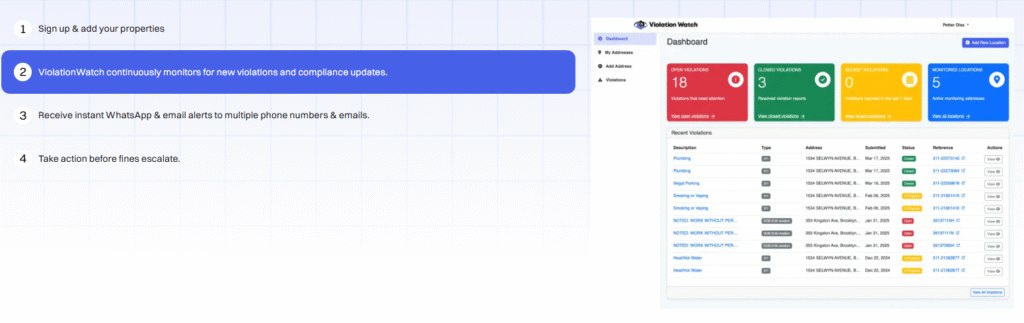
The platform’s monitoring engine checks city databases every few hours. Unlike manual searches that require visiting multiple agency websites, the AI tracks DOB, HPD, ECB, FDNY, DEP, DEC, DOH, DOT, DSNY, and DOF simultaneously. This DOB violation monitoring in NYC extends across all agencies, catching violations the moment they appear.
Step 3: Instant Multi-Channel Alerts
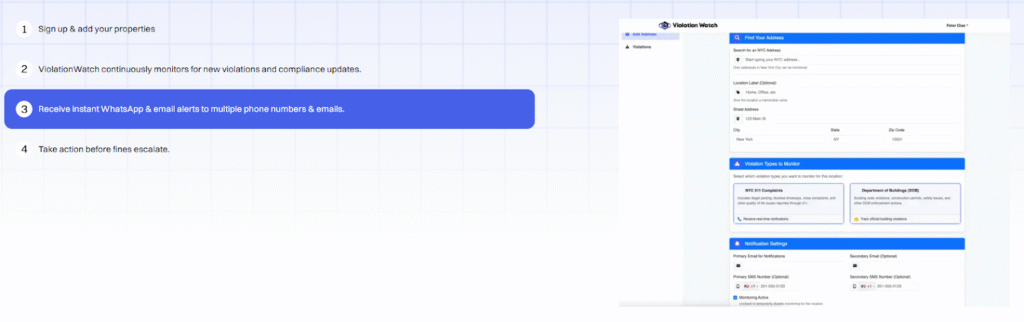
When new violations appear or existing ones escalate, you receive immediate notifications. The system sends alerts via WhatsApp and email to multiple team members simultaneously. Property managers, superintendents, and owners all stay informed without anyone manually checking for updates.
Step 4: Take Action Before Escalation
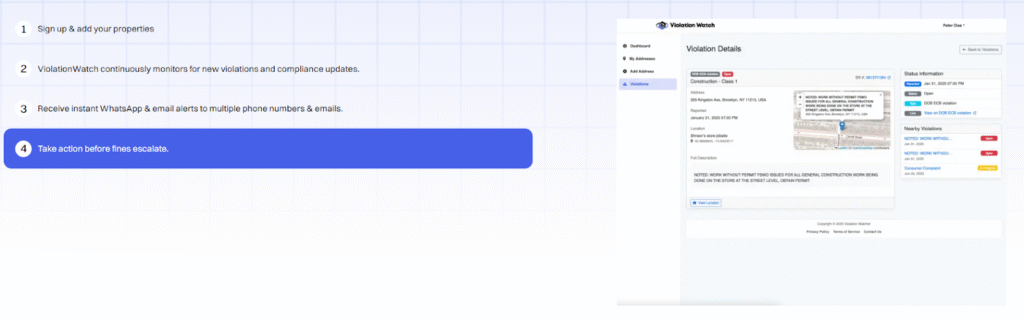
Early warning changes everything. With instant alerts, you address violations within the initial compliance window, avoiding doubled fines and enforcement triggers. The dashboard shows exactly which violations need immediate attention and which can wait.
Critical Features That Prevent Enforcement
The platform’s risk dashboard transforms raw violation data into actionable intelligence. Color-coded severity indicators show which properties face immediate risk versus those with minor issues.
- Violation timeline tracking displays how long each violation has been open and when it enters the next penalty phase. This visibility prevents violations from aging into enforcement triggers.
- Document management integration keeps all violation-related paperwork organized and accessible. When inspectors arrive or court dates approach, every document sits ready in one place.
- Compliance deadline calendars ensure nothing falls through the cracks. The system tracks correction deadlines, inspection appointments, and court dates across your entire portfolio.
The Evolution from Past Enforcement Approaches
While Mayor Adams previously focused on quality-of-life violations, the new administration takes a fundamentally different approach. The shift targets building owners who fail to maintain safe living conditions, moving beyond the previous system where repeat offenders could delay consequences indefinitely. New Yorkers deserve better than buildings with chronic violations that threaten their health and degrade their communities.
The enhanced code enforcement system creates real accountability. Additionally, the platform helps responsible owners improve their properties proactively, ensuring they comply with all regulations before penalties are imposed. Rather than treating violations as a cost of doing business, the new framework ensures owners are held accountable for maintaining standards.
Understanding Interstate Enforcement Coordination
New York State agencies now share violation data more extensively, creating a comprehensive enforcement network. The special enforcement units established under the new system have expanded authority to coordinate actions across jurisdictions. Property owners can review detailed enforcement procedures on the official gov websites, where new regulations are posted regularly.
The system particularly impacts owners who previously relied on paying higher fines rather than making repairs. Under the old system, wealthy landlords could absorb penalties as operational expenses. Now, accumulating fines triggers automatic enforcement escalation, regardless of payment ability. Even a simple text message complaint from a tenant can initiate a multi-agency investigation if the property has existing violations.
Cost-Effective Risk Management
ViolationWatch offers two pricing tiers designed for different portfolio needs. The free tier provides basic monitoring for smaller portfolios, while the per-address plan at $9.99 monthly delivers comprehensive protection with unlimited alerts and full dashboard access.
Consider the math: A single missed violation can trigger thousands in fines. One property entering enforcement proceedings costs tens of thousands. The monitoring investment pays for itself by preventing just one escalation.
Real-World Impact on Portfolio Protection
Properties using automated monitoring see immediate results. Violation resolution times drop dramatically when owners catch issues early. More importantly, properties avoid entering the city’s high-risk categories that trigger aggressive enforcement.
The platform particularly benefits portfolios where:
- Multiple properties require simultaneous monitoring
- Management teams need a coordinated violation response
- Owners lack dedicated compliance staff
- Properties have histories of accumulating violations
Integration with Your Existing Operations
ViolationWatch complements your current property management systems. The WhatsApp alerts integrate with how teams already communicate. Email notifications fit existing workflows. The web dashboard provides instant access from any device.
Property managers can grant access to maintenance teams, ensuring the right people receive relevant alerts. Owners maintain oversight without drowning in operational details. Everyone stays informed at the appropriate level.
Starting Protection Today
Every day without automated monitoring increases enforcement risk. Violations accumulate silently across multiple agencies. Fines double without warning. Properties edge closer to intervention thresholds.
Setting up protection takes minutes:
- Visit ViolationWatch
- Enter your first property address
- See existing violations immediately
- Configure alert preferences
- Begin receiving notifications
The system starts working instantly, scanning for new violations and monitoring existing ones. Within 24 hours, you’ll have complete visibility across your portfolio.
Beyond Basic Compliance
Automated tracking does more than prevent disasters. The data patterns reveal maintenance issues before they become violations. You spot problem contractors whose work triggers repeated citations. You identify which properties need preventive attention.
This proactive approach transforms violation management from reactive scrambling to strategic planning. Properties stay cleaner. Tenants stay happier. Enforcement risks disappear.
The new enforcement reality demands new tools. Manual tracking worked when violations moved slowly and agencies operated in silos. Today’s unified, accelerated enforcement requires automated protection. ViolationWatch provides that protection, keeping you ahead of violations before they threaten your property rights.
Your 10-Point Pre-Enforcement Readiness Checklist
Preparing for stricter enforcement requires a systematic evaluation of your properties’ compliance status. This checklist provides actionable steps to identify vulnerabilities and strengthen your position before enforcement actions begin.
1. Conduct a Multi-Agency Violation Audit
Start by pulling violation records from every city agency. Many owners focus only on DOB violations while HPD, ECB, or FDNY issues accumulate unnoticed.
Action steps:
- Check DOB NOW for building violations and permits
- Review HPD Online for housing maintenance violations
- Search ECB violations for environmental control board summonses
- Verify FDNY inspection reports and fire code violations
- Examine DEP records for water and sewer issues
Document every open violation, noting issue dates and current status. This baseline assessment reveals your true enforcement exposure.
2. Prioritize Class 1 and Immediately Hazardous Violations
These violations trigger the fastest enforcement actions under the new system. Any Class 1 violation older than 14 days puts your property at immediate risk.
Review your audit results and identify:
- Lead-based paint hazards affecting children under 6
- Inadequate heat or hot water complaints
- Structural issues threatening collapse
- Missing or defective fire escapes
- Broken door locks on building entrances
- Window guard violations in units with young children
Create an action plan addressing these violations first, with specific contractor assignments and completion dates.
3. Calculate Your Total Fine Exposure
Understanding your financial risk helps prioritize remediation efforts. Fines now double and triple rapidly, making early resolution critical.
Build a fine tracking spreadsheet including:
| Violation Type | Base Fine | Days Open | Current Fine | 30-Day Projection |
| HPD Class B | $250 | 45 | $500 | $1,000 |
| DOB Work Without Permit | $800 | 20 | $1,600 | $3,200 |
| ECB Sanitation | $100 | 60 | $300 | $600 |
Add daily penalties where applicable. The 30-day projection shows enforcement trigger points.
4. Schedule Professional Third-Party Inspections
Independent inspections catch problems before city inspectors arrive. Professional inspectors understand current enforcement priorities and spot issues owners often miss.
Focus inspection areas on:
- Fire safety systems and egress routes
- Electrical panels and wiring conditions
- Structural elements showing wear
- Mechanical rooms and boiler operations
- Common areas requiring maintenance
- Basement and cellar compliance
Request written reports with photo documentation. These reports guide remediation and demonstrate good-faith compliance efforts if questioned.
5. Verify All Required Certificates and Permits
Expired paperwork creates easy enforcement targets. The new system flags administrative violations as compliance indicators.
Critical documents to verify:
- Certificate of Occupancy matching current use
- Elevator inspection certificates (due annually)
- Boiler inspection reports (due annually or biannually)
- Fire suppression system certifications
- Electrical permit sign-offs for recent work
- Place of Assembly permits, if applicable
Set calendar reminders 60 days before each expiration. Renew early to avoid lapses that trigger scrutiny.
6. Document Your Maintenance and Repair History
Detailed records demonstrate responsible ownership during enforcement proceedings. Courts consider maintenance patterns when evaluating takeover actions.
Maintain records showing:
- Contractor invoices for all repairs
- Before/after photos of completed work
- Tenant complaint logs with response times
- Preventive maintenance schedules
- Capital improvement documentation
- Professional service contracts
Organize records by property and year. Digital storage with cloud backup ensures accessibility during emergencies.
7. Establish Rapid Response Protocols
The shortened compliance windows demand immediate action capabilities. Building response systems now prevents crisis scrambling later.
Create protocols for:
- 24-hour emergency repair contacts
- Backup contractors for each trade
- Expedited payment procedures
- Weekend inspection availability
- Legal counsel familiar with housing court
- Document production systems
Test these protocols quarterly. A heat complaint on Friday night needs resolution before Monday’s enforcement deadline.
8. Review Tenant Communication Channels
Tenants now have direct access to enforcement agencies. Positive tenant relationships reduce complaint likelihood and demonstrate good-faith management.
Implement communication improvements:
- Post updated contact information prominently
- Create online maintenance request systems
- Respond to all complaints within 24 hours
- Document all tenant interactions
- Provide repair timeline updates
- Address concerns before they become violations
Satisfied tenants rarely file complaints. Frustrated tenants trigger enforcement scrutiny.
9. Analyze Multi-Agency Patterns
The unified tracking system connects violations across agencies. Understanding these patterns helps anticipate enforcement actions.
Look for concerning combinations:
- Multiple agencies citing the same property
- Repeated violations for similar issues
- Seasonal violation patterns (heat, cooling)
- Tenant complaint clusters
- Work without permit histories
Properties showing patterns face enhanced scrutiny. Breaking these patterns requires addressing root causes, not symptoms.
10. Create a Compliance Reserve Fund
Financial preparedness enables quick violation resolution. Properties without ready funds face escalating fines and potential takeover.
Calculate reserve requirements:
- Average monthly violation fines × 6
- Emergency repair estimates for major systems
- Legal representation retainer
- Administrative fee cushion
- Property improvement allowance
Separate compliance reserves from operating accounts. When violations arise, immediate payment capability prevents escalation into enforcement proceedings.
Implementing Your Readiness Plan
This checklist identifies vulnerabilities before they become enforcement actions. Properties completing all ten points position themselves to survive the new enforcement regime.
Start with the violation audit. You can’t fix what you don’t know about. Move through each point systematically, documenting completion. The prepared properties will weather enforcement storms while the unprepared face escalating consequences.
Schedule monthly checklist reviews. Enforcement readiness requires ongoing vigilance, not one-time preparation. Properties maintaining consistent compliance avoid the devastating impacts of city intervention, protecting both your investment and your tenants’ homes.
Stop Playing Defense Against NYC Violations, Start Playing Smart
You’ve seen what’s coming. Mamdani’s enforcement machine targets unprepared properties with surgical precision. The days of treating violations as minor annoyances have ended. Properties that once coasted on delayed responses now face existential threatsdoubled fines, tripled penalties, and city takeover proceedings that strip away your management rights entirely.
The 10-point readiness checklist gives you a framework. The enforcement timeline shows you the stakes. What you need now is an execution manual that tracking won’t cut it when violations accumulate across DOB, HPD, ECB, FDNY, and six other agencies faster than any human can monitor.
Start by checking your properties’ current violation status with our Free NYC Violation Lookup Tool. See all open violations across every city agency instantly for any NYC address—no signup required.
That’s where ViolationWatch transforms your compliance strategy. Instead of checking multiple agency websites daily (and still missing violations), you get instant WhatsApp and email alerts the moment new violations appear. Your entire team stays informed. Nothing slips through.At $9.99 per property monthlyless than a single day’s late fee on most violations, you’re buying peace of mind and protecting investments worth hundreds of thousands. The free tier even lets you test the system with basic monitoring before committing. Start your protection today at ViolationWatch and turn Mamdani’s enforcement crackdown from a threat into a non-issue.