
You got hit with another HPD violation notice last Tuesday. Then three more arrived by Friday. Your tenant called about the heat. The inspector showed up before you fixed it. Now you’re scrambling to pull records, check status updates, and figure out which building has what problem.
Here’s the brutal truth: Most NYC landlords don’t lose money because violations happen. They lose money because they find out too late, miss hearing dates, or can’t track what’s already been fixed.
HPD violations pile up fast. Heat complaints in winter. Pest issues in older buildings. Maintenance problems that tenants report directly to the city. You need a system that catches these problems before they turn into expensive penalties.
This guide shows you how to stop playing catch-up with HPD violations and start managing them like a pro.
Here’s what we’ll cover:
- The most common HPD violations you’ll face (heat, pests, maintenance issues)
- How to manually check violations through HPD ONLINE (and why it’s a time sink)
- Why manual tracking puts your portfolio at risk (no alerts, can’t scale across buildings)
- How ViolationWatch turns HPD tracking into a streamlined, automated process
Let’s get started!
Most Landlords Face These HPD Violations
HPD violations fall into three main categories. You’ll see heat complaints spike between October and May. Pest problems show up year-round but get worse in summer. Maintenance issues? Those never take a break.
Heat and Hot Water Violations
New York City requires you to maintain specific temperatures during heating season (October 1 through May 31). Daytime temps must hit 68°F when it’s below 55°F outside. Nighttime? You need 62°F regardless of outdoor conditions.
Tenants don’t wait around when the heat fails. They call 311, and HPD sends an inspector within 24 hours for heat complaints. Here’s what triggers violations:
- Broken or inadequate heating systems
- Insufficient hot water supply (must be 120°F minimum)
- Radiators that don’t work in occupied units
- Boiler failures during heating season
The penalty structure hits hard. Class C violations (immediate hazards) can cost you $50-$150 per day until you fix the problem. Miss the correction deadline? Those fines stack up fast.
Pest Infestations
Rats, mice, roaches, and bedbugs make up the bulk of pest-related HPD violations. Tenants spot one roach and file a complaint. An inspector confirms the infestation. Now you’ve got a violation and a deadline to clear it up.
Common pest violations include:
- Rodent activity in common areas or apartments
- Cockroach infestations
- Bedbug presence after tenant complaints
- Improper garbage storage that attracts pests
You can’t half-fix pest problems. HPD wants documentation from licensed exterminators. Treatment records. Follow-up visits. Prove the infestation is gone. Skip any step, and the violation stays open.
Maintenance and Repair Issues
These violations cover everything from leaky pipes to crumbling plaster. HPD classifies them based on severity, and each class carries different correction timelines.
- Class A violations give you 90 days. Peeling paint. Minor leak. Cracked window. Nothing immediately dangerous, but still needs fixing.
- Class B violations require action within 30 days. We’re talking larger leaks, broken locks on apartment doors, missing smoke detectors, or damaged stairs.
- Class C violations demand immediate attention. Exposed electrical wiring. No heat in winter. Structural damage. You get 24 hours to make it safe.
The maintenance category is broad. You might see violations for:
- Plumbing failures (leaks, broken fixtures, sewage backup)
- Structural problems (damaged walls, floors, ceilings)
- Electrical issues (faulty wiring, broken outlets)
- Window and door defects
- Missing or broken safety equipment
Each violation lists the specific problem, its location, and your deadline to correct it. Miss that deadline, and the city can send a contractor to fix it on your dime. Plus penalties.
Manual HPD Violation Tracking Takes Hours For Property Owners

You can check HPD violations manually through three official city portals. Each one requires separate logins, different search methods, and none of them talk to each other. Let’s break the process down so you can see exactly where your time goes.
Checking NYC.gov/hpd Website
The NYC.gov/hpd website is your starting point for basic violation searches. You pull up the site, type in a property address, and hope the data loads without timing out.
Here’s the step-by-step:
- Navigate to the official website
- Enter the property address in the search bar
- Review open violations and their status
- Check violation details (complaint date, inspector notes, correction deadline)
- Note any upcoming hearing dates or required actions
This method works fine for a quick spot check. Got one building? You can probably stomach logging in once a week. But here’s where it falls apart: you only see what’s already filed. No alerts when new violations hit. No notifications about upcoming deadlines.
The interface shows you a static snapshot. You need to manually refresh the search every single time you want current data.
Using HPD Online Portal
The HPD Online portal gives you more research capabilities than the basic website. You can check building data, complaint history, and registration status all in one place.
Access the portal, and you’ll find:
- Building profiles with complete violation history
- Open violations sorted by class and status
- Registration information for your properties
- Complaint records filed by tenants or inspectors
The portal lets you run broader searches across your portfolio. You can look up multiple addresses, compare violation patterns, and download basic reports. But it’s still manual work. You log in. You search each property. You write the information down or export it. Then you come back next week and do it all over again.
No automation exists here. The system won’t ping you when a new violation appears. It won’t remind you of correction deadlines. You’re responsible for checking regularly and tracking everything yourself.
HPD Enforcement Desk Portal
The Enforcement Desk portal handles registration status and specific compliance tasks. You’ll use this when you need to:
- Verify your building’s current registration status
- Register a new property with HPD
- Update ownership or management information
- Check enforcement actions tied to registration issues
This portal operates separately from violation tracking. You might have active violations showing on NYC.gov/hpd, but you need to visit the Enforcement Desk to confirm your registration is current.
The disconnect between portals creates extra work. You can’t see your full compliance picture in one place. Registration lives here. Violations live there. Upcoming hearings? That’s somewhere else entirely.
Calling 311 for Violation Information
When the portals don’t answer your questions, 311 is your backup. You call, wait on hold, explain which property you’re asking about, and hope the operator can access the information you need.
This method works for:
- Clarifying violation details that seem unclear online
- Getting updates on inspection schedules
- Confirming whether corrections were accepted
- Asking about hearing procedures or appeal options
The downside? You’re at the mercy of wait times and operator knowledge. Some reps can pull up detailed information quickly. Others struggle to navigate the system and give you incomplete answers.
You might spend 20 minutes on hold for a 3-minute conversation that doesn’t fully resolve your question.
Why Manual Tracking Fails at Scale?
Here’s the problem with all these manual methods: they don’t scale. One building? You can probably check HPD portals weekly and stay on top of things. Three buildings? You’re spending an hour every week just logging in, searching, and taking notes. Ten buildings? Forget about it.
Manual tracking means:
- No alerts when new violations appear at any of your properties
- No centralized dashboard showing all violations across your portfolio
- No automated reminders about correction deadlines or hearing dates
- No easy way to compare violation patterns or identify recurring problems
You’re basically running a compliance operation with sticky notes and spreadsheets. It works until it doesn’t. Then you miss a deadline, skip a hearing, or forget about a Class C violation that’s racking up daily penalties.
The city’s portals give you access to data. They don’t give you a management system. That’s the gap you need to fill if you own multiple properties or manage buildings for other people.
ViolationWatch Automates Your HPD Tracking

Manual tracking keeps you stuck in reactive mode. You find out about NYC building violations after they pile up. Property owners get pulled into housing court, face pressure from housing preservation officials, and deal with violations issued for everything from mold to missing window guards in shared hallways.
ViolationWatch flips that script. The platform monitors activity across key agencies and delivers instant notifications the moment new risks surface, including immediately hazardous conditions that demand action. No more digging through portals. No more relying on scattered resources or outdated notes posted on office walls.
Here’s how we turn HPD tracking into a system that actually protects your properties and keeps you notified with the right level of urgency.
Step 1: Add Your Properties to the Platform
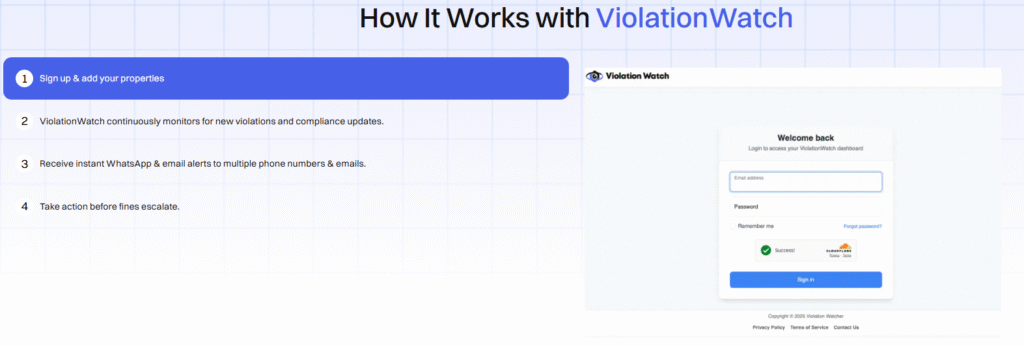
You start by signing up and adding your buildings to ViolationWatch. The process supports properties across all boroughs, including Brooklyn, and centralizes data for every single violation type into one dashboard.
Each address pulls violation history tied to enforcement from HPD, FDNY, and DEP, making it easier for clients and teams to monitor issues tied to ongoing development projects. You avoid mistakes that drive cases before a judge and simplify compliance review for every responsible person involved.
Pro tip: Use our Free NYC Building Violations Lookup tool to check any property’s violation status before you add it to your account. You’ll know exactly what you’re dealing with upfront.
The platform organizes properties by address and lets you tag buildings however makes sense for your operation. Group by neighborhood. Sort by management company. Filter by violation count. You control how you view your portfolio.
Step 2: Continuous Monitoring Catches New Violations
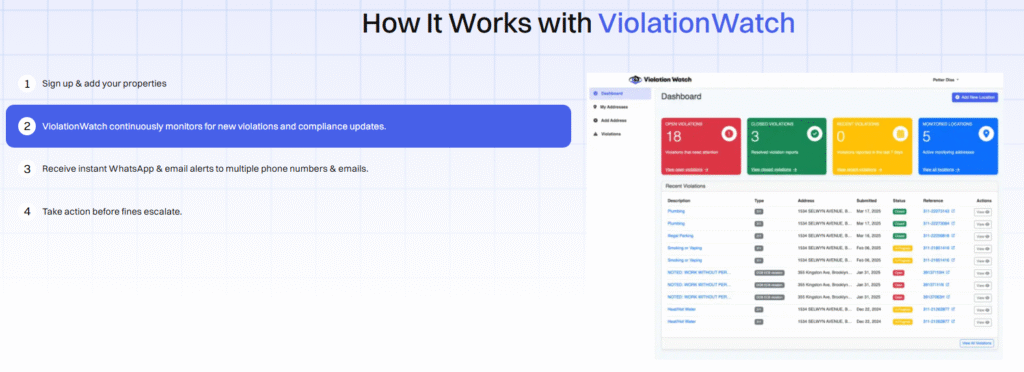
Once your properties are in the system, the platform tracks activity continuously and sends real-time alerts as soon as violations surface. These updates include situations where conditions escalate quickly, such as blocked exits, unsafe stairwells, or compromised safety systems.
Problems no longer go unseen. You get clarity without confusion, and violations never slip through due to missed settings or inactive tracking. You don’t need to log in every day to check for updates. The monitoring happens automatically. New violations show up in your dashboard with color-coded severity levels:
- Red for Class C violations (immediate hazards requiring 24-hour response)
- Yellow for Class B violations (30-day correction deadline)
- Green for Class A violations (90-day correction window)
The dashboard shows you which properties need attention right now and which ones you can schedule for later. No guesswork. No confusion about priorities.
Step 3: Instant Alerts Hit Multiple Channels
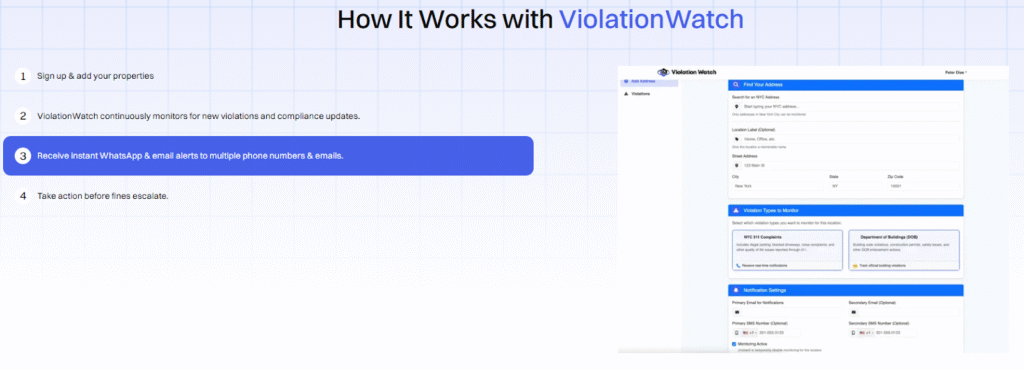
When violations surface, teams get instant notifications without delay. Here’s where most landlords lose money. They check HPD portals once a week, maybe twice if they’re diligent. A violation appears on Monday. They don’t see it until the following Monday. Now they’ve lost a full week to start corrections.
ViolationWatch solves this with instant alerts sent to multiple phone numbers and email addresses.
You choose how you want notifications:
- SMS text messages for urgent violations
- WhatsApp alerts that include violation details
- Email notifications with full reports attached
- Multi-recipient setup so your property manager, maintenance team, and compliance officer all stay informed
The alerts trigger automatically when:
- A new violation appears at any of your properties
- An existing violation status changes
- A hearing date gets scheduled
- A correction deadline approaches
Every alert confirms you’re fully notified, keeps communication streamlined, and avoids reliance on legacy tools or manual follow-ups. This proactive approach replaces back-and-forth emails, lost videos, and scattered internal chapters of compliance documentation.
You can configure different alert rules for different buildings. Maybe you want SMS alerts for your flagship property but email-only for smaller buildings. The platform lets you customize notification preferences property-by-property.
Here’s the key: You’re never hunting for information. The information finds you the moment it becomes available.
Step 4: Take Action Before Fines Pile Up
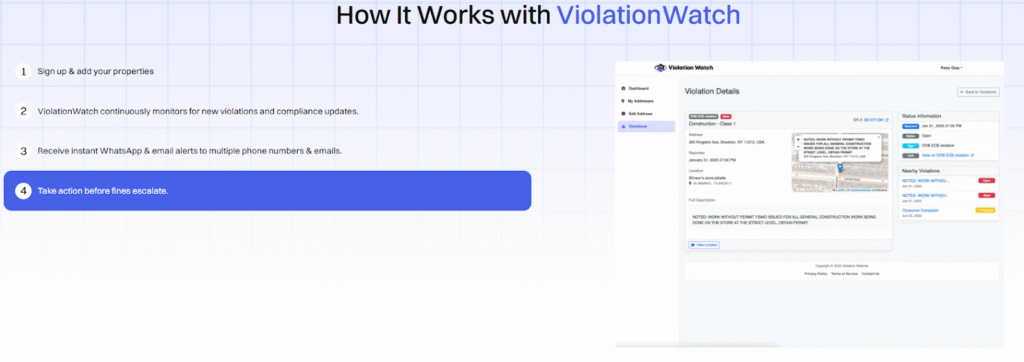
With all data centralized, you move fast to address conditions before escalation forces emergency intervention or action to cancel permits and operations. Smart landlords don’t wait for violations to become emergencies. They address problems early while correction costs stay manageable.
ViolationWatch gives you the violation details you need to act fast. Each alert includes:
- Exact violation location (apartment number, common area, specific room)
- HPD’s description of the problem
- Violation class and correction deadline
- Inspector notes and photos (when available)
- Historical data, if this is a recurring issue
This lets your team stay aligned, maintain accountability, and properly comply with regulatory expectations. You retain proof of action, maintain full transparency for legal review, and keep communication channels open for every active contact point involved in the correction process.
You can view violations individually or pull up comprehensive reports showing all open issues across your entire portfolio. The reports break violations down by type, severity, property, and deadline. Need to share violation data with your maintenance team? Export reports as PDFs. Want to show your attorney what you’re dealing with? Send them direct access to specific violation records.
The platform also tracks your correction efforts. Upload work orders. Attach contractor invoices. Document your compliance steps. When you go to HPD for a reinspection, you’ve got a complete paper trail showing everything you did to fix the problem.
Why This Approach Actually Works?
Let’s be clear about what separates smart landlords from the ones who constantly scramble to catch up. Smart landlords treat HPD compliance as an automated system. They set up monitoring. They get instant alerts. They respond fast. Their violation counts stay low, and their properties stay profitable.
The other landlords? They’re logging into HPD portals manually. Writing violation numbers on scraps of paper. Missing deadlines. Paying penalties. Wondering why their compliance costs keep climbing.
The difference isn’t effort. It’s systems. You can spend three hours every week checking HPD portals manually across ten buildings. Or you can let ViolationWatch monitor those buildings automatically and alert you the moment something needs attention. One approach keeps you busy. The other keeps you protected.
We’ve built ViolationWatch specifically for NYC landlords who manage multiple properties and can’t afford to miss HPD violations. The platform handles the monitoring, tracking, and alerting so you can focus on actually fixing problems instead of hunting for information.
Your tenants already have instant access to 311. You need instant access to what they’re reporting. That’s what we provide.
Stop Chasing Violations, Let Them Come to You
You’ve seen how HPD violations stack up. Heat complaints during winter. Pest issues that won’t quit. Maintenance problems tenants report straight to the city. Each one comes with deadlines, penalties, and the risk of letting something slip through the cracks.
Manual tracking through city portals works until you scale past two or three buildings. Then it becomes a time sink that still leaves gaps in your coverage. No alerts. No automation. No way to catch violations before they turn expensive.
Here’s what actually moves the needle for NYC landlords:
- Class C violations demand 24-hour responses, and missing that window costs you $50-$150 per day in penalties that stack until you fix the problem
- HPD’s three separate portals require manual searches for each property, and none of them sends notifications when new violations appear in the system
- Heat and hot water violations spike between October and May, with inspectors showing up within 24 hours of tenant complaints filed through 311
- Pest infestations need licensed exterminator documentation and follow-up treatment records before HPD closes the violation, not quick fixes
- Manual tracking collapses at scale because you’re checking multiple portals weekly for each building without centralized visibility or deadline reminders
ViolationWatch monitors your properties automatically and sends instant alerts to multiple phone numbers and email addresses the moment HPD logs a new violation. You get SMS, WhatsApp, and email notifications with full violation details so you can address problems while correction costs stay manageable. Our dashboard shows open violations across your entire portfolio, color-coded by severity, with automated deadline tracking that keeps you compliant without the manual work.
We’re at 433 Broadway #220, New York, or you can reach us at +1 347-201-2336 to set up monitoring for your buildings.