
You get the notice. Your stomach drops. Another violation. Another fine. Another headache you didn’t see coming. Here’s what most landlords miss: inspectors don’t show up randomly. They respond to patterns you could have spotted weeks ago. That leaky radiator? Red flag. The peeling paint in unit 3B? Ticking time bomb. The trash situation your super keeps “handling”? Already on someone’s complaint list.
Smart landlords flip the script. They catch problems before the city does. The difference isn’t luck or deep pockets. It’s a system. You walk through your buildings with inspector eyes. You know which violations cost $500 and which ones spiral into $25,000 nightmares. You fix small issues before they become legal liabilities.
We’ll show you how to build that system. This guide breaks violations down into three actionable strategies, the same ones property managers use to keep their portfolios clean while everyone else scrambles to respond to violation notices.
Here’s What You’ll Learn:
- Proactive inspection practices – Set up a violation-catching routine that spots issues before the DOB, HPD, or FDNY shows up at your door
- Preventing common violations – Target the top NYC violations that drain landlord bank accounts and learn how to shut them down early
- Maintaining tenant and landlord relationships – Turn your tenants into your early warning system instead of your biggest compliance risk
You can’t avoid every violation. But you can catch most of them before they catch you.
Catch Violations Before They Cost You
Most landlords inspect when something breaks. You need to inspect before anything breaks. Set up a schedule. Monthly walkthroughs for common areas. Quarterly checks for individual units. Seasonal reviews for exterior issues.
Mark them on your calendar like rent collection because catching violations early saves more money than chasing late payments.
Run Your Own Unit Inspections
You don’t need a clipboard and a bad attitude. You need a system that catches the violations inspectors always flag. Start with a 30-day notice to tenants. Schedule inspections during business hours. Bring a phone with a good camera. You’re not looking for perfection; you’re hunting for city code violations before the city finds them first.
Focus on these areas:
- Smoke and carbon monoxide detectors – Test them. Check dates. Dead batteries earn you instant violations from the FDNY
- Windows and window guards – Cracked panes, broken locks, missing guards in units with kids under 11
- Plumbing fixtures – Leaks under sinks, low water pressure, and toilets that run constantly
- Heating systems – Radiators that don’t heat, thermostats that don’t work, boilers making weird sounds
- Electrical outlets and switches – Loose covers, exposed wiring, outlets near water sources without GFCI protection
Take photos of everything. Date them. Store them somewhere you can find them six months later when you need proof you fixed something.
Check Common Areas Like an Inspector Would
Inspectors spend 80% of their time in hallways, stairwells, and basements. That’s where violations pile up. Walk your building top to bottom once a month. Bring a flashlight. HPD inspectors love dark corners where landlords never look.
Your checklist should hit:
- Exit signs and emergency lighting – Must work, must be visible, no exceptions
- Stairwell conditions – Handrails secure, steps intact, no storage blocking exits
- Hallway walls and ceilings – Peeling paint means lead paint violations if your building predates 1960
- Fire extinguishers – Mounted properly, inspected annually, pressure gauges in green zones
- Basement and boiler room – Clear exits, proper ventilation, no hazardous material storage
One violation in a common area can trigger a full building inspection. Find problems here first.
Walk the Exterior Every Season
Your building’s outside face tells inspectors what to expect inside. Cracked facades and broken doors signal neglect and invite closer scrutiny.
Spring and fall walkthroughs catch:
- Crumbling mortar between bricks
- Loose or missing fire escape bolts
- Clogged roof drains and damaged gutters
- Broken sidewalk sections (DOT loves these)
- Trash accumulation near entrances
Winter adds ice dams and snow removal failures. Summer brings overgrown vegetation and pest entry points.
Fix exterior issues fast. They’re visible from the street, which means they’re visible to anyone filing a 311 complaint.
Track Lease Violations That Become Code Violations in New York
Tenants break lease terms. Some of those breaks trigger city violations. Unauthorized occupants create overcrowding issues. Illegal alterations damage building systems. Hoarding situations block exits and attract pests. You need to spot these during inspections before they escalate.
Red flags that need immediate action:
- Extra locks installed on doors (fire code violation)
- Removed smoke detectors or covered alarms
- Space heaters running 24/7 (electrical hazard)
- Windows blocked or painted shut
- Commercial activity in residential units
Document everything. Photos, dates, written notices. You’ll need this paper trail if the city shows up.
Build Your Violation Prevention Kit
Keep inspection tools ready. You can’t catch problems if you don’t have the right equipment.
Your basic kit:
- Flashlight (bright LED, not your phone)
- Outlet tester for electrical issues
- Moisture meter for hidden leaks
- Tape measure for clearance violations
- Camera or phone with cloud backup
- Printed checklist based on your building’s history
Add a small toolbox for quick fixes. Tighten a loose handrail during inspection instead of scheduling another trip.
Log Everything You Find
Inspections mean nothing if you forget what you saw. Create a simple tracking system spreadsheet, app, or notebook. Pick one and stick with it.
Track these details:
- Date and time of inspection
- Location (unit number, common area, exterior)
- Issue found
- Photos taken
- Action needed
- Who’s responsible for the fix
- Target completion date
- Actual completion date
This log becomes your defense. When a violation notice arrives for something you already fixed, you have proof. When an inspector asks about maintenance history, you have answers.
Some landlords use property management software. Others use Google Sheets. The format doesn’t matter; consistency does. Pattern recognition wins here. If you log three plumbing leaks in the same stack over six months, you’ve got a systemic issue. Fix the root cause before the city mandates it with a violation and a deadline.
Stop the Violations That Actually Cost Money

Not all violations hit your wallet the same way. Some cost $500. Others cost $25,000 and trigger mandatory building-wide inspections. Know which violations drain bank accounts. Then build your prevention strategy around them.
The High-Cost Violations You Can’t Ignore
HPD and DOB don’t play favorites. They write the same violations for rent-stabilized walkups and luxury condos. The fines scale with severity, not property value.
Here’s what neglect actually costs:
| Violation Type | Fine Range | Escalation Risk |
| Lead paint (children under 6 present) | $2,000 – $10,000 per unit | Class C violation, criminal charges possible |
| Missing/non-functional smoke detectors | $1,000 – $2,500 per violation | Multiplies by the number of units affected |
| Heat and hot water failures | $250 – $1,000 per day | Daily penalties until corrected |
| Illegal occupancy/overcrowding | $1,000 – $5,000 per unit | Can trigger Certificate of Occupancy review |
| Structural defects (walls, ceilings, floors) | $2,000 – $10,000 | May result in vacate orders |
| Blocked fire exits or broken fire escapes | $2,500 – $25,000 | Life safety violation, immediate correction required |
| Pest infestation (rats, roaches, bedbugs) | $300 – $2,000 per unit | Spreads to adjacent units, fines multiply |
| Mold conditions | $500 – $5,000 per unit | Can trigger a full building inspection |
| Broken or missing window guards | $500 – $1,500 per window | Criminal liability if the child is injured |
| Elevator violations | $1,000 – $10,000 | Can result in a shutdown until repairs are completed |
These aren’t one-time hits. Violations compound. Miss your correction deadline, and the city doubles the fine. Ignore it completely, and they place a lien on your property.
Keep Safety Systems Running
Fire safety violations top the expensive list. FDNY doesn’t negotiate correction timelines. Test smoke detectors and carbon monoxide alarms monthly. Replace batteries twice yearly. Swap out units every ten years, even if they still beep. Inspectors check manufacturing dates.
Your building needs:
- Smoke detectors in every unit and common area
- Carbon monoxide detectors within 15 feet of sleeping areas
- Fire extinguishers on every floor (inspected annually by certified techs)
- Working sprinkler systems where required
- Clear exit pathways and illuminated exit signs
Walk fire escape routes quarterly. Check for rust, loose bolts, and blocked access. A tenant storing furniture on the fire escape costs you $2,500 minimum when inspectors spot it.
Window guards become mandatory when children under 11 live in your building or visit regularly. One missing guard in a building with kids triggers violations for every unguarded window. That adds up fast in a six-story walkup.
Handle Heating and Hot Water Violations
The heat season runs from October 1st through May 31st. During those months, you’re legally required to maintain specific temperatures. Fall short, and tenants call 311 faster than you can say “boiler repair.”
Required temperatures:
- Daytime (6 AM – 10 PM) when outdoor temp drops below 55°F = indoor temp must reach 68°F minimum
- Nighttime (10 PM – 6 AM) = indoor temp must reach 62°F minimum
- Hot water must hit 120°F at the tap, year-round
Boiler failures during cold snaps generate $250-$1,000 fines per day. A three-day weekend repair can cost $3,000 in violations before you even pay the plumber.
Service your boiler before October 1st. Every single year. Find a reliable heating contractor who answers calls at 2 AM. Lock in their emergency number. Keep backup space heaters in storage for emergencies. They buy you time while repairs happen, and they show good faith if inspectors arrive during an outage.
Shut Down Pest Problems Early
Rats and roaches don’t stay in one unit. They spread. HPD knows this, which is why pest violations trigger building-wide inspections.
You can’t wait for tenant complaints. Monthly inspections in basements, trash areas, and ground-floor units catch infestations early.
Prevention beats extermination:
- Seal cracks and gaps in exterior walls (rats fit through quarter-sized holes)
- Install door sweeps on all ground-level doors
- Keep dumpster lids closed and areas clean
- Fix plumbing leaks that attract pests to water sources
- Require tenants to bag trash properly
- Schedule regular exterminator visits (monthly minimum for multi-family buildings)
Bedbugs deserve special attention. One complaint triggers an inspection. Multiple units with bedbugs suggest building-wide infestation, and that brings violations, mandatory treatment schedules, and fines if you don’t comply.
Document every exterminator visit. Keep invoices, treatment logs, and follow-up schedules. When HPD asks for your pest control records, you need to produce them immediately.
Attack Mold Before It Attacks You
Mold violations cost money and trigger tenant lawsuits. HPD takes mold seriously because it signals deeper moisture problems. You can’t just paint over it. Inspectors know that trick. They’ll scrape the paint and write you up for concealment on top of the original violation.
Stop mold at the source:
- Fix leaks within 24 hours of discovery
- Run exhaust fans in bathrooms and kitchens
- Check window seals and weather stripping annually
- Inspect behind radiators and under sinks for hidden moisture
- Address roof leaks immediately (mold grows within 48 hours of water exposure)
- Maintain proper ventilation in basement and ground-floor units
Small mold patches (less than 10 square feet) can be cleaned with proper solutions. Anything larger needs professional remediation. Cut corners here, and you’re looking at $5,000 violations plus potential displacement costs if tenants need temporary housing.
Bathroom mold from poor ventilation? Install better exhaust fans. Chronic condensation on windows? Address air circulation. Persistent basement dampness? Bring in a waterproofing contractor. Fix the cause, not the symptom.
Handle Lead Paint Compliance
Buildings constructed before 1960 are presumed to contain lead paint. Buildings from 1960-1978 might contain it. This makes lead paint one of the costliest violation categories in NYC. If a child under six lives in your building, you must inspect units annually and correct any peeling paint within ten days. Not two weeks. Ten days.
Lead paint violations start at $2,000 per unit and climb to $10,000 for Class C violations. Criminal charges are possible if a child tests positive for elevated blood lead levels. You need certified contractors for lead paint work. DIY repairs don’t count. Inspectors want to see EPA-certified remediation and clearance testing.
Your compliance checklist:
- Annual visual inspections in units with young children
- XRF testing to identify lead paint locations
- Proper encapsulation or removal by certified contractors
- Clearance testing after work is complete
- Documentation of all work and testing
Prevention here means repainting before the paint peels. Friction surfaces (windows, doors) wear faster and need more frequent attention. Stay ahead of deterioration, and you avoid the violation entirely.
Pro tip: Create a violation prevention budget separate from your repair budget. Set aside 2-3% of rental income for catching issues early. Spending $500 monthly on preventive maintenance beats paying $5,000 in fines plus emergency repair costs. The math isn’t complicated. Prevention always costs less than penalties.
Turn Tenants Into Your Violation Detection System

Your tenants live in your building 24/7. You don’t. They spot problems you’ll miss on monthly walkthroughs. The difference between helpful tenants and 311 complaints? How you treat them before issues arise.
Build Trust Before Problems Start
Landlords who only contact tenants about late rent create adversarial relationships. Tenants who feel ignored call the city instead of calling you. Set up communication channels that actually work. Give tenants your direct number or a dedicated maintenance line. Respond within 24 hours, even if your response is “We’re on it, contractor arrives Thursday.”
Actions that build goodwill:
- Send seasonal reminders about heating system checks, AC maintenance, and smoke detector testing
- Provide clear instructions for reporting maintenance issues
- Follow up after repairs to confirm that the problems are solved
- Address minor complaints quickly (a $50 fix now prevents a $500 violation later)
- Keep tenants informed during building improvements or system upgrades
Tenants who trust you will text about a dripping pipe before it becomes a mold violation. Tenants who don’t trust you will document the drip for three weeks and call HPD. Your choice of which relationship you want.
Create a Maintenance Request System That Works
Verbal complaints disappear. Text messages get lost. You need a paper trail that protects you and gives tenants confidence that their issues matter. Email works. Property management apps work. A simple Google Form works. Pick a system and make it the official channel for all maintenance requests.
Your system should capture:
- Tenant name and unit number
- Date and time of report
- Detailed description of the issue
- Photos if applicable
- Urgency level (emergency, urgent, routine)
- Preferred contact method
Log every request. Track response times. Document completion dates. This record proves you’re maintaining the building, and it protects you when tenants claim you ignored problems.
Emergency requests (no heat, no hot water, gas leaks, electrical hazards) get a same-day response. Urgent issues (broken locks, plumbing leaks, non-working appliances) get a 48-hour response. Routine maintenance gets scheduled within a week. Stick to these timelines. Consistency matters more than speed.
Answer Tenant Requests Before They Escalate
Speed kills violations. The faster you respond to tenant complaints, the less likely those complaints reach the city. A leaky faucet reported on Monday becomes a mold violation by Friday if you ignore it. That same leak, fixed on Tuesday, never generates paperwork.
Response timeline that prevents violations:
| Issue Type | Your Response Time | City Response Time If Ignored |
| No heat/hot water | Same day | Tenant calls 311 within 24 hours |
| Gas smell/electrical hazard | Immediate | Tenant calls 911, FDNY inspection follows |
| Water leaks | Within 24 hours | Becomes a mold issue within 48 hours |
| Pest sighting | Within 48 hours | Infestation spreads, HPD inspection triggered |
| Broken locks/security | Same day | Safety violation, possible break-in liability |
| Peeling paint (pre-1960 building) | Within 10 days if the child is under 6 | Lead paint violation, $2,000+ fine |
Set up automatic confirmations when tenants submit requests. “We received your maintenance request for [issue]. Our team will contact you by [date] to schedule repairs.” Simple message. Massive difference in tenant satisfaction.
Keep tenants updated if repairs take longer than expected. “The part we ordered is delayed. New arrival date is Friday. We’ll install it same day.” Nobody likes delays, but everyone appreciates honesty.
Use Tenant Reports to Catch Building-Wide Issues
Is one tenant complaining about low water pressure? Unit-specific issue. Three tenants on different floors reporting the same thing? Building-wide problem that needs immediate attention. Track complaint patterns. When multiple units report similar issues, you’ve got systemic problems that will generate violations if left unchecked.
Common patterns that signal bigger problems:
- Multiple units with heat issues = boiler needs service or replacement
- Several reports of pest sightings = infestation requires building-wide treatment
- Recurring plumbing complaints in the vertical stack = pipe deterioration or blockage
- Window draft complaints across floors = facade or weather stripping failure
- Electrical outlet issues in the same line = wiring problem requiring an electrician
Address the root cause, not individual symptoms. Fixing one radiator doesn’t help if your boiler can’t heat the building. Treating one unit for roaches doesn’t work if they’re nesting in the walls.
Schedule Inspections That Respect Tenant Rights
You have the right to inspect your property. Tenants have the right to proper notice and reasonable scheduling. NYC law requires a 24-hour written notice for non-emergency inspections. Email counts. Text doesn’t unless your lease specifically allows it.
Inspection scheduling that maintains goodwill:
- Provide notice 48-72 hours in advance (more than the legal minimum)
- Offer flexible time windows (morning or afternoon options)
- Respect tenant work schedules when possible
- Keep inspections brief and professional
- Explain what you’re checking and why
- Leave a door hanger if the tenant isn’t home, confirming inspection was completed
Some tenants refuse entry. Document every attempt. After three instances with proper notice, you have grounds for lease violation proceedings. You also have protection if violations arise from issues you couldn’t access.
Take photos during inspections with timestamps. If a tenant later claims damage or violations existed before they moved in, your documentation proves otherwise.
Check for Tenant-Caused Violations During Walkthroughs
Tenants sometimes create the violations you’ll pay for. Catch these issues during inspections and address them immediately. Unauthorized alterations top the list. Tenants install extra locks, remove smoke detectors, block windows, or modify electrical systems. Each action creates potential violations.
Red flags during tenant unit inspections:
- Smoke detectors removed, disabled, or covered
- Windows painted shut or blocked with furniture
- Extension cords are used as a permanent wiring
- Space heaters plugged into power strips
- Unapproved locks or security bars on windows
- Evidence of unreported water damage or mold
- Pet damage to walls, floors, or fixtures
- Hoarding conditions that block exits or create fire hazards
Document everything. Take photos. Issue written notices requiring correction within specific timeframes. Follow up to confirm compliance. If a tenant refuses to correct violations, you have lease enforcement options. Better to handle it through proper channels than wait for an inspector to discover the issue and fine you for it.
Educate Tenants About Their Role in Prevention
Most tenants don’t try to create violations. They simply don’t know what constitutes one. A simple welcome packet prevents dozens of problems. Include building rules, maintenance request procedures, emergency contacts, and common violation triggers.
Topics worth covering:
- Why smoke detectors can’t be disabled (even when cooking sets them off)
- Proper trash disposal to prevent pest issues
- How to report leaks and water damage immediately
- Temperature requirements during the heat season
- Why window guards matter in buildings with children
- Proper use of electrical outlets and extension cords
Add a section about 311 complaints. Explain that you want to hear about problems directly so you can fix them faster than the city’s inspection schedule allows.
Some landlords include violation fine amounts in their tenant handbooks. When tenants see that a missing smoke detector costs you $1,000+, they understand why you take these issues seriously.
Reward Tenants Who Help You Maintain Standards
Tenants who report issues early, keep units clean, and follow building rules make your job easier. Recognition goes a long way.
You can’t reduce rent based on good behavior that creates fair housing issues. But you can show appreciation in legal ways.
Tenant appreciation strategies:
- Priority scheduling for maintenance requests
- First choice for unit upgrades when available
- Small holiday gifts or building improvement announcements
- Quick response to reasonable accommodation requests
- Flexible lease renewal terms for long-term, trouble-free tenants
Good tenants tell their friends. Word spreads. You’ll attract better tenant applications when current residents speak positively about management. Problem tenants also tell their friends. But those aren’t the friends you want applying to your vacancies.
Handle Difficult Tenants Without Creating Violations
Some tenants weaponize the complaint system. They file 311 reports for minor issues or non-existent problems, trying to leverage rent reductions or avoid eviction. Stay professional. Document everything. Fix legitimate issues immediately, regardless of tenant motivation.
Protecting yourself from retaliatory claims:
- Never threaten tenants who file complaints (actual retaliation is illegal)
- Maintain consistent response times for all tenants
- Keep detailed records of all communications and repairs
- Don’t discuss other tenants or building issues
- Follow proper legal procedures for lease violations or evictions
If a tenant files false 311 complaints, inspectors will see there’s no violation. Your maintenance records prove you’re responsive. The pattern of frivolous complaints works in your favor during legal proceedings.
But you still have to let the inspector in. You still have to show your records. You still have to stay calm and professional. Difficult tenants are expensive. Violations are more expensive. Pick your battles carefully.
Smart Landlords Don’t Chase Violations, They Automate Them
You can run inspections every week. You can respond to tenant requests in minutes. You can fix every issue before it becomes a problem. But you still can’t monitor every city database 24/7. That’s where smart landlords and property owners stop doing it manually and start using ViolationWatch to protect each rental property and every rental unit, whether leased as market-rate apartments or standard housing.
The Problem With Manual Violation Tracking
Most landlords find out about violations the old way when the notice arrives in the mail. By then, you’ve already been cited. The clock is ticking on your correction deadline. Fines are accruing, and those penalties often turn into legal fees and attorney fees, especially when repeated violations raise enforcement pressure or trigger discrimination claims or unresolved noise complaints.
You could check each agency website individually. DOB has a portal. HPD has a different one. ECB uses another system. FDNY, DEP, DEC, DOH, DOT, DSNY, and DOF all have separate databases with different search functions and update schedules. This fragmented approach increases risk tied to local laws, missed obligations to maintain habitable conditions, and disputes over unpaid rent, property damage, or failure to pay rent on time.
Checking different websites for multiple properties takes hours. You’ll miss updates. You’ll forget to check. You’ll find violations weeks after they’re issued, right when tenants dispute a rent increase, delay a month’s rent, or escalate matters that spiral into avoidable legal and financial strain. Or you can let automation handle it for you and eliminate the cycle of stress, oversight, and escalating exposure.
How ViolationWatch Catches Violations Before You Do
ViolationWatch monitors every major NYC violation database continuously. When a new violation hits any city system, you get notified instantly.
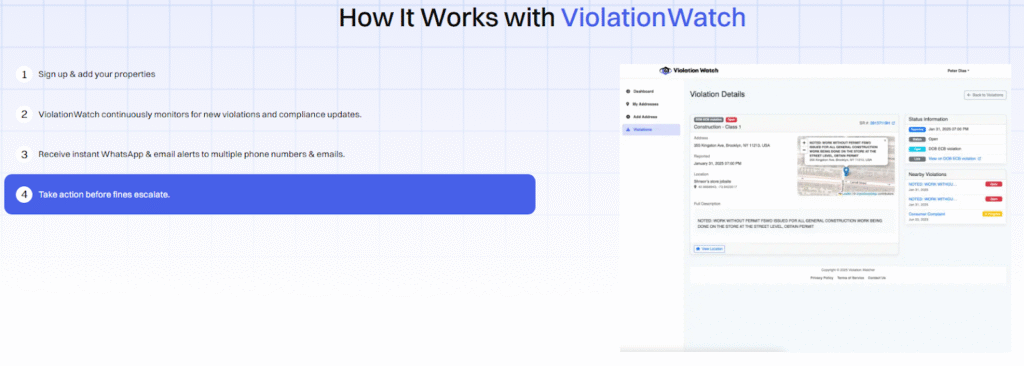
Here’s how it works:
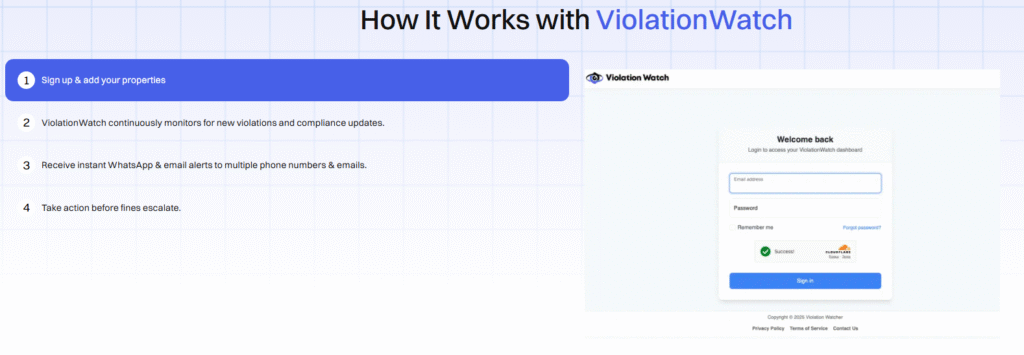
- Step 1: Add your properties: Input your building addresses once. ViolationWatch connects them to all relevant city databases automatically. No manual setup for each agency.
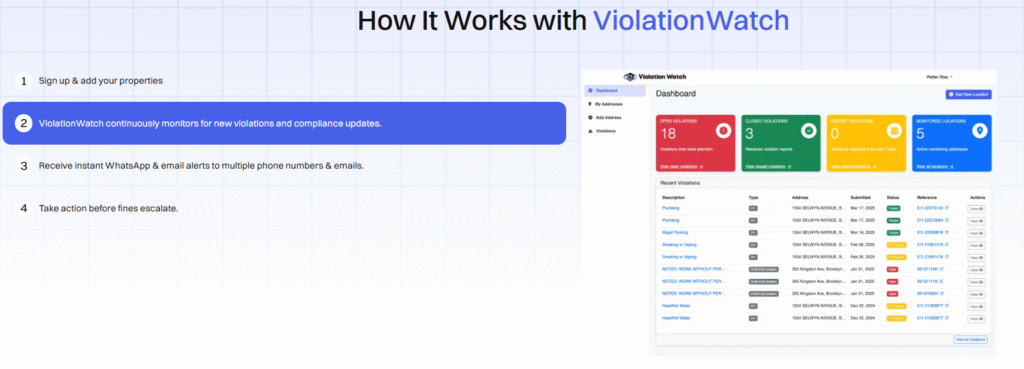
- Step 2: Automated monitoring begins: The system checks for new violations and compliance updates across DOB, HPD, ECB, FDNY, DEP, DEC, DOH, DOT, DSNY, and DOF. It runs 24/7 without you lifting a finger.
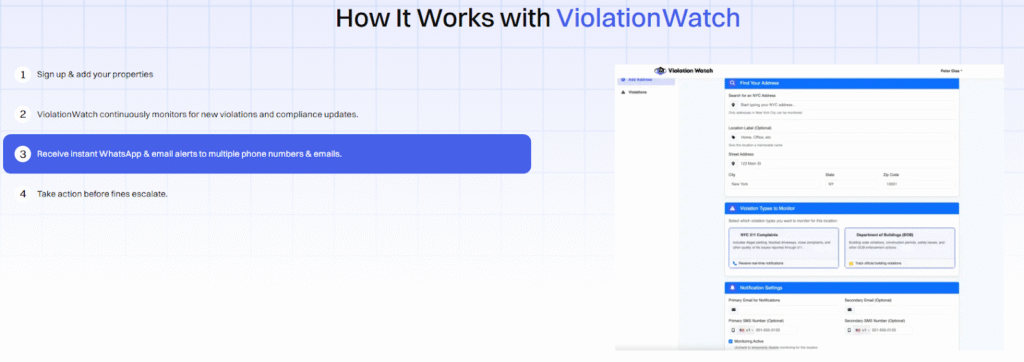
- Step 3: Instant alerts arrive: New violation? You get a WhatsApp message and an email immediately. Upcoming hearing? Notification sent. Status change on an existing violation? You’ll know before the city updates its public records.
- Step 4: Take action early: You see violations the moment they’re issued instead of weeks later. Earlier notification means more time to correct issues, gather documentation, and avoid escalating fines.
Your Unified Dashboard for All Violations
Managing violations across multiple properties and agencies gets messy fast. Papers pile up. Deadlines get missed. You lose track of which violations are resolved and which ones are pending. ViolationWatch centralizes everything in one dashboard, giving many landlords across New York cleaner oversight and stronger alignment with state law obligations tied to dealing with enforcement risks, non-compliance, or compliance tied to other properties under their portfolio.
Every violation from every agency for every property you own appears in a single view, helping you address matters tied to back rent, disputes over amounts owed, or cases that move toward courts in extreme cases where oversight failed and corrective action stalled.
What you see at a glance:
- Current violation count by status (open, closed, pending, dismissed)
- Color-coded priority levels based on fine amounts and correction deadlines
- Recent violations with submission dates and agency sources
- Upcoming hearing dates and required appearances
- Resolution status updates as the city processes corrections
This streamlined view supports smarter decisions around repairs, tenant disputes at the front door, enforcement risk tied to broken contracts, and documentation that helps ensure no critical update goes unseen or ignored.
No more logging into ten different city portals. No more searching through email for violation numbers. No more wondering if you missed something. One login. Complete visibility. This approach gives you more options to respond confidently, leave a clear comment trail for accountability, and avoid scenarios where oversight costs you more than half your time and resources.
Track Violations Automatically While You Work
Manual tracking means spreadsheets. Spreadsheets mean human error. You forgot to update a status. You miss a deadline. You pay unnecessary fines because your records don’t match the city’s. ViolationWatch updates violation statuses automatically. When the city marks a violation as resolved, your dashboard reflects it immediately. When a hearing date changes, you’re notified. When fines are adjusted, the new amounts appear in your records.
Automated tracking covers:
- Violation status changes (open to pending, pending to closed)
- Fine amount adjustments or reductions
- Hearing reschedules or cancellations
- Compliance deadline extensions
- Agency notes or inspection follow-ups
You spend time fixing problems instead of updating spreadsheets. The system handles the administrative work while you handle the actual violations.
Generate Reports That Actually Help Property Owners
Data means nothing if you can’t use it. Raw violation lists don’t tell you where problems cluster or which issues cost you the most money. ViolationWatch generates analytics that show you patterns.
Reports you can actually use:
- Violation trends over time (monthly, quarterly, annual)
- Cost analysis by violation type and agency
- Building-by-building compliance scores
- Agency-specific violation breakdowns
- Correction timeline tracking
This data guides your prevention strategy. You stop guessing which buildings need more attention and start allocating resources based on actual violation history.
Store Every Document in One Place
Violation resolution requires documentation. Proof of work completed. Photos of corrections. Contractor invoices. ECB hearing evidence. Compliance certificates. Most landlords store these in email folders, filing cabinets, or scattered across multiple computers. Finding a specific document when you need it becomes an archaeological expedition.
ViolationWatch includes document management built into each violation record. Upload photos, PDFs, work orders, and certificates directly to the relevant violation. Everything stays organized and accessible.
When an inspector asks for proof:
- Pull up the violation record on your phone
- Show uploaded photos with timestamps
- Display contractor certifications and invoices
- Provide documentation instantly instead of saying, “I’ll email it to you.”
Fast access to documentation speeds up dismissals and reduces follow-up inspections.
Get Expert Help When You Need It
Some violations are straightforward. Fix the leak, upload the invoice, case closed. Others require a strategy, knowing which violations to contest, which to cure, and how to minimize fines.
ViolationWatch connects you with compliance professionals who handle complex cases. They’ve seen every violation type. They know which ECB judges accept which arguments. They understand when to request extensions and when to resolve immediately.
Support for challenging situations:
- Class C violations requiring immediate action
- Multiple violations triggering building-wide inspections
- Disputed violations where you disagree with the citation
- Complex correction requirements involving multiple contractors
- Hearing preparation and representation options
You’re not figuring this out alone. Experienced professionals guide you through the process from citation to resolution.
Scale From One Building to Fifty
Single-property landlords face the same violation types as portfolio managers. The difference is volume. We scale to your portfolio size. Manage one building or track violations across fifty properties with the same system. Add new buildings as you acquire them. Remove sold properties instantly.
Flexible configuration for:
- Individual landlords with 2-5 properties
- Property managers handling 10-20 buildings
- Investment firms overseeing 50+ units
- Mixed-use portfolios (residential, commercial, industrial)
Pricing adjusts to portfolio size. You pay for what you manage, not for features you don’t need.
Start With the Free Lookup Tool
Not ready to commit? Test the system with ViolationWatch’s free lookup tool. Enter any NYC address and pull current violation records instantly. You’ll see active violations, historical citations, and agency sources, all the public data the city maintains, organized in a readable format.
Use the free tool to:
- Check properties before acquisition
- Verify violation status for buildings you’re considering
- Research neighborhood violation patterns
- Compare your building’s compliance to nearby properties
- See which agencies cite most frequently in your area
The free lookup shows you what the platform can do without requiring sign-up or payment information. Run as many searches as you need.
Visit us to set up your account. Or test the free lookup tool first to see how the system organizes violation data. Smart landlords don’t wait for violations to find them. They find violations first.
You’ve Got the System Now Automate It
You know how to catch violations before inspectors do. You understand which issues cost the most money. You’ve built inspection routines, prevention strategies, and tenant communication systems that work.
But here’s what happens when you apply these strategies consistently:
- You cut violation costs by 60-80% by fixing issues in the $50-$200 range instead of paying $1,000-$10,000 fines after the city finds them
- You avoid building-wide inspections that get triggered when one major violation signals systemic neglect to HPD or DOB
- You keep tenants from calling 311 because they trust you’ll fix problems faster than waiting for city intervention
- You protect your property values since buildings with clean violation records sell faster and command higher prices
- You spend less time in ECB hearings because early corrections mean fewer contested violations and dismissed cases
The challenge isn’t knowing what to do. It’s doing it consistently across multiple properties while monitoring ten different city agencies that update their databases at random times throughout the day.
That’s the gap ViolationWatch fills. You handle the inspections, repairs, and tenant relationships. The platform handles the monitoring, alerts, and tracking across every NYC agency that matters. You get notified the moment violations appear instead of weeks later when correction windows are nearly closed. Your prevention system works better when you actually know what you’re preventing against before the inspector knocks.Check your properties now at our free lookup tool or set up full monitoring at ViolationWatch. Smart landlords built the system. Now they automate the parts that don’t require walking through buildings with a flashlight.