
Most Brooklyn building owners treat violations like parking tickets, annoying but manageable. That assumption costs them thousands in unnecessary fines and legal headaches every year.
Brooklyn’s building stock presents unique compliance challenges. Aging brownstones, converted multi-families, and pre-war walk-ups face stricter scrutiny than newer construction. The city issues over 200,000 violations annually across all boroughs, and Brooklyn properties account for a substantial portion of that total.
You can’t afford to let violations pile up. Each unresolved notice triggers escalating fines, potential liens, and complications when you try to refinance or sell. Some violations even restrict your ability to collect rent or issue a certificate of occupancy.
The good news? Most common violations follow predictable patterns. Once you understand the resolution process, you can clear notices faster and prevent recurring issues from draining your budget.
Here’s what we’ll cover:
- How to properly review violation notices and identify the issuing agency
- When to hire licensed professionals versus handling corrections yourself
- What documentation agencies require as proof of compliance
- How to submit correction paperwork to DOB, HPD, FDNY, and ECB
- How ViolationWatch streamlines the entire resolution process for Brooklyn portfolios
So let’s get started!
Step 1: Review Building Violation Notices and Identify the Issuing Agency
Brooklyn property owners receive violation notices through multiple channels. The notice might arrive by certified mail, be posted directly on your building, or appear in your online portal. Missing or ignoring these notices starts the fine clock ticking immediately.
Check the Building Information System First
The NYC Building Information System (BIS) serves as your central database for all property-related violations. You can search violations by entering your building’s address or block and lot number. BIS shows you every open violation attached to your property, including ones you might not have received physical notices for. The system updates daily, so you’ll see new violations within 24-48 hours of issuance.
Pull up your building profile and scan the violations tab. You’ll find color-coded entries that indicate severity levels and current status. Red flags mean active violations requiring immediate attention, while yellow indicates upcoming deadlines.
Decode the Violation Notice Details
Each violation notice contains specific information that determines your next steps. The notice header identifies which city agency issued it: DOB, HPD, FDNY, ECB, or another department.
Key elements to locate on every notice:
- Violation number – Your unique tracking identifier for all future correspondence
- Issuing agency – Determines which department handles your correction paperwork
- Violation class – Defines severity and dictates resolution timeframes
- Violation description – Specific code section violated and what needs correction
- Cure date – Your deadline to fix the issue and submit proof of compliance
- Hearing date – When you must appear if contesting the violation or requesting extensions
The violation class carries the most weight for your resolution timeline. Class 1 violations (immediately hazardous) require correction within 24 hours to 30 days. Class 2 and 3 violations give you more time but still impose strict deadlines.
Match the Agency to Your Violation Type
Different agencies handle specific building issues. DOB violations typically involve structural problems, illegal alterations, or construction work done without permits. HPD focuses on housing maintenance issues like heat, hot water, pest infestations, and apartment conditions.
FDNY violations relate to fire safety equipment, sprinkler systems, and emergency exits. ECB handles environmental violations, including boiler emissions and waste disposal. DEP issues notices for water and sewer problems.
Common violation categories by agency:
- DOB – Illegal conversions, unsafe facades, elevator malfunctions, unpermitted construction work
- HPD – Lack of heat or hot water, mold conditions, broken windows, vermin infestations, lead paint hazards
- FDNY – Missing fire extinguishers, blocked exits, faulty sprinklers, expired fire alarm certificates
- ECB – Boiler violations, illegal dumping, air quality issues, noise complaints
The notice itself states the issuing agency prominently at the top. Cross-reference this with the violation code to confirm you’re submitting corrections to the right department.
Some violations involve multiple agencies. An illegal conversion might trigger both DOB structural violations and HPD housing quality notices. You’ll need to address each agency separately with specific documentation.
Step 2: Hire Licensed Professionals or Handle Corrections Yourself

The violation type and your building’s specifics determine if you can fix issues yourself or need licensed contractors. Making the wrong choice wastes time and money when agencies reject your amateur corrections.
When You Can Handle Repairs Yourself
Minor maintenance violations rarely require licensed professionals. HPD violations for broken door locks, missing smoke detector batteries, or peeling paint in common areas fall within most owners’ capabilities.
You can replace standard hardware, patch small holes, fix minor plumbing leaks, and address cosmetic issues without hiring help. Keep your receipts and take before-and-after photos showing the completed work.
DIY-friendly violation corrections:
- Replacing broken window panes (non-structural)
- Installing or replacing smoke and carbon monoxide detectors
- Fixing minor plaster cracks or holes under 6 inches
- Repairing loose handrails or guardrails
- Clearing blocked exits or hallways
- Basic weatherproofing and caulking
- Replacing damaged floor tiles in common areas
Your building’s certificate of occupancy might restrict what you can do yourself. Check the C of O before starting any work that could be interpreted as altering the building’s approved use or layout.
Violations That Require Licensed Contractors
Structural repairs, electrical work, plumbing beyond simple fixture replacement, and gas line modifications all require licensed professionals. DOB won’t accept correction certificates signed by unlicensed individuals for these categories.
Facade work demands a licensed Professional Engineer or Registered Architect. FDNY violations involving fire suppression systems need contractors with specific FDNY certificates of fitness. Boiler repairs require licensed master plumbers or boiler technicians.
Violations requiring licensed professionals:
- Structural repairs to walls, beams, or foundations
- Electrical system modifications or panel upgrades
- Gas line repairs or appliance installations
- Elevator repairs or inspections
- Boiler servicing or replacements
- Fire alarm or sprinkler system repairs
- Facade inspections and repairs (FISP violations)
- Asbestos or lead paint abatement
- Major plumbing work beyond fixture swaps
The violation notice sometimes specifies the required license type. Look for language like “work must be performed by a licensed master electrician” or “correction requires PE/RA certification.”
Verify Contractor Licenses and Insurance
Never hire unlicensed contractors for work requiring certification. The city rejects correction paperwork from unqualified workers, forcing you to redo the entire job with proper licensing. Check contractor licenses through NYC’s online verification system. Confirm they carry active workers’ compensation and liability insurance covering your property. Request certificates of insurance naming you as an additional insured party.
Licensed contractors file permits for work requiring DOB approval. They also sign and submit correction certificates directly to the issuing agency. Your role shifts to oversight and payment once you hire qualified professionals. Get written quotes from at least three licensed contractors before selecting one. Compare their violation resolution experience, timeline estimates, and references from other Brooklyn property owners. The cheapest bid often creates more problems than it solves.
Calculate the True Cost of DIY vs. Hiring Out
DIY repairs save labor costs but consume your time and risk improper corrections. Hiring professionals costs more upfront but guarantees agency acceptance and faster violation clearance. Factor in permit fees, inspection charges, and potential fines if your DIY work fails inspection. A $200 DIY repair that gets rejected becomes a $2,000 problem after escalating fines and professional re-work.
Brooklyn’s older building stock often reveals hidden issues during repairs. What starts as a simple fix uncovers code violations that multiply your costs. Licensed contractors identify these problems early and adjust their scope accordingly.
Track your violation resolution costs across your portfolio. Properties with recurring violations benefit more from professional contractors who prevent future issues. Buildings with rare violations might justify more DIY work to control expenses.
Step 3: Gather Required Documentation as Proof of Compliance
Each agency demands specific paperwork proving you corrected the violation. Submitting incomplete documentation delays your case and extends the period you’re accumulating automatic fines. Leaving unresolved violations on your properties can lead to default penalties and even legal action if agencies escalate the matter.
DOB Documentation Requirements
Department of Buildings (DOB) violations need the most detailed documentation because they involve structural and safety issues. Your paperwork package must demonstrate that the work was completed properly and safely according to NYC building codes.
- Signed and sealed correction certificate from a licensed Professional Engineer or Registered Architect (for structural work)
- Copy of the approved work permit showing permit number and issuance date
- Photographs clearly showing the completed correction with date stamps visible
- Licensed contractor’s affidavit certifying work completion to code
- Certificate of compliance from the licensed professional who supervised the work
- Approved building plans if the violation involved unpermitted alterations or missing permits
- Final inspection sign-off from DOB inspector (for certain violation types)
Outstanding violations from any construction project require extra scrutiny. The NYC Department of Buildings cross-references your submission against permit records to verify that all work was properly authorized.
HPD Documentation Requirements
HPD focuses on habitability and maintenance conditions for residential properties. Your proof centers on demonstrating that the living environment now meets housing standards and compliance requirements under local law.
- Before and after photographs with timestamps showing the corrected condition
- Receipts for materials purchased or contractor invoices with detailed work descriptions
- Certificate of correction signed by a licensed contractor (for plumbing, heating, or electrical work)
- Lead paint inspection certificate (if violation involved lead hazards)
- Pest control service records and treatment completion certificates
- Heating system repair invoices with equipment specifications
Properly documenting corrections helps you avoid future violations and prevents escalation to criminal court summons for severe housing code breaches.
FDNY Documentation Requirements
Fire safety violations require certificates from professionals with specific FDNY credentials. Generic contractor paperwork won’t satisfy FDNY review standards. Failing to properly handle violations from fire safety inspections can result in further penalties and operational shutdowns.
- Certificate of Fitness holder’s signed statement confirming completion
- Fire alarm or sprinkler system inspection report from an approved testing company
- Equipment purchase receipts showing code-compliant replacement parts
- Fire safety plan updates reflecting any system modifications
- Contractor affidavit from an FDNY-licensed fire suppression contractor
- Photographs of installed equipment with serial numbers and model information visible
- Testing reports showing all safety systems function properly
ECB Documentation Requirements
Environmental Control Board violations span multiple categories. Your documentation needs to match the specific environmental issue cited by the NYC Department of Environmental Protection or other agencies.
- Boiler inspection certificate from a licensed boiler inspector
- Emission test results showing compliance with air quality standards
- Waste disposal receipts from authorized carting companies
- Noise abatement work completion certificates
- Environmental remediation reports for soil or water contamination issues
Maintaining comprehensive documentation protects you from future violations during follow-up inspections. Agencies reference your correction history when determining whether NYC violations represent isolated incidents or patterns of neglect.
Step 4: Submit Correction Paperwork to the Appropriate Agency

Each agency operates its own submission system. Mixing up the process or sending paperwork to the wrong department restarts your entire timeline.
DOB Submission Process
DOB moved most violations and corrections to their online portal system. You’ll need to create an account if you don’t already have one.
- Log in to DOB NOW using your property owner credentials
- Select “Resolve Violations” from the main dashboard menu
- Enter your violation number in the search field to pull up the specific notice
- Upload all required documentation as PDF files (maximum 10MB per file)
- Complete the online certification form, confirming all work meets current building codes
- Submit the package electronically and save your confirmation number
- Monitor the application status through the portal (DOB reviews within 30-45 days typically)
- Respond promptly to any requests for additional documentation through the messaging system
For violations requiring in-person inspection, you’ll schedule an appointment through the same portal after submitting your paperwork.
HPD Submission Process
HPD accepts corrections through their online portal and by mail for certain violation types. Check your specific violation notice for submission instructions.
- Access the HPD Violation Portal
- Create an owner account or log in with existing credentials
- Search for your property using the address or block and lot number
- Click on the active violation you’re correcting
- Select “Submit Correction Documentation” from the action menu
- Upload photos, receipts, and certificates as separate attachments
- Fill out the correction certification describing the work completed
- Submit electronically and note your confirmation number
- Attend the scheduled hearing date if one appears on your violation notice
- Bring printed copies of all submitted documentation to the hearing
HPD typically schedules hearings 30-60 days after violation issuance. You can request adjournments online if you need more time to complete corrections.
FDNY Submission Process
FDNY requires you to work through their Certificate of Correction system. Most submissions happen at FDNY offices rather than online.
- Gather all required certificates and documentation in a complete package
- Make copies of everything for your records before submitting originals
- Visit the FDNY Bureau of Fire Prevention office at 9 MetroTech Center, Brooklyn
- Request a Certificate of Correction form at the violations desk
- Complete the form with your violation number and building details
- Attach all supporting documentation to the completed form
- Submit the package to the reviewing officer
- Pay any required reinspection fees at the cashier window
- Schedule the follow-up inspection if required for your violation type
FDNY reviews correction packages within 2-3 weeks. They’ll contact you to schedule inspections or request additional information.
ECB Submission Process
ECB violations follow a hearing-based process. You’ll present your correction proof at a scheduled hearing rather than submitting it in advance.
- Note your hearing date and time from the original violation notice
- Prepare a complete documentation package with multiple copies
- Arrive at the ECB Hearing Office at 66 John Street, Manhattan, at least 30 minutes early
- Check in at the reception desk with your violation number
- Wait for your case to be called by the hearing officer
- Present your documentation showing completed corrections
- Request dismissal or fine reduction based on timely correction
- Receive the hearing officer’s decision in writing
You can also submit correction proof online through the ECB portal before your hearing date. This sometimes allows for administrative dismissal without appearing in person.
Streamline Your Brooklyn Portfolio with Automated Violation Management
Managing violations across multiple Brooklyn properties drains time you could spend on revenue-generating activities. Tracking violations manually means logging into separate agency portals, cross-referencing spreadsheets, and hoping you don’t miss critical deadlines that could trigger additional penalties.
ViolationWatch consolidates your entire violation management process into one platform. You’ll monitor all your Brooklyn properties from a single dashboard that pulls violations from DOB, HPD, FDNY, ECB, and other city agencies automatically across all five boroughs.
Centralized Tracking Across All Your Properties
The platform connects directly to NYC agency databases and updates your violation status continuously. New violations appear in your dashboard within hours of issuance, giving you maximum time to respond and act quickly on urgent issues.
You can organize properties by neighborhood, building type, or management priority. Filter violations by agency, severity level, or deadline to focus on what needs immediate action. The system color-codes violations based on urgency so you can spot problems at a glance and avoid fines from missed deadlines.
What you’ll see in your unified dashboard:
- Total violation count across your entire Brooklyn portfolio
- Open violations sorted by cure date and severity, including class A immediately hazardous conditions
- Recent compliance updates showing which violations cleared after re inspection
- Upcoming hearing dates with calendar integration to prevent failure to appear for court appearance
- Agency-specific violation breakdowns for DOB, HPD, FDNY, and ECB
- Stop work orders flagged for immediate attention on active construction activity
- Historical violation trends showing patterns across your properties
Multi-property owners save hours each week by eliminating the need to check individual agency portals. You’ll know the exact status of every violation across every building you manage and stay ahead of enforcement actions in New York City.
Instant Alerts Keep You Ahead of Deadlines
Missing a cure date or hearing transforms a manageable violation into an expensive legal problem. ViolationWatch sends notifications through WhatsApp and emails the moment new violations hit your properties, helping you comply with all agency requirements.
You can customize alert settings for different violation types and properties. Set up notifications for specific team members handling particular buildings or violation categories. Your maintenance supervisor gets HPD alerts for housing preservation issues like lead-based paint hazards while your construction manager receives DOB notifications about curb cuts and structural concerns.
The platform sends reminder alerts as deadlines approach. You’ll get notifications at 30 days, 14 days, and 7 days before cure dates. Hearing reminders arrive with enough lead time to prepare the right paperwork and coordinate with contractors for emergency repairs when needed.
Quick Violation Lookups for Any NYC Property
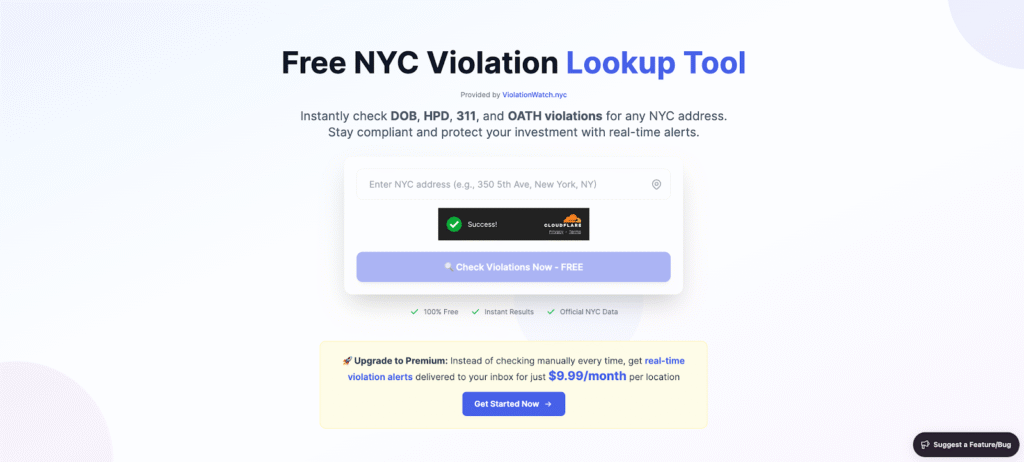
The violation lookup tool lets you research any property before purchasing or taking over management. Enter an address and pull up the complete violation history instantly, including both hazardous and non-hazardous conditions.
You’ll see active violations requiring correction and closed violations showing the property’s compliance track record. Inspection results from past corrections reveal whether previous owners maintained properties properly or let issues compound.
Use the lookup tool to benchmark your properties against comparable buildings in your Brooklyn neighborhood. Properties with significantly higher violation rates signal maintenance issues or management problems you need to address to achieve full compliance and ensure safety.
Automated Documentation Organization
Every violation generates paperwork that you need to access quickly when submitting corrections or attending hearings. ViolationWatch stores all violation-related documents in one searchable location, helping you manage compliance cost-effectively.
Upload correction certificates, contractor invoices, inspection reports, and compliance photos directly to each violation record. The platform organizes documents by property and violation number so you can find what you need in seconds.
You can generate comprehensive violation reports for specific properties or your entire portfolio. Export data for insurance renewals, refinancing applications, or sale negotiations where violation history matters.
Expert Guidance for Complex NYC Violations
Some violations require specialized knowledge to resolve efficiently. The platform connects you with compliance professionals who understand Brooklyn’s building stock and agency requirements.
You’ll get guidance on which contractors to hire for specific violation types, what documentation agencies expect, and how to prevent recurring issues. This support proves valuable when dealing with unfamiliar violation categories or multiple agency coordination.
The system flags violations that typically require professional intervention versus those you can handle with in-house staff. This helps you allocate resources appropriately and avoid wasting time on DIY attempts that won’t pass inspection.
Brooklyn Violations Don’t Resolve Themselves, But You Can Automate the Process
You now have a clear roadmap for handling Brooklyn building violations from start to finish. The difference between a minor inconvenience and a costly compliance nightmare comes down to how quickly you act and how well you organize your response.
Brooklyn property owners who resolve violations efficiently share common practices that keep their buildings compliant and their finances protected.
Here’s what separates successful violation management from chaotic firefighting:
- Review violations immediately through BIS and decode the agency, class, and cure date before they compound into larger problems
- Match the correction method to the violation type. Hire licensed professionals for structural work, and handle minor maintenance yourself
- Gather complete documentation packages specific to each agency’s requirements before submitting corrections or attending hearings
- Submit paperwork through the correct portal for DOB, HPD, FDNY, or ECB, following each agency’s unique process
- Build preventive maintenance schedules that catch issues before inspectors do, addressing root causes instead of patching symptoms repeatedly
Managing violations across multiple Brooklyn properties gets exponentially harder as your portfolio grows. You’re checking different agency portals, tracking cure dates in spreadsheets, and hoping nothing slips through the cracks.ViolationWatch pulls all your Brooklyn violations into one dashboard with automated tracking and instant alerts. You’ll spend less time chasing paperwork and more time running profitable properties. Check out the violation lookup tool to see what you’re currently dealing with across your portfolio.