
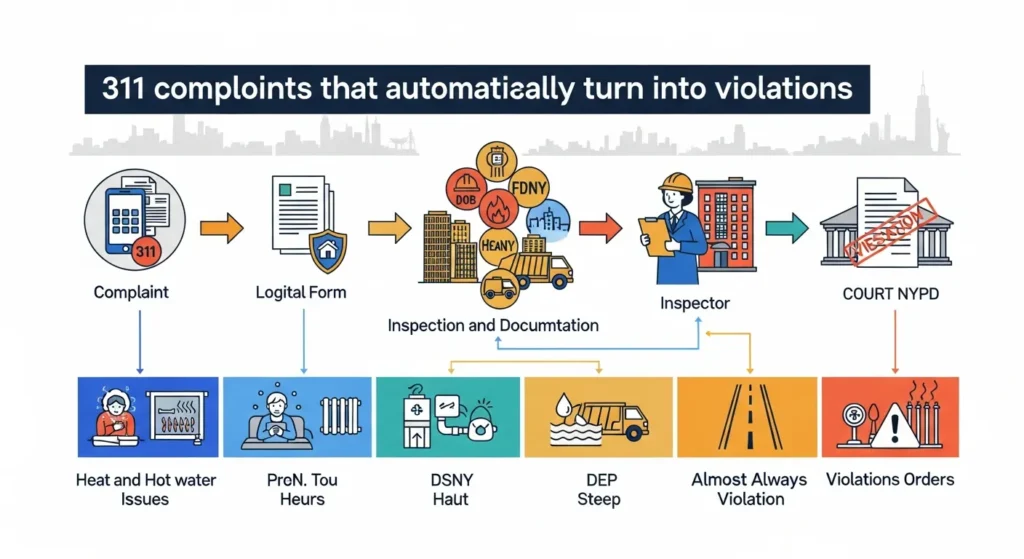
In New York City, a single 311 call can quietly snowball into a formal code violation, fines, and even a vacate order, sometimes faster than owners expect.
We hear the same question from both landlords and tenants: “Which 311 complaints actually turn into violations automatically?” The honest answer is that no complaint, by itself, is a violation. But certain complaint types are so closely tied to NYC building violations that, once an inspector confirms the condition, a violation is almost guaranteed.
In this guide, we break down how 311 really works, which complaints most often lead to DOB violations, HPD complaints and other enforcement actions, and what both property owners and tenants can do to protect themselves. We’ll stay practical and concrete, focusing on what actually happens on the ground in NYC.
How 311 Complaints Lead To Violations
What 311 Is (And What It Is Not)
First, we need to clear up a huge misconception: 311 does not issue violations.
New York City’s 311 system is a non-emergency service line, essentially a centralized intake and routing hub for complaints and service requests. When we call or submit online, 311:
- Takes the details of the problem.
- Creates a service request with a tracking number.
- Routes that request to the relevant enforcement or service agency.
Agencies that frequently receive 311 referrals include:
- HPD (Department of Housing Preservation and Development)
- DOB (Department of Buildings)
- FDNY (Fire Department, Bureau of Fire Prevention)
- DOHMH (Department of Health and Mental Hygiene)
- DEP (Department of Environmental Protection)
- DSNY (Department of Sanitation)
- DOT (Department of Transportation)
- NYPD (for certain noise, nuisance, or traffic issues)
What 311 is not:
- It’s not a law-enforcement or inspection agency.
- It cannot force repairs or corrections.
- It doesn’t issue NYC building violations, tickets, or fines.
The actual violations live in each agency’s system, HPD, DOB, FDNY, and so on, not in the 311 database. If you’re checking on your building’s status, you’ll see the complaint history in 311, but not the full violation record or penalty details.
For official explanations of how 311 routes housing complaints, HPD’s guidance is a good starting point: https://www.nyc.gov/site/hpd/services-and-information/311.page
The Path From Complaint To Inspection To Violation
So how does a 311 complaint turn into a violation?
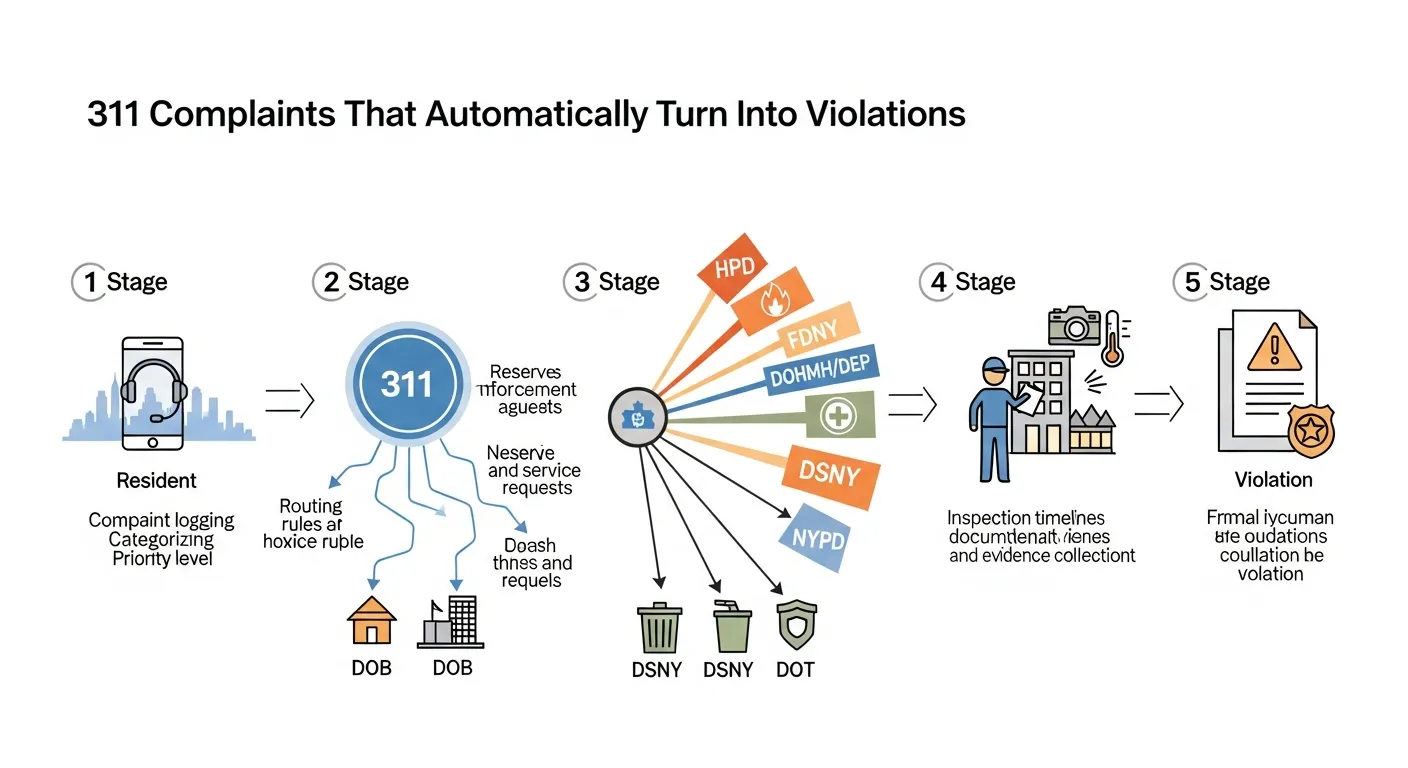
In NYC, the process usually follows this path:
- Complaint logged
You call 311 or submit online. A service request is created, categorized (for example, “No heat,” “Illegal conversion,” “Rodent infestation”), and assigned a priority level. Life-safety and essential services jump to the top of the list.
- Routing to an agency
The complaint is automatically sent to the “lead” agency based on its type. Lack of heat routes to HPD: illegal construction to DOB: blocked exits to FDNY or DOB, and so on.
- Inspection or investigation
The agency decides whether to inspect. For hazardous housing issues, HPD often aims to inspect within 2–5 days, and faster during extreme weather. Other agencies follow their own timelines and risk criteria.
- Documentation of conditions
An inspector visits the site, takes notes and photos, measures temperatures or clearances if needed, and compares what they see to the relevant code sections.
- Issuance of a violation (if warranted)
If the conditions meet the legal threshold for a code breach, the agency issues a violation notice, order to correct, or summons. This is when an HPD violation, DOB violation, or similar enforcement action officially exists.
From a practical standpoint: many people think “311 gave my landlord a violation.” What actually happened is: 311 routed the complaint, an inspector confirmed the problem, and the agency exercised its authority to issue the violation.
Agencies Involved And How They Coordinate
Because so many NYC issues overlap, it’s common for several agencies to touch the same building or situation.
Here’s how that typically plays out:
- HPD – Heat, hot water, leaks, mold, pests, broken windows, and basic housing-code conditions in residential buildings.
- DOB – Structural safety, illegal basement or attic apartments, unpermitted construction, façade problems, unsafe scaffolding.
- FDNY – Blocked exits, locked or chained egress doors, missing or disabled sprinklers and fire alarms, illegal gas or fuel setups.
- DOHMH / DEP – Public health risks, noise from mechanical equipment, air quality, standing water and mosquitoes, some pest conditions.
- DSNY – Garbage accumulation, dirty sidewalks, illegal dumping.
- DOT – Broken sidewalks, curb cuts, street defects, hazardous roadway conditions.
- NYPD – Certain recurring noise issues, nightlife nuisances, traffic and parking complaints.
Coordination happens in two main ways:
- Upfront routing rules
311 has built-in rules that assign each complaint type to a primary agency. For example, construction noise after hours may go to both DOB (permit and work-hours issue) and NYPD (quality-of-life enforcement). - Internal referrals and shared data
Agencies can refer a case to each other or open their own investigations based on existing complaints and trends. Buildings with a long history of HPD complaints, for example, may get more attention from DOB if inspectors spot potential structural or egress issues.
Public-facing tools like NYC’s DOB Building Information System (BIS) and HPD’s Housing Maintenance Code violation search (https://www.nyc.gov/site/hpd/services-and-information/ivr-available-services.page) let us see how these complaints translate into formal violations over time.
Key 311 Complaint Categories That Commonly Create Violations
Some complaints are more “violation-prone” than others. Below are the categories where a confirmed condition almost always results in a formal notice.
Housing And Building Safety Issues
These are the classic HPD complaints and DOB issues we see the most:
- No heat or insufficient heat during the official heat season.
- No hot water year-round.
- Peeling paint, leaks, mold, or collapsed ceilings in apartments and common areas.
- Broken or missing self-closing doors in fire-rated corridors.
- Unsafe stairs, railings, or floors that present a fall or collapse hazard.
- Illegal occupancy or overcrowding, such as three or four units carved out of a one-family house.
For residential buildings, once HPD confirms a lack of heat in winter, we’re almost guaranteed an immediately hazardous (Class C) violation. Similarly, when DOB confirms an illegal cellar apartment with no legal egress, a DOB violation and often a vacate order are very likely.
Health, Sanitation, And Pest Conditions
Health-related complaints are another fast track to NYC building violations if inspectors document the problem:
- Rodent and roach infestations in hallways, apartments, or basements.
- Chronic garbage accumulation in yards, areaways, or common spaces.
- Standing water that can breed mosquitoes.
- Unsanitary or unsafe common areas, including soiled stairwells or trash-choked corridors.
These can trigger actions from DOHMH, DSNY, or HPD, depending on the setting. Landlords are generally responsible for maintaining a pest-free, sanitary building: a confirmed infestation often leads to both a housing-code violation and sanitation tickets.
Noise, Nuisance, And Quality-Of-Life Issues
Noise complaints don’t always result in violations, but certain patterns raise the odds:
- Recurring loud music or amplified sound from bars, clubs, or event spaces.
- Construction noise during off-hours or without required permits.
- Chronic mechanical noise from rooftop equipment or fans.
Here, outcomes often depend on timing and evidence. DEP or NYPD may need to catch the noise in the act. If they do, and it exceeds legal limits or violates permit rules, they can issue notices of violation or summonses to the owner or operator.
Fire Safety And Life-Safety Concerns
Anything that interferes with escape in an emergency is treated very seriously in NYC:
- Blocked or locked exits (chained doors, furniture stored in stairwells).
- Disabled or missing fire alarms and sprinklers.
- Improvised gas or electrical setups that present a fire risk.
FDNY and DOB both have authority here. A single 311 complaint about a blocked exit that proves true can lead to a same-day FDNY violation and an order to remove the obstruction immediately.
Public Space, Sidewalk, And Curbside Conditions
Outdoors, 311 complaints can quickly turn into violations from DSNY, DOT, or NYPD:
- Dirty sidewalks and unremoved snow or ice.
- Illegal dumping next to properties.
- Abandoned vehicles, especially those without plates.
- Blocked bike lanes or crosswalks.
Owners are responsible for keeping the sidewalk area around their property clean and safe. DSNY is known for issuing tickets for repeat dirty-sidewalk complaints, and DOT can cite owners for sidewalk defects that create tripping hazards.
Examples Of 311 Complaints That Often Trigger Automatic Or Presumptive Violations
“Automatic” is a bit of a misnomer, inspectors still need to confirm the condition. But in NYC, certain patterns are so well-established that, once confirmed, enforcement is almost a foregone conclusion.
Illegal Conversions And Occupancy Violations
Imagine a two-family house with mailboxes for five units, multiple doorbells, and tenants reporting constant hallway congestion and blocked exits. A neighbor calls 311 about an illegal conversion.
DOB inspectors show up and find:
- Interior walls subdividing legal units into smaller rooms.
- Bedrooms with no proper windows or secondary means of egress.
- Locks on individual interior doors, suggesting SRO-style (single room occupancy) rentals.
When that happens, DOB almost always issues occupancy and egress violations, and may place a partial or full vacate order on the most dangerous units. That chain usually originates from a single 311 complaint.
Heat, Hot Water, And Essential Services
Nothing drives 311 call volume, and HPD enforcement, like lack of heat.
During the official heat season (October 1–May 31), owners must maintain minimum indoor temperatures under HPD rules. If tenants file HPD complaints through 311 and inspectors confirm the apartment is below the legal threshold, HPD will typically:
- Issue a Class C (immediately hazardous) violation.
- Give a short window to restore heat.
- Start accruing daily civil penalties if the condition isn’t corrected.
Hot water is required year-round. Confirmed lack of hot water also results in serious violations and potential emergency actions by HPD.
Blocked Exits, Illegal Locks, And Fire Hazards
Another common source of near-automatic violations: fire-safety hazards.
Examples include:
- Chained or padlocked exit doors.
- Double-cylinder deadbolts that require a key to exit.
- Stairs used as storage areas, narrowing escape routes.
If FDNY receives a 311 complaint and confirms any of these conditions, they’re likely to issue violations immediately and order the owner to remove the hazard on the spot. In extreme cases, they can also order temporary vacates for unsafe premises.
Unsanitary Conditions, Garbage, And Vermin
Chronic trash and vermin often show up as HPD complaints and sanitation violations at the same time.
Suppose a tenant repeatedly calls 311 about overflowing garbage in the rear yard and rats running through the basement. An inspection that finds:
- Uncovered or broken garbage containers.
- Accumulated trash and debris on the property.
- Rodent burrows, droppings, or gnawed materials.
…will almost always result in violations from DOHMH, DSNY, and/or HPD. The owner may face multiple layers of enforcement: housing-code violations plus sanitation tickets and health department orders.
Unpermitted Construction And Work Without Permits
Unpermitted work is one of the quickest ways to attract DOB violations through 311.
Common scenarios:
- Neighbors see workers removing load-bearing walls or installing new gas lines with no visible permit postings.
- Tenants report major renovations happening at night or on weekends.
When DOB inspectors find structural, plumbing, or gas work without required permits, they frequently issue:
- Work Without a Permit violations.
- Stop Work Orders.
- Additional violations for unsafe conditions or lack of tenant protection plans.
In other words, a single 311 call about “loud construction” may expose a whole web of compliance problems on site.
When A 311 Complaint Can Result In A Violation Without Warning
Not every complaint leads to a violation, and agencies do have discretion. But there are clear situations where a 311-triggered inspection can turn into an enforcement action with no prior warning to the owner.
Conditions Classified As Immediately Hazardous
NYC codes distinguish between non-hazardous, hazardous, and immediately hazardous conditions. Those last ones are where we see the fastest and firmest response.
Immediately hazardous issues include:
- No heat in freezing weather.
- Serious structural instability (risk of collapse).
- Blocked or inoperable fire exits.
- Dangerous gas or electrical work.
Agencies are not required to give a friendly heads-up in these cases. If an inspector sees a clear danger, they can issue violations on the first visit and may order emergency corrective action or vacates.
Situations Where Prior History Makes A Violation More Likely
Complaint history matters a lot in NYC property compliance.
If a building already has open HPD or DOB violations, or a long track record of similar complaints, agencies tend to:
- Prioritize new 311 complaints at that address.
- Take a stricter view when conditions are borderline.
- Use repeat issues as evidence of a pattern of non-compliance.
For example, a building with multiple open heat violations from prior winters will face close scrutiny on new no-heat complaints. Even short service disruptions can result in additional violations if inspectors find tenants without legal heat.
Photographic Evidence And Inspector Discretion
311 now allows photo uploads for many complaint categories. Clear images of hazards can:
- Encourage agencies to send inspectors faster.
- Shape inspectors’ expectations before arriving on site.
- Make it easier to document and classify conditions once they’re there.
That said, inspectors still have discretion. They decide whether a condition meets the code’s threshold for a violation. Two apartments with similar mold complaints may be treated differently depending on extent, source (active leak vs. prior damage), and health risks.
This is why, from an owner’s perspective, responding quickly to tenant reports before they escalate to 311 is often the difference between a temporary annoyance and a formal violation.
How Property Owners And Tenants Are Notified Of Violations
Once an agency decides to issue a violation, the clock starts running, sometimes before owners realize anything has happened.
Types Of Notices And How They Are Served
Different agencies use different documents, but formats you’ll commonly see include:
- Violation notices (HPD, DOB, DOHMH, DSNY)
- Orders to correct or orders to abate a condition
- Summonses directing owners to appear at OATH or another tribunal
These are typically served by:
- Posting on the property (for example, DOB posting orders on the front façade).
- Certified or first-class mail to the owner of record and/or managing agent.
- Personal service in some enforcement contexts.
Tenants generally won’t receive the formal notice, but they may see postings or receive updates from HPD inspectors about the status of housing-code issues.
Timelines To Correct And Potential Penalties
Timeframes to correct NYC building violations vary by class and agency.
For housing-code violations (HPD):
- Class A (non-hazardous): longer correction periods (often 90 days).
- Class B (hazardous): shorter periods, frequently 30 days.
- Class C (immediately hazardous): very tight deadlines, sometimes just 24 hours to restore essential services such as heat.
Miss the deadline and civil penalties can start to accrue per day, per violation, until HPD receives proof of correction or reinspects.
DOB, FDNY, and other agencies follow similar structures but with their own schedules and penalty formulas. Many violations also require appearances at OATH (the City’s administrative tribunal) where judges can impose or adjust fines.
What Happens If You Ignore A Violation
Ignoring a violation doesn’t make it go away, it usually makes it more expensive.
Consequences can include:
- Daily civil penalties and interest, sometimes adding up to thousands of dollars.
- Emergency repairs by the city (particularly for heat, hot water, and serious housing hazards), billed to the owner as liens.
- Additional inspections that uncover more violations.
- Escalated enforcement, including court proceedings, OATH hearings, or in the most serious DOB/FDNY cases, vacate orders.
For owners, keeping on top of new violations is crucial. That’s exactly why we built ViolationWatch, to centralize NYC building violations across agencies and give owners an early warning system before issues spiral.
Preventing 311 Complaints From Turning Into Violations
The best strategy isn’t fighting violations after the fact, it’s preventing 311 complaints from getting that far in the first place.
Routine Self-Inspections And Maintenance
We can’t control every tenant call or neighbor complaint. We can, but, find and fix many problems before an inspector does.
Practical steps:
- Heat and hot water checks: Regularly log temperatures in apartments and boiler rooms, especially during cold snaps.
- Egress and fire safety: Walk stairs and hallways weekly. Remove stored items, check self-closing doors, confirm exit signs and emergency lighting.
- Roof and façade: Inspect for loose masonry, cracks, clogged gutters, and ponding water.
- Pests and garbage: Seal entry points, maintain tight garbage schedules, and work with licensed exterminators on recurring rodent or roach issues.
A simple monthly checklist can drastically reduce surprise inspections and new NYC building violations triggered by 311.
Clear Communication Between Landlords And Tenants
Many tenants don’t actually want to call 311: they just feel ignored.
If we create easy, direct channels for tenants to report issues, and respond quickly, we cut down on HPD complaints and enforcement.
Consider:
- A monitored email or text line for maintenance requests.
- Clear signage in lobbies explaining how to report heat or leak problems.
- A policy of acknowledging every complaint within 24 hours, even if a full repair takes longer.
When tenants see progress, they’re less likely to escalate to 311 for routine problems.
Documentation, Records, And Proactive Repairs
Good records don’t just help in court, they also guide better decisions:
- Maintenance logs for boilers, elevators, and life-safety systems.
- Work orders and invoices for repairs, pest control, and cleaning.
- Access attempt records when tenants deny entry for inspections or repairs.
If a 311 complaint leads to an inspection, having this documentation on hand shows good-faith effort and can influence how strictly an inspector or hearing officer responds.
To stay ahead, many owners now monitor their properties across HPD, DOB, FDNY and other databases. For free lookups, use our NYC violation lookup tool to see existing issues that could make future 311 complaints more serious.
Responding Effectively After A 311 Complaint Or Violation
Even careful owners will face 311 complaints and violations at some point. What matters is how we respond once that first notice appears.
Confirming The Details Of The Complaint Or Violation
First step: don’t guess. Get the facts.
We recommend:
- Looking up the 311 service request using the confirmation number or address.
- Checking the relevant agency databases, HPD, DOB, FDNY, for any new violations or orders.
- Comparing the recorded condition to what’s actually on site.
Because 311 doesn’t show final violation details, we often need to piece together information from multiple sources. Tools like ViolationWatch and the City’s own search portals make this manageable.
Correcting The Condition And Gathering Proof
Once we understand what the inspector saw, the priority is to fix the underlying issue.
Best practices:
- Address life-safety first: Anything involving exits, gas, structure, or fire alarms goes to the front of the line.
- Use licensed professionals where required (plumbers, electricians, contractors).
- Document everything: time-stamped photos, before-and-after shots, signed work orders, and receipts.
This documentation isn’t just for our files. It’s often required when we certify correction to HPD or DOB, or when we appear at OATH to contest or reduce penalties.
Requesting Reinspection Or Contesting A Violation
After the fix, we typically need to:
- Submit a certification of correction through the relevant agency system.
- Request a reinspection where the agency requires on-site verification.
- Prepare for hearings if a summons was issued.
Sometimes, owners believe a violation was issued in error (for example, an inspector couldn’t access an apartment or the condition belonged to a tenant). In those cases, the options usually include:
- Presenting evidence at an OATH hearing.
- Providing logs of access attempts.
- Supplying engineer reports or professional statements.
This isn’t a quick process, which is why early detection helps. Get instant alerts whenever your building receives a new violation, sign up for real-time monitoring with our building violation alerts so you’re not learning about problems months later in the mail.
Rights, Responsibilities, And Common Misconceptions
Misunderstanding how 311 works can damage landlord–tenant relationships on both sides. It helps to be clear about who can do what, and what 311 actually is.
What Tenants Can And Cannot Use 311 For
Tenants are absolutely allowed to use 311 for legitimate code and service issues, such as:
- Lack of heat or hot water.
- Serious leaks, mold, or structural deterioration.
- Pests and unsanitary conditions in common areas.
- Certain noise and sanitation issues.
But, 311 is not:
- A way to enforce lease terms (like renewal rights or rent levels).
- A tool for private disputes that aren’t code-related.
- A replacement for 911 in emergencies.
If there’s an immediate threat to life or property, fire, active crime, gas leak, tenants should call 911, not 311.
What Property Owners Are Legally Required To Do
Owners in NYC must maintain safe, habitable, and code-compliant buildings. That includes, at a minimum:
- Providing heat, hot water, and other essential services.
- Keeping building systems in good repair (plumbing, electrical, structural elements).
- Maintaining safe egress and fire protection.
- Ensuring sanitary conditions and regular garbage removal.
Failing to meet these obligations is what turns 311 complaints into HPD, DOB, or FDNY violations. Meeting them consistently is also the best defense when we end up in front of an inspector or hearing officer.
Myths About Anonymous Complaints And Retaliation
We regularly run into three persistent myths:
- “If the tenant doesn’t give their name, the complaint doesn’t count.”
Not true. Many NYC complaint types allow anonymity. Agencies focus on the condition, not the identity of the complainant.
- “A complaint automatically proves the landlord is guilty.”
Also false. A 311 complaint is a lead, not a conviction. Agencies still need to inspect and confirm the condition before issuing violations.
- “Landlords can evict or punish tenants for calling 311.”
Retaliation for good-faith complaints is generally illegal in housing law. Tenants who believe they’ve faced retaliation typically need to assert their rights in Housing Court or through administrative agencies, 311 itself doesn’t enforce anti-retaliation laws, but the legal protections are real.
Understanding these boundaries helps reduce fear on both sides and encourages everyone to focus on actual NYC property compliance rather than rumor and guesswork.
Conclusion
311 isn’t the enemy, and it isn’t an enforcement hammer. It’s a routing system, but one that can quickly pull HPD, DOB, FDNY, and others into a building when complaints point to serious risks.
Certain 311 complaints, once confirmed, almost always translate into violations: no heat, illegal conversions, blocked exits, chronic garbage and vermin, and unpermitted construction are at the top of that list. The pattern is consistent: complaint → inspection → documentation → violation, often with very little warning for unprepared owners.
For tenants, 311 remains a crucial lifeline when basic housing standards aren’t being met. For owners, the smartest move is to treat it as an early warning signal, a prompt to tighten maintenance, communication, and documentation.
If we stay proactive about NYC building violations, understand how 311 feeds into HPD complaints and DOB enforcement, and track our properties across agencies, we can cut down on surprises and keep buildings safer for everyone.
And if you want help staying ahead of those surprises, start by checking your property with our NYC violation lookup tool and consider turning on automated monitoring through our building violation alerts. In a city where one phone call can trigger an inspection, staying informed isn’t optional, it’s part of doing business.
Key Takeaways
- 311 complaints do not themselves create penalties, but once an inspector confirms a hazardous condition, NYC building violations from HPD, DOB, FDNY, and others are very likely.
- Certain 311 complaints that automatically turn into violations when confirmed include no heat or hot water, illegal conversions, blocked exits, chronic garbage and vermin, and unpermitted construction work.
- Immediately hazardous conditions—such as lack of heat in winter, serious structural issues, fire egress blockages, and dangerous gas or electrical work—can trigger same-day violations, vacate orders, and emergency repairs without prior warning to owners.
- Repeat 311 complaints and a history of open HPD or DOB violations increase enforcement risk, making inspectors more likely to issue new or stricter violations based on current site conditions.
- Owners can prevent many 311 complaints from snowballing into violations by performing routine self-inspections, responding quickly to tenant reports, documenting all repairs, and monitoring HPD, DOB, and FDNY records with tools like violation lookup and real-time alerts.
Frequently Asked Questions
Which 311 complaints most often turn into NYC building violations?
311 complaints tied to life-safety and essential services most often become NYC building violations once confirmed by an inspector. Common examples include no heat or hot water, illegal basement or attic apartments, blocked or locked exits, serious leaks and mold, chronic garbage and vermin, and unpermitted construction work.
Do any 311 complaints automatically turn into violations without an inspection?
No 311 complaint is a violation by itself. 311 only routes the issue to agencies like HPD, DOB, or FDNY. A violation is issued only after an inspector investigates and confirms a code breach. That said, some confirmed conditions—like no heat or blocked exits—almost always trigger violations immediately.
How do 311 complaints that automatically turn into violations usually progress?
The typical path is: a 311 complaint is filed, routed to the right agency, and prioritized based on risk. An inspector may visit, document conditions, and compare them to the code. If a breach exists, the agency issues an HPD, DOB, or FDNY violation, order to correct, or summons.
What 311 complaints can lead to immediate or Class C violations?
Immediately hazardous conditions reported through 311 often lead to Class C or similar urgent violations once confirmed. These include no heat in winter, lack of hot water, dangerous gas or electrical work, blocked or locked fire exits, severe structural instability, and serious fire-safety failures like disabled alarms or sprinklers.
How can property owners prevent 311 complaints from becoming HPD or DOB violations?
Owners can reduce HPD complaints and DOB violations by doing routine self-inspections, maintaining heat and hot water logs, keeping exits clear, managing pests and garbage, and repairing leaks promptly. Clear communication channels for tenants and good documentation of maintenance and repair efforts are key to avoiding enforcement after 311 calls.
Can landlords find out who made a 311 complaint that led to a violation?
Many NYC 311 complaints can be made anonymously, and agencies focus on the condition, not the caller. Owners can see complaint types and violation details in HPD and DOB systems, but not always the tenant’s identity. Retaliation against tenants for good‑faith 311 complaints is generally illegal under housing law.