

Owning or managing residential property in New York City in 2025 isn’t just about collecting rent. It’s about navigating a dense web of state statutes, local laws, and overlapping agency rules that change far more often than many of us would like.
If we get compliance wrong, the costs can be brutal: HPD complaints turning into emergency repairs, DOB violations piling up daily penalties, rent abatements, overcharge claims, and even criminal exposure in extreme cases. If we get it right, we stabilize cash flow, cut risk, and stay out of the crosshairs of regulators and the courts.
This handbook walks through what we need to know right now about NYC building violations, NYC property compliance, and the 2025 rules shaping how we operate. It’s written for owners, managing agents, and small landlords who want practical guidance, not legal theory.
Understanding Your Legal Role As A New York City Landlord
Core Legal Duties And Who Regulates What
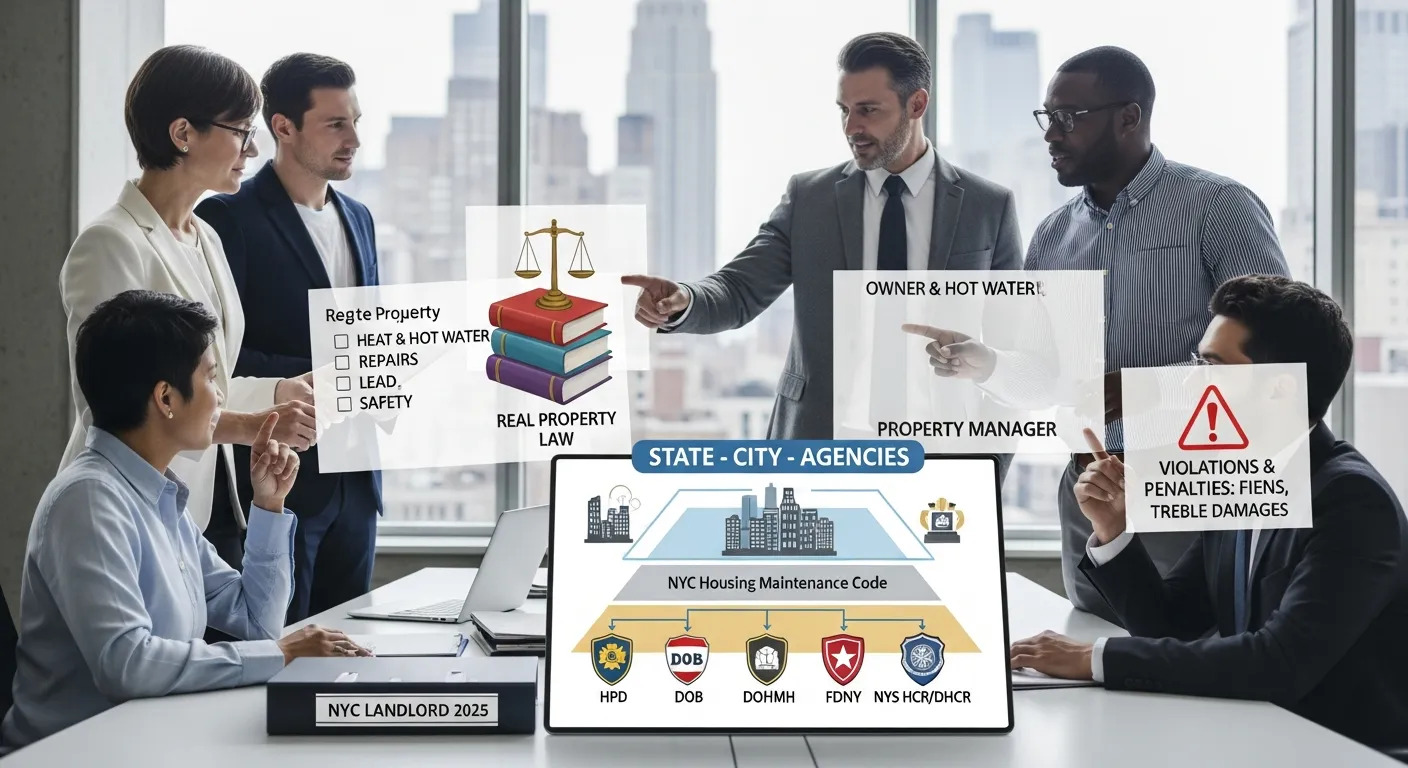
In New York City, our obligations don’t come from a single law or office. They’re layered.
At the state level, we’re governed by:
- Real Property Law and RPAPL (Real Property Actions and Proceedings Law) – leases, notices, and court procedures.
- HSTPA 2019 (Housing Stability and Tenant Protection Act) – caps security deposits at one month’s rent, restricts fees, tightens eviction rules, and changes how rent overcharges are calculated.
- Good Cause Eviction (New York City implementation, 2024) – for many unregulated units, we can’t simply refuse renewal or evict without one of the law’s defined “good causes.” Rent hikes are generally limited to inflation + 5%, capped at 10% unless a statutory exception applies.
- Fair housing rules – federal, state, and city protections against discrimination in rentals, advertising, and screening.
At the city level, our duties come mainly from:
- NYC Housing Maintenance Code and NYC Administrative Code – heat and hot water, repairs, essential services, and basic habitability.
- Local laws – lead paint, indoor allergens and pests, façade and structural safety, carbon emissions limits, and more.
By agency, the main players are:
- HPD (Department of Housing Preservation and Development) – housing conditions, registrations, inspections, and many residential violations.
- DOB (Department of Buildings) – structural safety, egress, building systems, and a large share of NYC building violations.
- DOHMH (Department of Health and Mental Hygiene) – lead, mold, pests, and indoor health hazards.
- FDNY – fire safety systems, sprinklers, alarms, and egress.
- NYS HCR/DHCR – rent-stabilized and rent-controlled units, registrations, and overcharge complaints.
If we think in those buckets, state, city, and agencies, it becomes easier to understand which rule applies in which situation.
Key Definitions: Owner, Managing Agent, Super, And Tenant
NYC law uses specific terms that matter when a violation is issued.
- Owner – Whoever holds title or effective control. This can be us personally, an LLC, or a corporate owner. For enforcement, HPD and DOB care who actually controls the building and who’s listed on registrations.
- Managing agent – The person or firm we designate on the HPD registration to act for us. HPD will call, email, and serve paperwork on this person. If they ignore notices, we suffer the consequences.
- Superintendent (“super”) – The on‑site building employee (or nearby designated person) responsible for daily maintenance, minor repairs, and access for inspectors and vendors.
- Tenant – Anyone lawfully occupying an apartment under a lease, renewal, or tenancy-at-will. If a unit is rent regulated, that tenant may have renewal rights and overcharge protections that don’t exist in a purely market-rate setting.
Understanding who is on the hook for what helps us set up clear roles and avoids the “I thought someone else was handling that” problem that leads directly to violations.
Risk And Liability: What Happens When You Do Not Comply
Non-compliance in NYC rarely stays small. Penalties tend to escalate.
We can face:
- HPD, DOB, DOHMH, and FDNY violations – with daily civil penalties until corrected.
- Emergency repair charges – HPD can make repairs and bill us, with liens added to the property tax bill if unpaid.
- Rent abatements – tenants can seek rent reductions for lack of services or serious conditions.
- Overcharge liability – in regulated units, DHCR or the courts can order refunds plus treble damages for willful overcharges.
- Attorneys’ fees – many housing laws and leases allow tenants to recover legal fees if they win.
- Criminal charges – in egregious or repeated cases (unsafe boilers, illegal wiring, chronic lead issues), the city can bring criminal proceedings.
The bottom line: prevention is cheaper. A $400 repair we delay can quickly become a multi‑thousand‑dollar DOB violation or HPD emergency work order.
Staying Current: New And Evolving NYC Regulations In 2025
Recent Changes In NYC Housing Law Affecting Landlords
The rules we operated under a decade ago are gone. Three policy shifts define the modern landscape.
- HSTPA 2019 (still the backbone in 2025)
- Security deposits capped at one month’s rent.
- Most application fees and “junk fees” are restricted.
- Tighter timelines and notice rules for rent increases and non‑renewals.
- Stronger protections for tenants in rent-regulated units, including how we calculate and defend rent histories.
- Good Cause Eviction in NYC (effective 2024)
- Applies to many previously unregulated apartments, subject to building size and owner-size thresholds and carve‑outs.
- We generally need a recognized “good cause” (like nonpayment, serious lease violations, or owner occupancy in limited circumstances) to refuse renewal or evict.
- Rent increases above the statutory formula (inflation + 5%, capped at 10%) can be challengeable as “unreasonable” absent specific justifications.
- Broker fee and “junk fee” rules (FARE Act and related guidance)
- When we hire a broker to list a unit, we generally must pay that broker’s fee: we can’t simply shift it to the tenant.
- We must itemize all up‑front charges in writing, and they must comply with HSTPA and other consumer protection laws.
We don’t need to be experts on every nuance, but we do need a working understanding and a habit of checking current guidance from HPD, DHCR, and the courts.
Climate, Energy, And Sustainability Requirements
Climate rules are no longer just a concern for large office towers. Multifamily landlords are directly in the crosshairs.
- Local Law 97 – caps greenhouse gas emissions for many buildings over 25,000 square feet and imposes fines starting in 2024, ramping up in 2030. Even if our building is smaller, lenders, buyers, and insurers have started asking about compliance.
- Boiler and heating efficiency rules – phase‑outs for No. 4 fuel oil, tighter combustion rules, and new annual boiler inspection requirements via DOB and DEP.
- Local Law 84/133 benchmarking – many larger residential buildings must annually report energy and water usage.
For details, the city maintains a Local Law 97 portal at www.nyc.gov/site/sustainablebuildings. Even if we’re under the square-footage threshold now, retrofits we plan in the 2020s should assume a stricter energy regime.
Local Law Updates To Watch For Beyond 2025
NYC doesn’t stand still. Beyond 2025, we should expect:
- More allergen and indoor air quality rules – expanding on the current mold and pest standards.
- Stronger building electrification pushes – pressure to replace gas stoves and older fossil-fuel systems.
- Tighter façade and balcony inspection regimes – especially for mid‑rise stock that’s aging.
We’ve learned that waiting passively is risky. A simple habit, reviewing HPD, DOB, and City Council updates once or twice a year, keeps us ahead of rules instead of scrambling after violations arrive.
Registration, Licensing, And Required Documents
Property Registration With HPD And The City
For most multifamily buildings, HPD registration isn’t optional, it’s the foundation of NYC property compliance.
We must:
- Register annually if we have 3 or more residential units in a building, or 1–2 units where the owner doesn’t live there.
- List the owner, managing agent, and emergency contact with current phone numbers, addresses, and emails.
- Update the registration promptly when ownership or management changes.
If we’re not registered, HPD can:
- Reject our attempts to schedule inspections on our terms.
- Escalate violations more quickly.
- Block certain court actions, including some nonpayment and HP actions.
DOB also maintains its own database of owners and responsible parties. Before we do any construction, structural work, or even some repairs, we may need permits, licensed professionals, and sign‑offs.
Collecting And Managing Security Deposits Legally
Under HSTPA, security deposits across New York State are heavily regulated.
Key rules:
- Maximum of one month’s rent as security deposit for most residential leases.
- No additional “last month’s rent” or extra side deposits.
- We must provide a written move‑in inspection checklist and give tenants a chance to note conditions.
- Deposits must be kept in a separate, interest‑bearing account in a New York bank, with interest (minus a small admin fee) payable to the tenant.
- We must return the security deposit within 14 days after the tenant vacates, with an itemized statement of any deductions.
Failure to follow these rules can lead to damages and attorneys’ fees. A simple, documented process, standard forms, photos on move‑in and move‑out, and clear timelines, protects us as much as it protects the tenant.
Essential Records To Keep And For How Long
Good records are our best defense when HPD complaints or DOB violations appear.
We should maintain, at minimum:
- Leases, riders, and renewals – especially for rent-stabilized units: keep for at least the DHCR look‑back period, and practically longer.
- Rent ledgers and payment histories – essential for nonpayment proceedings and overcharge defenses.
- DHCR rent registrations and correspondence – to show legal rent calculations.
- Repair records – invoices, work orders, photos, and communications with tenants.
- Inspection reports and certifications – boiler inspections, elevator tests, lead paint investigations, and gas piping inspections.
As a rule of thumb, we keep housing records for at least six years, and DHCR-related records much longer. In disputes over NYC building violations or rent histories, whoever has organized paperwork usually wins.
Apartment Standards: Habitability, Safety, And Quality Of Life Rules
Housing Maintenance Code And Warranty Of Habitability
NYC’s Housing Maintenance Code, combined with New York State’s warranty of habitability, sets the baseline for what every apartment must provide.
We’re required to:
- Maintain apartments in safe, sanitary, and livable condition.
- Keep structural features, windows, doors, and locks in good repair.
- Provide essential services: heat, hot water, electricity, and gas (where applicable).
- Address HPD complaints and hazardous conditions within specific time frames, often 24 hours for Class C emergencies.
Tenants who face serious or persistent issues, from no heat to collapsed ceilings, can call 311, file HPD complaints, bring court cases, or withhold rent and seek abatements.
Heat, Hot Water, And Utility Requirements
Few areas trigger more enforcement actions than heat and hot water.
- Heat season (typically October 1 – May 31): If the outside temperature falls below the legal threshold, we must provide a minimum indoor temperature (details at nyc.gov/hpd).
- Hot water must be available year‑round at legally required temperatures.
- We must maintain boilers, radiators, and controls so that apartments don’t swing between freezing and sauna-like.
Failure to provide heat or hot water is a fast route to emergency HPD intervention, civil penalties, and angry tenants.
Pest Control, Mold, And Indoor Allergen Laws
NYC’s allergen laws treat pests and mold as serious health hazards.
We must:
- Carry out integrated pest management, not just spray chemicals. That includes sealing cracks, addressing garbage and storage, and removing harborages.
- Promptly remediate visible mold, leaks, and water intrusion using safe work practices, often with licensed mold assessors and remediators for larger jobs.
- Give required Allergen and Indoor Allergen disclosures, especially in buildings with multiple units and families with children.
DOHMH can issue violations where we ignore leaks, chronic dampness, or infestations.
Fire Safety, Carbon Monoxide, And Building Systems
FDNY and DOB jointly regulate fire and life safety.
Landlords must:
- Install and maintain smoke and carbon monoxide detectors in each unit, with proper placement and tenant notice.
- Post approved fire safety notices in hallways and inside apartment doors in many buildings.
- Keep egress paths, stairwells, and exits clear at all times.
- Properly maintain sprinkler systems, standpipes, fire alarms, and self‑closing doors where required.
DOB and FDNY inspections often follow complaints or incidents. A single unmaintained fire door can turn into a cluster of violations.
Lead Paint Compliance And Child Safety Requirements
Pre‑1960 (and many pre‑1978) buildings fall under strict lead paint rules.
We must:
- Conduct annual lead paint inspections in apartments where a child under 6 resides or is expected to reside.
- Use EPA‑certified contractors and safe work practices for disturbing painted surfaces.
- File required certifications and documentation with HPD.
- Provide tenants with lead disclosure forms and the federal EPA pamphlet at leasing.
Lead-related violations can carry steep penalties and, more importantly, long‑term health impacts on children. HPD’s lead pages at nyc.gov/site/hpd are essential reading for anyone who owns pre‑1960 housing stock.
Rent Regulation, Increases, And Tenant Protections
Determining Whether Your Units Are Rent Regulated
Before we talk about rent increases, we need to know if any unit is rent regulated.
A unit may be rent‑stabilized if, among other criteria:
- It’s in a building with six or more units built before 1974, and
- It hasn’t legally exited regulation through mechanisms that HSTPA has now largely closed, and
- The rent history shows a continuous line of regulated status.
Rent‑controlled units still exist but are rare, usually tied to very long‑term tenancies.
We confirm status by:
- Pulling the building’s history and registration data from DHCR.
- Reviewing our own rent roll, old leases, and prior registrations.
- Consulting a housing attorney for ambiguous cases.
Treating a regulated unit as market‑rate is one of the fastest ways to end up with DHCR complaints and overcharge penalties.
Legal Rent Increases And Registration With DHCR
For rent‑stabilized units, annual rent increases are set by the Rent Guidelines Board. We may be allowed a fixed percentage increase for one‑year and two‑year renewals.
Our obligations include:
- Offering timely renewal leases on DHCR forms.
- Charging no more than the legal regulated rent, plus permitted surcharges.
- Filing annual rent registrations with DHCR.
For market‑rate units, Good Cause Eviction may still limit rent hikes depending on the building and ownership structure. In 2025, we ignore Good Cause at our peril.
Preferential Rents, Fees, And Surcharges
Preferential rents, where we charge less than the legal regulated rent, became much more constrained post‑HSTPA.
- In many cases, the lower charged rent becomes the base for future increases while that tenancy continues.
- We must avoid hidden or back‑door charges: “facility fees,” unnecessary add‑ons, or nonrefundable move‑in fees can raise red flags.
- Legitimate surcharges (for example, for individual apartment improvements in regulated units) have strict rules and documentation requirements.
For regulated housing, every extra dollar must fit into a DHCR‑recognized category or it risks being treated as an overcharge.
Required Disclosures And Tenant Communication
NYC layering of disclosure rules is easy to underestimate.
Depending on the building and unit, we may need to provide:
- Lead paint disclosures, bedbug history notices, and window guard forms.
- Rent-stabilization riders, DHCR informational forms, and Good Cause Eviction notices where applicable.
- Heat and hot water notice and emergency contact postings.
Clear, written communication with tenants reduces disputes, and it also helps if we ever need to prove in court that we gave all legally required information.
Inspections, Reporting Requirements, And How To Avoid Violations
Common Types Of City Inspections And What Triggers Them
Most inspections aren’t random. They’re triggered by:
- 311 complaints leading to HPD, DOB, DOHMH, or FDNY visits.
- Required periodic inspections – elevators, boilers, gas piping, façades.
- Construction permits – DOB inspections to sign off on permitted work.
- Fires, accidents, or high‑profile incidents – which often lead to multi‑agency reviews.
We can’t stop inspections, but we can make sure our staff is trained to provide access, escort inspectors, and document what happens.
Reading, Responding To, And Correcting Violations
When we receive a violation, step one is to read the class, deadline, and cure method.
- Class A (non‑hazardous) – often longer correction periods but still carry penalties if ignored.
- Class B (hazardous) and Class C (immediately hazardous) – tighter deadlines, higher fines, and faster escalation.
Best practices:
- Document conditions before and after the repair.
- Use licensed professionals where required and keep their certifications.
- File the certification of correction promptly using the agency’s portal.
To stay ahead of problems, many owners now monitor violations using tools like ViolationWatch and the city’s own online systems.
Get instant alerts whenever your building receives a new violation, sign up for real-time monitoring using building violation alerts so we’re not learning about issues from a marshal or a tenant lawsuit.
Using The City’s Online Systems To Monitor Your Buildings
NYC provides several public databases:
- HPD Online – housing maintenance code violations, complaints, and registrations.
- DOB NOW and BIS – building permits, DOB violations, inspections.
- FDNY and DOHMH portals – selected enforcement actions and permits.
For free lookups, use our NYC violation lookup tool to see HPD and DOB issues on our properties in seconds instead of hunting through multiple city websites.
Pairing city data with third‑party monitoring means we can respond to NYC building violations quickly, before they turn into liens or court actions.
Handling Tenant Issues Legally: Applications, Leases, And Evictions
Screening Applicants Without Violating Fair Housing Laws
Careful screening is allowed: discriminatory screening is not.
We must avoid decisions based on protected classes such as race, religion, national origin, gender, sexual orientation, family status, disability, lawful source of income, or immigration status.
Common risk areas:
- Blanket bans against Section 8 or other voucher programs (source-of-income discrimination is illegal in NYC).
- Questions about citizenship or immigration status.
- Criminal background checks that aren’t narrowly tailored and consistently applied.
A written screening policy, credit, income, references, applied evenly to all applicants is our safest path.
Lease Clauses That Are Illegal Or Risky In NYC
We still see leases with clauses that don’t survive a few minutes in Housing Court.
Clauses to avoid or have counsel revise:
- Waivers of the warranty of habitability or repair obligations.
- Provisions that try to waive Good Cause Eviction rights where that law applies.
- “Nonrefundable” security deposits or cleaning fees.
- Automatic attorney’s fee provisions that don’t mirror NYC’s reciprocal rules.
Standard NYC lease forms plus customized riders, reviewed by a housing attorney, are a better baseline than downloading generic templates that ignore local law.
Lawful Grounds And Procedures For Eviction In 2025
Eviction in NYC is intensely regulated and, post‑Good Cause, even more constrained.
We generally proceed on three main theories:
- Nonpayment of rent – requires proper demand notices and careful accounting: courts expect us to have detailed ledgers.
- Holdover – based on lease violations, illegal activity, owner occupancy in limited cases, or non‑renewal where legally allowed.
- No‑fault or expiration – now heavily restricted in units covered by Good Cause.
Every proceeding runs through Housing Court, with strict notice and service rules. Attempting “self‑help” (changing locks, shutting off utilities, harassing tenants to leave) is illegal and can lead to civil and criminal liability.
Accommodation Requests And Anti-Discrimination Rules
Under fair housing and disability laws, we must consider reasonable accommodations and modifications.
Examples include:
- Allowing service animals or emotional support animals even in “no pets” buildings, where properly documented.
- Adjusting policies about rent payment timing or communication methods for tenants with documented disabilities.
- Allowing certain physical modifications (grab bars, ramps), sometimes at the tenant’s expense, with conditions about restoration.
When in doubt, we document the request, ask for reasonable supporting information, and confer with counsel rather than denying reflexively.
Building A Compliance-First Landlord Operation
Creating Internal Compliance Checklists And Calendars
Compliance improves dramatically when we stop treating it as a series of emergencies and start treating it as a calendar.
We can:
- Build annual and seasonal checklists: heat season prep, roof and gutter checks, boiler inspections, smoke detector tests, lead inspections, and Local Law obligations.
- Set reminders for HPD registration renewals, DHCR rent registrations, and required inspections.
- Standardize move‑in, move‑out, and lease renewal packets with all required NYC disclosures.
A simple shared calendar and a few checklists can dramatically cut HPD complaints and surprise DOB violations.
Working With Professionals: Attorneys, Managers, And Supers
Even experienced landlords can’t realistically track every detail alone.
We should cultivate:
- A housing attorney who actually practices in NYC Housing Court and understands HPD, DOB, and DHCR.
- A competent managing agent or property manager, if we don’t self‑manage.
- A reliable super or building staff who know how to spot problems early and document repairs.
We don’t need a huge team, but we do need professionals who understand that NYC property compliance is part of their job description.
Budgeting For Compliance, Repairs, And Capital Improvements
Many violations stem from a simple failure to budget.
A realistic budget should include:
- Routine maintenance – plumbing, electrical, roofing, common areas.
- Code‑driven upgrades – boilers, windows, insulation, lighting, lead abatement.
- Local Law 97 and energy retrofits for larger buildings.
By forecasting these costs, we’re less tempted to defer essential work that later appears as a DOB violation, an HPD emergency repair, or a lawsuit.
Using Technology To Track Compliance And Communication
Software is finally catching up with the complexity of NYC housing.
We can use:
- Property management platforms to log work orders, complaints, and repairs.
- Document storage systems to keep leases, registrations, and inspection reports accessible.
- Violation tracking tools such as ViolationWatch to consolidate HPD and DOB data in one place.
For proactive risk management, we can also enable building violation alerts so our team hears about new issues as soon as they’re posted, rather than months later when interest and penalties have already accumulated.
Conclusion
NYC in 2025 is not a forgiving environment for careless landlords. Between DOB violations, HPD complaints, evolving climate rules, and expanding tenant protections, the margin for error keeps shrinking.
But a compliance‑first approach is entirely within reach. If we:
- Understand which agencies regulate which duties,
- Stay current on Good Cause Eviction, HSTPA, and local laws,
- Keep registrations, inspections, and files meticulously up to date,
- Treat habitability and safety issues as urgent, not optional,
- And use tools, like the city’s online portals, a modern property‑management system, and an integrated NYC violation lookup tool, to keep watch over our portfolio,
we dramatically lower our legal risk and protect both tenants and investments.
Compliance isn’t just a legal shield: in a market as competitive as New York, it’s part of our reputation. Buildings known for safety, responsiveness, and lawful practices attract better tenants, experience less turnover, and tend to perform better over time.
If we commit now to building solid systems, NYC property compliance becomes less about putting out fires and more about quietly running a stable, sustainable housing business, exactly what the city, our tenants, and our bottom line all demand.
Key Takeaways
- Treat NYC property compliance as a system, not a crisis response, by clearly defining owner, agent, and super roles and keeping HPD and DOB registrations current.
- Know how Good Cause Eviction, HSTPA, and rent regulation rules limit rent increases, fees, and evictions so you avoid overcharge claims and unlawful lease clauses.
- Prioritize habitability and safety—heat, hot water, pests, mold, fire protection, and lead paint—because ignored repairs quickly turn into costly NYC building violations, abatements, and lawsuits.
- Build a documentation backbone with organized leases, rent ledgers, DHCR registrations, inspection reports, and repair records to defend against complaints and enforcement actions.
- Use calendars, technology tools, and city portals to track inspections, Local Law 97 and energy rules, and real-time violation alerts so you stay ahead of 2025 and future regulatory changes.
Frequently Asked Questions for NYC Landlords in 2025
What does NYC property compliance mean for residential landlords in 2025?
NYC property compliance in 2025 means following overlapping state and city laws plus agency rules from HPD, DOB, DOHMH, FDNY, and DHCR. It covers habitability, registrations, rent regulation, disclosures, safety systems, and climate rules. Non-compliance can trigger daily fines, emergency repairs, rent abatements, and even criminal exposure.
How can I avoid NYC building violations and HPD complaints as a small landlord?
To avoid NYC building violations, keep HPD registration current, respond quickly to 311 complaints, prioritize heat, hot water, and repairs, and document all work. Use checklists, seasonal inspections, and online violation lookup tools to monitor issues early instead of waiting for court cases or emergency HPD interventions.
What are the key NYC landlord changes for 2025, including Good Cause Eviction?
In 2025, NYC landlords must still follow HSTPA limits on security deposits and fees, and comply with Good Cause Eviction for many formerly unregulated units. Good Cause restricts no‑renewals, caps most rent hikes at inflation + 5% (max 10%), and requires recognized “good causes” for many evictions or non‑renewals.
How should NYC landlords legally handle security deposits under HSTPA?
NYC landlords generally may only collect one month’s rent as a security deposit, no “last month’s rent” or side deposits. Deposits must be in a separate, interest‑bearing New York bank account, with a move‑in inspection checklist, photo documentation, and an itemized return within 14 days after vacancy, or risk damages and attorneys’ fees.
How does Local Law 97 affect residential landlords, and what should I do now?
Local Law 97 sets greenhouse gas emission caps for many buildings over 25,000 square feet, with fines starting in 2024 and tightening in 2030. Landlords should benchmark usage, plan efficiency upgrades to boilers and building systems, and assume stricter future standards, since lenders, buyers, and insurers increasingly ask about compliance.
Do I need a lawyer to manage NYC landlord compliance, or can I do it myself?
Very small landlords can self-manage NYC landlord compliance if they invest time in learning HPD, DOB, and DHCR rules, use calendars, and keep strong records. However, a housing attorney familiar with Housing Court and local agencies is strongly recommended for lease drafting, rent regulation questions, and any potential eviction or overcharge dispute.