
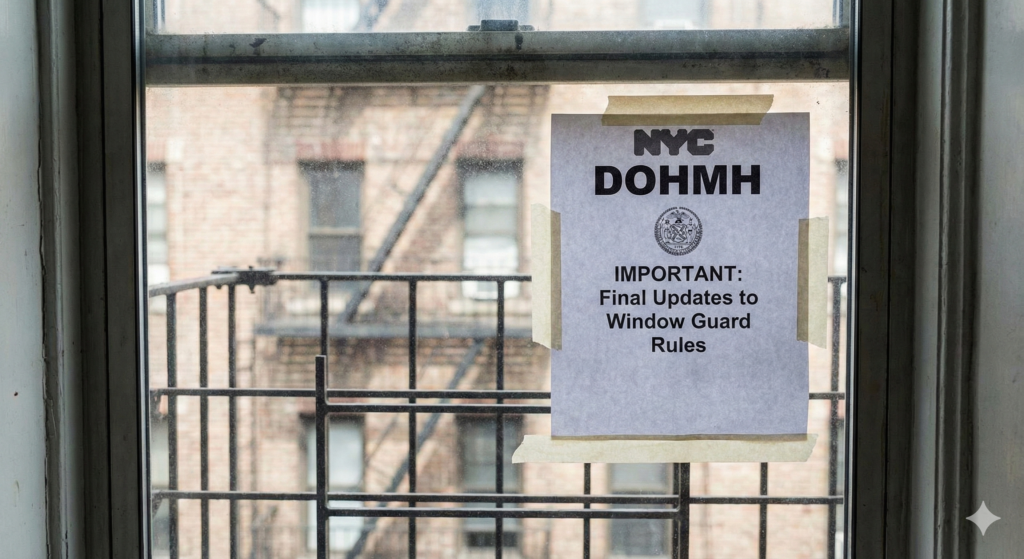
New York City has quietly but significantly tightened the rules around window guards, and for many of us in housing, property management, and compliance, these “final” updates from the Department of Health and Mental Hygiene (DOHMH) are not optional reading.
These changes increase our responsibilities as owners and managers, clarify documentation and notice requirements, and tweak how enforcement will work going forward. In this post, we break down what the DOHMH window guard rules actually require, what’s new in the final updates, and how we can get our buildings into full compliance before enforcement ramps up.
What The DOHMH Window Guard Rules Are And Who They Cover
At the core, the DOHMH window guard rules are about preventing children from falling out of windows in multiple dwellings. The underlying authority comes from the NYC Health Code (notably Section 131.15), which requires window guards in certain apartments and common areas.
In plain terms, the rules apply to:
- Multiple dwellings (generally three or more units) in New York City
- Apartments where a child 10 years of age or younger resides
- Units where a tenant or occupant requests window guards, even if no child lives there
- Certain public hallways and other common-area windows in buildings where children live
DOHMH’s long‑standing position is that window guards must be properly installed, maintained, and tamper‑resistant. Approved guards must meet design and installation criteria, and they can’t be easily removed or opened in a way that defeats their purpose.
For background, DOHMH reports that window guards have dramatically reduced child window falls since the city adopted these rules in the 1970s (NYC DOHMH). But incidents still occur, especially where guards are missing, damaged, or installed incorrectly, exactly what these latest updates are designed to address.
We should also keep in mind that these rules interact with broader habitability and safety standards, including the Warranty of Habitability under New York Real Property Law and enforcement by HPD and DOHMH together (NYC HPD).
Summary Of The Latest Final Updates
The “final updates” to the DOHMH window guard rules primarily do three things:
- Clarify who is responsible and when
- Strengthen notice, documentation, and recordkeeping requirements
- Tighten standards for installation, maintenance, and inspections
While the exact rule text sits in the Health Code and implementing rules (see the official NYC Rules portal), the main themes are:
- Expanded definition of covered units – The rules now make it even clearer that if a child under 11 lives in the unit or an occupant requests guards, we must treat the apartment as fully covered for all relevant windows.
- More explicit obligations to verify occupancy each year – Annual notices and follow‑up steps are spelled out with more detail, with fewer gray areas about what “reasonable efforts” mean.
- Clearer standards for what constitutes a compliant guard and installation – The updates reference DOHMH‑approved types of guards, required anchoring methods, and conditions that automatically render a guard “noncompliant.”
- Enhanced coordination with inspectors and data systems – Violations, orders, and corrective actions are expected to be more systematically tracked and cross‑checked across agencies.
In short, our margin for informal or undocumented practices is shrinking. DOHMH wants a paper (and digital) trail for how we identify covered units, install guards, and respond to tenant communications.
Key Changes For Property Owners And Managers
From an owner or manager’s standpoint, several updates are especially important.
1. Stronger Occupancy and Child-Resident Verification
The rules double down on annual verification of whether a child 10 or younger lives in each apartment. We now need:
- Annual window guard notices sent in a DOHMH‑approved format
- A clear process to track responses and non‑responses
- Follow‑up procedures for units where tenants don’t respond, often including documented attempts (mail, email, door posting) before we mark the unit as “no child resident”
2. Clearer Tenant Request Obligations
Even if no child lives in the unit, any written or documented tenant request for window guards triggers the full set of obligations. The final updates emphasize that this includes:
- Requests made by email or through online portals
- Requests made to supers, managing agents, or leasing staff
We should be training staff that any mention of “window guards” is a legal request, not just a casual comment.
3. Installation Standards and Prohibited Conditions
The revised language provides more detail on what makes an installation deficient. Noncompliance can now be cited for:
- Guards that don’t match DOHMH‑approved models
- Loose or insufficient screws/anchors
- Gaps wide enough for a child to pass through
- Guards blocked, removed, or disabled by building staff
These criteria line up with what field inspectors have been checking for, but now they’re more explicitly codified.
4. Recordkeeping Expectations
We’re now clearly on the hook for maintaining records of:
- Notices sent and responses received
- Date and type of window guard installations and repairs
- Vendor information and proof of qualified installers
If we ever need to defend ourselves against a citation or worse, litigation, these records will be crucial. Courts have repeatedly treated window guard compliance as a non‑delegable safety duty (NY Courts resource).
Compliance Steps And Required Documentation
To adapt to the final updates, we should formalize our process across the portfolio. At minimum, a solid compliance program now includes:
1. Standardized Annual Notice Workflow
- Use the current DOHMH‑approved annual window guard notice form.
- Send notices in multiple ways where possible (mail + email or tenant portal) and log the dates.
- Track non‑responses and perform follow‑ups before assuming “no child resident.”
2. Centralized Log of Covered Units
Maintain a centralized list that flags:
- Units where children 10 or younger live (based on tenant responses and prior history)
- Units where tenants previously requested guards, even if they later move out
- Dates when each unit was last inspected and when guards were last installed or serviced
Tools like a simple compliance database or even a structured spreadsheet work, as long as we actually keep it updated.
3. Installation And Inspection Protocols
- Use installers familiar with DOHMH requirements and approved guard models.
- Build pre‑move‑in and annual inspection checkpoints into our maintenance calendar.
- Take photos of completed installations and log them in unit files.
For additional context on effective fall prevention practices, it’s worth reviewing broader safety guidance like the CDC’s materials on child falls, which reinforce why these seemingly small details matter.
4. Documentation To Have Ready For Inspectors
When DOHMH or HPD knocks, we want to be able to produce, quickly:
- Copies (or samples) of annual notices used
- Logs of responses and follow‑ups
- Lists of covered units and dates of installations
- Proof of corrective actions taken on prior violations
Having this documentation organized also makes it much easier to monitor potential issues proactively using external tools like the NYC window guard violations lookup tool at ViolationWatch Lookup, which surfaces public enforcement data in a more usable way than raw city portals.
Enforcement, Penalties, And Inspection Practices
The final DOHMH updates don’t reinvent enforcement, but they sharpen it.
How Enforcement Works In Practice
- Complaints – Tenants, neighbors, and even social service agencies can report missing or unsafe window guards to 311, which routes to DOHMH/HPD.
- Proactive inspections – Inspectors may check window guards during broader housing or lead inspections, especially in high‑risk buildings.
- Violation issuance – If guards are missing, improperly installed, or documentation is lacking, DOHMH can issue violations and orders to correct.
Official enforcement information is periodically summarized by the city in public reports (see, for example, NYC Mayor’s Management Report for trends in housing safety enforcement).
Penalties And Liability
Potential consequences for noncompliance include:
- Civil penalties and fines, which can stack across multiple units and windows
- Emergency repairs ordered or carried out by the city, billed back to owners
- Negative history that may affect financing, insurance, or sales
- Heightened exposure in personal injury litigation if a fall occurs
In serious cases, especially where there’s a pattern of noncompliance and a child is injured, courts may look extremely unfavorably on owners who ignored clear statutory duties.
Using Data To Stay Ahead Of Problems
Because enforcement data is public, we can now monitor it more intelligently. Platforms like ViolationWatch aggregate and visualize HPD and DOHMH violations, allowing us to:
- Track our own portfolios for emerging patterns
- Benchmark against similar properties
- Prioritize at‑risk buildings for proactive inspections
We can also drill specifically into DOHMH and window‑guard‑related items by using the dedicated NYC window violation lookup interface, which simplifies what used to require a lot of manual searching across city systems.
Timeline For Implementation And Practical Preparation Tips
The “final” status of the DOHMH updates means they’re past the proposal stage and now legally binding, often with specified effective dates and phase‑in periods in the rule text. In practice, we should assume inspectors will begin applying the new standards as soon as those effective dates hit, if not slightly before in educational mode.
Wherever we’re starting from, a 60–90 day action plan tends to work well:
- Week 1–2: Policy And Template Refresh
- Update our written window guard policy, staff training materials, and annual notice templates to track the final rule language.
- Confirm that our property management software or internal tracking setup can log requests, responses, and inspections.
- Week 3–6: Data Clean‑Up And Field Checks
- Reconcile our list of covered units against both tenant responses and historic data.
- Prioritize buildings or units with prior window guard issues, these often show up clearly using tools such as ViolationWatch’s enforcement dashboards or the lookup interface.
- Schedule inspections and remedial work for any high‑risk locations.
- Week 7–12: Full Rollout And QA
- Deploy updated annual notices across the portfolio.
- Standardize how supers and building staff log tenant requests about window guards.
- Conduct quality‑assurance spot checks, pick a sample of units and confirm the file documentation matches reality.
For larger portfolios, we may want to designate a window guard compliance lead who owns the calendar, documentation standards, and training refreshers. Central ownership is often what separates buildings that just “react” from those that stay consistently in compliance.
Conclusion
The final updates to the DOHMH window guard rules don’t change the underlying mission: keeping kids safe from preventable falls. What they do is raise the bar on how rigorously we document, verify, and maintain that safety.
If we treat this as yet another box‑checking exercise, we’ll chase violations and scramble when inspectors arrive. If instead we build a structured, documented window guard program, anchored in updated notices, clear workflows, and regular self‑audits using resources like ViolationWatch’s NYC violations tools, we’ll be positioned not just to pass inspections, but to meaningfully reduce risk for the families in our buildings.
Window guards are a small piece of hardware with outsized consequences. With these final rules now in place, this is the right moment for us to tighten up our processes and make sure every eligible window in our portfolio is properly protected.
Key Takeaways
- The final updates to the DOHMH window guard rules expand covered units and make clear that any apartment with a child 10 or younger—or any tenant request—must have compliant guards installed.
- Owners and managers must implement a documented annual verification process, using DOHMH-approved notices and follow-ups, to confirm child residents and track window guard needs in every unit.
- The revised DOHMH window guard rules tighten installation and maintenance standards, defining noncompliance for issues like unapproved guard models, loose anchors, gaps, or disabled guards.
- Property owners are now expected to maintain detailed records of notices, tenant responses, installations, inspections, and repairs so they can quickly demonstrate compliance during DOHMH or HPD inspections.
- Enforcement will increasingly rely on coordinated data and public violation records, so proactive monitoring and a 60–90 day implementation plan are critical to avoid fines, litigation risk, and repeated violations.
Frequently Asked Questions About the Final DOHMH Window Guard Rules
What do the final DOHMH window guard rules require from New York City property owners?
The final DOHMH window guard rules require owners of multiple dwellings to install and maintain approved, tamper‑resistant window guards in covered units and common areas, verify each year whether children 10 or younger live in apartments, honor any tenant request for guards, and keep detailed records of notices, installations, inspections, and repairs.
Which apartments are covered under the updated DOHMH window guard rules?
The DOHMH window guard rules apply to NYC multiple dwellings (generally three or more units) where a child 10 or younger lives, any apartment where an occupant requests window guards in writing or electronically, and certain hallway or common‑area windows in buildings where children reside, regardless of whether a specific child uses that space day‑to‑day.
What documentation should I keep to prove compliance with DOHMH window guard rules?
Owners and managers should retain copies of annual window guard notices, logs of tenant responses and follow‑ups, lists of covered units, dates and details of each installation and repair, installer or vendor information, and proof of corrective actions on violations. Organized documentation is critical for DOHMH or HPD inspections and in any potential litigation after an incident.
How are the final DOHMH window guard rule updates being enforced?
Enforcement relies on tenant complaints to 311, proactive inspections during housing or lead visits, and targeted checks in higher‑risk buildings. If guards are missing, improperly installed, or records are lacking, DOHMH can issue violations, fines, and orders to correct, and may arrange emergency work billed back to the owner, increasing legal and financial exposure.
How can property owners prepare for the new window guard requirements in 60–90 days?
A practical 60–90 day plan includes updating policies and annual notice templates, configuring software to track responses and inspections, reconciling covered‑unit lists with historic and current data, conducting priority inspections and repairs, rolling out standardized request‑logging procedures for staff, and performing spot‑check audits to verify that on‑file documentation matches conditions in the field.
Do DOHMH window guard rules apply to condominium or co‑op buildings, and who is responsible?
Yes. DOHMH window guard rules can apply to condos and co‑ops if they meet the definition of a multiple dwelling. Typically, the board or managing agent handles common‑area windows, while individual unit owners must comply inside their apartments, subject to the building’s bylaws. Clear internal policies help prevent gaps in responsibility or documentation.