
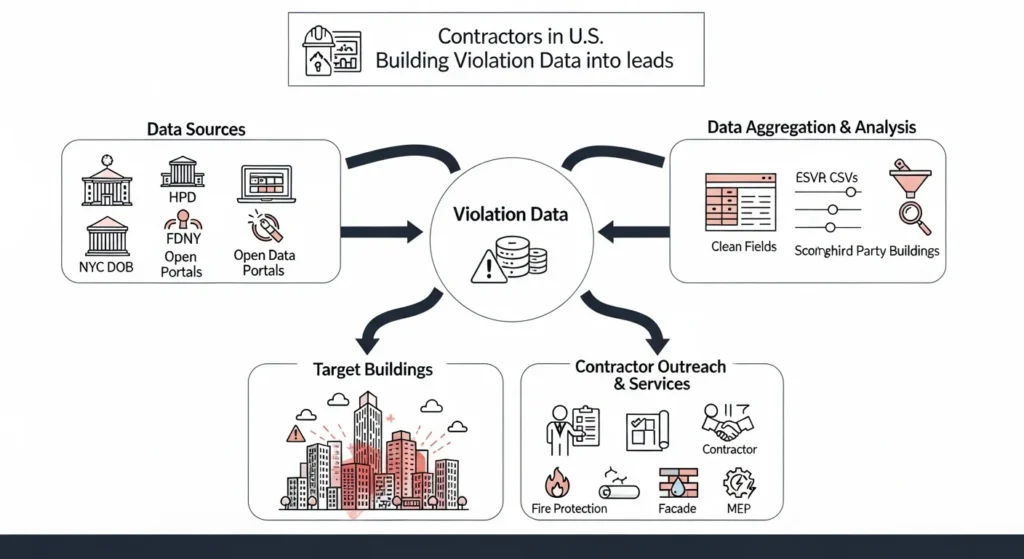
In most cities, the contractors winning the best work aren’t just waiting for the phone to ring. They’re watching where buildings are failing, and stepping in as the fix.
Nowhere is that clearer than in New York City. Every week, new DOB violations, HPD complaints, and enforcement actions quietly flag buildings that must do repair and compliance work on a deadline. For contractors, that’s not just paperwork: it’s a live feed of high-intent, often budgeted projects.
In this guide, we’ll walk through how we, as contractors or construction professionals, can turn violation data into a targeted, repeatable lead source, without being pushy, predatory, or out of step with NYC property compliance rules.
Why Violation Data Is a Goldmine for Contractors
What Is Violation Data and How Is It Created?
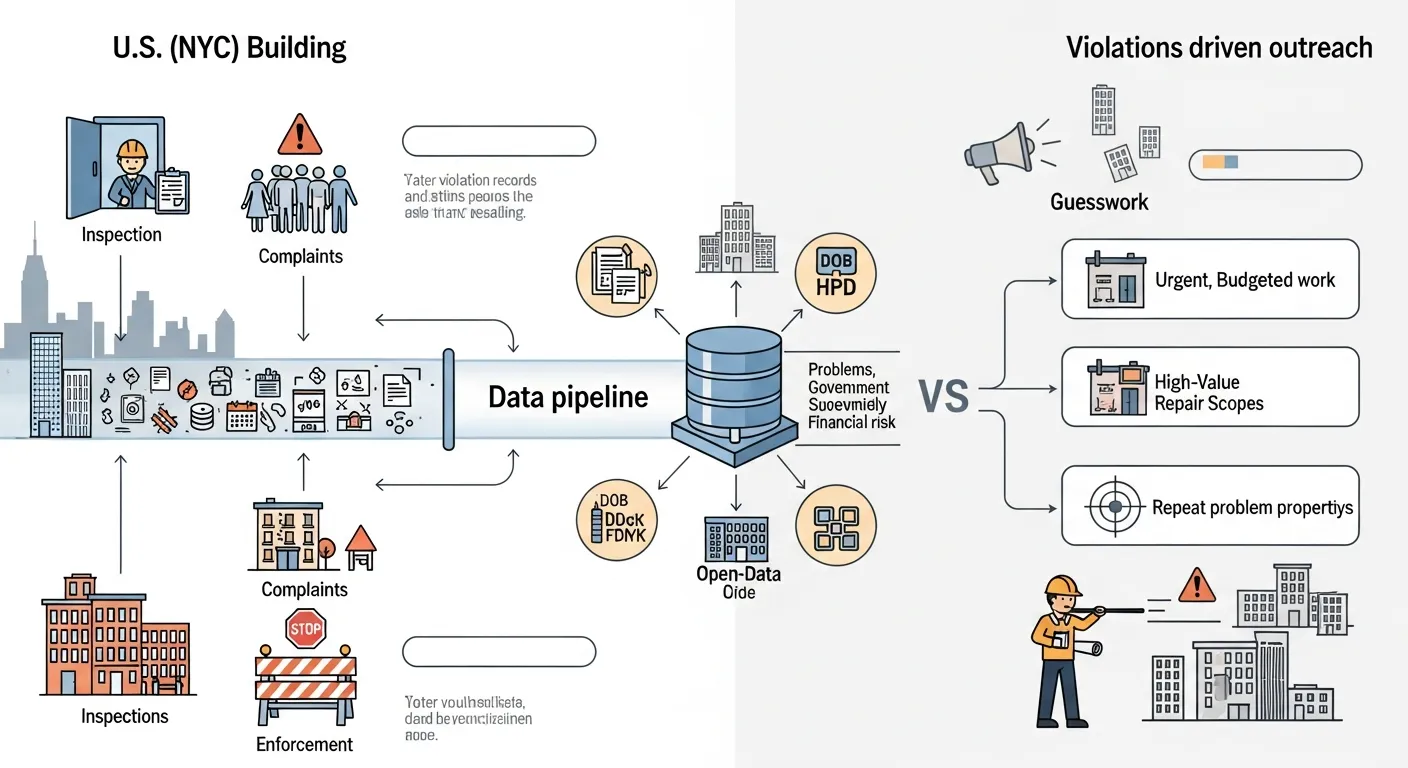
Violation data is the public trail left behind when a building doesn’t meet code.
In NYC, that typically comes from:
- Inspections by the Department of Buildings (DOB), Fire Department (FDNY), and other agencies
- Complaints from tenants, neighbors, or workers, think HPD complaints about heat, hot water, leaks, or unsafe conditions
- Enforcement actions like stop-work orders, vacate orders, and ECB/OATH summonses
Each of these events generates records: violation numbers, descriptions, inspection dates, responsible parties, and sometimes re‑inspection deadlines. Agencies then log those into systems like DOB NOW, BIS, HPD Online, or NYC Open Data.
For us, that’s structured evidence of three crucial facts:
- Something in the building is broken or unsafe.
- A government agency is watching.
- The owner will face fines, legal exposure, or revenue loss if it’s not fixed.
Why Violations Beat Traditional Lead Sources
When we market through ads or generic outreach, we’re guessing who might need work. With NYC building violations and HPD complaints, we’re looking at confirmed need.
Violation data often signals:
- Urgent, budgeted work – Owners usually have to correct violations within a specific timeframe to avoid escalating fines or hearings.
- High-value scopes – Structural repairs, façade work, fire protection upgrades, boiler replacements, these aren’t $500 handyman jobs.
- Repeat problem properties – Buildings with long histories of DOB violations and HPD complaints are more likely to need ongoing maintenance contracts.
We’ve seen owners move faster when we anchor conversations in specific, public issues:
“We saw your building at 123 Example Ave received a DOB violation for unsafe façade conditions last month. We specialize in Local Law 11 and envelope repairs and can help you clear this before your next inspection cycle.”
We’re not guessing: we’re speaking directly to what the city has already documented. That’s why violation-driven outreach tends to convert better than generic “Do you need any work done?” messages.
Understanding Building Violation Data Sources
Public Databases and Open Data Portals
Most of what we need is already online if we know where to look.
In NYC, key starting points include:
- DOB BIS & DOB NOW for permits, complaints, ECB/OATH summonses, and DOB violations: https://www.nyc.gov/site/buildings/index.page
- HPD Online for housing maintenance code violations and tenant HPD complaints: https://www.nyc.gov/site/hpd/services-and-information/housing-code-violations.page
- NYC Open Data for bulk downloads of DOB and HPD records: https://data.cityofnewyork.us/
These systems let us search by address, block and lot, or borough, and see:
- Violation type and description
- Status (open, resolved, dismissed)
- Inspection and issuance dates
- Sometimes penalty information or hearing schedules
Platforms like ViolationWatch layer on top of these public data sources to make them more usable for owners and professionals, especially when we’re trying to monitor many buildings at once.
For free lookups, use our NYC violation lookup tool. It’s a quick way to see open issues at a property before we invest time in outreach.
Freedom of Information Requests and Local Records Offices
Not every detail is digitized or easy to search. For older buildings or nuanced issues, we sometimes need to go beyond the web.
FOIL (Freedom of Information Law) requests to DOB, HPD, or other agencies can surface:
- Full inspection reports
- Photos taken by inspectors
- Historical enforcement actions not visible in public portals
It’s more work and takes weeks, not minutes. But for large potential projects, say, a major structural or fire-safety job, the extra documentation can help us scope accurately and demonstrate to owners that we’ve done our assignments.
Third-Party Data Providers and Industry Platforms
If we’re targeting violation-driven work at scale, manually checking dozens of websites won’t cut it.
Third‑party platforms and data providers aggregate:
- Violations from DOB, HPD, FDNY, and other agencies
- Permit history and construction activity
- Ownership information and contact details
Tools like ViolationWatch sit in this space for New York City. They watch official feeds and notify owners and professionals when new issues appear. As contractors, we can use these tools to:
- Spot new violations as they’re issued
- Track which owners consistently run into NYC property compliance problems
- Cross‑reference building size, use type, and neighborhood to focus on our best-fit projects
If we prefer a DIY approach, we can combine NYC Open Data downloads with our own spreadsheets. But for real‑time visibility, third‑party monitoring saves us many hours a month.
Types Of Violations That Signal High-Value Repair Opportunities
Not every violation is worth a sales call. Some are clerical, some are trivial, and some resolve without major work. We want the ones that usually require a contractor and a real budget.
Life Safety and Fire Code Violations
These are often the most urgent, and the most sensitive.
Examples include:
- Inoperable or missing fire alarms and detection systems
- Insufficient or blocked egress routes
- Non‑functional sprinklers or standpipes
- Improper firestopping and penetrations
- Fire door defects or missing rated assemblies
Life-safety violations can trigger:
- Vacate orders
- Insurance headaches
- Intense scrutiny from FDNY and DOB
That urgency makes owners far more receptive to a contractor who understands both the technical fix and the re‑inspection process.
Structural and Envelope Violations
The façade and structure category often represents large capital projects:
- Cracked or spalling masonry
- Unsafe façade conditions (think Local Law 11/Facade Inspection Safety Program – FISP)
- Deteriorated balconies or fire escapes
- Persistent water intrusion from roofing, parapets, or windows
A single “unsafe façade” DOB violation on a mid‑rise multifamily can turn into:
- Sidewalk sheds
- Engineering reports
- Multi‑phase repair work over several seasons
If our firm handles exterior restoration, waterproofing, or structural repair, these violations are some of the most valuable signals on the map.
Mechanical, Electrical, and Plumbing (MEP) Violations
MEP issues show up in both DOB violations and HPD complaints:
- Boilers out of service or not inspected
- Electrical hazards, overloaded panels, or illegal wiring
- Chronic leaks, sewage backups, or non‑functional waste lines
- HVAC failures impacting habitability
These problems are highly visible to occupants and can produce streaks of HPD complaints during cold snaps or heavy rain.
Owners under pressure from tenants, HPD, and DOB are usually focused on speed and reliability. If we can demonstrate that we:
- Understand the code path to clear the violation
- Provide proper paperwork and sign‑offs
- Coordinate with inspections and testing
, we immediately stand out from generic “we do everything” competitors.
Accessibility, Energy, and Maintenance-Related Violations
These may be less urgent, but they can still lead to sizable projects:
- Non‑compliant ramps, handrails, and entrances
- Elevator issues tied to accessibility requirements
- Lighting, insulation, and energy‑code shortfalls
- Chronic maintenance neglect: peeling paint, trip hazards, deteriorated common areas
Accessibility and energy items often connect to broader repositioning or renovation plans. If we specialize in retrofit work, violations in this category can be an entry point into a much larger conversation about long‑term upgrades rather than one‑off fixes.
How To Access and Aggregate Violation Data in Your Market
To turn violation data into a real pipeline, we need something more systematic than typing addresses into a search bar once in a while.
First, we decide on geography and asset type: for example, rent‑stabilized multifamily in Brooklyn and Queens, 10–100 units. Then we pull everything we can find for that slice of the market.
In NYC, that usually looks like:
- Exporting open data – Downloading CSV files from NYC Open Data for DOB violations, HPD violations, and HPD complaints in our target boroughs.
- Standardizing fields – Cleaning and aligning address formats, block and lot numbers, dates, and violation codes in a spreadsheet or simple database.
- Adding context – Joining that data with:
- Tax lot and assessor information
- Building class (e.g., walk‑up vs elevator, office vs retail)
- Unit counts and square footage
With a bit of spreadsheet work, we can see, on one page, buildings with multiple open DOB violations, frequent HPD complaints, and no recent permits suggesting that meaningful work has been done.
If we don’t want to maintain all this ourselves, we can lean more heavily on platforms like ViolationWatch, which already connect various NYC building violations and enforcement data into a single, trackable view for each property.
Analyzing Violation Data To Identify the Best Buildings To Target
Once we have data, the real advantage comes from how we prioritize it.
Prioritizing Violations by Risk, Cost, and Urgency
We can’t call everyone, so we rank buildings based on:
- Risk level – Life-safety, structural, and serious MEP issues go to the top of the list.
- Likely project value – More units, more square footage, and more complex building systems usually translate into bigger jobs.
- Urgency – Recent violations and those with re‑inspection or hearing dates in the next 30–90 days merit faster outreach.
For example, an 80‑unit Brooklyn building with:
- An open DOB violation for boiler issues in November, and
- A string of prior HPD complaints for lack of heat
…is probably a better prospect today than a single, minor elevator signage violation from two years ago.
Identifying Patterns in Specific Neighborhoods or Asset Types
Patterns matter. When we zoom out, we often see clusters of problems:
- Pre‑war multifamily stock with persistent roof and façade leaks
- 1960s high‑rises with chronic elevator and egress issues
- Smaller mixed‑use buildings with overloaded electrical systems and illegal conversions
Mapping NYC building violations and HPD complaints by neighborhood can reveal pockets of recurring pain that match our trade. Maybe we notice that in one area, almost every third building has open fire-safety or alarm issues. If we’re a fire-protection contractor, that neighborhood should probably be our focus.
Scoring Buildings for Likelihood To Need Your Services
A simple scoring model turns a messy spreadsheet into a ranked hit list.
We can assign points, for example:
- +5 for each open life-safety DOB violation
- +3 for structural or envelope violations
- +2 for each HPD complaint in the last 12 months
- +2 if the building is over 40 years old
- +1 for each prior violation in the past 5 years
- −3 if there’s a recent closed permit that clearly addressed the issue
Sort by total score and we now have a prioritized list of buildings that:
- Are likely to need our specific services
- Have a history of compliance issues
- Haven’t clearly resolved them yet
Building Prospect Lists and Simple Dashboards
From here, we can create:
- A weekly prospect list of the top 20–50 properties to contact
- A dashboard that tracks:
- New violations at those addresses
- Status changes from open to closed
- Key dates (hearing, re‑inspection, seasonal risk)
This doesn’t require enterprise software. Many contractors start with Google Sheets or Excel plus calendar reminders.
As we scale, we connect this to a CRM and, ideally, to an automated feed of new violations. Get instant alerts whenever your building receives a new violation, sign up for real-time monitoring through building violation alerts so nothing slips past us or our clients.
Turning Data Into Outreach: Contacting Building Owners and Decision-Makers
Having a list is one thing. Getting a real person on the phone or to answer an email is another.
Finding Accurate Owner and Manager Contact Information
The address on a violation usually isn’t where the decision-maker sits. We need to bridge that gap.
Typical steps:
- Look up the tax lot and owner name in the NYC Department of Finance or ACRIS records.
- Search that entity name in:
- State corporate registries
- Property management company websites
- Brokerage listings and offering memoranda
- Identify the property manager, asset manager, or managing member, the person who actually hires contractors.
Sometimes we’ll only find a management company name and a general inbox. That’s still good enough to start a conversation if the message is specific and relevant.
Crafting Outreach Messages Around Compliance and Risk Reduction
Violation-driven outreach should feel like help, not like ambulance-chasing.
Instead of leading with “We saw you got a violation,” we can frame it this way:
“We work with owners who are dealing with recurring DOB violations and HPD complaints, especially around boiler and heating systems. We noticed your building at 123 Example Ave has recent heat-related complaints on record. If you’re addressing that this season, we can help with both the repair scope and documentation to clear the issue quickly.”
Key elements to include:
- Acknowledgment that the information is public record
- Focus on solutions: clearing violations, passing re‑inspection, avoiding fines
- Evidence of specialization in their specific type of problem
- An easy next step: a quick call, a site walk, or a review of existing reports
Following Up After Inspections, Hearings, and Deadlines
Timing is often what separates a closed deal from a dead lead.
We’ve found three particularly strong moments to reach out or follow up:
- Right after a new violation posts – Owners are still figuring out next steps and may not have lined up a contractor yet.
- Two to three weeks before a hearing or re‑inspection date – There’s real urgency to get work done and paperwork in order.
- After a string of seasonal complaints – For example, multiple HPD complaints about heat in December and January.
Using tools like ViolationWatch or our own systems to track these events lets us time outreach so it’s genuinely useful, not just noisy. For free lookups, use our NYC violation lookup tool to confirm the latest status before we call.
Positioning Your Services Around Specific Violations
Once we’re in conversation with an owner or manager, the way we frame our services makes all the difference.
Aligning Your Service Packages With Common Violation Clusters
Violations rarely come one at a time. A building with envelope problems often has interior water damage. Fire-safety gaps may coincide with egress issues.
We can bundle services around these recurring clusters, for example:
- Fire & life-safety package – Alarm upgrades, sprinkler head replacements, exit signage, firestopping, and coordination with FDNY and DOB inspections.
- Façade & waterproofing package – Local Law 11/FISP compliance, brick and lintel repair, roof and parapet work, plus sidewalk shed management.
- MEP reliability package – Boiler upgrades, pump replacements, panel re‑wiring, and controls optimization.
By naming and structuring these packages around violation categories, we signal that we understand the entire problem, not just one line item on a punch list.
Using Before-and-After Case Studies Based on Past Violations
Owners respond well to stories that look like their situation.
We might share anonymized examples such as:
- “We took a 40‑unit Queens walk‑up from repeated HPD heat complaints and boiler-related DOB violations to a clean report in one winter by replacing the boiler, re‑balancing the system, and setting up ongoing maintenance.”
- “We helped a Midtown office building remove an unsafe façade designation and sidewalk shed within one inspection cycle by coordinating engineering, access, and phased brick replacement.”
The key is to connect violation status before (open, recurring, costly) and status after (closed, stable, insurable), showing that we’re not just builders, we’re compliance partners.
Pricing and Proposal Strategies for Violation-Driven Work
Violation-driven projects come with uncertainty. Hidden conditions are common, and owners are often time-pressed.
We can adapt our pricing and proposals by:
- Including clear allowances and contingencies for concealed damage
- Highlighting our ability to coordinate with inspectors and handle paperwork
- Offering phased work when appropriate (e.g., immediate life-safety fixes now, secondary improvements later)
- Being transparent about lead times for materials and specialty subs
Owners dealing with NYC building violations rarely pick solely on price. They pick the team that can:
- Fix the actual problem,
- Prove it to the city, and
- Reduce the risk of the same thing happening again.
Staying Compliant: Legal, Ethical, and Privacy Considerations
Violation data is public, but how we use it still matters.
Avoiding Predatory Practices and Respecting Local Regulations
We should always check local rules around:
- Commercial solicitation and do‑not‑contact lists
- Use and resale of public records
- Advertising claims related to government agencies
Just because we can see an owner’s problems doesn’t mean we should exploit them. A few basic principles help us stay on the right side of the line:
- Don’t imply we have special influence with inspectors or agencies.
- Don’t exaggerate the consequences of violations beyond what codes and agency guidance actually say.
- Don’t pressure distressed owners or tenants for inside information.
Our pitch should be: “We understand the system and can help you navigate it,” not “We know people who can make this go away.”
Coordinating With Inspectors, Engineers, and Code Consultants
For anything beyond routine repairs, we’re rarely the only professional involved. Engineers, architects, and code consultants often shape the scope of work.
Good practice here includes:
- Respecting the independence of third‑party inspectors and design professionals
- Basing our proposals on their findings rather than trying to steer reports
- Keeping documentation organized so re‑inspections go smoothly
When we build a reputation for doing clean, code‑compliant work that passes inspection the first time, we become the contractor that owners, and sometimes even inspectors, prefer to see on a job.
Building a Repeatable Violation-Driven Lead Generation System
The goal isn’t a one‑off push: it’s a system that runs in the background and feeds our pipeline every month.
Tracking Outcomes and Refining Your Targeting Over Time
We won’t get everything right on day one. Some owners won’t respond, some buildings will resolve issues with in‑house staff, and some scopes will be too small or too large.
That’s why we track, at minimum:
- How many buildings we contacted by violation type
- How many conversations, site visits, and proposals resulted
- Which types of violations and neighborhoods led to the most closed work
Over six to twelve months, patterns emerge. Maybe boiler-related DOB violations in older Bronx buildings convert at 20%, while small one‑off HPD complaints in Manhattan rarely go anywhere. We can then double down on the former and trim the latter.
Integrating Violation Data With Your CRM and Marketing
To make this sustainable, violation data needs to sit inside our normal sales tools, not in a separate spreadsheet we forget about.
A basic setup looks like this:
- Each building = an account in our CRM
- Key fields: address, owner entity, manager contact, building size, and summary of open violations
- Timeline entries for:
- New violations and complaints
- Outreach attempts and responses
- Site visits, proposals, and outcomes
We can automate part of this with feeds from NYC Open Data or monitoring platforms like ViolationWatch, which already pull in updated NYC building violations and HPD complaints. When those feeds tie into our CRM, we get a steady stream of warm opportunities instead of sporadic, manual campaigns.
And for owners we already serve, we can use building violation alerts to keep an eye on their portfolios, catching new issues early and turning them into proactive maintenance and capital work instead of last‑minute emergencies.
Conclusion
Violation data turns the opaque world of building problems into something we can actually see, sort, and act on.
When we treat NYC building violations, DOB violations, and HPD complaints as a live map of where buildings are struggling, we stop chasing generic leads and start showing up exactly where we’re needed most. We become partners in NYC property compliance and risk reduction, not just another name in the bid stack.
The playbook isn’t complicated:
- Pull and organize violation data for the buildings we care about.
- Focus on the issues that match our strengths and carry real urgency.
- Build respectful, compliance‑focused outreach around that information.
- Track what works, refine, and repeat.
Whether we do this ourselves or lean on tools like ViolationWatch for monitoring and owner‑friendly reporting, the opportunity is the same: a more predictable, higher‑quality pipeline built on real, documented need.
In a city where every week brings a new wave of violations, the contractors who know how to read, and act on, that data will keep winning the work that matters most.
Key Takeaways
- Contractors who systematically track building violation data tap into a steady stream of high-intent, often budgeted repair projects instead of relying on generic outreach.
- The most valuable targets are buildings with serious life-safety, structural, and MEP violations, especially where patterns of recurring DOB violations and HPD complaints indicate deeper issues.
- Using NYC public portals, Open Data, FOIL requests, and tools like ViolationWatch allows contractors to aggregate and monitor violation data at scale across chosen neighborhoods and asset types.
- Prioritizing buildings by risk, urgency, and potential project value—and scoring them based on violation type, age, and history—turns raw records into a focused, high-quality prospect list.
- Compliance-focused outreach that references specific public violations, offers clear solutions, and coordinates inspections positions contractors as long-term partners in NYC property compliance rather than commodity bidders.
- Integrating building violation alerts and status updates into a CRM creates a repeatable violation-driven lead generation system that improves over time as results are tracked and targeting is refined.
Frequently Asked Questions
What is building violation data and how can contractors use it to find repair opportunities?
Building violation data is the public record created when a property fails to meet code—through DOB violations, HPD complaints, FDNY issues, or enforcement actions. Contractors can mine this data to spot buildings with confirmed repair needs, time-sensitive deadlines, and often pre-approved budgets, turning it into a targeted, repeatable lead source.
Why is violation data better than traditional marketing for contractors?
Violation data is tied to documented problems and compliance deadlines, so you’re not guessing who needs work. NYC building violations and HPD complaints reveal urgent, high‑value repair needs—like unsafe façades, boiler failures, or fire-safety issues—making outreach far more relevant and conversion rates higher than generic “do you need any work done?” campaigns.
Which types of violations usually signal high‑value repair projects for contractors?
Life-safety and fire code violations, structural and façade issues, and serious mechanical, electrical, or plumbing (MEP) problems tend to signal larger, budgeted projects. Examples include unsafe façades, boiler failures, non‑functional sprinklers, chronic leaks, and elevator or accessibility issues—conditions that typically require professional contractors rather than minor handyman fixes.
How can contractors systematically track NYC building violations and HPD complaints?
Contractors can export NYC Open Data for DOB and HPD violations, standardize addresses and dates in spreadsheets, and join it with tax lot, building class, and unit counts. They can also use tools like ViolationWatch or similar platforms to aggregate NYC building violations, get real‑time alerts, and monitor portfolios without constant manual lookups.
Is it legal for contractors to market their services using public violation data?
Yes, using publicly available violation data for outreach is generally legal, but contractors must follow local rules on solicitation, privacy, and use of public records. Avoid implying special influence with agencies, exaggerating consequences, or exploiting distressed owners. The message should focus on compliance help and risk reduction, not fear or pressure tactics.
Can contractors outside New York City use violation data in a similar way?
Yes. Most major cities publish some combination of code violations, inspection results, and complaint data, often via open data portals or building department websites. Contractors can adapt the same playbook—pull data, standardize it, score properties by risk and urgency, and build respectful, compliance-focused outreach that targets buildings with documented repair needs.