
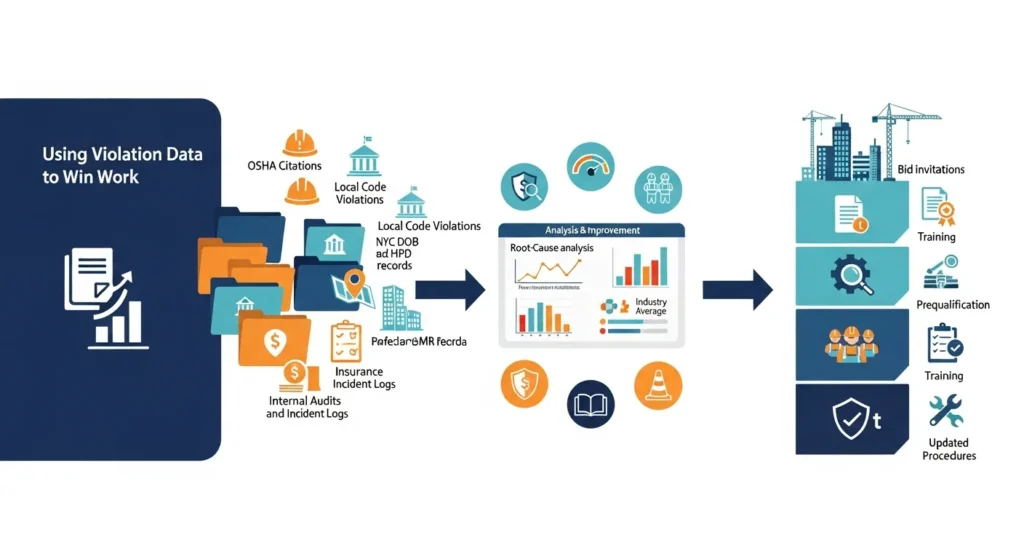
Most contractors treat safety and violation data like a liability file: something we only open when there’s a problem. Owners and GCs don’t see it that way. They’re quietly using that same data to decide who gets invited to bid, who wins the work, and who gets sidelined.
If we flip our mindset, violation data becomes a sales asset. A way to prove we’re reliable, justify our pricing, and separate ourselves from competitors whose paperwork tells a different story.
In this text, we’ll walk through how we can use violation data, OSHA citations, NYC building violations, HPD complaints, insurance records, internal audits, and more, to clean up our risk profile and turn it into something we’re proud to put in front of clients.
Understanding Violation Data And Why It Matters
At its core, violation data is the paper trail of how safely and compliantly we build. It’s broader than just OSHA citations. It’s any record that shows whether we control risk, or let it control us.
What Counts As Violation Data In Construction
For most of us, the list looks like this:
- OSHA citations and inspections – Formal citations, willful/repeat violations, and inspection notes.
- Recordable and lost‑time incidents – OSHA recordables, lost‑time cases, restricted‑duty cases.
- Key safety metrics – EMR (Experience Modification Rate), TRIR (Total Recordable Incident Rate), DART rate.
- Workers’ comp history – Claims, severity, and open reserves.
- Owner/GC internal ratings – Subcontractor scorecards, prequalification scores, punch‑list histories, quality nonconformances.
- Regulatory and code violations – State and local safety agency citations, DOT violations, environmental notices, and building‑code issues.
- Project‑level data – Daily reports, near‑miss logs, toolbox talk records, inspection findings, and corrective actions.
In NYC, that footprint is even bigger. We’re also judged on DOB violations, stop‑work orders, and open HPD complaints, which are publicly accessible and watched closely by sophisticated owners. Tools like the city’s DOB BIS and NOW systems make it easy for anyone to look us up.
The key point: every incident, complaint, or citation we touch is creating a data trail that someone else is already reading.
Key Sources Of Violation Records And Safety Scores
Where does all this information actually live? A few places:
- Regulators
- Federal OSHA and state plans publish inspection and citation data.
- In NYC, the Department of Buildings (DOB) and HPD maintain online records on building safety, violations, and tenant complaints.
- Insurance and risk partners
- Workers’ comp carriers track our claims and calculate our EMR.
- Liability and builder’s risk insurers maintain detailed loss runs, every claim, reserve, and payout.
- Clients and GCs
- Prequalification platforms (like Avetta, ISN, BuildingConnected, or in‑house portals) store our safety stats and past performance.
- Many large owners and GCs now have internal databases scoring subcontractors on safety, quality, and schedule.
- Public property data
- In NYC, owners and contractors can use a NYC violation lookup tool like https://lookup.violationwatch.nyc/lookup or city portals to see building‑level violation histories and HPD complaints.
- Our own systems
- Safety apps, incident logs, daily reports, QA/QC punch‑lists, and audit forms.
If we’re not pulling all of this into one picture, we’re letting others define our reputation without our input.
How Owners, GCs, And Agencies Use Violation Data To Judge You
Large owners and GCs quietly behave like risk analysts:
- They scrape and aggregate public and internal data to rank bidders.
- They track frequency and severity trends – Are our incidents going up or down? Are they minor or serious?
- They look at patterns – Falls, struck‑bys, electrical, rework, repeated DOB violations on similar scopes.
- They watch our corrections – Did we address root causes or just pay fines and move on?
In NYC, some real estate groups look at open DOB and HPD issues on a project before awarding work, because recurring violations signal future schedule risk. Publications like The Real Deal and city databases routinely spotlight repeat offenders.
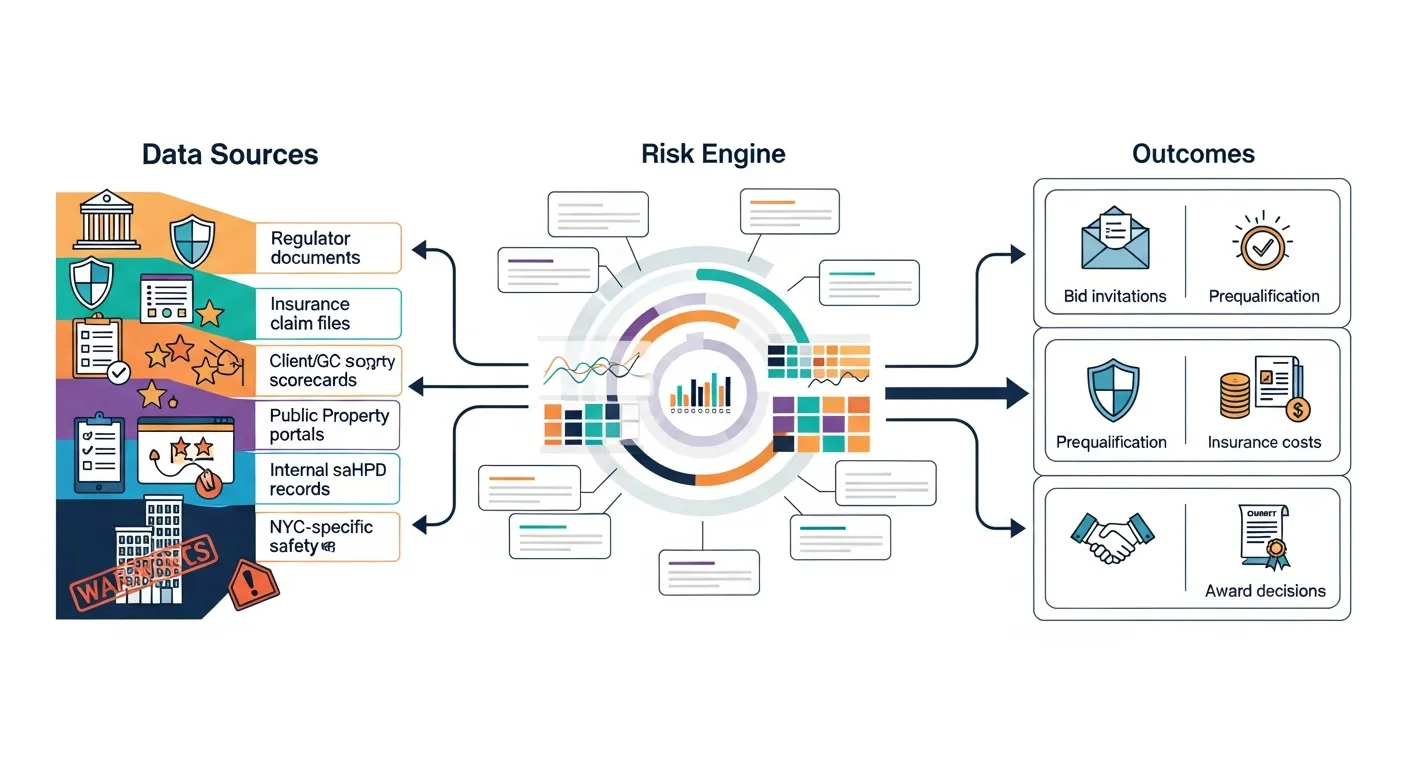
Whether we see it or not, violation data affects:
- Bid invitations – Are we on the “preferred subs” list or the “only in an emergency” list?
- Prequalification decisions – Does our EMR or TRIR trip a hard cutoff?
- Insurance costs – Higher EMR means higher premiums and sometimes lost coverage.
- Award decisions – When two bids are close, the safer, more compliant contractor often wins.
If we don’t actively manage and present this story, someone else will, and we may not like their version.
Auditing Your Current Violation History
Before we can use violation data as a sales tool, we need a clear, accurate picture of where we stand.
How To Access And Review Your Company’s Records
A good internal audit pulls from every source that matters to clients and insurers.
- Start with OSHA and state records
- Look up past inspections and citations for your company name and key supervisors.
- Review citation categories, abatement dates, and any repeat patterns.
- Pull insurer and workers’ comp data
- Ask your broker for a 5‑year loss run and your historical EMR.
- Flag big claims, repeat injury types, and projects with clusters of losses.
- Download client and GC scores
- Log into prequalification portals and export safety data, audit findings, and comments.
- Collect any internal scorecards from repeat clients.
- Mine your own systems
- Incident reports, near‑miss logs, QA/QC defects, safety audits, and toolbox talk records.
- Project meeting minutes where safety or compliance issues were raised.
- Add local and building‑level data
- For NYC work, we should audit building‑specific risk too: active DOB violations, stop‑work orders, and HPD complaints.
- Owners and managers can use ViolationWatch (https://violationwatch.nyc/) to centralize property violations, then share risk expectations with us before we mobilize.
Once we’ve gathered everything, we want one consolidated view, ideally in a spreadsheet or BI dashboard, so we can see trends, not just one‑off events.
Prioritizing The Issues That Hurt You Most
Not all violations carry the same commercial impact. A missing ladder tag isn’t the same as a fall from height.
We generally prioritize by:
- Severity – Serious injuries, life‑safety issues, structural concerns, or environmental releases.
- Visibility – Items that show up in public databases or client dashboards (OSHA willful, DOB Class 1 violations, HPD heat/hot water complaints on a high‑profile building).
- Repeat patterns – Same type of incident on multiple jobs, or the same corrective action left open for months.
- Client sensitivity – Issues on flagship projects or with marquee owners.
A practical approach: create a short list (10–20 items) of the violations or trends that most damage our credibility, then document what we’ve already done, and what’s still missing, to fix them.
Benchmarking Against Competitors In Your Market
To turn data into an advantage, we need context. An EMR of 0.90 may be excellent in one trade and mediocre in another.
We can:
- Compare our TRIR, DART, and EMR to industry averages published by BLS or our trade association.
- Ask our broker where we stand relative to similar contractors in our region and size.
- For NYC, look at how often competitors appear in DOB enforcement actions or media coverage about unsafe sites.
If we’re better than average, that’s a story for proposals. If we’re behind, the gap becomes our roadmap for improvement, and our narrative once we start closing it.
Turning Violation Data Into A Competitive Advantage
Once we understand our violation history, the next step is to convert those lessons into better operations, and then into a better sales story.
Fixing Root Causes, Not Just Individual Violations
Paying fines and updating a single form after each incident is the fastest way to stay on a hamster wheel.
Instead, we can treat every major violation as a case study in root cause:
- Was the issue really a “worker error,” or did planning fail?
- Were means and methods rushed because of schedule pressure?
- Did supervision or staffing fall short?
- Were subcontractors unclear on expectations?
Use tools like 5 Whys or fishbone diagrams to connect each violation back to planning, supervision, equipment, training, or culture. Then carry out fixes that apply across multiple projects, not just the one where we got caught.
Clients don’t expect perfection. They expect us to learn visibly from problems and prevent repeats.
Improving Safety Culture And Field Practices
Violation data often exposes cultural issues: shortcuts tolerated, near‑misses ignored, PPE seen as optional.
We can respond by:
- Making field leaders accountable for safety metrics, not just production.
- Running short, focused toolbox talks built around our actual incidents, not generic slides.
- Encouraging near‑miss reporting with positive reinforcement instead of blame.
- Doing joint walk‑throughs with supers, foremen, and even owners’ reps.
In dense markets like NYC, where enforcement is high and neighbors are watching, a visible safety culture is a differentiator. Owners dealing with NYC building violations and HPD complaints want contractors who make them look good in the eyes of regulators and tenants.
Updating Policies, Training, And Documentation
Our written program is what prequalification teams see first, and they use it to guess how we’ll behave in the field.
Based on our audit, we should:
- Update safety plans to explicitly address the violation patterns we’ve seen (fall protection, housekeeping, public protection, noise, after‑hours work, etc.).
- Refresh project‑specific Site Safety Plans, especially for DOB‑regulated sites.
- Align our training matrix with real risks, e.g., scaffold user training, rigging, silica, confined space.
- Document corrective actions: new procedures, supervision changes, equipment upgrades.
When an RFP asks, “Describe how you have responded to past incidents,” we want to point to specific policy and training changes, not vague statements about “reinforcing expectations.” That specificity separates serious contractors from those just checking boxes.
Using Violation Trends To Sharpen Your Bids
Violation data doesn’t just help us look better, it should influence what work we chase, how we price it, and how we plan to execute.
Selecting Projects Where Your Record Gives You An Edge
If we analyze a few years of incidents and violations by project type, we usually see patterns:
- Maybe our record is strong on interior build‑outs but weaker on high‑rise exterior work.
- Maybe we struggle on tight urban sites with heavy public interface, but excel on greenfield projects.
- Maybe DOB violations spike when we work above active tenants.
That information should shape our marketing and go/no‑go decisions. We can:
- Lean into project types and scopes where our violation rate is lower than peers.
- Avoid or partner on scopes where we’ve historically had trouble, unless we’ve clearly changed our approach.
Owners notice when we speak honestly about our strengths and limits. It builds trust.
Pricing Risk Accurately To Avoid Margin Erosion
Violations are expensive, even when fines are small:
- Work stoppages and rework kill margin.
- Insurance deductibles and EMR increases hit multiple years of premiums.
- Extra supervision and design changes added mid‑job erode profit.
By looking at past projects, we can quantify hidden costs of risk. Then we can:
- Adjust our contingency for high‑risk scopes or sites.
- Justify higher pricing to clients by showing how we’ll reduce the risk of delays, change orders, and enforcement actions.
- Offer options: a base price with standard controls, and an alternate with enhanced protections (e.g., better protection for neighbors, more off‑hours work, extra monitoring).
Owners focused on NYC property compliance often accept a premium if we can credibly argue it means fewer DOB violations and tenant disruptions.
Designing Safer Means And Methods In Your Proposals
Violation trends are a blueprint for smarter means and methods.
For example:
- If we repeatedly received overloading citations on scaffolds, we can propose a different access system or stricter loading controls.
- If waste and housekeeping citations were common, we can propose more frequent carting, dedicated laborers, and better material staging.
- If prior jobs triggered numerous HPD complaints about noise or dust, we can plan quieter equipment, better dust control, and more communication with tenants.
We don’t have to share all our past mistakes in the proposal. Instead, we talk about what we’ve learned and the controls we now design in from day one. That level of specificity often wins tie‑breakers in competitive bids.
Showcasing Your Safety Record In Prequalification And Bids
Once we’ve cleaned up our data and improved our practices, we need to present that story clearly. Safety and compliance should be part of our value proposition, not just a form to fill out.
Highlighting Improvements And Corrective Actions
A lot of contractors are afraid to mention past violations. The reality: large owners already know. What they don’t know is what we did next.
We can:
- Show a timeline: “In 2021 our TRIR was X. After implementing A, B, and C, it’s now Y.”
- Call out major changes tied to specific incidents, new fall‑protection program, new rigging procedures, new QA checks.
- Emphasize closure: all OSHA citations abated, all serious DOB violations resolved, corrective actions tracked to completion.
When we address risk head‑on, prequal reviewers see us as honest and mature, not defensive.
Using Charts, Dashboards, And Metrics That Decision‑Makers Trust
Decision‑makers are flooded with claims like “safety is our #1 priority.” We stand out when we show data, not slogans.
Useful visuals include:
- Year‑over‑year TRIR and DART compared to industry averages.
- EMR trend over 3–5 years.
- Count of OSHA/DOB violations per 10,000 work hours.
- Time to close corrective actions.
- For NYC clients: charts showing declining building‑level issues on our projects, fewer DOB violations and faster resolution of tenant complaints.
We can embed simple charts in SOQs, RFP responses, and interview slide decks. Even a basic Excel chart, clearly labeled, beats text-heavy safety sections.
Crafting Safety Narratives For RFP Responses And Interviews
Most RFPs ask some version of: “Describe your safety program and how you manage risk.” This is where we tie everything together.
A strong narrative usually:
- Acknowledges reality – We operate in risky environments: incidents happen.
- Explains evolution – We show how specific past issues changed our planning, training, and supervision.
- Connects to the client’s project – We highlight the particular violation and complaint risks they face, then explain our controls.
For example, in a NYC residential rehab RFP, we might write:
“On prior occupied renovations, we saw an increase in HPD complaints around noise and dust. In response, we developed a tenant‑communication plan, upgraded dust control, and added evening inspections. On our last three similar projects, HPD complaints dropped by 60% and we had zero DOB violations related to tenant protection.”
That level of specificity helps clients feel we’ll protect them, regulators, neighbors, and tenants included.
Collaborating With Owners And GCs To Reduce Violations On Their Projects
The contractors who win repeat work treat violation data as a shared problem with owners and GCs, not a blame game.
Using Past Violation Data To Propose Job‑Specific Controls
Before kickoff, we can sit down with the owner/GC and look at:
- Their past DOB and HPD issues on similar buildings.
- Our own incidents on comparable scopes.
- Neighborhood complaints and political sensitivities.
Then we propose targeted controls:
- Additional public‑protection measures on tight NYC sidewalks.
- Clear sequences to avoid after‑hours noise violations.
- Early outreach to tenants to reduce HPD complaints about access, dust, and services.
If the owner or manager already uses a service like ViolationWatch to track their portfolio, we can ask for access to project‑specific data so we align our controls with their risk priorities.
Negotiating Contract Language Around Safety And Compliance
Contract language can either help us manage risk, or set us up to fail.
We can negotiate:
- Clear responsibilities for DOB filings, permits, and tenant‑protection plans.
- Realistic schedule allowances for inspections and abatement work.
- Shared protocols for incident reporting and regulatory notifications.
When we bring violation data to the table, “On similar projects, inspections typically take X days and generate Y comments”, we’re not just asking for concessions. We’re showing we’ve done our assignments and protecting everyone’s schedule.
Turning Joint Safety Wins Into Case Studies And References
Every project where we reduce incidents and violations is a marketing asset.
After closeout, we can:
- Compile before/after stats: prior projects vs. this job’s incidents, DOB violations, and complaints.
- Ask the owner/GC for a short testimonial focusing on safety and compliance.
- Turn that into a one‑page case study for future RFPs.
Over time, these proof points become more persuasive than any slogan. When a risk‑averse owner sees multiple projects with demonstrably lower violations, our bid rises to the top, even if we’re not the cheapest number on the table.
Leveraging Technology To Monitor And Reduce Violations
Staying ahead of violations manually is almost impossible, especially in busy urban markets. Technology lets us spot problems early and respond before regulators or neighbors do.
Digital Inspections, Incident Reporting, And Analytics
Paper checklists buried in job trailers don’t help us win work. Digital tools do.
We can:
- Use mobile apps for daily safety inspections and QA/QC walks.
- Log incidents and near‑misses in real time, with photos and locations.
- Track open corrective actions and send automatic reminders.
- Aggregate data by project, superintendent, trade, or client.
With even basic analytics, patterns jump out: which crews have frequent housekeeping issues, which sites trend toward public complaints, which subs routinely trigger enforcement.
Using Predictive Insights To Prevent Repeat Violations
Once we have data in one place, we can start to predict where violations are most likely.
Examples:
- If we know that the first two weeks of a schedule acceleration are when falls spike, we can flood the site with supervision and training during that window.
- If weekend work has historically produced noise complaints, we plan extra notifications and monitoring before those shifts start.
In NYC, property owners and managers are increasingly using building violation alerts to stay ahead of DOB and HPD issues. The same mindset helps us. Get instant alerts whenever your building receives a new violation, sign up for real-time monitoring with building violation alerts so we can coordinate our response before it snowballs into delays.
Integrating Field Feedback Loops For Continuous Improvement
Technology only works if field teams feel heard.
We should:
- Make it easy for crews to flag hazards, design flaws, or unworkable methods through apps or quick forms.
- Close the loop by showing what changed because of their feedback.
- Share lessons learned across projects, “Here’s how we avoided a repeat DOB violation on a sister job.”
Over time, this feedback loop shrinks the gap between “what the manual says” and “what actually works,” which is exactly what sophisticated clients want to see.
Common Mistakes Contractors Make With Violation Data
Even well‑intentioned contractors fall into patterns that quietly hurt their win rate.
Underreporting, Hiding, Or Ignoring Negative Records
Trying to bury incidents or violations is tempting, and dangerous.
- Regulators, insurers, and large owners usually find out anyway.
- Underreporting distorts our own data, so we don’t learn from near‑misses.
- If a client discovers we hid a serious issue, the trust damage is worse than the original event.
It’s better to own the record, show our corrective actions, and demonstrate how performance has improved.
Overreacting To One Event Instead Of Long‑Term Patterns
Another trap is reorganizing our entire program around a single high‑profile incident, while ignoring the quieter trends.
We’ve seen companies pour resources into fall protection after one accident, while ongoing electrical or housekeeping issues continue untouched.
The fix is to weigh both:
- Treat serious incidents with urgency.
- Still analyze multi‑year data to see what risks are actually driving most violations, costs, and downtime.
Failing To Communicate Improvements To Clients
We can do a lot of good work, new training, better supervision, fewer violations, and then forget to tell anyone.
Owners and GCs aren’t inside our safety meetings. If we don’t:
- Update our prequalification packages,
- Refresh our proposal boilerplate, and
- Highlight changes in interviews,
then our win rate won’t reflect the progress we’ve made.
This is where tools that centralize violation data for properties, like ViolationWatch, can help owners see the impact of our work over time, especially on portfolios with a history of NYC building violations and HPD complaints.
Conclusion
Violation data isn’t going away. Regulators are getting more transparent, owners are getting more data‑driven, and insurers are tightening underwriting. The question for us as contractors is whether we let that data work against us, or turn it into evidence that we’re the safest, most reliable choice on the shortlist.
If we:
- Audit our full record, OSHA, DOB violations, HPD complaints, insurance, and internal logs.
- Fix root causes and modernize our culture, training, and documentation.
- Use trends to choose the right projects and price risk honestly.
- Present our improvements with clear metrics, visuals, and case studies,
we can turn what used to be an uncomfortable file drawer into one of our strongest sales tools.
In NYC and other data‑rich markets, this starts with visibility. For free lookups, use our NYC violation lookup tool to see how regulators view your buildings and projects today. Then, if you manage a portfolio or regularly build in the city, consider setting up building violation alerts so you’re never surprised by a new issue.
We win more work, better work, when we show clients that we don’t just react to violations. We study them, learn from them, and build safer, more compliant projects as a result. That’s a story owners, GCs, and lenders are willing to pay for.
Key Takeaways
- Contractors who treat violation data as a sales asset instead of a liability can use it to win more jobs, justify pricing, and stand out from competitors.
- A full audit of OSHA citations, insurance records, NYC building violations, HPD complaints, and internal safety logs is the foundation for understanding your true risk profile.
- Focusing on root causes, safety culture, and targeted policy and training updates turns violation data into measurable improvements that owners and GCs can see and trust.
- Using violation data trends to choose project types, price risk accurately, and design specific means and methods helps contractors align bids with their real strengths.
- In prequalification and RFPs, clear metrics, charts, and case studies that show reduced violations and complaints make your safety record a persuasive differentiator.
- In data‑rich markets like NYC, tools such as violation lookups and building violation alerts let contractors and owners monitor issues in real time and collaborate to prevent repeat violations and secure more work.
Frequently Asked Questions
What is violation data in construction and why does it matter for contractors?
Violation data is the record of how safely and compliantly you build: OSHA citations, EMR, TRIR, DOB violations, HPD complaints, insurance losses, client scorecards, and internal audits. Owners, GCs, regulators, and insurers quietly use this violation data to decide who gets invited to bid, wins work, and pays higher premiums.
How can contractors use violation data to win more jobs instead of losing them?
Contractors can audit their full violation history, fix root causes, and then use improving trends in EMR, TRIR, DOB violations, and HPD complaints as proof of reliability. Presenting charts, timelines, and job‑specific controls in prequalification and proposals turns violation data into a sales asset instead of a liability.
How do I review my company’s violation data and safety scores?
Start by pulling OSHA and state inspection records, five‑year loss runs and EMR from your broker, and safety stats from prequalification platforms. Add internal incident logs, audits, and daily reports. In NYC, include DOB and HPD histories. Consolidate everything in a spreadsheet or dashboard to see trends and priority issues.
How does NYC violation data like DOB and HPD records affect construction bids?
In NYC, owners and GCs often check DOB violations, stop‑work orders, and HPD complaints before awarding work. Recurring issues signal future schedule, neighbor, and tenant risk. Contractors with fewer, faster‑resolved NYC building violations and complaints are more likely to make preferred‑bidder lists and justify stronger pricing.
What is the best way to use an NYC violation lookup tool as a contractor?
Use an NYC violation lookup tool or city portals to review building‑level DOB violations and HPD complaints before bidding or mobilizing. Share findings with owners, propose targeted controls for common issues, and track closure of open items. This proactive approach helps prevent surprises, enforcement delays, and strained client relationships.
Can improving my EMR and TRIR really help me win more construction work?
Yes. Many large owners and GCs set hard EMR or TRIR cutoffs in prequalification. A declining EMR and lower‑than‑average TRIR reduce insurance costs and signal better risk control. When you show multi‑year improvements with clear corrective actions, those metrics can be a key tie‑breaker in competitive selections.