
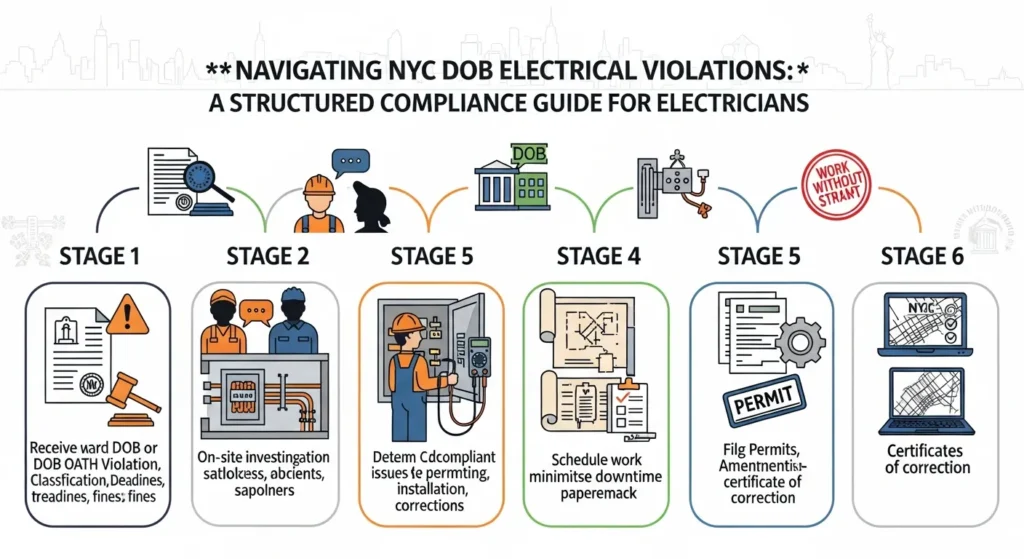
In New York City, electrical work doesn’t really end when we pull our last wire or land the final breaker. It ends when the Department of Buildings (DOB) is satisfied, the paperwork is clean, and there are no open NYC building violations hanging over the property.
When we get hit with a DOB electrical violation, it’s more than an annoyance. It can stop a project, trigger OATH hearings and fines, damage relationships with clients, and even raise questions with insurers and licensing officials. The good news: if we treat violations as a structured process, not a fire drill, we can protect our business and our reputation while getting the building back into full NYC property compliance.
In this guide, we’ll walk through how we, as electricians working in NYC, should handle DOB violations related to electrical work, from understanding the notice, to fixing the underlying issues, to preventing repeat problems on future jobs.
Understanding DOB Electrical Violations
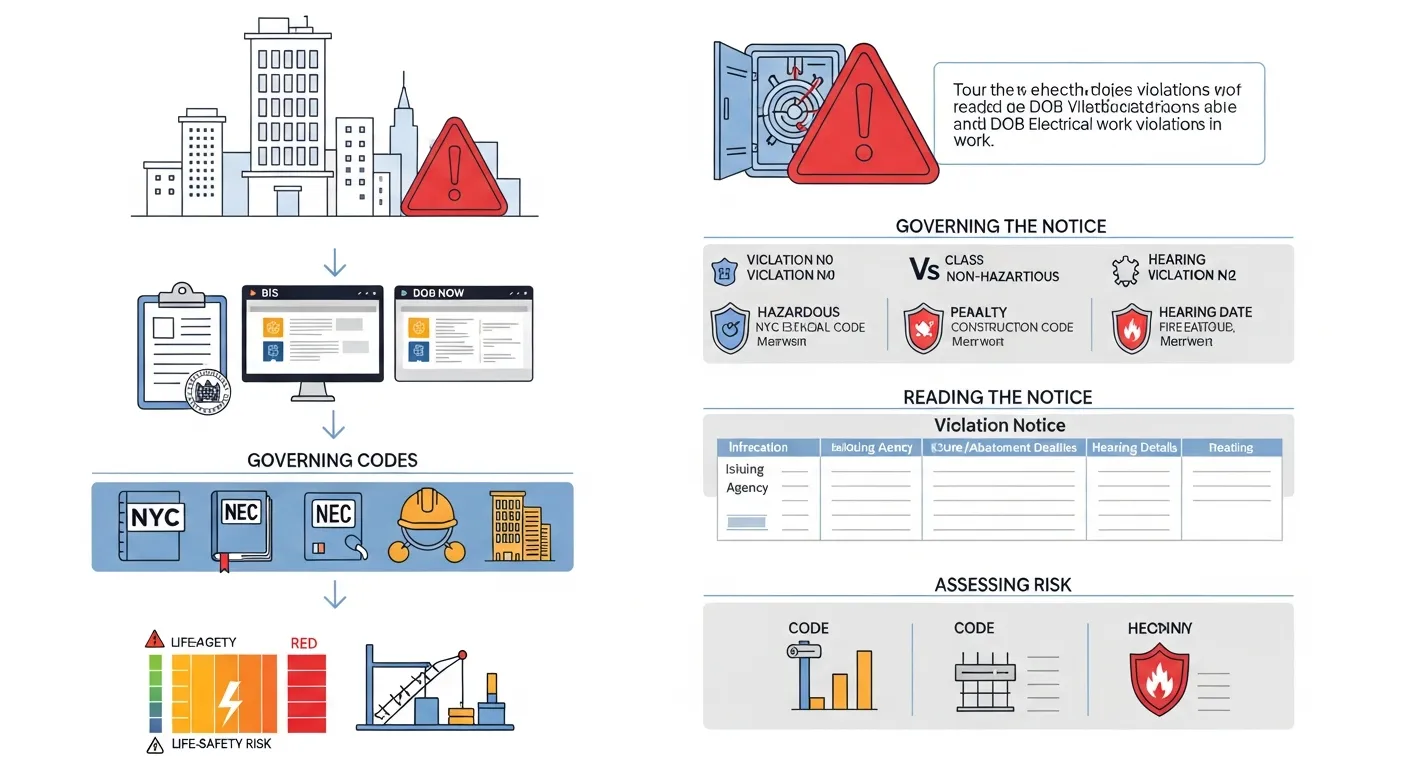
What Is A DOB Electrical Violation?
A DOB electrical violation is an official notice from the New York City Department of Buildings that some part of the electrical work or existing electrical system does not comply with the NYC Electrical Code, related Construction Codes, or permit and inspection requirements.
In practical terms, that usually means one of two things:
- The work wasn’t filed or permitted properly, or
- The installation itself doesn’t meet code or approved plans.
Violations can show up as DOB violations in the Buildings Information System (BIS) and as OATH summonses (formerly ECB). They follow us and the property until they’re corrected and closed, and they can block new permits and sign-offs.
Key DOB Codes And Standards Electricians Must Know
We don’t need to memorize every subsection, but we do have to know what governs our work:
- NYC Electrical Code – Based on NFPA 70 – National Electrical Code (NEC), with specific NYC amendments.
- NYC Construction Codes – Including Building, Fire, and Energy Codes that affect things like equipment rooms, fire alarms, emergency power, and clearances.
- DOB Rules and Bulletins – Filing requirements, inspections, and enforcement policies.
The DOB’s Electrical Code resources and local laws are published on the city’s site: NYC DOB – Electrical Code.
If we’re working on life-safety systems, fire alarms, emergency lighting, generators, we’re also touching requirements enforced by the Fire Department and other agencies. Those crossovers are where violations often get more serious.
How To Read And Interpret The Violation Notice
We can’t fix what we don’t fully understand, so the first move is to dissect the violation itself. Key items to note:
- Violation or summons number
- Issuing agency – DOB unit, or OATH summons
- Infraction code and description – e.g., “B309 – Electrical work without a permit”
- Class of violation – immediately hazardous vs. non-hazardous
- Cure/abatement date – deadline to correct to avoid higher penalties
- Hearing date and location – if there’s an OATH hearing required
- Penalty range – minimum/maximum potential fines
We then confirm status and history in BIS or DOB NOW (depending on the building and filing) to see:
- Prior related violations
- Open permits or stop-work orders
- Whether the property has a history of repeated DOB violations in the same area
Assessing Risk: Safety, Fines, And Work Stoppages
Once we know what we’re dealing with, we have to size up the risk:
- Life-safety risk – Is there a real possibility of shock, fire, or equipment failure? Overloaded panels, missing grounding, and unprotected conductors go to the front of the line.
- Stop-work exposure – Some violations trigger or support a stop-work order, which can shut down entire projects.
- Fine and penalty exposure – OATH fines plus DOB administrative penalties, especially for work-without-permit cases, can add up fast.
- Impact on permits and sign-offs – Open electrical violations can block new permits, final inspections, Certificates of Occupancy, and closings.
We also pay attention to whether the violation overlaps with HPD complaints or Housing Maintenance Code issues for residential properties. A building with HPD complaints and DOB electrical violations is already on multiple agencies’ radar, which can mean tighter scrutiny on everything we do. For reference, HPD’s complaint and violation info is public via the NYC HPD website.
Common Types Of Electrical DOB Violations
Permit-Related Violations
Permit problems are some of the most common DOB violations we see:
- Electrical work without a permit (e.g., B309)
- Work started under one permit but expanded well beyond the original scope
- Expired permits where work continued
- Work filed under the wrong property or BIN
Often, an owner or GC pushes for “just a small change,” and over time that “small change” grows into a full system modification with no proper filing. When DOB inspects, sometimes triggered by neighbor complaints or other NYC building violations, this is where we get burned.
Installation And Workmanship Violations
These violations focus on the actual installation:
- Exposed or unsupported wiring
- Wrong conductor sizes or improperly sized overcurrent protection
- Inadequate working clearances in front of panels
- Missing or improper grounding and bonding
- Overcrowded raceways or overfilled junction boxes
- Use of unapproved or non-listed equipment
This is where familiarity with the NYC amendments to the NEC really matters. What might pass in another jurisdiction won’t necessarily pass here.
Inspection, Maintenance, And Documentation Violations
Even when the physical work is solid, we can still get hit for paperwork and follow-through:
- Work completed but never scheduled for inspection
- Failure to submit required test reports or forms
- Missing as-built drawings for critical systems
- Open violations never closed out properly in DOB systems
On larger projects, these issues can block NYC property compliance milestones such as TCO or final CO.
Safety-Related Violations With High Liability
Some violations carry outsized liability because they’re directly tied to fire and shock risks:
- Overloaded circuits or panels
- Extension cords used as permanent wiring
- Missing GFCI or AFCI protection where required
- Unsafe or obsolete panels
- DIY or “handyman” wiring buried in walls or ceilings
These are the ones that can come up later in litigation or insurance disputes after an incident. How we respond, and how thoroughly we document our corrective work, matters just as much as the fix itself.
Immediate Steps To Take When You Receive A DOB Violation
Communicating With The Client And Other Stakeholders
As soon as we receive a DOB electrical violation, we move on two tracks at the same time: technical and communication.
On the communication side, we:
- Notify the owner, property manager, or GC right away.
- Explain, in plain language, what the violation means and what the deadlines are.
- Outline immediate safety actions, temporary shut-downs, barricading, signage.
- Discuss access needs for our assessment and eventual corrective work.
- Flag possible service interruptions and budget impact.
We also confirm whether anyone else, another contractor, building staff, or a previous electrician, has already been contacted by DOB or OATH. Confusion here leads to duplicated work and finger-pointing later.
On the technical side, we:
- Read the notice in full and log cure/hearing dates.
- Stabilize any obvious hazards (locking out a panel, isolating a circuit, posting warnings).
- Decide quickly whether this is administrative only (e.g., missing filing) or if it also involves an OATH summons that needs formal representation and evidence.
This early clarity helps us keep the client calm and focused, which is often half the battle.
Investigating The Root Cause Of The Violation
On-Site Assessment And Testing
Our investigation starts on the ground, not on a laptop.
We walk the site with the violation in hand and verify:
- Every relevant panel, feeder, and branch circuit
- Equipment rooms and closets, including clearances and access
- Grounding and bonding jumpers
- Device locations (GFCI, AFCI, tamper-resistant devices where required)
- Equipment approvals and listing marks
Then we perform targeted testing as needed:
- Continuity and insulation resistance tests
- Load measurements on heavily used circuits
- GFCI/AFCI functional tests
- Fault-current checks where coordination is an issue
We document everything, photos, notes, and any test results, because that package becomes the backbone of our corrective plan and, if needed, our OATH defense.
Reviewing Plans, Permits, And Past Work
Next, we compare what’s in the field to what’s on paper:
- Approved drawings vs. actual installation
- Original scope vs. current conditions
- DOB permit and inspection records (BIS, DOB NOW)
We look for:
- Work that was added but never revised on the plans
- Permits that were never closed out
- Old violations tied to the same area of work
This is also where we double-check whether the violation might be linked to a broader pattern of NYC building violations or previous enforcement actions on the property.
Determining Responsibility: Your Work vs. Others’ Work
One of the hardest but most important steps is defining who owns what.
We separate our contracted scope from:
- Work performed by prior electricians
- Owner-performed or “super did it” wiring
- GC-directed changes that never made it to revised plans
We’re honest with clients here. If the issue came from our work, we say so and propose a clear path to correction. If it stems from legacy conditions or other contractors, we document that and structure our proposal accordingly.
This isn’t just about fairness. It’s also about risk management. Taking responsibility for someone else’s unpermitted mess without clear documentation and contract language is a quick way to inherit their liability.
Developing A Corrective Action Plan
Designing Code-Compliant Repairs Or Modifications
Once we understand the real problem, not just the sentence on the violation, we design a fix that’s clean, code-compliant, and properly documented.
That plan might include:
- Reworking circuits to meet conductor sizing and overcurrent rules
- Replacing panels or adding subpanels to reduce overloading
- Bringing grounding, bonding, or GFCI/AFCI protection up to current code
- Legalizing existing unpermitted work through proper filings and inspections
We design to current NYC Electrical Code requirements unless DOB explicitly allows a different approach for existing installations.
Scheduling Work To Minimize Disruption And Downtime
Clients care about compliance, but they also care about staying open. We plan the work to minimize impact:
- Off-hours or weekend shutdowns for panel or feeder work
- Phased work in occupied areas
- Temporary power solutions where critical loads can’t go dark
We explain that getting back into NYC property compliance sometimes means short-term disruption, but careful scheduling and communication can keep operations largely intact.
Estimating Costs And Explaining Options To The Client
We put numbers to the plan with a detailed estimate that:
- Separates minimum code-compliant fixes from optional upgrades
- Clearly flags exclusions (e.g., opening finished walls beyond specific areas)
- Identifies any likely change-order triggers, like concealed conditions
Where there’s flexibility, we outline options:
- A narrow scope to just address the violation
- A broader modernization that reduces future risk and maintenance issues
For clients managing multiple properties, or who are already watching several NYC building violations across their portfolio, we sometimes recommend proactive monitoring. Get instant alerts whenever your building receives a new violation, sign up for real-time monitoring using building violation alerts so nothing falls through the cracks again.
Working With The DOB To Resolve The Violation
Filing Required Paperwork, Permits, And Amendments
Even the best corrective plan goes nowhere without the right filings. Depending on the violation, we may need to:
- File new electrical permits for the corrective work
- Submit amendments to existing filings to match as-built conditions
- Prepare and file Certificates of Correction (e.g., AEU2 forms) with photos, invoices, test reports, and affidavits
Accuracy matters. Sloppy or incomplete documentation is a common reason NYC building violations stay open longer than they should.
In some cases, we’ll also prepare for an OATH hearing, gathering:
- Before-and-after photos
- Proof of correction and inspections
- Evidence clarifying who performed the original work
When appropriate, we present that to seek fine reductions or dismissals.
Preparing For Re-Inspection
Before we invite DOB back, we make sure the field matches the paperwork:
- All corrective work completed, labeled, and accessible
- Panels and junction boxes opened where the inspector will need access
- Keys, escorts, and security cleared in advance
We treat re-inspections like we treat final inspections on large jobs: no surprises, no “we’ll fix that after you leave.”
Following Up After Resolution And Keeping Records
After the work passes inspection and the violation is marked resolved or dismissed in BIS or DOB NOW, we’re not quite done.
We:
- Screenshot or print status pages showing closure
- Retain copies of permits, inspection sign-offs, and Certificates of Correction
- Store photos and test reports in our project files
Long-term, these records are invaluable when questions come up from insurers, future buyers, or agencies.
For owners and managers, it’s also smart to centralize compliance monitoring. For free lookups, use our NYC violation lookup tool to see open DOB violations, and consider ongoing tracking so nothing quietly reappears down the line.
Preventing Future DOB Electrical Violations
Implementing Better Planning And Documentation
Prevention starts before we ever step on site.
We build compliance into our process by:
- Confirming early whether the proposed work is permit-required or exempt
- Coordinating with design professionals and expediters on complex projects
- Making sure drawings actually reflect what’s being built, and updating them when scope changes
On multi-building portfolios, we encourage clients to use tools like ViolationWatch to keep an eye on NYC building violations across their entire portfolio instead of property by property.
Standardizing Internal Quality And Safety Checks
We can dramatically reduce risk with simple, repeatable checks:
- Pre-inspection checklists for panels: clearances, labeling, torque, and dead-fronts
- GFCI/AFCI and ground-fault testing logged before DOB inspections
- Verifying support and protection of all raceways and cables
- Confirming that all devices and equipment are listed, labeled, and approved
This kind of structure turns “hope we pass” inspections into “we already know we’re ready.”
Training Your Team On DOB Requirements
Our team is only as compliant as the least-informed person in the field.
We invest in:
- Regular code update sessions focused on NYC amendments, not just generic NEC
- Walkthroughs of real violation cases we’ve handled, what went wrong, how we fixed it
- Training on DOB processes: when and how to pull permits, what triggers inspections, what inspectors actually look for
This is especially important for foremen who make day-to-day decisions that can quietly drift away from the approved plans.
Contract Language And Client Education
A lot of violations trace back to scope creep and DIY surprises. We address that on paper and in conversations.
In our contracts, we:
- Require owners to disclose existing violations and known unpermitted work
- Clarify who is responsible for legalizing prior non-compliant conditions
- Include clauses for extra costs if we uncover serious code issues behind walls or ceilings
With clients, we’re direct: unpermitted work and “friend of a friend” wiring might feel cheaper in the short term, but it’s exactly what leads to DOB violations, failed closings, and insurance headaches later.
For those who want to stay ahead of enforcement, we recommend they set up building violation alerts tied to their properties so they’re notified any time a new violation hits the system.
Legal And Business Implications For Electricians
Fines, Penalties, And Insurance Considerations
From a business perspective, DOB and OATH penalties aren’t trivial line items.
We may face:
- OATH fines for each summons, which can escalate for repeat offenses
- DOB administrative penalties, especially in work-without-permit cases
- Additional costs when cure dates are missed or when violations drag on
Insurers pay attention, too. If electrical work is found to be unpermitted or non-code-compliant after a fire or shock incident, carriers may:
- Dispute or limit coverage
- Push back on claims
- Reassess premiums or terms at renewal
Clear records showing that we corrected issues and brought systems into compliance can be a major asset during those conversations.
For general background on how DOB enforcement works, it’s useful to review the city’s own guidance at NYC OATH – ECB / Violations.
Impact On Licensing, Reputation, And Future Work
Repeated or serious violations don’t just cost money. They can:
- Draw unwanted attention from DOB to all of our projects
- Affect how comfortable GCs and owners feel hiring us
- Show up in public records that competitors may quietly use against us
In a market as tight as NYC, our track record on NYC property compliance is part of our brand. Owners managing multiple buildings, often already juggling HPD complaints, DOB violations, and other enforcement, want electricians who solve problems without creating new ones.
When To Consult An Attorney Or Compliance Specialist
Most routine violations we can handle ourselves with solid documentation and good field work. But there are clear situations where we should bring in outside help:
- Large or escalating penalties
- Allegations of willful or repeat violations
- Cases that threaten our electrical license or the owner’s ability to secure financing
- Complex responsibility disputes between multiple contractors, owners, and managing agents
In those scenarios, a construction attorney or DOB compliance specialist can:
- Help structure our response and evidence for hearings
- Negotiate penalty reductions or settlements
- Advise on long-term strategies to keep our license and business protected.
Conclusion
DOB electrical violations are part of doing business in New York City, but they don’t have to derail our projects or define our reputation.
When we respond with a clear process, understand the notice, stabilize safety, investigate the real cause, design a compliant fix, file correctly, and document everything, we turn a potential crisis into a controlled, professional service.
Long term, the electricians who thrive in this city aren’t just good with wire and pipe. We’re good with NYC building violations, DOB procedures, and client education. We build compliance into our workflow, train our teams, and help owners keep their portfolios clean.
If we want a simple way to stay ahead of problems across multiple addresses, we can lean on tools designed for exactly that. For free lookups on open issues, we can always turn to the NYC violation lookup tool, and for ongoing protection, set up building violation alerts so we’re never surprised by a new notice again.
Handled correctly, DOB violations become less of an emergency, and more of a structured part of how we deliver safe, compliant, and trustworthy electrical work in New York City.
Key Takeaways
- Treat DOB electrical violations as a structured process—understand the notice, assess safety and fine exposure, and verify the property’s history in BIS or DOB NOW before you act.
- Start by stabilizing any immediate hazards, clearly communicating timelines and risks to the client, and determining whether the DOB violation is administrative, technical, or tied to an OATH hearing.
- Investigate the root cause with a thorough field walk-through, testing, and plan review so you can separate your contracted work from legacy or third-party issues and avoid inheriting unnecessary liability.
- Develop a clear corrective action plan that brings the installation up to current NYC Electrical Code, pulls proper permits, files Certificates of Correction, and prepares for DOB re-inspection with complete documentation.
- Protect your business long term by standardizing internal quality checks, training your team on NYC-specific DOB requirements, tightening contract language around unpermitted work, and using NYC violation lookup tools and building violation alerts to stay ahead of new DOB violations.
- Recognize when serious or repeat DOB electrical violations require help from a construction attorney or compliance specialist to manage penalties, protect your license, and safeguard insurance and reputation.
Frequently Asked Questions About DOB Electrical Violations
What is a DOB electrical violation for NYC electricians?
A DOB electrical violation is an official notice from the NYC Department of Buildings that electrical work or an existing system does not comply with the NYC Electrical Code, Construction Codes, or permit requirements. It can block permits and sign-offs, trigger OATH hearings, and lead to fines until fully corrected and closed.
How should electricians handle DOB violations related to electrical work step by step?
Electricians should first read the DOB violation notice carefully, confirm status in BIS or DOB NOW, stabilize any safety hazards, communicate clearly with the owner or GC, investigate field conditions and permits, design a code-compliant corrective plan, file required permits and Certificates of Correction, then prepare for and pass DOB re-inspection.
What are the most common DOB electrical violations electricians see in New York City?
Common DOB electrical violations include electrical work without a permit, expanded work beyond the approved scope, expired permits, exposed or unsupported wiring, improper conductor sizing or overcurrent protection, inadequate panel clearances, missing grounding or bonding, use of unlisted equipment, and completed work that was never inspected or properly closed out in DOB systems.
Can an electrician help reduce fines or dismiss a DOB violation at an OATH hearing?
Yes. An electrician can support fine reductions or dismissal by providing strong documentation: before-and-after photos, test results, permits, inspection sign-offs, and proof of who performed the original work. For major penalties, repeat DOB violations, or license risk, it’s wise to work with a construction attorney or DOB compliance specialist.
What is the best way for electricians and owners to prevent future DOB electrical violations?
Prevention starts with always pulling required electrical permits, keeping drawings aligned with field work, and updating filings when scope changes. Standardized quality checklists, regular NYC Electrical Code training for field staff, clear contract language about unpermitted conditions, and using tools like building violation alerts all help avoid new DOB violations and surprise enforcement.