
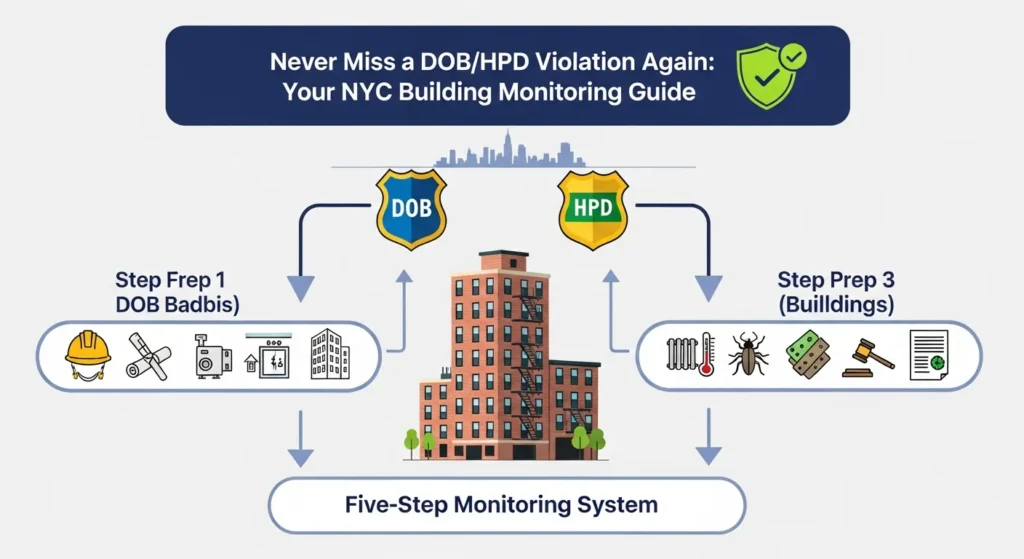
In New York City, a single unnoticed DOB or HPD violation can quietly snowball into thousands of dollars in penalties, emergency repair liens, and even housing court. Most of us managing buildings aren’t ignoring compliance on purpose, we’re just buried under addresses, portals, and scattered emails.
The good news: we can realistically get to a place where we never miss a DOB/HPD violation again.
In this guide, we’ll walk through a practical monitoring system we can use across any size portfolio, from a single walk‑up to hundreds of units, by combining official NYC tools, clear internal roles, and automated alerts.
Understanding DOB And HPD Violations In New York City
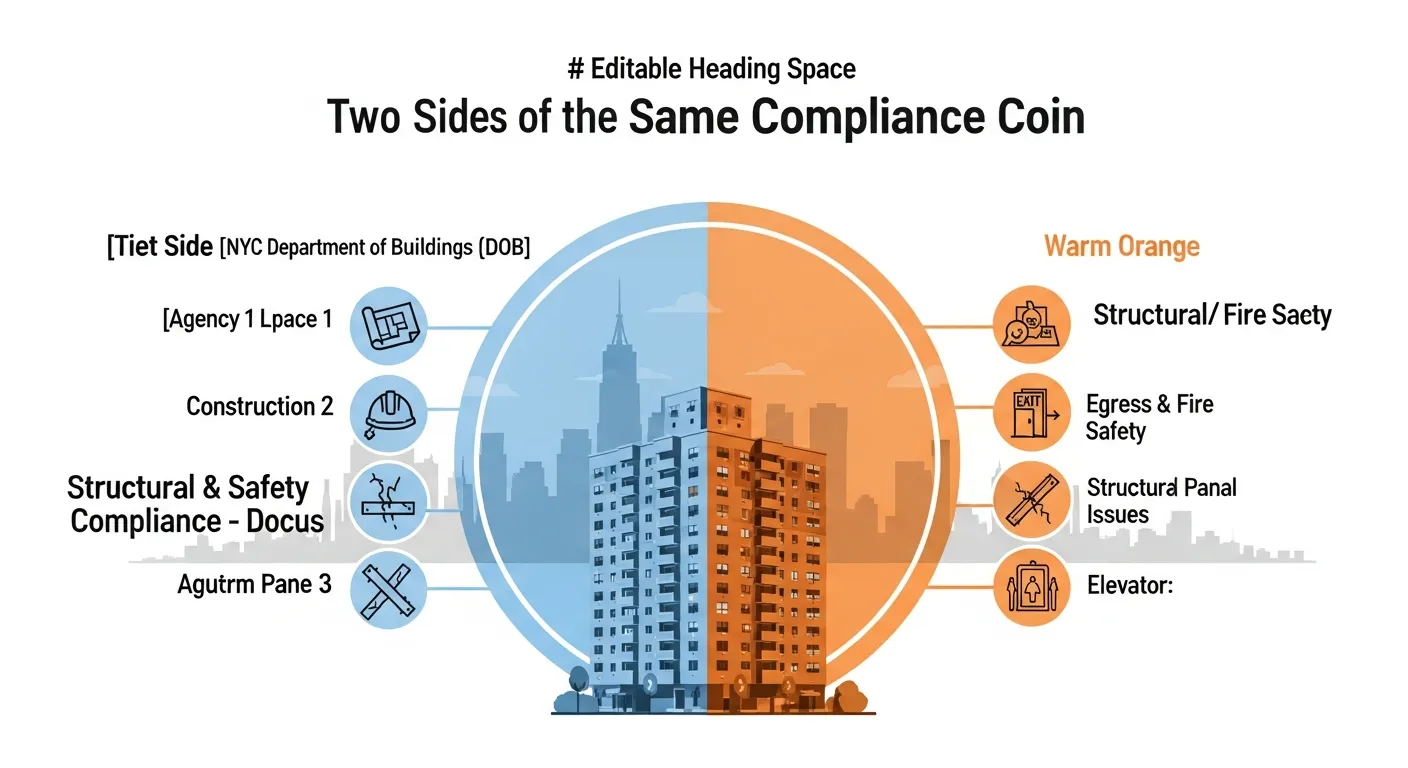
Before we talk monitoring, we need to be clear on what we’re watching. NYC building violations mostly fall under two agencies: the Department of Buildings (DOB) and the Department of Housing Preservation & Development (HPD).
Types Of DOB Violations Owners Need To Track
DOB violations cover the physical structure and safe operation of the building. At a minimum, we should track:
- Construction and work without a permit – jobs done without proper permits or contrary to approved plans.
- Egress and fire safety – blocked exits, illegal partitions, locked egress doors.
- Structural issues – sagging floors, compromised beams, unsafe retaining walls.
- Elevator violations – failed inspections, missed tests, out‑of‑service conditions.
- Boiler violations – missed inspections, unsafe boiler conditions, expired certificates.
- Façade violations (Local Law 11/NYC FISP) – unsafe façade reports, failure to file, public safety concerns.
- Stop‑work and vacate orders – immediate enforcement that can shut down work or occupancy.
- ECB/OATH summonses – civil penalty tickets that end up in front of the Office of Administrative Trials and Hearings.
DOB violations often sit in multiple places: DOB BIS, DOB NOW, and associated OATH records. If we’re not checking all the angles, we can easily miss something.
For official definitions and current rules, it’s worth bookmarking the NYC DOB site: https://www.nyc.gov/site/buildings/index.page.
Types Of HPD Violations Owners Need To Track
HPD violations focus on housing conditions and tenant habitability. These are mostly driven by 311 complaints and HPD inspections and are categorized as:
- Class A – Non‑hazardous (e.g., minor leaks, small repairs, non‑urgent conditions)
- Class B – Hazardous (e.g., some pest issues, moderate leaks, broken entrance doors)
- Class C – Immediately hazardous (e.g., no heat or hot water, lead paint hazards where children live, severe mold, major leaks, broken self‑closing doors)
We also need to pay attention to:
- Heat and hot water conditions
- Pests and rodents
- Mold and chronic dampness
- Lead‑based paint requirements
- HPD registration status
- Housing court actions and emergency repairs
Those Class C HPD violations are the ones that can rack up daily civil penalties and trigger emergency repairs that become liens on the property. HPD provides detailed info for owners here: https://www.nyc.gov/site/hpd/services-and-information/landlords.page.
If we treat DOB and HPD violations as two sides of the same compliance coin, structure and life safety on one side, habitability and tenant rights on the other, our monitoring strategy becomes much clearer.
Why Missing A Violation Costs You Time And Money
We don’t need to fear violations, but we do need to respect what happens when we miss them.
How Violations Lead To Fines, Liens, And Court Actions
When we fail to notice and correct violations, the city doesn’t just send reminders. It escalates:
- Daily civil penalties – HPD Class C violations (like no heat) can accrue daily fines until corrected and certified.
- Default judgments at OATH – skip or miss a DOB/OATH hearing notice and the city can enter a default judgment with higher fines.
- Emergency repairs – HPD can send its own contractors for certain hazardous conditions: the cost becomes a lien on the property.
- Environmental control and ECB penalties – stack up quickly, especially for recurring issues like illegal occupancy or unpermitted work.
- Housing court actions – chronic HPD complaints and open violations can end up in housing court, with court‑ordered repairs and potential civil penalties.
Often, the owner or manager’s first clue that something was missed is when a title search, refinance, or sale turns up a cluster of liens and open violations.
Reputation, Tenant Relations, And Inspection Frequency
There’s also a quieter cost: our reputation with tenants and regulators.
- Buildings with long histories of HPD complaints or chronic no‑heat issues get more scrutiny. Inspectors remember addresses.
- Tenants talk. When conditions linger, they learn that 311 is more effective than the management office.
- Once we’re on the radar, inspection frequency can increase. A property that looks consistently non‑compliant invites follow‑up visits and more enforcement.
On the flip side, when we respond quickly to early violations and document what we’ve done, we can shift how agencies see the building: from “problem address” to “cooperative owner/manager who fixes things.”
That shift starts with one habit: never letting a violation sit unnoticed.
Step 1: Know Exactly Which Buildings You Are Responsible For
The first failure point in NYC property compliance is surprisingly basic: we’re not always clear, in one place, what buildings we own or manage, or how they appear in city systems.
Creating A Master Building Inventory
We need a master inventory that lists each building exactly as DOB and HPD see it. At minimum, every record should include:
- Street address (including unit or building identifiers if there are multiple structures)
- BBL (Borough, Block, Lot)
- BIN (Building Identification Number)
- Number of units and type of occupancy (e.g., mixed‑use, multi‑family, SRO)
- Legal owner name and any alternate business names
- Managing agent and on‑site contact (super, porter, etc.)
We can pull this from:
- DOB BIS / DOB NOW (for BBL, BIN, occupancy, jobs, and violations)
- HPD Registration (for legal owner, registered agent, and units)
A simple spreadsheet works. Larger operators might use property management software, but the key is: one authoritative list, not a mix of emails, leases, and memory.
Assigning Ownership, Management, And Contact Roles
Each building in that inventory should also list:
- Owner of record – the entity that’s legally on the hook.
- Property manager / management company contact – who actually handles violations day to day.
- Compliance contact – the person (or team) responsible for tracking NYC building violations across the portfolio.
- Site contact – super or resident manager who can provide access and coordinate repairs.
When a violation lands, we shouldn’t be asking, “Who deals with this one?” The answer should already be in that master list.
We also want backup contacts. If our main compliance person is on vacation when a DOB immediately hazardous violation or HPD emergency repair notice hits, someone else must receive it and know what to do.
Step 2: Set Up Official Online Accounts And Profiles
Once we know our buildings, we need proper access to the city’s systems that generate and store violations.
Creating And Securing eFiling And DOB NOW Accounts
DOB runs multiple portals, but for monitoring NYC building violations our main focus is:
- DOB eFiling – for filings, applications, and some older records.
- DOB NOW – for jobs, inspections, safety compliance, and many modern DOB violations.
We should:
- Create DOB NOW and eFiling accounts for each responsible party (owner entity, filing representatives, and property managers where appropriate).
- Use role‑based email addresses if possible (e.g., [email protected]) so access doesn’t disappear when employees change.
- Turn on multi‑factor authentication and maintain a secure password log: we don’t want to lose access in the middle of resolving a violation.
DOB’s online services overview is here: https://www.nyc.gov/site/buildings/industry/online-tools.page.
Configuring Notifications And Contact Information
Accounts are only useful if they actually alert us when something changes.
In DOB NOW and related profiles, we should:
- Confirm that the email and phone numbers on file for each building’s owner or managing agent are current.
- Add a central compliance email wherever possible (for example, on permits and job applications) so violation notices are copied to one inbox.
- Set up email forwarding rules or shared mailboxes so violation‑related messages are easily visible to the compliance team.
On the HPD side, we should log into HPD Online and double‑check:
- Owner and managing agent names
- Mailing addresses
- Phone numbers and emails
HPD relies heavily on registration data: if that’s wrong, violation and court notices can go to old addresses we haven’t used in years.
This setup work is not glamorous, but it’s foundational. A lot of “we never saw that violation” stories trace back to an outdated owner address or a Gmail inbox that no one checks anymore.
Using NYC Department Of Buildings (DOB) Tools Effectively
With our accounts set up, we can turn DOB’s public and industry tools into a tracking system.
How To Search And Filter DOB Violations
The core DOB lookup tools are DOB BIS (the older system) and DOB NOW (the newer platform). For each building in our inventory, we should regularly:
- Search by address, BBL, or BIN in BIS.
- Review:
- “Violations” tab
- “Complaints” tab
- Any “Actions” or “Special / Enforcement” sections
- Cross‑check DOB NOW for:
- Open DOB violations and safety issues
- Elevator, boiler, and façade compliance
We can filter for open violations versus resolved ones and, where available, export or print reports to feed into our internal tracking spreadsheet.
Tracking Complaints, Jobs, And Enforcement Actions
Violations don’t appear out of nowhere. They usually follow a trail:
- Complaints – often from 311, logged in BIS. A sudden spike in complaints is an early warning sign.
- Jobs/permits – show where work is happening and whether final inspections and sign‑offs are complete.
- Stop‑work or vacate orders – appear in enforcement sections and can carry serious risk if missed.
A practical routine:
- During our regular checks, note new complaints: if enough of them are substantiated, they can turn into violations.
- Track whether jobs related to prior violations are actually reaching final sign‑off, not just pulled permits.
How To Read Violation Details And Deadlines
Every DOB violation has details we should read carefully:
- Issuing inspector and date – helps us reconstruct what happened.
- Description of condition – to brief the super, engineer, or contractor.
- Classification (immediately hazardous vs. lesser classes) – drives how fast we must respond.
- Hearing date or certification deadline – critical for avoiding defaults and extra penalties.
We want to capture, in our own log:
- Violation number
- Date issued
- Short description
- Hazard level
- Required action (repair, certification, hearing, etc.)
- Deadline(s)
- Current internal status (noticed, in progress, certified, dismissed)
The pattern is simple: if we can see every DOB violation and its deadline in one place, we’re much less likely to wake up to a surprise default judgment or lien.
Using NYC HPD Tools To Stay Ahead Of Housing Violations
HPD’s systems may look a bit dated, but they’re powerful once we know where to click.
How To Search And Export HPD Violations
The workhorse here is HPD Online. For each building, we should:
- Search by address or BBL.
- Review:
- Registration – confirm the owner/managing agent is current.
- Complaints – especially recent 311 calls.
- Violations – filter by open vs. closed.
- Litigation / Emergency Repairs – any housing court actions or HPD liens.
- Use any export, print, or PDF options to create a current violation list for our records.
That exported list is a snapshot we can compare against our internal log during audits.
Heat, Hot Water, And Maintenance Hotspots
From October through May, HPD is aggressive on heat and hot water enforcement. We should:
- Monitor buildings with a history of heat complaints more frequently.
- Track Class C no‑heat and no‑hot‑water violations with the utmost urgency.
Beyond heat, HPD data shows recurring hotspots:
- Pests and rodents – often a sign of gaps in housekeeping or building envelope issues.
- Mold and leaks – especially in basements and top‑floor units.
- Self‑closing doors – key for fire safety: these draw consistent enforcement.
If the same stack line or unit appears repeatedly in HPD violations, that’s a signal: we’re dealing with a systemic issue, not a one‑off complaint.
Seasonal Patterns In HPD Enforcement
HPD enforcement has a rhythm:
- Winter – heat/hot water and window guards dominate.
- Spring – more mold, roof leaks, and water penetration complaints.
- Summer – pests, garbage, and some ventilation issues.
- Fall – prep for heat season again: lingering boiler or chimney problems surface.
If we align our proactive inspections with those patterns, we can correct conditions before tenants pick up the phone and call 311. Training supers to look for early signs (rust stains, peeling paint, musty odors, sagging ceilings) is worth more than any single repair invoice.
Step 3: Create An Automated Monitoring And Alert System
Manual checks alone aren’t enough anymore, especially if we manage more than a handful of buildings. We need a monitoring setup that runs in the background.
Daily And Weekly Monitoring Routines
First, we establish a simple cadence:
- Daily (or at least several times per week):
- Quick scan of DOB BIS and DOB NOW for new DOB violations and complaints on high‑risk buildings.
- HPD Online check for new HPD complaints in buildings with a history of Class C issues.
- Weekly:
- Full sweep of all buildings by BBL/BIN.
- Export or capture new violations into our portfolio spreadsheet.
Even if we later automate everything, this routine keeps us familiar with how data appears in the city’s own systems.
Email, Calendar, And Spreadsheet Automation
We don’t need expensive software to start automating. We can:
- Create a shared spreadsheet with one row per violation and filters by building, agency, class, and status.
- Use email rules to label and route messages containing words like “violation,” “notice of violation,” “OATH,” “HPD,” or “DOB NOW” into a shared folder.
- Set calendar reminders keyed to violation deadlines and hearing dates.
This kind of “basic automation” reduces the risk that a single busy week causes us to miss an important notice.
Third-Party Monitoring And Alert Services
At some point, checking multiple portals manually becomes unrealistic. That’s where third‑party monitoring platforms help.
Tools such as ViolationWatch, DOB Guard, and similar services automatically monitor:
- DOB (BIS and DOB NOW)
- HPD
- 311 complaint data
- ECB/OATH
- Sometimes FDNY and other enforcement sources
They send email or SMS alerts when new items appear so we don’t have to keep logging in and searching.
We can, for example, get instant alerts whenever our building receives a new violation, sign up for real-time monitoring through a service that offers dedicated building violation alerts.
For free one‑off checks, we can also use an online NYC violation lookup tool to quickly see open DOB and HPD items by address.
Automated monitoring doesn’t replace our internal process: it feeds it. When a new alert hits, our workflow (next section) should already spell out who acts and how.
Step 4: Build An Internal Violation Response Workflow
Catching violations is half the battle. The other half is responding in a structured, predictable way so nothing falls through the cracks.
Assigning Responsibility And Escalation Paths
For each building, we should define:
- Primary compliance contact – receives alerts and owns the initial response.
- Backup contact – handles issues when the primary is unavailable.
- On‑site contact – super or manager who can verify conditions and coordinate access.
Our written workflow might look like this:
- New violation or complaint appears in DOB/HPD or via our monitoring tool.
- Compliance contact logs it and forwards to the super with a short summary.
- Super confirms the condition, sends photos, and estimates what’s needed.
- Compliance decides whether to use in‑house staff or outside vendors.
- If legal or technical issues are complex, we loop in counsel or a design professional.
Escalation rules should be clear: For example, all HPD Class C or DOB immediately hazardous violations must be reported to ownership within 24 hours.
Standard Response Timelines By Violation Type
We can’t treat a loose handrail and a no‑heat complaint the same way. Setting standard timelines helps us prioritize:
- HPD Class C and DOB immediately hazardous – same day acknowledgement, contractor scheduled within 24 hours where feasible.
- HPD Class B / non-immediately hazardous DOB – investigation within 2–3 business days, repair scheduled within a week (unless more urgent).
- Clerical or paperwork issues (e.g., missing posting, administrative errors) – corrected and certified within the shortest window allowed.
These are internal goals: actual legal deadlines vary by violation. But having our own rules keeps the team from slowing down just because an official notice allows more time.
Coordinating With Supers, Vendors, And Professionals
Execution lives and dies with coordination:
- Supers and porters – trained to document conditions with clear photos and notes.
- Licensed contractors – familiar with DOB/HPD certifications and willing to provide the affidavits or paperwork we need.
- Design professionals and expediters – handle filings, hearings, and complex structural or façade issues.
We should maintain a list of preferred vendors who understand DOB and HPD processes so we’re not scrambling when a serious violation hits.
And we can centralize everything in a single log or platform: violation number, what work was done, who did it, when, and how we certified or closed it.
If we’re using a service like ViolationWatch, we can often attach notes, documents, and statuses directly to each violation, keeping the story of that issue in one place.
Step 5: Audit, Document, And Prevent Repeat Violations
The best‑run portfolios treat violations as data, not just headaches. That means documenting carefully and looking for patterns.
Keeping Proof Of Repairs And Communications
For each building, we should keep a central folder (digital or well‑organized physical) that includes:
- Copies of violation notices
- Photos of “before” and “after” conditions
- Invoices, work orders, and contractor letters
- DOB/HPD certification receipts and emails
- Any correspondence with tenants about the issue
If HPD or DOB questions whether we actually corrected a condition, this file becomes our evidence. It’s also invaluable in court or during a sale or refinance.
Periodic Internal Compliance Audits
At least quarterly (monthly for high‑risk buildings), we should run an internal audit:
- Export the current list of violations from HPD Online and DOB BIS / DOB NOW.
- Compare each item to our internal log.
- Confirm statuses (open, corrected, certified, dismissed) match reality.
- Identify any violations we’ve fixed in the field but haven’t properly certified with the agency.
The goal is to catch gaps before they become long‑term problems or show up as surprises in lender or buyer due diligence.
Using Data To Spot Systemic Building Issues
When we look at our violations as a dataset instead of one‑off events, we start to see:
- Buildings with chronic elevator or boiler issues.
- Stacks where leaks and mold keep reappearing.
- Properties that repeatedly trigger HPD complaints in the same season.
That’s where monitoring becomes strategy. If one roof line or riser keeps generating violations, we can build a capital project around fixing the root cause instead of patching the same apartment every winter.
Training Staff To Recognize And Prevent Issues
Preventing NYC building violations is often about what happens long before an inspector arrives.
We can:
- Train supers to walk buildings with an “inspector’s eye”, looking at egress routes, boiler rooms, compactor rooms, self‑closing doors.
- Give them a short checklist tied to our most common violations.
- Encourage tenants to report issues directly to us first, with clear channels (text, email, portal) so they don’t feel 311 is their only option.
If we combine trained eyes on the ground with automated monitoring and a disciplined response workflow, we dramatically reduce both the number and severity of violations we face.
Integrating Violation Monitoring With Broader Compliance And Risk Management
Violation monitoring doesn’t live in a vacuum. It affects financing, insurance, and the long‑term health of our assets.
Aligning Violation Monitoring With Insurance And Financing
Insurers and lenders increasingly review NYC building violations as part of their underwriting:
- A building with open DOB and HPD violations, especially immediately hazardous items, looks riskier.
- Emergency repair liens and large OATH penalties can complicate closings or refinances.
If we can show a clean, up‑to‑date violation history, plus documentation of how we monitor and respond, we’re in a stronger position when negotiating terms.
Using Monitoring To Inform Capital Planning
Our monitoring logs can double as a planning tool:
- Repeated façade or parapet issues might push us to schedule a full façade program or FISP cycle earlier.
- Chronic boiler or heating plant problems could justify a major upgrade instead of constant repairs.
- Ongoing elevator shutdowns might support a modernization project.
By tying violations to actual capital spending, we move from reactive, emergency‑driven work to planned improvements that reduce risk and improve tenant satisfaction.
When To Consult Attorneys Or Compliance Experts
Most day‑to‑day issues can be handled by our internal team and regular vendors. But we shouldn’t hesitate to bring in:
- Landlord‑tenant counsel for buildings with chronic HPD litigation, emergency repair liens, or large clusters of Class C violations.
- DOB/ECB specialists or expediters where we’re facing complex structural or façade violations, or large ECB penalty exposure.
- Risk consultants if our portfolio shows systemic problems that could threaten insurance coverage or lender covenants.
Monitoring tools and internal workflows give these professionals better information to work with, violations, timelines, and documentation all in one place.
For ongoing, portfolio‑level oversight, we can lean on services that centralize everything. When we register for building violation alerts and consolidate DOB and HPD data through platforms like ViolationWatch, we’re not just chasing tickets: we’re managing risk in a structured way.
Conclusion
We can’t control when inspectors show up or when tenants call 311. But we can control whether we’re the last to know about a new violation on our building.
If we:
- Build a clear master inventory of every address, BBL, and BIN we’re responsible for.
- Keep DOB NOW, eFiling, and HPD registration data up to date.
- Use DOB and HPD tools regularly, and understand what the data is telling us.
- Layer on automation, from simple email rules to portfolio‑wide monitoring services.
- Create a disciplined internal workflow to respond, document, and learn from each violation.
…then missing a violation becomes the rare exception, not the rule.
To make that easier, we can start today with small steps: run a portfolio‑wide check using an NYC violation lookup tool, standardize our spreadsheets, and set up shared email rules. From there, we can scale into real‑time building violation alerts and deeper analytics.
NYC property compliance will never be effortless. But with the right system, it can be predictable, and that’s what protects our buildings, our tenants, and our bottom line.
Key Takeaways
- Create a single, accurate master inventory of every building you manage, including address, BBL, BIN, and contacts, so you always know exactly which properties you must monitor for DOB/HPD violations.
- Set up and maintain DOB NOW, eFiling, and HPD Online accounts with current contact information and shared compliance emails to ensure you receive every official notice and hearing date.
- Use NYC Department of Buildings (DOB) and HPD tools regularly—plus exports and logs—to track all open NYC building violations, complaints, deadlines, and enforcement actions in one centralized spreadsheet or system.
- Automate monitoring with email rules, shared calendars, and third‑party services that send real‑time DOB/HPD violation alerts, then route each new item through a standardized internal response workflow with clear roles and timelines.
- Audit your portfolio quarterly, document all repairs and certifications, and use recurring violation patterns to guide staff training and capital planning so you prevent repeat issues and reduce long‑term compliance risk.
Frequently Asked Questions
What is the best way to monitor DOB and HPD violations so I never miss one?
Create a master building inventory with accurate BBL, BIN, and owner data, keep DOB NOW, eFiling, and HPD registration updated, and check BIS, DOB NOW, and HPD Online on a set schedule. Layer in automated alerts or third‑party monitoring tools so new DOB/HPD violations trigger immediate notifications.
How often should I check NYC DOB and HPD systems for new building violations?
For most portfolios, a weekly full sweep of all buildings plus daily (or several times weekly) checks on high‑risk properties works well. Export current DOB and HPD violations, compare them with your internal log, and immediately flag any new complaints, Class C HPD violations, or DOB immediately hazardous conditions.
Which NYC tools can I use to track DOB/HPD violations and complaints?
Use DOB BIS and DOB NOW to review DOB violations, complaints, stop‑work or vacate orders, and safety compliance. Use HPD Online to check registration, 311‑driven complaints, violations, litigation, and emergency repairs. Export or print lists regularly so they feed into your internal spreadsheet or compliance software.
How do automated building violation alerts work for NYC properties?
Automated monitoring platforms such as ViolationWatch or DOB Guard connect to DOB BIS, DOB NOW, HPD, 311 data, and sometimes OATH/ECB and FDNY. They scan these sources continuously and send email or SMS alerts whenever a new complaint, violation, or enforcement action appears for any building you’ve registered.
Can tenants look up DOB and HPD violations on their building in NYC?
Yes. Tenants can search DOB BIS and DOB NOW by address to see construction history, complaints, and DOB violations. They can also use HPD Online to view open HPD violations, registration information, and some litigation data. These tools are public and designed to make building safety and habitability more transparent.
How can I prevent repeat DOB/HPD violations on the same building or unit?
Treat violations as data, not one‑offs. Keep detailed records of notices, photos, repairs, certifications, and tenant communication. Run periodic audits to spot patterns by building, stack, or system (e.g., boiler, roof, doors). Then plan targeted capital projects and train supers to inspect common problem areas before complaints arise.