
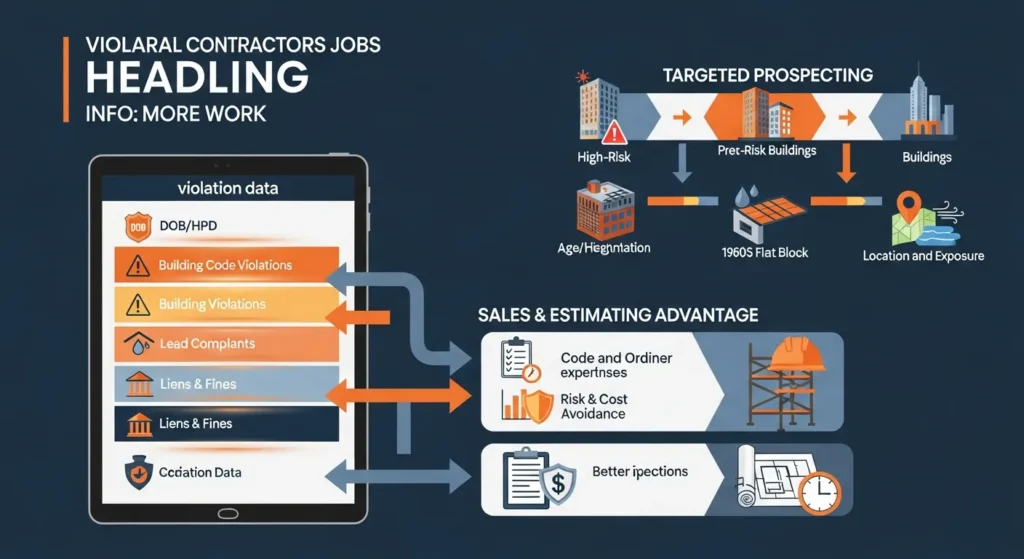
When we talk to successful facade and roofing contractors in New York City and other major markets, a pattern keeps coming up: the best-performing firms don’t just wait for RFPs or word of mouth. They quietly mine violation data.
NYC building violations, DOB violations, HPD complaints, open fines, missed filings – all of this creates a clear trail of buildings under pressure to act. When we use that data strategically, we’re not “chasing violations.” We’re positioning ourselves as the fastest, safest path to getting those violations cleared and the property back into compliance.
In this piece, we’ll break down how violation data actually works in facade and roofing, how we can turn it into a repeatable advantage in sales and estimating, and how to do it without crossing ethical lines or burning relationships.
Understanding Violation Data In Facade And Roofing Work
What Counts As Violation Data?
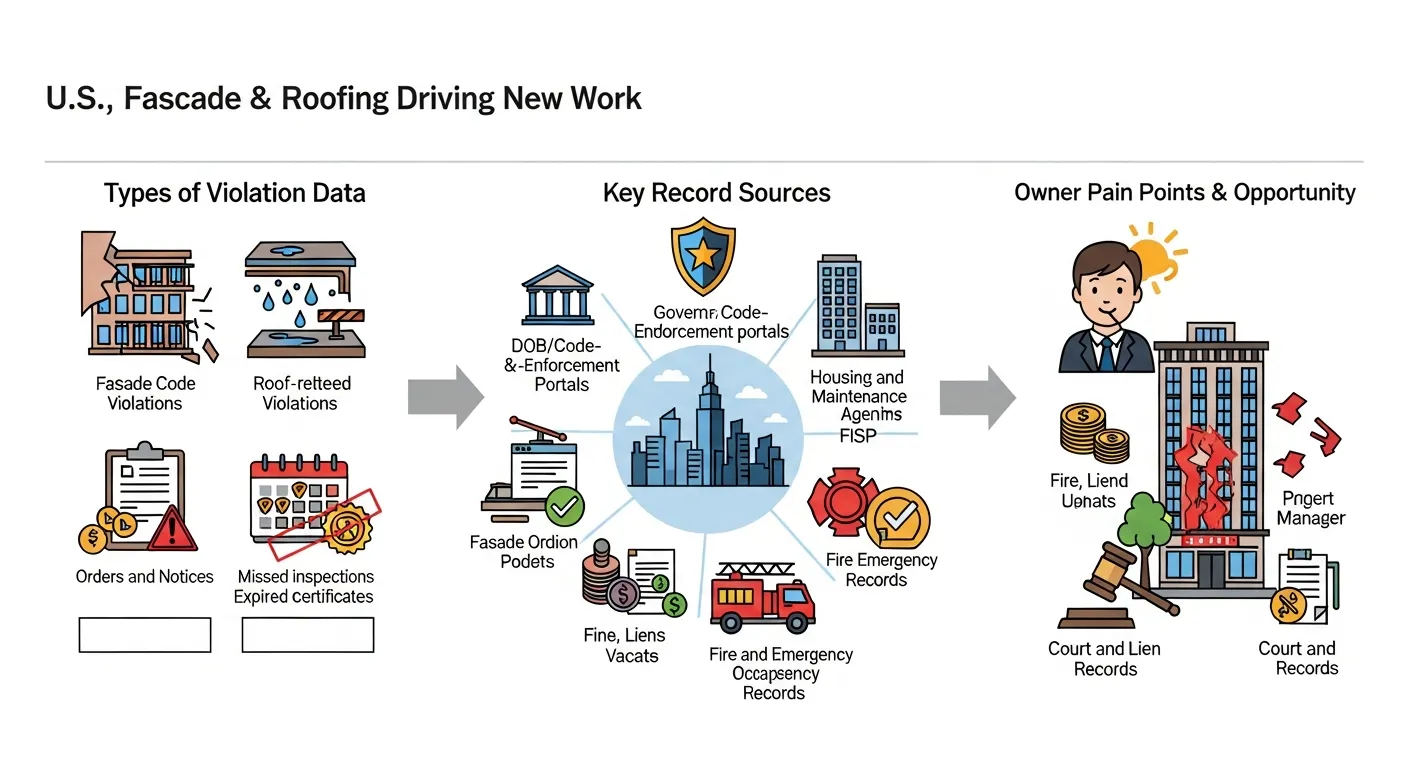
For facade and roofing contractors, “violation data” isn’t just a single list. It’s a cluster of records that all signal risk, urgency, and upcoming spend.
Typically, we’re looking at:
- Building code and facade ordinance violations – unsafe facade conditions, loose or spalling masonry, cracked lintels, failed balconies, missing or deteriorated parapet copings.
- Roof-related violations – chronic roof leaks, failed membranes, missing guardrails, unsafe roof access, ponding water that’s damaging structural elements.
- Orders and notices – “unsafe” or “immediately hazardous” designations, emergency repair orders, Partial Vacate or Full Vacate orders tied to facade or roof hazards.
- Administrative compliance issues – missed inspection filings (such as NYC’s FISP cycles), expired certificates of compliance, unresolved DOB violations, or HPD complaints linked to water intrusion and mold.
In New York, much of this flows through NYC Department of Buildings (DOB) records and NYC Housing Preservation & Development (HPD) systems. Other cities package it differently, but the substance is similar: documented conditions that show a building is falling behind on safety and maintenance.
Key Sources Of Violation Records For Contractors
If we’re serious about using violation data to win more facade and roofing work, we need to know where to pull it from and how reliable each source is.
Common sources include:
- City DOB / code-enforcement portals
In NYC, the DOB’s online systems and open-data feeds list complaints, open DOB violations, ECB/OATH summonses, permits, and more. This is our starting point for NYC property compliance work.
→ Official DOB portal: https://www.nyc.gov/site/buildings/index.page
- Housing and maintenance agencies
HPD databases surface Housing Maintenance Code violations and HPD complaints – many of which are tied to leaks, mold, and unsafe conditions that originate at the facade or roof.
→ HPD maintenance violations: https://www.nyc.gov/site/hpd/services-and-information/maintenance-violation.page
- Facade ordinance programs
In NYC that’s FISP (formerly Local Law 11). Other cities like Philadelphia, Cleveland, Detroit, San Francisco, Pittsburgh, and St. Louis have similar periodic facade inspection rules. Unsafe or “SWARMP” (Safe With a Repair and Maintenance Program) classifications are strong signals that significant facade work is coming.
- Fire department and emergency records
Conditions like falling debris, compromised parapets, or roof access issues sometimes show up first in fire department or emergency services reports.
- Court and lien records
When fines escalate or the city performs emergency repairs, we may see liens or court actions. At that stage, owners are under extreme pressure to resolve issues quickly.
In NYC, tools like ViolationWatch centralize much of this for us, making it easier to track open violations, monitor changes, and identify buildings that are about to spend serious money on repairs.
Why Owners And Property Managers Care About Violations
From the owner’s side, violations aren’t an abstract problem – they’re a direct hit to cash flow and risk exposure.
They care because violations can mean:
- Fines and liens – Open DOB violations, HPD violations, and OATH summonses can stack up and become liens that interfere with refinancing or sale.
- Insurance and financing issues – Carriers and lenders increasingly ask about NYC building violations and facade conditions. Significant open items can affect premiums, deductibles, or even coverage.
- Loss of occupancy or restrictions – Vacate orders or sidewalk shed requirements reduce revenue and frustrate tenants.
- Reputation and tenant experience – Visible deterioration, leaks, or recurring HPD complaints undermine the building’s brand in the market.
- Personal and organizational liability – When there’s falling debris or a safety incident, plaintiffs’ attorneys will use that violation history.
That’s why, when we walk in not just as “another roofer” or “another facade contractor,” but as the team that understands the building’s specific violation history and compliance pathway, we immediately feel different to an owner or property manager.
Turning Violation Data Into A Competitive Advantage
Spotting Buildings That Are Likely To Need Facade And Roof Work
Not all buildings are equal opportunities. Violation data lets us focus on the ones that are most likely to convert.
We can:
- Filter for high-risk categories – In NYC FISP terms, “Unsafe” or “SWARMP” reports often mean major facade or roof repairs are imminent.
- Look for water-infiltration patterns – Multiple HPD complaints about leaks, mold, or ceiling damage suggest roof or facade envelope problems.
- Target older, taller buildings – Structures over 5–6 stories and 20–30+ years old are more likely to be covered by facade ordinances and to have aging roofs.
Instead of blanketing a ZIP code with generic outreach, we’re choosing properties where violation history already tells us: work is coming.
Identifying Chronic Noncompliance And Deferred Maintenance
One violation doesn’t always mean a big job. But a pattern of violations nearly always does.
We look for:
- Repeated violations over multiple years or cycles – Same line items showing up inspection after inspection.
- Missed or late inspection filings – Indicates a reactive ownership mindset and likely backlog of issues.
- Temporary band-aid fixes – For example, patch roofs every winter but never address membrane failure or inadequate drainage.
When we see this, we know the odds are high that an owner will eventually be forced into a capital project. If we’re the first team to present a thoughtful, phased plan, our win rate jumps.
Prioritizing Prospects By Urgency, Risk, And Budget Pressure
Violation data also helps us rank which opportunities deserve our time this quarter.
We can score buildings by:
- Urgency – Open “immediately hazardous” DOB violations, upcoming FISP filing deadlines, or expiring temporary repairs.
- Risk – Buildings on busy sidewalks or transit corridors, or with prior falling-debris incidents, carry more liability.
- Budget pressure – Fines that are accruing daily, or liens that threaten refinancing, push owners to act now.
This kind of prioritization matters. Most contractors don’t have the bandwidth to chase every lead. When we lean on data to decide who’s most likely to move, our pipeline becomes healthier and more predictable.
Using Violation Data To Target The Right Prospects
Segmenting Properties By Violation Type, Age, And Location
Once we’ve gathered violation data, we shouldn’t treat it as one big undifferentiated list. We get much better results when we segment.
Useful segmentation slices include:
- By violation type
- Spalling masonry, loose stone, delaminated brick: facade restoration and structural repairs.
- Roof membrane failures, chronic leaks, ponding water: roofing replacement or major rehab.
- Guardrail or parapet issues: edge protection, coping replacement, safety upgrades.
- By age and height
- Pre-war masonry over 6 stories: often facade-heavy work with access and structural challenges.
- 1960s–1980s flat-roof buildings: aging roofs, outdated details, vulnerable flashings.
- By location and exposure
- Coastal or high-wind zones: more wind-driven rain and cladding stress.
- Corridors with heavy pedestrian traffic: regulators are more aggressive about loose facade elements.
Segmentation lets us customize our outreach and proposals. We’re not just saying “we do roofs”: we’re saying, “we fix exactly the type of leakage pattern your HPD complaints show.”
Aligning Your Service Offerings With Common Violation Patterns
Violation trends in a given city tell us what to emphasize in our service mix and marketing.
If we’re seeing a lot of:
- FISP-related facade violations – We can offer complete ordinance-compliance packages: inspection assist, access planning, repairs, and filing support.
- Roof leak complaints tied to interiors – We can position ourselves as envelope specialists, connecting roof work with interior damage prevention.
- Guardrail and parapet issues – We can highlight safety upgrades and code-compliant details that solve multiple items at once.
Over time, our proposals and website content should mirror the violations we see most often. That’s how we become the obvious choice for specific problems, not just a generic “GC who also does roofs.”
Timing Outreach Around Inspections, Deadlines, And Weather Cycles
Timing is one of the quiet advantages of using violation data well.
We can plan outreach around:
- Known inspection cycles – In cities with 3–10 year facade inspection requirements, we know when owners will be commissioning new reports and budgeting for work.
- Filing deadlines – Reaching out six to twelve months before a FISP or similar filing deadline gives owners time to plan real repairs rather than panic spending.
- Weather-driven damage windows – In NYC, for example, post-winter and post-hurricane-season periods see spikes in new leaks and falling-masonry incidents.
If our calls, emails, and site visits show up right as owners are dealing with fresh DOB violations or trying to clear HPD complaints, our message lands differently. We aren’t cold-calling: we’re arriving when a known pain point is top-of-mind.
Strengthening Your Sales Pitch With Data-Backed Insights
Building Credibility With Evidence Of Code And Safety Expertise
One of the fastest ways to differentiate ourselves is to speak the same language as regulators and engineers.
In practice, that means we:
- Reference specific ordinances in proposals – FISP requirements, local facade or roofing codes, guardrail height standards, maintenance obligations.
- Tie observed conditions to root causes – movement, thermal cycling, trapped moisture, failed flashings, wind uplift, or previous substandard repairs.
- Describe risk pathways clearly – how a cracked parapet turns into falling masonry, or how chronic roof leaks lead to structural steel corrosion and mold.
Owners and property managers quickly sense whether we’re comfortable operating in this compliance-heavy environment. If we can talk intelligently about NYC building violations, DOB processes, and HPD enforcement, we’re already ahead of most bidders.
Using Past Violation Resolutions As Case Studies
We shouldn’t just say we “handle violations.” We should show it.
Effective case studies include:
- Before/after violation status – Screenshots or documentation showing open violations, then “closed” after our work.
- Timeline vs. deadlines – How we sequenced investigation, permits, and repairs to beat a FISP or DOB deadline.
- Risk avoided – For example, eliminating sidewalk sheds years earlier than expected by addressing root facade issues instead of piecemeal patches.
Even anonymized case studies help. When we can say, “We recently helped a similar 12-story co-op clear three Unsafe facade classifications and restore full compliance within one cycle,” the owner can picture themselves in that story.
Quantifying Risk Reduction, Cost Avoidance, And Compliance Benefits
Most bids focus on line-item costs. Violation data lets us focus the conversation on value and risk.
We can quantify things like:
- Fines and penalties avoided – Taking a daily-penalty situation to zero when violations are closed.
- Emergency-repair costs avoided – Showing that a planned facade or roof project costs far less than piecemeal emergency work after every storm.
- Insurance and financing benefits – Better insurability, smoother refinancing, fewer inspection “surprises” at sale.
Public data and market coverage from sources like The Real Deal (https://therealdeal.com/) regularly highlight how noncompliant buildings suffer in transactions. Citing those realities makes our value tangible and keeps the conversation grounded in real-world consequences, not abstract fear.
Improving Estimating And Project Planning With Violation Data
Scoping Work To Match Actual Deficiencies And Likely Hidden Issues
Good violation data makes our estimates sharper.
Instead of guessing, we:
- Read violation descriptions and inspector notes to understand the types and locations of failures.
- Cross-reference with building age and construction type to anticipate likely hidden issues – for example, corroded shelf angles behind spalled brick or saturated insulation under a patched roof.
- Use any prior engineering reports (when available) to shape a realistic range of quantities for repointing, brick replacement, membrane removal, and so on.
Our goal isn’t to be perfectly precise up front – that’s impossible. It’s to be accurate enough that we minimize surprises while keeping our pricing competitive.
Forecasting Access, Safety, And Logistics Requirements
Violation records often reference the parts of the building that are unsafe or exposed. That’s gold for planning access.
We can use this information to:
- Decide between swing stages, mast climbers, and pipe scaffolding based on height and facade configuration.
- Plan for sidewalk sheds, street closures, and protection decks where falling debris is a concern.
- Identify complex roof access issues in advance – limited stair or elevator access, tight courtyards, adjacent-property coordination.
When we show up to a pre-bid meeting already aware of likely access challenges – because we read the violations – we build trust and reduce RFIs later.
Reducing Change Orders And Schedule Slippage
Change orders and delays erode margins and relationships. Violation data helps us reduce both.
We do this by:
- Building reasonable allowances and alternates into our bids for conditions strongly suggested by the history (for example, more extensive brick replacement at corners exposed to years of water infiltration).
- Sequencing work in line with regulatory expectations – prioritizing hazardous conditions noted by DOB before moving to less critical items.
- Communicating early with owners and engineers when the violation history hints that “once we open this up, it may be worse.”
Owners don’t mind change orders nearly as much when they feel we predicted the risk honestly and gave them options from day one.
Enhancing Relationships With Owners, Managers, And Regulators
Helping Clients Navigate Notices, Fines, And Compliance Steps
Many owners, especially smaller landlords and co-op boards, are overwhelmed by violation paperwork. This is our chance to be more than a contractor.
We can:
- Walk them through typical compliance steps – initial site assessment, engaging design professionals, securing permits, scheduling work, final inspections, and close-out documentation.
- Clarify what’s truly urgent – distinguishing between immediately hazardous DOB violations and less critical items, so they can prioritize budget.
- Help them understand HPD vs. DOB roles – which agency controls which violations and what closure looks like in each system.
When we position ourselves as guides through NYC property compliance, we become the first call whenever a new notice hits their inbox.
Coordinating With Design Professionals And Inspectors
In most facade-ordinance cities, engineers and architects play a central role. Violation data tells them where to focus investigations, and it tells us how to align with their work.
We should:
- Build relationships with facade and structural engineers who routinely prepare FISP and similar reports.
- Share relevant violation histories during pre-design meetings to avoid surprises once probes begin.
- Coordinate access, probes, and test cuts around the most serious violation items so inspectors see early progress on the biggest risks.
When inspectors and design professionals see that we’ve read and internalized the violation record before setting foot on site, we’re easier to work with – and more likely to get invited back.
Positioning Yourself As A Long-Term Compliance Partner
Facade and roofing compliance isn’t a one-off event: it’s cyclical.
We can leverage violation data over time by:
- Offering multi-cycle maintenance plans aligned with local facade inspection intervals.
- Setting reminders to re-engage owners before the next filing window, with updated snapshots of their violation and complaint history.
- Tracking how our projects reduce new complaints and violations in subsequent years, and feeding that back into our marketing.
This is where monitoring tools become valuable. Get instant alerts whenever your building receives a new violation, sign up for real-time monitoring using our building violation alerts, and we can respond before problems escalate.
Practical Steps To Start Using Violation Data In Your Business
Choosing Data Sources And Setting Up A Simple Tracking System
We don’t need a massive data-science project to get started. A lean process works well.
- List our target jurisdictions.
Start with NYC if that’s our core market, then add nearby cities that have facade or aggressive maintenance codes.
2. Identify primary data portals.
For NYC, that means DOB, HPD, and FISP/Façade Safety Program resources, plus tools like ViolationWatch that pull them together.
3. Build a simple tracking sheet.
Columns might include: building address, owner/manager contact, open violations by type (DOB, HPD, facade, roof), last inspection date, deadlines, and notes.
4. Update on a schedule.
Weekly or bi-weekly updates are usually enough to catch new issues without drowning in data.
For free lookups, use our NYC violation lookup tool. Once we know which properties are under the most pressure, we can start prioritizing outreach.
Integrating Violation Insights Into Your CRM And Sales Process
Next, we bring violation data into the systems our teams already use.
We can:
- Add custom violation-related fields and tags in our CRM – things like “Facade-Unsafe,” “Roof-Leak,” “HPD-Leak Complaints,” “Fines-Accruing.”
- Set automated reminders tied to key dates – upcoming FISP cycles, known renewal windows, or anniversary dates of major storms that previously caused damage.
- Use violation intensity as a lead-scoring input – higher scores for buildings with multiple unsafe items or compounding fines.
This turns our CRM into more than a contact database. It becomes a live map of where facade and roofing dollars are most likely to be spent over the next 6–24 months.
Training Your Team To Talk Confidently About Codes And Violations
The best data in the world won’t help if our salespeople and project managers stumble when owners ask basic compliance questions.
We should:
- Run quick training sessions on local facade and roofing requirements, FISP terminology, and how DOB and HPD complaints are typically resolved.
- Create cheat sheets summarizing common violation codes, what they mean practically, and typical repair approaches.
- Practice solution-focused conversations – less “You’re in trouble,” more “Here are your options to clear this and prevent it from recurring.”
Our goal is simple: every client-facing person should be able to look at a violation record and explain, in plain English, what it means and how we can help.
Common Pitfalls And Ethical Considerations
Avoiding Fear-Based Selling And Respecting Owner Concerns
Violation data can tempt us into scare tactics. That’s a mistake.
Owners already feel exposed when they’re facing NYC building violations or HPD complaints. If we pile on fear, they tend to shut down or shop around.
Instead, we should:
- Stick to verifiable facts in the public record.
- Frame violations as solvable problems, not as catastrophes.
- Respect that some owners are juggling competing priorities – life-safety items may be urgent, but cosmetic issues can reasonably wait.
We want to be the calm, competent voice in the room, not the one shouting the loudest.
Staying Within Legal And Privacy Boundaries
Most of the data we’re talking about is public. Still, there are lines we shouldn’t cross.
We should avoid:
- Quoting or sharing confidential engineering reports or internal documents without permission.
- Misrepresenting ourselves as city officials or inspectors in outreach.
- Making definitive claims about liability or legal exposure – that’s for attorneys and insurers, not contractors.
If we’re ever unsure, we can point owners back to official NYC resources or their professional advisors rather than guessing.
Keeping Data Current And Verifying Before You Pitch
Violation status changes. Owners close some items, new ones appear, and classifications get updated.
Before we prepare a proposal or launch a major outreach push for a building, we should:
- Re-check the latest DOB, HPD, and facade-program data.
- Confirm with the owner or manager which violations are still open and active.
- Clarify whether any major repairs have already been completed but not yet closed out in the system.
That final verification step saves us from embarrassing moments – like pitching to fix an “unsafe” parapet that was rebuilt months ago.
Conclusion
Violation data isn’t just for lawyers and regulators. Used well, it’s one of the most practical tools we have for growing a facade and roofing business.
When we track DOB violations, HPD complaints, and facade classifications with some discipline, we can:
- Find buildings that are truly under pressure to act.
- Tailor proposals to the real risks and conditions on site.
- Bid more accurately and plan access and safety more intelligently.
- Build long-term, trust-based relationships as compliance partners.
Most contractors are still operating blind, waiting for the phone to ring or for a sidewalk shed to pop up down the block. If we build a simple, ethical process around violation data now, we’ll be the team owners call first when they’re ready to fix the problem instead of keep patching it.
And if we want to make this systematic, we don’t need to reinvent anything. We can plug into tools built for this exact purpose and layer them onto our own CRM and prospecting workflows. Over the next few years, the gap will widen between contractors who use violation data and those who don’t. We know which side we want to be on.
Key Takeaways
- Using violation data lets facade and roofing contractors target buildings under real compliance pressure, instead of waiting passively for RFPs or word-of-mouth leads.
- NYC building violations, DOB records, HPD complaints, and facade ordinance classifications (like FISP Unsafe or SWARMP) highlight which properties are most likely to need immediate facade and roofing work.
- Segmenting prospects by violation type, building age, and location helps tailor offers—such as full facade ordinance-compliance packages or roof envelope solutions—to the exact problems owners are facing.
- Bringing violation data into your CRM and sales process improves lead scoring, outreach timing, estimating accuracy, and project planning, reducing change orders and schedule slippage.
- An ethical, fact-based approach to violation data positions contractors as long-term compliance partners who guide owners through notices, fines, and regulatory steps, building trust and repeat business.
Frequently Asked Questions
What is violation data in facade and roofing work, and why does it matter for contractors?
Violation data is the collection of public records about building code issues, such as NYC building violations, DOB violations, HPD complaints, FISP classifications, and open fines. For facade and roofing contractors, it highlights buildings under safety, financial, and regulatory pressure—exactly where owners are most likely to approve repair projects soon.
How does using violation data help general contractors win more facade and roofing jobs?
When general contractors track violation data, they can identify buildings with unsafe facades, chronic roof leaks, open fines, and upcoming deadlines. This lets them target owners who must act, tailor proposals to specific violations, and present themselves as compliance partners—not just bidders—dramatically improving close rates and repeat work.
Where can I find NYC building violation data for facade and roofing opportunities?
In New York City, key sources include the DOB online portal and open-data feeds, HPD maintenance and violation databases, FISP/Facade Safety Program records, and sometimes fire department or court/lien records. Many contractors also use aggregators like ViolationWatch to centralize NYC building violations and monitor high-pressure properties efficiently.
Can using violation data for sales outreach be unethical or illegal for contractors?
Using publicly available violation data is legal, but the approach matters. Contractors should avoid fear-based selling, misrepresenting themselves as officials, or sharing confidential reports without permission. The ethical way is to stick to public facts, focus on solutions, and respect that owners are already under pressure from regulators and tenants.
How should contractors integrate violation insights into their CRM and sales process?
Add custom fields or tags for key items like “Facade-Unsafe,” “Roof Leak Violations,” or “Accruing Fines.” Tie reminders to FISP cycles, filing deadlines, and seasonal damage windows. Use violation intensity as a lead-score factor so sales teams prioritize buildings with urgent, high-value facade and roofing needs.
Does violation data strategy only work in NYC, or can contractors use it in other cities too?
The model works anywhere with active code enforcement and facade or safety ordinances. Cities like Philadelphia, Cleveland, Detroit, San Francisco, Pittsburgh, and St. Louis have periodic facade inspection or maintenance rules. Contractors can tap local building, housing, and code-enforcement portals to find violation data and build a similar targeted sales playbook.