
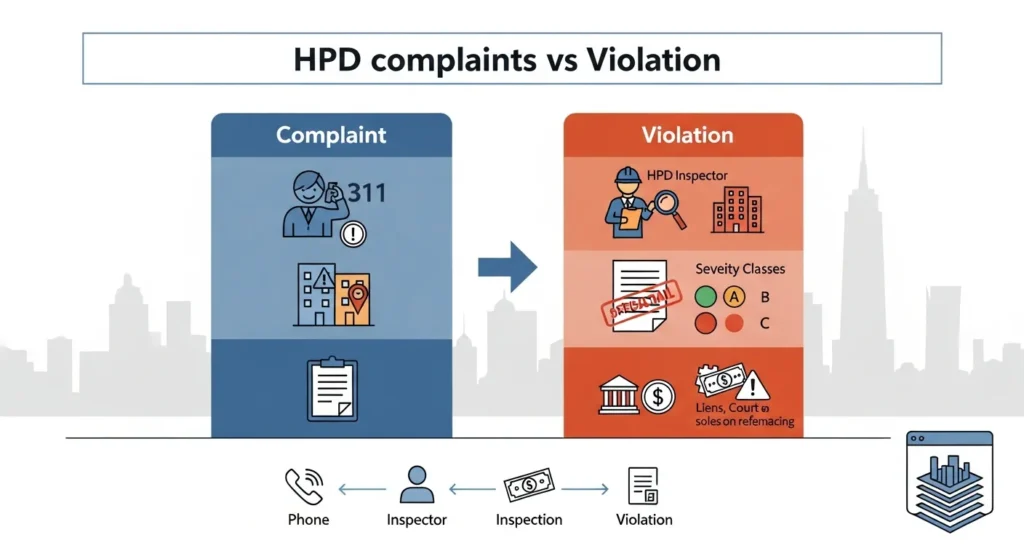
In New York City, the difference between an HPD complaint and an HPD violation can decide how fast a problem gets fixed, whether fines are issued, and even whether a sale or refinance goes through.
We see the same confusion over and over: tenants think that calling 311 automatically means the landlord “got a violation,” and owners assume that if no one is yelling at them, everything is fine. Both are wrong.
In this guide, we break down, plainly, how HPD complaints and violations actually work, how they show up in public records, and what both tenants and building owners can do to stay on top of NYC building violations and overall NYC property compliance.
Understanding HPD’s Role In Housing Enforcement
HPD As The City’s Housing Watchdog
The New York City Department of Housing Preservation and Development (HPD) is the main agency enforcing the Housing Maintenance Code for most residential buildings. If you rent an apartment in a multifamily building, or you own one, HPD is the watchdog making sure that basic living standards are met.
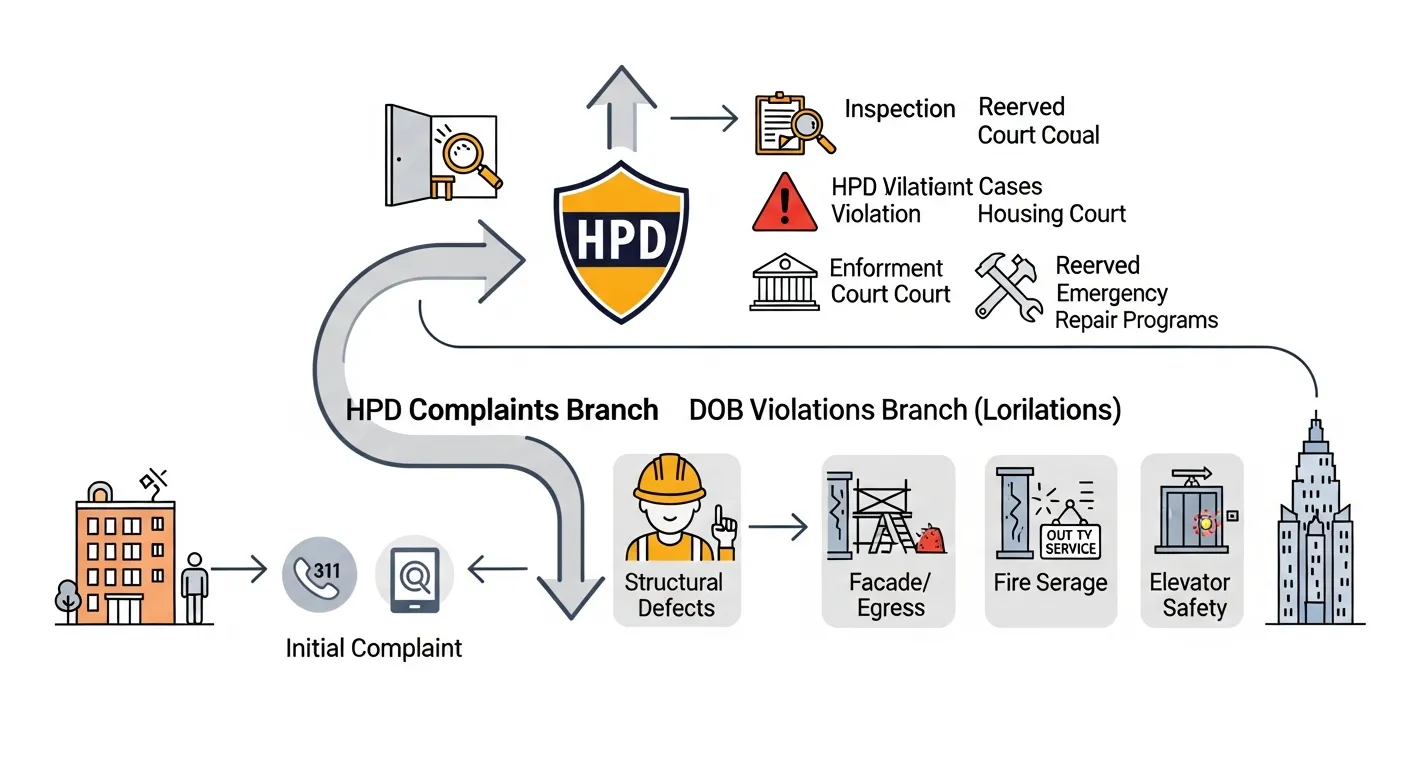
According to HPD and the NYC Administrative Code, the agency is responsible for:
- Responding to housing condition complaints (often via 311)
- Inspecting apartments and common areas for code violations
- Issuing HPD violations when the Housing Maintenance Code isn’t met
- Bringing enforcement cases in Housing Court when owners don’t comply
- Running emergency programs to make repairs when conditions are dangerous
What HPD doesn’t do is just as important. HPD doesn’t deal with structural zoning issues (that’s usually the Department of Buildings), and it doesn’t referee every landlord–tenant dispute that’s really about rent, roommates, or noise.
How HPD Coordinates With 311, DOB, And Other Agencies
The front door for most HPD complaints is NYC’s 311 system. A tenant calls or files online. 311 routes housing-condition issues, heat, hot water, leaks, pests, broken doors, lead paint, to HPD. Other issues, like structural defects, illegal construction, or elevator safety, often get routed to the Department of Buildings (DOB).
In practice, we see the same building show up in multiple systems:
- 311 logs the complaint.
- HPD inspects for housing conditions and issues HPD violations.
- DOB handles DOB violations related to construction, egress, façades, and other building-code issues.
HPD and DOB data then feed into public databases, like HPD’s own online violation search, the city’s NYC Housing Maintenance Code info, and real estate research tools, which lenders, buyers, and even brokers check as part of due diligence.
That’s why understanding HPD complaints vs violations isn’t just a tenant issue. Owners and buyers who ignore this data can run into surprises at closing, with insurers, or with banks asking why open violations haven’t been cleared.
What Is An HPD Complaint?
Definition And Purpose Of An HPD Complaint
An HPD complaint is simply a report, a signal that something might be wrong.
When someone calls 311 to say, “We don’t have heat,” or “There’s mold in my bathroom,” that becomes a housing complaint routed to HPD. On its own, a complaint does not mean HPD has confirmed a violation or that the owner has legal liability yet.
The purpose of a complaint is to:
- Alert HPD to potentially unsafe or substandard conditions
- Trigger an inspection or review
- Create a record of issues in a particular apartment or building
Think of a complaint as the start of the process, not the outcome.
What Issues You Can And Cannot Report To HPD
HPD focuses on conditions covered by the Housing Maintenance Code. Common HPD complaints include:
- Heat and hot water problems during the legally required heat season
- Leaks, mold, and water damage
- Pest infestations (rodents, roaches, bedbugs)
- Peeling or chipping paint, especially where children under 6 live (possible lead)
- Broken doors or windows, missing locks, or unsecured building entrances
- Broken plaster, damaged walls, missing tiles, or unsafe common areas
Complaints that typically don’t fall under HPD’s direct authority include:
- Disputes about rent amounts (primarily for the courts or rent regulation bodies)
- Noise complaints between neighbors (often handled by NYPD or building management)
- Lease disputes, roommate conflicts, or personality clashes
Those can still be serious, but they’re usually not HPD’s lane.
Who Can File A Complaint And How To Prepare
Anyone affected by the condition can file an HPD complaint:
- Tenants in rent-stabilized, rent-controlled, or market-rate apartments
- Occupants in multifamily buildings (3+ units) and some 1–2 family rentals
- Neighbors concerned about unsafe conditions in another unit or building
Before calling 311, we recommend that tenants:
- Notify the owner or management in writing (email or text is fine). That creates a paper trail.
- Document the problem with photos, videos, or temperature readings (for heat cases).
- Write down dates and times when the condition is worst, e.g., no heat overnight, leak during heavy rain.
When you call 311, be specific: “The bedroom is 53°F at 7 a.m.: we have no radiator heat,” is more useful than, “It’s kind of cold.” Detailed complaints tend to lead to more targeted inspections and clearer outcomes.
What Is An HPD Violation?
Definition And Legal Effect Of An HPD Violation
An HPD violation is an official finding by an inspector that a condition does violate the Housing Maintenance Code. It usually appears as a Notice of Violation (NOV) sent to the owner and recorded in HPD’s public database.
Legally, that NOV:
- States which code section was violated
- Describes the condition HPD observed
- Sets a deadline by which the owner must correct it
- Requires the owner to certify that the condition has been fixed
Once issued, an HPD violation is a binding order, not a suggestion. Unresolved violations can lead to penalties, Housing Court cases, liens, and problems with sales, refinances, and insurance underwriting.
Types Of Violations (A, B, C) And What They Mean
HPD classifies violations by severity:
- Class A – Non-Hazardous
Examples: minor plaster cracks, broken tiles, cosmetic damage.
These usually carry longer deadlines because they don’t pose an immediate threat to health or safety.
- Class B – Hazardous
Examples: certain leaks, lack of self-closing doors, some pest conditions.
These are more serious and come with shorter correction periods.
- Class C – Immediately Hazardous
Examples: no heat, no hot water, certain lead paint hazards, severe leaks or mold, broken entry doors, no gas in the building.
Class C violations often require very fast correction, sometimes within 24 hours, because they’re considered emergencies.
Owners who treat all HPD violations the same way, slowly, end up in trouble. Class C conditions, in particular, can trigger emergency repairs by HPD or fast-tracked court enforcement.
Penalties, Fines, And Court Involvement
If violations aren’t corrected and certified on time, HPD can:
- Seek civil penalties in Housing Court (daily fines that add up quickly)
- Charge inspection fees, often $200, for repeated or uncorrected conditions
- Perform Emergency Repair Program (ERP) work on immediately hazardous conditions and place a lien on the property for the cost
Details on penalties change periodically, but HPD publishes guidelines and FAQs on its Code Enforcement pages. For owners, ignoring an NOV is often more expensive than dealing with the repairs promptly.
Complaints vs Violations: The Key Differences
Process vs Outcome: Report vs Official Finding
The biggest mistake we see is people using “complaint” and “violation” as if they’re the same thing. They’re not.
- An HPD complaint is the report: “I don’t have heat.”
- An HPD violation is the official decision: “HPD inspected and confirmed the heat is below the legal minimum: the owner must fix it.”
Every HPD violation usually starts with a complaint, but not every complaint results in a violation. Sometimes the inspector finds the condition has been fixed already, or that it doesn’t actually violate the code.
Evidence Required And HPD’s Inspection Standards
HPD inspectors don’t rely solely on what tenants or owners say. They:
- Take temperature readings for heat/hot water cases
- Measure moisture, look for visible mold, check for pests
- Verify door locks, self-closing doors, window guards, and other safety items
- Document what they see with notes and sometimes photos
If the inspector can’t access the unit (no answer, locked gate, etc.), they may close the complaint without issuing a violation. That’s a common, and frustrating, reason complaints don’t turn into violations.
For tenants, that means it’s crucial to:
- Be available during the inspection window
- Buzz the inspector in promptly
- Show them every affected area, not just the most obvious spot
For owners, it means being proactive. If you fix a condition before the inspection and have documentation ready, HPD may find no violation, even though there’s still a history of a complaint.
Public Records: How Complaints And Violations Show Up Online
Both complaints and violations leave a digital trail.
- Complaints show patterns of reported problems, useful for tenants shopping for a new apartment and for buyers vetting a building’s history.
- Violations show confirmed code breaches and the owner’s track record of compliance.
Instead of digging through multiple city sites, we prefer to use the NYC violation lookup tool from ViolationWatch, which pulls together HPD complaints, HPD violations, and even DOB violations in one place: NYC violation lookup tool.
For landlords, it’s smart business to monitor your property’s record regularly. For tenants, it’s a way to confirm whether HPD actually issued violations after your complaint.
How The HPD Complaint Process Works Step By Step
Filing An HPD Complaint Through 311
Here’s how the process usually unfolds from the moment someone reports a problem:
- Call 311 or file online.
Choose “housing conditions” or a similar category. Be precise about what’s happening and where.
2. Provide building and unit details.
HPD needs the exact address, apartment number, and best contact info.
3. Describe the condition.
Include duration (“no heat for 3 days”), frequency, and any health risks (asthma, small children, etc.).
The 311 operator logs the complaint, and a case number is assigned. That case feeds into HPD’s Central Complaint Bureau.
What Happens After You File: Inspections And Timelines
Once HPD receives the complaint, the agency:
- Decides whether the issue fits HPD’s jurisdiction
- Prioritizes complaints, giving higher urgency to Class C–type issues like no heat, no hot water, or no gas
- Assigns an inspector and schedules a visit
In emergencies (for example, no heat during a cold snap), HPD aims to inspect relatively quickly, often within 24 hours. For less urgent problems, inspection windows may be longer.
During the inspection, the inspector will:
- Attempt to gain access to the unit and common areas
- Inspect the reported condition and related areas
- Document findings and decide whether the condition violates the code
If the condition does violate the code, HPD issues a violation. If it doesn’t, or if the problem has already been corrected, the complaint may be closed without a violation.
How To Follow Up And Track Your Complaint
Tenants often wonder what happened after they called 311 and never heard back. To track progress, we recommend a few steps:
- Use online lookup tools, like ViolationWatch’s NYC violation lookup tool, to see if violations were issued after your complaint.
- Keep a log of calls, complaint numbers, and HPD letters or notices.
- If the problem persists and no violation appears, file a new complaint and reference prior issues.
For both tenants and owners, continuous monitoring makes a huge difference. Get instant alerts whenever your building receives a new violation, sign up for building violation alerts so you’re not blindsided by enforcement actions or tenant questions.
Staying on top of HPD complaints and DOB violations in real time is one of the easiest ways to avoid small problems turning into expensive, chronic issues.
How HPD Issues, Classifies, And Enforces Violations
How HPD Decides Whether To Issue A Violation
After an inspection, HPD evaluates whether the observed conditions violate specific code sections. They consider:
- Measurable standards (minimum heat, hot water temperature, etc.)
- Visual evidence (mold, leaks, pests, damaged walls, missing hardware)
- Safety risks (broken entry doors, missing window guards where required)
If the inspector determines the condition violates the Housing Maintenance Code, they:
- Record the condition and classification (Class A, B, or C)
- Issue an HPD violation (NOV) to the owner of record
- Enter the violation into HPD’s online system as an open item
Correction Deadlines And Owner Obligations
Every violation comes with:
- A correction deadline (when the condition must be fixed)
- A certification deadline (when the owner must formally certify the correction)
Owners are required to:
- Fix the condition by the correction date
- Maintain records, contracts, invoices, photos, of the repairs
- File certification with HPD, usually online or by mail, stating that the condition has been corrected
If they believe a violation is incorrect, say, the inspector misidentified a unit or the condition wasn’t as described, owners can seek reinspection or pursue administrative remedies. But simply ignoring the NOV isn’t an option.
What Happens If Violations Are Ignored
Uncorrected violations can escalate quickly:
- HPD may return for follow-up inspections.
- Civil penalties can be sought in Housing Court, sometimes daily fines for each outstanding violation.
- For immediately hazardous conditions, HPD can send contractors under the Emergency Repair Program, then bill the owner and place a lien on the property.
Persistent non-compliance can also impact:
- Refinancing, lenders routinely check HPD and DOB records
- Building sales, buyers use violation histories as leverage or walk away
- Insurance, some carriers flag properties with chronic HPD violations
For owners managing portfolios, tools like ViolationWatch make it easier to see HPD violations, DOB violations, and trends across multiple buildings. We’ve seen owners save significant money simply by catching violations early and addressing them before they snowball into court cases.
Rights And Responsibilities: Tenants And Owners
Tenant Rights When Conditions Are Not Repaired
Under New York’s warranty of habitability and the Housing Maintenance Code, tenants have the right to:
- Live in a safe, sanitary, and habitable apartment
- Report problems to 311/HPD without retaliation
- Cooperate with HPD inspections and request follow-ups
- Use HPD complaints and violation records as evidence in Housing Court
If HPD issues violations and the owner still doesn’t act, tenants can:
- Seek repairs and rent abatements in Housing Court
- Combine forces with neighbors for group cases
- Work with legal aid or tenant advocates to leverage HPD’s findings
HPD violations are powerful evidence because they’re objective, third-party confirmations that conditions violate city law.
Owner Obligations To Maintain Safe, Habitable Housing
Owners, for their part, must:
- Maintain buildings in compliance with the Housing Maintenance Code and related regulations
- Provide lawful heat and hot water, functioning plumbing and electricity, and secure entry
- Address HPD complaints proactively, even before an inspector shows up
- Correct HPD violations on time and certify completion
Good owners don’t wait for HPD to knock. They run regular inspections, maintain preventative contracts (for boilers, pest control, etc.), and watch for patterns of complaints.
From a risk-management perspective, monitoring NYC building violations is no longer optional, it’s part of baseline NYC property compliance.
Best Practices For Documenting Problems And Repairs
For tenants, we recommend:
- Keeping a simple log: dates, times, what happened, who you contacted
- Saving screenshots of 311 confirmations and HPD notices
- Taking photos before and after repairs, especially for leaks, mold, or pests
For owners, we recommend:
- Maintaining digital folders by property: complaints, violations, work orders, invoices
- Asking vendors to include violation numbers on invoices when repairs relate to HPD NOVs
- Using monitoring tools, such as building violation alerts, so you see HPD or DOB actions the same day they’re posted
The more organized the records, the easier it is to resolve disputes and show that you acted promptly and responsibly.
Common Scenarios: From Complaint To Violation To Resolution
Heat And Hot Water Problems
This is the classic HPD scenario.
- A tenant calls 311 in January: the apartment is freezing overnight.
- HPD inspects and records indoor temperatures below the legal minimum.
- HPD issues a Class C violation for lack of heat.
The owner now has a very short window to restore legal heat. If they fail, HPD can:
- Seek daily fines
- Refer the case to Housing Court
- In extreme cases, arrange emergency boiler repairs and bill the owner
From a public-records standpoint, repeated heat-related HPD violations in winter will jump out to any buyer, lender, or savvy tenant researching the building.
Pests, Mold, And Water Leaks
Another common pattern:
- Tenants complain about a ceiling leak and visible mold in the bathroom.
- HPD inspects, documents the leak and mold, and issues Class B or Class C violations depending on severity.
- The owner patches the ceiling but doesn’t fix the source of the leak or fully remediate the mold.
HPD reinspects, finds the condition persists, and issues repeat violations or fees. Over time, these HPD violations can become a red flag that the building has chronic water intrusion issues, something lenders and sophisticated buyers take seriously.
Illegal Apartments And Overcrowding
Some conditions, like illegal basement units or partitioned rooms with blocked exits, involve both HPD and DOB.
A typical sequence might look like this:
- Neighbors report overcrowding and blocked exits.
- HPD responds to housing complaints: DOB responds to structural and egress issues.
- HPD may issue violations for occupancy and safety conditions: DOB may issue DOB violations for illegal construction.
These cases can lead to vacate orders, court cases, and steep penalties. Owners who treat them as minor paperwork are often shocked at how quickly enforcement escalates.
In all of these scenarios, both tenants and owners benefit from being able to see the full history of HPD complaints and violations. For free lookups, use our NYC violation lookup tool to see how a building’s story looks on paper before you sign a lease, buy, or refinance.
When To Seek Help Beyond HPD
Indicators That You Need Legal Or Advocacy Support
HPD is powerful, but it’s not always enough on its own. We usually suggest seeking outside help when:
- Multiple HPD complaints and confirmed violations haven’t led to real repairs
- Conditions are so bad that health or safety is clearly at risk
- You’re facing potential displacement due to vacate orders or major work
- You’re an owner dealing with repeated HPD violations or a looming Housing Court case
If you’re unsure, look at the pattern: if the same complaint keeps coming back or HPD violations pile up without resolution, it’s time to bring in backup.
Where To Turn: Legal Aid, Tenant Organizations, And Courts
Resources in NYC include:
- Legal aid organizations that focus on housing law for low- and moderate-income tenants
- Tenant unions and community groups that help organize building-wide responses
- Bar association referral services for owners needing experienced real estate and housing attorneys
The NYC Housing Court website and HPD’s own tenant resources pages list many of these organizations.
For owners, hiring counsel who actually understands HPD and DOB systems, not just generic real estate law, can save a lot of time and money.
Preparing For Court Or Administrative Proceedings
Whether you’re a tenant or an owner, walking into court without documentation is a mistake.
We recommend:
- Printing HPD violation histories and DOB records for the property
- Bringing photos, videos, and logs of conditions or repairs
- Having copies of 311 complaint numbers and any HPD correspondence
Tools like ViolationWatch can help assemble a timeline of HPD complaints, HPD violations, and DOB violations in one place, which is far easier to present than a stack of screenshots from multiple city websites.
The stronger your documentation, the more likely a judge or hearing officer will take your position seriously, whether you’re pushing for repairs or arguing that you corrected violations promptly.
Conclusion
New York City’s housing enforcement system is complex, but the core idea is simple: complaints start the process, violations enforce it.
An HPD complaint is the signal, a tenant, neighbor, or observer saying, “Something’s wrong here.” An HPD violation is the verdict, HPD has inspected, confirmed a code breach, and ordered the owner to fix it.
For tenants, understanding the difference helps set realistic expectations and guides your next steps: document conditions, call 311, cooperate with inspections, and track whether HPD violations are actually issued and corrected.
For owners, the distinction is just as critical. Complaints are early warnings: violations are legal liabilities. Monitoring both is now part of doing business in NYC. Ignoring them can jeopardize financing, sales, and, eventually, the building’s reputation.
Whether you’re renting a studio or managing a full portfolio, staying on top of NYC building violations and broader NYC property compliance doesn’t have to be chaotic. Use public data, organize your records, and lean on tools like ViolationWatch and automated building violation alerts to keep surprises to a minimum.
In a city where every inch of real estate is scrutinized, the buildings that fare best are the ones where everyone, tenants and owners, understands how HPD complaints become violations, and how those violations get resolved.
Key Takeaways
- HPD complaints vs violations are not the same: a complaint is just a report to 311/HPD, while a violation is an official finding that the Housing Maintenance Code was broken.
- Every HPD violation usually begins with a complaint, but many complaints close with no violation if inspectors find no code breach, no access, or that the condition is already fixed.
- HPD violations are legally binding orders with deadlines, classifications (Class A, B, or C), and potential fines, liens, and court cases if owners ignore them.
- Both tenants and owners should monitor HPD complaints and violations in public records, since open violations can affect tenant safety, building reputation, sales, refinancing, and insurance.
- Strong documentation—photos, logs, repair records, and HPD/DOB histories—helps tenants push for repairs and helps owners prove timely compliance when dealing with HPD or Housing Court.
HPD Complaints vs Violations: Frequently Asked Questions
What is the main difference between an HPD complaint and an HPD violation in NYC?
An HPD complaint is a report to 311 that a housing condition might be unsafe or illegal. An HPD violation is the official finding after inspection that the condition actually breaks the Housing Maintenance Code, with deadlines, legal obligations, and potential fines for the owner.
Do all HPD complaints automatically turn into HPD violations?
No. Every HPD violation usually starts with a complaint, but many complaints are closed without violations. This happens if the owner fixes the problem before inspection, the condition doesn’t legally violate the code, or HPD can’t gain access to the apartment or building to verify the issue.
How do HPD complaints vs violations show up in public NYC building records?
HPD complaints appear as reports of alleged problems and show patterns of tenant concerns. HPD violations are recorded as confirmed code breaches with status (open or closed). Both are visible in HPD’s databases and on combined NYC building violations lookup tools that buyers, lenders, and tenants routinely check.
How can an owner clear an open HPD violation from the record?
Owners must repair the underlying condition, then certify correction with HPD by the stated deadline, usually online or by mail. HPD may reinspect. If the work checks out, the violation is marked corrected/closed in public records. Simply fixing the issue without filing certification usually leaves the violation listed as open.
Can HPD complaints or violations affect a sale or refinance of a NYC property?
Yes. Lenders, buyers, and insurers often review HPD and DOB histories. Multiple open or serious Class C HPD violations can raise red flags, delay closings, trigger lender conditions, or reduce sale price. Proactively monitoring and resolving NYC building violations is now a standard part of NYC property compliance for owners.
Can tenants file HPD complaints anonymously, and will it impact their eviction risk?
Tenants can ask 311 not to share their name with the owner, but HPD may still need contact information to schedule inspections. Retaliatory eviction for making good‑faith HPD complaints is illegal in New York. Tenants who suspect retaliation should document timelines and speak with a housing attorney or legal aid group.