
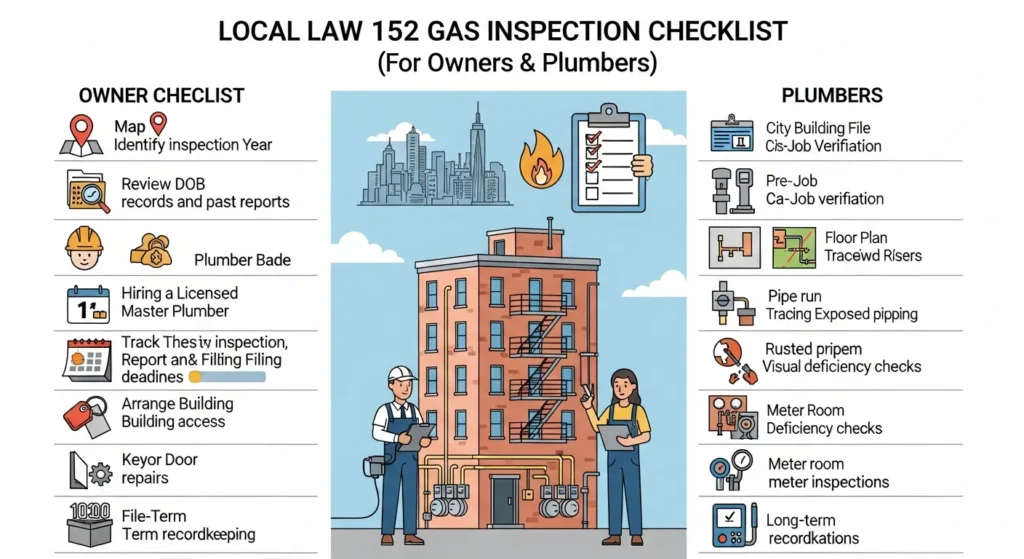
If we own or manage a building in New York City and it has gas, Local Law 152 or LL152 is no longer optional background noise, it’s part of our regular NYC property compliance routine.
The law was written after several high‑profile gas explosions, and it’s designed to force a simple question every four years: is our gas piping system actually safe? For owners, managers, and Licensed Master Plumbers (LMPs), that means clear roles, tight deadlines, and serious penalties if we miss them.
In this guide, we walk through a practical Local Law 152 gas inspection checklist from both sides: what owners must do, and how plumbers should structure the inspection so it passes DOB scrutiny and keeps occupants safe. We’ll cover deadlines, forms (GPS1 and GPS2), common DOB violations, and real‑world tips to avoid last‑minute panic.
What Is Local Law 152 And Who Must Comply
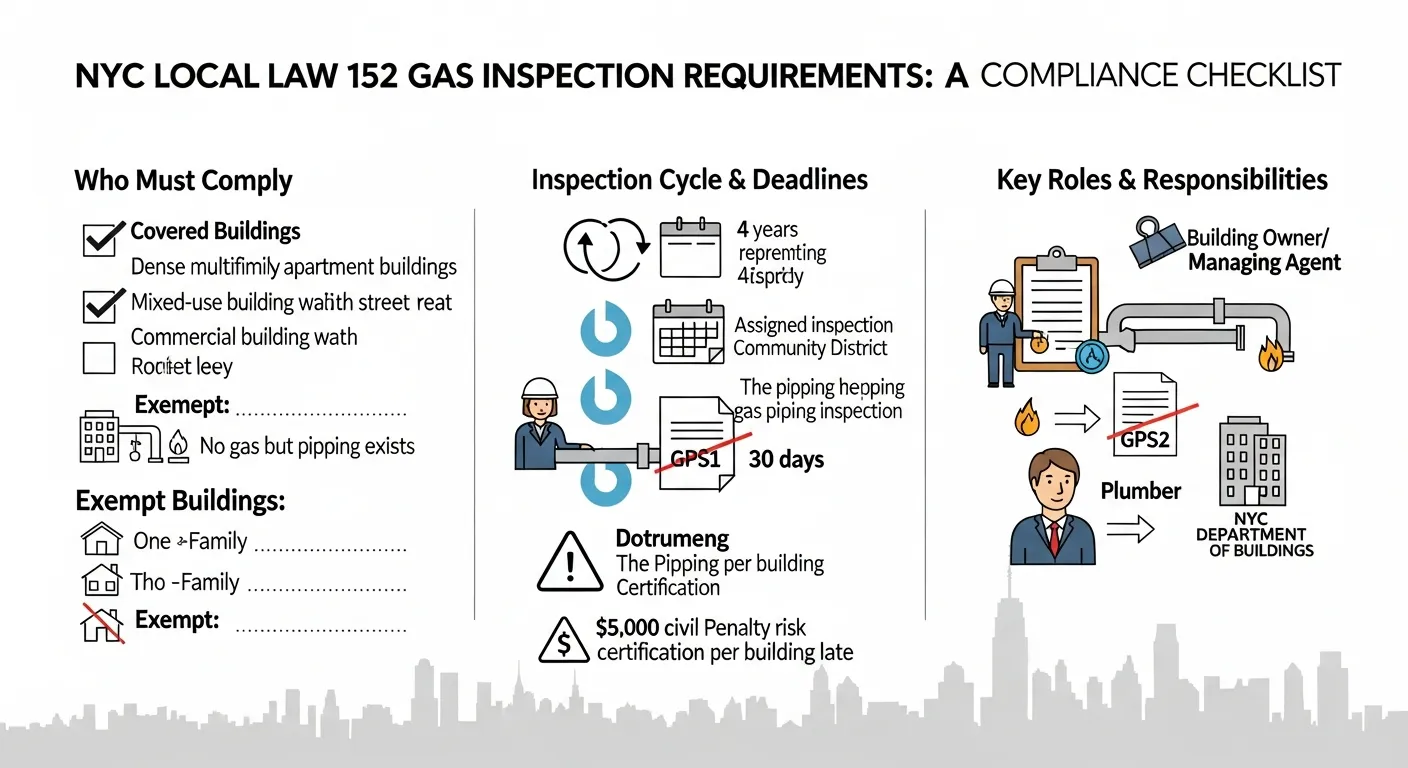
Local Law 152 of 2016 requires periodic inspections of gas piping systems in most New York City buildings. The goal is simple: reduce the risk of gas leaks, fires, and explosions by catching unsafe conditions before they become emergencies.
At its core, the law ties together three big ideas:
- Regular gas inspections by qualified professionals
- Mandatory reporting to the NYC Department of Buildings (DOB)
- Civil penalties if we fail to file on time
The law sits inside the broader 2016 gas safety reforms and is implemented under the NYC Fuel Gas Code and Construction Codes. The DOB’s official overview is here for reference: https://www.nyc.gov/site/buildings/safety/local-law-152.page.
Buildings Covered Under Local Law 152
Local Law 152 applies to almost all buildings in NYC with gas piping, with a key carve‑out:
- Covered:
- Multifamily residential buildings (e.g., typical walk‑ups, larger apartment buildings)
- Mixed‑use buildings (residential plus retail/office)
- Commercial buildings with gas piping (restaurants, offices with gas boilers, etc.)
- Buildings with “no gas” but where a gas piping system exists in any form
- Generally exempt:
- One- and two‑family homes
- Buildings classified in Occupancy Group R‑3 (most small residential buildings that resemble one/two‑family homes)
Even if our building has no gas piping at all, there’s still a burden: we must file a certification stating there’s no gas piping system in the building. The DOB has a specific form for this scenario as well.
For new buildings that received a Certificate of Occupancy after December 31, 2019, the first gas inspection is due 10 years after the CO issuance date, and every four years after that.
Inspection Cycles, Deadlines, And Penalties
The city staggered inspection deadlines by community district so that not every building hits DOB at once. Each community district falls into a four‑year cycle, with inspections required once every four years.
Key timing rules under Local Law 152:
- Inspection frequency:
- Once every 4 years for each covered building
- During the inspection year:
- The inspection must take place within the calendar year assigned to our community district.
- After the inspection:
- Our Licensed Master Plumber (LMP) must give us the Gas Piping System Periodic Inspection Report (GPS1) within 30 days of the inspection.
- We, as the building owner, must file the Gas Piping System Periodic Inspection Certification (GPS2) with DOB within 60 days of the inspection date.
If we miss that certification deadline, DOB can impose a $5,000 civil penalty per building. In practice, that means a single forgotten file upload can cost as much as a serious HPD complaint or multiple ECB violations.
The current rules and forms are linked on the DOB site here: https://www.nyc.gov/site/buildings/industry/local-law-152.page.
Key Roles: Owners, Plumbers, And Licensed Master Plumbers
Local Law 152 divides responsibility clearly.
Building Owners / Managing Agents
We’re responsible for:
- Confirming when our building must be inspected (based on community district)
- Hiring and scheduling a qualified Licensed Master Plumber or LMP’s designee
- Providing access to all spaces with exposed gas piping
- Receiving and reviewing the GPS1 report within 30 days
- Filing the GPS2 certification with DOB within 60 days
- Correcting violations within mandated timeframes (often 120–180 days)
- Keeping records for 10 years, ready for DOB review
Licensed Master Plumbers (LMPs)
LMPs are the only professionals allowed to sign and seal the inspection certification. Their role includes:
- Personally performing, or supervising, the gas piping inspection
- Ensuring work complies with NYC Construction Codes and the Fuel Gas Code
- Documenting all deficiencies, DOB violations, and unsafe conditions
- Providing the GPS1 report to the owner within 30 days
- Signing and sealing the GPS2 that we file with DOB
If we’re plumbers or LMPs, Local Law 152 adds real liability. DOB expects us to use professional judgment, calling out unsafe conditions even when they’re not spelled out line‑by‑line in the code.
Tenants and building staff also play a supporting role: granting access, following safety instructions, and reporting gas odors early so we aren’t blindsided by emergencies during an inspection.
To help stay ahead of potential DOB violations and missed filings, many owners now rely on ViolationWatch (https://violationwatch.nyc/) to track open issues, HPD complaints, and new enforcement activity across their portfolios.
Pre‑Inspection Preparation For Building Owners
We can make Local Law 152 inspections painless, or painful, based on how we prepare. Scrambling on the day of the visit with locked mechanical rooms and no access to meter rooms is how inspections get rescheduled and timelines slip.
Here’s how we get organized before the plumber ever steps on site.
Confirming Your Building’s Inspection Due Date
Our first job is to figure out when we’re due.
We should:
- Identify our community district.
Use NYC Planning’s community district maps or the City’s online tools.
2. Check DOB’s Local Law 152 schedule.
DOB publishes which community districts must inspect in which calendar year.
3. Confirm building classification and CO dates.
Look at our Certificate of Occupancy and DOB NOW / BIS records to see if we’re a new building (CO after 12/31/2019), and whether we fall under R‑3 or a covered occupancy group.
As part of broader NYC property compliance, this is also a good time to scan for any existing DOB violations tied to gas work so we’re not surprised after the inspection.
Choosing A Qualified Licensed Master Plumber
Local Law 152 inspections must be performed by an NYC Licensed Master Plumber or a qualified individual working under the LMP’s supervision, with the LMP eventually signing and sealing the filing.
When we vet an LMP for Local Law 152 work, we should:
- Confirm license status via DOB’s license search tool
- Ask about their Local Law 152 experience specifically, this isn’t the same as a standard service call
- Clarify pricing: does it include the inspection, GPS1, and GPS2 completion?
- Confirm availability within our inspection year and our internal deadlines
Good LMPs treat Local Law 152 more like an audit than a casual look around the building. That mindset matters.
Gathering Records, Plans, And Previous Inspection Reports
We want our plumber to see the full picture, not guess.
Before the visit, we should assemble:
- Prior GPS1 and GPS2 documents
- Gas riser diagrams and floor plans showing gas piping
- Any work permits and sign‑offs for gas work in recent years
- Records of past gas leaks, Con Edison shutoffs, or emergency repairs
This gives the LMP context: they can spot recurring issues and double‑check that prior DOB violations were properly resolved.
Notifying Tenants And Planning Access To Apartments
Inspections focus on exposed gas piping, not private life. Local Law 152 generally does not require LMPs to enter apartments that don’t have exposed building piping.
Still, in many multifamily buildings, gas risers or meter manifolds run through:
- Basement storage areas
- Utility closets
- First‑floor commercial spaces
- Occasionally, apartment kitchens or service rooms
We should:
- Send written notice to tenants and commercial occupants well in advance
- Clarify whether LMPs will need access to individual units or just common areas
- Coordinate with superintendents and porters to unlock:
- Boiler/mechanical rooms
- Meter rooms
- Cellars and subcellars with piping
Clear communication cuts down on HPD complaints, since tenants are more cooperative when they know why inspectors are present.
Safety And Access Checklist For Owners
Before inspection day, we can run through a simple safety and access checklist:
- Ensure the LMP has unlocked access to all areas with exposed gas piping
- Clear pathways to:
- Boiler rooms
- Mechanical spaces
- Meter rooms
- Provide current floor plans and utility layouts
- Confirm adequate lighting in mechanical and storage areas
- Make sure inspections can occur during reasonable hours to limit tenant disruption
- Verify building staff know the schedule and are available to escort the LMP
For extra protection, many owners use building violation alerts (https://violationwatch.nyc/register/) to get notified when new DOB violations or HPD complaints hit, so LL152 issues don’t get buried in the day‑to‑day paperwork. Get instant alerts whenever your building receives a new violation, sign up for real-time monitoring with building violation alerts.
Local Law 152 Inspection Scope: What Plumbers Must Check
From the plumber’s side, Local Law 152 is a structured, visual, non‑destructive inspection of the building’s gas piping system. It’s not a pressure test and doesn’t automatically trigger a gas shutdown, unless unsafe conditions are found.
Gas Piping Systems And Components Subject To Inspection
Under Local Law 152, the LMP must inspect all exposed gas piping starting at the point where gas enters the building, including:
- Piping connected to building service meters
- Piping in:
- Public corridors and stairwells
- Basements and cellars
- Mechanical and boiler rooms
- Meter rooms and utility rooms
- Any exposed piping in common areas or spaces accessible to occupants or staff
If we’re the LMP, we’re not tearing open walls: we’re inspecting what’s visible, accessible, and related to the building’s gas distribution.
Required Visual Inspections Inside The Building
Inside the building, LMPs focus on visible signs of deterioration, improper installation, or tampering.
Typical items to look for:
- Corrosion or rust on piping, hangers, or supports
- Dents, gouges, or mechanical damage to pipes
- Improper supports or sagging lines
- Unapproved materials (e.g., flexible connectors where rigid piping is required)
- Potentially illegal connections to appliances
- Piping running through unprotected or prohibited locations
LMPs should also check for signs that DIY work has been done without permits, often a red flag for future DOB violations during more detailed inspections.
Exterior And Meter Room Inspections
Outside the building and in dedicated meter spaces, we need to examine:
- Any exterior exposed gas piping on facades or rear yards
- Utility meter banks and regulator assemblies
- Supporting brackets and corrosion protection systems
Meter rooms deserve special attention. LMPs should look for:
- Evidence of water infiltration or chronic dampness
- Blocked access to meters or shutoff valves
- Non‑code compliant storage (e.g., flammable materials in the same room)
Gas Leak Detection And Testing Requirements
Local Law 152 explicitly requires LMPs to check for the presence of combustible gas. That typically means using an approved gas detection device during the visual inspection.
But, two important boundaries apply:
- No routine pressure test required. The law does not require pressure testing of the entire gas distribution system.
- No automatic service interruption. The inspection itself does not require shutting off gas service, unless the LMP identifies an unsafe condition.
If combustible gas is detected or an unsafe condition is suspected, the LMP must follow DOB and utility protocols, which can include immediate shutdown and emergency notifications.
Common Code Violations And Deficiencies
From actual field inspections, some issues come up again and again:
- Active or historical gas leaks that weren’t fully repaired or documented
- Corroded piping near wet areas, in basements, or on exterior walls
- Improperly supported piping or missing hangers
- Appliances connected without proper shutoff valves
- Flexible connectors that are kinked, damaged, or not listed for the use
- Piping run through shafts or spaces not allowed by code
- Missing or inaccessible main shutoff valves
When LMPs flag these in the GPS1, DOB treats them as serious, and they can quickly escalate into DOB violations and service interruptions if not corrected on schedule.
To keep track of which properties have open issues, we can use an NYC violation lookup tool (https://lookup.violationwatch.nyc/lookup/) to search open DOB and HPD items before and after Local Law 152 inspections. For free lookups, use our NYC violation lookup tool.
Step‑By‑Step Local Law 152 Inspection Process
A good Local Law 152 inspection follows a predictable sequence. That makes life easier for owners, plumbers, and, most importantly, the DOB plan examiner who may review our filing down the road.
Owner And Plumber Coordination Before The Visit
Before anyone shows up with a gas detector, we should:
- Confirm date, time, and expected duration of the inspection
- Share floor plans and gas riser information with the LMP
- Identify all access points: basements, roofs, mechanical rooms
- Share any known issues, recent gas leaks, open DOB violations, or work in progress
From the plumber’s side, this is when we verify building classification, occupancy, and whether the property is indeed subject to Local Law 152.
On‑Site Walkthrough And Documentation
On inspection day, the LMP (or supervised designee) will:
- Start at the point of entry where gas piping comes into the building.
- Walk the exposed piping through:
- Basements and cellars
- Corridors and public spaces
- Mechanical and boiler rooms
- Meter rooms and exterior runs
- Use a combustible gas detector as needed to check for leaks.
- Photograph and document any deficiencies or suspected DOB violations.
For owners, it’s helpful to have the super accompany the LMP so that any concerns, weeping pipes, old patches, shaky supports, can be pointed out in real time.
Completing The Gas Piping System Periodic Inspection Report
After the site visit, the LMP must complete the Gas Piping System Periodic Inspection Report (GPS1).
Key points about the GPS1:
- It must list all findings: satisfactory conditions, deficiencies, and unsafe conditions.
- It should identify each location clearly (e.g., “Basement boiler room, north wall, 2″ line to domestic hot water heater”).
- It should state whether the overall assessment is:
- No unsafe conditions identified, or
- Unsafe condition(s) requiring corrective action
The LMP must deliver this report to us within 30 days of the inspection. That 30‑day clock is important because our 60‑day DOB filing deadline doesn’t pause.
Filing The Inspection Certification With The City
Once we receive the GPS1, we move to the official DOB filing.
- The LMP prepares and signs the Gas Piping System Periodic Inspection Certification (GPS2), essentially summarizing the inspection outcome.
- We, as the building owner, are responsible for submitting the GPS2 to DOB, typically through the DOB portal, within 60 days of the inspection date.
- There is no DOB filing fee for this certification at the time of writing, but the penalty for missing it remains $5,000.
If violations or unsafe conditions are noted, DOB may expect additional documentation of corrections within 120–180 days. Missing those follow‑up deadlines can lead to more DOB violations, HPD complaints, and even utility shutoffs in severe cases.
Owner’s Post‑Inspection Responsibilities And Timelines
The inspection isn’t the end of the story. For owners, the real work often starts once we read the GPS1 report and see what the LMP found.
Interpreting The Inspection Report: Pass, Fail, Or Unsafe
Local Law 152 doesn’t literally stamp buildings “pass” or “fail,” but in practice we’ll see one of three situations:
- No unsafe conditions identified
- The LMP notes normal wear but no immediate hazards.
- GPS2 is filed, and we’re effectively “clear” until the next cycle.
- Deficiencies that must be corrected
- Issues that aren’t immediately dangerous but violate code or good practice.
- DOB may expect proof of correction within 120–180 days.
- Unsafe condition identified
- Active gas leaks, severely corroded piping, improper installations that could lead to failure.
- The LMP may need to coordinate with Con Edison or National Grid and shut off portions, or all, of the gas service.
We should read the GPS1 line by line and, if needed, schedule a follow‑up meeting with the LMP to prioritize work.
Correcting Defects And Scheduling Repairs
Once deficiencies are identified, we must:
- Engage an LMP (often the same one) to design and perform needed repairs.
- Determine if a DOB work permit is required for the gas work, and obtain it before starting.
- Coordinate with tenants about any planned outages or work access.
Repairs should be done in compliance with NYC Construction Codes and the Fuel Gas Code, including proper pressure testing where required for new work.
Emergency Conditions And Gas Shutoff Procedures
If the inspection reveals an unsafe condition, for example, an active leak or dangerously corroded main, it may trigger an immediate gas shutdown.
Typical emergency steps include:
- The LMP notifying the utility (Con Edison / National Grid) and DOB as required.
- Shutting off gas to the affected area or the entire building.
- Posting notices to tenants and commercial occupants.
- Performing emergency repairs and testing.
In these situations, documenting every step is crucial, both for legal protection and for DOB’s review.
Tracking Deadlines For Corrective Work And Re‑Certification
Plus to the 60‑day GPS2 deadline, we must track:
- 120‑day deadline: Submit certification that conditions identified as requiring correction have been fixed, or
- 180‑day deadline: If more time is needed, submit a follow‑up certification within 180 days showing all conditions fully corrected.
Missing these windows can generate fines and additional DOB violations. To avoid surprises, many owners set calendar reminders for 30/60/120/180 days from the inspection date.
Recordkeeping Requirements And Future Inspections
Local Law 152 has long memory. We’re required to:
- Maintain GPS1 and GPS2 records for at least 10 years.
- Make them available to DOB upon request.
This is especially important when buildings change hands. Buyers increasingly ask for Local Law 152 histories, alongside HPD complaint records, open DOB violations, and gas work permits.
Using a system like ViolationWatch (https://violationwatch.nyc/) helps us centralize this information and monitor for new NYC building violations or HPD issues across our whole portfolio instead of just one building at a time.
Practical Local Law 152 Checklist For Building Owners
To keep things simple, we can treat Local Law 152 like any other recurring compliance item: calendar it, checklist it, file it.
Here’s a practical, owner‑focused checklist to work from.
Administrative And Compliance Checklist
- Identify our community district and inspection cycle year.
- Confirm the building is covered (not one‑ or two‑family, not R‑3 exempt).
- Check our building’s DOB records and existing NYC building violations using an NYC violation lookup tool.
- Hire a qualified NYC Licensed Master Plumber with LL152 experience.
- Confirm the inspection date falls within the required calendar year.
- Clarify who will prepare and sign GPS1 and GPS2.
- Set internal reminders for:
- Inspection date
- GPS1 due date (30 days after inspection)
- GPS2 filing deadline (60 days after inspection)
Building And Tenant Readiness Checklist
- Ensure unlocked access to:
- Boiler and mechanical rooms
- Meter rooms
- Basements and cellars with gas piping
- Clear clutter and storage away from gas piping.
- Provide adequate lighting in utility areas.
- Coordinate with tenants and commercial spaces for any required access.
- Confirm building staff (super, porter) know the schedule and can accompany the LMP.
Post‑Repair And Follow‑Up Checklist
- Receive and review the GPS1 report within 30 days.
- File the GPS2 with DOB within 60 days of the inspection date.
- Schedule and complete corrective work for all deficiencies.
- Submit proof of corrections to DOB within 120–180 days, as required.
- File all GPS1, GPS2, and repair documentation in a 10‑year archive.
- Use building violation alerts (https://violationwatch.nyc/register/) to monitor for any follow‑up DOB violations related to gas work or Local Law 152 filings.
Practical Local Law 152 Checklist For Plumbers And LMPs
For plumbers and Licensed Master Plumbers, Local Law 152 is both an opportunity and a responsibility. A structured process keeps inspections consistent and protects us if DOB ever audits our work.
Pre‑Job Documentation And Verification Checklist
Before we step on site, we should:
- Verify the building address and occupancy classification via DOB records.
- Confirm the property is not exempt (i.e., not a one‑ or two‑family or R‑3 building).
- Review previous GPS1/GPS2 reports if available.
- Obtain floor plans or gas riser diagrams.
- Confirm inspection date, time, and scope with the owner or manager.
- Check whether there are any open DOB violations or known gas issues.
On‑Site Inspection And Testing Checklist
During the inspection, we:
- Start at the building gas entry and trace exposed piping through the building.
- Visually check for:
- Corrosion and rust
- Physical damage or wear
- Improper supports or missing hangers
- Unapproved materials or illegal connections
- Inspect:
- Meter rooms and building service connections
- Boiler rooms and mechanical spaces
- Exterior exposed piping
- Use an approved combustible gas detector where appropriate.
- Document all deficiencies and suspected code violations with photos and clear notes.
- Avoid interrupting gas service unless an unsafe condition requires a shutdown.
Reporting, Filing, And Client Communication Checklist
After the inspection, we should:
- Complete the GPS1 report within 30 days.
- Clearly describe each deficiency and unsafe condition, including location and severity.
- Prepare, sign, and seal the GPS2 certification for the owner.
- Explain our findings to the owner or manager, including:
- Which items are urgent safety issues
- Which are compliance upgrades or best practices
- Expected cost and timeline for repairs
- Maintain professional records of all reports, photos, and communications.
Being thorough here doesn’t just protect us legally: it also helps owners understand why certain repairs can’t wait, and reduces friction when gas service interruptions are unavoidable.
Best Practices To Avoid Violations And Improve Gas Safety
Local Law 152 is a periodic snapshot. The real safety gains happen in the years between inspections, when owners and plumbers build good habits into daily operations.
Design And Maintenance Habits That Reduce Risk
We can lower the odds of future DOB violations by:
- Scheduling internal visual checks of exposed gas piping annually, not just every four years.
- Making sure new gas work is always performed under proper DOB permits with an LMP.
- Avoiding “temporary fixes” that never get fully corrected.
- Keeping gas piping clear of storage, especially corrosive or flammable materials.
- Using code‑compliant materials and following manufacturer instructions on appliances and connectors.
NYC DOB’s gas safety pages (https://www.nyc.gov/site/buildings/safety/gas.page) and HPD’s owner resources (https://www.nyc.gov/site/hpd/services-and-information/property-owner-faqs.page) are useful references when in doubt.
Working With Tenants To Maintain Safe Gas Use
Tenants are often the first to smell trouble, literally.
We improve safety by:
- Educating residents on what to do if they smell gas: don’t light switches, do leave the area and call 911 or the utility.
- Posting simple, multilingual signage in lobbies and common areas with emergency numbers.
- Discouraging unauthorized appliance installations or gas line modifications.
- Encouraging tenants to report gas odors and strange appliance behavior early.
Transparent communication also reduces HPD complaints and creates a better paper trail if DOB ever investigates an incident.
Coordinating Local Law 152 With Other Building Inspections
We can reduce disruption and cost by lining up Local Law 152 with other recurring checks, such as:
- Boiler inspections
- Elevator and façade inspections
- Annual fire safety or sprinkler inspections
Bundling these visits means fewer tenant notices, fewer access headaches, and a more coherent view of the building’s overall risk profile.
We can also align our internal compliance tracking with tools like ViolationWatch (https://violationwatch.nyc/), which consolidate NYC building violations, HPD complaints, and inspection schedules across our portfolio. That way, Local Law 152 becomes one more manageable line item, not a surprise crisis every four years.
Conclusion
Local Law 152 brought gas safety out of the boiler room and into our regular compliance conversations. For New York City building owners, managers, and plumbers, it’s now a core part of how we protect residents and avoid costly NYC building violations.
If we break it down, the law isn’t complicated:
- Know whether our building is covered and when it’s due.
- Hire a qualified Licensed Master Plumber who understands Local Law 152.
- Prepare the building for a thorough, visual inspection of all exposed gas piping.
- File GPS1 and GPS2 on time, then fix what the inspection uncovers.
- Keep records and build good safety habits between inspections.
Done right, Local Law 152 becomes less about chasing deadlines and more about running a safer, more reliable building. We stay ahead of DOB violations, keep tenants safer, and reduce the chances of the kind of gas emergency that makes headlines.
To keep everything in one place, LL152 filings, DOB violations, HPD complaints, and more, we can lean on tools like an NYC violation lookup tool (https://lookup.violationwatch.nyc/lookup/) and portfolio‑wide monitoring through ViolationWatch (https://violationwatch.nyc/). Together with a trusted LMP, those tools help turn a complex gas safety mandate into a clear, repeatable checklist we can actually manage year after year.
Key Takeaways
- Local Law 152 requires most NYC buildings with gas piping to complete a Local Law 152 gas inspection checklist every four years, using a Licensed Master Plumber (LMP) and filing GPS1 and GPS2 on strict 30- and 60-day timelines.
- Building owners must handle scheduling, tenant access, document gathering, GPS2 filing, and long-term recordkeeping, while LMPs perform structured visual inspections of exposed gas piping and formally certify conditions to DOB.
- Pre-inspection prep—confirming your inspection year, hiring an experienced LMP, clearing access to boiler and meter rooms, and notifying tenants—prevents rescheduling, missed deadlines, and avoidable $5,000 penalties.
- During a Local Law 152 gas inspection, plumbers visually review interior and exterior piping, meter rooms, and mechanical spaces, use combustible gas detectors as needed, and document all corrosion, damage, illegal connections, and unsafe conditions that may trigger repairs or gas shutoffs.
- Owners must promptly interpret the GPS1 report, complete required repairs within 120–180 days, maintain 10-year records, and use tools like NYC violation lookup and monitoring services to stay ahead of DOB violations and future inspection cycles.
Local Law 152 Gas Inspection FAQ
What is Local Law 152 and who needs a gas inspection in NYC?
Local Law 152 requires periodic gas piping inspections for most NYC buildings with gas, including multifamily, mixed‑use, and commercial properties. One- and two‑family homes and most R‑3 buildings are generally exempt. Covered buildings must have a Licensed Master Plumber inspect exposed gas piping at least once every four years.
What should be included in a Local Law 152 gas inspection checklist for building owners?
A Local Law 152 gas inspection checklist for owners should cover: confirming your community district cycle, verifying the building is covered, hiring an LMP with LL152 experience, coordinating tenant and staff access, preparing prior GPS1/GPS2 and gas plans, tracking 30/60/120/180‑day deadlines, and maintaining 10‑year inspection records for DOB review.
What do plumbers inspect during a Local Law 152 gas inspection?
During a Local Law 152 gas inspection, the Licensed Master Plumber visually checks all accessible, exposed gas piping from the point of entry through basements, corridors, mechanical and boiler rooms, meter rooms, and exterior runs. They look for corrosion, damage, improper supports, illegal connections, and use a combustible gas detector to check for leaks.
How can I avoid penalties and DOB violations related to Local Law 152 gas inspections?
To avoid penalties, confirm your inspection year early, schedule the LMP visit within that calendar year, and file the GPS2 certification within 60 days of the inspection. Correct all deficiencies within 120–180 days, keep detailed records, and use NYC violation lookup or alert tools to track open DOB or HPD issues.
How much does a Local Law 152 gas inspection typically cost in NYC?
Costs vary by building size, complexity, and provider, but many small to mid‑size multifamily buildings see Local Law 152 gas inspection fees in the low hundreds to low thousands of dollars. Clarify whether the quoted price includes the on‑site inspection, GPS1 report preparation, GPS2 completion, and any reinspection fees.
Do Local Law 152 gas inspections require shutting off gas to the building?
No, a Local Law 152 gas inspection is normally a non‑destructive, visual inspection and does not require automatically shutting off gas. However, if the Licensed Master Plumber finds an unsafe condition—such as an active leak or severely corroded piping—they must follow DOB and utility protocols, which can include partial or full gas shutoff.