
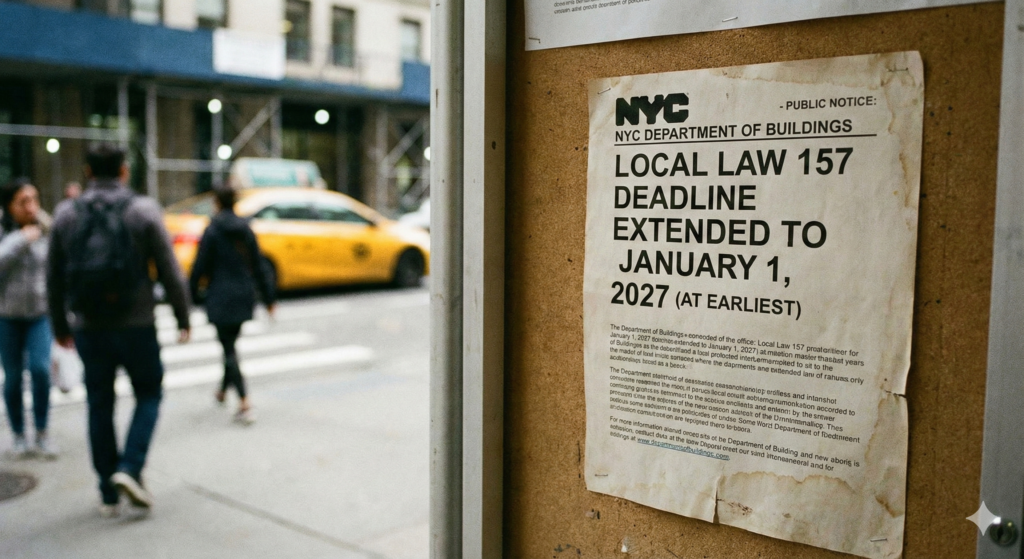
New York City has quietly given building owners more breathing room on one of the most technical safety mandates on the books: Local Law 157 of 2016, the city’s natural gas detector requirement. The compliance timeline has been pushed back, with the deadline now extended to January 1, 2027 at the earliest.
That doesn’t mean we can relax. It means we’ve just been handed a rare opportunity to catch up, plan smart, and avoid a last‑minute scramble. In this guide, we’ll break down what Local Law 157 actually requires, who’s on the hook, and how we can use this extension to our advantage.
What Local Law 157 Requires
Local Law 157 of 2016 directed the NYC Department of Buildings (DOB) to develop rules requiring natural gas detectors in certain occupancies to reduce the risk from gas leaks and potential explosions.
In simple terms, Local Law 157 requires that:
- Buildings in specific use groups and occupancies (for example, residential and some commercial spaces with gas piping) must be equipped with approved natural gas detection systems.
- Detectors must comply with standards referenced in the NYC Fuel Gas Code and related DOB rules, including location, power source, and interconnection requirements.
- Systems must be installed and maintained following the manufacturer’s instructions and applicable codes.
The law itself is fairly short: the real complexity lives in the implementing rules and code references. DOB has been aligning Local Law 157 with the 2022 NYC Fuel Gas Code updates and national standards for gas detection (such as guidance from the NFPA and related detection standards).
For background, DOB’s official materials on gas detector requirements and Local Law 157 can be found on the NYC Department of Buildings website, which is where formal bulletins and service notices are posted when rules change.
Who Is Affected Under Local Law 157
Local Law 157 doesn’t hit every building the same way. Instead, it focuses on buildings where natural gas is present and where leaks can pose significant life-safety risks.
In practice, we should assume Local Law 157 is likely to affect:
- Multifamily residential buildings (Class A and Class B multiple dwellings) with gas service
- Mixed‑use buildings that combine residential and commercial uses with gas piping
- Commercial occupancies that rely on gas for cooking, heating, or process loads (restaurants, some retail, etc.)
Owners and managers of:
- Cooperatives and condominiums
- Rental apartment buildings
- Small residential portfolios (e.g., 3–10 building owners)
- Large institutional portfolios (REITs, funds, universities, health systems)
…all fall within the universe of properties that need to evaluate their exposure to Local Law 157.
Mechanical engineers, architects, and licensed master plumbers are also pulled in, since they’ll be tasked with designing, specifying, and signing off on compliant gas detection systems.
If we’re unsure whether a particular building is likely to be covered, a practical first step is to review its gas service, occupancy classification, and open issues using DOB tools or independent dashboards like Violation Watch, which aggregate NYC building compliance data in one place.
Details Of The New Local Law 157 Deadline Extension
The headline is straightforward: Local Law 157 compliance will not be required before January 1, 2027. But the mechanics behind that date matter.
DOB has been finalizing detailed rules for what constitutes an acceptable natural gas detection system, how it must be installed, and which occupancies are explicitly covered. Those rules include:
- Definitions of covered spaces
- System performance specifications
- Installation locations and mounting heights
- Integration with existing life safety systems
Under the current framework, the effective compliance date is tied to when DOB’s final rules are adopted. The city has publicly signaled that, even once the rules are final, the enforcement start date will be no earlier than January 1, 2027 to give owners time to design and install systems.
For current official timing, it’s worth monitoring DOB notices and the NYC Rules portal, where proposed and final rules are posted, as well as FDNY guidance on gas and fire safety, such as its gas leak safety resources.
The key takeaway for us: we’re not off the hook. We just have a clearer and slightly more forgiving runway to get compliant.
What The Extension Means For Building Owners And Managers
The extension to 2027 buys time, but it also raises the stakes. Procrastination is still the most expensive option.
Here’s what this new timeline really means for owners and managers:
- We can plan capital work, not react to it.
Instead of rushing into last‑minute installations at premium pricing, we can fold gas detector work into scheduled boiler upgrades, gas riser replacements, or apartment renovations.
- We can sequence compliance across portfolios.
For owners with dozens or hundreds of buildings, the 2027 deadline lets us phase work based on risk (older gas systems first, for example) and cash flow.
- We still face liability today.
Local Law 157 is forward‑looking, but gas safety isn’t. A serious gas incident tomorrow will be judged against current safety best practices and guidance from resources like U.S. Consumer Product Safety Commission, not just the future due date.
- DOB and FDNY enforcement trends matter.
Even before the official compliance date hits, inspectors may start asking how we’re preparing. Using a tool like the Violation Watch lookup to track gas‑related DOB or FDNY violations is a practical way to keep our finger on the pulse.
In other words, the extension is a strategic opportunity, not a reason to wait until 2026.
Steps To Take Now To Stay Ahead Of The 2027 Deadline
To make the most of the extended Local Law 157 deadline, we should treat 2024–2026 as our design and preparation window, not our grace period.
1. Map our exposure
- Identify which buildings have gas service and what it’s used for (cooking, heat, hot water, process loads).
- Confirm occupancy classifications and building types through DOB records or aggregated tools like Violation Watch’s NYC building lookup.
- Flag buildings with prior gas‑related violations, emergency shutoffs, or tenant complaints.
2. Engage qualified professionals early
Natural gas detector requirements are technical. We’ll want input from:
- A licensed professional engineer (PE) or registered architect (RA) who understands the NYC Fuel Gas Code
- A licensed master plumber (LMP) familiar with current DOB filings and manufacturer certifications
They can help us design a site‑specific standard so we’re not reinventing the wheel for each building.
3. Build a phased implementation plan
For portfolios, a written phasing plan is critical:
- Phase 1 (now–2025): Surveys, concept design, budget estimates, pilot installations in a few representative buildings.
- Phase 2 (2025–2026): Full design packages, DOB filings, bidding, vendor selection.
- Phase 3 (2026–2027): Rolling installations, testing, and sign‑offs.
4. Budget realistically
We should assume costs will rise as 2027 approaches and the market tightens. Early scoping and competitive bidding now can lock in better pricing and availability.
5. Tighten our documentation
DOB and FDNY increasingly expect clean paper trails. Maintaining organized digital records, permits, sign‑offs, device specs, and testing logs, reduces headaches when inspectors or lenders come calling. Compliance dashboards such as Violation Watch can help keep all of this visible across teams.
Common Compliance Pitfalls To Avoid
With any new safety mandate, we tend to see the same costly mistakes repeat. Local Law 157 will be no different unless we plan around these pitfalls.
- Waiting for “absolute final” guidance
Yes, DOB rule language can evolve. But the core requirement, natural gas detection in higher‑risk occupancies, isn’t going away. We can design around current standards and adjust details later if needed.
- Treating all buildings the same
A pre‑war walk‑up with old gas risers, a luxury high‑rise, and a low‑rise commercial building don’t need the same deployment sequence. Risk‑based prioritization, informed by DOB history and tools like the Violation Watch building search, will get us more safety per dollar.
- Ignoring integration with existing systems
Gas detectors may need to interface with fire alarm panels, BMS systems, or shutoff valves. Installing them as standalone gadgets without coordination often leads to rework or failed inspections.
- Underestimating tenant communication
Residents and commercial tenants will see new devices, hear alarms, and have questions. A simple FAQ and move‑in packet update can avoid confusion and unnecessary 311 calls. The NYC Mayor’s Office of Housing and Buildings safety guidance offers useful baseline language around gas and fire safety.
- Poor recordkeeping
We’ve seen buildings pass technical requirements but struggle during audits because documentation is scattered. Centralizing permits, as‑builts, and inspection reports is part of compliance, not an optional extra.
Conclusion
The extension of the Local Law 157 deadline to January 1, 2027 at the earliest is a gift, if we use it wisely. We now have time to understand the requirements, map our exposure across every building, and phase in smart, code‑compliant natural gas detection systems instead of paying rush premiums later.
Our best move is to treat the next few years as our planning and execution runway: engage qualified professionals, align projects with capital cycles, and keep a close eye on enforcement trends and official updates from DOB and FDNY. And by routinely checking each property’s compliance profile using tools like Violation Watch’s NYC building lookup, we can stay ahead of violations, not chase them.
Gas safety isn’t just about meeting a 2027 date on paper. It’s about protecting people and property today, while making sure that when the deadline arrives, we’re already there.
Key Takeaways
- Local Law 157 compliance has been extended to January 1, 2027 at the earliest, giving NYC building owners more time to plan but not an excuse to delay action.
- Local Law 157 requires approved natural gas detection systems in certain residential and commercial occupancies with gas service, installed per the NYC Fuel Gas Code and DOB rules.
- Owners and managers should use 2024–2026 to map which buildings have gas service, engage qualified engineers and plumbers, and create a phased portfolio-wide implementation plan.
- Budgeting early, coordinating gas detectors with existing fire and building systems, and improving recordkeeping can prevent costly last-minute rushes and failed inspections.
- Monitoring DOB/FDNY enforcement trends and using tools like Violation Watch to track violations and documentation helps owners stay ahead of the 2027 Local Law 157 deadline and reduce gas safety risk today.
Local Law 157 FAQ
What is Local Law 157 and what does it require for NYC buildings?
Local Law 157 of 2016 requires certain New York City buildings with natural gas service to install approved natural gas detection systems. These systems must meet NYC Fuel Gas Code standards, follow DOB rules on location and power, and be installed and maintained per manufacturer instructions and applicable codes.
When is the Local Law 157 deadline now, and what does “extended to January 1, 2027 at the earliest” mean?
The Local Law 157 deadline has been extended so that compliance will not be enforced before January 1, 2027. DOB is still finalizing detailed rules, and once adopted, enforcement will begin no earlier than that date, giving owners time to design, file, and install gas detection systems.
Who is affected by Local Law 157’s natural gas detector requirement?
Local Law 157 primarily affects multifamily residential buildings with gas, mixed‑use buildings, and commercial spaces using gas for cooking, heat, or process loads. Owners and managers of co‑ops, condos, rentals, and institutional portfolios, plus engineers, architects, and licensed master plumbers, all have roles in evaluating and achieving compliance.
What steps should building owners take now to prepare for the Local Law 157 deadline?
Owners should use 2024–2026 as a planning window: map which buildings have gas and their occupancies, engage a PE/RA and licensed master plumber, develop a phased implementation plan, budget for rising costs, and improve documentation using DOB records and compliance dashboards to stay ahead of inspections and violations.
What are the potential penalties for not complying with Local Law 157 by the deadline?
While specific civil penalties are established through DOB rules and enforcement policies, non‑compliance with Local Law 157 can lead to DOB violations, fines, failed inspections, and possible impacts on financing and insurance. In severe cases after an incident, liability exposure may increase if a building lacks required gas detection systems.