
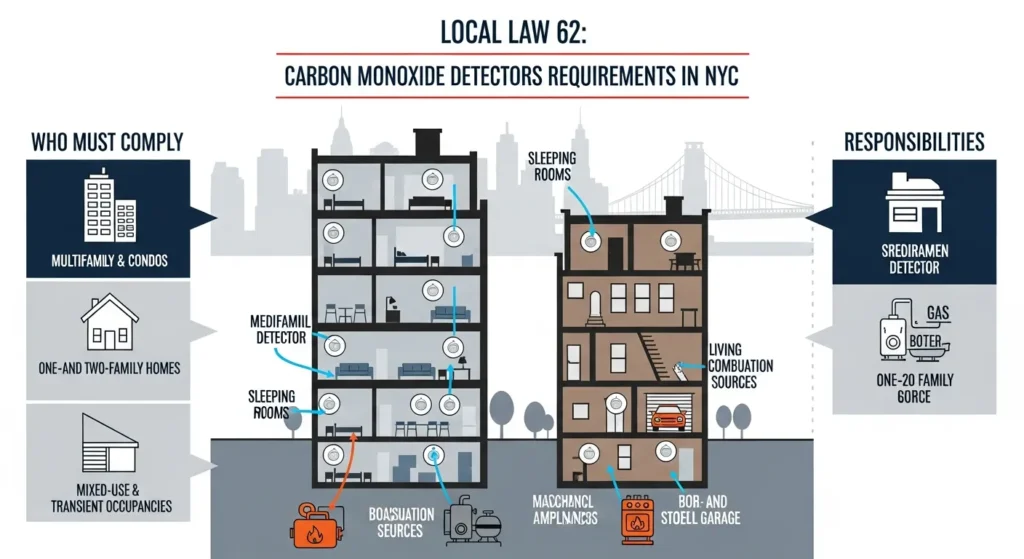
Carbon monoxide is called the “silent killer” for a reason. It’s colorless, odorless, and can build up quickly from everyday equipment, boilers, gas stoves, water heaters, even idling cars in attached garages. In New York City’s dense housing stock, one missed detector can put an entire building at risk.
Local Law 62 of 1981 is one of the backbone laws that shaped how New York City regulates smoke and carbon monoxide (CO) detection in residential buildings. Today, it works together with the NYC Building Code, Fire Code, and Rules of the City of New York to dictate where CO detectors are required, how they must be installed, and what owners and managers need to do to stay compliant.
In this guide, we’ll walk through what Local Law 62 actually covers, how it connects to current NYC building violations and enforcement, and what practical steps we should be taking as owners, managers, or boards to avoid costly DOB violations and, more importantly, protect people in our buildings.
What Local Law 62 Is and Why It Matters
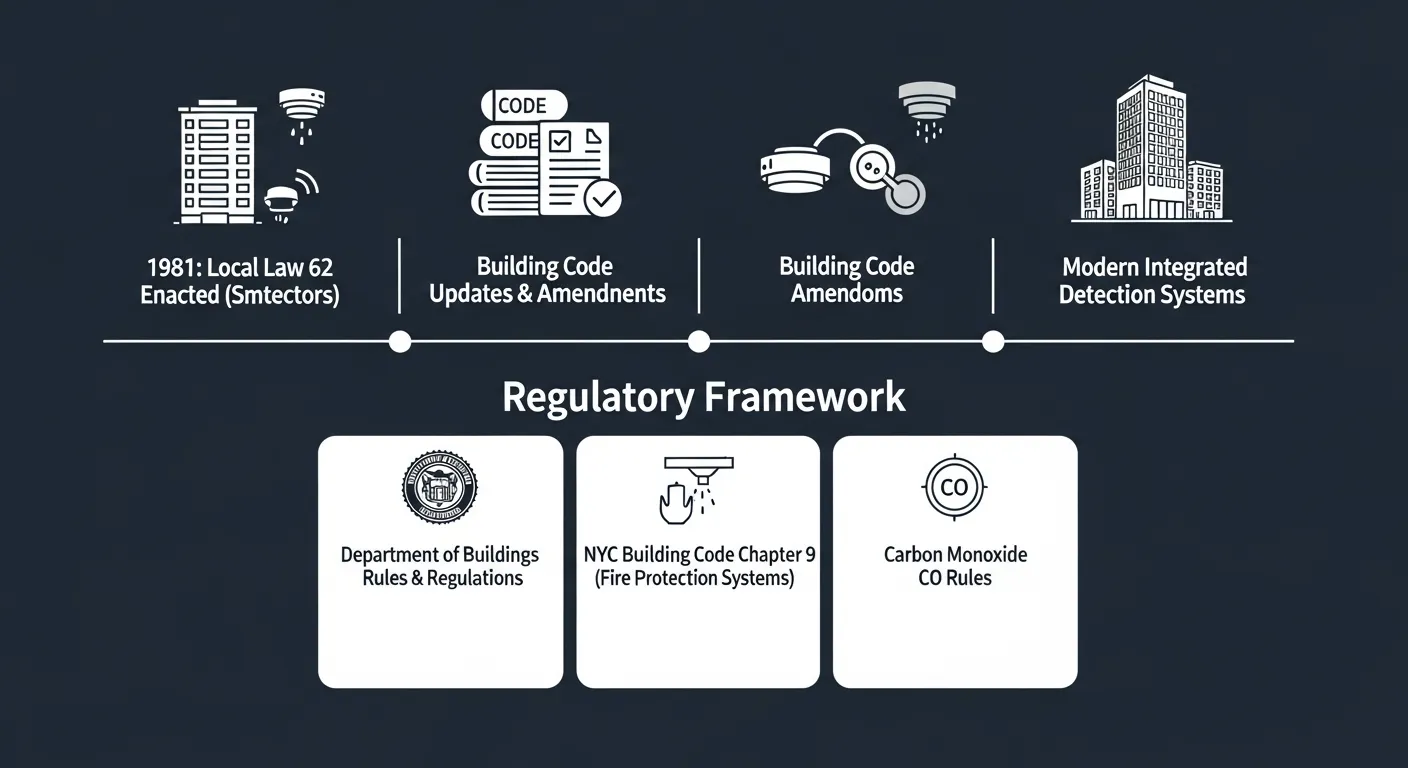
Local Law 62 of 1981 didn’t originally mention carbon monoxide. It was enacted to require smoke detecting devices in all existing dwelling units in specified occupancy groups and set the technical standards for their approval and installation.
Over time, as NYC adopted new building codes and additional local laws (including requirements for CO detection, such as Local Law 7 of 2004), Local Law 62’s framework was folded into the modern regulatory scheme. Today, its concepts live on in:
- 1 RCNY §28‑01, a Department of Buildings (DOB) rule that sets out requirements for smoke detectors and informs how life‑safety detection devices are listed, approved, and installed.
- NYC Building Code Chapter 9 (Fire Protection Systems), including sections that govern CO detectors and alarm systems.
- 1 RCNY 915‑01 (formerly 908‑01), which focuses on CO detection in various occupancies.
In practical terms, Local Law 62 matters because it:
- Established the expectation that every dwelling unit in covered occupancy groups must have listed, properly installed detection devices.
- Tied compliance to national testing standards and independent laboratory listings.
- Helped build the enforcement framework that DOB, HPD, and FDNY use today when they issue NYC building violations for missing or faulty detectors.
For owners and managers, this means CO detection isn’t optional or “best practice” – it’s a critical, enforceable part of NYC property compliance that regulators expect us to understand and carry out.
If we ever want to verify whether a violation exists at a specific property, we can always run a quick check using the city’s systems – or use a third‑party NYC violation lookup tool like this one: NYC violation lookup tool.
Who Must Comply With Local Law 62
Local Law 62 applies broadly to residential occupancies and, through later code provisions, links to CO detection in fuel‑fired appliance rooms and buildings with fire alarm systems. Let’s break down who’s on the hook.
Types of Buildings and Spaces Covered
Local Law 62 was originally aimed at the former J‑1, J‑2, and J‑3 occupancy groups, now essentially the R‑group residential occupancies under the modern Building Code. That includes:
- Multifamily apartment buildings (rental and co‑op/condo)
- One- and two-family homes
- Transient residences such as certain hotels or similar occupancies, when used as dwelling units
Today, when we talk about CO detector requirements that grow out of this framework and the later laws, the rules generally cover:
- All dwelling units in covered residential buildings
- Fuel‑fired appliance rooms (boiler rooms, mechanical rooms with gas‑fired equipment)
- Existing buildings with fire alarm systems, where CO detectors must often tie into the building’s system and meet specific placement standards
If our building has gas or oil‑fired equipment, attached private garages, or any combustion sources, we should assume CO detection is required somewhere, typically in the appliance rooms and in dwelling units near sleeping areas.
Responsibilities of Owners, Managers, and Tenants
Local Law 62 and its successor rules draw a clear line between owner obligations and occupant responsibilities.
Owners and property managers must:
- Provide and install required smoke and CO detectors in all dwelling units and affected spaces.
- Use listed and approved devices that comply with the NYC Building Code and DOB rules.
- Ensure detectors are correctly located, mounted, and, where applicable, interconnected with the fire alarm system.
- Maintain systems in good working order, including replacements at the end of service life.
- Keep adequate records to prove compliance during DOB, HPD, or FDNY inspections.
Tenants/occupants are generally responsible for:
- Day-to-day testing (e.g., pressing the “test” button) as directed by the owner.
- Not disabling or tampering with detectors.
- Promptly notifying owners or management when a detector chirps, fails, or is damaged.
These occupant duties are fleshed out more fully in later laws (like Local Law 7/2004 for CO) and HPD/DOB guidance, but the principle is consistent: owners must install and maintain: occupants must cooperate and report issues.
Where we see problems – and eventual DOB violations or HPD complaints – is often where those roles break down: detectors never installed in the first place, or devices removed and never replaced.
To keep ourselves ahead of enforcement, tools like ViolationWatch make it easier to spot patterns of NYC building violations across a portfolio and tackle issues before they escalate.
Where Carbon Monoxide Detectors Are Required
Local Law 62 itself revolved around smoke detectors, but the modern regime that grew out of it and related local laws now makes CO detection mandatory in specific locations.
Required Locations in Residential Buildings
Under the Building Code and related rules implementing CO detection, we typically must provide CO detectors in:
- Dwelling units in covered residential buildings, particularly:
- In the vicinity of sleeping areas (outside bedrooms or within a certain distance of sleeping rooms, as specified in the Administrative Code and Building Code §915.1.1.1.1 and related sections).
- On each level containing sleeping areas or fuel‑burning appliances, depending on layout and equipment.
- Fuel‑fired appliance rooms that serve residential buildings, such as:
- Boiler rooms with gas- or oil‑fired heating equipment
- Mechanical rooms with fuel‑fired water heaters, furnaces, or generators
In these rooms, listed CO detectors must be installed to detect elevated CO levels and trigger an alarm that complies with Chapter 9 of the Building Code.
In a typical NYC multifamily building with a gas boiler and central corridor fire alarm system, we should expect to see:
- System‑connected CO detectors in the boiler room and possibly other mechanical spaces.
- Standalone or system-connected CO alarms in dwelling units, usually mounted on the ceiling or high on the wall near sleeping areas.
Special Requirements for Commercial and Mixed-Use Buildings
For mixed-use or commercial properties, CO detection requirements depend on how the building is classified and what equipment is present.
Examples:
- A mixed-use building with ground-floor retail and apartments above, served by a shared fuel‑fired boiler, will generally need CO detectors in:
- The boiler/mechanical room
- Dwelling units
- Possibly in certain commercial areas if code‑triggering equipment or occupancies are present
- A commercial property with enclosed parking or fuel‑fired generators may be subject to separate CO detection rules under the Building Code and Fire Code.
The key point is that once a building has fuel‑burning appliances or a fire alarm system, CO detection often becomes part of the required life‑safety package. When in doubt, we should be reviewing current DOB guidance and, if needed, consulting an engineer or fire alarm contractor.
The NYC Department of Buildings maintains up‑to‑date bulletins and rule texts on CO detection and alarm systems on its site: https://www.nyc.gov/site/buildings (search for “carbon monoxide detectors” and “Chapter 9”).
Installation Standards and Technical Requirements
Once we know where detectors belong, the next question is how they must be installed. Local Law 62, 1 RCNY §28‑01, and Building Code Chapter 9 all point us to a technical framework that’s more specific than many owners realize.
Approved Types of Carbon Monoxide Detectors
CO detectors used in NYC must be listed and approved by a nationally recognized independent testing laboratory that:
- Publishes standards for CO detection equipment, and
- Conducts ongoing production inspections of listed devices.
In practice, this usually means detectors bearing listings from organizations like UL, ETL, or similar NRTLs.
Acceptable devices include:
- Single‑station CO alarms (often combination smoke/CO units) for installation in dwelling units.
- Addressable or system‑type CO detectors that integrate into a building’s fire alarm system.
- Combination smoke/CO detectors, provided they’re listed for both functions and installed per NYC rules and manufacturer instructions.
Off‑brand devices purchased online without clear listings or documentation are risky: if an inspector can’t verify listing and compliance, we’re effectively inviting a DOB violation.
Power Sources, Placement Height, and Mounting Rules
NYC’s rules borrow heavily from the smoke detector guidelines in 1 RCNY §28‑01, adapting them for CO detection. Key points:
Power sources
- In many residential buildings, CO detectors must be hard‑wired with battery backup if part of a system, or plug‑in or battery‑powered if permitted by code and installed in dwelling units.
- Replacement detectors should match the required power type unless a code‑compliant upgrade is being done.
Height and location
- CO is roughly the same weight as air and mixes throughout the space. NYC rules generally allow ceiling or high‑wall mounting, as long as we follow manufacturer instructions.
- When mounted on the ceiling, detectors must respect minimum clearances from walls and other obstructions, similar to smoke detector rules in §28‑01.
- Detectors shouldn’t be installed right next to windows, vents, or doors that could cause air currents and delayed detection.
Mounting and environment
- Devices must be mounted securely to resist vibration and tampering.
- Avoid placing detectors in dead-air pockets (e.g., where walls and ceilings meet) or extremely dusty, humid, or high‑heat areas that aren’t designed for detection.
Building Code Chapter 9 and 1 RCNY 915‑01 provide more detailed placement rules for certain occupancies: for complex layouts, we’re usually better off having a licensed fire alarm contractor lay out detector locations.
Interconnection, Audible Alerts, and Accessibility
CO detectors in NYC must provide audible notification clearly recognizable as an alarm. Depending on building type:
- In one‑ and two‑family homes, interconnected alarms (so that when one sounds, others sound) are often required or strongly recommended.
- In multifamily buildings with fire alarm systems, CO detectors may be required to:
- Connect to the fire alarm control panel,
- Trigger audible appliances (horns, speakers) in the unit or common areas, and
- In some cases, activate visual notification appliances (strobes) for accessibility.
For residents with hearing impairments, visual devices coordinated with CO detection may be mandated in certain occupancies. Requirements here align with both the Building Code and the NYC Fire Code, and DOB enforcement has become more active where accessibility-related life‑safety features are missing.
Any interconnection work should be done by a licensed electrician or fire alarm installer and may require DOB filings or amendments. Cutting corners on this piece often shows up later as system‑level DOB violations or even FDNY summonses if an alarm doesn’t function correctly during an incident.
Deadlines, Inspections, and Documentation
Local Law 62 was originally a retrofit law: it pushed detectors into existing housing that previously had none. While its compliance deadlines are long past, the enforcement regime it helped create is very much alive.
Compliance Timelines and Retrofit Requirements
Today, compliance isn’t about a one‑time deadline: it’s about ongoing conformity with the current code. In practice, that means:
- Existing buildings must maintain detectors to the standard in effect for their occupancy and construction class, including later CO requirements.
- Substantial renovations, changes of occupancy, or system upgrades can trigger newer, stricter standards, especially around system‑connected CO detection.
- When we replace detectors at end of life, we’re expected to bring them up to current listing and installation standards.
DOB, HPD, and FDNY conduct inspections through:
- Routine programs (e.g., HPD housing maintenance inspections, DOB audits),
- Complaint‑driven responses, including HPD complaints about lack of working smoke/CO detectors,
- Post‑incident investigations after fires or CO emergencies.
Recordkeeping, Notices, and Proof of Installation
When an inspector shows up, having clean documentation can be the difference between a quick sign‑off and a formal violation.
Best practices include:
- Installation logs documenting when and where detectors were installed or replaced, including model numbers and listing information.
- Contractor invoices or affidavits from licensed electricians or alarm companies confirming work performed under permit or job filings.
- Copies of any relevant DOB filings, sign‑offs, and FDNY approvals for system‑connected detectors.
- Tenant notices or acknowledgment forms where required by HPD rules (for example, smoke/CO detector notices and lease riders).
DOB and HPD both offer online resources explaining smoke and CO detector responsibilities and sample notices, such as:
- HPD’s detector information page: https://www.nyc.gov/site/hpd/services-and-information/smoke-and-carbon-monoxide-detectors.page
- DOB forms and bulletins: https://www.nyc.gov/site/buildings/industry/forms-and-publications.page
We’ve also found it useful to maintain a portfolio‑level view of open violations and detector‑related issues. Services like ViolationWatch make this easier by centralizing NYC building violations data. And if we want to go a step further, we can get instant alerts whenever your building receives a new violation, sign up for real-time monitoring using building violation alerts.
Penalties for Noncompliance and Liability Risks
Missing or nonfunctional CO detectors don’t just draw paper violations: they create real legal and financial exposure, especially after an incident.
Civil Fines and Enforcement Actions
Noncompliance with detector requirements can lead to:
- DOB violations for failure to maintain life‑safety systems, often carrying civil penalties and mandatory correction.
- HPD violations for lack of required smoke/CO detectors in dwelling units, which can lead to civil penalties and court actions in Housing Court.
- FDNY enforcement, especially where system‑connected alarms or fuel‑fired equipment are involved.
Typical consequences include:
- Per‑violation fines that can accumulate across multiple units and buildings.
- Orders to correct within a short timeframe, sometimes requiring permits and professional filings.
- Escalating penalties for failure to correct or repeated findings on reinspection.
DOB and HPD violation histories are public and can affect financing, insurance, and sales. Major real estate publications frequently highlight how persistent NYC building violations can depress values: for example, market analyses by outlets like The Real Deal regularly note the impact of open housing and DOB violations on transaction risk.
Landlord and Property Manager Liability
The more serious risk comes when a CO incident leads to injuries or deaths and investigators find no working detectors where the code required them.
In those cases, owners and managers may face:
- Negligence claims or wrongful death lawsuits.
- Claims that failure to comply with Local Law 62’s framework and later CO laws constitutes negligence per se (violation of a safety statute).
- Higher insurance payouts, premium increases, or policy non‑renewals.
Courts and insurers look closely at:
- Whether detectors were installed in required locations.
- Whether devices were listed/approved and maintained.
- How quickly owners responded to known issues or HPD complaints.
Having clear documentation, regular testing programs, and proof of replacement at end of life can dramatically change how liability questions play out after an incident.
Best Practices for Maintaining Compliance
We can treat Local Law 62 and its successor CO requirements either as a compliance burden or as a framework for a routine safety program. The latter is far easier to live with.
Testing, Maintenance, and Replacement Schedules
A practical program usually includes:
- Regular testing
- At least once a month for common‑area and building‑owned detectors.
- Annual testing and documentation for system‑connected CO detectors, ideally tied to the fire alarm inspection schedule.
- Battery replacement
- For battery‑powered units, follow the manufacturer’s recommendations (often annually), or sooner if chirping begins.
- For sealed 10‑year battery units, track installation dates and replace the entire device at end of life.
- Device replacement
- Most CO detectors have a service life of 5–10 years: after that, sensors degrade and must be replaced.
- Keep a simple spreadsheet or building log noting:
- Location
- Installation date
- Expected replacement date
- Visual inspections
- Check that detectors are not painted over, blocked by furniture, or hanging loose.
- Confirm indicator lights and test buttons are accessible.
By systematizing this, we greatly reduce the chance of surprise NYC building violations tied to neglected detectors.
Staff Training and Tenant Communication
Even the best equipment fails if people don’t understand it. We should:
- Train supers, porters, and building staff on:
- Basic operation and testing of CO detectors.
- How to log checks and replacements.
- What to do when a detector shows a fault condition.
- Educate tenants at move‑in and annually on:
- Their obligation not to disable smoke/CO detectors.
- How to recognize low‑battery chirps vs. full alarms.
- Who to call and what to do if a CO alarm.
- Provide clear written notices and lease riders that reflect HPD and DOB guidance on detectors.
We’ve seen that buildings that formalize this communication tend to have fewer HPD complaints and smoother inspections, because everyone understands their role in maintaining NYC property compliance.
Coordinating With Other NYC Fire and Building Code Requirements
CO detectors don’t exist in a vacuum. To really comply with Local Law 62’s legacy and modern CO rules, we have to look at the whole life‑safety picture.
Aligning With Smoke Detectors and Fire Safety Plans
Local Law 62’s original target, smoke detection, is still front and center in NYC regulation. For most residential buildings, we should be aligning:
- Smoke detector layout (per §28‑01 and Building Code requirements) with
- CO detector placement (per Building Code §915 and 1 RCNY 915‑01), and
- Any required fire safety plans or FDNY notices.
Practical steps:
- When we replace smoke detectors, evaluate whether a combination smoke/CO unit is allowed and makes sense to simplify maintenance.
- Make sure our fire safety and evacuation plans address CO alarms explicitly: what residents should do, where to go, and who to call.
- Coordinate with insurance carriers, who increasingly expect robust smoke and CO detection as part of risk management.
FDNY’s fire safety information pages (https://www.nyc.gov/site/fdny/prevention/fire-safety/for-the-public.page) offer public‑facing guidance we can adapt for tenant communications.
Working With Inspectors and Licensed Professionals
Getting the technical details right often requires professional help. In NYC, that usually means:
- Licensed design professionals (RAs, PEs) who can:
- Confirm code applicability for unique layouts or mixed‑use properties.
- Prepare or amend fire alarm and CO detection plans.
- Licensed electricians and fire alarm contractors to:
- Install and interconnect system‑type CO detectors.
- File any required DOB job applications and coordinate inspections.
- Open communication with inspectors
- During DOB or HPD inspections, walk the inspector through what’s been installed.
- Have documentation ready, logs, invoices, product datasheets.
- Ask clarifying questions if there’s a disagreement and, if needed, consult counsel or a code consultant.
To keep tabs on where we stand at any time, we like to regularly scan our properties for open issues, either through city portals or via a consolidated service. For free lookups, use our NYC violation lookup tool. And if we’d rather not wait for a surprise violation, we can enroll buildings in building violation alerts to catch problems as soon as they’re posted.
Conclusion
Local Law 62 started over forty years ago as a push to get basic smoke detection into New York City’s housing. Today, its framework underpins a more sophisticated system that demands both smoke and carbon monoxide protection across almost every type of dwelling.
For us as owners, managers, and boards, the takeaway is simple: if our building has people sleeping in it, and especially if it has fuel‑burning equipment, we’re expected to have properly installed, listed, and maintained CO detectors in all required locations. Failing to do that isn’t just a paperwork issue: it’s a life‑safety gap that can lead to serious NYC building violations, HPD complaints, and real liability.
The good news is that compliance is manageable when we treat it as an ongoing program rather than a one‑off project. Clear layouts, proper device selection, regular testing and replacement, good records, and transparent tenant communication all go a long way.
Whether we oversee a single brownstone or a city‑wide portfolio, it’s worth taking a fresh look at our CO detection strategy considering Local Law 62’s legacy and the current Building Code. If we find gaps, we fix them now, before an inspector, or worse, an emergency, does it for us.
Key Takeaways
- Local Law 62 created the foundation for today’s carbon monoxide detectors requirements in NYC, making properly listed and installed life-safety detectors a mandatory part of residential property compliance.
- Owners and managers must provide, install, and maintain approved CO detectors in all required dwelling units and fuel‑fired appliance rooms, while tenants are responsible for testing devices, not tampering with them, and reporting problems.
- Carbon monoxide detectors are required near sleeping areas on each relevant level of residential buildings and in boiler or mechanical rooms with fuel‑burning equipment, and often must be interconnected with the building’s fire alarm system in larger or mixed‑use properties.
- To comply with Local Law 62’s legacy framework and current Building Code rules, CO detectors must be nationally listed (e.g., UL, ETL), correctly powered and mounted, periodically tested, and replaced at the end of their 5–10 year service life with clear installation and maintenance records kept on file.
- Failing to meet carbon monoxide detectors requirements in NYC can trigger DOB, HPD, and FDNY violations, significant fines, and serious liability after an incident, so properties should implement a proactive program of regular inspections, staff training, tenant communication, and ongoing violation monitoring.
Frequently Asked Questions About Local Law 62 and Carbon Monoxide Detectors in NYC
What is Local Law 62 and how does it relate to carbon monoxide detector requirements in NYC?
Local Law 62 of 1981 originally required smoke detectors in dwelling units, but its framework now underpins modern NYC rules for both smoke and carbon monoxide detectors. Together with the NYC Building Code and DOB rules, it dictates where CO detectors are required, how they’re approved, and how owners must install and maintain them.
Where are carbon monoxide detectors required under NYC rules based on Local Law 62’s framework?
CO detectors are generally required in dwelling units of covered residential buildings, especially near sleeping areas and on levels with fuel‑burning appliances. They’re also required in fuel‑fired appliance rooms, such as boiler and mechanical rooms, and often must connect to the building’s fire alarm system in properties with central alarms.
Who is responsible for carbon monoxide detectors in NYC buildings—landlords or tenants?
Under Local Law 62’s framework and later CO laws, owners and property managers must provide, install, and maintain approved CO detectors in required locations and keep records. Tenants are responsible for testing as instructed, not disabling devices, and promptly notifying management when a detector chirps, fails, or is damaged.
What are the penalties for failing to comply with NYC carbon monoxide detector requirements?
Noncompliance can trigger DOB and HPD violations for failing to maintain life‑safety systems, and FDNY enforcement where alarm systems or fuel‑fired equipment are involved. Owners can face accumulating fines across units, court actions, orders to correct under tight deadlines, and, after an incident, potential negligence or wrongful death lawsuits.
Do I need carbon monoxide detectors in an all‑electric NYC apartment with no gas appliances?
Even in all‑electric apartments, CO detectors may be required if the building has any fuel‑burning equipment (like a central gas or oil boiler), generators, or attached garages. NYC rules focus on the building’s overall combustion sources, not just the appliances inside a single unit, so owners should confirm requirements with DOB or a design professional.
How often should carbon monoxide detectors be replaced to stay compliant in NYC?
Most carbon monoxide detectors have a service life of about 5–10 years, after which the sensor degrades and the unit must be replaced. NYC expects owners to follow manufacturer instructions and current code standards when replacing devices, upgrade to listed, approved models, and keep logs showing installation and replacement dates for inspections.