
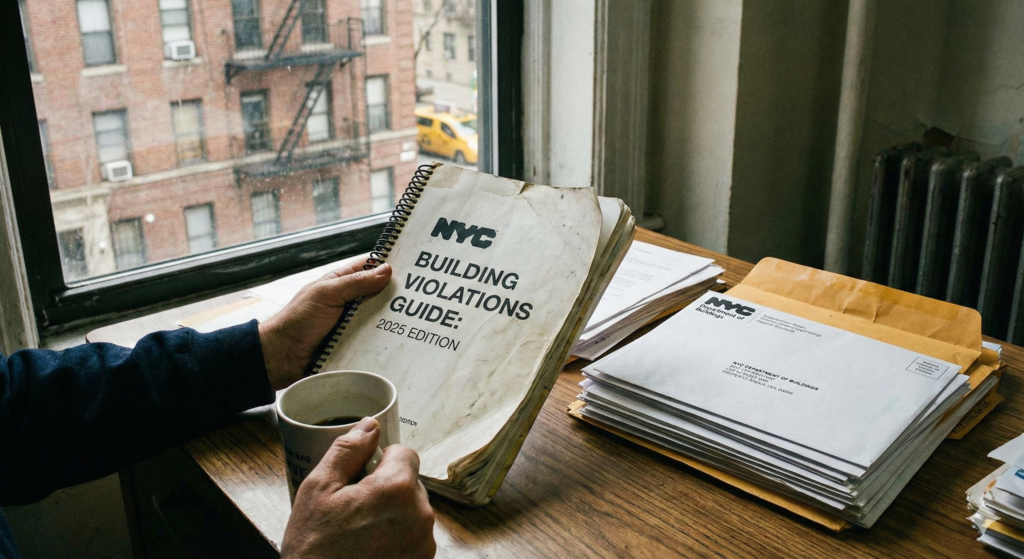
Every property manager in New York City has the same nightmare: a surprise violation that blows up a budget, delays a closing, or triggers a tense call from ownership.
In 2025, enforcement around NYC building violations is only getting tougher. Local Law 97 emissions caps are ramping up, façade and parking structure inspection cycles are tightening, and agencies are coordinating data more aggressively than ever.
In this guide, we walk through how NYC building violations actually work today, which agencies and systems matter most, and how we can build a practical, portfolio-wide compliance strategy. Our goal isn’t theory, it’s to help us avoid preventable violations, manage the ones we do receive, and keep our properties finance-ready year-round.
Understanding NYC Building Violations In 2025
What Counts As A Building Violation In NYC?
In simple terms, a building violation is an enforcement action issued when a property doesn’t meet a legal requirement. In NYC, those requirements come from several codes and local laws, including:
- NYC Building Code and Zoning Resolution
- NYC Housing Maintenance Code
- Fire Code and related FDNY rules
- Local Laws (11, 97, 152, 126, 77, 84/87/88, and others)
Violations can stem from a 311 complaint, an inspector’s routine visit, a construction inspection, or even data reviews (for example, missing energy benchmarking). For property managers, NYC building violations sit at the intersection of habitability, safety, and paperwork. A missed elevator test, an unfiled façade report, or a tenant’s no-heat complaint can all land in the same violation stack.
What’s changed by 2025 is less about new categories of violations and more about enforcement intensity and cross-agency visibility. Failing to file one report today can trip flags across multiple systems tomorrow.
Classes Of Violations: Immediately Hazardous, Major, And Lesser
The Department of Buildings (DOB) categorizes most DOB violations into three main classes:
- Class A – Non-Hazardous
Examples: sign-off issues, minor paperwork or filing errors, certain administrative failures. We typically get 30–60 days to correct. If we miss the deadline, fines escalate and permits can be held.
- Class B – Hazardous
Examples: broken handrails, defective elevator components, unprotected openings. Correction windows are tighter (often 30 days) and the required documentation is more formal. Re-inspections tend to be more aggressive.
- Class C – Immediately Hazardous
Examples: serious façade hazards, illegal gas work, blocked egress, dangerous structural conditions. These must be corrected within 24 hours, and DOB expects a Certificate of Correction with photos, contractor affidavits, and engineer or architect letters where appropriate.
HPD uses slightly different language (A, B, C violations for Housing Maintenance Code issues), but the logic is similar: Class C means conditions that endanger life, safety, or health and require very fast action.
How 2025 Code Updates And Local Laws Affect Violations
Several Local Laws now drive a large share of NYC building violations:
- Local Law 11 (FISP) – Façade inspections and repairs for buildings over six stories. Unfiled reports or unsafe conditions lead to major penalties and, in some cases, sidewalk sheds that stay up for years.
- Local Law 97 – Building emissions limits, primarily for larger buildings over 25,000 sq. ft. In 2025, emissions caps and reporting are tightening, with significant civil penalties for non-compliance. NYC DOB’s climate page details current thresholds.
- Local Law 152 – Periodic gas piping inspections for many multifamily properties. Missed inspection cycles or unfiled reports generate DOB violations.
- Local Law 126 – Parking structure inspections on a set cycle, beginning with certain Manhattan and Brooklyn buildings.
- Local Law 77 – Cooling tower registration and quarterly maintenance/inspection requirements, with heightened enforcement given Legionella concerns.
- Local Laws 84/87/88 – Energy benchmarking, audits/retro-commissioning, and lighting/sub-metering.
For property managers, these laws mean we can’t treat violations as purely reactive. NYC property compliance now depends on a calendar of recurring obligations that are easy to miss if we don’t systematize them.
Key NYC Agencies And Systems Property Managers Must Know
DOB, HPD, FDNY, And DOT: Who Does What?
Multiple agencies can hit a single building with different types of violations:
- Department of Buildings (DOB) – Oversees construction, structural safety, elevators, boilers, gas piping, façade inspections, and Local Law filings. DOB violations often go to OATH/ECB for hearings and penalties. More at nyc.gov/buildings.
- Housing Preservation & Development (HPD) – Enforces the Housing Maintenance Code. HPD violations arise from habitability issues: heat and hot water, pests, leaks, mold, peeling paint, and other conditions commonly driven by 311 complaints.
- FDNY – Handles fire safety and life-safety issues: fire alarms, sprinklers, standpipes, emergency lighting, blocked egress, storage of combustibles, and operational permits.
- Department of Transportation (DOT) – Sidewalks, roadway obstructions, curb cuts, and some scaffolding/street occupancy issues.
Behind the scenes, these agencies share data more than many owners realize, especially for repeat offenders or life-safety hazards.
Key Databases: DOB NOW, BIS, HPD Online, And ACRIS
We can’t manage NYC building violations without working in the core systems:
- DOB NOW – Active system for filings, permits, inspections, and many DOB violations.
- BIS (Building Information System) – The legacy DOB system. Older violations and historical data still live here, so we nearly always check both.
- HPD Online – Shows HPD complaints, open and closed violations, as well as registration status and ownership data. See HPD’s violation portal.
- ECB/OATH – Tracks administrative hearings, defaults, and penalties for many DOB, FDNY, and other agency violations.
- ACRIS – NYC Department of Finance system for deeds, mortgages, and recorded documents. We use it mainly to cross-check ownership and see if violations or compliance issues are tied to recorded covenants or agreements.
How Violation Data Flows Between Agencies
The flow of data matters because it affects our risk exposure:
- A 311 complaint about no heat can become an HPD inspection, a Class C heat violation, and later a Housing Court case if ignored.
- A DOB inspector finding illegal gas work can trigger DOB violations, FDNY involvement, and even utility shutoffs.
- Repeated HPD complaints and violations can flag a building for proactive sweeps or targeted enforcement.
OATH/ECB acts as a sort of clearinghouse for many fines and hearings. Defaults here can turn into judgments collectible through the Department of Finance and, in some cases, show up in title reports.
Housing Maintenance Code And HPD Violations
For multifamily operators, HPD complaints and violations are often the most frequent, especially in winter. Common HPD issues include:
- Heat and hot water outages during legally required periods
- Rodents, roaches, and bedbugs
- Leaks, mold, and chronic plumbing failures
- Broken or missing self-closing doors
- Lead paint and child safety issues
Many HPD violations originate from tenant 311 calls. Our response time and documentation around these service requests often determine whether a complaint dies quietly or escalates into a violation.
DOB Construction, Safety, And Elevator Violations
DOB violations tend to carry bigger price tags and greater operational consequences:
- Work without a permit – Renovations, partitions, or structural changes done without approvals.
- Elevator violations – Missed annual or five-year tests, unsafe conditions, or failure to maintain devices.
- Façade/FISP violations – Unsafe façade conditions, missed filing cycles, or uncorrected reports.
- Gas piping – Failing to comply with Local Law 152 inspection cycles.
Because DOB violations can block new permits and final sign-offs, they can derail capex projects and sales if left unresolved.
FDNY Fire Safety And Life-Safety Violations
FDNY focuses relentlessly on life safety. Violations often arise from:
- Blocked or locked exits
- Non-functional fire alarms, pull stations, or sprinklers
- Missing signage and emergency lighting
- Improper storage of combustibles or hazardous materials
A single FDNY issue in a large mixed-use building can disrupt operations for multiple tenants, from restaurants to offices to retail.
Sanitation, Sidewalk, And Environmental Violations
Outside the building envelope, we’re also exposed to violations from:
- Sanitation – Trash accumulation, improper receptacles, or set-out issues
- DOT – Sidewalk defects, curb ramp issues, and street occupancy
- DEP and DOHMH – Noise, water quality, asbestos, and public health-related issues
Individually, these violations may be smaller, but in aggregate they send a message about management quality and can affect how aggressively agencies respond to more serious complaints.
As we manage all this, tools like ViolationWatch can help us see across agencies by consolidating violation data into a single, property-level view, rather than forcing us to bounce between portals every week.
Most Common Types Of NYC Building Violations
High-Risk Areas In Multifamily, Commercial, And Mixed-Use Buildings
In practice, most NYC building violations cluster in a few high-risk zones:
1. Multifamily buildings
- Heat, hot water, and boiler issues (HPD)
- Pests, leaks, and mold leading to repeat HPD complaints
- Self-closing door failures in fire corridors and stairwells
- Local Law 152 gas inspections and elevator test filings
2. Commercial buildings
- Egress obstructions from storage in corridors, basements, and back-of-house areas
- FDNY violations tied to sprinkler/standpipe systems and alarm impairments
- Local Law 11 façade compliance for mid- and high-rise office buildings
- Local Law 97 emissions compliance for large commercial portfolios
3. Mixed-use properties
- Restaurant exhaust, grease traps, and combustible storage issues
- Sidewalk and curb violations tied to high pedestrian traffic
- Noise complaints (bars, lounges) that can prompt inspections leading to broader building scrutiny
Across asset types, “work without a permit” remains a classic, and avoidable, violation. Unapproved office buildouts, small retail alterations, or in-unit residential renovations done by owners or tenants can all trigger DOB enforcement.
Our job as property managers is to identify these hotspots early, put systems around them, and avoid repeat violations that make buildings stand out as problem properties to regulators.
How To Check For Violations On Your Properties
Using DOB NOW And BIS To Look Up Violations
For DOB-related issues, we almost always start with the address or BIN (Building Identification Number):
- Search BIS – This gives us a historical snapshot: complaint history, old violations, job applications, and ownership data.
- Check DOB NOW – For newer filings, current permits, open inspections, and many post-2018 violations.
- Cross-reference – Open ECB/OATH violations often show as “open” in BIS even after a hearing, until the Certificate of Correction is accepted.
The key is consistency. We should build a habit of scanning DOB NOW and BIS at least monthly for priority properties, and always before launching major construction or closing a transaction.
Checking HPD, FDNY, And ECB/OATH Records
For HPD:
- We use HPD Online to review open housing code violations, complaints, and registration status.
- During heat season, we pay close attention to Class C heat/hot water violations, which can pile up quickly.
For FDNY and other agencies:
- Many FDNY and DOB-related violations appear in OATH/ECB records, along with hearing dates and penalty amounts.
- We verify whether violations are “open,” “in compliance,” or “defaulted” (which means we missed a hearing and likely face higher penalties).
To make this easier across a portfolio, we can centralize lookups. For free lookups, use our NYC violation lookup tool, which pulls data into a single interface and reduces the chance we miss an older, lingering violation: https://lookup.violationwatch.nyc/lookup
How To Run Pre-Acquisition Or Pre-Lease Violation Due Diligence
Before we recommend a purchase or sign a large commercial lease, we should treat violation research as seriously as financial underwriting:
- Pull a full DOB and HPD history for at least the last 5–10 years.
- Check OATH/ECB for open defaults and large unpaid penalties.
- Look for patterns, not just counts, repeated HPD Class C violations for heat, or chronic DOB elevator violations, signal systemic issues.
- Ask for supporting documents from the seller or current owner: sign-offs, Local Law reports, elevator test filings, and emission reports.
We’ve all seen deals delayed because of a “small” open violation, a missed elevator test, an unresolved façade item, a defaulted OATH ticket. Building violation issues can surface late in the process through lender counsel or title review, so we’re better off surfacing them early.
Where we manage multiple buildings, using centralized tools like NYC violation lookup tool and portfolio dashboards saves substantial time versus manual, address-by-address lookups.
Preventing Violations: Compliance Best Practices For 2025
Creating A Property Compliance Calendar
Prevention starts with a calendar. For each building, we should map out all recurring obligations, including:
- Boiler inspections and filings
- Elevator annual and five-year tests
- FISP/Local Law 11 cycles and intermediate parapet observations
- Local Law 97 emissions reporting and planning milestones
- Local Law 152 gas piping inspection deadlines
- Parking structure inspections (Local Law 126)
- Cooling tower quarterly inspections (Local Law 77)
- Annual bedbug reporting and HPD registration
A simple spreadsheet works at small scale, but by the time we manage more than a handful of buildings, automation becomes essential. We want date-driven reminders long before deadlines, plus ownership-level visibility so no one is surprised in Q4.
Inspections, Maintenance Logs, And Required Testing Cycles
Agencies assume that well-run buildings keep good records. We should, too. For each system, we maintain:
- Inspection reports and vendor invoices
- Logs of recurring checks (e.g., weekly boiler logs, monthly sprinkler checks)
- Photos of key conditions before and after repairs
- Copies of permits, sign-offs, and Certificates of Correction
When a violation does occur, this documentation often makes the difference between a reduced penalty and a full fine, or between an “immediately hazardous” classification and something less severe.
Tenant Communication And Complaint-Handling Protocols
Most HPD complaints start with a simple tenant frustration: no response, no update, no clarity. We can reduce risk by:
- Setting clear expectations for work order response times
- Training staff to log all complaints, including after-hours calls
- Following up in writing when repairs are completed
- Proactively communicating during outages or construction
If a tenant does call 311, we want to be able to show HPD, and, if needed, Housing Court, that we responded quickly and reasonably. That’s much easier if our internal systems show timestamps and documented efforts.
Working With Supers, Porters, And Vendors To Avoid Violations
The people on-site see problems before we do. To leverage that:
- We train supers and porters on basic violation triggers: blocked exits, broken self-closing doors, unreported leaks, missing signage.
- We set up a simple reporting channel, text, app, or email, for quick escalation.
- We vet vendors carefully, using only licensed professionals for trade work, and confirm permits before they start.
A surprising percentage of DOB violations trace back to an unlicensed contractor or a “small” job done without a permit. If we make compliance non-negotiable with vendors, we cut this risk dramatically.
For portfolio managers who want an extra layer of defense, building violation alerts can help catch issues as soon as they appear in city systems, before they snowball: https://violationwatch.nyc/register/
Responding To A New Violation: Step-By-Step Process
What To Do The Day You Receive A Violation
The first 24–48 hours are critical. When a new violation hits:
- Confirm the basics – Address, unit (if applicable), date, and violation number.
- Identify the agency and type – DOB vs. HPD vs. FDNY vs. DOT makes a big difference in response.
- Check for hearing dates – OATH/ECB tickets almost always include a hearing date.
- Determine the class – Is it immediately hazardous (Class C)? That dictates whether we have 24 hours or several weeks.
At the same time, we should pull the property’s recent complaint and violation history. Recurring issues require a different strategy than genuine one-offs.
Coordinating With Owners, Attorneys, And Design Professionals
Next, we assemble the right team:
- Owners/asset managers need a quick, factual summary: what happened, what’s at risk, and what we’re doing next.
- Attorneys can advise on whether to challenge the violation, seek adjournments, or negotiate penalties.
- Architects and engineers are often needed for structural, façade, or egress issues.
- Licensed contractors (plumbers, electricians, elevator companies) must handle trade-specific corrections.
We’ve found that fast, organized communication, screenshots of the violation, links to BIS/DOB NOW, and a few photos of the condition, helps everyone move more quickly and coherently.
Correcting Conditions, Filing Certificates, And Closing Violations
From there, we focus on two parallel tracks: physical correction and administrative closure.
- Physical correction
- Remove illegal work, repair unsafe conditions, restore fire separations, fix leaks, or clear egress.
- For DOB/FDNY violations, insist on before-and-after photos and detailed contractor affidavits.
- Administrative filings
- File Certificates of Correction with DOB, HPD, or FDNY as required.
- For OATH/ECB violations, decide whether to contest on the merits, seek a mitigated penalty, or accept and pay.
- Status tracking
- Monitor BIS, DOB NOW, and OATH to confirm that violations flip from “open” or “active” to “resolved” or “closed.”
- Keep digital proof of closure for lenders, buyers, and future compliance reviews.
When we manage multiple properties, doing this manually for every ticket is extremely time-consuming. That’s where centralized tools like ViolationWatch and automated alerts can prevent tickets from slipping through the cracks and turning into costly defaults.
Handling Fines, Hearings, And Settlements
Penalties, Daily Fines, And Default Judgments
NYC’s enforcement model is designed to escalate. If we ignore a violation, the cost curve gets steep fast:
- Base penalties – Set by code and often scaled by building size and violation class.
- Daily penalties – Especially for immediately hazardous conditions or ongoing non-compliance.
- Default judgments – If we miss an OATH/ECB hearing, the city can enter a default at the maximum allowed penalty.
- Tax bill add-ons – Some unpaid fines can be added to property tax bills or sent to collection.
Defaults are particularly dangerous. Once entered, reversing them usually requires formal motions, legal fees, and a strong factual basis.
Navigating OATH/ECB Hearings In 2025
OATH hearings are administrative, but we should treat them as real legal proceedings:
- Preparation – We bring photos, contractor letters, permits, inspection reports, and a concise timeline.
- Mitigation – If the condition is corrected before the hearing, we may qualify for reduced penalties.
- Adjournments – If more time is needed to correct a serious condition, attorneys can often seek an adjournment while work proceeds.
Post-pandemic, many hearings remain virtual, which helps us involve owners and consultants without losing a full day to travel and waiting.
Payment Plans, Reductions, And Amnesty Or Relief Programs
When fines are large, our strategy shifts to damage control:
- Payment plans – We can often arrange installment plans rather than a single lump-sum payment.
- Stipulations and settlements – Especially for repeat violations, agencies sometimes agree to reduced penalties in exchange for clear corrective action and monitoring.
- Amnesty programs – The city periodically runs limited-time amnesty initiatives for older ECB/OATH debt. When these appear, they can save owners significant money, but only if we have a clear, accurate ledger of all outstanding violations.
By keeping organized violation records, we’re in a much better position to take advantage of any relief programs that emerge.
Building A Long-Term Violation Management Strategy
Tracking Open Violations Across A Portfolio
One or two violations at a single building are manageable. The challenge comes when we’re responsible for dozens of assets, each with HPD complaints, DOB violations, and FDNY tickets arriving at different times.
At the portfolio level, we should:
- Maintain a master violation log by building, agency, and status
- Flag immediately hazardous and high-penalty items for executive attention
- Identify frequent flyers, buildings with recurring heat, elevator, or façade problems
This log becomes a core part of our NYC property compliance reporting to ownership and lenders.
Using Software, Dashboards, And Automation
Manual spreadsheets eventually break. Once our portfolio crosses a certain size, it’s time to move to dashboards and automation:
- Automatic data pulls from city systems instead of one-off searches
- Status dashboards showing open vs. closed violations by building and agency
- Email or SMS alerts when new violations are issued or hearings are scheduled
Tools like NYC violation lookup tool and building violation alerts from https://violationwatch.nyc/register/ are built around this idea: we shouldn’t find out about a new DOB or HPD issue from a tenant or a lender: we should see it as soon as it posts.
Training Staff And Embedding A Compliance-First Culture
Technology only works if people use it. To embed a compliance-first culture, we:
- Include violation trends in regular ops meetings
- Share real examples of costly tickets or delayed deals caused by missed filings
- Recognize supers and managers who proactively prevent issues
We’ve seen buildings with similar age and condition have wildly different violation histories. The difference usually comes down to how seriously management takes compliance and training.
Preparing For Future NYC Code Changes Beyond 2025
NYC’s regulatory environment isn’t stabilizing: it’s evolving. In the next few years, we expect:
- Stricter Local Law 97 emissions caps and expanded enforcement
- Possible adjustments to façade and structural inspection rules after high-profile incidents
- More digital integration across DOB, HPD, FDNY, and OATH
Following DOB service updates, HPD rule changes, and credible industry coverage from outlets like The Real Deal helps us anticipate what’s coming. The goal is to adjust our systems before new rules take effect, not scramble after the first wave of violations hits.
Conclusion
Running buildings in New York has always meant living with risk. In 2025, that risk is less about surprise inspections and more about whether we’ve built systems that keep up with an increasingly complex code environment.
If we understand how DOB violations, HPD complaints, and FDNY life-safety rules fit together, and we use the right tools to track them, we can keep most problems small. A living compliance calendar, trained staff, disciplined documentation, and portfolio-level monitoring allow us to stay ahead of violations instead of chasing them.
For day-to-day operations, we recommend putting three habits in place:
- Check violations regularly across DOB NOW, BIS, HPD Online, and OATH/ECB.
- Centralize data so owners, managers, and site staff see the same picture.
- Act fast on new violations, prioritizing life safety and clear documentation.
For free lookups, we can lean on the NYC violation lookup tool at https://lookup.violationwatch.nyc/lookup, and for ongoing monitoring we can sign up for building violation alerts at https://violationwatch.nyc/register/ so we’re notified whenever a new issue hits our properties.
NYC building violations aren’t going away. But with a proactive, systems-driven approach, and platforms like ViolationWatch helping us connect the dots, we can treat violations as a manageable operational reality, not a constant crisis.
Key Takeaways
- In 2025, NYC building violations are driven less by new rules and more by tougher enforcement, cross-agency data sharing, and stricter local law requirements like LL11, LL97, and LL152.
- Property managers should treat NYC building violations as an ongoing compliance workflow by maintaining a detailed calendar of inspections, filings, and testing cycles across boilers, elevators, façades, emissions, gas piping, parking structures, and cooling towers.
- Regular checks of DOB NOW, BIS, HPD Online, and OATH/ECB, ideally through consolidated tools like the NYC violation lookup tool and ViolationWatch, help catch open violations and defaults before they derail projects, closings, or financing.
- Strong tenant communication, trained onsite staff, and disciplined documentation (logs, photos, contractor affidavits, and Certificates of Correction) significantly reduce repeat HPD, DOB, and FDNY violations and support penalty mitigation at hearings.
- A portfolio-wide violation management strategy with centralized logs, dashboards, automated alerts, and a compliance-first culture enables owners and property managers to stay ahead of NYC building violations rather than reacting to costly crises.
NYC Building Violations FAQ for Property Managers (2025)
What are NYC building violations and which agencies issue them?
NYC building violations are enforcement actions issued when a property fails to meet legal requirements under the Building Code, Housing Maintenance Code, Fire Code, and local laws. The main issuers are DOB, HPD, FDNY, DOT, and related agencies, often with penalties handled through OATH/ECB hearings.
How should property managers check for NYC building violations in 2025?
Property managers should regularly search DOB NOW and BIS for DOB violations, HPD Online for housing code issues, and OATH/ECB for open tickets, defaults, and penalties. For portfolio-wide oversight, tools like the NYC violation lookup tool can consolidate data so issues are spotted early instead of during a sale or refinance.
What is the best way to prevent NYC building violations across a portfolio?
Build a detailed compliance calendar for each property, covering boilers, elevators, FISP, Local Law 97, gas piping, parking structures, cooling towers, and HPD registrations. Combine this with consistent maintenance logs, staff training on common violation triggers, documented tenant-complaint handling, and automated alerts when new violations are posted.
What should I do the day I receive a new NYC building violation?
First, verify the address, violation number, agency, and class (especially if it’s immediately hazardous). Check for any OATH/ECB hearing date, pull recent complaint history, and notify ownership. Then coordinate licensed contractors, engineers, and attorneys as needed, and plan both physical correction and required Certificates of Correction or filings.
Can NYC building violations affect financing, sales, or large commercial leases?
Yes. Open DOB, HPD, or FDNY violations and defaulted OATH/ECB tickets can delay closings, trigger lender concerns, and complicate major leases. Lenders and buyer’s counsel frequently flag unresolved elevator, façade, or emissions issues. Thorough pre-acquisition and pre-lease violation due diligence is now a standard part of NYC property underwriting.
How long do NYC building violations stay on record, and can they be removed?
Violations generally remain in systems like DOB NOW, BIS, HPD Online, and OATH/ECB indefinitely as part of the building’s history. You can close or satisfy them, but not erase them. The goal is to correct conditions, file proper documentation, pay or settle penalties, and maintain a clean, “resolved” status for future reviews.