
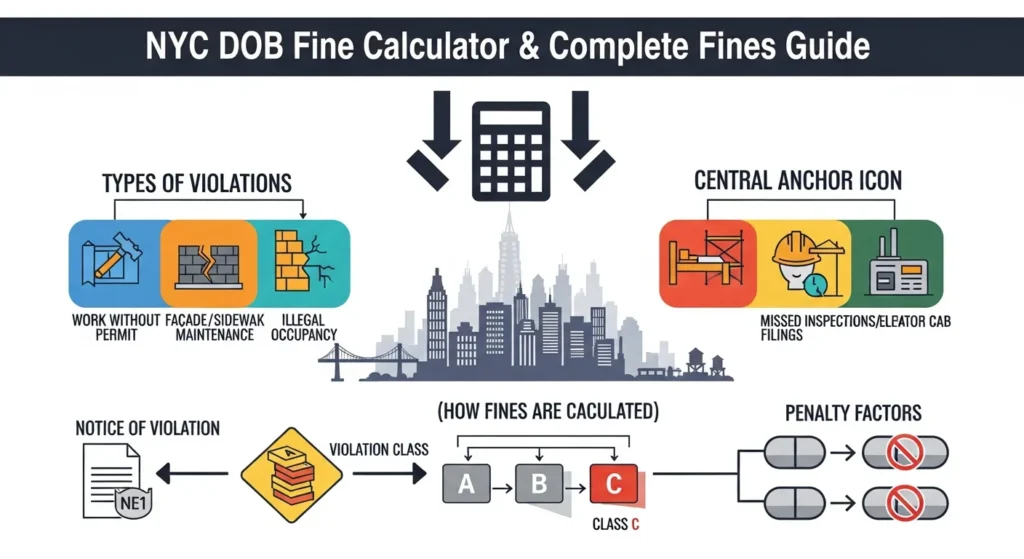
If we own or manage property in New York City, DOB violations and fines aren’t abstract legal concepts, they’re line items that can quickly wreck a budget, delay projects, and even block sales or refinances.
Owners often ask us: “Is there a real NYC DOB fine calculator that tells me what I’ll owe?” The honest answer is no single official calculator exists. But there are reliable ways to estimate our exposure, understand what’s driving the numbers, and, most important, cut those fines down or avoid them altogether.
In this guide, we’ll break down how NYC Department of Buildings (DOB) fines really work, the penalty ranges we see in practice, and a practical step‑by‑step approach to using any DOB fine calculator or worksheet. We’ll also cover how to challenge penalties at OATH, what’s realistic to negotiate, and how to build a compliance system so we’re not constantly fighting fires.
We’ll focus on NYC building violations that most frequently hit small and mid‑size owners: work without a permit, failure to maintain facades and sidewalks, illegal occupancy, missed inspections, and recurring reporting rules like benchmarking and emissions. Our goal is simple: help us translate dense DOB paperwork into clear numbers and decisions we can act on.
What NYC DOB Fines Are And How They Work
The Role Of The NYC Department Of Buildings
The NYC Department of Buildings is the agency that polices how buildings are constructed, maintained, and used. DOB enforces the Building Code, the Zoning Resolution, and a long list of Local Laws, everything from façade inspections to energy grades.
In day‑to‑day terms, that means DOB can:
- Inspect our property after a complaint, accident, or routine sweep
- Issue violations, orders to correct, and stop‑work orders
- Refer cases to OATH (the city’s administrative court) where fines are imposed
DOB’s enforcement power is backed by civil penalties. Those penalties, often referred to as DOB fines, are laid out in rulebooks and penalty schedules, not invented on the spot.
For official background, DOB’s main site is here: NYC Department of Buildings, and hearings are handled through OATH.
Violations vs. Fines vs. Penalties
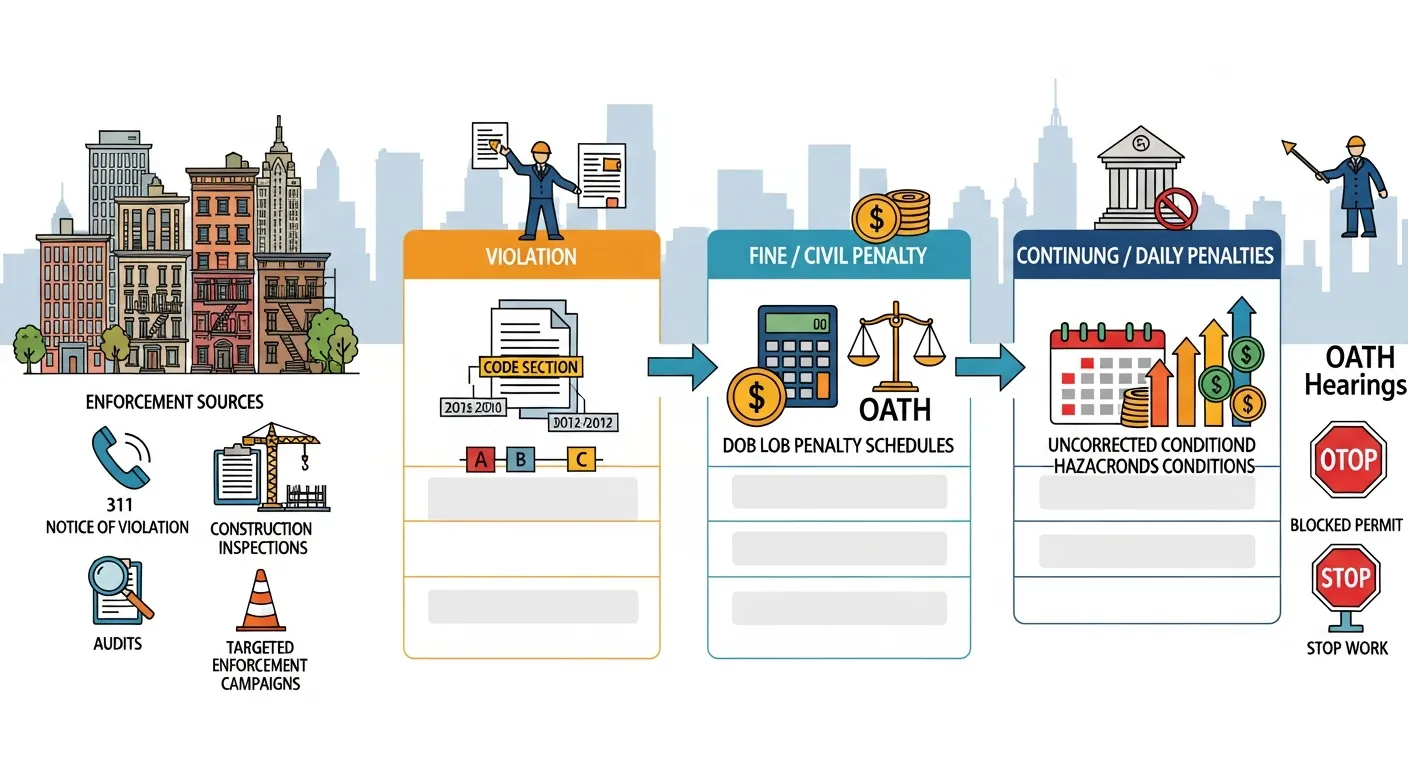
It helps to separate three concepts we tend to lump together:
- Violation (Notice of Violation / summons): the formal document saying we broke a specific code section. It lists the condition DOB observed, the legal citation, a cure date, and a hearing date.
- Fine / civil penalty: the money we owe because of that violation. In most cases OATH, using DOB’s penalty schedules, decides the final amount.
- Continuing / daily penalties: extra fines that accrue every day an immediately hazardous or unsafe condition remains uncorrected. These can dwarf the base penalty if we ignore them.
So the violation is the trigger. The fine is the financial outcome that flows from the violation and the relevant penalty schedule.
How DOB Issues And Enforces Violations
DOB violations usually start from one of four sources:
- 311 or HPD complaints (e.g., leaks, heat/hot water, unsafe conditions)
- DOB inspections of active construction sites
- Audits of filings (sign‑offs, self‑certifications, façade or energy reports)
- Targeted enforcement campaigns (scaffolds, retaining walls, parapets, illegal occupancy)
When an inspector believes there’s a code issue, they issue a Notice of Violation (NOV) or summons. Key features on that document:
- Violation description and code section (e.g., Admin. Code §28‑xxx)
- Classification: Class A – non‑hazardous, Class B – hazardous, Class C – immediately hazardous
- Cure/commissioner’s order date (sometimes allows penalty waiver if corrected on time)
- OATH hearing date, time, and location (or remote hearing instructions)
If we ignore the NOV, don’t correct the condition, don’t certify correction, and don’t show up at OATH, the violation can go into default. Defaults are where fines often jump: the schedule usually sets a higher fixed penalty for no‑show cases.
Open DOB violations can also:
- Block new permits or Certificates of Occupancy
- Trigger additional enforcement (stop‑work orders, vacate orders)
- Lead to higher repeat‑offender penalties on future violations
In parallel, HPD complaints and HPD violations (especially in rent‑regulated housing) create their own set of enforcement and penalties. Even when fines are technically separate, DOB and HPD problems tend to travel together, for example, chronic leak complaints can become DOB structural or façade issues if left unaddressed.
Common Types Of DOB Violations That Lead To Fines
Work Without A Permit
Work without a permit is one of the fastest ways to rack up serious DOB fines. Typical scenarios we see:
- Interior renovations started on a handshake with a contractor, no filings
- Electrical or gas work done as “minor” when it clearly isn’t
- Combining or splitting apartments without proper plans
DOB treats this as a core public‑safety issue. Civil penalties can reach into the five‑figure range per project, especially if there’s structural work, egress changes, or gas piping involved.
Failure To Maintain Buildings And Facades
“Failure to maintain” is a broad category that covers:
- Cracked or spalling façades
- Loose parapets and masonry
- Defective sidewalks and trip hazards
- Bulging retaining walls
For larger buildings subject to FISP/Local Law 11, façade conditions can quickly generate major fines and monthly continuing penalties until a safe condition is restored and properly filed.
Illegal Occupancy And Use Of Space
Illegal occupancy and use cases are common across all boroughs:
- Cellars used as sleeping rooms
- SROs or rooming units carved out of legal apartments
- Multifamily use in one‑ and two‑family districts
- Short‑term rentals that violate use and egress rules
These are often classified as hazardous or immediately hazardous, with thousands of dollars in penalties per illegal unit or condition, plus potential daily penalties.
Construction Safety And Site Conditions
On active jobs, DOB and site safety inspectors focus heavily on:
- Guardrails, edge protection, and netting
- Sidewalk sheds and scaffolds
- Site safety plans and site safety managers where required
- Housekeeping and debris, access ways, and signage
Each missing or non‑compliant safety measure is its own violation, and fines stack quickly. After injuries or incidents, penalties can land at the top of the schedule.
Elevator, Boiler, And Equipment Violations
For existing buildings, recurring equipment violations are a steady source of NYC building violations:
- Missed annual elevator inspections and tests
- Boiler inspections and registrations
- Gas piping inspections under newer local laws
Missed reports typically start in the low hundreds to around $1,000 per missed filing, but repeat violations escalate, and they can interfere with DOB approvals and HPD programs.
Failure To File Required Reports And Inspections
NYC property compliance isn’t just about bricks and concrete anymore. It’s also about paperwork:
- Façade/FISP reports (generally for buildings 6+ stories)
- Local Law 97 emissions limits for larger properties
- Local Law 84 benchmarking and energy grade labels
- Bedbug and other annual housing reports for residential buildings
These programs have fixed, published penalty amounts, $500 for missed benchmarking, $1,250 per quarter for missing energy labels, and LL97 penalties of $268 per metric ton CO₂e above our emissions cap per year.
When we view them as just another notice in the mail, it’s easy to ignore a deadline. When we view them as a clear dollar amount we’ll owe if we’re late, priorities change quickly.
How DOB Fines Are Calculated
Base Fine Schedules And Penalty Ranges
DOB fines aren’t random. They’re governed by penalty schedules adopted by rule, usually cross‑referenced as 1 RCNY (Rules of the City of New York) penalty items and Admin. Code sections.
For most violations, the schedule provides:
- A base penalty range (e.g., $500–$10,000)
- Different amounts by class (A/B/C) and sometimes by building size
- Special rules for defaults or repeated violations
In general, current DOB/OATH ranges we see in practice run from about $100 up to $25,000+ per violation, with the top of the range reserved for immediately hazardous, life‑safety, or large‑building cases.
Many programs have their own separate schedules, for example, façade safety, parking structures, and energy reporting, so a “NYC DOB fine calculator” typically needs to know which schedule applies.
Aggravating Factors: Repeat Or Willful Violations
Base penalties are just the starting point. The rules also spell out aggravating factors that push us toward the higher end of the range:
- Repeat violations of the same condition or code section
- Willful or knowing non‑compliance
- Prior enforcement history at the same property
At OATH, hearing officers look at these factors when setting the final penalty. If DOB’s attorney shows a stack of prior similar violations, our odds of getting the minimum fine shrink fast.
Daily Penalties And Continuing Violations
Some of the harshest NYC DOB fines come from daily penalties. In these cases, the rules say that for each day an immediately hazardous or unsafe condition remains uncorrected, an extra amount accrues.
Examples include:
- Unsafe façade conditions under FISP
- Illegal use/occupancy that blocks legal exits
- Certain construction safety or structural hazards
Typical patterns we see:
- Façade non‑compliance: $1,000–$5,000 per month in continuing penalties, depending on law and cycle
- Illegal occupancy: daily penalties that can reach into the thousands if months go by with no correction
This is where time really is money. Leaving a hazardous violation open for a year can cost more than correcting it in the first month.
Interest, Late Fees, And Default Penalties
On top of base and daily penalties, we’re also dealing with:
- Default penalties: higher fixed amounts when we don’t appear at OATH
- Interest and collection fees when we don’t pay by the Department of Finance deadline
Once a case is in default, options narrow. We may still be able to vacate the default or reopen the case in limited circumstances, but that typically requires quick action and a credible explanation.
This is why we recommend monitoring our properties for new violations in real time. Get instant alerts whenever your building receives a new violation, sign up for building violation alerts so we can deal with problems while mitigation is still on the table.
Using An NYC DOB Fine Calculator Step By Step
Data You Need Before Using A Fine Calculator
Because there’s no single official NYC DOB fine calculator, most owners either:
- Use private calculators or law‑firm tools, or
- Build a simple worksheet that mirrors DOB’s penalty schedules
In both cases, we need the same core data:
- Property BIN, block, and lot
- Violation/summons number
- Code section and violation class (A/B/C)
- Issue date and any cure/commissioner’s order date
- Current status (open, in compliance, cured, default, etc.)
We can pull most of this from DOB’s online systems (BIS and DOB NOW) and from OATH’s summons lookup.
For free lookups, use our NYC violation lookup tool, which pulls from DOB and related city datasets so we’re not bouncing between tabs.
Finding Your Violation Number And Code Section
To estimate fines, we first need to confirm exactly what DOB thinks we did wrong.
- Go to DOB’s BIS or DOB NOW search page and look up the property by address, block/lot, or BIN.
- Open the “Violations” or “Summonses” tab and locate the specific DOB violation or OATH summons.
- Note down:
- Violation number / OATH summons number
- Law code (Admin. Code, Building Code, Zoning, rule number)
- Classification and description
If we’re using a calculator or worksheet, we’ll match this law code against the relevant penalty schedule item.
Entering Assessed Dates, Cure Dates, And Status
Next, we feed timing and status into the calculator:
- Issue date of the violation
- Cure date (if the NOV offers a cure with possible penalty waiver)
- Correction date (when the condition was actually fixed)
- Certification date (when we filed proof with DOB)
- Current status: open, in compliance, cured, or default
A decent NYC DOB fine calculator will then:
- Pull the base penalty range for that law/code section
- Add daily/continuing penalties from the cure date forward, if applicable
- Apply default penalties if we missed the hearing
- Adjust for repeat violations if the history is available
Interpreting The Estimated Fine Output
Whatever tool we use, we should treat the result as an estimate, not a bill.
Why? Because at OATH, hearing officers can:
- Reduce penalties for prompt correction, clean history, or hardship
- Increase penalties for aggravating factors within the schedule
- Dismiss the violation entirely if DOB can’t prove its case
So a good calculator gives us a range, such as: “Base penalty likely $2,500–$5,000, plus up to $3,000 in daily penalties if the unsafe condition isn’t cured by X date.”
We then make business decisions: correct immediately, challenge aggressively, or prepare for settlement negotiations.
When To Confirm Numbers With An Expert
There are plenty of situations where we shouldn’t rely solely on a home‑made sheet:
- Life‑safety issues (facades, structure, gas, egress)
- Multiple open DOB violations across several properties
- Large LL97 or façade penalties that could reach six figures
- Defaults or liens where DOF is already pursuing collection
In these cases, we strongly suggest speaking with a DOB‑savvy attorney, code consultant, or experienced expediter.
Tools like ViolationWatch help us track NYC building violations and get early warnings. But when numbers get big or complicated, an expert who lives in these schedules daily is worth the fee.
Typical Fine Amounts For The Most Common Violations
Work Without Permit Fine Ranges And Examples
For work without a permit, the law often ties penalties to the scope of work and the cost of the missing permit.
Patterns we routinely see:
- Small interior alterations: base penalties in the low thousands
- Structural work, egress changes, or gas work: penalties jumping into the mid‑ to high‑thousands, sometimes approaching five figures
- Repeat or willful violations: amounts pushing toward the $25,000 per‑violation ceiling allowed under parts of Title 28 of the Admin. Code
Example: A landlord legalizes a long‑standing, unpermitted interior reconfiguration in a multifamily building. The permits and professional fees might be $15,000. By the time DOB finishes enforcement, total DOB fines and OATH penalties for work without a permit and related safety violations can easily add another $10,000+.
Failure To Maintain Building Exterior Or Sidewalk
For basic “failure to maintain” conditions (cracked steps, missing handrails, smaller façade defects), penalties often sit in the hundreds to low thousands per violation.
For façade programs like FISP/LL11, things escalate quickly:
- Initial unsafe façade report penalties
- Monthly continuing fines while the condition remains uncorrected
- Additional violations if protection (sidewalk sheds, netting) is missing or inadequate
In real‑world terms, we’ve seen owners pay $1,000–$5,000 per month in façade penalties alone, on top of the cost of the repair project and shed rentals.
Scaffold, Site Safety, And Worker Protection Fines
At active construction sites, DOB and OSHA both care about safety, but DOB’s penalties flow through its own schedules.
Typical ranges:
- Missing guardrails, inadequate fall protection: mid‑hundreds to a few thousand dollars per violation
- No required site safety manager or missing site safety plan: thousands per violation
- Multiple unsafe conditions after an incident: stacked fines that can total tens of thousands across several summonses
Because each unsafe condition is usually its own summons, a single inspection can generate a cluster of penalties.
Illegal Conversions, Cellars, And Short‑Term Rentals
Illegal occupancy and use violations are often treated as hazardous or immediately hazardous, especially where egress is compromised or residential use occurs in spaces not designed for sleeping.
Penalty patterns:
- Base penalties in the thousands per illegal unit or per condition
- Potential daily penalties until the illegal use stops and the space is restored to legal occupancy
An owner who continues to rent illegal cellar apartments, for instance, may see fines multiply over months. Beyond DOB, we also risk enforcement from other agencies, and in a worst‑case scenario, vacate orders that immediately disrupt rent rolls.
Missed Inspections, Filings, And Certificate Issues
Missed filings are where we can actually predict fines with reasonable precision because the law sets fixed dollar amounts.
Examples:
- Benchmarking (LL84): $500 per year for not submitting the annual benchmarking report
- Energy grade labels: $1,250 per quarter for failing to post the required label
- LL97 emissions: $268 per metric ton CO₂e above our carbon cap per year
- Elevator and boiler reports: commonly a few hundred dollars to around $1,000 per missed annual inspection, higher for repeats
Because these are recurring rules, the biggest mistake we can make is to let them slip year after year. Automating reminders and tying them into our NYC property compliance calendar is often cheaper than a single year of missed reports.
Reducing, Challenging, Or Dismissing DOB Fines
Understanding Your Notice Of Violation (NOV)
Whenever we receive a DOB NOV, we should read it like a contract. Every line matters.
Key items to check:
- Correct party: Is the right owner or entity named?
- Location and description: Does it match our property and the actual condition?
- Law and code section: Some have different penalty schedules or cure options
- Class: A, B, or C drives both the fine and whether daily penalties apply
- Cure by date and instructions: Some violations allow us to fix and certify correction to avoid a hearing and sometimes avoid penalties entirely
Newer owners often miss the cure language buried in the middle, then find out later they could’ve avoided the OATH process.
Curing The Violation Before The Hearing
If the NOV allows, curing before the hearing is one of the most powerful tools we have.
Typically this means:
- Correcting the physical condition (e.g., pulling a permit, completing repairs, restoring legal occupancy).
- Assembling proof: contractor affidavits, dated photos, permits and sign‑offs, engineer/architect letters if needed.
- Submitting a Certificate of Correction package to DOB with all required forms.
If DOB accepts the cure and the rules allow penalty waiver, the associated DOB fine can be heavily reduced or avoided.
Attending Hearings At OATH And What To Expect
When cure isn’t available or we miss the cure window, the case goes to OATH.
At an OATH hearing, we can:
- Admit the violation but seek a lower penalty (mitigation)
- Contest the violation entirely and require DOB to prove its case
- Present evidence of correction, impossibility, or prior condition
Hearings are typically short, often 15–30 minutes, but preparation matters. Bringing disorganized photos and vague explanations is a recipe for paying the maximum scheduled penalty.
Grounds For Reductions, Mitigation, Or Dismissal
There are several common paths to lower or eliminate DOB fines:
- Mitigation: Showing prompt correction, no prior history, and good‑faith efforts can move us toward the lower end of the penalty schedule.
- Impossibility or lack of control: In limited situations (e.g., we truly lacked legal access to the space), we may argue we couldn’t correct.
- Incorrect party or address: If DOB named the wrong entity or premises, dismissal may be appropriate.
- Condition not as described: Strong factual proof that the violation condition didn’t exist or was misdescribed.
- Cure accepted: If DOB accepted a cure and the rules say penalties are waived, we can use that to argue against assessed fines.
The details of what’s persuasive can vary by hearing officer, which is another reason experienced representation can pay off.
Paying Fines, Settlements, And Payment Plans
Once OATH issues a decision, the case usually moves to the Department of Finance for collection.
At that point, our options include:
- Paying in full by the deadline to avoid interest and additional collection actions
- Requesting a payment plan in some circumstances, especially for large aggregated penalties
- Exploring whether any settlement programs are available for older or specific classes of violations
Ignoring outstanding DOB fines is risky. They can grow with interest, interfere with future DOB filings, and surface in due diligence when we try to sell or refinance.
To stay ahead of enforcement, we prefer to track issues across our portfolio in one place and act early. That’s where tools like ViolationWatch and automated building violation alerts make a practical difference: they give us time to cure, contest, or negotiate before penalties peak.
Preventing Future DOB Fines
Creating A Compliance Checklist For Your Property
The most reliable DOB fine calculator, in our view, is the one that outputs $0 because we stayed compliant.
We start by building a simple, property‑specific checklist that covers:
- Permits and sign‑offs on all active and recent jobs
- Cyclical inspections: façade/FISP, parking structures, parapet observations
- Annual reports: boilers, elevators, gas piping
- Energy rules: LL84 benchmarking, LL33 energy grades, LL97 emissions planning
- HPD obligations: tenant‑facing notices, bedbug reports, housing maintenance standards
NYC Housing Preservation & Development has a helpful overview of violation categories at HPD Violations, which we use to cross‑check habitability issues that can spill into DOB territory.
Proactive Inspections And Maintenance Schedules
We shouldn’t wait for a 311 complaint or a DOB sweep to find problems.
Instead, we:
- Schedule regular walk‑throughs of roofs, façades, parapets, sidewalks, and retaining walls
- Bring in engineers or architects before each FISP cycle or major exterior project
- Use DOB’s “no‑penalty” inspection programs when offered for certain small‑owner scenarios
Catching a loose brick or leaning wall early is a minor project. Catching it after it falls is a DOB emergency, an HPD nightmare, and a lawsuit risk.
Keeping Permits, Licenses, And Filings Up To Date
A surprising number of DOB violations start as simple paperwork lapses:
- Expired permits where work continues
- Jobs never fully signed off
- Elevator or boiler inspections missed by a month
We recommend assigning clear internal responsibility, whether it’s a property manager, a back‑office staffer, or an outside compliance service, for tracking all these dates.
Training Staff, Tenants, And Contractors
Even the best compliance calendar fails if people on the ground don’t understand the rules.
For supers, porters, and staff, we focus training on:
- Spotting obvious hazards (loose masonry, blocked exits, water infiltration)
- Knowing when to call management before hiring someone to “patch” a problem
- Documenting conditions with photos before and after repairs
For tenants, we clarify:
- No unauthorized partitions, gas or electrical work, or illegal sublets
- How to report leaks, cracks, or unsafe conditions promptly
For contractors, we’re explicit: no work without permits and no deviations from approved plans without talking to us first.
Monitoring Your DOB NOW And BIS Records
Finally, we treat DOB’s online systems as an early‑warning radar.
At least monthly, and preferably weekly, we:
- Check each property in BIS and DOB NOW for new complaints, violations, or hearing dates
- Review HPD records for trends in HPD complaints that could become DOB issues
- Confirm that recent cures, Certificates of Correction, and sign‑offs are properly reflected
Doing this manually for multiple buildings is tedious, which is why we lean on tools like ViolationWatch. Get instant alerts whenever your building receives a new violation, sign up for real‑time monitoring and building violation alerts so we’re not finding out about OATH hearings after the default date has passed.
And when we want to quickly check where things stand, before a refinance, sale, or major capital plan, we use the NYC violation lookup tool to pull a clean snapshot of open DOB violations and related issues.
Conclusion
Key Takeaways For Managing And Avoiding DOB Fines
If we strip away the legalese, NYC DOB fines come down to a few core ideas:
- Violations trigger fines. Until we understand the specific DOB violation, class, and code section, we can’t realistically estimate what we’ll owe.
- Penalty schedules do the math. There’s no single official NYC DOB fine calculator, but we can approximate any fine by combining violation data (from BIS/DOB NOW and OATH) with the published penalty schedules and some basic date logic.
- Time is money. Immediately hazardous conditions, illegal occupancy, and unsafe façades often carry daily penalties. Leaving them open for months can cost more than fixing them quickly.
- OATH isn’t just a formality. How we handle hearings, cure, evidence, representation, can swing penalties dramatically up or down.
- Systems beat reactions. A simple, repeatable NYC property compliance system, checklists, proactive inspections, trained staff, and automated alerts, does more to keep our DOB fines at zero than any last‑minute scramble.
We’re never going to eliminate every risk in a city with aging buildings and complex rules. But by understanding how DOB fines really work, using calculators and tools intelligently, and staying ahead of the calendar, we can treat enforcement as a manageable operating cost instead of a constant emergency.
Key Takeaways
- There is no single official NYC DOB fine calculator, but you can closely estimate NYC DOB fines by combining violation details from BIS/DOB NOW and OATH with the published penalty schedules and dates.
- Understanding the exact violation type, class (A/B/C), and code section is essential before using any NYC DOB fine calculator or worksheet to project your financial exposure.
- Immediately hazardous conditions, illegal occupancy, and unsafe façades often trigger daily penalties, making fast correction and certification far cheaper than letting violations sit open.
- Showing up prepared at OATH hearings—with proof of correction, a clean history, or strong factual defenses—can significantly reduce, or sometimes eliminate, assessed DOB fines.
- The most effective long‑term strategy is a structured NYC property compliance system with checklists, proactive inspections, staff and tenant training, and automated violation monitoring to prevent fines before they start.
NYC DOB Fine Calculator & Violations FAQ
Is there an official NYC DOB fine calculator I can use to see exactly what I’ll owe?
No, there is no single official NYC DOB fine calculator from the city. Fines are determined using DOB and OATH penalty schedules. You can estimate amounts by matching your violation code, class, and dates against those schedules or using private tools and custom spreadsheets.
How do NYC DOB fines get calculated for my building violations?
NYC DOB fines are calculated from published penalty schedules based on the specific code section, violation class (A/B/C), property type, and history. Daily penalties may apply for immediately hazardous conditions, and default fines are higher if you miss your OATH hearing or fail to respond.
What information do I need before using any NYC DOB fine calculator or worksheet?
You’ll need your property’s address or BIN, the DOB or OATH summons number, the exact law/code section, violation class, issue date, any cure date, correction and certification dates, and current status (open, cured, in compliance, or default). This lets a calculator apply the right base and daily penalties.
Which NYC DOB violations usually lead to the highest fines?
The costliest NYC building violations typically involve work without a permit, unsafe or non‑compliant façades, serious construction safety issues, illegal occupancy that blocks egress, and large‑building programs like FISP or Local Law 97. These often carry high base penalties plus continuing or daily fines until corrected.
Can NYC DOB fines be reduced, and what’s the best way to challenge them at OATH?
Yes. You can often reduce NYC DOB fines by curing violations quickly, submitting a proper Certificate of Correction, and appearing at OATH with organized evidence. Arguments that may help include prompt correction, clean history, lack of control, misidentification of the property or owner, or factual errors in the summons.
Are NYC DOB fines tax deductible for property owners?
Generally, NYC DOB fines and other government penalties are not tax deductible, even for business or investment properties. The IRS and most state rules disallow deductions for fines paid to a government for violating the law. Always confirm treatment with your accountant or tax advisor for your specific situation.