
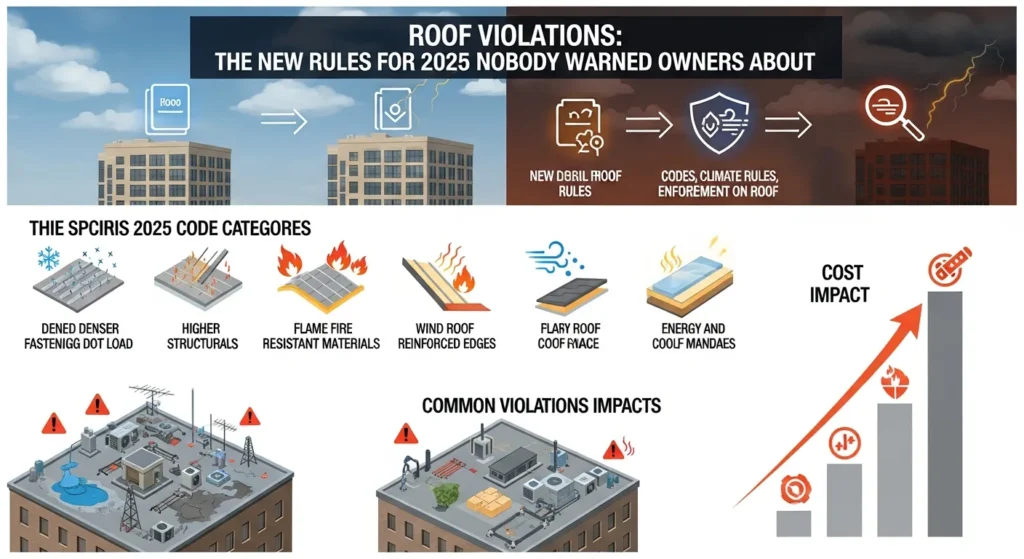
We’re watching something happen in real time that a lot of owners, boards, and even smaller contractors didn’t see coming: roof violations are exploding in 2025.
Across the country, and especially in dense markets like New York City, roof systems are suddenly under a microscope. New structural and energy codes, climate resilience rules, and tougher enforcement tools are all converging at once. Insurers, lenders, and HOAs are piling on their own requirements. The result? Owners who thought their roof was “fine” are getting hit with surprise violations, failed inspections, and five‑ or six‑figure correction costs.
In this guide, we’ll break down what’s changed, why NYC building violations tied to roofs are rising, and how we can stay ahead of DOB violations, HPD complaints, and new 2025 roof rules before they turn into a very expensive problem.
Why Roof Violations Are Exploding In 2025
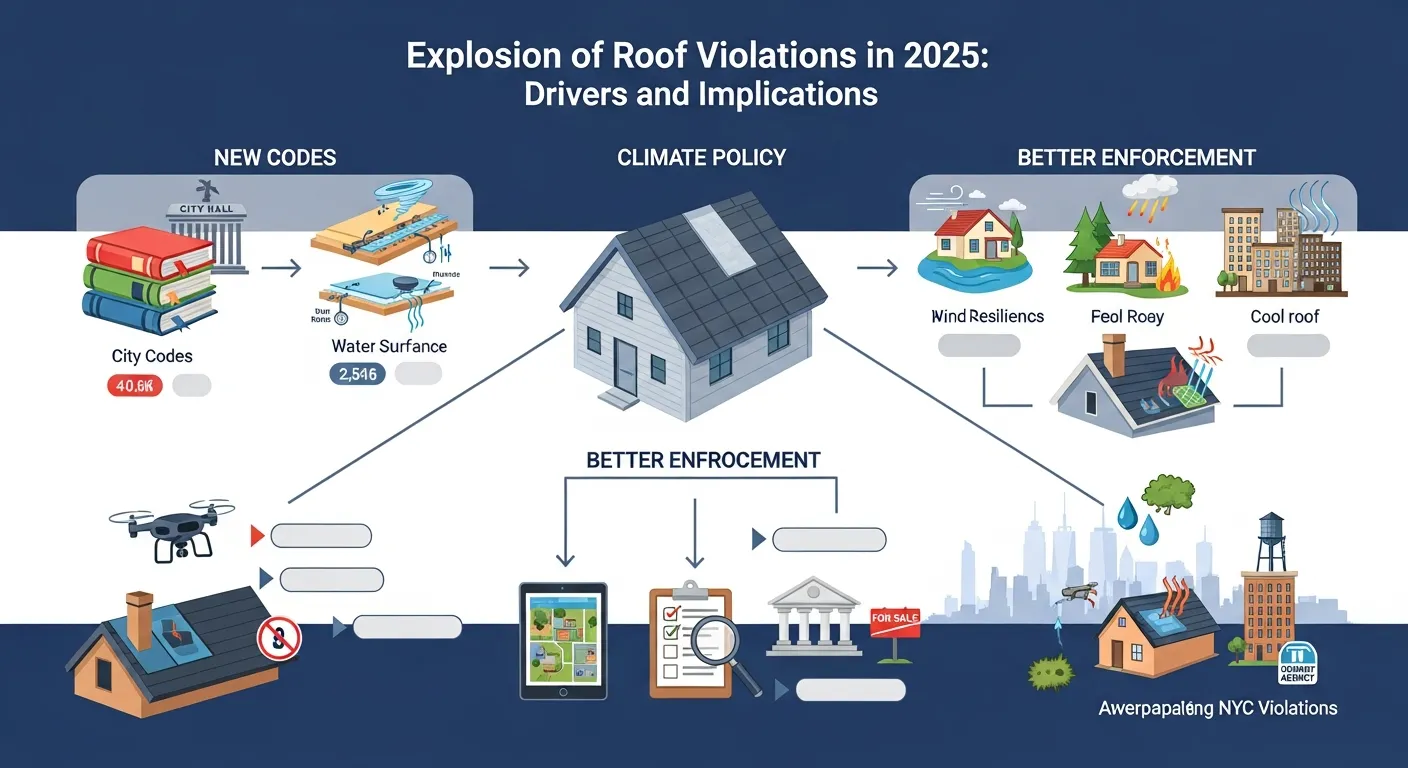
Three forces are driving the spike in roof violations this year: new codes, climate policy, and better enforcement.
First, 2025 code cycles are raising the bar. States and cities are adopting updated versions of the International Building Code (IBC), International Residential Code (IRC), and energy codes. Many of these add stricter requirements for roof attachment, insulation, and drainage. In practice, that means a roof that passed inspection in 2015, or even 2020, might fail today if we touch it without upgrading to current standards.
Second, climate and resilience policy is now squarely aimed at roofs. Roofs are the first line of defense against wind, water, and fire, and they’re also a major driver of a building’s energy performance. We’re seeing:
- Higher standards for wind and hurricane resistance in coastal and tornado-prone regions.
- Fire and ember-resistant assemblies in wildfire zones.
- Cool roof and insulation mandates in hot, dense cities to fight heat islands and cut emissions.
Third, enforcement tools have caught up. Inspectors, insurers, and even buyers are relying on drones, aerial imagery, and shared data. Unpermitted roof work that might have flown under the radar in the past is now being flagged at refinance, sale, or in claims investigations.
In New York City, this is intersecting with an already complex compliance regime. A roof that contributes to leaks or mold can generate HPD complaints, and if the Department of Buildings (DOB) inspects and finds unpermitted or unsafe work, we’re suddenly dealing with NYC building violations on multiple fronts. That’s exactly the scenario we want to avoid.
The Biggest Code And Compliance Changes Hitting Roofs In 2025
Several categories of change are hitting at once. Knowing which buckets apply to our property is the first step toward staying compliant.
Stricter Structural Requirements And Load Ratings
Structural safety margins for roofs are tightening. Updated 2025 codes demand:
- Stronger roof deck fastening patterns.
- Verified load capacity for snow, equipment, and occupancy.
- Better detailing at connections and parapets to resist uplift.
If we’ve added HVAC units, telecom equipment, or even a roof deck over the years, there’s a good chance the original design never contemplated today’s combined loads. When a DOB inspector or structural engineer runs the numbers under 2025 criteria, that can translate to a violation and a requirement for reinforcement or removal.
New Fire Safety And Ember-Resistant Standards
In wildfire-exposed regions, roofs now have to be treated almost like a defensive shield. 2025 updates increasingly require:
- Class A or ignition-resistant roof coverings.
- Ember-resistant vents and screened openings.
- Noncombustible or limited-combustible materials near eaves and edges.
Even in non-wildfire cities like NYC, fire-propagation rules around roof assemblies, mechanical curbs, and rooftop equipment pathways are getting tighter. An older combustible roof system, or cluttered roof with stored materials, can raise fire-risk red flags during inspections.
Tougher Wind, Hurricane, And Hail Resistance Rules
Programs like the 2025 FORTIFIED standards push beyond standard code:
- Denser nailing patterns on roof decks.
- Tested and rated roof vents.
- Enhanced edge metal and fascia to prevent peel-off.
States such as Florida and coastal jurisdictions are layering on their own high-wind requirements. For owners, this means we can’t simply swap shingles or membranes and call it a day. Re-roofing often triggers a requirement to bring the entire assembly, deck, underlayment, fasteners, up to current high-wind standards.
Energy, Insulation, And Cool Roof Mandates
Energy codes are treating roofs as a major performance lever. The 2025 changes commonly include:
- Higher minimum R-values for roof insulation.
- Stricter rules on thermal bridges and continuous insulation.
- Requirements or strong incentives for reflective, “cool” roofing materials in hot urban zones.
In NYC, for example, cool roof requirements dovetail with broader building emissions caps for larger buildings. If a re-roof doesn’t meet these criteria, it’s not just a technical miss, it can become part of a broader NYC property compliance issue affecting energy grades and local law reporting.
Drainage, Ponding Water, And Flat Roof Compliance
Flat roofs are under heavier scrutiny for drainage. 2025 codes and guidance emphasize:
- Positive drainage away from all roof areas.
- Properly sized drains, scuppers, and leaders.
- No long-term ponding beyond a defined time period after rainfall.
For multifamily buildings, chronic ponding often shows up first as tenant complaints, leaks, stains, mold, which may lead to HPD complaints and eventual DOB inspections. What started as “just a little ponding” can snowball into violations, interior repairs, and even structural concerns if the deck is deteriorating.
Solar Panels, EV Infrastructure, And Roof Equipment Rules
Cities and states are increasingly baking solar-readiness, and in some cases solar mandates, into new construction and major renovation rules. That has three big implications for roofs:
- Structural capacity has to account for future or current panel loads.
- Fire access paths must remain clear for firefighters to move across the roof.
- Waterproofing and flashing around mounts and conduits must be properly detailed.
The same goes for EV chargers, antennas, satellite dishes, and rooftop amenity spaces. 2025 codes treat these as part of a single coordinated system, not random “add-ons.” Unpermitted installations or sloppy penetrations are now prime targets for roof violations.
Common 2025 Roof Violations Owners Are Already Getting Cited For
We’re seeing the same clusters of roof violations pop up again and again across different jurisdictions.
Unpermitted Roof Work And Hidden Past Repairs
One of the biggest triggers in 2025 is work that was done quietly years ago:
- Re-roofs done without permits.
- Layered-over shingles beyond what code allows.
- Swapped membranes on flat roofs with no documentation.
When we go to sell, refinance, or pull a new permit, these past shortcuts come to light. Inspectors may require destructive testing to verify what’s under the surface. If the assembly doesn’t meet today’s requirements, we’re looking at tear-offs, delays, and full-assembly upgrades just to close out violations.
In NYC, this can also surface via DOB complaints or routine inspections recorded as DOB violations in public databases. That’s why tools like the NYC violation lookup tool are so useful for spotting issues early.
Improper Flashing, Sealing, And Penetrations
Most leaks don’t start in the middle of a field of membrane, they start at edges, joints, and penetrations. Under 2025 resilience-focused standards, inspectors are paying close attention to:
- Flashing at parapets, curbs, and skylights.
- Seals around vents, conduits, and rooftop units.
- Transitions between old and new roof sections.
Improper or deteriorated flashing can be cited as a direct code violation, especially when there’s evidence of active water intrusion. It’s also a classic source of disputes between owners, contractors, and insurers during storm or water-damage claims.
Noncompliant Materials And Outdated Roof Assemblies
Many older roof assemblies were legal at the time they were built but don’t satisfy today’s structural, fire, or energy rules. When we touch them, by re-roofing, adding equipment, or converting space, 2025 codes often require upgrades such as:
- Additional insulation to meet current R-values.
- Fire-resistant coverings or underlayments.
- Enhanced attachment hardware.
If a contractor simply replaces “like-for-like” without designing to 2025 standards, we may pass a casual visual check but fail a formal inspection. That gap is showing up as a wave of new violations.
Rooftop Add-Ons: HVAC, Antennas, And Decks Gone Wrong
Rooftop amenities can easily become code headaches:
- Oversized HVAC units bearing on undersized dunnage.
- Antennas or telecom equipment bolted directly through membranes without proper curbs.
- Roof decks built over old roofs with no structural review.
Inspectors now expect a complete package: structural justification, load calculations, fire egress paths, and watertight detailing. When that paperwork is missing, or the installation doesn’t match stamped drawings, violations follow.
Neglect, Deferred Maintenance, And Life-Safety Violations
Finally, plain old neglect is still a leading cause of trouble. Long-term issues like:
- Blistered or open seams on membranes.
- Rusted or rotted decking.
- Active leaks into occupied spaces.
In 2025, these conditions are more likely to be treated as life-safety concerns, not just “maintenance items.” Particularly in multifamily housing, they can trigger HPD complaints, follow-up DOB inspections, and stacked NYC building violations if we don’t act quickly.
How Roof Enforcement Is Changing: Inspectors, Drones, And Data
The rules aren’t just changing on paper: the way they’re enforced is evolving too.
More Frequent Inspections And Point-Of-Sale Triggers
Jurisdictions are increasingly tying roof compliance checks to key events:
- Major renovation permits.
- Change of use or occupancy.
- Property sales and refinancing.
For example, in New York City, a DOB plan examiner might flag an aging roof assembly during a vertical expansion or penthouse project, even if the roof wasn’t the primary scope. That opens the door to required upgrades and potential DOB violations if conditions are unsafe.
Drone And Aerial Imaging For Remote Roof Checks
Drones and aerial imagery have quietly revolutionized roof enforcement. Instead of relying only on on-site visits, agencies and insurers can:
- Scan large areas after storms for missing shingles or damaged membranes.
- Spot ponding, debris, or makeshift roof decks.
- Compare current imagery to past years to identify unpermitted work.
This doesn’t always result in an immediate citation, but it absolutely increases the likelihood that questionable conditions end up on an inspector’s checklist.
Insurance, Lenders, And HOAs Pushing Code Compliance
Even when the building department isn’t at our door, other players are:
- Insurers are tightening underwriting on older or non-code-compliant roofs. They may require upgrades, exclude certain damage from coverage, or raise premiums until we can show compliance.
- Lenders want proof that major building systems, including roofs, won’t impair collateral value. During due diligence, their engineers often reference current codes, not the codes in place when the roof was built.
- HOAs and co-op/condo boards are feeling pressure from both directions, regulators and owners, and are increasingly commissioning their own roof assessments.
In NYC, these pressures intersect with formal city processes. Public DOB records, HPD complaints, and violations visible through tools like ViolationWatch are part of the risk picture that lenders and insurers quietly look at.
Penalty Shocks: What New Roof Violations Really Cost In 2025
The financial impact of a roof violation goes well beyond a small fine. In 2025, we’re seeing four big cost buckets.
Fines, Re-Inspection Fees, And Stop-Work Orders
Local codes typically allow for:
- Base fines for each violation.
- Daily penalties if we miss correction deadlines.
- Re-inspection fees every time an inspector has to return.
If a stop-work order is issued, the project schedule can implode. Trades sit idle, temporary protections have to stay in place longer, and we may be paying interest on a loan while nothing moves forward.
In NYC, the Department of Buildings publishes detailed penalty schedules and enforcement information on its site: https://www.nyc.gov/site/buildings/index.page. Those fines can climb quickly when multiple NYC building violations stack up on a single property.
Forced Tear-Offs, Retrofits, And Emergency Repairs
The most painful outcome is when authorities order us to remove non-approved materials and rebuild to current standards. Typical triggers include:
- Non-code-compliant underlayment or fastening patterns.
- Roofs installed without permits.
- Structural issues missed during earlier work.
Instead of a planned re-roof spread out over time, we’re forced into an emergency tear-off at the worst possible moment, often in the middle of a project, sale, or renewal.
Impacts On Insurance Coverage, Premiums, And Claims
Insurance carriers are increasingly explicit about code compliance. Common scenarios in 2025:
- Claims denied or reduced because the damaged roof wasn’t up to code.
- Higher deductibles or premiums for older roofs with no proof of upgrades.
- Requirements to complete certain improvements (like roof reinforcement or drainage fixes) as a condition of renewal.
If inspectors or adjusters find evidence of unpermitted roof work, that can complicate claims further. We may win the code battle with the city but lose the coverage battle with our insurer.
Property Value, Resale Risk, And Legal Exposure
Visible roof issues, or a history of roof-related violations, drag down value. Buyers factor in the cost of:
- Immediate repairs or replacement.
- Potential future DOB violations and HPD complaints.
- Insurance limitations and lender conditions.
In New York, buyers and their attorneys routinely pull DOB and HPD records, including complaints and violations, before closing. The city’s resources, like HPD’s information on housing maintenance issues at https://www.nyc.gov/site/hpd/services-and-information/housing-maintenance-code.page, make it very easy to see who’s been neglecting their roofs.
On top of that, if leaks or unsafe conditions cause injury or health issues, owners and boards can face legal claims well beyond the cost of simple compliance.
How To Find Out Which New Roof Rules Apply To Your Property
Because codes vary by state and city, we can’t assume our neighbor’s rules are our rules. We need to trace the path from model codes down to our specific property.
Decoding National, State, And Local Roof Codes
Most roof requirements flow through three layers:
- Model codes like the IBC, IRC, and International Energy Conservation Code (IECC).
- State adoptions, often on a multi-year cycle, sometimes with amendments.
- Local modifications, city or county ordinances that tweak wind loads, snow loads, drainage rules, or energy standards.
In NYC, for instance, the city maintains its own building code with local provisions that differ from the base IBC. The DOB’s code pages and bulletins explain how those rules apply to real projects.
Where To Check For 2025 Updates (And How Often)
We shouldn’t rely on word of mouth. Instead, we can:
- Check our state building department site for code adoption timelines and effective dates.
- Review local ordinances or bulletins for city-specific amendments.
- For resilience programs like FORTIFIED, refer directly to their 2025 technical standards.
At least once a year, and definitely before any major roof work, it’s worth doing a quick review. For NYC-specific questions, the DOB and HPD public resources are essential, and citywide information about complaints and violations feeds directly into our NYC property compliance strategy.
Working With Building Departments And Inspectors Proactively
Most building departments would rather help us do it right the first time than fight us later. We can:
- Request pre-application or preliminary review meetings.
- Ask written clarification on ambiguous code sections.
- Share conceptual details of unusual roof assemblies or equipment layouts before we finalize design.
In New York City, reaching out early to DOB plan examiners or using their published guidance can save months of back-and-forth later, especially on complex roofs with solar, amenity spaces, or large mechanical loads.
Preventing Roof Violations Before They Happen
Avoiding 2025 roof violations isn’t just about reacting faster, it’s about building a smarter plan.
Scheduling Roof Assessments And Code-Focused Inspections
A good starting point is a professional roof assessment explicitly tied to current codes. We want an engineer or qualified roofing consultant to:
- Inspect structural conditions, deck integrity, and supports.
- Check insulation thickness and thermal performance.
- Review drainage, ponding, and overflow paths.
- Document any unpermitted past work or questionable details.
In NYC, this kind of assessment also helps us anticipate DOB violations or HPD complaints before they’re filed. When we know where the problems are, we can prioritize fixes and budget realistically.
Setting A Maintenance Plan For The Next 5–10 Years
Roofs fail slowly, and codes change slowly, but both keep moving. A 5–10 year plan might include:
- Annual or semi-annual inspections, especially after major storms.
- Proactive sealing of joints and penetrations.
- Scheduled replacement of aging components like flashing, not just full membranes.
- Target dates for full re-roofing aligned with loan cycles or capital plans.
If we expect a major 2028–2030 code update, it may be smarter to time big investments to coincide with those changes, rather than doing a minimal re-roof today that will be obsolete in a few years.
Documenting Work, Permits, And Warranties The Right Way
Paperwork is our shield when inspectors, insurers, or buyers start asking questions. We should keep:
- Copies of all permits, plans, and approvals.
- Progress photos before, during, and after roof work.
- Manufacturer warranties and contractor guarantees.
- Final inspection sign-offs and as-built documentation.
In a city like New York, where NYC building violations and DOB violations are visible to anyone who cares to look, having tight documentation makes it much easier to clear issues quickly and defend the quality of our work.
Choosing Contractors Who Actually Build To 2025 Standards
Not every roofer is designing to current standards: some are still installing what they’ve always installed. We should be asking:
- Which code editions are you designing to for this project?
- How are you verifying structural loads and attachment patterns?
- Will you handle permits and inspections, and provide stamped drawings where needed?
Contractors familiar with resilience programs like FORTIFIED or with complex markets such as NYC tend to be more comfortable with documentation, coordination, and code changes. It’s usually worth paying slightly more for a team that can keep us out of trouble.
On the monitoring side, digital tools can help. For example, we can get instant alerts whenever our building receives a new violation, sign up for real-time monitoring using building violation alerts so roof-related issues don’t sit unnoticed for months.
What To Do If You Already Have A Roof Violation In 2025
If we’ve already been cited, the priority is to stop the problem from spreading, technically, financially, and on our public record.
Reading Your Violation Notice And Deadlines Carefully
First, we need to read the notice line by line:
- Which specific code sections are cited?
- Is the issue structural, fire, energy, drainage, or documentation related?
- What are the compliance deadlines and potential escalations?
In NYC, DOB violations and HPD violations each have their own processes and timelines. Misunderstanding which agency is involved can delay the right fix.
Prioritizing Life-Safety Risks Vs. Minor Defects
All violations matter, but not all carry the same level of risk. We should prioritize:
- Active leaks affecting electrical systems or habitability.
- Structural concerns like sagging, rot, or overloaded equipment.
- Fire safety issues around roof pathways or combustible materials.
Addressing the highest-risk items first not only protects people, it also shows inspectors and agencies that we’re acting in good faith, which can help when we need flexibility elsewhere.
Appeals, Variances, And Negotiating Timelines
In some cases, we may be able to:
- Appeal a violation if it’s based on incorrect facts.
- Request a variance for unique site conditions.
- Negotiate more time to complete complex structural repairs or re-roofing.
To do this effectively, we usually need a qualified design professional who can make a technical case, plus solid documentation of existing conditions and proposed remedies.
Coordinating Contractors, Financing, And Compliance Proof
Closing out a roof violation often requires a mini project team:
- A licensed engineer or architect to design and certify the fix.
- A contractor to execute the work under the right permits.
- Coordination with our insurer and lender if coverage or loan terms are involved.
Once work is complete, we have to close the loop with the agency, often by scheduling reinspections and submitting formal proof of compliance. That’s where having consistent records and clear communication pays off.
For NYC properties, we track this closely using tools that mirror city data. For free lookups, use our NYC violation lookup tool to see open and resolved violations. And if we want violations off our radar as quickly as possible, we can enable automated building violation alerts so nothing slips through the cracks again.
Conclusion
Roof violations in 2025 aren’t random, they’re the logical result of higher structural, energy, and resilience standards colliding with older building stock and more aggressive enforcement.
If we own or manage property, especially in complex jurisdictions like New York City, we can’t treat the roof as an afterthought anymore. It’s a regulated building system tied directly to NYC property compliance, insurance, financing, and long-term asset value.
The owners who come out ahead will be the ones who:
- Understand which 2025 roof rules apply to their specific property.
- Use qualified professionals who actually build to current standards.
- Budget and plan for upgrades on a 5–10 year horizon.
- Monitor violations proactively instead of waiting for a crisis.
Platforms like ViolationWatch make it easier to keep an eye on NYC building violations across an entire portfolio, but the underlying strategy is the same everywhere: know the rules, document everything, and act before a small issue turns into a life-safety problem or a six-figure emergency project.
Our roofs are now front and center in how cities, insurers, and lenders measure building risk. If we treat them with that level of seriousness, starting this year, we’ll spend far more time planning smart upgrades and far less time arguing with inspectors on a windy, leaking roof.
Key Takeaways
- Roof violations are surging in 2025 as stricter structural, fire, wind, and energy codes collide with aging roofs, especially in complex markets like New York City.
- Common 2025 roof violations include unpermitted past work, outdated or noncompliant roof assemblies, poor flashing and penetrations, and overloaded rooftop equipment like HVAC units and decks.
- New enforcement tools—drones, aerial imagery, and tighter checks by insurers, lenders, and HOAs—mean roof issues are now flagged at sale, refinance, and permit stages, not just during routine inspections.
- The real cost of roof violations in 2025 extends beyond fines to forced tear‑offs, emergency retrofits, higher insurance premiums, reduced property value, and potential legal exposure.
- Owners can avoid most roof violations by scheduling code-focused roof assessments, planning 5–10 year upgrade cycles, documenting all permits and work, and hiring contractors who design to 2025 standards.
- If a roof violation is already on record, owners should triage life-safety issues first, understand deadlines and specific code sections cited, and coordinate engineers, contractors, and agencies to close violations quickly.
Roof Violations 2025 – Frequently Asked Questions
What are roof violations in 2025 and why are they increasing?
Roof violations in 2025 are citations for roofs that don’t meet current structural, fire, drainage, or energy codes, or that were altered without proper permits. They’re rising because new 2025 code cycles, climate‑resilience rules, and tougher enforcement tools are exposing older, non‑compliant or undocumented roof work.
How do the 2025 roof rules affect NYC building violations specifically?
In New York City, 2025 roof rules layer onto an already strict DOB and HPD regime. Leaks, mold, unsafe structures, or unpermitted roof work can trigger DOB violations, HPD complaints, and energy non‑compliance. These NYC building violations become public, affecting insurance, financing, property value, and sometimes leading to costly tear‑offs or retrofits.
What are the most common 2025 roof violations owners are getting cited for?
Typical 2025 roof violations include unpermitted past re‑roofs, layered shingles beyond code limits, non‑compliant materials, poor flashing and penetrations, inadequate drainage and ponding, overloaded roofs with HVAC or decks, and neglected conditions like rusted decks or active leaks. Many older assemblies were legal when built but now fail under current structural, fire, or energy standards.
How can I prevent roof violations in 2025 before they happen?
Prevention starts with a code‑focused roof assessment by an engineer or qualified consultant, followed by a 5–10 year maintenance plan. Owners should schedule regular inspections, fix drainage and flashing issues early, document all permits and warranties, and hire contractors who design to 2025 codes instead of repeating outdated “like‑for‑like” replacements.
What should I do if I already received a roof violation notice in 2025?
Review the notice line‑by‑line to identify cited code sections, deadlines, and whether issues are structural, fire, drainage, or documentation‑related. Prioritize life‑safety risks, engage a licensed design professional, pull proper permits, and coordinate financing. After repairs, submit required documents and schedule re‑inspections to formally close out the violation.
How often should a roof be inspected to stay compliant with 2025 roof codes?
To minimize roof violations in 2025, most experts recommend inspections at least once a year, plus after major storms or significant rooftop changes. Older roofs, multifamily buildings, and properties in high‑wind, wildfire, or heavy‑snow regions may need semi‑annual checks to catch structural, drainage, and waterproofing issues before they trigger formal violations or insurance problems.