
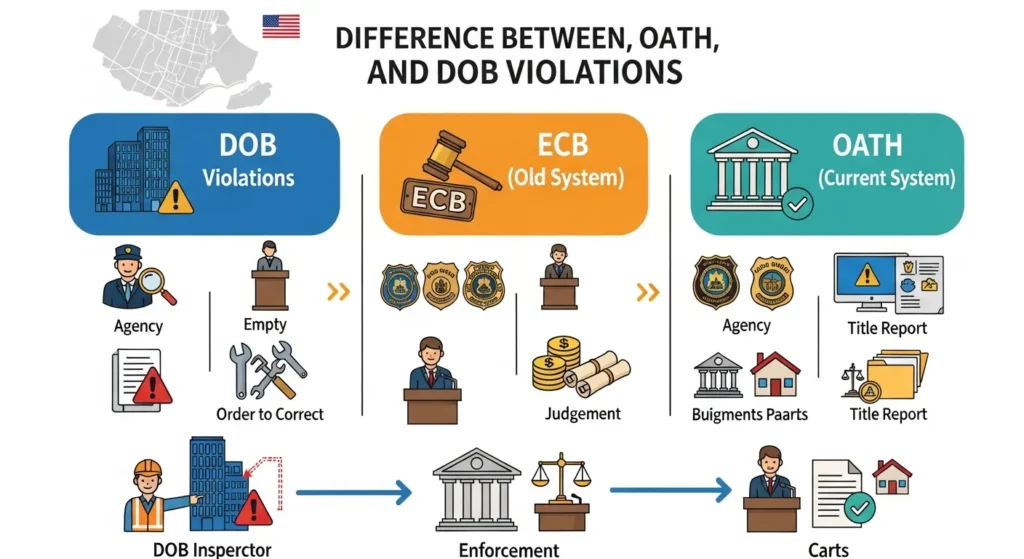
If you own, manage, or even just live in a New York City building, you’ve probably heard people throw around terms like DOB violation, ECB ticket, or OATH summons. They all sound official, a little scary, and, if we’re honest, pretty confusing.
We see this confusion all the time. A landlord gets a notice in the mail and doesn’t know if it’s a warning, a fine, or a lawsuit. A buyer’s attorney finds “ECB judgments” on a title report and the deal stalls. Tenants file HPD complaints and wonder why DOB inspectors show up instead.
This guide breaks down, in plain English, the difference between DOB violations, ECB violations, and OATH violations, how they fit together, and what they mean for NYC building violations and NYC property compliance.
We’ll walk through the agencies involved, how a simple DOB issue can escalate into fines and judgments, and what you can realistically do about it, without needing a law degree.
Why New York City Violations Are So Confusing
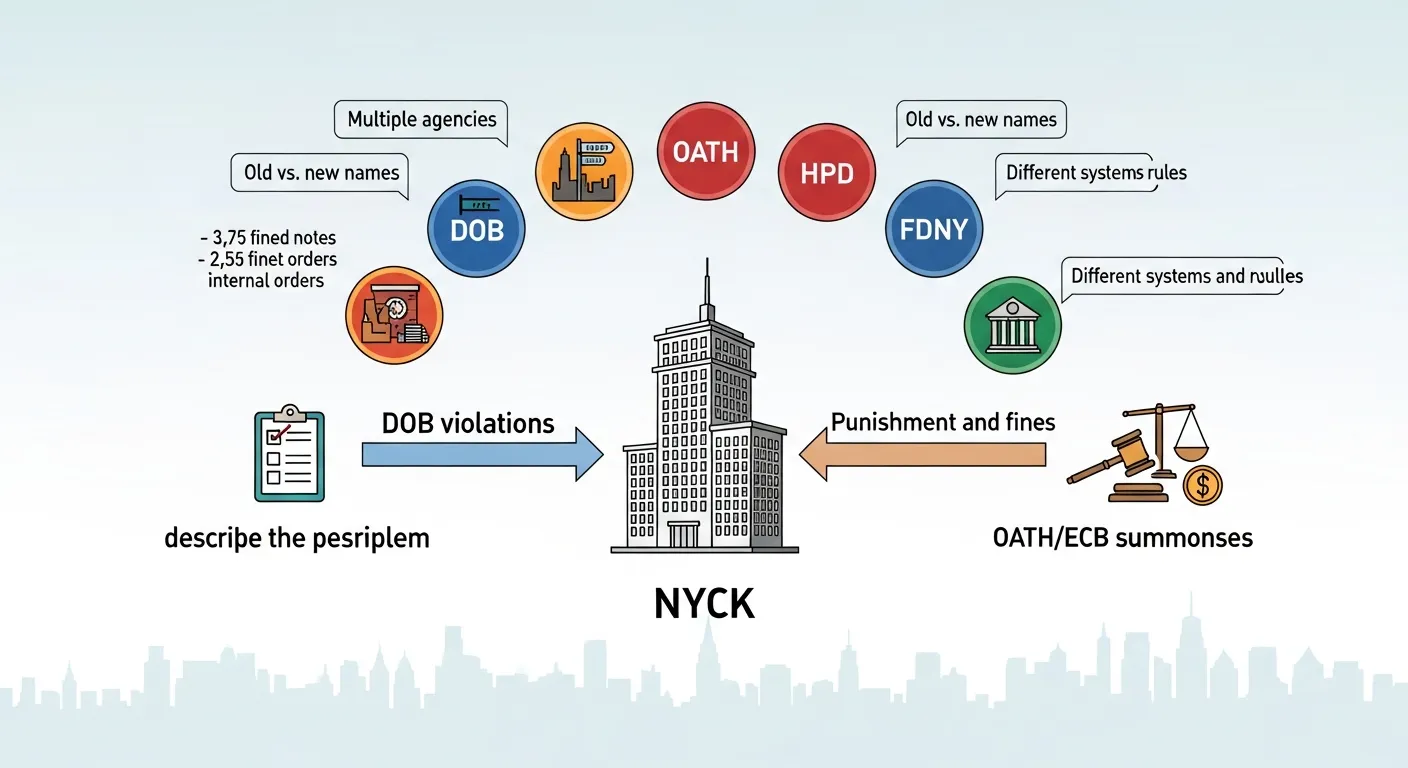
New York City didn’t set out to make its violation system confusing, but that’s the result.
Several things collide:
- Multiple agencies: The Department of Buildings (DOB), the Office of Administrative Trials and Hearings (OATH), the Department of Finance (DOF), the Department of Housing Preservation and Development (HPD), and sometimes the Fire Department (FDNY) all play a role.
- Old vs. new names: For years, enforcement hearings were handled by the Environmental Control Board (ECB). That function now sits inside OATH, but people still say “ECB ticket” or “ECB judgment.”
- Two different kinds of actions: Some issues are internal DOB violations that are basically official orders to fix something. Others are OATH/ECB summonses that come with hearings, fines, and judgments.
Layer in separate online systems, legacy records, and different rules depending on the year and the agency, and even seasoned owners can get tripped up.
The key is to remember this: DOB violations describe a problem: OATH/ECB summonses are how the City punishes it with fines. Often they’re about the same underlying condition, just at different stages.
Key Agencies And Acronyms You Need To Know
The Agencies Involved And What Each One Does
Before we talk about violations, we need to be clear on the players:
- DOB – Department of Buildings
The main regulator of construction, building safety, and zoning for private buildings. DOB inspects properties, issues DOB violations, and can issue OATH/ECB summonses when it believes a law or rule has been broken.
Website: https://www.nyc.gov/site/buildings
- OATH – Office of Administrative Trials and Hearings
New York City’s central administrative court. The OATH Hearings Division conducts hearings for civil summonses issued by DOB and other agencies. What most people call an “OATH violation” is actually a DOB (or other agency) summons that’s adjudicated at OATH.
- ECB – Environmental Control Board
The former tribunal for these kinds of building and quality‑of‑life cases. ECB has been folded into OATH, but its name lives on in older cases and in the phrase “ECB judgment.” Those are still collectible.
- DOF – Department of Finance
DOF collects money judgments that come out of OATH/ECB cases and runs settlement programs for defaulted OATH‑adjudicated ECB judgments.
Settlement info: https://www.nyc.gov/site/finance
- HPD – Department of Housing Preservation and Development
Handles HPD complaints and violations related to housing maintenance standards, heat, hot water, pests, mold, and similar issues in residential buildings. HPD violations are a separate track from DOB, though they often show up together in due diligence.
How These Agencies Interact On A Single Violation
On a single building issue, here’s how the agencies might line up:
- Inspection and violation
DOB inspects a property, maybe after an HPD complaint, a 311 call, or a routine program like facade inspections. If DOB finds a condition that violates the construction code, zoning resolution, or related laws, it issues a DOB violation ordering the owner to correct it.
- Summons and hearing
If the condition is serious, uncorrected, or repeated, DOB may also issue an OATH/ECB summons. That’s a separate document instructing the owner (or sometimes a contractor) to appear for a hearing at OATH. This is where penalties and DOB violations turn into money.
- Decision and judgment
OATH hears the case and either dismisses it or finds a violation and sets a fine. If the respondent doesn’t show up, OATH enters a default and imposes a higher penalty. DOF then dockets the amount as a judgment, which can accrue interest and potentially block permits or transactions.
In other words: DOB finds and documents the problem: OATH/ECB decides how much you owe: DOF makes sure the City gets paid.
What Are DOB Violations?
DOB violations are the starting point for most NYC building violations.
They’re official notices in DOB’s systems that a property is “not in compliance with the law” and must be corrected. They can relate to construction work, building safety, zoning, or administrative requirements.
DOB violations live in the Building Information System (BIS) or DOB NOW and are publicly visible. Lenders, buyers, and insurers regularly check them.
Types Of DOB Violations You Might See
We typically see a few common categories:
- Unsafe or illegal work
Examples: work without a permit, structural work that doesn’t match approved plans, open shafts without guards. These are tied directly to life safety and are taken seriously.
- Failure to maintain
Things like deteriorated facades, loose masonry, missing handrails, blocked exits, or damaged fire doors. These often stem from routine inspections or 311 complaints.
- Use and occupancy violations
Illegal cellar apartments, converting a one‑family house to multiple units, or using a manufacturing building as a full‑time office without proper approvals. These issues can trigger both DOB violations and, separately, enforcement for illegal residential conversions.
- Administrative violations
Failing to file required reports, boilers, elevators, facade inspections (Local Law 11), energy benchmarks, and similar filings. These are critical to NYC property compliance and often come with preset administrative fines, even without an OATH hearing.
Each DOB violation has a unique number, a brief description, and sometimes a required “Certificate of Correction” filing.
What A DOB Violation Means For Owners And Tenants
For owners and managers, a DOB violation means:
- The condition is part of the public record.
- It can block new permits, a final sign‑off, or a new or amended Certificate of Occupancy.
- It can delay or complicate sales and refinancing when attorneys pull building records.
- It may trigger increased scrutiny from DOB if new work is filed.
For tenants, DOB violations can be evidence that the building isn’t being properly maintained. In some cases, they can support HPD proceedings, rent challenges, or claims in housing court.
Importantly, a DOB violation does not always mean there’s an immediate fine. Sometimes it’s only an order to correct. Other times, especially for administrative issues, there’s a fixed penalty but no hearing.
But if you ignore DOB violations, especially serious safety or occupancy problems, they can and often do escalate into ECB/OATH summonses with significant penalties.
How DOB Violations Turn Into ECB Or OATH Cases
DOB has two main levers: it can order you to fix the problem, and it can seek money penalties. Many cases involve both.
When A DOB Violation Stays Internal To DOB
Some violations remain strictly inside DOB’s administrative world:
- Certain administrative infractions, like late filings, come with a fixed DOB-issued penalty but no OATH hearing. You pay DOB directly and file the missing paperwork.
- Minor issues that are quickly corrected may never generate an OATH/ECB summons if the inspector confirms the correction or DOB accepts a Certificate of Correction on time.
In those cases, your focus is on:
- Fixing the condition.
- Getting DOB to acknowledge the correction.
- Clearing the violation in BIS or DOB NOW so it doesn’t linger on your record.
When A DOB Violation Leads To Fines And A Hearing
If DOB believes a violation warrants stronger enforcement, because it’s hazardous, repeated, or uncorrected, it can issue an OATH/ECB summons based on the same underlying condition. That’s what many people still call an “ECB violation” or “OATH violation.”
The summons will:
- Identify the issuing agency (DOB, FDNY, etc.).
- Describe the violating condition and its class (Class 1 immediately hazardous, Class 2 major, or Class 3 lesser).
- Direct a named respondent, often the owner, sometimes a contractor, to appear at OATH on a specific date.
From that point, you’re not just dealing with NYC property compliance on paper, you’re in a quasi‑court process where missing a date can create a default judgment.
This is where it pays to track your cases closely. We’ve seen owners discover old defaults only when a sale was about to close. To avoid surprises, many rely on ongoing building violation alerts so a new summons doesn’t slip through the cracks.
What Are ECB Violations? (Old System)
For decades, what we now call OATH building cases were handled by the Environmental Control Board (ECB). The term stuck, and you still see it everywhere, from title reports to Finance bills.
History Of ECB And Why It Was Replaced
ECB started as a board that heard civil violations issued by agencies like DOB, Sanitation, and the Parks Department. If DOB wrote a ticket, you went to ECB for a hearing.
Over time, New York City consolidated most of these tribunals under OATH to standardize procedures and centralize administration. ECB wasn’t abolished so much as absorbed. Its functions moved into what’s now the OATH Hearings Division.
Today, if you get a DOB summons, your notice will likely reference OATH, not ECB, but older documents, databases, and even some staff still use the old language.
How Old ECB Violations Are Handled Today
ECB hasn’t disappeared from the financial side. You’ll still see:
- “ECB judgment” on Department of Finance statements and title searches.
- References to “OATH‑adjudicated ECB judgments” in DOF settlement programs.
In practice, that means:
- If you or a prior owner defaulted on an ECB case years ago, DOF can still collect.
- The amount owed usually includes the original fine, default penalties, and interest.
- Under certain programs, such as DOF’s OATH‑adjudicated ECB Judgment Settlement Program, owners may get a break on default penalties once they prove the underlying DOB violation has been corrected.
If your building has older ECB debt, it’s worth checking DOF’s information carefully and, if needed, speaking with a professional familiar with these settlement options.
For overall tracking and context on your building’s enforcement history, tools like ViolationWatch can help you see both old ECB judgments and current DOB/OATH issues in one place.
What Are OATH Violations? (Current System)
Today, when people talk about an OATH violation, they’re really talking about an agency summons that’s adjudicated at OATH. For DOB cases, the underlying laws haven’t changed much, the venue has.
What OATH Is And How It Works
OATH is the City’s central administrative court. Its Hearings Division manages cases for DOB, HPD, Sanitation, FDNY, and others.
In a typical DOB case, OATH will:
- Schedule a hearing date and location (or remote appearance instructions).
- Allow you or your representative to appear, present evidence, and call witnesses.
- Issue a written decision either dismissing the summons or sustaining it and imposing a penalty.
OATH is not a criminal court, but its decisions are legally enforceable. Once DOF dockets an OATH‑adjudicated ECB judgment, it becomes a collectible debt.
Official overview: https://www.nyc.gov/site/oath
From Inspection To OATH Summons: Step‑By‑Step
For DOB‑related cases, the path usually looks like this:
- Inspection – DOB inspects the property, sometimes triggered by 311, HPD complaints, or routine safety programs.
- Finding a violation – The inspector documents what they see: unpermitted work, blocked egress, illegal occupancy, etc.
- Issuing a DOB violation – DOB records the issue in its system and orders you to correct it.
- Issuing an OATH/ECB summons – For more serious or persistent issues, DOB issues a summons that lists:
- Summons/violation number
- Place of occurrence
- Date of inspection
- Legal section allegedly violated
- Hearing date and OATH location
- Hearing at OATH – You (or your representative) appear, admit or contest, and provide proofs, permits, photos, affidavits, engineer’s reports.
- Decision – The OATH hearing officer dismisses the summons or sustains it and sets a penalty, sometimes considering whether the condition has been corrected.
Deadlines, Defaults, And What Happens If You Ignore OATH
This part catches many owners off guard.
If you don’t appear on your hearing date and don’t arrange a reschedule in time:
- OATH will generally issue a default decision sustaining the summons.
- The penalty may jump to a higher “default” amount.
- The case is transmitted to DOF, which dockets it as a judgment and adds interest.
At that stage:
- Paying the judgment does not automatically close the underlying DOB violation. You still have to correct and certify the condition with DOB.
- Multiple unpaid judgments can complicate permits, trigger enforcement, and create problems when you try to sell or refinance.
OATH does allow limited motions to vacate defaults, but the standards are strict and time‑sensitive. It’s far easier (and cheaper) to track your summonses from the start.
To stay ahead, many owners now rely on automated building violation alerts so they’re notified as soon as DOB or OATH records something new. Get instant alerts whenever your building receives a new violation, sign up for real-time monitoring using building violation alerts.
Side‑By‑Side Comparison: ECB Vs. OATH Vs. DOB Violations
Sometimes the cleanest way to understand these terms is to see them next to each other.
| Feature | DOB Violation | ECB Violation (Old) | OATH Violation (Current) |
|---|---|---|---|
| Who issues it? | DOB | DOB and other agencies | DOB and other agencies |
| Who hears it? | No tribunal (internal DOB) | ECB (now within OATH) | OATH Hearings Division |
| Main purpose | Order to correct and track non‑compliance | Civil enforcement with fines | Civil enforcement with fines |
| Hearing required? | No | Yes, or default | Yes, or default |
| Appears on public record? | Yes, in DOB databases | Yes, especially as DOF judgments | Yes, especially as DOF judgments |
Legal And Financial Consequences Of Each Type
- DOB violations
Legal consequence: an official finding that your building isn’t in compliance.
Financial consequence: may involve administrative fines or trigger later enforcement, but not always immediate OATH penalties.
- ECB/OATH violations (summonses)
Legal consequence: you’re a named respondent in a City enforcement case. A decision will either dismiss or sustain the summons.
Financial consequence: sustained summonses mean fines, which can become OATH‑adjudicated ECB judgments if unpaid.
Ignoring either type is risky. Letting DOB violations pile up can lead to escalated enforcement: ignoring OATH summonses leads directly to larger defaults.
How Violations Affect Property Sales, Refinancing, And Insurance
In practice, violations show up at the worst possible time, right when money is on the line.
- Sales – Attorneys and title companies routinely pull DOB and OATH/Finance records. Open violations, especially Class 1 safety issues or large ECB judgments, can delay closings or lead to escrows and price adjustments.
- Refinancing – Lenders don’t like surprises. Significant open violations or unpaid judgments can raise red flags about the building’s condition or the owner’s compliance culture.
- Insurance – Carriers increasingly scan public data. A pattern of serious NYC building violations may factor into underwriting or premiums, particularly for liability coverage.
Keeping violations under control is no longer just about avoiding tickets: it’s part of being finance‑ready in the New York City real estate market.
Common Types Of Violations And What They Actually Mean
Not all violations are created equal. Some signal paperwork sloppiness: others point to immediate safety risks.
Building Safety And Construction Violations
These are the ones that most worry DOB, and for good reason.
Common examples:
- Work without a permit – Renovations in an apartment, adding a deck on a roof, or moving structural walls without permits.
- Unsafe scaffolding or sidewalk sheds – Missing guardrails, poor bracing, or sheds that aren’t maintained.
- Facade issues – Loose bricks, spalling concrete, or improperly maintained exterior walls under Local Law 11.
- Egress and fire safety – Blocked exits, locked or obstructed stairwells, missing self‑closing doors, disabled sprinklers.
These often generate Class 1 (Immediately Hazardous) summonses and can trigger quick follow‑up inspections.
Occupancy, Use, And Certificate Of Occupancy Issues
Your building’s Certificate of Occupancy (CO) sets out how each part of the property is legally allowed to be used.
Violations in this bucket include:
- Using a cellar as a sleeping space when the CO doesn’t permit it.
- Turning a one‑family house into an SRO or multiple units without approvals.
- Running a commercial business in a purely residential building.
DOB views these as serious because they often involve fire and egress risks that the building wasn’t designed for.
Signage, Sidewalk Sheds, And Public Right‑Of‑Way Violations
Anything extending into the public way, signs, awnings, sheds, canopies, tends to be closely watched.
Typical problems:
- Installing a large illuminated sign without permits.
- Failing to maintain a sidewalk shed during long‑running construction.
- Awnings that don’t comply with zoning or building code requirements.
These often start with a DOB violation and can quickly move into OATH territory if ignored. They’re also highly visible, which means more 311 calls and complaints.
For more detailed examples, DOB’s own enforcement pages provide good real‑world case summaries: https://www.nyc.gov/site/buildings/business/violations.page
How To Read A Violation Notice Or Summons
When a notice arrives, the first step is to calm down and read it carefully. A few key lines tell us almost everything we need to know.
How To Match Your Paper Notices To Online Records
Each notice, whether it’s a DOB violation or an OATH/ECB summons, has one or more identifying numbers. You can usually match them online using:
- BIS or DOB NOW – Search by property address, BIN, or DOB violation number.
- OATH/DOF search tools – Look up by OATH/ECB summons number or related info.
For free lookups, use our NYC violation lookup tool.
If you’re trying to reconcile multiple paper notices, we recommend lining them up by date and cross‑checking numbers in the City systems and in tools like NYC violation lookup tool and ViolationWatch, which can aggregate records from different agencies into a single view.
Key Sections To Check On A Summons Or Violation Notice
When we review a notice for a client, we focus on:
- Issuing agency – Is this DOB, HPD, FDNY, or another entity?
- Type of document – Does it say “OATH/ECB summons” or is it just labeled as a DOB violation or “Notice of Violation and Hearing”?
- Place of occurrence – The exact address, apartment number, or part of the building. Mistakes here can be a defense.
- Description of the violating condition – Plain‑language summary of what the inspector saw.
- Legal section and class – The law allegedly violated and the class (1, 2, or 3) for OATH/ECB summonses.
- Remedies and deadlines – Look for phrases like “correct the violating condition,” “certify correction,” “appear for hearing,” and specific dates.
- Penalty information – Base penalties, ranges, or notes that the penalty will be set at hearing.
Taking a high‑resolution scan or photo of the notice and organizing it alongside your online search results can make it much easier to strategize your next steps.
How To Respond: Fixing The Problem, Hearings, And Penalties
Once we understand what’s on the paper, we move to action. There are three overlapping tracks: correcting the condition, handling the hearing, and dealing with money.
Fixing Conditions: Corrections, Inspections, And Proof
For DOB violations, the priority is correcting the underlying condition:
- Diagnose the issue precisely – Is it truly work without a permit, or was there an existing permit that wasn’t on‑site? Is the alleged illegal unit actually storage?
- Engage the right professionals – Architect, engineer, licensed contractor, or expeditor as needed.
- Obtain permits if required – Many corrections themselves require permits and sign‑offs.
- Do the work and document it – Before‑and‑after photos, contractor affidavits, test reports (for boilers, sprinklers, etc.).
- File a Certificate of Correction or similar proof with DOB – Follow DOB’s instructions exactly, including notarized statements and supporting documents.
Remember: Paying an OATH/ECB fine does not close the DOB violation. You still need DOB to accept your correction.
Contesting A Violation At An OATH Hearing
For OATH/ECB summonses, we decide whether to:
- Admit with explanation – Accept that a violation occurred but explain mitigating factors or correction efforts to seek a reduced penalty.
- Contest the violation – Argue that the facts or law don’t support the summons.
Common defenses include:
- Wrong place of occurrence (inspector noted the wrong property or unit).
- Work was covered by a valid permit and within its scope.
- Condition was already corrected before the inspection, and the summons is factually inaccurate.
- The named respondent wasn’t the responsible party under the code.
You can appear yourself, send a representative, or in some cases, submit written or online defenses. For high‑stakes cases, it’s often worth engaging an attorney or DOB specialist who knows OATH’s procedures.
Reducing Or Settling Penalties
If a summons is sustained (or you defaulted), you still have options:
- Requesting reduced penalties based on correction – For some violations, demonstrating timely correction can significantly reduce the fine.
- Applying to DOF settlement programs – For older OATH‑adjudicated ECB judgments, DOF has periodically offered programs that reduce default penalties if the underlying condition is corrected and the base fine and interest are paid. Details change, so we always check the current rules directly with DOF.
A practical workflow many owners use:
- Fix and document the condition.
- Certify correction with DOB.
- Resolve active OATH/ECB cases (hearings, motions to vacate defaults, etc.).
- Negotiate or enroll in any available DOF settlements.
- Confirm that public records now show the violations as closed.
To avoid being blindsided, we strongly recommend setting up systematic monitoring, either internally or via services that provide ongoing building violation alerts across DOB, OATH, and related agencies.
Practical Tips To Avoid Future Violations
Preventing violations is far cheaper than cleaning them up after the fact. A few disciplined habits go a long way.
Routine Self‑Checks And Recordkeeping
We encourage owners and managers to build a basic compliance rhythm:
- Quarterly safety walk‑throughs – Check exits, stairwells, fire doors, alarms, extinguishers, and obvious facade issues. Document each walk‑through with photos and notes.
- Annual paperwork audit – Confirm boiler, elevator, facade, energy, and any other mandatory filings are on calendar and up to date.
- Permit discipline – Before starting any work, no matter how small, ask: does this need a DOB permit? When in doubt, check with a design professional or DOB resources.
- Organized records – Keep permits, plans, inspection reports, test certificates, and prior violation correspondence in one easily searchable location.
- Regular online checks – Search your property periodically in DOB and OATH/Finance systems. For a more automated approach, tools like ViolationWatch and similar services can flag new actions quickly so nothing sits unnoticed.
By turning these into routine tasks, you reduce your exposure to both new DOB violations and escalated OATH cases.
Working With Professionals And When To Get Help
There are moments when DIY isn’t realistic. You should seriously consider professional help when:
- You receive a Class 1 (Immediately Hazardous) violation or a serious fire‑safety issue.
- You’re facing large or repeated DOB violations or complex OATH dockets.
- Violations are blocking a major transaction, sale, refinance, or new Certificate of Occupancy.
- You believe the inspector got key facts wrong and you want to build a strong defense.
Experienced DOB expediters, code consultants, and attorneys who handle OATH cases every day can often spot solutions, alternate pathways, corrective filings, or legal arguments, that aren’t obvious from the notice alone.
For day‑to‑day awareness, many owners now lean on digital tools. Get instant alerts whenever your building receives a new violation, sign up for real-time monitoring using building violation alerts.
And if you just want to see where you stand today, our NYC violation lookup tool is a quick way to check your property’s current DOB, OATH/ECB, and related records for free.
Conclusion
ECB, OATH, and DOB violations are three pieces of the same enforcement puzzle.
- DOB violations document that something at your property isn’t compliant and must be fixed.
- ECB/OATH summonses are how the City seeks fines and, if ignored, money judgments for those problems.
- DOF sits at the end of the line, collecting on judgments that started as relatively simple code issues.
If we understand who does what, and how a minor paperwork lapse can evolve into a major NYC building violation problem, we’re in a better position to act early, correct conditions quickly, and keep our buildings finance‑ready.
The playbook is straightforward: stay on top of required filings, respond promptly to HPD complaints and DOB inspections, fix issues thoroughly, and don’t let hearing dates slide. Layer in regular online checks or automated monitoring through services like ViolationWatch, and we dramatically lower the odds of an unpleasant surprise.
New York’s enforcement system isn’t going to get simpler overnight. But with a clear grasp of the difference between DOB, ECB, and OATH, we can navigate it, protect our properties, and keep our focus where it belongs, on running safe, lawful, and livable buildings.
Key Takeaways
- ECB, OATH, and DOB violations are connected stages of NYC enforcement: DOB documents the problem, OATH/ECB hearings impose fines, and the Department of Finance collects judgments.
- A DOB violation is mainly an official order to correct a non‑compliant condition, which can block permits, sales, and refinancing even if no fine is issued yet.
- What people call ECB or OATH violations are actually agency summonses that require a hearing, can default into higher penalties if ignored, and become enforceable money judgments.
- Paying an OATH/ECB judgment does not remove the underlying DOB violation—you must still fix the condition and file proof of correction with DOB to fully clear your record.
- Staying ahead of NYC building violations means keeping up with required filings, promptly correcting issues after inspections or complaints, tracking hearing dates, and using online tools or alerts to monitor new DOB and OATH activity.
Frequently Asked Questions About ECB, OATH, and DOB Violations in NYC
What is the main difference between a DOB violation and an OATH (formerly ECB) violation?
A DOB violation is an internal Department of Buildings notice that your property is not in compliance and must be corrected. An OATH (formerly ECB) violation is a summons for a hearing where fines can be imposed. Often, the same condition generates both: DOB documents it, OATH penalizes it.
How do NYC building violations typically escalate from DOB to OATH?
A DOB inspector finds a condition and issues a DOB violation ordering correction. If the issue is hazardous, repeated, or ignored, DOB may also issue an OATH/ECB summons. That summons sends you to OATH for a hearing, where a hearing officer can sustain the charge and set a monetary penalty.
Do I have to pay a fine every time I get a DOB violation in New York City?
Not always. Some DOB violations are only orders to correct, with no immediate fine. Others, especially administrative violations, carry fixed penalties. Fines that go through OATH hearings come from OATH/ECB summonses, not the DOB violation itself. You must still correct and certify the condition with DOB either way.
How do ECB judgments affect NYC property sales and refinancing?
Open ECB judgments, now OATH‑adjudicated ECB judgments, show up in Department of Finance and title searches. Large unpaid judgments or many NYC building violations can delay closings, trigger escrow demands, reduce purchase prices, or make lenders reluctant to refinance until the debt is paid and underlying violations are resolved.
What is the best way to check for DOB, ECB, and OATH violations on my NYC building?
Start with DOB’s online systems (BIS and DOB NOW) using the address or BIN to see DOB violations. Then search OATH and Department of Finance tools for OATH/ECB summonses and judgments. Many owners also use third‑party NYC violation lookup and monitoring tools to consolidate data and get real‑time alerts.
Can ECB or OATH violations be removed or forgiven through settlement programs?
You generally can’t erase a valid violation, but you can sometimes reduce what you owe. For older OATH‑adjudicated ECB judgments, the NYC Department of Finance has periodically run settlement programs that cut default penalties when you correct the underlying DOB violation and pay the base fine plus interest. Always check current DOF rules.