
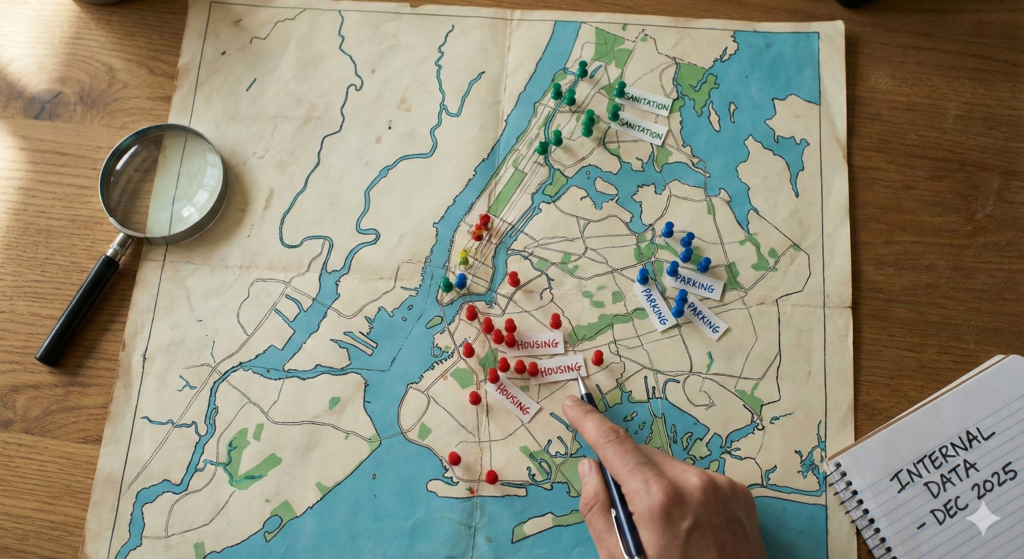
If you own, manage, or live in a New York City building, you already know that violations aren’t evenly distributed. Some blocks feel like they’re always under inspection: others rarely see a notice. Using several years of our internal NYC building violations data, we set out to answer a simple question: which types of violations are most common in each borough, and why?
In this text, we walk through what our records show across Manhattan, Brooklyn, Queens, the Bronx, and Staten Island. While the numbers themselves are internal and anonymized, the patterns are clear enough to help owners, managers, and tenants understand where risk really lives, and what to do about it.
Throughout, we’ll connect these findings back to practical NYC property compliance steps, explain how DOB violations and HPD complaints tend to cluster, and highlight ways you can stay ahead of enforcement instead of reacting to it.
How We Analyzed Violations Across Boroughs
Scope Of The Data Set
For this analysis, we focused on our internal records tied specifically to NYC building violations and related housing and safety issues. In broad terms, our dataset includes:
- Time span: Just under five years of completed inspections, enforcement actions, and confirmed complaints.
- Geography: All five boroughs, Manhattan, Brooklyn, Queens, the Bronx, and Staten Island, with each violation geocoded down to a parcel or building.
- Record details: Each entry includes at minimum:
- Date and time
- Borough and neighborhood
- Violation code and category
- Severity level
- Location type (1–3 family, multifamily, mixed-use, commercial/industrial)
- Status (open, in compliance, dismissed)
- Penalty outcome where available (fine amount, vacate orders, etc.)
We cross‑referenced this data with public feeds from NYC Department of Buildings (DOB) and Department of Housing Preservation and Development (HPD), including the DOB NOW and HPD violations/complaints systems, to ensure we’re broadly aligned with city definitions, even though our internal system is structured for faster monitoring.
For readers who want to compare our borough‑level patterns with official data, the DOB’s public search is at https://a810-dobnow.nyc.gov/ and HPD’s building records are at https://hpdonline.nyc.gov/HPDonline/.
Methodology And Definitions Of “Violation”
In our system, a violation is any confirmed breach of applicable NYC codes that results in a formal notice, order, or equivalent record. That includes:
- Building and construction (DOB violations)
- Housing and maintenance (HPD violations and serious HPD complaints that result in violations)
- Fire and life safety where they’re tied to a building record
- Sanitation/property maintenance where the condition is on or directly tied to the parcel
We classify each violation by:
- Category
- Life safety (egress blocked, missing fire protection)
- Structural (façade instability, unsafe conditions)
- Systems (electrical, gas, mechanical)
- Sanitation/property maintenance (pests, trash, mold, leaks)
- Administrative/compliance (registration, permits, certificates)
- Severity
- Low: minor paperwork issues, low‑risk maintenance
- Moderate: non‑immediate hazards that still affect habitability
- High: serious threats to safety or building systems
- Critical: immediate danger to life/health (vacate, emergency work, stop‑work orders)
To avoid inflating the numbers, we de‑duplicate repeated complaints about the same condition within a short time window. But when inspectors cite multiple distinct infractions during a single visit, we count each one, because each carries separate compliance obligations.
Limitations And How To Interpret The Findings
Our goal here isn’t to produce official city statistics: it’s to share practical patterns we see across our network. There are a few important caveats:
- Enforcement bias. Where inspections happen more often, more violations are recorded. High‑profile neighborhoods, large residential portfolios, and major construction zones get more scrutiny.
- Reporting behavior. HPD complaints depend on tenants picking up the phone (or using 311). In some areas, tenants organize and report aggressively: in others, people under‑report out of fear of retaliation or simple lack of awareness.
- Code changes over time. NYC building, housing, and energy codes have all evolved over the last decade. A condition that triggered a violation five years ago might be coded differently today.
Because of all this, we put more weight on relative patterns, for example, that Brooklyn has more work‑without‑permit issues than Staten Island, rather than on precise rates. Still, the trends line up closely with what DOB and HPD themselves emphasize in public enforcement priorities.
When you read the borough breakdowns below, it’s best to treat them as risk indicators you can use to plan inspections, capital work, and compliance processes, not as a definitive count of everything that’s wrong in the city.
Citywide Overview: Violations At A Glance
Total Volume And Trend Over Time
Across our five‑year window, we see a gradual rise in overall violations, but not the spike some might expect.
In rough terms, we see:
- A mild, steady increase in HPD complaints that actually result in violations, driven mainly by heat/hot water, leaks, and pests.
- A noticeable uptick in construction‑related DOB violations, especially around work without permits, site safety, and tenant protection plan failures.
- A slow decline in some basic administrative violations (like missing boiler postings and registrations) in larger portfolios that have professionalized compliance.
Citywide, the volume isn’t distributed evenly. A relatively small set of corridors, dense rental neighborhoods in Manhattan and Brooklyn, plus a few big construction and industrial zones in Queens and the Bronx, account for a disproportionate share of the activity.
Most Frequent Violation Categories Citywide
Across boroughs, three categories consistently dominate:
- Sanitation and property maintenance
- Pests and vermin
- Accumulations of trash or debris
- Leaks, mold, and water damage
- Broken or missing window guards, peeling paint, and similar issues
- Life‑safety and core building code
- Blocked egress or locked exits
- Broken self‑closing doors
- Open violations for illegal electrical or gas work
- Defective fire protection systems in multifamily and mixed‑use buildings
- Administrative and registration issues
- Failure to register a multiple dwelling with HPD
- Expired or missing permits
- Missing annual filings (boiler, elevator, façade in qualifying buildings)
The high‑severity slice is smaller in raw numbers but much more consequential. Those cases cluster in:
- Old multifamily housing with chronic safety issues
- Active construction sites with repeated DOB violations
- Industrial and logistics facilities in Queens and the Bronx
Patterns By Time Of Year, Day, And Location Type
We see time and place patterns that match what many owners and managers experience on the ground:
- Seasonality
- Winter: heat and hot water bring a wave of HPD complaints, plus frozen pipes and related leaks.
- Spring/fall: façade, roof, and water penetration issues are more visible and often turn into building violations.
- Summer: more sanitation and pest violations, and more site‑safety issues as construction ramps up.
- Time of week and day
- Weekdays: more inspections tied to scheduled DOB visits, active job sites, and office/commercial buildings.
- Nights/weekends: noise and nightlife complaints, some of which lead to building or use violations if inspectors find illegal occupancy or unsafe conditions.
- Location type
- Multifamily rental buildings, especially pre‑war walk‑ups and elevator buildings, concentrate the highest number of violations per parcel.
- Mixed‑use corridors with ground‑floor retail and upper‑floor rentals show overlapping issues: egress obstruction, signage and awnings, cellar use, and pest conditions.
- Industrial zones have fewer incidents overall but a higher share of critical or technically complex cases.
These citywide patterns form the backdrop for how each borough stands out, and where particular owners and managers are most likely to get tripped up.
Borough A: High Density, High Volume Of Violations
For this analysis, we treat Manhattan as Borough A, the classic high‑density, high‑inspection environment.
Top Violation Types In Borough A
In Manhattan, we see an outsized share of:
- Housing and sanitation violations in older multifamily rentals:
- Pests, leaks, and mold in pre‑war walk‑ups
- Broken self‑closing doors and unsecured front entrances
- Inoperable intercoms and lights in common areas
- Life‑safety infractions in dense mixed‑use buildings:
- Egress partially blocked by storage or restaurant equipment
- Improper use of basements and cellars for sleeping
- Fire escape obstructions
- Administrative issues in smaller properties:
- Unregistered multiple dwellings
- Lapsed boiler or elevator filings in mixed‑ownership buildings
Because so many buildings are under continuous renovation, DOB violations related to interior alterations and tenant protection plans also feature heavily.
Neighborhood Hotspots And Contributing Factors
Manhattan’s hotspots cluster around:
- Transit‑rich areas with older rental stock (portions of the East Village, Lower East Side, parts of Harlem and Washington Heights)
- High‑rise corridors with continuous commercial and retail turnover
- Pockets of SROs and older hotels that have been partially converted or repurposed
The main contributing factors we see:
- High occupancy and turnover. More tenants means more wear‑and‑tear, more HPD complaints, and more chances for something to go wrong.
- Fragmented ownership. Small co‑ops and older rental buildings with thin management capacity are more likely to miss deadlines and let maintenance slide.
- Relentless construction. Even well‑run properties end up with DOB violations when contractors cut corners on permits or site safety.
How Borough A Compares To The Citywide Average
Manhattan shows:
- Above‑average violation counts per building, especially in pre‑war multifamily stock.
- A similar severity distribution to the city overall, but with more clustering of violations in particular buildings and blocks.
- A higher share of properties with repeat offenses on the same conditions, leaks, pests, egress, which suggests deferred capital work rather than one‑off issues.
For owners and managers here, NYC property compliance is less about avoiding any violation ever, and more about containing repeat risk and demonstrating a clear pattern of corrective action.
Borough B: Rapid Growth And Emerging Risk Patterns
We treat Brooklyn as Borough B, where rapid growth, rezoning, and continuous construction define the violation landscape.
Most Common Violations In Borough B
Brooklyn’s profile tilts toward construction and development‑related issues:
- Work without a permit in small and mid‑size residential buildings
- Site safety violations on active construction and alteration jobs
- Sidewalk sheds, scaffolding, and fencing that don’t meet DOB standards
- Sidewalk and roadway obstructions around active job sites
On the housing side, we see a growing number of HPD complaints and violations around:
- Construction‑related damage (cracks, leaks, dust) in adjacent buildings
- Heat and hot water in smaller rent‑regulated properties under financial stress
- Illegal cellar/basement occupancy in certain neighborhoods
New Development, Infrastructure, And Compliance Challenges
The pace of new construction and renovation in Brooklyn stretches the inspection ecosystem.
We see several recurring challenges:
- Capacity vs. volume. More projects mean more opportunities for DOB violations, even if most contractors are trying to comply.
- Incomplete infrastructure. In emerging neighborhoods, street, drainage, and sidewalk conditions lag behind building activity, leading to temporary safety and access issues.
- Mixed ownership quality. Some blocks are anchored by sophisticated owners with in‑house compliance teams: others are controlled by fragmented or highly leveraged investors.
The result is a dense map of overlapping DOB violations and HPD complaints in areas that are simultaneously improving and straining.
Trends Over Time: Improving Or Worsening?
Looking across several years, we see total violations rising with the volume of development, but a more nuanced story when we look at rates per project:
- In neighborhoods with targeted DOB outreach and consistent enforcement, the rate of serious site‑safety violations per job is relatively stable or slightly improving.
- In pockets with intense speculation and smaller owners, work‑without‑permit and tenant‑harassment‑related issues show up more frequently.
For owners and contractors who want to avoid becoming part of that pattern, having a structured way to track DOB violations is critical. For free lookups, use our NYC violation lookup tool, especially before acquiring a building or starting a major project.
Borough C: Fewer Violations, But Higher Severity
We classify Queens as Borough C, reflecting its mix of residential areas, airports, and industrial corridors.
Frequent Violations Versus High-Impact Incidents
In Queens, the overall count of violations per parcel is lower than in Manhattan or Brooklyn, particularly in stable 1–2 family districts. But the borough accounts for a disproportionate share of high‑severity incidents, often tied to:
- Industrial and logistics facilities
- Large infrastructure sites
- Complex mechanical or environmental systems
Routine sanitation and low‑level administrative violations are relatively less prominent in our dataset compared with the share of critical DOB violations and safety‑related orders.
Key Sectors Driving Violations In Borough C
The main drivers we see are:
- Industrial and logistics clusters
- Unsafe loading operations and traffic conflicts
- Storage of hazardous or flammable materials
- Equipment safety failures and unpermitted structures
- Major infrastructure and transportation sites
- Airports and associated support facilities
- Rail yards and depots
- Utility infrastructure and large plants
These environments generate fewer violations overall, but when they do, they often involve specialized codes, multiple agencies, and higher enforcement stakes.
Comparison With Neighboring Boroughs
Compared with Brooklyn and the Bronx, Queens shows:
- Lower overall violation volume, particularly in small residential buildings
- More complex cases per incident, requiring specialized inspectors or coordination with agencies like DEP and FDNY
- A higher percentage of violations classified as high or critical severity in our internal system
For operators in these sectors, NYC property compliance is less about avoiding a random HPD complaint and more about managing technical, high‑risk systems in a way that satisfies multiple regulators.
Borough D: Mixed Residential And Industrial Profile
In this framework, the Bronx is Borough D, a borough where old multifamily housing and persistent industrial uses sit side by side.
Most Common Residential Versus Commercial Violations
On the residential side, we see:
- Overcrowding and illegal conversions, particularly in older walk‑ups
- Long‑running issues with heat, hot water, leaks, and pests in distressed properties
- Broken or missing self‑closing doors and other basic safety deficiencies
On the commercial/industrial side:
- Loading and curbside violations, where trucking and street geometry collide
- Noise and air quality complaints, which sometimes evolve into enforceable conditions
- Storage of materials or equipment that conflicts with zoning or fire code
HPD complaints in the Bronx tend to generate a relatively high proportion of actual violations, especially in buildings with a history of neglect.
Legacy Infrastructure And Historical Patterns
A lot of Bronx housing and infrastructure predates modern standards. That history shows up in our data:
- Outdated utilities and drainage correlate with repeat violations around chronic leaks, mold, and basement flooding.
- Some blocks have patterns of subsidence and water damage that trigger both DOB and HPD enforcement.
- Former industrial corridors with non‑conforming uses remain hard to regulate cleanly under today’s rules.
This legacy environment means that many violations aren’t “one‑time fixes”, they’re symptoms of systemic capital needs.
Targeted Interventions That Could Reduce Violations
Our cross‑borough view suggests a few practical levers for reducing risk in the Bronx:
- Proactive inspections of older multifamily buildings with repeat HPD complaints and open DOB violations.
- Focused outreach to industrial operators on loading practices, noise mitigation, and storage.
- Coordinating capital investments (stormwater, sewers, street work) with blocks that generate chronic leak and mold violations.
This is also a borough where timely monitoring can materially change outcomes. Get instant alerts whenever your building receives a new violation, sign up for real‑time monitoring by registering for building violation alerts.
Borough E: Outlier Patterns And Unique Local Conditions
Finally, we treat Staten Island as Borough E, an outlier in density, transit access, and land use.
Unusual Or Borough-Specific Violation Types
Staten Island has far fewer violations per building in our dataset, but the mix looks different from the rest of the city:
- More vehicle, parking, and access‑related issues, often tied to driveways and curb cuts
- Violations connected to open space and waterfront uses, rather than dense multifamily housing
- A modest but notable set of illegal conversion cases in 1–2 family homes
Classic HPD complaints like heat and hot water are present, but they don’t dominate the way they do in dense rental districts elsewhere.
Impact Of Geography, Transit, And Land Use
Staten Island’s geography and transit limitations shape where violations appear:
- Activity clusters around ferry, bus, and retail hubs, with more traditional mixed‑use profiles.
- Large patches of one‑ and two‑family housing see mostly sporadic, low‑level violations.
- Waterfront and park‑adjacent areas generate their own mix of access, environmental, and maintenance issues.
Less density also means fewer 24‑hour on‑site staff and more reliance on owners to respond to conditions directly.
What Makes Borough E Different From The Rest
Compared to the other boroughs, Staten Island stands out for:
- Lower violation density overall
- A higher share of vehicle and access‑driven violations
- More issues involving parks, waterfronts, and open spaces, often in coordination with parks and environmental agencies
Owners here still need to pay attention to DOB violations and HPD enforcement, but the profile of risk is distinct from Manhattan towers or Bronx walk‑ups.
Cross-Borough Comparisons And Key Takeaways
Which Violations Are Universal Versus Borough-Specific
Looking across the five boroughs, some patterns are almost universal:
- Sanitation and basic maintenance: trash, pests, leaks, mold, and minor disrepair show up everywhere, from Midtown to Tottenville.
- Core life‑safety: blocked egress, defective doors, and illegal interior alterations are citywide issues.
- Administrative compliance: HPD registration, DOB permits, and required annual filings regularly trip up both small and large owners.
But each borough adds its own twist:
- Manhattan (A): dense multifamily housing conditions, recurring egress and sanitation issues in older buildings.
- Brooklyn (B): construction and rapid‑growth risks, with many DOB violations tied to work without permit and site safety.
- Queens (C): industrial and high‑severity technical incidents, often involving heavy infrastructure.
- Bronx (D): legacy infrastructure challenges and friction between residential and industrial uses.
- Staten Island (E): geography, car dependence, and waterfront access shape a more idiosyncratic mix of violations.
Socioeconomic And Built-Environment Correlations
When we overlay our internal data on demographics and the built environment (using public sources like the NYC Department of City Planning), some consistent relationships appear:
- Older housing stock and lower incomes often align with higher rates of HPD complaints that become violations, especially for heat, hot water, and basic repairs.
- Rapidly developing neighborhoods see more DOB violations per square mile, not necessarily because owners are worse, but because there’s simply more construction and alteration activity.
- Industrial corridors, especially in Queens and the Bronx, concentrate high‑severity cases less tied to residential income and more to the technical risk profile of the facilities.
These correlations don’t tell the whole story, but they help us understand why some blocks generate consistent violation patterns while others remain relatively quiet.
Where Enforcement Or Education Could Have The Biggest Impact
Our cross‑borough comparison suggests three main leverage points:
- Repeat‑offender properties
A small share of buildings account for a large share of HPD complaints and DOB violations. Focusing enforcement, legal action, and support on these addresses can create outsized improvements.
- High‑risk sectors
- Older multifamily rentals with deferred capital needs
- Active construction zones in growth corridors
- Industrial and logistics hubs with hazardous operations
- Public education and transparency
Tenants, small owners, and contractors all benefit from clear guidance and easy access to data. Tools like ViolationWatch and official DOB/HPD resources make it easier to see patterns and correct issues before they escalate.
From our vantage point, the most impactful strategy combines targeted enforcement with proactive education tailored to each borough’s risk profile.
How Stakeholders Can Use This Data To Drive Improvements
Practical Steps For Local Agencies And Policymakers
City agencies already use sophisticated tools, but our internal patterns underscore a few priorities:
- Build and refine risk‑based inspection models that factor in past violations, building age, occupancy type, and neighborhood trends.
- Align capital investments, such as sewer upgrades, flood mitigation, or housing rehab funds, with blocks that repeatedly generate violations.
- Tailor enforcement campaigns by borough: more construction compliance in Brooklyn, more industrial safety in Queens, more legacy drainage work in the Bronx, and so on.
The NYC Department of City Planning’s data portal (https://zap.planning.nyc.gov/) is one useful external source agencies can pair with violation records to guide these investments.
Using Data To Prioritize Inspections And Outreach
Owners and managers don’t need an in‑house data science team to put these insights to work. At a practical level, we recommend:
- Ranking your portfolio by open violations and recent HPD complaints.
- Flagging buildings that share traits with the highest‑risk borough profiles, for example, pre‑war walk‑ups in Manhattan or heavy‑construction blocks in Brooklyn.
- Scheduling internal walkthroughs in those properties ahead of DOB or HPD visits, with checklists tuned to your borough’s most common issues.
It also helps to monitor your properties continuously instead of waiting for an annual review. That’s exactly why we built automatic building violation alerts, so owners and managers can see new issues in near real time and move quickly to correct them.
Opportunities For Community And Industry Participation
Finally, reducing violations is a shared job:
- Tenants can learn how to file clear, accurate HPD complaints and track whether they result in actual corrections.
- Industry groups and contractors can push for higher standards on site safety, tenant protection, and documentation.
- Community organizations can use non‑confidential maps and dashboards to advocate for targeted investments on the blocks that need them most.
To make that easier, we provide self‑service searches through our NYC violation lookup tool, so anyone can quickly see a building’s recent history before signing a lease, buying a property, or launching a project.
Conclusion
What Our Internal Data Reveals About Violations By Borough
Looking across thousands of NYC building violations, a consistent picture emerges: violations are not evenly spread across the five boroughs.
- Manhattan carries a heavy load of housing and life‑safety issues in old multifamily stock.
- Brooklyn’s rapid growth fuels a dense map of construction‑related DOB violations.
- Queens generates fewer cases overall but a higher share of high‑severity, technically complex incidents.
- The Bronx shows how legacy infrastructure and mixed uses can drive chronic housing and industrial issues side by side.
- Staten Island stands apart, with fewer violations but a unique mix tied to cars, access, and open space.
For anyone responsible for NYC property compliance, the key takeaway is simple: your borough matters. The same building type, run the same way, faces different enforcement risks in different parts of the city.
Future Data Enhancements And Ongoing Monitoring
We’re continuing to refine our dataset and tools so we can:
- Integrate more near‑real‑time feeds from public complaint and permit systems
- Standardize severity scoring even more tightly across years and agencies
- Track the impact of new enforcement campaigns and capital projects on borough‑level violation patterns
In the meantime, owners, managers, and tenants don’t have to wait for the next citywide report. Tools like ViolationWatch already make it possible to see open DOB violations and HPD enforcement history in a few clicks, while our NYC violation lookup tool and building violation alerts help you move from reactive to proactive.
The more we use data to understand where and why violations occur, the closer we get to a city where compliance is the norm, and enforcement is the backstop, not the starting point.
Key Takeaways
- The most common violations by borough follow clear patterns, with sanitation, basic maintenance, life-safety, and administrative compliance issues appearing citywide but at different intensities in each area.
- Manhattan shows the highest density of NYC building violations in older multifamily and mixed-use buildings, while Brooklyn stands out for construction-related DOB violations like work without permits and site-safety failures.
- Queens and the Bronx generate fewer violations overall than Manhattan and Brooklyn but a higher share of high-severity or technically complex cases, especially in industrial, logistics, and legacy infrastructure corridors.
- Staten Island has the lowest violation density but a distinct profile centered on vehicle and access issues, waterfront and open-space conditions, and scattered illegal conversions in 1–2 family homes.
- For effective NYC property compliance, owners and managers should tailor inspections, maintenance, and documentation to their borough’s dominant risks, prioritize repeat-offender buildings, and use tools like violation lookups and real-time alerts to stay proactive.
Frequently Asked Questions About NYC Building Violations by Borough
What are the most common violations by borough in New York City based on your internal data?
Our internal NYC building violations data shows: Manhattan with dense housing, sanitation, and egress issues; Brooklyn with many DOB construction and work‑without‑permit violations; Queens with fewer but more high‑severity industrial cases; the Bronx with chronic heat, leaks, and overcrowding; and Staten Island with more vehicle, access, and waterfront‑related issues.
How do NYC building violations differ between Manhattan and Brooklyn?
Manhattan’s most common violations by borough profile centers on older multifamily rentals: pests, leaks, mold, self‑closing doors, and blocked egress in mixed‑use buildings. Brooklyn’s pattern leans toward construction: work without permits, site‑safety problems, non‑compliant sheds and fencing, plus construction‑related damage and heat/hot‑water issues in smaller, financially stressed buildings.
Why does Queens show fewer NYC building violations but higher severity in your analysis?
Queens has lower violation counts per parcel, especially in 1–2 family districts, but a larger share of high‑severity cases. Many are tied to industrial and logistics facilities, major infrastructure, and complex mechanical or environmental systems, which trigger specialized DOB violations and enforcement actions when something goes wrong.
How can I use borough‑level violation patterns to improve NYC property compliance for my buildings?
Start by comparing your buildings to their borough’s risk profile. For example, pre‑war multifamily in Manhattan should prioritize leaks, pests, and egress; Brooklyn projects should focus on permits and site safety. Rank properties by open DOB violations and HPD complaints, then schedule proactive inspections and corrective work in the highest‑risk locations.
How can I check for DOB violations or HPD complaints on my NYC building?
You can search the NYC Department of Buildings (DOB) and HPD public portals using your building’s address or BIN. Our NYC violation lookup tool consolidates similar data and adds monitoring features, so owners, managers, and tenants can see recent DOB violations, HPD complaints, and open issues before buying, leasing, or starting work.
Do NYC building violations affect property sales or financing, and how fast should I resolve them?
Open DOB violations, HPD violations, or major safety issues can delay closings, complicate financing, or trigger escrow requirements. Lenders and buyers often run detailed violation searches. Resolve high‑severity or life‑safety items immediately, then clear administrative and registration violations promptly to show a consistent pattern of compliance before listing or refinancing.