
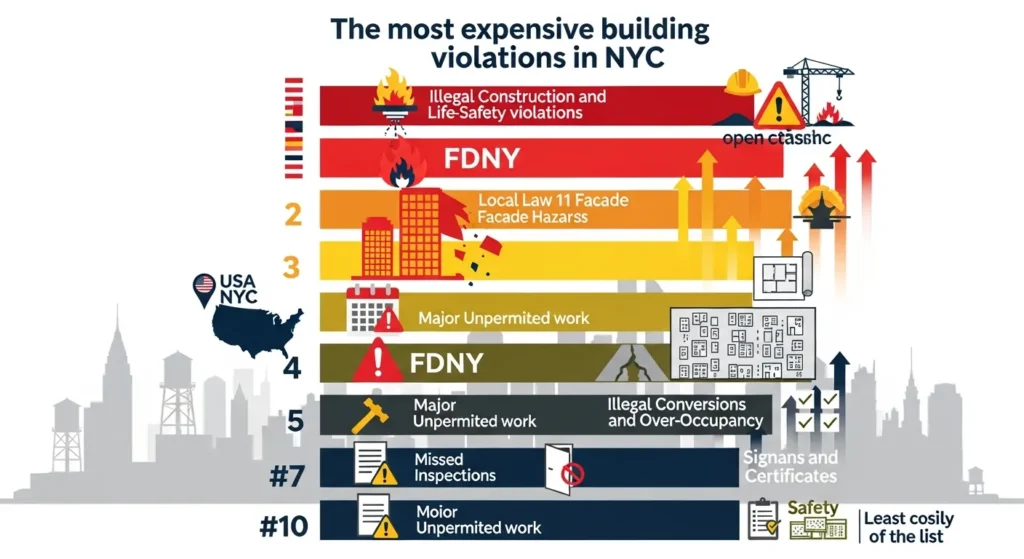
In New York City, not all building violations are created equal. Some will cost a few hundred dollars and a bit of paperwork. Others can quietly snowball into six‑ and seven‑figure problems, trigger Stop Work or Vacate Orders, and permanently drag down a property’s value.
When we talk with owners, managers, and even architects about NYC building violations, the same surprise comes up again and again: the biggest expenses usually aren’t the base fines. They’re the daily penalties, the emergency repairs, the lost rent, the legal bills, and the reputational damage when a building ends up in the news for the wrong reasons.
In this guide, we walk through the most expensive building violations in NYC, ranked from “painful but common” to “potentially catastrophic.” We’ll focus on DOB violations, FDNY enforcement, and HPD complaints that routinely generate the highest direct and indirect costs, especially around life safety, illegal construction, and facade safety.
Our goal isn’t to scare anyone. It’s to help us prioritize risk. If we understand which issues move the needle financially, we can design smarter compliance strategies, budget realistically, and catch problems before they turn into emergency orders.
Let’s start with the basics: how these violations work, and why some of them become so brutally expensive so quickly.
How NYC Building Violations Work
How NYC Building Violations Work {#0gXPQQhkinob5QWiQNiic}
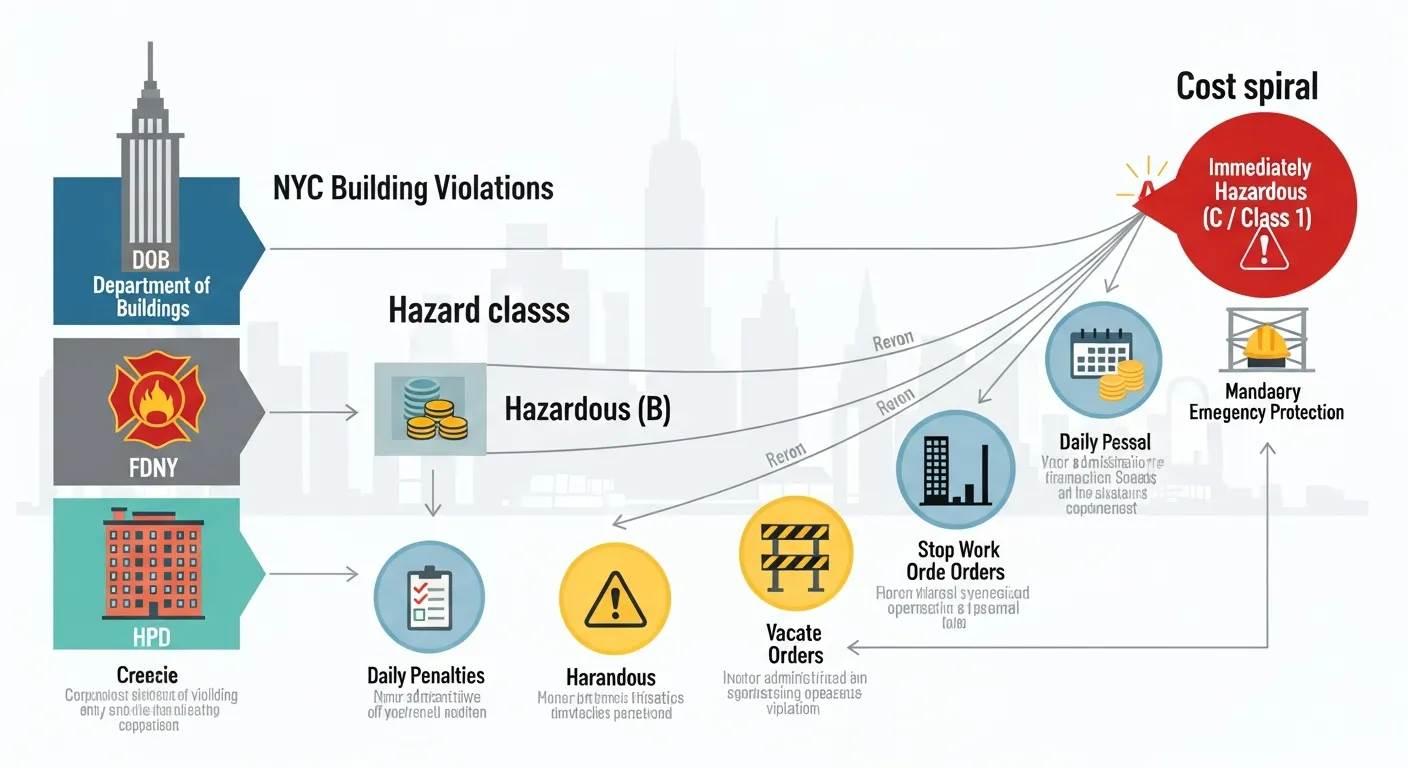
New York City spreads enforcement across several agencies, but when we talk about costliest violations, two dominate: the Department of Buildings (DOB) and the Fire Department (FDNY). HPD and other agencies also play a role, especially for housing quality and tenant safety.
Who Issues What
- DOB handles structural safety, construction work, egress, facades, elevators, boilers, and overall NYC property compliance.
- FDNY focuses on fire protection systems, hazardous materials, egress, and operational fire safety.
- HPD issues housing maintenance violations and tracks HPD complaints that often overlap with DOB and FDNY issues (heat/hot water, leaks, mold, unsafe conditions, illegal occupancies).
Each agency has its own rules and penalty schedules. The DOB’s penalty schedule, for example, is published on the city’s website and regularly updated to reflect new local laws and higher fines for repeat offenders.[^dob]
Hazard Classes: A, B, and C
Most DOB violations fall into three buckets:
- Non-Hazardous (A) – Paperwork issues, minor maintenance. Annoying, but usually not ruinous.
- Hazardous (B) – Conditions that could become dangerous if ignored: moderate egress problems, damaged exterior elements, some mechanical issues.
- Immediately Hazardous (C or Class 1) – Conditions that DOB and FDNY consider an active risk to life safety. These carry the highest fines and often trigger emergency orders.
FDNY has similar tiers for fire code violations, and in practice, anything tied to fire protection or blocked egress is treated very seriously.
Why Costs Spiral
What makes NYC building violations uniquely expensive is the way penalties and orders compound:
- Daily penalties for failure to correct and certify violations on time.
- Stop Work Orders (SWOs) that freeze construction and add delay costs.
- Vacate Orders that force tenants out and kill rent rolls overnight.
- Mandatory emergency protection (e.g., sidewalk sheds, fire watch) that can run for months or years.
Even a single immediately hazardous violation can set off a chain reaction: emergency stabilization, engineering reports, hearings at the Office of Administrative Trials and Hearings (OATH), insurance involvement, and often litigation.
For anyone responsible for NYC property compliance, the question isn’t if we’ll see violations, it’s which ones we absolutely can’t afford to ignore.
[^dob]: NYC Department of Buildings – Penalty Schedules & Enforcement: https://www.nyc.gov/site/buildings/safety/penalties-and-enforcement.page
How We Ranked The Most Expensive Violations
How We Ranked The Most Expensive Violations {#OQfMTQTMxfym38_xLkMPM}
To build a meaningful ranking, we looked beyond face-value fines. Some modest-looking DOB violations end up costing far more than a big one-time ticket.
We ranked each category using four factors:
- Maximum civil penalties under DOB and FDNY schedules.
- Likelihood of recurring or daily fines when corrections aren’t filed.
- Probability of emergency orders – Stop Work Orders, Vacate Orders, or mandated safety measures.
- Typical indirect costs – legal fees, engineering and consulting, insurance impacts, lost rent and sales, and long-term reputational damage.
We also leaned on real-world case patterns reported in DOB press releases, HPD and FDNY enforcement actions, and industry reporting from outlets like The Real Deal and Crain’s on large defect and facade cases.[^realdeal]
The result isn’t a mathematical formula but a practical hierarchy: if we oversee a portfolio and can only tackle a few high-risk issues at a time, this list shows where inaction is most likely to hurt us financially.
[^realdeal]: For examples of large New York building defect and facade disputes, see coverage in The Real Deal: https://therealdeal.com
10–7: Costly But Common Violations
#10–#7: Costly But Common Violations {#cmNJiY-jpbVgFNlQHw7O3}
These violations rarely destroy a balance sheet on their own, but they’re constant, easy to miss, and surprisingly expensive at scale, especially across multi-building portfolios.
Unpermitted Minor Alterations And Renovations
We see this constantly: a “small” interior renovation done without permits. Moving a non-load-bearing wall, shifting plumbing for a bathroom, installing a through-wall AC unit, or adding built-ins that impact sprinkler coverage.
DOB considers most of this work without a permit, even if it looks minor. Penalties often land in the thousands of dollars per job, plus the cost of hiring professionals to legalize the work and obtain after-the-fact permits.
Indirect costs include:
- Demolition of non-compliant elements.
- Re-doing work to meet code and approved plans.
- Project delays if the space can’t be occupied or marketed.
For small owners, a couple of “informal” renovations can quickly surpass the cost of doing it right from the start.
Failure To Maintain Building Exteriors And Sidewalks
Cracked sidewalks, loose brick, deteriorated parapets, and spalling concrete don’t just look bad. They can trigger DOB violations and, for taller buildings, Class 1 facade violations under Local Law 11 if deterioration reaches unsafe conditions.
Costs show up in several ways:
- Fines for failure to maintain exterior walls and appurtenances.
- Liability claims and settlements if someone is injured on a sidewalk.
- The need for emergency shoring or sidewalk sheds to protect the public.
Once a building gets a reputation for unsafe exterior conditions, it can also attract closer scrutiny from inspectors on future visits.
Inadequate Egress And Blocked Exits
Blocked stairwells, locked exit doors, storage in corridors, these are among the most common immediately hazardous life-safety issues we see in both residential and commercial buildings.
DOB and FDNY treat them aggressively:
- High fines per violation.
- Orders to clear and permanently correct conditions.
- Potential partial vacates of affected floors or units.
For multifamily owners, something as simple as housekeeping clutter in a stairwell can turn an HPD complaint into a DOB/FDNY egress case, with major liability if there’s ever a fire.
Incorrect Or Missing Building Signage And Certificates
On paper, missing or incorrect signage looks minor: egress diagrams, maximum occupancy signs, boiler room postings, elevator permits, or a missing Certificate of Occupancy (CO) in a lobby.
In reality, this is one of the most frequent sources of small-to-moderate fines:
- Inspectors can write multiple summonses in a single visit.
- Each boiler, elevator, or assembly space can generate its own posting or documentation violation.
- A missing or outdated CO can complicate leasing, refinancing, and sales.
Individually, these violations are manageable. Across a large portfolio, they quietly add up to tens of thousands of dollars a year if we’re not proactive about compliance and documentation.
6–4: Mid-Tier Violations That Quickly Snowball
#6–#4: Mid-Tier Violations That Quickly Snowball {#Bc4saUxua9HHVqpnPAvmG}
Now we get into violations that may start as paperwork lapses or “temporary” shortcuts but can evolve into persistent financial drains.
Failure To File Required Safety Inspections And Reports
NYC requires recurring inspections and filings for boilers, elevators, facades, gas piping, cooling towers, and more. Missing a single due date often means:
- A separate violation per device or per inspection cycle.
- Late fees and penalties that escalate over time.
- Possible re-inspections at our cost.
Elevator violations alone can reach $5,000 per device for certain non-compliances and missed filings. Boiler and gas piping report failures add their own penalties.[^hpd]
The real issue is volume. A 300-unit building with multiple elevators, boilers, and gas systems can easily rack up dozens of notices if a compliance calendar slips. That’s before we factor in reputational risk with tenants who see recurring outages or failures posted in lobbies.
Work Without A Permit (Major Scope Projects)
When unpermitted work crosses into structural changes, gas piping, or major plumbing, penalties rise sharply. DOB sees this as a serious risk to life safety and building integrity.
Typical consequences:
- High base fines for work without a permit.
- Additional penalties for false statements or misclassifying work.
- Requirements to open up walls, slab, or ceilings so inspectors can verify what was done.
- Possible Stop Work Orders that halt all construction on the site.
We’ve seen owners spend more on legalizing unpermitted major work, including design, engineering, and demolition, than they originally paid the contractor who did it off the books.
Illegal Conversions And Over-Occupancy
Subdividing apartments into multiple small units, renting out cellar spaces as bedrooms, or packing more people into a unit than its legal occupancy allows, all of these fall into illegal occupancy territory.
DOB typically classifies these as immediately hazardous (Class C), and they often involve HPD complaints and FDNY concerns as well.
The cost profile is brutal:
- Civil penalties for illegal conversions.
- Mandatory restoration of legal layouts (often expensive, invasive work).
- Vacate Orders for illegally occupied spaces, killing rental income.
- Increased legal exposure if there’s ever a fire, injury, or fatality.
In rent-regulated and SRO contexts, illegal conversions can also entangle owners in protracted litigation with tenants and the city.
[^hpd]: NYC HPD – Violations and Fees overview: https://www.nyc.gov/site/hpd/services-and-information/violations.page
3: Fire Safety System Violations
#3: Fire Safety System Violations {#7sWWtgvnyQ0JjsBmxuFbZ}
Fire protection systems sit near the top of NYC’s enforcement priority list for one simple reason: when they fail, people die. FDNY and DOB both have authority here, and fines often come with operational restrictions.
Missing Or Nonfunctional Sprinklers, Alarms, And Fire Stopping
If sprinklers don’t cover the required areas, alarms are disabled, or fire-stopping is missing at penetrations, FDNY can issue high-tier violations and, in some cases, order occupancy restrictions.
Financial impacts typically include:
- Fines for each system or zone that’s out of compliance.
- Costs for new risers, heads, pipe, alarm devices, or panel upgrades.
- Architect/engineer design fees and DOB/FDNY filings.
- Potential shutdown of specific floors, uses, or assembly spaces (restaurants, gyms, event spaces).
In commercial buildings, a partial shutdown can mean:
- Lost rent if tenants can’t operate.
- Lease disputes over whether rent is abated.
- Claims from tenants for lost business.
Improper Storage Of Combustibles And Hazardous Materials
Storing fuel, gas cylinders, paint, or even ordinary trash in egress routes or mechanical rooms is a classic FDNY violation. It’s also common in small buildings where storage space is tight.
Consequences include:
- Multiple FDNY violations in a single visit (storage, egress, housekeeping, fire code).
- Orders to remove materials and clean/organize spaces.
- In some cases, requirements for a fire watch – trained personnel who monitor the building until systems or storage practices are brought into compliance.
Fire watch alone can run thousands of dollars per week. For owners of mixed-use or industrial properties, improper storage issues can easily outstrip the cost of building proper storage enclosures and training staff from day one.
2: Local Law 11 (Facade) Violations
#2: Local Law 11 (Facade) Violations {#PD7Jm7RSy2Fg5ue_KlLxj}
For buildings over six stories, facade compliance under the Facade Inspection & Safety Program (FISP), commonly called Local Law 11, is one of the most expensive lines on the risk ledger.
Unsafe Facade Conditions And Failure To Correct
Every five years, owners must hire a qualified exterior wall inspector (QEWI) to examine the facade and file a report with DOB. The report will classify the building as Safe, Safe With a Repair and Maintenance Program (SWARMP), or Unsafe.
An Unsafe classification triggers strict deadlines to design and complete repairs. Missing those deadlines leads to:
- Steep civil penalties, often assessed annually while the unsafe condition persists.
- Mandatory protective measures like sidewalk sheds and netting, which can cost hundreds of thousands of dollars over a few years at large buildings.
- DOB enforcement actions, including additional violations and hearings, if owners delay.
For high-rise buildings with complex facades, the repair work itself can run into the tens of millions of dollars. We’ve seen cases where continuous Local Law 11 issues drag on for years, with owners effectively paying “shed rent” while legal and engineering teams dispute scopes of work.
Missed Inspection Cycles And Repeat Noncompliance
Even if a facade is relatively sound, simply failing to file the required FISP report can generate automatic penalties. Repeat non-filers or chronic late filers face higher fines and closer scrutiny.
In extreme cases where unsafe conditions, delayed repairs, and missed filings all overlap, owners can face:
- Multi-year scaffolding requirements that tenants and neighbors hate.
- Litigation from unit owners (in condos/co-ops) or tenants alleging unsafe conditions and loss of use.
- Insurers pushing back on coverage or hiking premiums, especially after any falling-debris incidents.
Local Law 11 doesn’t just protect pedestrians and occupants: it also acts as a financial stress test. Buildings that can’t keep up with facade repair cycles often show deeper capital planning problems, which buyers, lenders, and regulators notice quickly.
1: Illegal Construction And Life-Safety Violations
#1: Illegal Construction And Life-Safety Violations {#RZceWYJQ2xtAfRSP9r2Zu}
At the very top of the list are violations tied to imminently hazardous construction conditions and active threats to life safety. These are the headlines we all dread: collapses, fires fueled by illegal gas taps, falling debris from unprotected work sites.
Imminently Hazardous Construction Conditions
Examples include:
- Unsafe scaffolding or temporary shoring.
- Open elevator shafts or unguarded floor openings.
- Gas work performed without authorization or pressure testing.
- Working without required protection over public sidewalks and neighboring properties.
DOB treats these as Class 1 / Immediately Hazardous violations with some of the highest civil penalties on the books. Beyond the fines, inspectors can impose immediate corrective measures:
- Emergency shoring or bracing at the owner’s expense.
- Mandatory retention of engineers or special inspectors.
- Orders to install sheds, fencing, and protective netting.
If someone is injured, or worse, criminal investigations and civil lawsuits can follow, turning an expensive violation into a career-defining disaster for everyone involved.
Stop Work Orders, Vacate Orders, And Daily Penalties
The financial shock often comes not from the initial violation, but from the enforcement tools DOB and FDNY use to control risk.
- A Stop Work Order (SWO) freezes construction, often for weeks or months. Carrying costs on loans and holding costs on projects continue, but progress stops.
- Working in defiance of an SWO can trigger even higher penalties and potential criminal referral.
- Vacate Orders displace tenants from units, floors, or entire buildings. Mortgage, taxes, and utilities continue, but rent disappears.
Daily penalties for failing to correct immediately hazardous conditions can rack up quickly, especially if owners can’t get contractors, engineers, and DOB inspectors aligned on a solution.
For ground-up construction or major repositioning projects, an ill-timed SWO can derail financing timelines and kill deals. That’s why serious developers put construction safety and code compliance at the top of their risk checklists, not as a box-checking exercise, but as a core financial control.
Hidden Costs: Legal Fees, Insurance, And Lost Revenue
Hidden Costs: Legal Fees, Insurance, And Lost Revenue {#Ca3UiXF3fH008XvdtYmbJ}
When we talk about the “most expensive” NYC building violations, it’s tempting to focus on the city’s penalty schedule. In practice, that’s often just the down payment.
Legal And Consulting Expenses
Serious facade, fire safety, and construction cases routinely generate:
- Tens of thousands to millions of dollars in legal fees over multi-year disputes.
- Multiple expert reports from engineers, facade consultants, fire protection specialists, and forensic architects.
- OATH hearings, settlement negotiations, and, in severe cases, civil litigation involving tenants, contractors, or neighboring properties.
High-profile tower defect disputes covered by major real estate publications have shown legal and consulting costs alone reaching into the tens of millions of dollars, even before remediation work begins.
Insurance And Financing Impacts
Major violations and associated incidents (falls, fires, structural failures) can trigger:
- Higher liability and property insurance premiums.
- Coverage carve-outs or increased deductibles for certain building systems or construction activities.
- Tougher questions from lenders during refinancing or acquisition due diligence.
Insurers and lenders regularly review open DOB, FDNY, and HPD records. A pattern of serious NYC building violations reads like a risk profile, and they price it accordingly.
Lost Revenue And Depressed Values
Vacate Orders, unsafe facade conditions, and highly visible DOB enforcement can:
- Reduce rental income during repairs or periods of limited occupancy.
- Delay lease-up of new developments.
- Push down sale prices or scare off buyers entirely.
In condo and co-op buildings, owners often see assessment fatigue, as repeated capital calls for Local Law 11 work, fire system upgrades, and legal defenses sap appetite for future investment.
The bottom line: when we evaluate DOB violations only by the face amount of the ticket, we radically understate the real financial exposure.
How Owners Can Avoid The Most Expensive Violations
How Owners Can Avoid The Most Expensive Violations {#lXFDOoNLYvEfDvYlOsryE}
We can’t make violations disappear entirely, but we can dramatically reduce the odds of catastrophic ones, and catch small issues before they snowball.
Build A Preventive Inspection Program
Proactive beats reactive every time. At minimum, we should:
- Schedule regular internal walks of roofs, facades, mechanical rooms, and egress paths.
- Have trusted engineers inspect known risk areas (parapets, balconies, garages, bulkheads).
- Treat recurring HPD complaints as early warning indicators for larger DOB or FDNY problems.
A simple quarterly checklist for on-site supers, with photos logged and tracked, can reveal loose masonry, blocked exits, and storage creep long before inspectors do.
Calendar Every Recurring Filing
For NYC property compliance, the most cost-effective tool is often a shared calendar. We should track due dates for:
- Boilers and pressure vessels.
- Elevators and lifting devices.
- Facade cycles under FISP/Local Law 11.
- Gas piping and backflow preventers.
- Cooling towers and water systems.
Tie each item to responsible parties (owner, managing agent, engineer, contractor) and set reminders well before the deadline. Missing an inspection cycle is almost always more expensive than paying for it on time.
Use Licensed Professionals And Verify Permits
Unpermitted or improperly supervised work is a common thread in the most expensive DOB violations. To avoid it:
- Hire only licensed design professionals and contractors.
- Confirm that permits are issued and posted before work begins.
- Make sure changes in scope, especially structural, gas, or plumbing, are updated in filings, not handled “under the radar.”
It’s cheaper to argue over a contractor’s change order than to clean up the aftermath of illegal work in front of DOB and FDNY.
Respond To Violations Fast, And Track Them
Once a violation lands, the clock usually starts running on penalties.
- Investigate the condition immediately.
- Fix or stabilize hazards first, then finalize paperwork.
- File Certificates of Correction as soon as work is complete.
To stay ahead of open items, we can regularly review our buildings on ViolationWatch and through the city’s open data portals. For free lookups, use our NYC violation lookup tool.
If we manage multiple properties, automation helps. Get instant alerts whenever your building receives a new violation, sign up for real-time monitoring with building violation alerts so we don’t find out about a serious issue months later during a refinance.
Communicate With Tenants And Staff
Superintendents, porters, and front-desk staff are often the first to notice risky conditions:
- Tenants propping open fire doors.
- Storage creeping into stairwells.
- Cracks, leaks, or shifting masonry.
Creating a simple reporting channel, and acting on it, can prevent both DOB violations and emergency incidents. It also signals to residents that safety and compliance are real priorities, not just slogans.
For a more systematic view across portfolios, we can also register directly for building violation alerts to bridge the gap between what’s happening in the field and what’s showing up in city records.
Conclusion
Conclusion {#h-em2Pqr3W07MoU93fM-T}
NYC’s most expensive building violations share a few common traits: they touch life safety, they create visible risks to the public, and they’re hard to unwind once they appear in DOB or FDNY records.
Illegal construction, unsafe facades, failed fire protection, and chronic missed filings don’t just produce fines: they invite closer scrutiny, legal action, and long-term damage to a building’s economics.
As owners, managers, or advisors, our job is to flip the script from reacting to enforcement to managing risk on our own terms. That means:
- Treating Local Law 11, fire safety systems, and egress as non-negotiable priorities.
- Keeping a tight grip on inspection and filing calendars.
- Refusing to cut corners on permits and licensed professionals.
We also need clear visibility into our violation history. Tools like ViolationWatch help us see patterns across portfolios and neighborhoods, not just react to one-off tickets. For quick checks on individual properties, our NYC violation lookup tool is a simple starting point.
NYC will always be a heavy-regulation environment. But if we understand which violations truly move the financial needle, and we build systems to spot and fix them early, we can keep our buildings safer, our tenants happier, and our compliance costs under control.
Key Takeaways
- The most expensive building violations in NYC are driven less by base fines and more by daily penalties, Stop Work and Vacate Orders, emergency protections, and long-term reputational damage.
- Unpermitted work, missed safety filings, and common issues like blocked egress or poor exterior maintenance quietly compound across a portfolio into major NYC building violations costs.
- Mid- and top-tier violations—illegal conversions, major work without permits, fire safety failures, and Local Law 11 facade violations—can trigger unsafe classifications, tenant displacement, and multimillion-dollar repair and legal bills.
- The truly most expensive building violations in NYC center on illegal construction and life-safety hazards, which can lead to immediate enforcement actions, project shutdowns, litigation, and even criminal investigations after incidents.
- Owners and managers can avoid catastrophic violations by building preventive inspection programs, tightly calendaring all recurring filings, insisting on licensed and properly permitted work, and monitoring properties with NYC violation lookup and alert tools.
Frequently Asked Questions
What are the most expensive building violations in NYC for property owners?
The most expensive building violations in NYC typically involve illegal construction, life-safety issues, unsafe facades under Local Law 11, and serious fire protection system failures. These don’t just bring large fines; they often trigger Stop Work or Vacate Orders, emergency protection, legal fees, and long-term lost rent.
Why do the most expensive building violations in NYC cost far more than the base fines?
Costs spiral because violations trigger daily penalties, emergency repairs, mandated safety measures (like sidewalk sheds or fire watch), legal and consulting fees, and potential Vacate or Stop Work Orders. Lost rent, delayed projects, and higher insurance or financing costs often dwarf the original civil penalty.
Which common NYC building violations quietly add up across a portfolio?
Unpermitted minor renovations, failure to maintain exteriors and sidewalks, blocked egress, and missing signage or Certificates of Occupancy are frequent. Individually they seem modest, but across multiple buildings they can generate recurring fines, re-inspections, project delays, and growing reputational risk with tenants and regulators.
How can owners avoid the costliest DOB and FDNY violations in New York City?
Owners should build preventive inspection programs, rigorously calendar all recurring filings, use licensed professionals with proper permits, and respond quickly to violations. Regular roof, facade, mechanical, and egress walks, plus clear reporting channels for staff and tenants, catch small issues before they become immediately hazardous conditions.
How do I check if my NYC property has open building violations?
You can search DOB, HPD, and FDNY records using NYC’s online tools, including DOB NOW, BIS, and HPD’s violation lookup. Many owners also use third-party services or violation monitoring tools that send alerts when new violations or enforcement actions are issued against a building.
Can NYC building violations affect refinancing, insurance, or a future sale?
Yes. Lenders and insurers routinely review DOB, FDNY, and HPD histories. Patterns of serious or unresolved violations—especially illegal construction, unsafe facades, or major fire safety issues—can lead to higher premiums, tougher loan terms, delayed closings, price reductions, or even lost deals during due diligence.