
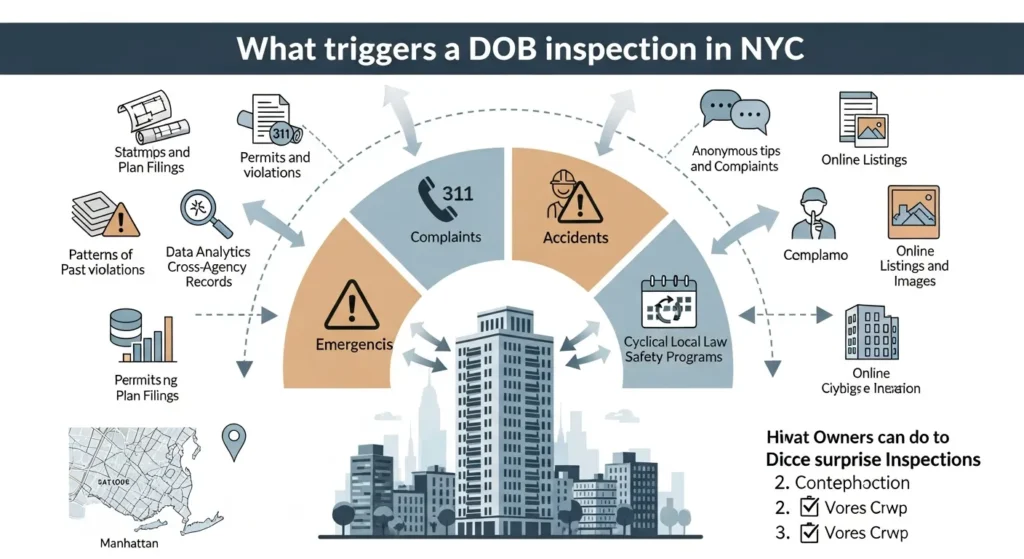
If we own or manage property in New York City long enough, the same question eventually comes up:
“Why did the Department of Buildings show up today, and not last month when everything seemed worse?”
On paper, the NYC Department of Buildings (DOB) is very clear about why it inspects: permits, complaints, and local-law safety programs. In practice, it feels more mysterious. Some buildings rack up obvious issues and never see an inspector. Others get a surprise visit after a single noisy weekend of construction.
In this guide, we’ll unpack both sides: the official triggers the city publishes and the quiet, risk-based systems that push certain buildings to the top of the list. We’ll draw on how DOB actually operates, how complaints and HPD complaints feed into the process, and what we see in day‑to‑day NYC property compliance.
Our goal is simple: help all of us understand what really triggers a DOB inspection in NYC, and what we can realistically do to reduce “out of nowhere” visits and NYC building violations.
How NYC DOB Inspections Really Work Behind The Scenes
The Mission And Limits Of The Department Of Buildings
At its core, DOB’s job is straightforward: ensure the safe and lawful use of buildings and properties by enforcing the NYC Construction Codes and Zoning Resolution. The agency signs off on new buildings and major renovations, and it also polices unsafe or illegal conditions.
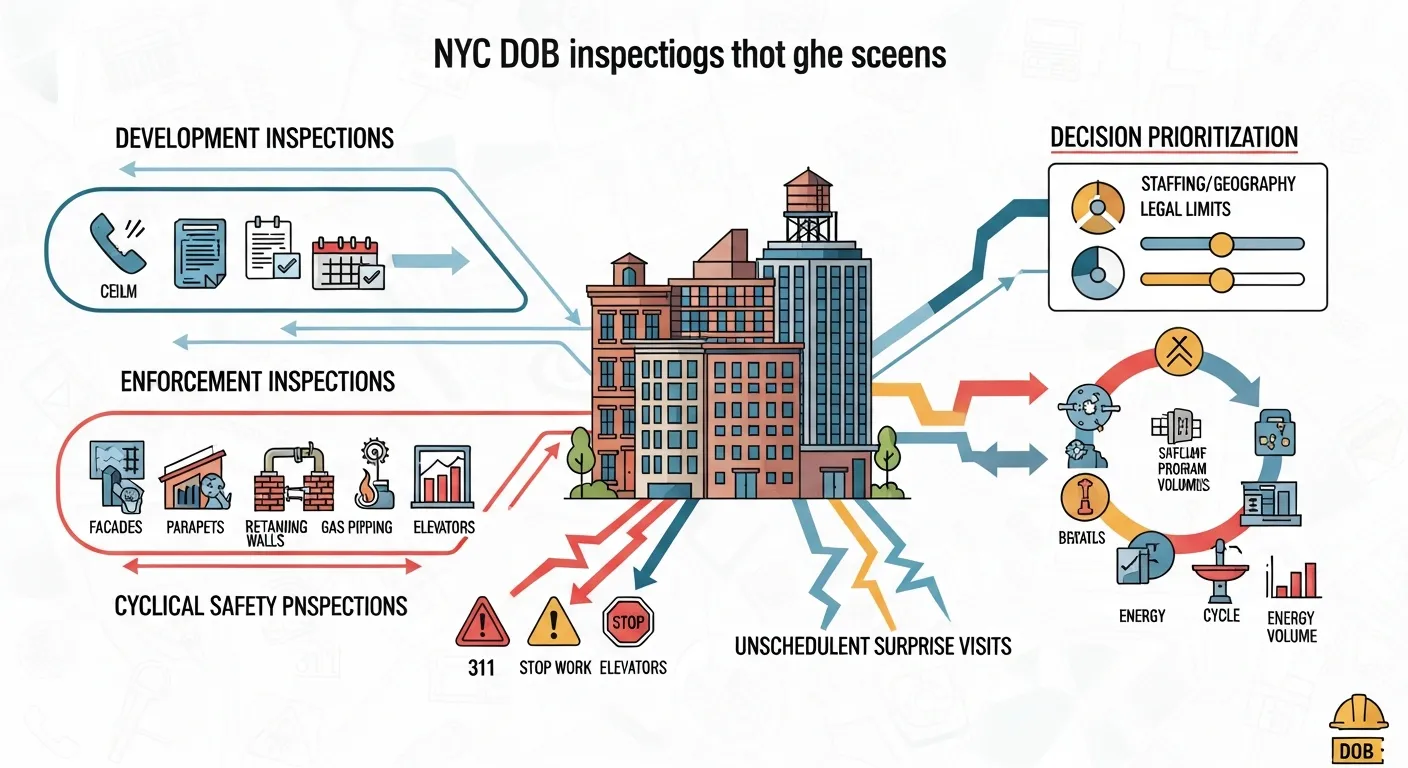
Internally, DOB splits its work into two broad buckets:
- Development inspections – inspections tied to approved permits and ongoing construction.
- Enforcement inspections – inspections driven by complaints, illegal work, unsafe conditions, and follow‑ups.
That split matters. Development inspections are usually scheduled and predictable. Enforcement inspections are where we see surprise visits, stop‑work orders, and serious DOB violations.
But DOB isn’t an all‑seeing eye. It’s constrained by:
- Staffing and geography – limited inspectors covering thousands of properties across five boroughs.
- Legal limits – inspectors can’t search every inch of a property without consent or, in some cases, a warrant.
- Complaint volume – 311 and agency referrals generate more complaints than DOB can respond to immediately.
So the agency prioritizes. And that prioritization, how it decides which door to knock on today, is where many of the “hidden rules” really live.
For official background, DOB explains much of its mission and enforcement structure on its Buildings – About pages, but it doesn’t spell out every data point that feeds its decisions.
Types Of DOB Inspections You Might Face
When we talk about a DOB inspection, we’re really talking about several different systems that all happen to bring inspectors to our building:
- Development inspections (work under permit)
These are tied to filed plans and permits, structural, plumbing, electrical, signs, sprinkler, etc. Milestone inspections and a final inspection are required before a job can be signed off. Many of these are scheduled through DOB NOW: Inspections.
- Enforcement inspections (complaints and illegal work)
This is the “cop” side of DOB. Common triggers include:
- Work without a permit
- Unsafe construction practices
- Occupied spaces with no Certificate of Occupancy
- Reported structural cracks or collapses
- Cyclical safety program inspections (Local Laws)
Some inspections are driven by laws that apply citywide on a cycle, regardless of complaints:
- Facade/FISP (Local Law 11) for buildings over six stories
- Parapet inspections (annual, starting 2024)
- Parking structure inspections
- Retaining wall inspections
- Gas piping inspections on a 4‑year cycle
- Periodic checks and filings for elevators, boilers, and energy benchmarking
Each track has its own rules, timelines, and penalties. But from our perspective as owners and managers, they share one thing: if we ignore them, we end up with NYC building violations and more visits.
The Official Triggers For A DOB Inspection
Permit Applications And Plan Filings
The most visible and predictable trigger is simple: we file for work.
Whenever we submit plans or obtain permits, new building, alteration, electrical, plumbing, signs, DOB will require inspections at specific phases:
- Milestone inspections (e.g., structural, plumbing roughing, electrical roughing)
- Final inspection for job sign‑off and occupancy
For many trades, we request inspections through DOB NOW: Inspections. If we don’t schedule required inspections, the permit can expire and the work can become a compliance problem.
From an enforcement perspective, approved permits are also flags that work is happening. If neighbors call 311 about noise or debris, inspectors already know there’s an active job and can check whether it matches what we filed.
Complaints To 311 And Other City Hotlines
This is the classic “someone called the city on us” scenario.
Any person, tenant, neighbor, passerby, can call 311 and report building issues. Those complaints are a major pipeline for:
- Work without a permit
- Unsafe scaffolding or sidewalk sheds
- Illegal basements or attic apartments
- HPD complaints like no heat/hot water or mold that have a structural angle
- Overcrowding or blocked egress
DOB logs these complaints, triages them by risk level, and dispatches inspectors accordingly. High‑risk complaints (e.g., collapse, gas smell tied to building systems) get faster, often unannounced responses.
HPD and DOB data increasingly intersect. For example, chronic HPD complaints on a property can coexist with significant DOB violations if structural or egress issues are involved.
Accidents, Injuries, And Emergency Calls
If there’s a construction accident, structural failure, serious fire, or public safety incident, DOB is very likely to appear. Sometimes alongside FDNY, HPD, and NYPD.
Common triggers include:
- Worker injuries or fatalities on a construction site
- Falling debris from a facade or parapet
- Partial collapses or major cracks
- Fires that may have been worsened by illegal layouts or blocked egress
DOB’s role is to determine whether the building or construction work is structurally safe and whether immediate actions, like vacate orders or stop‑work orders, are necessary.
Routine Cyclical Safety Programs (Local Laws)
New York City runs a growing list of Local Law programs that force buildings into recurring inspection cycles. If we’re in one of these categories and skip a filing, DOB often issues automatic violations and may send inspectors.
Key programs include:
- FISP / Facade inspections (Local Law 11) – For buildings over six stories, a Qualified Exterior Wall Inspector must examine the exterior walls every five years and file a report with DOB. Unsafe or SWARMP (Safe With a Repair and Maintenance Program) conditions often trigger re‑inspections.
- Parapet inspections – Owners of most buildings must conduct annual parapet inspections and keep written records: this is new territory for many smaller owners.
- Parking structures – Garages and certain parking structures must be inspected on a set cycle by a Qualified Parking Structure Inspector.
- Retaining walls – Retaining walls over 10 feet tall facing a public right‑of‑way require inspection and reporting every five years.
- Gas piping system inspections – Most multifamily and commercial buildings must have gas piping inspected at least once every four years by a Licensed Master Plumber.
- Elevators, boilers, energy benchmarking – These systems come with their own periodic inspection and filing requirements. Missed filings often lead directly to violations and sometimes enforcement inspections.
DOB outlines these programs in various local law and safety pages, and HPD summarizes housing‑related requirements on its Owner Resources site.
If we consistently miss filings or ignore unsafe conditions flagged in these programs, our building quickly moves into a high‑risk profile for future inspections.
Hidden And Unspoken Triggers Owners Rarely Hear About
Patterns Of Previous Violations Or Noncompliance
DOB insists there are no “secret rules.” Technically true. But in practice, buildings with a bad track record get more attention.
If our property shows a pattern of:
- Repeated NYC building violations for the same issues
- Open, unresolved ECB/Office of Administrative Trials and Hearings (OATH) violations
- Long‑standing unsafe or SWARMP facade conditions
- Chronic elevator, boiler, or gas system failures
…then inspectors are more likely to come back, even if the initial trigger was a single complaint.
This is basic risk management. With limited staff, DOB focuses enforcement on properties most likely to hurt people.
Data Flags: Tax Records, Utility Usage, And Online Listings
Over the last decade, NYC (like many big cities) has moved toward data‑driven enforcement. DOB doesn’t just wait for a neighbor to complain.
City agencies can compare:
- Certificates of Occupancy vs. actual use (e.g., “warehouse” showing up as a full‑time event space online)
- Tax records and rent registrations vs. the number of units being advertised
- Utility usage spikes suggesting more people are living in a space than legally allowed
These data points don’t automatically trigger an inspection, but they flag buildings for targeted sweeps or cross‑checks when a 311 complaint or incident pops up.
When we see enforcement around large illegal hotels or carved‑up railroad apartments, that’s often the result of multiple data points, not just one phone call.
Anonymous Tips From Tenants, Employees, And Neighbors
One uncomfortable reality: we usually don’t know who called 311, and we may never know.
The system allows for anonymous or confidential complaints, and DOB treats those as valid reasons to investigate. That means:
- A tenant upset about repairs or rent can report unrelated issues like illegal partitions or blocked egress.
- A contractor can call out a rival’s job.
- A neighbor annoyed by dust or noise can report “work without a permit” or unsafe scaffolding.
DOB doesn’t care why the person called. It cares whether the underlying condition could violate the Construction Codes. If the potential risk is high, an inspector is coming.
Social Media, Online Reviews, And Public Photos
We don’t think of Instagram or Airbnb photos as enforcement tools, but they can be.
Photos that show:
- Clearly illegal interior layouts
- Bedrooms with no windows or egress
- Packed bunk beds in supposed “one bedrooms”
…can support complaints about illegal conversions, rooming houses, or dangerous overcrowding. The official intake might still be 311 or another agency, but DOB inspectors can and do look at publicly available information to verify patterns.
Online reviews mentioning “10 roommates in a 2‑bedroom” or “renovation dust everywhere, no permits posted” don’t help either.
When One Agency Alerts Another (Inter‑Agency Referrals)
DOB doesn’t work in isolation. It shares and receives information from:
- FDNY (fires, blocked egress, illegal gas or electrical work)
- HPD (overcrowding, dangerous conditions in residential buildings)
- NYPD (illegal clubs or assembly uses)
- Department of Transportation (unsafe sidewalk or street occupancy)
If there’s a fire in a building with questionable layouts, FDNY may flag illegal apartments or blocked exits. That can trigger a DOB inspection focused on structural and construction issues.
Likewise, repeated HPD complaints about overcrowding or unsafe conditions can line up with DOB enforcement when there are underlying construction or egress problems.
This is where tools like ViolationWatch are so valuable. By centralizing and tracking violations across agencies, we can see the full picture of our building’s risk instead of discovering patterns only when an inspector knocks.
Red Flags During Construction That Practically Invite An Inspector
Visible Work Without Permits Or Posted Signs
Few things attract DOB enforcement faster than obvious construction with no permits displayed.
Legally, permitted work must display the appropriate work permit and project information where it’s clearly visible from the street. When passersby see major work, dumpsters, framing, windows going in, without any signage, 311 calls tend to follow.
From DOB’s perspective, visible unpermitted work is a high‑value target: it often uncovers broader NYC building violations and safety hazards.
Excessive Deliveries, Debris, Or After‑Hours Noise
Even with permits, we can draw attention by how the project looks and sounds:
- Constant material deliveries blocking the street
- Piles of debris with no housekeeping
- Jackhammers and saws well outside standard construction hours
After‑hours work without an after‑hours variance is a classic 311 complaint. Once an inspector shows up for noise, they may start checking:
- Whether the permits match the actual work
- Whether safety protections (guardrails, netting, egress) are adequate
- Whether workers have proper safety measures in place
Blocked Sidewalks, Scaffolds, And Sidewalk Sheds
Sidewalk sheds and scaffolds are deeply regulated, especially around facade and FISP work. Red flags include:
- Sheds without visible permits
- Obstructions forcing pedestrians into traffic
- Incomplete or visibly damaged scaffolding
DOB routinely inspects sheds tied to facade enforcement because falling debris is a major city concern. A shed lingering for years without clear progress on repairs can also invite more scrutiny.
Dumpster Placement, Street Occupancy, And Traffic Disruption
Anytime we place equipment or containers in the street, dumpsters, material pods, cranes, we’re usually in Department of Transportation (DOT) territory too.
If we don’t have proper DOT and DOB approvals or if we’re blatantly blocking traffic and crosswalks, complaints roll in quickly. DOT or NYPD may respond first and then loop DOB in if there appears to be unsafe or unpermitted construction work.
These are the situations where a seemingly minor logistics decision turns into a full‑blown enforcement visit.
Renovation Red Flags Inside Apartments And Small Buildings
Illegal Apartment Conversions And Added Rooms
Small buildings and apartments aren’t immune. In fact, they’re often where the most dangerous and least documented work happens.
Illegal conversions include:
- Turning a one‑family into a three‑unit building with no filings
- Carving railroad apartments into tiny windowless rooms
- Adding interior partitions that block egress or ventilation
These configurations usually come to light after HPD complaints, overcrowding reports, or FDNY responses to fires or medical emergencies. Once the layout doesn’t match the Certificate of Occupancy, DOB has grounds for serious violations.
Combining Or Splitting Units Without Proper Filings
On the higher‑end side, owners sometimes:
- Combine two apartments into one large unit
- Split a large apartment into smaller rentals
If the work is done without permits and architect/engineer filings, DOB may view it as illegal alterations, especially where walls affect fire‑rated separations, egress, or mechanical systems.
A broker’s listing boasting a “newly combined penthouse” with no record of Alteration filings is exactly the sort of clue that can lead to questions.
Suspicious Plumbing, Gas, And Electrical Changes
Gas and electrical work are among the most tightly regulated trades. Warning signs include:
- Extra gas lines running to makeshift kitchens
- Multiple, clearly DIY electrical panels or tangled extension cords
- Plumbing vents or exhaust pipes added in odd places
These aren’t just paperwork problems: they’re life‑safety issues. When inspectors find unpermitted gas or electrical work, they can order immediate shutdowns, which are costly and disruptive.
Short-Term Rentals, Boarding Rooms, And Overcrowding
Illegal short‑term rentals and de facto rooming houses are a huge enforcement focus. Red flags include:
- Listings that show far more beds than legally allowed occupants
- Lockable interior doors dividing what’s supposed to be a single family unit
- Hallways and common rooms filled with mattresses or personal belongings
We’ve seen DOB, HPD, and the Mayor’s Office of Special Enforcement work together on these cases. What begins as a complaint about short‑term rentals can evolve into a full review of egress, fire safety, and illegal occupancy.
Monitoring our building’s violation history and HPD complaints helps us catch patterns early: that’s where a platform like ViolationWatch is useful for owners trying to stay ahead of issues instead of reacting to the next surprise inspection.
How “Random” Inspections Often Aren’t Random At All
Risk-Based Targeting And Building Profiles
DOB has slowly shifted away from purely first‑come, first‑served complaint response toward risk‑based targeting.
In practice, that means inspectors are more likely to be dispatched to buildings that:
- Are larger or more heavily occupied (higher consequence if something goes wrong)
- Have past DOB violations or open unsafe conditions
- Are in use groups with a history of serious incidents (e.g., big residential, assembly, or industrial uses)
Two buildings might each get the same complaint. The one with a history of illegal work and missed facade filings is more likely to see an inspector quickly, while the other waits.
Geographic Hotspots And Neighborhood Enforcement Sweeps
After major incidents, like a facade failure, a high‑profile fire, or a spate of illegal hotel busts, DOB often conducts targeted sweeps.
They’ll focus on:
- Buildings with similar age and construction type in the same neighborhood
- Properties already flagged for missing local‑law filings
- Clusters of 311 complaints pointing to the same kind of risk
So when we hear that an inspector “just happened to be in the area,” it’s often because DOB planned a sweep of a certain corridor or building type based on recent data.
Follow-Up Inspections After Major Violations Or Complaints
Once DOB finds a serious issue, it’s rarely a one‑and‑done visit.
Follow‑up inspections are common when:
- A Stop Work Order has been issued and we’ve claimed to correct the problem
- A facade was classified as unsafe or SWARMP and repairs were required
- Gas or electrical hazards were found and shut down
If we fail to close out violations, or if conditions appear unchanged when inspectors return, we quickly fall into the “repeat offender” category, a surefire way to keep our address high on the enforcement list.
Common Misconceptions About DOB Inspections
Myths About Who Can Trigger An Inspection
A few persistent myths get owners in trouble:
- Myth: Only tenants or owners can trigger a DOB inspection.
Reality: Anyone can call 311. Neighbors, contractors, even pedestrians. - Myth: Anonymous complaints don’t count.
Reality: They do. DOB doesn’t need the caller’s identity to investigate. - Myth: If an issue is “between us and the tenant,” DOB won’t get involved.
Reality: Many tenant issues, egress, structural cracks, unsafe stairs, missing guards, are squarely DOB’s business.
Understanding this is key to keeping HPD complaints and DOB enforcement separate. Habitability disputes may start with HPD, but physical safety problems often pull DOB into the picture.
What Inspectors Can And Cannot Do On Site
Another fuzzy area is what inspectors are actually allowed to do.
Generally, DOB inspectors:
- Can examine visible exterior conditions and construction visible from public areas
- Can enter common areas and work areas with access provided by an owner, manager, or super
- Can inspect the parts of the property reasonably related to the complaint or permit
But they cannot:
- Force entry into private spaces without consent, unless supported by a warrant or emergency condition
- Wander far beyond the scope of the complaint or relevant work just to “look around,” absent clear justification
That said, if they see an obvious, serious safety hazard in plain view, they’re obligated to act.
How Much Notice You Actually Get
The amount of notice depends almost entirely on why DOB is coming:
- Development inspections (tied to permits) are usually scheduled ahead of time through DOB NOW. We know the date and can prepare.
- Complaint and emergency inspections may be completely unannounced. Inspectors can show up during normal working hours based on a 311 complaint, a fire, or an accident.
If we’re already struggling with NYC property compliance, those unannounced visits are where things tend to snowball, from a single complaint to multiple violations across different systems.
Practical Ways To Reduce Your Chances Of A Surprise Visit
Keeping Permits, Signage, And Records In Order
We can’t control every complaint, but we can control how vulnerable we are when DOB arrives.
Start with basics:
- Always file the right permits for any work that goes beyond basic, legally allowed minor repairs.
- Post permits and required signage where they’re visible from the street.
- Keep copies of approved plans, job logs, and inspection records accessible on site.
- Close out permits promptly once work is completed: don’t leave “Zombie” jobs open for years.
This won’t stop every complaint, but when inspectors arrive and see clean paperwork and an organized site, the visit usually goes much better.
Proactive Safety Checks And Documentation
Because so many inspections stem from cyclical programs and recurring issues, we’re far better off getting ahead of them.
That means:
- Tracking deadlines for FISP, parapet, retaining wall, parking structure, gas piping, elevator, and boiler inspections.
- Hiring qualified professionals (QEWI, Licensed Master Plumber, elevator companies) who know DOB’s requirements.
- Keeping digital records of reports, filings, and corrections.
This is exactly where technology helps. With tools like ViolationWatch, we can pull up our building’s open issues from multiple agencies in one place and see where we’re drifting offside.
If we want to go a step further, we can get instant alerts whenever our building receives a new violation, sign up for real-time monitoring through building violation alerts so we’re not caught off‑guard months later.
Managing Tenant And Neighbor Relationships
A significant share of 311 calls are frustration calls. People feel ignored, so they go straight to the city.
We can’t eliminate every complaint, but we can reduce the urge to pick up the phone by:
- Responding promptly to habitability issues like leaks, pests, and heat
- Communicating construction timelines and noisy work windows in advance
- Providing clear contact information for management or ownership
The more reachable and responsive we are, the less likely tenants and neighbors are to escalate problems to 311.
On the information side, we should actively monitor our buildings’ status. For free lookups, use our NYC violation lookup tool to see DOB and related violations tied to a property and catch patterns before they attract more enforcement.
Combining regular in‑house checks with external monitoring is often the difference between staying ahead of issues and constantly reacting to the next surprise inspector at the door.
What To Do If The DOB Shows Up At Your Door
How To Respond In The Moment
When DOB inspectors arrive, scheduled or not, how we handle the first five minutes matters.
We should:
- Politely ask to see their identification and confirm they’re from DOB.
- Ask what prompted the visit (complaint number, permit inspection, incident follow‑up).
- Provide reasonable access to areas related to the complaint or ongoing work.
- Call our super, property manager, or design professional if they’re not already on site.
Being hostile or evasive rarely helps. Inspectors write what they see. Our goal is to ensure what they see is safe, documented, and within the code.
Protecting Your Rights While Cooperating
Cooperation doesn’t mean surrendering all rights.
We can and should:
- Clarify the scope of the inspection: “Is this related to a specific complaint or job number?”
- Take our own photos and notes of conditions while the inspector is present.
- Ask for copies of any documents, orders, or violation notices they issue.
If inspectors request access to areas that don’t appear connected to the complaint or permit, we can ask them to explain the basis. In complex or high‑risk situations, especially involving gas, structural concerns, or potential criminal exposure, consulting an attorney or experienced code consultant is wise.
Next Steps After Receiving Violations Or Stop Work Orders
Once a violation or Stop Work Order is issued, the clock starts.
Our typical next steps are:
- Understand the specific charge. Read the violation carefully: note which code section is cited and whether it’s “immediately hazardous.”
- Engage the right professional. For construction or layout issues, that’s usually a registered architect or professional engineer. For systems, bring in licensed trades.
- Correct the unsafe condition. DOB and OATH judges care about real‑world safety at least as much as paperwork.
- File necessary applications and inspections. That often means new or amended permits, scheduling inspections through DOB NOW, and requesting rescission of Stop Work Orders after compliance.
- Address penalties and hearings. Many violations require appearances or submissions through OATH. Showing corrective action and a compliance plan can meaningfully affect outcomes.
To stay on top of this, we like to maintain a clear violation log per property. Online tools, like our own NYC violation lookup tool and automated building violation alerts, help us make sure nothing slips through the cracks or quietly escalates.
Remember, unresolved DOB violations often feed into the risk profile that triggers more inspections later. Closing them out aggressively is both good practice and smart risk management.
Conclusion
When we strip away the mystery, most DOB inspections in New York City come down to a few predictable forces:
- Official, public triggers – permits, 311 complaints, accidents, and cyclical local‑law programs.
- Risk‑based priorities – past NYC building violations, missed filings, building size and use, and neighborhood patterns.
- Data and inter‑agency coordination – HPD complaints, FDNY incident reports, online listings, and city analytics.
The “hidden rules” aren’t secret laws. They’re the practical ways DOB decides where to spend limited inspection resources. Buildings that ignore NYC property compliance, pile up DOB violations, or show signs of illegal conversions will always get more attention than properties that stay current on filings and respond quickly to issues.
As owners and managers, our best strategy isn’t to try to fly under the radar, it’s to be boringly compliant:
- File the right permits, post them, and close them out.
- Stay ahead of Local Law obligations and safety inspections.
- Take tenant and neighbor concerns seriously before they become 311 calls.
- Monitor our buildings’ enforcement history across agencies.
Tools like ViolationWatch, real‑time building violation alerts, and the free NYC violation lookup tool exist for exactly this reason, to give us a clear, up‑to‑date picture of our risk.
We can’t stop every DOB inspector from ever visiting. But we can make sure that when they do, they find a building that’s safe, well‑documented, and prepared, rather than one surprise visit away from a cascade of costly violations.
Key Takeaways
- What triggers a DOB inspection in NYC is usually a mix of visible permit activity, 311 complaints, accidents, and required Local Law safety programs, not random chance.
- Buildings with a history of NYC building violations, missed filings, or unsafe facade, gas, or elevator conditions are prioritized for risk-based DOB enforcement visits.
- Less obvious triggers for a DOB inspection in NYC include data flags (tax and utility records), online listings and photos, anonymous tenant or neighbor tips, and referrals from agencies like FDNY, HPD, and NYPD.
- Messy or conspicuous construction—unposted permits, after-hours noise, blocked sidewalks, unsafe scaffolds, or visible unpermitted work—practically invites DOB inspectors to show up.
- Owners can reduce surprise DOB inspections by keeping permits and signage in order, staying ahead of cyclical safety programs, addressing tenant issues before they become 311 calls, and actively monitoring violation histories across agencies.
Frequently Asked Questions
What triggers a DOB inspection in NYC?
Most DOB inspections in NYC are triggered by permit filings, 311 complaints, accidents or emergencies, and cyclical safety programs like facade (FISP), parapet, gas piping, elevator, and boiler inspections. Past NYC building violations, missed filings, and patterns of unsafe or illegal conditions can also push a property to the top of DOB’s inspection list.
How do 311 complaints lead to a DOB inspection in New York City?
When someone calls 311 about work without a permit, unsafe scaffolding, illegal apartments, or blocked egress, DOB logs the complaint, assigns a risk level, and may dispatch an inspector. High‑risk complaints, such as collapses or gas smells tied to building systems, usually get faster, often unannounced, inspections.
Can past NYC building violations trigger more DOB inspections?
Yes. Buildings with repeated or unresolved DOB and OATH violations, long‑standing unsafe or SWARMP facade conditions, or chronic system failures are treated as higher‑risk. Even a single new complaint can lead to more thorough or frequent inspections when a property already has a history of noncompliance or open unsafe conditions.
Are DOB inspections in NYC really random, or are they risk‑based?
DOB increasingly uses risk‑based targeting rather than purely first‑come complaint response. Inspectors are more likely to visit large or heavily occupied buildings, properties with previous violations or missed local‑law filings, and buildings in neighborhoods where similar incidents or complaint patterns have recently occurred, such as facade failures or illegal hotel crackdowns.
How can I reduce the chances of a surprise DOB inspection in NYC?
You can’t prevent all visits, but you can lower the risk by filing proper permits, posting signage, closing out jobs promptly, and staying current on Local Law inspections. Proactive maintenance, quick responses to tenant issues, and monitoring your building’s violation history through tools like NYC violation lookup services also help.
What should I do if a DOB inspector shows up at my property in NYC?
Ask to see identification and clarify the reason for the visit, such as a specific complaint number or permit inspection. Provide reasonable access to related areas, take your own notes and photos, and contact your super, manager, or design professional. If serious violations or complex issues arise, consult an experienced code consultant or attorney.