
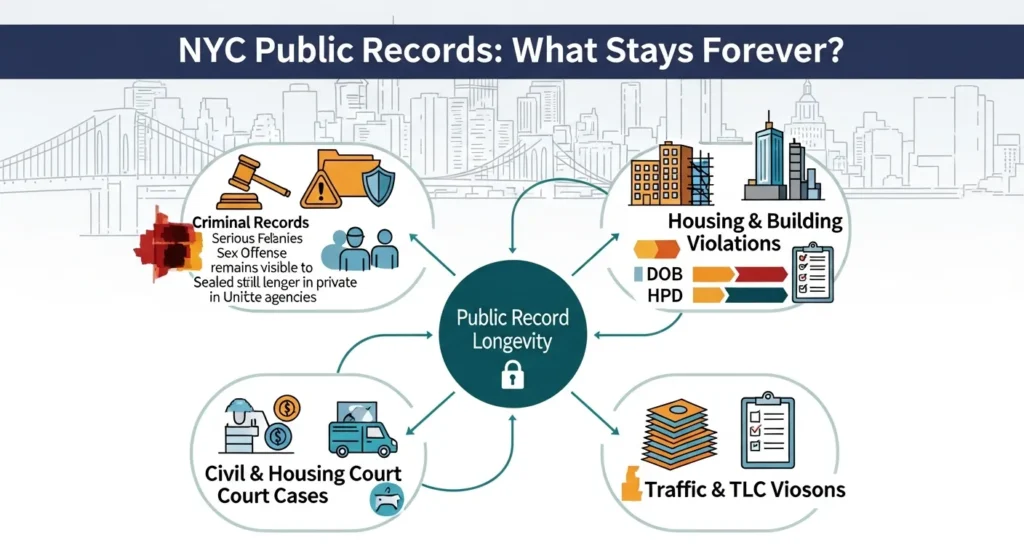
If we’ve learned anything from helping New Yorkers dig through records, it’s this: in NYC, “forever” is less about ink on paper and more about what shows up in a quick online search.
Most NYC violation records are legally retainable indefinitely. But whether a violation actually stays easy to find, for landlords, employers, or anyone with Wi‑Fi, depends on the type of record, sealing laws, and how aggressively private data brokers scoop up and republish public data.
In this guide, we’ll walk through which NYC building violations, criminal records, housing cases, and tickets tend to follow you the longest, where they live in city systems, and what we can realistically do to reduce their impact on our lives and on NYC property compliance.
How Public Records Work In New York City
How Public Records Work In New York City {#2S4Er0MNjC5_zjg0q69_v}
Before we talk about what lasts “forever,” we need to be clear on where violations actually live and who controls them.
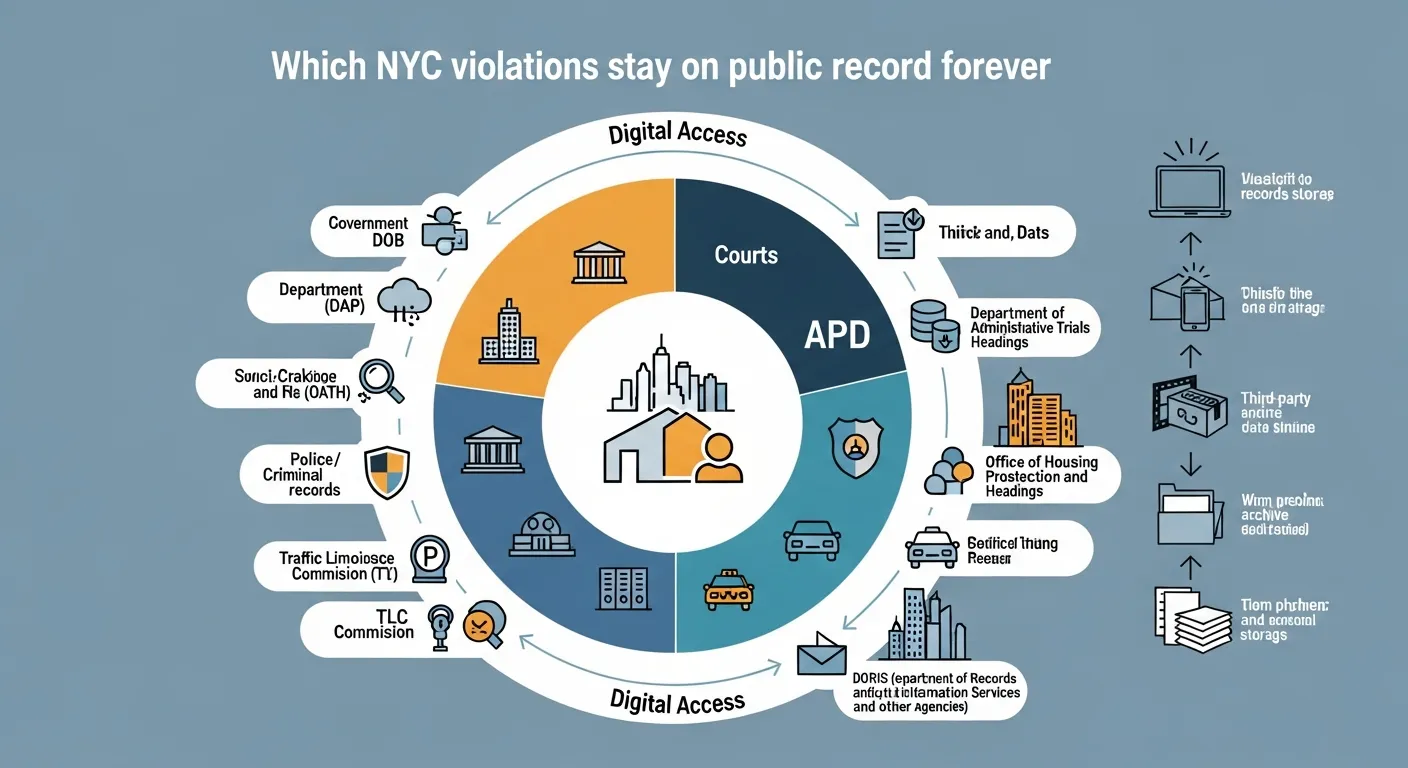
Key Agencies And Databases That Store Violations
New York City doesn’t have a single all‑in‑one public file on each person or property. Instead, information is scattered across agencies:
- NYC Department of Buildings (DOB) – Tracks building history, permits, complaints, and DOB violations. Two main systems:
- BIS (Building Information System) – The older database, still crucial for legacy properties.
- DOB NOW Public Portal – Newer system for many permits and enforcement records. Both are openly searchable and not routinely purged.
Public portal: https://www.nyc.gov/site/buildings
- HPD (Department of Housing Preservation and Development) – Manages HPD violations and HPD complaints for residential buildings. These appear in HPD Online and on NYC Open Data.
- OATH/ECB (Office of Administrative Trials and Hearings) – Handles many civil penalties (formerly ECB), including building, sanitation, and environmental violations. Many decisions are searchable on OATH’s site and via NYC Open Data.
- Other enforcement agencies – FDNY (fire safety), DEP (environmental protection), DSNY (sanitation), TLC (Taxi & Limousine Commission), DOF (parking, property taxes), DMV for traffic violations, and more.
- Courts – Criminal, civil, housing, and small claims cases are court records, typically accessible through New York State Unified Court System tools like WebCivil, WebCrims, and eCourts: https://iapps.courts.state.ny.us
- DORIS & Municipal Library – The Department of Records & Information Services maintains permanent digital archives of NYC government publications and some historical records: https://www.nyc.gov/site/records.
Put simply: once something is officially recorded, it usually stays somewhere inside government systems, even if public visibility changes.
Types Of NYC Violations That May Be Public
Different record types play by different rules. In broad strokes, these are the categories we see most often:
- NYC building violations – DOB violations, ECB/OATH civil penalties, unsafe building orders, and related enforcement actions.
- Housing code violations – HPD Housing Maintenance Code violations and heat/hot water, mold, and pest issues linked to specific buildings.
- Criminal records – Arrests, charges, convictions, and dispositions maintained by New York State (DCJS) and the courts.
- Traffic and parking – Parking tickets, red‑light/ speed‑camera summonses, moving violations, and DMV driver abstracts.
- TLC and licensing – TLC violations, suspensions, license revocations for drivers and bases.
- Civil and debt – Landlord–tenant cases, civil lawsuits, judgments, tax liens, and other civil enforcement records.
Each category has its own rules for retention, sealing, and online access. Some are hardened into public view: others are technically public, but much harder for the average person to find.
Digital Records, FOIL, And The Shift To Permanent Online Access
Historically, a lot of NYC records were only accessible by going to a clerk’s office or ordering microfilm. Today, that’s changed.
- FOIL (Freedom of Information Law) lets us request many government records through NYC’s OpenRecords portal: https://a860-openrecords.nyc.gov.
- Agencies don’t generally have a statutory obligation to delete old violations from their databases: retention schedules often allow indefinite storage.
- As more systems move online, what used to be “in a box in the basement” is now a few clicks away.
In practice, “forever” isn’t just about what the government keeps. It’s about what’s searchable online, and what third‑party sites, from background check companies to real‑estate data platforms, decide to copy and keep.
For building owners and buyers trying to track their own exposure, we rely heavily on tools like the official DOB portals and independent services such as ViolationWatch, which centralize NYC property compliance data into a single view.
Criminal Records In NYC: What Can Stay Forever
Criminal Records In NYC: What Can Stay Forever {#t0I4wlnBY_bI7d9AKlTze}
Criminal records are often the area where people most fear a “forever record.” The reality in New York is more nuanced, especially with the state’s Clean Slate Act reshaping long‑term access.
Felony Convictions And Long-Term Public Access
New York’s official criminal history repository is the Division of Criminal Justice Services (DCJS). DCJS rap sheets are not public under FOIL, but they’re accessible to law enforcement, courts, and certain authorized agencies.
With the Clean Slate Act, many felony convictions will be automatically sealed after set waiting periods, provided the person has no new serious convictions and has completed their sentence. But there are key exceptions that can effectively last forever:
- Sex offenses requiring registration
- Non‑drug Class A felonies, such as murder and some serious violent crimes
These are never sealed and remain visible to criminal justice agencies and certain employers (for example, those working with vulnerable populations or in law enforcement), indefinitely.
Public‑facing searches, like the Office of Court Administration’s Criminal History Record Search (CHRS), show open cases and convictions that are not sealed. Sealed cases simply don’t appear.
Misdemeanors, Violations, And Sealed Cases
For lesser offenses, New York law is far more forgiving than many people realize.
- Many misdemeanor convictions become eligible for sealing under Clean Slate after specific waiting periods.
- Certain older provisions (like Criminal Procedure Law § 160.59) already allowed limited sealing of some convictions.
- Dismissed cases, acquittals, and many cases resolved with certain dispositions are automatically sealed under existing law.
But, sealing doesn’t magically erase the past:
- Law enforcement and courts can still see sealed records.
- Some private data brokers may retain copies of old, now‑sealed court information scraped years ago.
- If you voluntarily disclose details on a job or housing application, those statements can be used like any other information.
So while the law restricts what official sources reveal, unofficial copies may linger.
Sex Offense Registries And Other Special Registries
Separate from standard criminal records, some categories are designed to be long‑term or effectively permanent.
- Sex Offender Registration Act (SORA) – Depending on risk level, registration can last for decades or for life. Public access is offered through the NYS Sex Offender Registry and can be searched by name or location.
- Professional and occupational discipline – Doctors, lawyers, real‑estate brokers, and other licensed professionals may have disciplinary histories posted on state or city websites, sometimes indefinitely.
For many New Yorkers, though, the more immediate concern isn’t a criminal conviction, it’s the combination of NYC building violations, HPD complaints, or housing court history that keeps resurfacing every time they apply for an apartment.
Housing And Building Violations That Rarely Disappear
Housing And Building Violations That Rarely Disappear {#glb3BSkJQ_uDSCrgn1RNH}
If there’s one category of record that feels practically permanent in NYC, it’s housing and building enforcement. DOB violations, HPD violations, and related OATH/ECB penalties form a kind of permanent medical chart for a property.
DOB (Department Of Buildings) Violations
DOB maintains decades of history for each building in BIS and DOB NOW. When we pull a building’s profile, we routinely see:
- DOB violations from the 1990s or earlier
- Complaints and inspection results across multiple owners
- Corrected and dismissed violations, still visible as part of the timeline
Critically:
- There is no general expiration date for DOB violations in BIS/DOB NOW.
- Even when they’re paid, corrected, or dismissed, they typically remain in the record, with updated statuses.
- Many DOB violations are also tied to OATH/ECB cases, which appear in separate but related systems.
From a compliance standpoint, this is good: future buyers and tenants can see a building’s history of unsafe conditions, illegal work, or chronic violations. From an owner’s perspective, it means a renovation mistake from 12 years ago can still be front‑and‑center on a simple lookup.
For ongoing oversight, we often recommend owners and managers use regular monitoring instead of reactive checks. Get instant alerts whenever your building receives a new violation, sign up for real-time monitoring via building violation alerts.
HPD (Housing Preservation And Development) Violations
HPD handles Housing Maintenance Code enforcement for residential buildings: heat and hot water, lead paint, mold, pests, broken doors and windows, and other habitability issues.
Key points about HPD violations:
- They’re visible through HPD Online and on NYC Open Data.
- Like DOB records, there’s no routine purging of old HPD violations.
- Even when violations are corrected and closed, the historical record stays.
From the tenant side, this history is powerful. A rent‑stabilized tenant can look up their building and see decades of issues. From the owner side, a long trail of uncorrected violations can tank a building’s reputation with lenders and buyers.
We see more and more landlords proactively tracking HPD complaints and violations across their portfolio, using city tools plus services like ViolationWatch that unify multiple data feeds into one NYC property compliance dashboard.
ECB/OATH Civil Penalties And Environmental Violations
A large share of NYC enforcement actions flow through OATH (formerly ECB for Environmental Control Board cases):
- Building code violations forwarded from DOB
- Sanitation tickets for dirty sidewalks or improper trash
- DEP violations related to noise, asbestos, or air quality
- FDNY fire safety violations
A few important realities:
- Many OATH/ECB decisions are publicly searchable and don’t expire from the database.
- Even where the violation is eventually dismissed or reduced, the case record can still exist.
- If a judgment goes unpaid, it can appear as a debt owed to the city, with interest, and may lead to liens or collections.
Taken together, DOB, HPD, and OATH form a persistent narrative of how seriously an owner treats NYC building violations. That narrative is what banks, buyers, and sophisticated tenants look at when deciding whether to trust a property.
How Long NYC Parking Tickets And Traffic Violations Stay Public
How Long NYC Parking Tickets And Traffic Violations Stay Public {#We0mux4FjpQQ3Ax5keExT}
Parking tickets and traffic violations don’t haunt people quite like criminal or housing records, but they leave a longer footprint than most of us expect.
Parking Tickets, Scofflaw Status, And Judgment Debts
The NYC Department of Finance (DOF) keeps records of all parking and camera violations issued in the city.
- If you don’t respond on time, tickets can go into judgment, becoming collectible debts.
- DOF can use booting, towing, and other enforcement for chronic scofflaws.
- Unpaid judgments can be referred to collections and may be reported to credit bureaus, subject to general credit‑reporting rules.
While consumer credit reporting is time‑limited (usually seven years for most negative items under federal law), internal DOF records of those tickets and judgments can exist well beyond that. They may not be front‑and‑center on a public lookup forever, but they don’t simply disappear.
Traffic Violations, DMV Points, And Insurance Records
Moving violations (speeding, failure to yield, etc.) are handled through the NY DMV and, in NYC, often through the Traffic Violations Bureau (TVB).
- Convictions typically result in points on your license, which drop off after a set period (often 18 months for point calculation purposes).
- The DMV keeps a longer driver history record than insurers or employers usually see.
- Insurers maintain their own internal records and risk models, sometimes storing prior incidents longer than the DMV points remain “active.”
In practice, your insurer is more likely to react to a three‑year driving window, even if the DMV’s archive stretches further.
TLC (Taxi And Limousine Commission) And Transit-Related Records
For professional drivers, the TLC has its own ecosystem of violations and enforcement.
- TLC violations, suspensions, and license revocations are often searchable and may be referenced in licensing decisions for years.
- Safety‑related incidents can weigh heavily in renewal decisions, regardless of whether a related DMV ticket has aged off your point total.
While TLC doesn’t explicitly promise that every violation will remain online forever, internal records remain part of your licensing file long‑term. Any driver relying on TLC work should treat each violation as potentially visible for the life of their career.
Civil Court, Landlord–Tenant, And Debt-Related Records
Civil Court, Landlord–Tenant, And Debt-Related Records {#M05qSUH3jnpMDj6B7pE-B}
Civil and housing court records don’t have a clean “expiration date” the way credit reports do. Once a lawsuit or eviction case is filed, the fact that it existed is often public for good.
Evictions, Housing Court Cases, And Tenant Screening Reports
In NYC, landlord–tenant (housing) court filings are court records. There’s no broad expungement law that automatically wipes old eviction cases.
- Case dockets and many documents can be looked up via NYS courts eCourts systems.
- Background and tenant‑screening companies routinely scrape and repackage this data.
Even if:
- The case was settled, or
- You won, or
- The landlord eventually dropped the case,
…the existence of the case can end up on a tenant screening report. Some companies will update their records: others keep outdated or incomplete data much longer.
This is where we see a big gap between what’s legally public and what shows up in private screening tools.
Civil Judgments, Liens, And Credit Reporting Timelines
Civil money judgments and liens (including some city judgment debts) can affect both court records and your credit profile.
- In court systems, there is usually no automatic deletion after a set number of years.
- By contrast, credit reporting agencies must follow federal and state rules, which generally limit most negative items to seven years.
So you can have a judgment that:
- No longer appears on your credit report, but
- Still exists in court records, accessible through public searches or FOIL.
Lenders, sophisticated landlords, and some employers may look directly at court databases, not just at your credit file.
When Court Records May Be Redacted, Restricted, Or Sealed
There are targeted ways to limit public access to court records:
- Sealing in specific case types (e.g., certain criminal matters, some family and juvenile cases).
- Motions to redact sensitive information (Social Security numbers, account numbers, certain medical details).
- Protective orders or restricted access in particular high‑risk contexts.
But New York does not provide a broad “right to be forgotten” for civil or housing court. Once a lawsuit is filed, the safest assumption is that some trace of it will always be findable, especially for people who know where to look.
What “Forever” Really Means: Practical Permanence Vs Legal Retention
What “Forever” Really Means: Practical Permanence Vs Legal Retention {#t5BFF9M9RY3Vh3iKSATE_}
When we talk to owners and tenants, “Is this on my record forever?” really has three sub‑questions: what does the government keep, what’s easily searchable, and what do private companies hold onto?
Official Retention Schedules Vs Private Data Aggregators
Government agencies follow records retention schedules that tell them how long they’re allowed, or required, to keep certain categories of documents. For many types of violations and court records, the answer is essentially: indefinitely.
But the part that shapes our day‑to‑day lives is what private data aggregators do:
- Background‑check companies
- Tenant‑screening services
- Real‑estate data platforms
- People‑search sites and data brokers
These companies routinely scrape NYC systems (DOB, HPD, OATH, courts) and build their own databases. Even if a record is later sealed, corrected, or updated on the government side, the private copy may never be refreshed.
That’s how a dismissed HPD complaint or corrected DOB violation can keep showing up years later on a third‑party report.
How Web Archiving And Data Brokers Extend Your Digital Footprint
On top of that, web archiving amplifies permanence:
- Snapshots of public sites (including some government pages) can be captured and stored by web archives.
- A listing that once showed a building’s ugly violation history might get scraped, cached, or quoted elsewhere.
For NYC building violations, we routinely see data echoed across brokerage sites, map overlays, and “building history” portals that draw from official feeds but update at different schedules, or not at all.
Once a record has been shared broadly, you’re not just cleaning up one system: you’re trying to unwind a chain of copies.
Differences Between Publicly Searchable And Legally Public
There’s an important legal nuance:
- A record can be legally public, meaning subject to FOIL or court inspection, – But not easily searchable online by name, address, or building.
For example:
- A sealed criminal case is generally not disclosed in standard OCA public searches, even though law enforcement still sees it.
- An older housing court file might require an in‑person visit, even if the docket is visible online.
From a practical perspective, “forever” tends to mean “as long as someone can find it with a basic search.” That’s why we put so much emphasis on:
- Keeping current NYC property compliance clean going forward.
- Monitoring what shows in city systems in real time.
- Addressing errors quickly before they propagate.
For free lookups, use our NYC violation lookup tool to see the same public data many screening tools pull from.
Options To Limit Or Remove NYC Violations From Public View
Options To Limit Or Remove NYC Violations From Public View {#KcHhIqvkvarAcVPRsXPU4}
We can’t erase the past, but in NYC we do have tools to reduce the visibility and impact of old violations and cases.
Sealing, Expungement, And Record-Correction Procedures
For criminal matters:
- Explore eligibility under the Clean Slate Act and existing sealing provisions.
- Request your own official records from DCJS or the OCA CHRS system so you know exactly what appears.
- If records seem wrong or incomplete, work with an attorney or legal aid group to correct them.
For building and housing records:
- Make sure DOB and HPD violations are properly certified as corrected and that the online systems reflect the right status.
- If a violation was issued in error, pursue formal correction rather than ignoring it.
Expungement, actual deletion, is rare in NYC. The more realistic goal is getting records sealed, corrected, or accurately marked as resolved, so their impact in screening tools is minimized.
Administrative Appeals And Vacating Incorrect Violations
City agencies have processes to challenge and overturn mistakes:
- OATH/ECB offers appeals for many administrative violations and penalties.
- DOB, HPD, and other agencies allow for reconsideration or administrative review of certain determinations.
When we advise owners, we stress speed and documentation:
- Act quickly when a clearly incorrect DOB violation or HPD complaint hits.
- Gather proof: photos, permits, inspection reports, correspondence.
- File timely appeals or requests to vacate and keep copies of everything.
Once a bad violation has sat for years, it’s far harder to convince anyone, including a future buyer, that it was harmless or erroneous.
This is why continuous monitoring helps. Using building violation alerts via ViolationWatch or similar services means you hear about issues as they’re posted, not six months later when a lender’s attorney raises a red flag.
Negotiating With Data Brokers, Background Checks, And Screening Services
Even after fixing things at the source, you may still have to deal with private data brokers:
- Many companies have opt‑out or dispute procedures.
- Some will update their records when you send proof that a case was sealed, dismissed, or corrected.
- Others are less responsive, especially if they operate outside strict regulatory regimes.
Concrete steps we usually recommend:
- Get copies of your own background and tenant‑screening reports whenever possible.
- Dispute inaccuracies in writing, attaching official court or agency documents.
- Keep a short written explanation you can share with landlords or employers when a record isn’t technically wrong, but also isn’t telling the whole story.
You won’t scrub every copy of an old eviction filing or DOB violation from the internet, but you can:
- Ensure official NYC records are accurate and current.
- Reduce the number of third‑party sites repeating outdated information.
- Be prepared to address what still surfaces.
Protecting Yourself When Applying For Housing, Jobs, Or Licenses
Protecting Yourself When Applying For Housing, Jobs, Or Licenses {#E3HC1PmaaWn-TxsWO_L7y}
At some point, every old violation or case becomes a practical question: “How do we get through this application process without being blindsided?”
Disclosure Strategies And Explaining Old Violations
First, we need to understand what the form is really asking.
- If a housing or job application asks about current violations or pending cases, we don’t need to volunteer long‑closed matters.
- If it asks about any history, we have to weigh literal accuracy against the risk of misrepresentation.
A few principles that help:
- Never lie in writing. If a background check later turns up records that contradict your statement, that can be worse than the record itself.
- Answer the question as narrowly and truthfully as possible.
- Where allowed, add a short note: one or two sentences explaining that an issue was corrected, the case was dismissed, or the violation stemmed from a previous owner.
For property owners and managers, having a clean, well‑documented NYC building violations history becomes a selling point. Prospective tenants and lenders are far more forgiving when they see a short burst of violations tied to a known renovation, followed by years of clean records.
When To Consult An Attorney Or Legal Aid Organization
There are moments when DIY efforts aren’t enough:
- Complex criminal histories, especially involving felonies or overlapping cases
- Repeated evictions or housing court disputes that may be mischaracterized in screening reports
- Large civil judgments or liens that may have been satisfied but not updated
In those situations, it’s worth talking to:
- A NYC legal aid organization focused on housing, re‑entry, or consumer rights
- A private attorney with experience in sealing, record correction, or administrative law
They can:
- Review your full record across systems (DCJS, OCA, DOB, HPD, OATH, DMV)
- Identify what can realistically be sealed, vacated, or corrected
- Help you craft safe, accurate disclosures for applications
At the same time, we should stay proactive. Regularly checking our properties and personal records, using official systems and tools like the NYC violation lookup tool, means we catch issues early, rather than discovering them in the middle of a high‑stakes application.
Conclusion
Conclusion {#v4UYD4LGUgoTriyeJOxgG}
In New York City, very few things are erased outright. NYC building violations, HPD complaints, OATH decisions, housing court records, and many criminal convictions can persist in one form or another for decades, and sometimes effectively forever.
But there’s a real difference between what’s technically public and what actually shapes our lives:
- Government systems usually keep a permanent or near‑permanent record.
- Online portals and data brokers decide what’s visible with a quick search.
- Our own vigilance, correcting errors, closing out violations, and monitoring new entries, determines how much damage a record can do.
We can’t rewrite the past, but we can manage it. That means:
- Cleaning up DOB and HPD histories so that resolved issues are properly reflected.
- Using tools like ViolationWatch and the NYC violation lookup tool to stay on top of compliance.
- Seeking sealing, appeals, and legal help where the law allows.
In a city where data rarely dies, the most powerful move we can make is staying informed and acting quickly, so old violations become part of the record, not the whole story.
Key Takeaways
- When asking which NYC violations stay on public record forever, the real issue is less legal deletion and more how long they remain easily searchable online and copied by data brokers.
- NYC building violations, HPD violations, and OATH/ECB civil penalties are rarely purged; even when paid or corrected, they usually stay visible in DOB, HPD, and OATH systems indefinitely as part of a property’s history.
- Certain serious criminal records, such as non‑drug Class A felonies and registrable sex offenses, are never sealed under New York law and effectively remain accessible to criminal justice agencies and some employers for life.
- Housing court filings, civil lawsuits, judgments, and many NYC traffic and parking records do not have a true expiration in court or agency databases, even if related credit report impacts drop off after about seven years.
- You generally cannot erase NYC violations, but you can limit their impact by correcting agency records, using sealing and appeals where available, monitoring NYC property compliance in real time, and challenging outdated or inaccurate data with private screening and background‑check companies.
Frequently Asked Questions About NYC Violations and Public Records
Which NYC violations are most likely to stay on public record forever?
In NYC, records that tend to be effectively permanent include DOB building violations, HPD housing code violations, OATH/ECB civil penalties, housing court cases, many civil judgments, and serious criminal convictions like certain Class A felonies and sex offenses. They may be searchable online indefinitely and mirrored by private data brokers.
Do NYC building violations ever get removed from BIS or DOB NOW?
NYC building violations in BIS and DOB NOW usually do not get deleted. Even when they’re paid, corrected, or dismissed, they remain visible as part of the property’s history, with status updates. From a compliance and due‑diligence perspective, you should assume DOB violations live in those systems indefinitely.
Can criminal NYC violations and convictions be sealed or cleared from public view?
Many lesser offenses in New York can be sealed under the Clean Slate Act and existing laws, meaning they no longer appear in typical public court searches. However, some serious crimes—like sex offenses requiring registration and non‑drug Class A felonies—are never sealed and remain accessible to criminal justice agencies and certain employers.
How long do NYC parking tickets and traffic violations stay on record?
The NYC Department of Finance keeps internal records of parking and camera violations indefinitely, even after debts fall off credit reports. DMV keeps long‑term driver histories, though points are typically counted for about 18 months. Insurers often focus on roughly the last three years, but agency databases themselves are much longer‑lived.
Can I get an old NYC housing court or eviction case removed from public record?
New York does not offer broad expungement for housing court or civil cases. Once a landlord‑tenant case is filed, the docket generally remains public. You may be able to correct errors, redact sensitive details, or show that the case was dismissed or settled, but full removal of the record is rarely possible.
What’s the best way to reduce the impact of old NYC violations on background checks?
Start by correcting the official record: close out DOB and HPD violations, resolve OATH/ECB judgments, and pursue sealing or correction of eligible criminal cases. Then request your own background or tenant‑screening reports, dispute inaccuracies with documentation, and prepare a brief written explanation for any accurate but potentially misleading records that still appear.