
If we work in New York City construction or property management long enough, we’ll eventually see the red notice: STOP WORK ORDER.
A DOB stop work order (SWO) is one of the most disruptive actions the NYC Department of Buildings can take. It doesn’t just slow a project down, it can shut a site instantly, trigger mounting costs, and put financing, leases, and relationships at risk.
The good news: most SWOs follow a predictable pattern. They’re issued for specific, traceable DOB issues. When we understand why DOB issues stop work orders in the first place, we can move much faster to clear them, and better yet, prevent them.
In this guide, we walk through how SWOs work, what typically triggers them, and the exact steps we use in practice to get them lifted as quickly as possible while staying on the right side of NYC building violations and NYC property compliance rules.
Understanding DOB Stop Work Orders

What A Stop Work Order Actually Means
When DOB issues a stop work order in NYC, it’s a legal directive: construction work covered by the order must cease immediately. It’s not a suggestion and it’s not something we can negotiate on the sidewalk with the inspector.
Under the NYC Building Code and DOB’s enforcement rules, a stop work order means:
- All covered work must stop right away.
- Only limited remedial work is allowed, and only when it’s specifically to make the site safe (shoring, temporary fencing, debris removal, etc.).
- In many cases, DOB expects us to get explicit authorization for that remedial work.
If work continues against an active SWO, DOB can issue additional violations, higher civil penalties, and even refer the matter for criminal enforcement in extreme cases. These penalties stack on top of existing NYC building violations and can easily turn a bad week into a bad quarter.
From DOB’s perspective, a stop work order is fundamentally about risk control: they use it when they believe ongoing work is unsafe or non‑compliant enough that the project can’t be allowed to continue “as is.”
Types Of Stop Work Orders Issued By DOB
DOB uses two main flavors of stop work orders, and understanding the difference matters when we’re planning a path to resolution.
1. Full Stop Work Order
A full SWO shuts down all construction work on the site, except specific safety measures DOB approves. Typical scenarios:
- Unpermitted structural work (e.g., cutting major beams without engineering).
- Serious unsafe conditions, unstable shoring, failing scaffolds, falling debris.
- Major egress or fire protection issues that put workers or the public at immediate risk.
Under a full SWO:
- No trades should be working, even on “small” items.
- Deliveries, material stockpiling, and new mobilization should stop.
- We focus on site safety, documentation, and DOB coordination.
2. Partial Stop Work Order
A partial SWO is more targeted. DOB will specify which areas, floors, or scopes are stopped. Typical cases:
- Work proceeding beyond what’s shown on approved plans.
- A localized unsafe condition (e.g., one scaffold run, a particular excavation area).
- A discrete violation tied to a specific trade.
With a partial SWO, other portions of the project may continue, but only if they’re clearly outside the stopped area and fully compliant. We still treat it like a major event: the violations behind a partial SWO can escalate into a full one if we’re casual about compliance or communication.
Common Triggers For DOB Stop Work Orders
DOB doesn’t wake up in the morning looking to shut jobs down at random. Stop work orders usually come from a familiar set of problems we see over and over across projects.
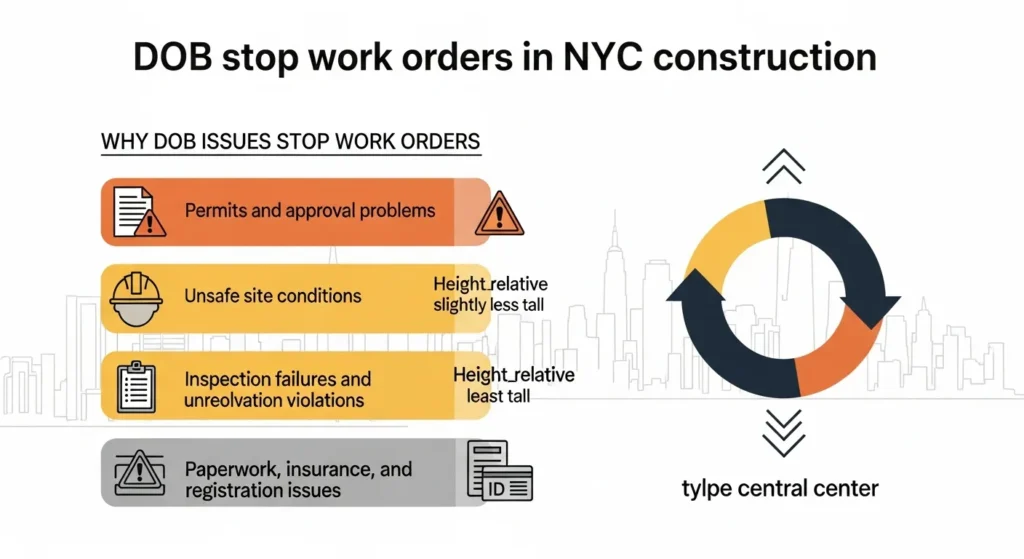
Permits And Approval Problems
Work without a permit is still one of the fastest ways to get hit with a SWO. Common scenarios:
- Interior build‑outs treated as “minor” when they clearly require permits.
- Structural alterations performed under an architectural alteration permit without the proper structural filings.
- Work in a use group or occupancy that doesn’t match approved zoning or certificate of occupancy.
DOB violations here often read like a greatest hits list: “Work Without a Permit,” “Work Contrary to Approved Plans,” or “Change in Occupancy Without a CO.” These issues go straight to the heart of NYC property compliance, so DOB uses SWOs to freeze the site until plans, permits, and filings catch up with reality.
Unsafe Or Non‑Compliant Site Conditions
The second big category: safety.
We see SWOs triggered by conditions like:
- Unprotected edges or missing guardrails at roofs and open floors.
- Improper scaffolding or sidewalk sheds, especially after a close call or debris incident.
- Excavations without proper shoring that threaten adjacent buildings.
- Evidence of falling debris, damage to neighboring structures, or worker injuries.
DOB inspectors are trained to err on the side of caution. If they see a condition that could lead to a serious accident, or already has, they’ll often issue a SWO on the spot, especially in dense neighborhoods where one bad decision can affect an entire block.
Inspection Failures And Violations
Sometimes the trigger isn’t a single dramatic event but a pattern of non‑compliance.
Examples:
- Repeated failure of required special inspections.
- Long‑standing, uncorrected ECB/OATH summonses tied to construction work.
- Inspectors finding that previously cited DOB violations were never addressed.
At that point, DOB essentially says: “We gave you chances, and you didn’t correct this. Work stops until you do.” This is where lingering NYC building violations and HPD complaints can come back to haunt a project, especially if someone at DOB or HPD connects the dots between old issues and current work.
Paperwork, Insurance, And Registration Issues
Finally, paperwork problems can, and do, lead to stop work orders:
- Missing or expired general liability insurance on file.
- Unregistered or expired general contractor or safety registration.
- Incomplete or missing site safety logs or training records.
- No superintendent or site safety manager present where required.
On paper these look “administrative,” but for DOB they’re foundational. If the responsible parties aren’t properly licensed, insured, and documented, DOB treats the entire job as suspect.
In many of these cases, we’re dealing with issues that could have been caught early with routine checks and proper use of tools like HPD complaint searches and DOB record reviews before mobilizing.
How DOB Issues Are Identified Before A Stop Work Order
DOB Inspections And Site Visits
Most SWOs start with a site visit. Inspectors may arrive:
- As part of a routine audit of permits and active jobs.
- In response to specific DOB violations or prior enforcement actions.
- To verify special inspections, structural work, or safety plans.
They’ll typically review:
- Posted permits and site signage.
- Access to approved plans (physical or digital).
- Housekeeping, protection, scaffolds, and access/egress.
- Whether work on the ground matches what DOB records say should be happening.
If they find serious discrepancies or unsafe conditions, a stop work order is one of the tools on the table. Their notes, photos, and formal reports will drive what we have to correct later.
Complaints, 311 Reports, And Neighbor Concerns
NYC has millions of unofficial “assistant inspectors”: neighbors.
DOB receives a steady stream of 311 complaints about noise, after‑hours work, dust, vibrations, and suspected illegal construction. HPD complaints about building conditions in occupied properties also generate cross‑agency attention.
In practice, a sequence might look like this:
- A neighbor calls 311 about work shaking their apartment.
- DOB sends an inspector.
- The inspector discovers unpermitted underpinning or an unshored excavation.
- A SWO is issued on the spot.
We can see how often this happens by watching the DOB complaint and enforcement data on DOB’s own portal and, for residential issues, on HPD’s website.
Data Matching And System Flags Inside DOB
Not every enforcement action starts with someone knocking on the door.
DOB’s internal systems match data across permits, violations, complaints, and inspections. Some triggers we’ve seen in practice:
- A new permit filed at a building with serious unresolved structural violations.
- A contractor with a pattern of safety issues pulling permits for high‑risk work.
- Properties with repeated HPD complaints suddenly showing major renovation permits.
Those flags may lead DOB to prioritize a site for inspection. If the on‑site conditions match (or exceed) the risk profile in the system, a stop work order becomes much more likely.
Using tools like ViolationWatch and public DOB search portals to monitor a building’s history gives us an early warning before DOB shows up. We don’t want to be surprised by a long‑forgotten violation or complaint that’s still sitting open in the record.
Immediate Steps To Take When You Receive A Stop Work Order
The moment we receive a SWO, the clock starts. What we do in the first few hours can either shorten or stretch the road back to work.
Securing The Site And Protecting Safety
First, we stop all work covered by the order, no gray area, no “just five more minutes.” Then we:
- Power down and secure equipment and tools.
- Lock out hazardous areas and post clear notice for crews.
- Make sure egress routes, fencing, and public protection are intact.
DOB is primarily worried about safety. Showing that we take that seriously from minute one sets the tone for every interaction that follows.
Reading The Order And Understanding The Specific DOB Issues
Next, we carefully read the stop work order and any associated DOB violations line by line.
We identify:
- Every cited condition (e.g., “unpermitted plumbing work in cellar,” “missing guardrails at roof perimeter”).
- Any references to specific code sections or approved plans.
- Required actions or documentation spelled out on the violation or SWO.
Creating a simple matrix, issue, code reference, responsible party, required fix, helps keep everyone aligned and prevents us from missing smaller items that might hold up rescission later.
Notifying Your Team, Lenders, And Stakeholders
A SWO doesn’t just affect the trades on site. It can ripple through financing, leases, and contracts.
We usually notify, in writing:
- The owner/developer and property manager.
- The general contractor and key subcontractors.
- The lender or construction monitor.
- Insurer and surety, where required by policy or bond.
Transparency here avoids surprises later when schedule extensions, change orders, or claims come into play.
For tracking the full picture of violations at the property while we’re coordinating, we like to run a quick check using a NYC violation lookup tool such as https://lookup.violationwatch.nyc/lookup so we’re not blindsided by older open issues.
Avoiding Actions That Can Make The Situation Worse
A surprising amount of SWO pain comes from what people do after the notice goes up.
We avoid:
- Quietly continuing interior work “so we don’t fall behind.”
- Moving equipment or materials in ways that alter the site conditions DOB saw.
- Arguing with inspectors on site or refusing reasonable access for follow‑up.
Continuing work against an SWO can trigger additional DOB violations, higher civil penalties, and delays in rescission. We’ve seen projects lose weeks not because of the original issue, but because someone tried to push through anyway.
This is the moment to slow down, get organized, and move deliberately, not the time to improvise.
Diagnosing The Root DOB Issues Behind The Stop Work Order
Once the site is stable and stakeholders are informed, we move to diagnosis. The goal is to understand not just what DOB cited, but why and what else might be lurking behind it.
Reviewing Permits, Plans, And Approvals
We start at the desk, not in the field.
- Pull every active DOB permit, amendment, and letter of approval.
- Compare them to current drawings, RFIs, and change directives.
- Walk the job with the design team to confirm whether the actual work matches what’s on file.
Typical mismatches that lead to SWOs:
- Field changes that never made it into formal revisions.
- Structural additions or reconfigurations not covered by the original filing.
- Mechanical, electrical, or plumbing work extending beyond the permitted scope.
Our aim is to create a clean list of what needs to be re‑designed, re‑filed, or legalized before DOB will be comfortable lifting the order.
Checking Open Violations, Complaints, And Prior Enforcement
Next, we zoom out and look at the building’s broader compliance picture.
We check:
- Open DOB ECB/OATH summonses and prior stop work orders.
- HPD complaints, especially for occupied buildings where tenant safety is in play.
- Any prior enforcement actions related to unsafe scaffolding, egress, or structural issues.
At this stage, it’s critical to have accurate violation data. For free lookups, we’ll use our NYC violation lookup tool at https://lookup.violationwatch.nyc/lookup so we’re working from a complete record, not guesses or partial histories.
Patterns matter. If DOB sees that the same types of issues have been flagged before, they’ll expect more robust corrections and clearer documentation this time around.
Coordinating With Your Design Professionals And Contractors
We don’t clear a SWO in isolation. It takes coordinated work from:
- Architects and engineers, to design and stamp corrective measures.
- The GC and affected trades, to price and execute remediation work.
- Expediters or filing reps, to shepherd corrections through DOB.
We find it helpful to hold a single coordination meeting where all parties review:
- Each cited violation and code section.
- Proposed design fixes and safety measures.
- Required filings (Alt‑2, Alt‑1, amendments, after‑the‑fact permits).
- A realistic timeline for work and inspections.
When everyone leaves that meeting with a shared checklist and schedule, the odds of a fast rescission go up significantly.
Working With DOB To Clear A Stop Work Order Quickly
With the root issues defined, we shift into resolution mode. This is where process and documentation make or break the timeline.
Preparing A Corrective Action Plan
DOB responds best when we present a structured corrective action plan rather than piecemeal fixes.
A strong plan usually includes:
- A summary of each cited condition.
- The proposed engineering or architectural solution.
- How we’ll protect workers, neighbors, and the public during corrective work.
- A schedule for filings, work, and requested re‑inspections.
In more serious cases, structural instability, facade hazards, major egress issues, DOB may expect a formal letter from the engineer of record outlining the risk assessment and corrective strategy.
Scheduling Re‑Inspections And Special Inspections
Once corrective work is planned (and permits/approvals are in motion), we coordinate inspections on two fronts:
- Special inspections by approved third‑party agencies, where required by code.
- DOB re‑inspections to verify that violations are corrected and that conditions are safe.
Timing matters. We try not to call DOB for re‑inspection until:
- All cited conditions are corrected or safely mitigated.
- Special inspection reports are complete and ready to upload or present.
- The site is clean and clearly reflects the narrative we’ve presented in filings.
Calling DOB too early, before we’re truly ready, can result in a failed re‑inspection, and more delay.
Submitting Required Documents, Filings, And Sign‑Offs
Behind almost every SWO rescission is a stack of paperwork.
Common requirements include:
- Certificates of correction for related DOB violations.
- Photos and affidavits documenting completed corrective work.
- Approved plan amendments and new permits, if the work scope has changed.
- Proof of current insurance, registrations, and safety training logs.
DOB generally won’t rescind a stop work order until:
- All underlying DOB violations tied to the SWO are addressed.
- Required filings are approved and permits are updated.
- Any civil penalties or fines are paid.
We track this in a single checklist so we’re not chasing missing documents at the last minute.
Communicating Effectively With Plan Examiners And Inspectors
How we talk to DOB is almost as important as what we file.
We aim for:
- Clarity: Short, factual explanations of what went wrong and how we fixed it.
- Consistency: What we say on site matches what we’ve filed on paper.
- Responsiveness: Quick follow‑up when DOB asks for additional information.
In some cases we’ll request a meeting or use DOB’s appointment systems to sit down (virtually or in person) with plan examiners and walk through our corrective plan. That’s often faster than a long email thread.
Meanwhile, we keep owners and lenders informed of progress. Using tools like building violation alerts (https://violationwatch.nyc/register/) helps us ensure we’re notified immediately if any new NYC building violations or DOB violations appear while the SWO is still pending.
Typical Timelines And Costs To Resolve Stop Work Orders
No two SWOs are identical, but the patterns are clear enough that we can offer realistic expectations on time and money.
What Drives Resolution Time Up Or Down
Resolution time is driven by a mix of factors:
- Severity of the hazard: Imminent danger conditions take priority but usually require more complex fixes.
- Complexity of corrective design: Structural redesign, underpinning, or facade stabilization add weeks or months.
- DOB workload: Busy periods or citywide initiatives can slow plan review and inspections.
- Quality of filings: Clean, complete submissions move faster than rushed or inconsistent ones.
- Past history: A building or contractor with a long record of NYC building violations may face closer scrutiny.
In broad strokes:
- Simple paperwork issues (lapsed insurance, missing registration, basic unpermitted interior work) can sometimes be resolved within days to a few weeks, assuming we move quickly on filings and penalties.
- Moderate issues (scaffold corrections, guardrails, limited structural fixes with clear engineering) often land in the 3–8 week range.
- Complex structural or safety problems, especially those requiring redesign, major remediation, or coordination with neighbors, can stretch into multiple months.
Direct And Indirect Costs Owners Should Expect
A stop work order hits both the hard costs on our balance sheet and the soft costs baked into our schedule.
Typical direct costs include:
- Civil penalties and fines tied to DOB violations and OATH summonses.
- Design and consulting fees for architects, engineers, and expediters.
- Permit, filing, and special inspection fees.
- Overtime or premium time to complete corrective work once we’re cleared.
Indirect costs are often bigger:
- Schedule delays that push out TCO, lease‑up, or rent start dates.
- Extended general conditions, site supervision, rentals, and security.
- Remobilization costs for trades forced to leave and return later.
- Potential claims or disputes among owners, GCs, and subs over who bears what.
For income‑producing buildings, we also factor in:
- Lost rent if CO/TCO issuance is delayed.
- Higher interest or carry costs on construction loans.
- Reputational risk with tenants and the market.
Keeping tight control of NYC property compliance, through periodic checks, proactive filings, and real‑time monitoring of violations, tends to pay for itself when we compare it to even a single serious SWO event.
Strategies To Prevent Future DOB Issues And Stop Work Orders
The fastest way to clear a stop work order is still not to get one in the first place. While we can’t eliminate risk entirely, we can dramatically lower the odds with the right systems.
Building A Compliance‑First Project Culture
Prevention starts with mindset.
We make it clear, from owner to laborer, that anyone can stop unsafe work. Site supers and safety managers should feel empowered to:
- Shut down activities that don’t match approved plans.
- Demand proof of permits, insurance, and training.
- Escalate concerns without fear of retaliation.
This “compliance‑first” culture doesn’t slow jobs down. In our experience, it avoids the worst disruptions, like SWOs, that truly wreck schedules.
Setting Up Pre‑Construction DOB Checks
Before we mobilize on a new project, we run a pre‑construction compliance check:
- Review existing DOB records for open violations, old SWOs, and complaints.
- Check HPD complaints for tenant safety or habitability issues in occupied buildings.
- Confirm zoning, certificates of occupancy, and any prior determinations that might affect scope.
We like to do this with fresh data, not historical PDFs buried in emails. That’s where a tool like ViolationWatch (https://violationwatch.nyc/) comes into play, pulling together DOB, HPD, and other violation data into one place so we can spot red flags early.
Ongoing Monitoring During Construction
Conditions change constantly on active sites. So should our monitoring.
Best practices include:
- Daily safety walks and documented inspections.
- Regular internal audits of work in progress vs. approved plans.
- Tight review of change orders to see if they trigger new filings.
On the compliance side, we’ve found it game‑changing to set up building violation alerts (https://violationwatch.nyc/register/) so we know the moment a new DOB violation or HPD complaint hits. Get instant alerts whenever your building receives a new violation, sign up for real-time monitoring.
That early warning often lets us correct issues before they escalate into a full stop work order.
Keeping Documentation, Insurance, And Licenses Current
Finally, we stay ahead of the “paperwork” issues that so often snowball into DOB violations:
- Track expiration dates for insurance, contractor registrations, and site safety licenses.
- Keep site safety plans, training cards, and daily logs organized and accessible on site.
- Ensure emergency contact information and site signage match DOB records.
Most of this isn’t glamorous, but it’s exactly what inspectors look for on surprise visits. A well‑run, well‑documented site reads as low risk, which reduces the chance that a minor issue turns into an SWO.
For properties we manage long‑term, we periodically review the building’s public profile via official resources like the DOB Building Information Search and HPD Online, then cross‑check it against our own logs and tools like our NYC violation lookup tool so nothing slips through the cracks.
Conclusion
DOB issues stop work orders when they believe continued construction poses an unacceptable safety or compliance risk. That decision can feel abrupt on site, but behind it there’s almost always a clear trail: missing permits, unsafe conditions, ignored violations, or weak documentation.
When we respond with structure, immediate shutdown, accurate diagnosis, a clean corrective plan, and consistent communication, most SWOs can be cleared faster than they first appear. The key is to treat each one not as a one‑off crisis, but as a signal to tighten our systems.
If we own or manage NYC property, staying on top of NYC building violations, DOB violations, and HPD complaints is no longer optional. For free lookups, use our NYC violation lookup tool at https://lookup.violationwatch.nyc/lookup, and consider using building violation alerts at https://violationwatch.nyc/register/ so we’re never the last to know when something hits our record.
In a city where every delay is expensive, a proactive, data‑driven approach to NYC property compliance isn’t just good practice, it’s one of the most reliable ways to keep our projects moving and our sites safe.
Key Takeaways
- DOB issues stop work orders when inspectors see unsafe conditions, missing permits, or serious non-compliance that makes continued construction an unacceptable risk.
- Understanding the type of DOB stop work order—full or partial—shapes your strategy, from completely shutting down the site to isolating specific areas or trades.
- The fastest way to clear a stop work order is to immediately halt all covered work, stabilize and secure the site, then systematically diagnose every cited violation against permits, plans, and open records.
- A structured corrective action plan, backed by updated filings, special inspections, clean documentation, and clear communication with DOB, dramatically shortens rescission timelines and limits penalties.
- You can prevent many DOB issues that lead to stop work orders by building a compliance-first culture, running pre-construction DOB and HPD checks, monitoring violations in real time, and keeping insurance, licenses, and safety paperwork current.
Frequently Asked Questions
What is a DOB stop work order in NYC and what does it actually stop?
A DOB stop work order is a legal directive from the NYC Department of Buildings requiring specified construction work to cease immediately. All covered work must stop, including deliveries and mobilization. Only narrowly defined safety measures—like shoring, fencing, or debris removal—are allowed, often with explicit DOB authorization.
Why do DOB issues stop work orders so quickly on construction sites?
DOB issues stop work orders when inspectors believe ongoing work presents an unacceptable safety or compliance risk. Common triggers include unpermitted work, unsafe scaffolding or excavations, missing guardrails, expired insurance, or unresolved violations. The agency uses SWOs to freeze conditions on site until hazards are corrected and paperwork is brought into full compliance.
How do I clear a DOB stop work order as fast as possible?
To clear a DOB stop work order quickly, immediately stop all work, secure the site, and carefully review the SWO and related violations. Coordinate with your architect, engineer, and GC to design corrective measures, file necessary permits and amendments, complete required inspections, pay penalties, and request DOB re‑inspection once all cited conditions are resolved.
How long does it usually take to get a NYC DOB stop work order lifted?
Timelines vary by severity and complexity. Administrative or simple permit issues can sometimes be cleared in days to a few weeks. Moderate safety or structural corrections often take 3–8 weeks. Major structural redesigns, facade hazards, or complex neighbor impacts can stretch into several months, especially if DOB’s review calendar is backed up.
Can I keep some trades working under a partial stop work order?
Under a partial stop work order, DOB specifies which areas or scopes must stop. Work clearly outside the cited zones and fully compliant with approved plans may continue. However, any ambiguity can lead to new violations or escalation to a full SWO, so coordinate closely with your design team and document decisions before proceeding.
What’s the best way to prevent future DOB issues and stop work orders?
Prevention starts with a compliance‑first culture, thorough pre‑construction DOB and HPD checks, and ongoing monitoring during construction. Match field work to approved plans, keep insurance and licenses current, perform daily safety walks, and use NYC violation lookup tools and alert services to catch new DOB violations or complaints before they escalate into a stop work order.