
New York City construction sites don’t get the luxury of going quiet at 5 p.m.
Even after crews leave, we’re still dealing with tight sidewalks, high-value materials, scaffold access, curious pedestrians, and the reality that thieves and vandals know exactly where to look. That’s why more NYC contractors, developers, and owners are moving from traditional guards and basic cameras to live video monitoring tailored to dense urban job sites.
In this guide, we’ll walk through why live monitoring matters so much in New York, what to look for in a provider, and the 4 best types of live video monitoring options depending on your project risk, timeline, and budget. Our goal is simple: help you choose a solution that actually reduces incidents, supports safety, and stands up to NYC’s real-world conditions, not just what looks good on a proposal.
Comparing Video Monitoring Companies: Live Lion Security and Monitex
When considering live video monitoring, companies like Live Lion Security and Monitex are strong contenders. Additionally, let’s look at Protec Security and CCTV Security Pros for comparison. These companies vary in pricing, technology, and service offerings, providing options for different project needs.
Why Live Video Monitoring Matters For NYC Construction Sites
Unique Security And Safety Risks In New York City
Construction in New York is different. We’re building in the middle of an active city, often on tight lots with public access just inches away from fencing. That creates security and safety risks that static cameras or drive-by patrols can’t really handle.
Common NYC-specific risks we see:
- Material and tool theft: Copper, lumber, appliances, and small power tools walk off fast, especially on nights and weekends. (Learn more about construction theft here).
- Trespassing and vandalism: Curious teens, taggers, and people looking for shelter or a view will climb scaffolding or slip in through side gates.
- Liability exposure: An injured trespasser, a pedestrian struck by falling debris, or kids accessing a crane can all turn into costly claims or DOB scrutiny.
- Union and neighborhood tensions: High-profile projects can attract protests, disputes, or intentional disruption.
Traditional guards help, but they’re expensive, can’t see everything at once, and are human, meaning tired, distracted, or simply not where the incident is happening. Live video monitoring fills that gap by putting “eyes on” every key zone at once and reacting in real time.
How Live Monitoring Works On An Active Job Site
At a high level, live video monitoring combines:
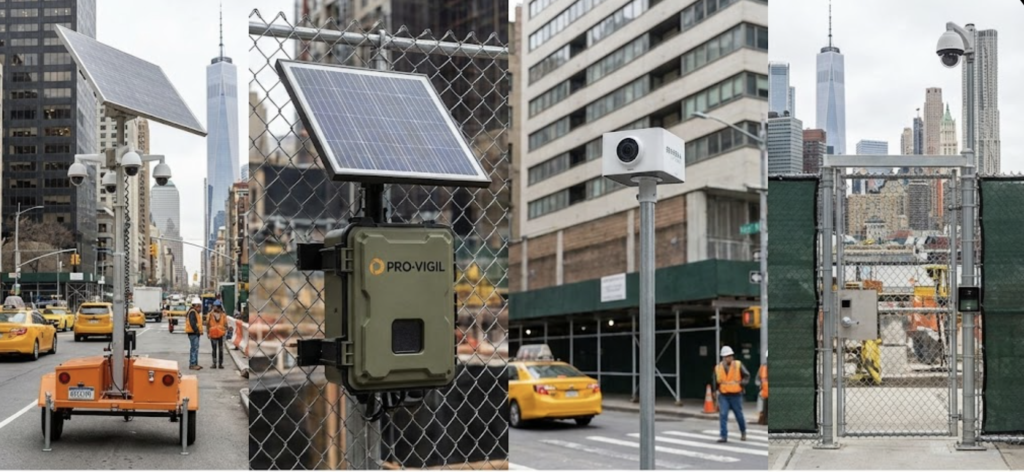
- Strategically placed cameras – fixed, PTZ (pan-tilt-zoom), and sometimes thermal or 360° units focused on entrances, street-facing perimeters, laydown yards, scaffold runs, and critical equipment.
- Connectivity – wired internet where available, or cellular/LTE for more temporary or remote setups.
- A monitoring center – trained operators watching alerts and key views, usually 24/7 or during off-hours.
- Deterrence and response tools – loudspeakers, sirens, flashing lights, and direct contact with site reps or NYPD.
On an active NYC job site, here’s what that looks like in practice:
- During working hours, cameras support operations and safety. (Find out more about site safety here).
- After hours, the system switches to a high-alert security mode. Smart analytics detect motion or human presence in restricted areas.
- Operators receive an alert, verify on live video whether it’s a threat, and then:
The big advantage in NYC: we’re not just recording incidents for later. We’re interrupting them in the moment, which is usually the difference between a near-miss and a very expensive loss.
Key Features To Look For In A Live Video Monitoring Service
Camera Coverage, Image Quality, And Night Performance
On New York construction sites, coverage and clarity are everything. We want fewer blind spots and footage that actually holds up if we need it for insurance or law enforcement.
Key questions we ask providers:
- Can they design coverage for tight, multi-level urban lots (front sidewalk, rear yard, roof, scaffold, interior floors)?
- Do cameras offer at least 1080p resolution, with some higher-res units for entrances and material storage?
- How well do they handle nighttime and mixed lighting (streetlights, headlights, shadows, glare)? IR or low-light performance is crucial.
- Are there PTZ cameras to follow suspicious activity across multiple zones?
Monitoring Center Standards And Operator Response
Not all “live monitoring” is truly live. We want to know exactly who is watching and how they respond.
Look for:
- A U.S.-based, 24/7 monitoring center with redundant locations.
- Clear response playbooks: when do they give audio warnings, call site contacts, call security, or escalate to NYPD?
- Average verification and response time after an alert.
- Operator training for construction-specific risks (scaffold access, crane safety, hazardous materials).
Deterrence Tools, Integrations, And Compliance
Deterrence is where live monitoring earns its keep.
We look for:
- Two-way or one-way audio speakers to issue live, site-specific warnings.
- Strobes or sirens to scare off intruders and draw attention from passersby.
- Integrations with access control, alarms, or time-and-attendance systems.
- Support for local regulations and privacy, including signage requirements and storage policies.
In NYC, it also helps if providers understand DOB expectations and union safety committee concerns, so we’re not re-litigating surveillance every time someone new walks the job.
Pricing Models, Contracts, And Hidden Costs
Construction budgets are tight, and change orders are constant. We want monitoring that’s predictable.
Typical cost components include:
- Equipment – cameras, network gear, speakers, trailer or poles.
- Installation and setup – labor, permits (if needed for poles), configuration.
- Monitoring fees – monthly per site, per camera, or per trailer.
Key things to clarify up front:
- Contract terms: month-to-month vs. 12–36 month commitments.
- Fees for adding/removing cameras, relocating trailers, or changing coverage.
- Any data storage surcharges or fees for pulling and exporting video.
Conclusion
Live video monitoring has moved from a “nice-to-have“ to a core part of risk management on NYC construction job sites. When choosing between providers like Live Lion Security, Monitex, Protec Security, and CCTV Security Pros, consider your project’s specific needs, technology integration, and total cost of ownership.
The next step is simple: map your current and upcoming projects to these models, run the numbers on total cost of ownership, and choose the live video monitoring approach that will keep your NYC construction sites secure from day one to ribbon cutting.