
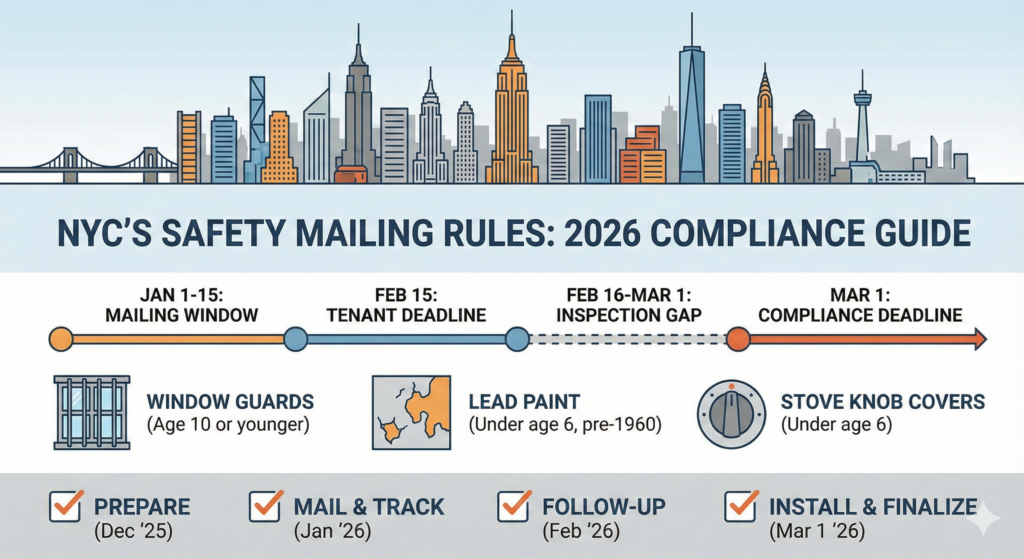
If you live in New York City, there’s a good chance your mailbox fills up every year with official-looking envelopes about fire safety, window guards, lead paint, gas leaks, and more. Many of us glance at these NYC Safety Mailings, feel a little overwhelmed, and then… set them aside.
Those envelopes aren’t junk. They’re required by law, they protect your health and safety, and they can affect your rights as a tenant or your liability as a building owner.
In this guide, we break down NYC Annual Safety Mailings in plain English, what they are, why you get them, what 2026 requirements and deadlines look like, and how to stay compliant without losing your mind in paperwork.
What NYC Annual Safety Mailings Are And Why You Receive Them
NYC Annual Safety Mailings are notices, forms, and information packets that building owners and managers are legally required to send to tenants each year. These mailings cover things like lead paint, window guards, fire safety plans, and gas leak instructions.
They’re not optional courtesy flyers. They exist because past tragedies, childhood lead poisoning, falls from windows, deadly fires, and gas explosions, showed that “common sense” alone isn’t enough. The City built laws that require clear communication between landlords and tenants, every year, in writing.
The Laws Behind Annual Safety Notices
Several NYC and New York State laws sit behind NYC Safety Mailings. Some of the main ones are:
- Local Law 1 of 2004 (Lead Paint) – Requires landlords in most pre-1960 (and some 1960–1978) buildings to identify whether children under 6 live in an apartment, provide annual lead notices, and safely address any lead hazards.
- Window Guard Law (NYC Health Code §131.15) – Requires owners to install and maintain approved window guards in apartments where children 10 or younger live, and in certain common areas. Annual notices help confirm if children live in the unit.
- FDNY Fire Safety Laws (e.g., Local Law 10/1999, Local Law 26/2004) – Require fire safety guides, building-specific fire and emergency procedures, and, in some cases, annual distribution of updated safety information.
- Carbon Monoxide & Smoke Alarm Requirements (Local Laws 7, 112, and others) – Mandate installation and maintenance of smoke and CO alarms, and written notice to tenants about their responsibilities.
- Gas Safety & Stove Knob Laws (Local Law 152, Local Law 113 of 2016, and related rules) – Require gas piping inspections and safety information, including gas leak instructions and, in apartments with young children, stove knob covers.
NYC agencies such as the Department of Housing Preservation and Development (HPD), the Department of Buildings (DOB), and the Fire Department of New York (FDNY) enforce these rules. The annual mailings are one of the easiest ways for owners to prove they informed tenants of their rights and obligations.
Which Buildings And Households Are Covered
Most multifamily residential buildings in NYC are covered by at least some of these requirements. In broad strokes:
- Rental apartment buildings (3+ units) – Almost always required to send multiple NYC Annual Safety Mailings.
- Two-family homes where one unit is occupied by a tenant (not the owner) – Often covered, especially for lead and window guard rules.
- Co-ops and condos – Boards and managing agents usually must send fire safety and alarm notices to shareholders/unit owners and sometimes to subtenants.
- Short-term rentals / illegal occupancies – Still subject to safety laws, though compliance can be messy. If we’re renting to someone, we’re typically still responsible for required notices.
Households with children under 6 or 10 and buildings built before 1978 usually trigger the most requirements. But even an adults-only household in a newer building will typically receive at least fire safety and alarm information every year.
Key Types Of NYC Annual Safety Mailings
Not every building sends the exact same packet, but most NYC Safety Mailings fall into a few common categories. Understanding what each one is for helps us respond correctly instead of ignoring them.
Lead Paint Disclosure And Annual Lead Safety Notice
If our building was built before 1960, or between 1960 and 1978 with known lead paint, and there’s a child under 6 in the household, the owner must:
- Send an annual lead paint safety notice (often combined with window guard questions).
- Ask whether any child under 6 lives in the unit and spends at least 10 hours a week there.
- Inform us about our rights to lead-safe work practices and inspections.
These forms usually ask us to confirm:
- Whether a young child lives in or regularly visits the apartment.
- If we’ve noticed peeling, chipping, or damaged paint.
Our answers determine whether the owner must inspect for lead hazards during the year. If we report potential hazards, they’re required to use EPA-certified lead-safe methods to correct them.
Window Guard And Child Safety Notices
Window guard notices typically:
- Ask if any children age 10 or younger live in the apartment.
- Ask if we want window guards installed anyway (for guests, peace of mind, etc.).
- Explain that window guards must be properly installed in all required windows (with some exceptions, like fire escape windows).
These aren’t cosmetic bars we can remove. In many units, they’re legally required safety devices. Our response helps the owner understand where they must install or maintain them.
Many buildings combine window guard, lead paint, and stove knob cover questions on a single “Annual Notice” form.
Fire Safety, Smoke Alarms, And Carbon Monoxide Alarms
At least once a year, we should receive fire and emergency information that may include:
- A Fire & Emergency Preparedness Guide or fire safety plan, depending on building type.
- Instructions about what to do in case of fire (stay or go, depending on construction).
- Details on hallways, stairwells, exits, and fire doors.
- Information on smoke alarm and carbon monoxide alarm requirements.
Owners must inform us of:
- Where alarms should be installed.
- Our responsibility to test alarms regularly and replace batteries.
- How and when to report broken or missing alarms.
In some buildings, this information is posted in common areas and also delivered to each unit annually.
Gas Leak, Stove Knob, And Heating Safety Notices
In gas-fueled buildings, we’ll usually see:
- Gas leak safety notices – explaining the smell of gas, what to do (and what not to do), and emergency numbers to call.
- Stove knob cover notices – asking whether a child under 6 lives in the apartment and whether we want free stove knob covers to reduce the risk of accidental gas turning on.
- Heat and hot water notices – reminding us of legal temperature requirements (for example, during heat season, owners must maintain certain temperatures during the day and night) and how to report issues.
These notices might look boring, but in emergencies, like smelling gas in the kitchen or losing heat in January, they become critical references. That’s exactly why NYC requires us to receive them every year.
Who Is Responsible For Sending And Responding
NYC Safety Mailings create a two-way communication loop. Both owners and tenants (or shareholders) have clear responsibilities.
Landlord And Property Manager Responsibilities
Owners, managing agents, and boards must:
- Send required annual notices to each occupied unit, usually by January 15 for HPD-related notices (like lead and window guards). Exact deadlines can shift slightly year to year, so we always want to check the most current NYC guidance for 2026.
- Use approved forms or include all legally required language.
- Provide notices in appropriate languages when required or requested.
- Track which units return forms and follow up on non-responses (often with a second mailing or by delivering notices in person).
- Arrange inspections and repairs when responses indicate children, lead hazards, missing window guards, broken alarms, or other safety issues.
- Keep records and proof of mailing in case of audits, HPD complaints, or litigation.
If we’re owners or managers, ignoring NYC Annual Safety Mailings isn’t just risky, it’s an easy way to rack up violations and potential lawsuits.
Tenant Responsibilities And Deadlines
Tenants, subtenants, and in some cases owner-occupants have obligations too. We’re typically required to:
- Read the NYC Safety Mailings we receive, at least enough to understand what’s being asked.
- Respond in writing when the form asks for information (for example, if a child under 6 lives in the apartment).
- Return forms by the deadline, which is often within 30 days of receipt or by February 15 for certain HPD notices. Again, exact timing can vary, so the safest move is to send them back as soon as possible.
- Provide accurate information – especially about children, roommates, or conditions in the apartment.
- Notify the owner promptly if conditions change during the year (e.g., a baby is born or moves in, peeling paint appears, heat stops working).
Failing to return these forms can slow down repairs, complicate emergencies, and in some cases give a landlord an excuse (at least on paper) to say they “didn’t know“ about a safety issue.
How To Read And Respond To Your Safety Mailings
The best way to handle NYC Safety Mailings is simple: open, skim, answer, and keep copies. It usually takes less time than scrolling social media.
What Information You May Be Asked To Confirm
Most annual notices ask a predictable set of questions. We’ll often be asked to confirm:
- Who lives in the apartment (adults, children, ages of kids).
- Whether children under 6 or 10 live there or regularly spend 10+ hours per week.
- If we want window guards or stove knob covers installed, even if no children officially live there.
- Whether we’ve observed peeling or chipping paint or dust, especially on windows, doors, and radiators.
- If our smoke and carbon monoxide alarms are present and working.
- If we’ve noticed gas odors, heating problems, or other safety concerns.
We don’t need to write an essay. Typically, we just check boxes, fill in names and ages, sign, and date.
How To Return Forms And Keep Copies
Most buildings will accept forms:
- By mail (traditional stamped envelope).
- By hand delivery to a management office or super.
- Sometimes by email or portal upload, if the owner has a digital system.
To protect ourselves and stay organized, we can:
- Take a clear photo or scan of the completed forms before returning them.
- Keep copies (digital or paper) in a single folder labeled “Housing – Safety Notices 2026.”
- If we hand-deliver, ask for a receipt or have someone in the office sign and date a copy.
Having proof that we returned NYC Safety Mailings can be incredibly helpful if there’s ever a dispute about whether the owner was notified of kids, hazards, or needed repairs.
What Happens If You Ignore Or Miss A Safety Mailing
Ignoring NYC Safety Mailings doesn’t make the legal requirements disappear. It mostly creates more risk, for both sides.
Potential Risks For Tenants
If we’re tenants and we don’t return or read these notices, we may face:
- Delayed or missed safety upgrades – If we never confirm that a child lives in the apartment, the owner might not install window guards or perform required lead inspections on time.
- Weaker documentation in disputes – In court or with HPD, it’s stronger for us to show: “We told them about our child and the peeling paint on this date: here’s a copy.”
- Greater safety hazards – Malfunctioning alarms, unstable windows, or unreported gas odors can become real emergencies.
- In extreme cases, questions about negligence – If someone is hurt and it turns out we never responded, that could complicate how liability is viewed, even if we’re primarily protected as tenants.
We usually won’t get fined directly just for failing to fill out a form, but the downstream consequences can be serious.
Penalties And Liability For Owners
For owners and managers, ignoring NYC Safety Mailings or failing to send them properly can get expensive quickly. Consequences can include:
- HPD violations and fines for not providing required annual notices or not following up with inspections and repairs.
- Civil penalties in Housing Court, sometimes accruing daily until a condition is corrected.
- Increased liability in lawsuits – If a child is injured or poisoned and the owner can’t show they sent and acted on NYC Safety Mailings, courts and juries take that very seriously.
- Problems with financing or sales – Repeated open violations or poor safety records can slow down refinancing or building sales.
For 2026 and beyond, enforcement trends in NYC have generally been moving toward more documentation and accountability, especially around lead, fire safety, and gas systems. Having a clean paper trail of annual notices and tenant responses is no longer “nice to have“: it’s essential risk management.
Practical Tips To Stay Safe And Compliant
We don’t need a law degree to stay on top of NYC Safety Mailings. A few simple habits can make the whole process painless.
Organizing Your Housing Documents And Notices
A bit of organization now saves stress later. We can:
- Create a single folder (physical or digital) labeled with our address and year, e.g., “Apartment 4B – NYC Safety 2026.”
- Keep in it:
- Annual safety notices and completed forms.
- Our lease and renewals.
- Receipts or emails related to repairs and inspections.
- Photos of any hazardous conditions we’ve reported.
- Once a year, say, every January, block 20 minutes to:
- Open and review all new NYC Safety Mailings.
- Fill out forms for lead, window guards, and stove knob covers.
- Scan or photograph everything, then return forms immediately.
If we’re owners or managers, a similar system, plus a simple spreadsheet of units and response dates, can dramatically reduce the risk of missed deadlines.
When And How To Request Repairs Or Inspections
NYC Annual Safety Mailings aren’t just paperwork: they’re an opportunity to trigger needed work. We should request repairs or inspections when:
- We see peeling or chipping paint, especially in homes with children or in older buildings.
- Smoke or CO alarms chirp, fail to sound when tested, or are missing.
- Window guards are loose, missing, or installed incorrectly.
- We smell gas, hear hissing near pipes or stoves, or see issues with gas-powered appliances.
- Our apartment is too cold during heat season or there’s no hot water for extended periods.
Best practices for requesting help:
- Notify the owner or management in writing (email is usually fine) describing the issue and when it started.
- Reference the mailing if relevant: “As noted on the 2026 Annual Safety Notice, we have a child under 6 and peeling paint in the bedroom.”
- Document follow-up – If nothing happens in a reasonable time, send a second written reminder.
For serious immediate hazards, like the smell of gas, follow the emergency instructions on your gas safety mailing, including leaving the apartment immediately and calling 911 or the utility — such as Con Edison.
By tying repair requests back to our NYC Safety Mailings, we create a clear, time-stamped trail that protects us and pushes issues toward resolution.
Conclusion
NYC Safety Mailings can feel like just another stack of bureaucratic forms, but they’re actually one of the city’s most important tools for keeping homes safe, especially for kids, seniors, and anyone in older buildings.
When we understand what each notice is for, who’s responsible for what, and how to respond, those annual envelopes turn from clutter into leverage. They help us secure window guards, lead-safe repairs, working alarms, clear fire procedures, and responsive management.
As 2026 approaches, our best move is simple: open the mail, answer honestly, return forms on time, and keep copies. Whether we’re tenants, owners, or managers, taking NYC Annual Safety Mailings seriously is one of the easiest ways we have to stay safe, compliant, and prepared in a city where the unexpected is never far away.
NYC Annual Safety Mailings: Frequently Asked Questions
What are NYC annual safety mailings and why do I receive them every year?
NYC annual safety mailings are legally required notices that landlords and building managers must send tenants each year. They cover topics like lead paint, window guards, fire safety, gas leaks, and alarms. The goal is to communicate safety responsibilities, prevent accidents, and create a paper trail of tenant notifications and responses.
Which NYC buildings and tenants are required to receive NYC annual safety mailings?
Most NYC multifamily residential properties are covered. Rental buildings with 3+ units, two-family homes with a tenant, and many co-ops and condos must send at least some NYC safety mailings. Households with children and buildings built before 1978 usually trigger additional requirements, especially for lead paint and window guards.
What happens if I ignore or don’t return my NYC annual safety mailing forms?
Ignoring NYC safety mailings doesn’t cancel your rights, but it increases risk. Safety upgrades like window guards or lead inspections may be delayed, documentation in disputes is weaker, and hazards may go unaddressed. While tenants are rarely fined just for not responding, owners may claim they weren’t informed of children or unsafe conditions.
Can NYC annual safety mailings be sent or completed online instead of by paper mail?
Yes, many owners now supplement paper notices with email or online portals, especially for tracking responses. However, agencies like HPD still expect owners to comply with legal mailing or delivery requirements. Tenants should follow the instructions provided, and if unsure, return at least one signed paper or clearly documented digital response.
Are NYC annual safety mailings available in languages other than English?
Often, yes. NYC encourages landlords to provide safety information in languages commonly spoken by tenants, and some forms are available in multiple languages through HPD, FDNY, or DOB. If you need NYC safety mailings in another language, you can request translated versions or ask management to direct you to official translated materials.