
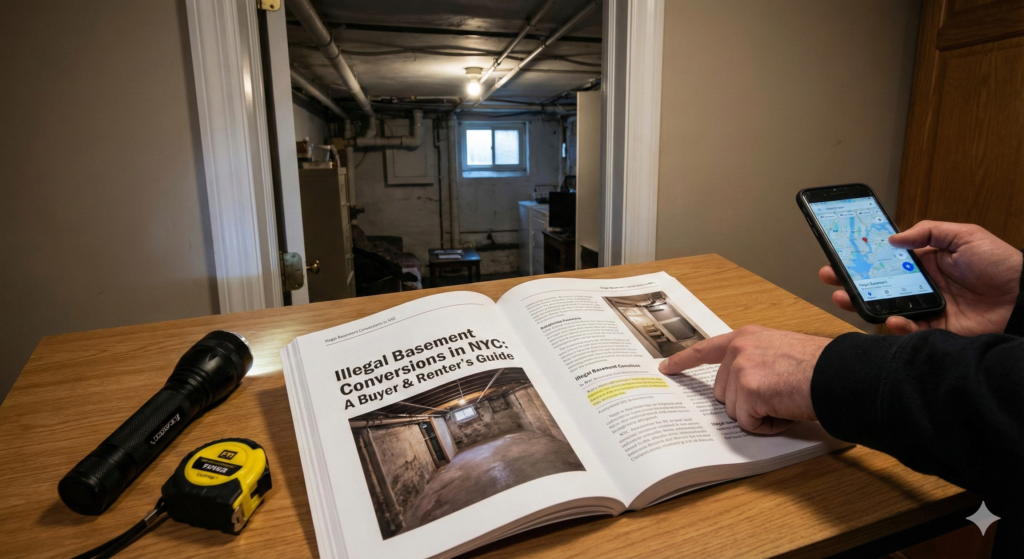
In New York City, basement and cellar apartments sit in a legal gray zone that can quickly turn into a legal and safety nightmare for owners, buyers, and renters. Some are fully legal and code-compliant. Many aren’t.
Illegal basement conversions in NYC don’t just risk fines: they’re often the most dangerous units in the building during fires, floods, or power outages. And for buyers, an “extra income unit” in the listing can suddenly become a financial liability once the city gets involved.
In this guide, we’ll walk through how NYC defines legal vs. illegal basement apartments, the risks for everyone involved, the key laws and programs to know, and practical steps for landlords, renters, and buyers to protect themselves.
What Counts As An Illegal Basement Or Cellar Apartment In NYC
Basement and cellar apartments are heavily regulated in New York City. A space can look attractive, separate entrance, new flooring, even a full kitchen, and still be completely illegal to live in.
NYC Rules For Basements Vs. Cellars
NYC law makes a sharp distinction between a basement and a cellar:
- A basement is a story that is at least 50% above curb level.
- A cellar is a story that is more than 50% below curb level.
Under the NYC Building Code and Housing Maintenance Code, basements can sometimes be used as dwelling units if they meet strict requirements. Cellars, in most cases, cannot be legally rented for residential use at all.
We can find the city’s own explanation in the NYC Department of Buildings’ guidance on illegal residential conversions and in the NYC Housing Maintenance Code.
Key requirements for a legal basement apartment typically include:
- Minimum ceiling height (usually at least 7 feet in most of the space, per NYC Building Code §1208)
- Two means of egress (for example, a door to the exterior and a code-compliant window or another door to a separate exit)
- Proper-sized windows for light and ventilation
- Legally installed heat, electrical, and gas systems
- No history of a vacate order or illegal conversion violations on record
When those conditions aren’t met, or when the zoning and certificate of occupancy don’t allow a dwelling unit in that space, we’re usually looking at an illegal basement conversion.
Common Red Flags That A Unit Is Not Legal
We don’t need DOB access to spot many problem units. Some red flags:
- Only one way out: One door to the street and no other exit, or tiny windows that don’t open or can’t fit an adult.
- Very low ceilings: If we can almost touch the ceiling while standing upright, the unit may not meet height requirements.
- Bars or gates on windows with no quick-release mechanism.
- No direct heat: Space heaters, oven doors left open, or extension cords running to the main unit.
- No separate utilities or weird wiring: Exposed wiring, tangled extension cords, or gas lines that look improvised.
- No mailboxes or buzzers indicating the unit officially exists.
- Cash rent only, no written lease, or a landlord who avoids paperwork.
- HPD or DOB records showing complaints or violations for illegal conversions at the address (we can search them via DOB NOW / BIS Property Profile and HPD’s building lookup tool).
If we see two or three of these signs at once, there’s a real chance the basement or cellar unit isn’t legal, no matter how nicely renovated it looks.
Legal, Financial, And Safety Risks Of Illegal Basement Conversions
Illegal basement conversions in NYC sit at the intersection of life safety, city enforcement, and civil liability. Everyone involved, owner, tenant, and buyer, carries risk, but not the same kind.
Life-Safety Dangers For Tenants And Neighbors
The biggest problem isn’t the fines: it’s the danger. The NYC Department of Buildings has repeatedly warned that illegal cellar and basement units are among the most hazardous places to live during fires and floods. After Hurricane Ida in 2021, several NYC residents in basement apartments died during sudden flooding, highlighted in reports by the NYC Comptroller
and covered extensively in local and national news.
Typical life-safety issues include:
- Blocked or insufficient exits in a fire or smoke condition
- Rapid flooding in heavy rain, with water rising faster than a person can escape
- Carbon monoxide buildup from improper boilers or heaters
- Electrical hazards from overloaded or illegal wiring
The U.S. Fire Administration and FEMA both emphasize that low-level, windowless spaces are some of the worst places to be in these emergencies.
Fines, Violations, And Vacate Orders For Owners
For property owners, an illegal basement apartment isn’t just “extra income.” It can trigger:
- DOB violations and civil penalties for illegal occupancy, unsafe conditions, or work without a permit. DOB outlines enforcement and penalties in its housing and sustainability enforcement page.
- Emergency vacate orders, forcing tenants to leave immediately if the unit is deemed unsafe. See DOB’s info on vacate orders and unsafe buildings.
- Orders to restore the property to its prior legal condition (removing kitchens, walls, bathrooms, etc.).
- HPD violations for illegal dwelling units, overcrowding, or lack of required services.
Fines can run into the tens of thousands of dollars, especially when multiple units or repeat violations are involved.
Insurance, Liability, And Resale Problems
Illegal units are also a minefield for insurance and resale value:
- Insurance coverage gaps: If a fire, flood, or injury occurs in an illegal basement, the insurer may deny claims on the basis of misrepresentation or illegal occupancy. The New York State Department of Financial Services
has repeatedly cautioned that policyholders must disclose material facts about how a property is used.
- Personal injury lawsuits: If a tenant or guest is hurt in an illegal unit, the owner can face serious liability exposure beyond any insurance.
- Resale and financing issues: Appraisers and underwriters usually ignore illegal units when valuing the property, and outstanding violations or vacate orders can derail a sale or refinance.
For buyers, that “bonus apartment” in the basement often turns out to be non-income-producing for lending purposes, and may even reduce the property’s true value once the cost of bringing it into compliance is factored in.
Key NYC Laws And Programs Affecting Basement Apartments
Illegal basement conversions sit at the crossroads of multiple NYC rules and emerging reform efforts.
Building Code, Zoning, And Housing Maintenance Code Basics
Three main frameworks govern whether a basement or cellar can be legally occupied:
- NYC Zoning Resolution – Dictates whether a residential unit is allowed at all in that part of the building and neighborhood. Zoning text is posted on the NYC Department of City Planning site.
- NYC Building Code – Governs construction and safety standards: egress, fire protection, ceiling heights, light and air, structural work, plumbing, electrical, etc. Current code text is available via the NYC Buildings Codes portal.
- Housing Maintenance Code (HMC) – Enforced primarily by HPD, it governs minimum standards for habitability: heat, hot water, pests, space, overcrowding, and illegal occupancy. HPD summarizes the HMC in its Housing Code information page.
If a basement or cellar unit fails any of these layers, zoning, building code, or HMC, it’s very likely illegal to rent as a dwelling unit.
Basement Apartment Conversion Pilot And “City Of Yes” Efforts
NYC has acknowledged that thousands of people already live in basement and cellar units and that outright prohibition isn’t realistic. In recent years, the city has tested ways to legalize some of these units safely.
Two key initiatives:
- Basement Apartment Conversion Pilot Program (BACPP) – A pilot focused on parts of Brooklyn (like East New York) that aimed to help homeowners convert basements into safe, legal apartments with city support. Information and updates have been shared via the NYC Department of Housing Preservation & Development (HPD) when funding is active.
- “City of Yes” for Housing Opportunity – A broader zoning reform initiative aimed at enabling more legal housing options, including more flexible rules for accessory dwelling units. Details and status are tracked by the Department of City Planning.
These efforts don’t make existing illegal units automatically legal. Instead, they may create pathways to legalization, but only if owners go through proper design, permitting, and inspections.
How Landlords Can Address An Illegal Basement Unit
If we already have an illegal basement or cellar apartment, or suspect we do, ignoring it is usually the worst option. NYC enforcement tends to escalate, not disappear.
Confirming Status And Responding To Violations
First, we need to confirm how the city views the space:
- Check the Certificate of Occupancy (C of O) or, for one- and two-family homes that may not have one, any available records via the DOB Building Information System / DOB NOW.
- Look for open violations and complaints through DOB and HPD database searches.
- Review zoning and building classification (e.g., one-family vs. two-family) on the NYC Zoning and Land Use Application (ZoLa).
If we’ve already received a violation or vacate order:
- Don’t ignore it: failing to comply can lead to higher fines and enforcement.
- Contact an architect, engineer, and/or real estate attorney experienced in DOB matters.
- If tenants must vacate, direct them to resources like NYC 311 or HPD for emergency housing assistance.
DOB’s page on unsafe buildings and vacate orders explains the typical enforcement path.
Options: Legalize, Decommission, Or Repurpose The Space
Owners generally have three realistic paths:
- Legalize the unit
- Only possible if zoning allows another dwelling unit and the space can be brought up to code (egress, ceiling height, flood safety, etc.).
- Requires full DOB permitting, inspections, and eventually an updated C of O.
- Decommission the unit as a dwelling
- Remove kitchens, illegal bathrooms, and partitions creating separate occupancy.
- Restore the space to storage, mechanical, or recreation use as allowed.
- Close out violations with DOB by passing inspections.
- Repurpose within legal limits
- In some property types, basements can be used legally for home offices, recreation, or accessory space connected to the main dwelling, but not as a separate rental.
The “right” path depends on our long‑term goals, the building’s layout, and whether the numbers work once we factor in construction and professional fees.
Working With Professionals To Design A Compliant Unit
If legalization is on the table, we should:
- Hire a licensed architect or professional engineer familiar with basement conversions.
- Have them perform a code and zoning feasibility study: can we get proper egress, required light and air, flood and damp-proofing, and mechanical systems within legal parameters?
- Get realistic construction cost estimates from insured contractors.
The design team will handle DOB filings and coordinate inspections. For complex issues, like flood-zone rules or landmarked buildings, a land use attorney or expediter can also be invaluable.
We can verify a professional’s license status through the NYS Office of the Professions (for architects/engineers) and confirm contractor licensing via the NYC Department of Consumer and Worker Protection.
Guidance For Renters Considering Or Living In A Basement Apartment
For renters, the key is balancing short‑term housing needs with long‑term safety and stability. A below‑market basement apartment can come with hidden costs.
How To Tell If A Basement Rental Is Likely Illegal
Along with the red flags we mentioned earlier, renters can take a few practical steps:
- Ask directly whether the unit is legal and on the Certificate of Occupancy.
- Search HPD and DOB records for the address: complaints, violations, and vacate orders. Use HPD Online and DOB’s Building Information Search.
- Look for signs that the unit is completely separate from the main dwelling (own kitchen, locked doors, separate doorbell) even though the building is listed as a one‑family home.
If the landlord becomes evasive or discourages questions about the legality of the unit, that’s a strong signal to proceed cautiously.
Risks If There Is A Vacate Order Or Emergency
If DOB or HPD issues a vacate order, renters may have to leave with very little notice. In serious cases, the city can post a red or yellow notice and prohibit anyone from sleeping there.
Renters then face:
- Scrambling to find emergency housing
- Difficulty getting back prepaid rent or security deposits
- Potential loss or damage to personal property during a rush move
In an emergency such as a fire or flood, illegal basements have historically been some of the deadliest locations. FEMA’s flood safety guidance for residents makes it clear: staying in a rapidly flooding basement can be life‑threatening.
Practical Steps If You Need To Move Or Report Unsafe Conditions
If we’re currently in a questionable basement unit:
- Document conditions – Photos and videos of exits, windows, utilities, and any flooding, mold, or structural issues.
- Check city records – Confirm whether there are open violations or vacate orders.
- Consider reporting – We can report unsafe or illegal occupancy via NYC 311, by phone or online. Complaints can be anonymous.
- Plan an exit strategy – Even if we can’t move immediately, we should have a plan for where to go if a vacate order is issued.
- Seek legal help if needed – Organizations listed by the NYC Office of Civil Justice may offer free or low‑cost tenant legal services.
While tenants do have some protections, and in many cases can’t simply be “thrown out” without proper process, no court order can make an inherently unsafe unit truly safe.
What NYC Property Buyers Should Watch For
For buyers, basement income can make a deal look much sweeter on paper than it really is. We need to underwrite the legal income, not the hoped‑for income.
Due Diligence Before You Go Into Contract
Before we get locked into a purchase contract:
- Pull DOB and HPD records for the property.
- Review the Certificate of Occupancy (or its absence) carefully with our attorney.
- Ask directly: Is this basement or cellar unit legal, and can you provide documentation?
- Have our home inspector pay special attention to egress, ceiling height, moisture, and mechanical systems in the basement.
If a listing advertises a “3‑family with finished basement,” but the C of O shows a 2‑family, proceed with extreme caution.
How Illegal Units Affect Financing, Insurance, And Future Plans
Lenders and insurers typically base decisions on the legal configuration of the building, not whatever extra units happen to exist.
That means:
- A bank may ignore basement rent when qualifying us for a mortgage.
- Appraisers may value the property as if the illegal unit doesn’t exist, especially if DOB records show violations.
- Insurers may rate the policy as a smaller dwelling and can deny claims tied to unreported or illegal occupancies.
The Consumer Financial Protection Bureau’s material on mortgages and underwriting is a good general reference, even though it isn’t NYC‑specific.
If our long‑term plan is to rely on basement rental income, it’s critical to know whether legalization is feasible and what it would cost.
When To Walk Away Versus Renegotiate Or Legalize
In some cases, the smartest move is simply to walk away:
- Cellar units with no realistic second egress
- Properties in high‑risk flood zones where adding habitable space below grade is especially dangerous
- Buildings with a history of repeat illegal conversion violations and heavy fines
In other situations, we might:
- Renegotiate the price to reflect the need to decommission or legalize the basement.
- Make our offer contingent on resolving violations or on DOB approval for a planned conversion.
A good NYC real estate attorney, ideally one familiar with DOB practice, can help us stress‑test different scenarios and decide whether the risk and cost trade‑offs make sense for our goals.
Conclusion
Illegal basement conversions in NYC sit at the intersection of housing pressure, complicated codes, and very real safety risks. For owners, they can look like an easy way to boost income, until violations, vacate orders, and liability catch up. For renters, they can be the only affordable option in the neighborhood, but also the most dangerous place to be in a fire or flood. And for buyers, they can quietly turn a promising investment into an expensive problem.
If we take one lesson from recent enforcement and storm events, it’s this: we can’t ignore what’s happening below grade. Whether we’re signing a lease, drafting a contract, or planning a renovation, we should always check the legal status of basement and cellar spaces, confirm what city records say, and bring in qualified professionals before we commit.
Doing that assignments up front doesn’t just protect our wallets. It helps ensure that the spaces people actually live in, including the ones below street level, are safe, legal, and sustainable for the long term.