
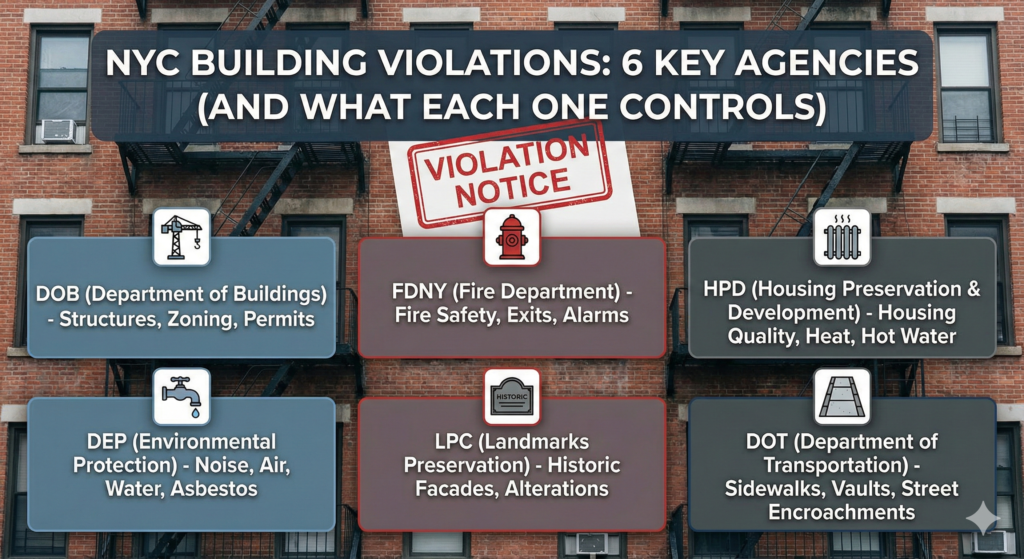
If we operate a business or manage facilities in New York City, building violations aren’t an abstract legal concept, they’re a daily operational risk. A single missed inspection or unpermitted upgrade can delay openings, block refinancing, or shut down parts of our space.
The challenge isn’t just knowing that violations exist. It’s understanding which NYC agency controls what, how their rules overlap, and what that means when we retrofit offices, add digital signage, or remodel customer areas.
In this guide, we’ll break down the main NYC building violation agencies, how violations actually work, and how we can build a practical, repeatable compliance workflow for every location we operate, all while keeping modernization projects on track.
How NYC Building Violations Work
NYC building violations typically start with one of three triggers:
- A scheduled or random inspection
- A 311 complaint or similar report
- A failed filing, missed test, or administrative review
When an inspector from DOB, FDNY, HPD, DEP, or another agency finds a problem, they issue a written violation that:
- Identifies the condition (for example, unpermitted electrical work or missing fire signage)
- Cites the code section that’s been violated
- States the class/level of severity
- Sets a deadline to correct the issue and/or appear at a hearing
For DOB violations, the major classes include:
- Class 1 (Immediately Hazardous) – Life-safety or major structural risk. These can lead to emergency repairs, vacate orders, or stop-work orders.
- Class 2 (Major) – Serious but not immediately life-threatening issues, such as work without a permit in some scenarios.
- Class 3 (Lesser) – Non-hazardous or administrative issues.
To resolve a violation, we generally have to:
- Correct the condition – Fix the underlying issue (e.g., remove illegal work, file for proper permits, install compliant signage).
- Document the correction – Photos, affidavits, contractor invoices, permits, and sign-offs.
- Submit proof – Through tools like DOB NOW or directly to the issuing agency.
- Pay penalties or attend an OATH hearing – Many violations are adjudicated at the Office of Administrative Trials and Hearings (OATH).
- Verify closure – Confirm in public systems like DOB’s Buildings Information System that the violation shows as resolved.
Open violations can block a sale, a new Certificate of Occupancy, refinancing, or new permits. That’s why many owners partner with violation-focused services like ViolationWatch to track issues across portfolios and avoid surprises during transactions.
Key Types Of Building Violations Affecting Commercial Spaces
For commercial and institutional buildings, we tend to see the same violation patterns over and over, especially when spaces are being updated for new tenants, new technology, or branding.
Common categories include:
- Work without a permit – Interior demolition, framing, electrical, plumbing, or HVAC work performed without the required DOB permits.
- Illegal alterations – Structural changes, occupancy changes, or layout changes that don’t match the approved plans on file.
- Failure to file inspections or reports – Missed façade inspections, boiler inspections, sprinkler/standpipe tests, or other mandated filings.
- Boiler and equipment issues – Unregistered boilers over 350,000 BTUs, defective equipment, or failure to correct defects within the required timeframe.
- Fire and life-safety violations – Non-functioning alarms or sprinklers, blocked egress paths, missing or non-compliant fire safety signage, or improperly stored combustibles.
- Housing and habitability violations (for mixed-use) – In mixed-use or residential-above-retail buildings, HPD violations for heat, hot water, pests, or deterioration can affect the entire property’s risk profile.
For any brand rolling out new interiors or technology (like digital signage, POS hardware, or AV systems), the big risk is that “small” upgrades quietly trigger permit requirements, and inspectors rarely treat them as small once they’re discovered.
Using a tracking platform such as ViolationWatch’s NYC building violation tools alongside internal facility records makes it easier to see patterns across locations and address systemic problems before they become repeat violations.
New York City Department Of Buildings (DOB)
The New York City Department of Buildings (DOB) is the core agency most of us think of when we hear “building violation.” DOB enforces the NYC Construction Codes, Zoning Resolution, and associated rules.
DOB is responsible for:
- Reviewing and approving construction plans
- Issuing building, electrical, and related permits
- Inspecting construction, renovations, and building systems
- Issuing violations for unsafe or non-compliant conditions
Typical DOB violations that affect commercial and institutional properties include:
- Work without a permit (WWP)
- Illegal occupancy or use changes
- Failure to maintain buildings in a safe condition
- Missing or expired periodic inspections (elevators, façades, boilers, etc.)
Property data, open violations, and permit histories are visible in DOB’s public Buildings Information System. Many issues now flow through DOB NOW, which handles filings, inspections, and certificates of correction.
For owners, facility managers, and national brands, the practical play is to:
- Have design and construction teams involve a Registered Design Professional early.
- Make sure every interior upgrade, signage, wiring, structural supports, gets screened for permit triggers.
- Use third-party monitoring (for example, ViolationWatch’s DOB violation monitoring) to flag new issues quickly instead of discovering them during deals or audits.
Fire Department Of New York (FDNY) And Life-Safety Signage
The Fire Department of New York (FDNY) focuses on fire and life safety. For commercial and institutional spaces, FDNY is just as critical as DOB.
FDNY jurisdiction typically covers:
- Fire alarm and detection systems
- Sprinkler and standpipe systems
- Fire extinguishers and suppression systems (including in commercial kitchens)
- Egress routes and emergency lighting
- Storage of combustibles and hazardous materials
- Fire and life-safety signage (egress diagrams, stair signage, occupancy placards, etc.)
FDNY issues violations for:
- Non-functioning or impaired fire protection systems
- Missing or out-of-date Certificates of Fitness
- Lack of required FDNY permits
- Missing, incorrect, or non-compliant signage
Details on permits and certifications are available on the FDNY’s official Certificates of Fitness page.
Whenever we install new technology, like digital menu boards, wayfinding screens, or video walls, we have to plan around FDNY rules. Screens can’t block exit signs, obscure alarm strobes, or create glare that makes egress directions hard to read. In some occupancies, even the wiring and power supplies for digital signage must be coordinated with DOB and FDNY sign-offs.
Pulling FDNY into layout discussions early is always cheaper than relocating hardware or re-running cabling after a failed inspection.
Other NYC Agencies Involved In Building Violations
While DOB and FDNY get most of the attention, several other NYC agencies can issue violations that directly impact our buildings and operations.
1. Department of Environmental Protection (DEP)
DEP oversees environmental regulations, including air and water quality. In building operations, this often means:
- Boilers and fuel-burning equipment
- Emissions and fuel type compliance
- Asbestos rules during renovations
DEP can issue violations for unregistered or improperly maintained boilers, emissions issues, and unauthorized work. Their programs and requirements are outlined on the agency’s official DEP site.
2. Department of Housing Preservation and Development (HPD)
HPD governs housing quality and maintenance in residential and some mixed-use properties. HPD violations include:
- Heat and hot water issues
- Mold, pests, leaks, and unsafe conditions
- Broken doors, windows, or security features
Open HPD violations are visible on the city’s HPD Violations portal. If we manage mixed-use assets (retail below, apartments above), HPD issues can influence financing, insurance, and overall portfolio risk.
3. OATH / ECB (Administrative Hearings)
The Office of Administrative Trials and Hearings (OATH), formerly ECB, doesn’t issue most violations but does adjudicate them. If we contest a DOB, FDNY, DEP, or HPD violation, the case usually goes through OATH.
Knowing when to contest versus when to settle is a financial decision: analytics from services like ViolationWatch’s NYC violation insights can help us prioritize which issues to fight and which to pay and close quickly.
Managing Compliance When Updating Interiors And Installing Technology
Modernizing locations, especially in industries like retail, hospitality, fitness, healthcare, and education, often means rethinking interiors and layering in more technology:
- Digital menu boards and promotional screens
- Interactive wayfinding and directories
- Patient or guest information displays
- Corporate communication boards in lobbies and offices
From a violation-risk standpoint, we can’t treat these as “just screens.” They come with supports, power, data cabling, and sometimes millwork or framing. That can trigger DOB, FDNY, and DEP touchpoints.
To stay ahead of violations when we roll out new tech:
- Loop compliance in early – Involve facilities, code consultants, or expediters during concept design, not after everything is specified.
- Screen every change for permit impact – Mounting on structural walls, cutting into fire-rated assemblies, adding junction boxes, or rerouting wiring may require DOB permits.
- Coordinate with fire and life safety – Ensure digital signage doesn’t obscure FDNY-required signage, alarms, or egress components.
- Standardize across locations – Once we’ve validated a compliant design for one NYC site, use it as a template for others to reduce repeat violations.
When we combine strong local partners, solid documentation, and centralized violation tracking, using tools like ViolationWatch.nyc, we dramatically reduce the odds that an ambitious rollout gets slowed down by surprise agency notices.
Creating A Practical Compliance Workflow For Your Locations
A consistent workflow is what separates reactive, violation-prone portfolios from predictable, low-risk operations. Here’s how we can structure one that works across NYC properties.
1. Centralize visibility
Create a single source of truth for each property:
- List of all active agencies: DOB, FDNY, DEP, HPD, and others, if applicable
- Logins for DOB NOW, BIS, FDNY systems, and internal facilities platforms
- A violation dashboard, whether in-house or via a service like ViolationWatch
2. Standardize intake and triage
Whenever a notice arrives (mail, email, on-site posting):
- Capture it digitally (scan or photo)
- Log the issuing agency, violation type, location, and due dates
- Classify severity (immediate life-safety vs. routine vs. administrative)
This lets us triage quickly instead of reacting in crisis mode every time an inspector visits.
3. Assign owners and deadlines
Map violation types to responsible roles:
- DOB structural or permit issues → project management / construction
- FDNY system or signage issues → life-safety vendor / facilities
- DEP boiler issues → mechanical contractor or engineer
- HPD habitability issues → property management / superintendents
Then set clear internal deadlines that are earlier than the city’s, so we have time for reinspections and resubmissions if something’s rejected.
4. Close the loop with documentation
For every correction, capture:
- Before-and-after photos
- Invoices and letters from licensed professionals
- Permit numbers, inspection reports, and sign-offs
- Certificates of Correction or similar forms
Housing this in a shared location means we can support audits, refinancing, and future disputes with real evidence, not guesswork.
5. Bake compliance into project delivery
For remodels, digital signage installations, or new-build interiors, add compliance steps into the project plan:
- Code review and permit strategy at schematic design
- FDNY coordination for life-safety and signage
- Inspections and sign-offs scheduled before turnover
This way, we’re not scrambling to fix violations after the ribbon-cutting.
Conclusion
NYC’s building violation landscape can feel like a maze, but it’s really a defined ecosystem: DOB handles building safety and permits, FDNY covers fire and life safety, DEP looks at environmental impacts and boilers, and HPD protects housing quality. OATH sits in the background to resolve disputes.
If we’re responsible for commercial or institutional spaces, especially ones that are constantly evolving with new branding, layouts, and technology, our real advantage isn’t memorizing every rule. It’s building systems that keep us compliant by default.
Common DOB Violations For Commercial And Institutional Buildings
Across offices, retail, healthcare, education, fitness, and hospitality, the same DOB violations recur:
- Work without a permit for interior build-outs and rewiring
- Illegal occupancy changes, like back-of-house space quietly becoming office or assembly space
- Failure to maintain structural or life-safety elements
- Missed recurring inspections (elevators, façades, boilers)
These are preventable with early design reviews, the consistent use of licensed professionals, and regular checks of DOB records.
Permit, Inspection, And Sign-Off Requirements
Every physical change to a NYC building should trigger a quick internal question: “Could this require a permit or inspection?”
- Structural supports for large screens or video walls
- Penetrations through fire-rated walls and ceilings
- New circuits or load on existing electrical systems
- Changes to egress paths or occupancy
When in doubt, we consult a Registered Design Professional and review DOB guidance on the official Buildings site. It’s far cheaper to file one more permit than to undo a completed installation under a violation.
FDNY Permits, Inspections, And Certificates Of Fitness
Fire and life safety isn’t just the domain of the fire alarm vendor. For many occupancies, FDNY expects:
- Current permits for systems and certain operations
- Documented inspections, testing, and maintenance
- Valid Certificates of Fitness for staff managing fire and life-safety equipment
If we’re adding technology, displays, kiosks, digital menu boards, these must integrate with exits, alarms, and signage, not compete with them. The FDNY Certificates of Fitness portal is an essential reference here.
Coordination With Building Management, Landlords, And Vendors
For tenants, there’s a common myth: “That’s the landlord’s problem.” In reality, many violations, especially for interior work and operations, land squarely on the tenant’s shoulders.
We protect ourselves by:
- Requiring vendors to confirm permit requirements in writing
- Getting landlord sign-off on scopes that impact base building systems
- Sharing drawings and specs with building management before work begins
This three-way coordination helps ensure one party doesn’t unknowingly create a violation that all parties end up paying for.
Documentation, Recordkeeping, And Digital Tools
Finally, compliance is only as strong as our records. Good documentation turns a violation from a crisis into a paperwork exercise.
We should maintain:
- A digital archive of permits, plans, inspection reports, and violation notices
- A simple matrix of each building’s systems, responsible vendors, and renewal dates
- Access to city systems like DOB NOW, BIS, HPD’s violations search, and DEP records
Layering these with dedicated tracking tools, such as portfolio-wide dashboards from services like ViolationWatch.nyc, gives us a consolidated view of risk.
In a city as complex as New York, we can’t eliminate compliance friction entirely. But with clear ownership, smart use of technology, and a disciplined workflow, we can keep our focus where it belongs: running safe, modern, and engaging spaces for the people who use them every day.