
Missing a single violation notice can cost you $25,000 in fines. Or worse, a stop-work order that halts your project for weeks. You check your mailbox. You scan your email. You call the city hotline. But violations still slip through the cracks.
Why? Because NYC’s different agencies don’t communicate with each other. They issue violations independently. They mail notices to outdated addresses. They post updates on separate portals that require different logins. By the time you find out about a violation, your window to respond has already closed.
The good news? Subscription services now automate this entire mess. They monitor almost all agencies for you. They catch violations the moment they’re issued. They send you alerts before deadlines hit. But here’s the catch: not all violation alert services are built the same.
Some only track DOB violations. Others charge you per property. A few lack mobile access, meaning you’re stuck refreshing a desktop portal all day. We’ve tested every major service on the market, and now we’re here with a complete feature breakdown for each subscription service. Just the raw data you need to pick the right service before the next violation hits your building.
What You Actually Get From Each Service
We put several major services through a rigorous test. We signed up properties across all five boroughs. Here’s what we found.
1. NYC DOB Violations Alert Service
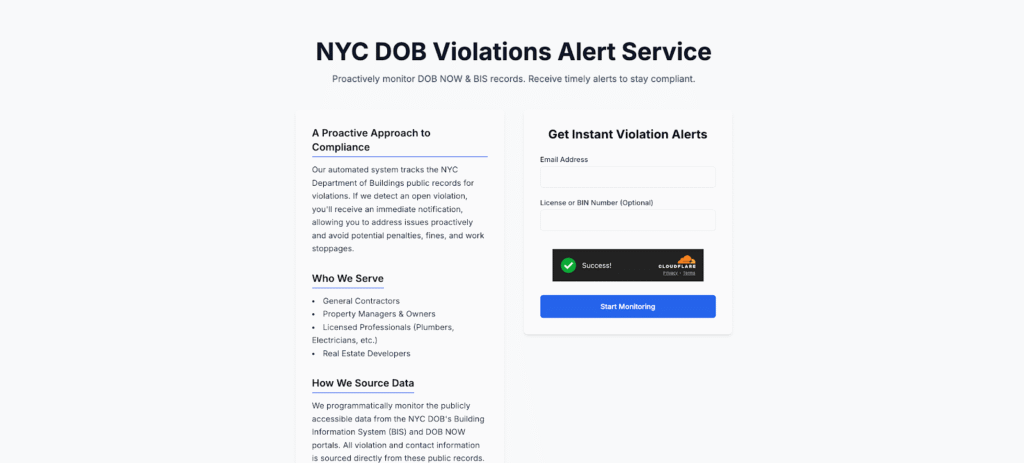
The NYC DOB Violations Alert Service operates as a specialized monitoring tool focused exclusively on Department of Buildings violations. The platform connects directly to DOB NOW’s database infrastructure and pulls violation data through scheduled API calls.
Technical Architecture
The service runs on a batch processing system that queries DOB NOW every 24 hours. When new violations appear in the system, the platform generates automated email notifications to registered users.
Database synchronization:
- Daily API calls to DOB NOW at scheduled intervals
- Violation data parsed and matched against registered property addresses
- Email alerts are generated when new records appear
- Historical violation data stored for reference
The 24-hour sync cycle creates a predictable monitoring rhythm but introduces latency. Violations issued at 9 AM might not trigger alerts until the next day’s batch process runs.
Notification System
Email serves as the sole delivery channel. The system sends plain-text notifications containing:
- Violation number and issuance date
- Property address and BIN (Building Identification Number)
- Violation category and description
- Issuing inspector information
- Direct link to the violation on DOB NOW
You can’t customize alert frequency or filter by violation severity. Every new DOB violation generates an email regardless of urgency or type.
Data Granularity
The platform extracts core violation details from DOB NOW, but doesn’t add context or interpretation. You get raw data fields:
- Violation class (Class 1, 2, or 3)
- ECB violation indicator
- Compliance certification requirements
- Associated permits or applications
What’s missing? No automated status tracking after initial notification. If you certify a violation as corrected or the DOB dismisses it, the system won’t update you. You’ll need to check DOB NOW manually to track resolution progress.
User Interface
The web portal displays a chronological list of violations by property. Basic filtering options let you:
- Sort by issuance date
- Filter by violation class
- Search by violation number
- Group by property address
The interface mirrors DOB NOW’s data structure, functional but not optimized for portfolio-level analysis. If you manage 20 buildings, you’ll scroll through individual property pages rather than viewing aggregated violation activity across your portfolio.
Use case fit: Construction managers tracking permit-related violations during active building projects. The DOB focus aligns with construction workflow requirements, where other agency violations typically don’t apply during the build-out phase.
2. SiteCompli
SiteCompli built a compliance management ecosystem that extends beyond violation monitoring into permit tracking, inspection coordination, and team workflow management. The platform targets property management companies running multi-city portfolios.
Multi-Agency Monitoring Infrastructure
SiteCompli monitors four major NYC agencies through a combination of automated data extraction and manual verification processes.
Covered agencies:
- Department of Buildings (DOB)
- Department of Housing Preservation and Development (HPD)
- Environmental Control Board (ECB)
- Fire Department of New York (FDNY)
The system connects to each agency’s public database and runs extraction scripts at staggered intervals. DOB and ECB data refreshes every 4 hours. HPD and FDNY data updates every 6 hours.
Alert Delivery Mechanism
SiteCompli uses a dual-channel notification system, email and mobile push notifications, with customizable delivery rules.
Configuration options:
- Set priority levels for different violation types
- Assign team members to specific properties
- Create escalation paths for critical violations
- Schedule digest summaries for non-urgent alerts
The 4-6 hour data refresh cycle means violations don’t trigger instant alerts. A DOB stop-work order issued at 10 AM might not generate a notification until the 2 PM refresh cycle completes.
Permit Management Integration
SiteCompli’s permit tracking module runs parallel to violation monitoring. The system:
- Tracks active permits by property and expiration date
- Sends renewal reminders 30, 15, and 7 days before expiration
- Links violations to associated permits when applicable
- Maintains permit document archives
This integration helps identify which violations stem from permit compliance issues versus structural or operational problems.
Dashboard Analytics
SiteCompli’s analytics module aggregates violation data across your portfolio:
- Violation trends by agency and property
- Average resolution timeframes
- Open violation counts by severity
- Compliance score calculations
The system generates visual charts showing violation patterns over time. Spot which properties consistently rack up HPD complaints or which violation types appear most frequently across your portfolio.
Mobile Application
The iOS and Android app provide field access to violation data and document management:
- View violations by property while on-site
- Upload photos directly to violation records
- Assign violations to team members
- Add notes and status updates
The mobile interface replicates most desktop functionality but lacks the advanced analytics and bulk editing capabilities available on the web platform.
Use case fit: Mid-to-large property management firms operating 15-50 buildings that need permit tracking, inspection coordination, and violation monitoring in a unified platform. The four-agency coverage works well if your properties don’t generate significant violations from the six uncovered NYC agencies.
3. Jaffa Alert Services
Jaffa runs Alert Service Plus as part of its broader expediting and compliance consulting practice. The service combines automated monitoring through the Jaffa deFINEd app with hands-on account management from compliance specialists.
Hybrid Monitoring Model
Jaffa uses a two-tier approach: automated database monitoring supplemented by manual verification from experienced compliance professionals.
- Automated component: The Jaffa deFINEd app connects to NYC agency databases and extracts violation data through scheduled queries. The system monitors:
- DOB violations and notices
- HPD complaints and violations
- ECB hearing schedules and decisions
- FDNY violation notices
- Manual verification component: Dedicated account managers review flagged violations and cross-reference them against city records to confirm accuracy. This human verification step catches data entry errors or mismatched property records that automated systems might miss.
Jaffa deFINEd App Architecture
The mobile application serves as the client-facing interface for violation monitoring and expediting coordination.
Core app features:
- Property portfolio dashboard
- Violation alerts with detailed descriptions
- Direct messaging with assigned account managers
- Document upload for violation responses
- Expediting service request module
The app focuses on simplicity over feature density. You won’t find advanced filtering, analytics dashboards, or bulk editing tools. The design prioritizes quick access to violation details and direct communication with your account team.
Multi-Channel Alert System
Jaffa delivers alerts through three primary channels based on violation severity and client preference:
- Phone calls: Critical violations stop-work orders, immediate hazard notices, or violations with hearing dates inside 10 days trigger direct phone calls from your account manager.
- Text messages: Standard violations generate SMS alerts containing violation numbers, property addresses, and brief descriptions. Text messages link directly to the violation record in the Jaffa deFINEd app.
- App notifications: Lower-priority violations and status updates appear as push notifications in the app. These alerts don’t require immediate action, but keep you informed of portfolio activity.
You configure alert preferences during onboarding. Some clients want phone calls for all DOB violations. Others prefer texts for everything except emergency situations.
Agency Coverage Scope
Jaffa’s monitoring scope adapts based on client needs and property types. Standard monitoring includes DOB, HPD, ECB, and FDNY violations.
Extended monitoring:
Clients can request monitoring for additional agencies:
- DEP (particularly for properties with cooling towers or water quality issues)
- DOH (for properties with food service or healthcare tenants)
- DSNY (for commercial properties with waste management violations)
The extended monitoring doesn’t happen automatically; you specify which additional agencies matter for your properties during setup.
Violation Interpretation Service
Jaffa’s compliance professionals don’t send you raw violation data. They interpret it:
- Explain what the violation means in practical terms
- Outline required corrective actions
- Estimate resolution timeframes
- Identify whether you need licensed professionals (architects, engineers, expeditors)
- Recommend specific expeditors from Jaffa’s network when appropriate
This interpretation layer helps property managers without technical building expertise understand what violations actually require.
Response Time Characteristics
Alert timing varies by violation source and detection method:
- DOB violations: Typically detected within 12-24 hours of issuance
- HPD complaints: Detected within 6-12 hours
- ECB hearing schedules: Detected within 24-48 hours
- FDNY violations: Detected within 12-24 hours
The manual verification step adds time compared to fully automated systems, but catches errors that could lead to missed violations or false alerts.
Client Communication Preferences
Jaffa adapts its communication style to client preferences. Some property managers want detailed explanations for every violation. Others prefer concise summaries with action items only.
During onboarding, you specify:
- Preferred communication channels by violation type
- Business hours for phone contact
- Backup contacts when primary managers are unavailable
- Escalation protocols for emergency violations
The system maintains these preferences and routes alerts accordingly.
Use case fit: Property owners managing 5-15 buildings who value personal attention and expert interpretation over self-service automation. The hybrid model works particularly well for owners without in-house compliance expertise who need guidance on complex violations.
4. BCM New York
BCM New York positions its alert service as the front door to its comprehensive expediting and consulting practice. The monitoring system identifies violations early so BCM’s expeditors can step in before issues escalate.
Five-Agency Monitoring Network
BCM monitors violations from five NYC agencies through a combination of automated scraping and direct agency data feeds.
Covered agencies:
- Department of Buildings (DOB)
- Department of Housing Preservation and Development (HPD)
- Environmental Control Board (ECB)
- Fire Department of New York (FDNY)
- Department of Environmental Protection (DEP)
The DEP monitoring distinguishes BCM from competitors focused solely on DOB, HPD, ECB, and FDNY. Properties with cooling towers, backflow prevention devices, or water quality issues benefit from DEP violation tracking.
Weekly Digest Delivery Model
BCM sends consolidated violation summaries every Friday afternoon rather than instant alerts for individual violations.
Digest contents:
- All new violations detected during the week
- Upcoming ECB hearing dates
- Violations with approaching certification deadlines
- Status changes on previously reported violations
The weekly format reduces notification volume but delays awareness. A violation issued Monday doesn’t reach you until Friday’s digest, potentially consuming four days of available response time.
Dual-Channel Alert System
BCM delivers digests through text messages and email simultaneously. Both channels contain identical content formatted for each medium.
- Text message format: Short summaries listing property addresses, violation types, and issuance dates. Text messages link to BCM’s online portal for full violation details.
- Email format: Detailed tables showing all violation information:
- Full property address and BIN
- Violation number and description
- Issuing agency and inspector
- Violation class and severity
- Recommended actions
- Direct links to agency databases
You can’t customize which channel receives which types of alerts. Both channels get all the content every time.
Online Portal Access
BCM’s web portal provides on-demand access to violation data outside the weekly digest cycle.
Portal features:
- Property-by-property violation listings
- Search by violation number or address
- Status indicators (open, pending, resolved)
- Document upload for violation responses
- Direct messaging with BCM account representatives
The portal updates daily with new violation data, so you can check between Friday digests if you suspect new violations have appeared.
Priority Expediting Access
Clients using BCM’s alert service get preferential access to BCM’s expediting team. When violations require professional representation:
- Expeditors receive violation details directly from the monitoring system
- No need to send violation notices or brief expeditors separately
- Status updates flow back to your portal automatically
- Resolution documentation gets archived in your violation record
The integrated workflow streamlines the handoff between monitoring and resolution services.
Use case fit: Building owners who already use BCM for expediting and want violation monitoring as part of a comprehensive service relationship. The weekly digest works for portfolios where violation urgency is lower and response time requirements are less stringent.
5. ViolationWatch
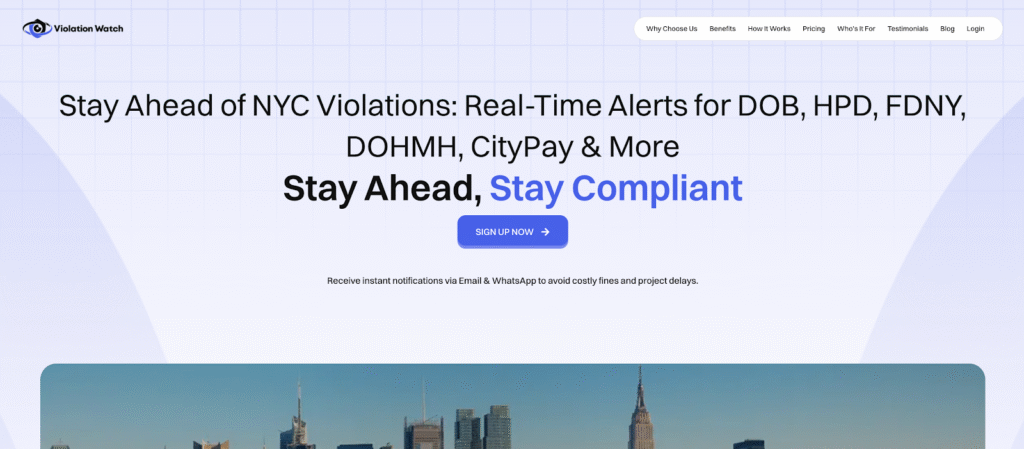
ViolationWatch designed its platform around complete agency coverage and instant notification delivery. The system monitors all NYC agencies that issue building violations and sends alerts within minutes of violations being posted to city databases, allowing users to search violations, receive real-time alerts, and manage compliance tracking for multiple properties and multiple buildings through one dashboard built on verified public data.
Comprehensive 10-Agency Monitoring
ViolationWatch tracks violations from every NYC agency with building jurisdiction:
- Core agencies:
- Department of Buildings (DOB)
- Department of Housing Preservation and Development (HPD)
- Environmental Control Board (ECB)
- Fire Department of New York (FDNY)
- Environmental and health agencies:
- Department of Environmental Protection (DEP)
- Department of Environmental Conservation (DEC)
- Department of Health (DOH)
- Infrastructure and operations agencies:
- Department of Transportation (DOT)
- Department of Sanitation (DSNY)
- Department of Finance (DOF)
The 10-agency coverage eliminates blind spots. Properties with cooling towers get DEP monitoring. Buildings with storefronts get DOT monitoring. Properties with waste management contracts get DSNY monitoring.
Continuous Database Monitoring Architecture
ViolationWatch uses a continuous polling system that checks agency databases every few minutes rather than daily or weekly cycles.
Technical infrastructure:
- API connections to all 10 agency databases
- Polling intervals of 3-5 minutes per agency
- Real-time data extraction when violations appear
- Automatic matching against registered property addresses
- Instant alert generation when new violations are detected
The continuous monitoring model means violations trigger alerts within minutes of appearing in city systems. A DOB violation issued at 10:15 AM generates an alert by 10:20 AM.
Multi-Channel Notification System
ViolationWatch delivers alerts through four simultaneous channels, giving you redundant notification paths.
- WhatsApp alerts: Instant messages sent to registered phone numbers containing:
- Property address
- Violation type and agency
- Violation number
- Issuance date
- Severity indicator
- Direct link to violation details
- Email notifications: Detailed email alerts sent to multiple addresses containing:
- Complete violation description
- Issuing inspector information
- Required corrective actions
- Certification requirements
- Deadline dates
- SMS text messages: Concise text alerts for critical violations:
- Stop-work orders
- Immediate hazard notices
- Violations with hearings scheduled within 14 days
- Environmental violations requiring urgent response
Unified Violation Dashboard
The web-based dashboard consolidates all violations across your entire portfolio in one searchable interface.
Dashboard organization:
- Color-coded violation cards by severity (red for critical, yellow for standard, green for resolved)
- Property grouping with total violation counts per address
- Agency filters to isolate violations by the issuing department
- Status filters (open, pending hearing, awaiting certification, resolved)
- Date range selectors for historical analysis
Advanced search capabilities:
- Full-text search across violation descriptions
- Violation number lookup
- Inspector name search
- Property address search with autocomplete
- Multi-filter combinations
The dashboard loads all portfolio data on one screen. Scroll through violations across 50 buildings without clicking between property pages or changing views.
Automated Status Tracking System
ViolationWatch checks violation status automatically every 24 hours. When agencies update violations:
- Status changes from “open” to “pending certification”
- Hearing dates get added or modified
- Violations get dismissed or certified as corrected
- Fine amounts get adjusted or dismissed
The system updates your dashboard automatically and sends notifications when status changes occur.
Compliance Professional Support Network
ViolationWatch connects users with experienced compliance professionals when violations require expert guidance.
Support scenarios:
- Complex DOB violations requiring architectural or engineering plans
- ECB hearings where you need representation strategy advice
- Multi-agency violations affecting the same property condition
- Historic building violations with landmark preservation implications
Contact support directly through the dashboard. Compliance professionals respond with practical guidance on correction approaches, required professional certifications, and realistic resolution timeframes.
Portfolio Analytics Dashboard
The analytics module aggregates violation data to reveal patterns and trends:
Available metrics:
- Violation frequency by property
- Most common violation types across the portfolio
- Average resolution time by agency
- Violations by building age or property type
- Seasonal violation patterns
- Comparative violation rates between properties
Analytics help identify which buildings generate the most violations and which violation types appear repeatedly, insights that inform preventive maintenance strategies.
Free NYC Building Violations Lookup Tool
ViolationWatch operates a public violation lookup tool that lets anyone check violations for NYC properties without signing up, helping users stay ahead of risks tied to unresolved violations, HPD violations, and potential ECB judgments sourced from DOB, HPD & FDNY databases.
Lookup tool capabilities:
- Enter any NYC address to see current violations and check status before issues grow
- View violations from all 10 agencies to help you stay compliant and comply with required standards
- See violation details, including descriptions and status, linked to lead paint or missed correction procedures
- Check the violation history for properties you’re considering purchasing so you can avoid penalties before fines stack
- Export violation reports as PDFs for documentation or audit use
The free tool serves property buyers conducting due diligence, tenants checking building compliance, or owners getting a quick snapshot so they can act within the maximum time allowed and not rely on outdated reports from limited sources.
How the lookup tool connects to monitoring? After using the free tool, you can add properties directly to paid monitoring through seamless registration. The transition takes one click, no re-entering property information or setting up accounts from scratch, reinforcing smarter property oversight and faster response when action matters most.
Flexible Pricing Structure
ViolationWatch offers two straightforward pricing options:
- Free Trial
- Per-Address Monitoring
- $9.99 per property per month
- Unlimited properties (no volume restrictions)
- All features are included at every tier
- No setup fees or hidden charges
- Cancel anytime without penalties
The per-address pricing scales linearly. Ten properties cost $99.90 monthly. Fifty properties cost $499.50 monthly.
Violation Export and Reporting
Generate detailed violation reports for property sales, refinancing, or internal audits:
Export formats:
- CSV spreadsheets with all violation data fields
- PDF reports formatted for professional presentation
- Excel workbooks with multiple sheets by agency
- JSON data exports for custom integrations
Reports include configurable date ranges, property selections, and violation status filters. Create compliance reports showing only open violations or historical reports covering entire ownership periods.
Hearing Reminder System
We automatically track ECB hearing dates and send escalating reminders:
- 14 days before hearing: Initial notification
- 7 days before hearing: Second reminder
- 3 days before hearing: Final urgent alert
- Day of hearing: Morning reminder with hearing location details
Never miss a hearing date because violations get buried in email. The automated reminder system keeps hearing obligations visible.
Use case fit: Any property owner, manager, or portfolio operator who needs complete violation coverage without worrying about agency gaps. The instant alerts and $9.99 per-property pricing work for single buildings, small portfolios, and large multi-property operations. The free trial lets you test the system risk-free before paying anything.
Pick the System That Matches Your Risk Tolerance
You’ve seen how five different platforms handle NYC violation monitoring. Each one takes a different approach to coverage, speed, and pricing.
Here’s what matters when you’re picking between them:
- Agency coverage determines your blind spots – monitoring 4 agencies leaves 6 agencies unchecked, and those gaps create compliance risk you won’t see coming until fines arrive
- Alert speed affects your response window – weekly digests consume 4-6 days of available correction time before you even know violations exist
- Notification channels impact reliability – email-only alerts get buried in inbox clutter, while multi-channel systems (WhatsApp, SMS, push) reach you wherever you actually check messages
- Pricing models change economics at scale – per-property charges multiply fast across portfolios while flat-rate or portfolio-based pricing keeps costs predictable as you grow
- Mobile access matters for field operations – desktop-only platforms force you back to the office, while mobile apps let you handle violations on-site where problems actually occur
- Document management reduces administrative friction – platforms with integrated storage eliminate the email attachment shuffle and keep violation records organized in one searchable location
The right choice depends on your portfolio size, violation volume, and how much risk you’re comfortable carrying.