
You get the violation notice. You hire an inspector. They sign off. Two months later? Another citation for the same issue. Sound familiar?
Here’s the problem: most property owners treat inspections like checkboxes. Find someone cheap, get it done, move on. But compliance isn’t a one-time fix. It’s a system. And when you pick the wrong firm or skip the follow-through, you’re stuck in a loop of fines, re-inspections, and wasted money.
The good news? You can break the cycle.
Some inspection firms actually prevent violations instead of chasing them. They catch problems early. They document everything correctly. They know which DOB examiners will flag what. And when you pair the right firm with a smart tracking system, repeat violations become rare.
Here’s what we’ll cover:
- The top inspection firms in NYC that specialize in building code compliance
- How to vet an inspection company before you sign a contract
- The most common reasons violations come back and how to stop them
- How ViolationWatch helps you track inspection deadlines, violation statuses, and documentation in one place
Stop paying twice for the same problem. Let’s figure this out.
Top Inspection Firms That Keep NYC Buildings Compliant
Finding an inspection firm that actually understands NYC building codes isn’t hard. Finding one that prevents violations from coming back? That’s where most property owners struggle.
The firms below don’t simply show up, check boxes, and leave. They catch code violations before the city does. They know how to document findings so your paperwork holds up during DOB reviews. And they work with you to fix problems at the root, not slap on temporary Band-Aids that fail in six months.
Here’s who stands out.
1. NYC Tenant Protection Plan Inspections, LLC
This firm built its reputation around Local Law 2/4 compliance, the mandatory inspections for SROs and buildings with rent-stabilized units. If you manage older residential properties, you’ve probably dealt with TPP headaches before.
NYC Tenant Protection Plan Inspections makes the process straightforward:
- Specialized TPP knowledge – They know exactly what HPD inspectors look for during audits
- Fast turnaround times – Most inspections get scheduled within days, not weeks
- Detailed violation reports – You get clear documentation that holds up if HPD challenges your findings
- Proactive repair recommendations – They flag potential violations before they become official citations
They work mostly with landlords managing rent-stabilized buildings in Manhattan and Brooklyn. If you’re dealing with HPD violations tied to TPP compliance, they’re a solid choice.
Best for: SRO operators, landlords with rent-stabilized units, property managers handling Local Law 2/4 requirements
2. The Inspection Boys

The Inspection Boys focus on pre-purchase inspections and code compliance reviews for residential properties. Their team includes licensed engineers and architects who understand how NYC’s building codes apply to older construction.
What sets them apart:
- Thermal imaging technology – They spot hidden moisture problems and electrical issues that standard inspections miss
- Structural assessments – Goes beyond surface-level checks to identify foundation, framing, and load-bearing wall concerns
- Post-inspection consultation – They walk you through findings and prioritize repairs by urgency and cost
- Buyer advocacy – If you’re purchasing a property, they give you leverage during negotiations by documenting every code deficiency
They’re popular with investors buying pre-war buildings in Queens and Long Island. Their reports are thorough enough to use during co-op board reviews or HPD violation disputes.
Best for: Real estate investors, homebuyers, property owners preparing for major renovations
3. Zicklin Contracting

Zicklin does more than inspections. They’re a full-service contracting firm that handles violations from discovery to resolution. You bring them in, they inspect, they fix it, and they handle the DOB paperwork.
Why property managers like them:
- One-stop violation resolution – No need to coordinate between inspectors, contractors, and expediters
- Licensed in multiple trades – Plumbing, electrical, HVAC, structural work, all in-house
- DOB violation expertise – They’ve cleared thousands of ECB violations and know how to argue dismissals
- Emergency response available – If you get a vacate order or stop-work notice, they mobilize fast
Their pricing runs higher than inspection-only firms, but you save time by keeping everything under one roof. They’re strongest with commercial properties and multi-family buildings in Brooklyn and the Bronx.
Best for: Property owners with active DOB violations, landlords facing stop-work orders, managers who want inspection and remediation handled together
4. Accredited Environmental Solutions

If your violations involve environmental hazards, lead paint, asbestos, mold, or air quality, Accredited Environmental Solutions is who you call. They’re EPA-certified and specialize in testing, abatement, and compliance for hazardous materials.
What makes them reliable:
- EPA and OSHA certifications – Their reports satisfy city, state, and federal requirements
- Laboratory analysis – All samples get tested in accredited labs, so results hold up during legal disputes
- Tenant safety protocols – They coordinate testing and abatement without displacing residents unnecessarily
- Post-abatement clearance testing – You get proof that hazards are gone before tenants move back in
They handle a lot of pre-demolition asbestos surveys and lead paint testing for buildings undergoing gut renovations. If you’re dealing with HPD or DOH violations related to environmental hazards, their documentation is airtight.
Best for: Property owners with lead or asbestos violations, buildings undergoing major renovations, landlords dealing with HPD environmental complaints
5. Broadway Inspections
Broadway Inspections runs Local Law 11 (FISP) and facade inspection programs for commercial and residential buildings across NYC. Facade violations carry steep fines and create liability risks if falling debris injures someone.
Their process includes:
- Licensed facade inspectors – All inspectors are Qualified Exterior Wall Inspectors (QEWI) registered with DOB
- Detailed FISP reports – They document every crack, spall, and structural deficiency with photos and measurements
- Repair coordination – They work directly with contractors to make corrections to meet DOB standards
- Filing support – They handle all FISP paperwork and follow up with DOB until your filing gets approved
Facade inspections are complex. Broadway Inspections knows how to classify deficiencies correctly so you don’t over-repair (and overspend) on issues that DOB considers low-risk.
Best for: Building owners with upcoming Local Law 11 deadlines, property managers handling facade violations, and co-op and condo boards
6. Alan Margolin & Associates Consulting Engineers and Architects (AMAA)
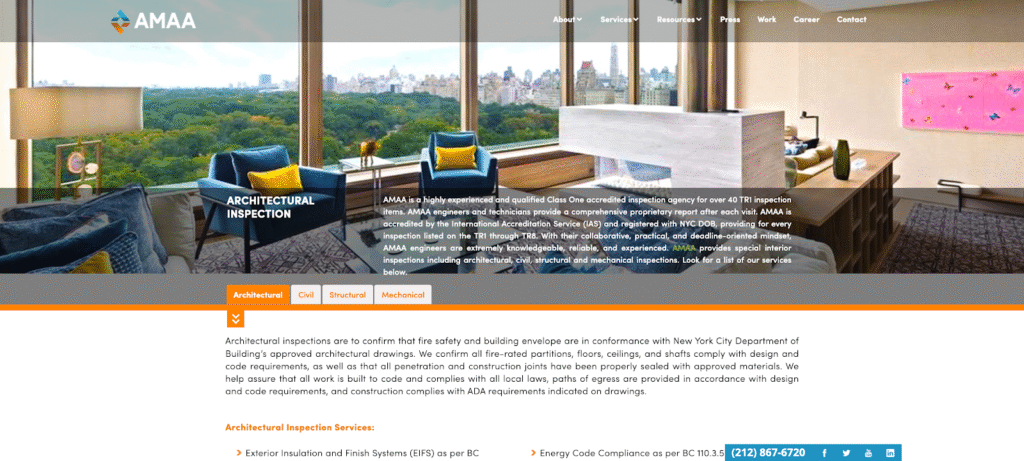
AMAA provides special inspection services for new construction, renovations, and structural modifications. If you’re pulling permits for foundation work, steel installation, or major load-bearing changes, DOB requires special inspections. AMAA handles that.
Why contractors and developers trust them:
- Licensed Professional Engineers (PE) on staff – Their inspectors have the credentials DOB requires for sign-offs
- Progress inspections – They visit sites at key construction milestones to verify work meets approved plans
- Structural testing – Concrete strength tests, steel weld inspections, soil compaction reports, all documented
- DOB filing experience – They know how to submit TR1 and TR8 reports, so your permits don’t stall
AMAA works mostly with developers and general contractors managing ground-up construction or significant alterations. Their reports satisfy DOB’s special inspection requirements and keep your project moving.
Best for: Developers, general contractors, property owners doing major structural work
How to Pick the Right Firm for Your Property
Not every inspection firm handles every violation type. Here’s how to match your needs with the right company.
| Violation Type | Best Fit |
| Local Law 2/4 (TPP) violations | NYC Tenant Protection Plan Inspections |
| Pre-purchase inspections | The Inspection Boys |
| Active DOB violations needing repairs | Zicklin Contracting |
| Environmental hazards (lead, asbestos, mold) | Accredited Environmental Solutions |
| Facade and Local Law 11 (FISP) compliance | Broadway Inspections |
| Special inspections for new construction | AMAA |
Before you hire anyone, ask these questions:
- Are you licensed and insured for this specific inspection type?
- How long will the inspection take, and when can I get the report?
- Do you provide repair recommendations, or do I need to hire someone else?
- Will your documentation hold up if DOB or HPD challenges the findings?
- Can you help with filings and paperwork, or do I need an expediter?
The wrong firm wastes your time and money. The right one prevents violations from coming back.
Stop Repeat Violations Before They Start
Getting slapped with the same violation twice isn’t bad luck. It’s a breakdown in the process. Most property owners fix the immediate problem but never address what caused it. They patch the leak without checking the pipes. They correct the code violation without updating their maintenance schedule. Three months later, the city shows up again.
Here’s how to break that cycle for good.
Conduct Proactive Inspections Regularly
Waiting for DOB or HPD to find problems is the expensive route. You pay fines, deal with tenant complaints, and scramble to fix issues under deadline pressure.
Smart property owners schedule inspections before violations happen. Pick one of the firms we covered earlier and set up annual or semi-annual walkthroughs. These aren’t emergency calls. They’re preventive checks that catch problems early.
What to inspect proactively:
- Facade conditions – Cracks, spalling, loose bricks (especially before Local Law 11 deadlines)
- Fire safety systems – Sprinklers, alarms, extinguishers, emergency lighting
- Plumbing and drainage – Leaks, backflow preventers, sewer connections
- Electrical panels and wiring – Overloaded circuits, outdated systems, exposed wiring
- HVAC equipment – Boilers, cooling towers, ventilation systems
- Structural elements – Load-bearing walls, foundations, staircases, railings
You’ll spend money on inspections up front. But you’ll avoid violations that cost 10 times more to fix under city deadlines.
Pro tip: Schedule inspections at least 90 days before any Local Law compliance deadlines. That gives you time to make repairs without rushing or paying emergency contractor rates.
Implement a Preventive Maintenance Plan
Inspections tell you what’s wrong. Maintenance plans keep problems from coming back. After your inspection firm hands over its report, sit down with them and build a maintenance calendar. Not every issue needs immediate attention, but every issue needs a timeline.
Here’s how to structure it:
- Immediate repairs (0-30 days) – Active violations, safety hazards, anything that could trigger fines
- Short-term repairs (1-6 months) – Deteriorating systems that will fail soon if ignored
- Long-term upgrades (6-24 months) – Equipment nearing end-of-life, outdated systems that aren’t code-compliant
Your maintenance plan should include:
| System | Inspection Frequency | Maintenance Tasks |
| HVAC | Quarterly | Filter changes, coil cleaning, refrigerant checks |
| Plumbing | Semi-annual | Drain cleaning, valve testing, and backflow certification |
| Electrical | Annual | Panel inspection, circuit load testing, outlet checks |
| Fire safety | Annual | Sprinkler testing, alarm testing, and extinguisher certification |
| Facade | Every 5 years (FISP) | Crack repairs, repointing, and waterproofing |
Stick to the schedule. The violations you prevent are the ones you never see.
Stay Current on NYC Building Regulations
NYC building codes change constantly. Local Laws get updated. New requirements get added. If you’re managing properties the same way you did five years ago, you’re already behind. You don’t need to become a code expert, but you need to know when regulations affect your buildings.
Key resources to monitor:
- NYC Department of Buildings (DOB) – Check their website for new Local Law announcements and compliance deadlines
- HPD updates – Rent-stabilized buildings face different requirements than market-rate properties
- ECB rulings – Review recent hearing decisions to understand how violations are being interpreted
- Industry newsletters – Property management associations often summarize regulatory changes
Set calendar reminders for major compliance deadlines. Local Law 11 (facade inspections), Local Law 87 (energy audits), and Local Law 152 (carbon emissions) all have recurring schedules. Miss a deadline, and you’re facing automatic penalties before you even get the violation notice.
Pro tip: Subscribe to DOB email alerts. They send notifications about code changes, new filing requirements, and emergency orders that could affect your properties.
Get Permits for All Work
This one seems obvious, but it’s where most repeat violations start. You hire a contractor to fix a plumbing issue. They reroute some pipes, patch the wall, and leave. Months later, DOB inspects and writes you up for unpermitted work. Now you’re paying fines and pulling after-the-fact permits that cost more than doing it right the first time.
Before any contractor touches your building, confirm they’re pulling the proper permits. Don’t take their word for it. Check the DOB BIS system yourself.
Work that always requires permits:
- Structural modifications (walls, beams, columns)
- Plumbing alterations (new fixtures, pipe rerouting)
- Electrical upgrades (panel changes, new circuits, wiring)
- HVAC installations (boilers, cooling towers, ductwork)
- Facade repairs (repointing, structural repairs, scaffolding)
- Fire suppression systems (sprinkler installations, alarm upgrades)
Work that sometimes requires permits:
- Window replacements (depends on building type and historic district status)
- Roofing repairs (major replacements need permits, patching usually doesn’t)
- Interior renovations (cosmetic work is fine, but moving walls or plumbing requires permits)
When in doubt, file. The permit fee is cheaper than the violation.
Keep Every Document Organized
You fixed the violation. Great. But can you prove it six months from now when HPD comes back asking for records? Most property owners lose documentation in email threads, filing cabinets, or contractor trucks. When the city requests proof of compliance, they can’t find it. That turns a resolved issue into a new violation.
What to keep on file:
- Inspection reports (with photos and date stamps)
- Contractor invoices and receipts
- Permit applications and approvals
- Certificate of Corrections (filed with DOB or HPD)
- Work completion photos
- Correspondence with city agencies
Store everything digitally. Cloud storage works, but you’ll still spend time searching through folders when you need something fast. That’s where a violation monitoring tool makes sense.
Track Violations with ViolationWatch
Here’s the problem with manual tracking. You deal with NYC building violations across multiple properties. Some are open, some are pending, and others are already heading toward the environmental control board because of non-compliance. Deadlines scatter across calendars, documents are split between inboxes, and that chaos leads to costly delays with real legal consequences under strict NYC law and evolving city regulations.
ViolationWatch gives you a smarter way forward. The platform takes on violation removal using a comprehensive approach built on deep knowledge of the most common building violations, including risks like blocked exits and missing sprinklers that trigger direct action from the fire department and compromise core safety standards.
This system helps you maintain compliance, stay compliant, and ensure your property remains safe while guiding all required corrective work to restore compliance with critical safety requirements tied to housing preservation rules across New York City.
How to set it up?
- Step 1 – Add your properties: Log into your ViolationWatch account and add each property by address. The system automatically pulls existing violations from DOB, HPD, ECB, FDNY, and other city databases.
- Step 2 – Monitor violations automatically: ViolationWatch checks for new violations daily. When the city issues a citation, you get notified immediately via email or WhatsApp. No more waiting for paper notices to arrive in the mail.
- Step 3 – Set up alert preferences: Choose which violation types trigger notifications. You can filter by agency (DOB vs. HPD), severity (Class 1 vs. Class 2), or location (specific boroughs or buildings).
- Step 4 – Track resolution progress: As you work through violations, update their status in the dashboard. Mark inspections scheduled, repairs completed, or certificates filed. The system keeps everything timestamped, so you have proof of action.
- Step 5 – Store documents centrally: Upload inspection reports, contractor invoices, permits, and photos directly to each violation record. When the city requests documentation, you pull it up in seconds instead of digging through emails.
- Step 6 – Review compliance reports: Generate reports showing open violations, upcoming deadlines, and resolution timelines. Use these during monthly property reviews or budget planning meetings.
Before you sign up for ViolationWatch, run a free lookup on your properties using our Free NYC Building Violations Lookup tool. You’ll see every open violation tied to your addresses, which gives you a clear starting point for cleanup.
Train Your On-Site Teams
Your supers and porters are the first line of defense against violations. They’re on-site every day. They see problems before inspectors do. But if they don’t know what to look for, or they don’t know how to report issues correctly, problems slip through and lead to failure that impacts building operations.
Run quarterly training sessions covering:
- Common violation triggers – What inspectors look for during DOB and HPD visits, including patterns tied to most violations
- Reporting procedures – How to escalate issues before they become violations and prevent fines
- Maintenance best practices – Proper procedures for HVAC, plumbing, electrical work, and fire safety systems
- Documentation requirements – What records to keep and where to store them so teams can comply with internal and regulatory standards
Make your on-site staff partners in compliance, not just maintenance workers. When they understand why something matters, they pay closer attention. This approach creates internal success stories that reflect a safer, more responsive environment for your clients and property stakeholders.
Pro tip: Create a simple checklist for weekly walkthroughs. Include items like checking fire extinguishers, testing emergency lighting, inspecting stairwell railings, and looking for water leaks. These steps offer the fastest path to consistent oversight and help reinforce habits that reduce risk across the board. Small checks prevent big violations.
The Real Cost of Repeat Violations
Here’s what repeat violations actually cost you:
- Higher fines – Second and third offenses carry steeper penalties
- ECB hearings – You lose time attending hearings and preparing defenses
- Tenant complaints – Unresolved violations drive tenant dissatisfaction and turnover
- Property value decline – Buildings with violation histories sell for less
- Insurance impacts – Some carriers raise premiums or drop coverage for properties with chronic violations
Fix it once, fix it right. That’s how you stop the cycle.
Your Buildings Deserve Better Than Repeat Violations
You’ve got the right inspection firms. You know how to structure a maintenance plan. You understand what triggers violations and how to stop them.
Now comes the hard part: keeping all of it organized across multiple properties, deadlines, and city agencies.
When you apply what’s in this guide, here’s what changes:
- Your properties stay ahead of violations instead of reacting to them after fines start piling up
- Inspection firms catch problems early because you’re scheduling proactive walkthroughs, not emergency calls
- Maintenance gets done on schedule because someone’s actually tracking what needs attention and when
- City inspectors find less to cite because your systems are documented, permitted, and code-compliant
- Your team knows what to look for during daily walkthroughs and how to escalate issues before they escalate into violations
The difference between property owners who deal with repeat violations and those who don’t comes down to systems. One group manages violations in spreadsheets and email threads. The other uses tools built for the job.
We built ViolationWatch for property managers who are tired of chasing violations across disconnected systems. You add your properties, we monitor for new citations, and you get instant alerts so nothing slips through. All your inspection reports, permits, and compliance documents live in one place. No more digging through files when the city asks for proof.If you’re managing more than a few buildings in NYC, it’s worth a look. We’re at 433 Broadway #220, New York. Call us at +1 347-201-2336 or visit ViolationWatch to see how it works.