
You check your building’s violation status on a Tuesday and find nothing. By Friday, three new violations appear from different city agencies, and you had no idea they were coming.
Here’s the problem: most property managers rely on free city portals to track violations. These tools give you basic lookup capabilities, but they don’t tell you when violations hit your properties. You need to check them yourself, manually, repeatedly, across multiple agency websites. That’s not monitoring. That’s guesswork with extra steps.
Free tools can show you violations after they’re filed. What they can’t do is alert you the moment violations appear, track status changes automatically, or centralize violations from ten different NYC agencies into one dashboard. You’re left jumping between DOB NOW, HPD, ECB, and half a dozen other portals, hoping you caught everything before deadlines pass.
Here’s what we’ll cover:
- How ACRIS helps you research property history, but offers zero violation tracking
- What DOB NOW shows you (and the critical gaps it leaves behind)
- Why ViolationWatch’s free lookup tool gives you instant visibility across all NYC agencies
- The specific limitations that turn “free tools” into expensive blind spots
We tested these tools against active violation portfolios. The results show exactly where free city portals fall short and what you need to fill those gaps before violations turn into compounding fines.
What Free NYC Violation Tracking Tools Actually Show You
Most property managers start with the city’s free portals. They’re accessible, they don’t cost anything, and they contain official records straight from NYC agencies. The question isn’t if these tools work but rather what they actually show you and what critical information they leave out.
1. ACRIS
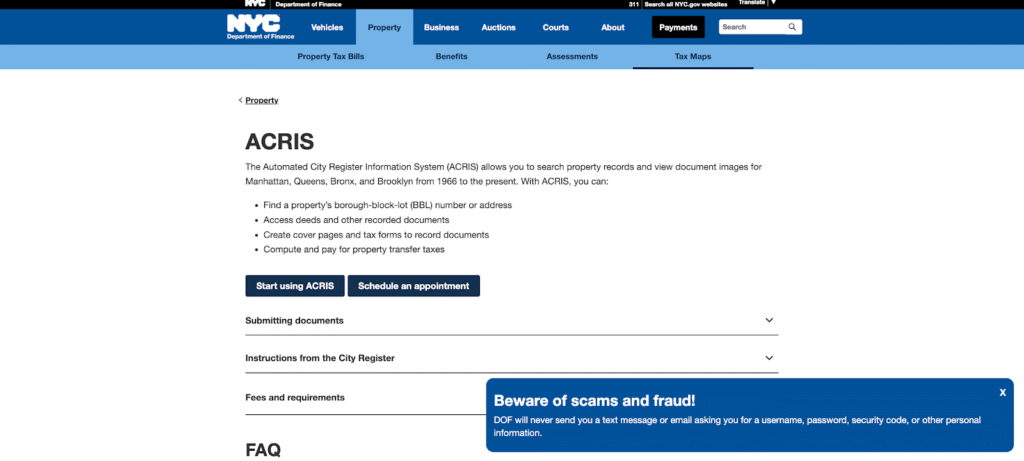
The Automated City Register Information System gives you access to property transaction history across all five boroughs. You can pull deeds, mortgages, UCC filings, and other recorded documents dating back to 1966. For due diligence on property purchases or researching ownership history, ACRIS delivers comprehensive documentation that developers and investors rely on during acquisition analysis.
But here’s what it doesn’t do: track building code violations.
ACRIS focuses on recorded property documents filed with the Office of the City Register. You won’t find NYC DOB violations, HPD complaints, or ECB penalties here. The system wasn’t built for compliance monitoring. It was designed to provide transparency around property ownership and financial liens. Contractors researching property ownership or lien status will find all the information they need about recorded documents, but zero data about active code violations or enforcement actions.
How ACRIS Works?
You can search ACRIS by borough, block, and lot number or by street address. The interface lets you filter results by document type and date range. Once you locate your property, you’ll see a list of all recorded documents associated with that address during the current period and historical timeframes.
What you can find in ACRIS:
- Deeds and property transfers
- Mortgage documents and assignments
- Satisfaction of mortgages
- UCC financing statements
- Mechanic’s liens, which are among the most common types of encumbrances contractors file against properties
- Condominium declarations
The system provides scanned copies of original documents. You can view these PDFs directly through the portal and download them for your records. For older properties with decades of transaction history, ACRIS becomes a digital archive of ownership changes and financial encumbrances. If you’re planning a project upgrade or renovation, you can research existing liens before starting work.
The Compliance Gap
Property managers often confuse ACRIS with violation tracking systems. The two serve completely different purposes. ACRIS tells you who owns a property and what financial obligations are recorded against it. It doesn’t monitor whether that property meets current building code requirements or has active stop work orders from the Department of Buildings.
What ACRIS doesn’t provide for compliance tracking:
- No notifications when new DOB violations appear
- No alerts or new messages about enforcement actions
- No ability to receive push notifications about compliance issues
- No tracking of open DOB violations or HPD complaints
- No subscription-based monitoring features, where a user can cancel or manage subscription settings to control notifications
The system updates when new documents get recorded, but building violations aren’t recorded documents in the ACRIS sense. They’re enforcement actions filed by regulatory agencies. Different databases, different purposes, different limitations.
Unlike monitoring platforms that offer automated alerts and customizable notification settings, ACRIS doesn’t offer any subscription-based tracking features at all. If you’re managing compliance across multiple properties, ACRIS offers zero functionality for that objective.
2. DOB NOW Public Portal
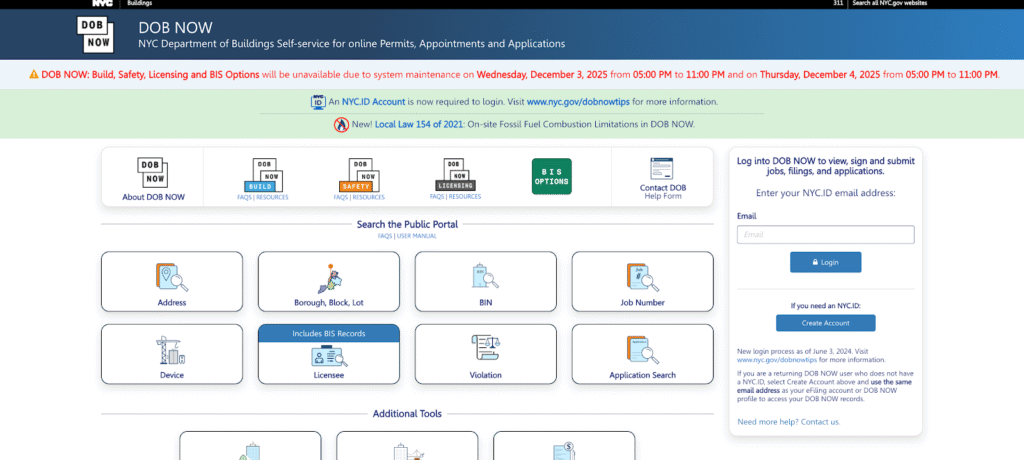
DOB NOW gives you direct access to Department of Buildings records. You can look up permits, applications, inspections, and violations for any property in the city. The portal consolidates various DOB functions into one interface, making it significantly easier to find building-specific information than the legacy systems it replaced.
What DOB NOW Actually Displays
The public portal shows active and resolved violations issued by the Department of Buildings. You can search by address or BIN (Building Identification Number) and pull up a property’s complete DOB violation history. Each violation entry includes the issue date, description, violation class, and current status.
Core DOB NOW features for violation research:
- Active DOB violations with descriptions and severity classifications
- Historical violation records showing resolution dates
- Associated ECB hearing information and penalty amounts
- Permit applications and approval statuses
- Filed complaints and inspection results
- Property profile data, including building class and construction type
The interface lets you filter violations by status, type, and date range. You can view which violations remain open, which are currently in ECB proceedings, and which have been dismissed or resolved. For properties with extensive violation histories, these filters help you sort through dozens or hundreds of entries.
The Multi-Agency Problem
DOB NOW covers Department of Buildings violations. That’s it. If your property has open HPD violations for heat complaints, FDNY violations for fire safety issues, or DEP violations for plumbing problems, you won’t see them here. You need to check separate portals for each agency.
This creates a fragmented view of your compliance status. A property might show clean on DOB NOW while carrying serious violations from three other agencies. You’re forced to track the violation down across multiple systems, each with different search interfaces and data formats.
The portal doesn’t send notifications when new violations appear. You have to log in and manually check each property. For managers overseeing ten, twenty, or fifty buildings, that turns into hours of repetitive searches across multiple addresses every week.
Status Updates Lag Behind Actual Changes
DOB NOW displays violation data pulled from the department’s internal systems. Updates typically appear within 24 to 48 hours of being filed, but that window can stretch longer during high-volume periods. You might check a property on Monday and miss a violation that was issued on Friday but hasn’t been populated on the public portal yet.
The same delay affects status changes. When you resolve a violation and submit documentation, the portal won’t reflect that resolution immediately. The backend processing time means you’re always looking at slightly outdated information, which becomes problematic when you’re managing tight compliance deadlines.
What DOB NOW doesn’t provide:
- Violations from HPD, FDNY, DEP, or other NYC agencies
- Automated alerts when new violations get issued
- Centralized tracking across your entire property portfolio
- Status change notifications as violations move through resolution
You can set the portal up to run the same searches repeatedly, but that’s manual work. You’re logging in, entering addresses, checking results, and noting any changes yourself. The system provides lookup functionality without the monitoring layer that turns data into actionable intelligence.
3. ViolationWatch’s Lookup Tool
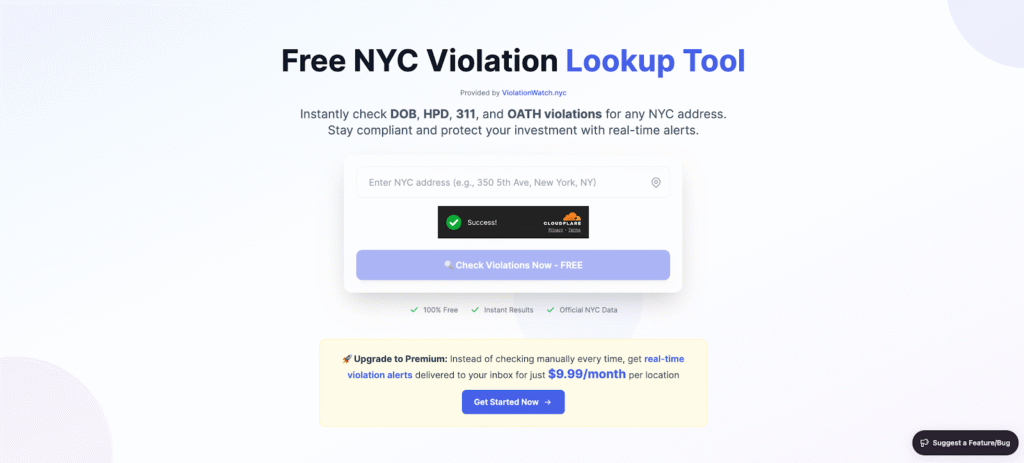
The free lookup tool powered by ViolationWatch pulls violation data from DOB, HPD, 311, and OATH systems into one search result. You enter an address once and get a complete violation report covering multiple NYC Department records. No jumping between portals, no separate searches, no fragmented compliance picture.
This tool was built specifically to solve the multi-agency tracking problem that city portals leave unaddressed. When you search a property address, the system queries official New York City department databases and returns all active violations, closed violations, and pending OATH fines associated with that location.
The simple dashboard provides open access to comprehensive violation data across agencies, including the Environmental Control Board, Housing Preservation and Development, and the Department of Buildings.
How the Lookup Process Works for NYC Building Violations
You enter any NYC address into the search field. The tool validates the address against city records to confirm it exists, then searches violation databases across DOB, HPD, 311 complaint systems, and CityPay OATH records. The entire process takes seconds, helping you stay ahead of compliance issues before they escalate.
What you see in the violation report:
- Active violations with issue dates and descriptions, including immediately hazardous violations that require urgent attention
- Closed violations showing resolution dates
- Current status for each open violation (in progress, closed, pending review)
- Agency reference numbers for tracking specific cases
- OATH fines and hearing information when applicable, including ECB violations that can cost thousands in penalties
Each violation entry includes the issuing agency, violation type, and current status. You can see which violations remain open and which have been resolved. The report displays the five most recent violations by default, giving you an immediate snapshot of the property’s compliance status and helping you avoid costly surprises that derail budgets.
Multi-Agency Coverage in One Interface
Unlike DOB NOW or individual agency portals, this tool aggregates building data from multiple enforcement systems. A single search shows you DOB building code violations, HPD housing maintenance issues, 311 complaints that generated violations, and OATH penalties all together.
This matters when you’re managing properties with violations from different agencies. A building might have an open DOB violation for facade work, an HPD violation for heat complaints, and a 311-generated DSNY violation for illegal dumping. The lookup tool shows all three in one report instead of forcing you to check three separate portals.
For construction professionals tracking construction project compliance or managing upgrade project subscription requirements, this centralized view prevents violations from slipping through the cracks.
The tool pulls data directly from official NYC databases. You’re seeing the same information that appears on individual agency portals, consolidated into a unified view. When agencies update violation statuses in their systems, those changes flow through to the lookup results, giving you accurate information to help you act fast when violations appear.
Free Lookup Versus Automated Monitoring
The lookup tool gives you instant violation visibility for any address you search. You can check properties as often as you want at no cost. For spot checks or researching potential acquisitions, this provides everything you need to assess violation status and maintain NYC compliance.
What it doesn’t do is monitor properties automatically or send alerts when new violations appear. You still need to run searches yourself to catch new violations. The tool shows you what exists right now, but it won’t notify you when agencies file new enforcement actions against your properties. There are no instant alerts, real-time alerts, app notifications, or push notifications to warn you about new violations that could cause project delays or trigger costly fines.
Limitations of manual lookup:
- You have to remember to check each property regularly
- New violations only appear when you run a new search
- No tracking of how violation statuses change over time, or work progress on resolving issues
- Manual process for managing multiple properties across a portfolio
- No task planner to organize resolution workflows across your project team
- Can’t access the attached documents or the centralized files related to violations
- No account settings to customize notifications or monitoring preferences
- Missing the cloud service infrastructure that enables automated tracking
For managers tracking one or two buildings, running periodic searches works fine. For larger portfolios, the manual approach creates the same repetitive workload you face with city portals. You’re still checking properties one by one, hoping you catch violations before deadlines pass.
A monthly plan with automated monitoring eliminates this manual burden, letting users receiving department notifications stay informed without constant manual searches.
When Free Tools Stop Being Sufficient?
Free lookup tools handle instant violation checks effectively. They fail at ongoing compliance monitoring. You get data on demand, but you don’t get proactive alerts, automated status tracking, or centralized portfolio management.
The gap becomes obvious when you’re managing multiple properties. Checking ten addresses weekly means ten separate searches. Checking fifty addresses means fifty searches. You’re either spending hours on manual lookups or accepting that some violations will slip through until your next round of searches.
This is where the distinction between lookup and monitoring becomes critical. Lookup tools answer the question “what violations exist right now” when you ask. Monitoring systems answer “what violations appeared since you last checked” without requiring you to ask. One is reactive, the other is proactive.
The free lookup tool gives you the reactive capability. You can search any property instantly and see its complete violation profile across all major NYC agencies. But turning that into an effective monitoring system requires you to build the automation layer yourself through repeated manual searches.
Free Tools Give You Data, but Monitoring Gives You Control
You’ve seen what free lookup tools can and can’t do. ACRIS handles property records but ignores violations entirely. DOB NOW shows building code violations, but leaves out every other agency. The free lookup tool consolidates multi-agency data into one search, but you still have to run those searches yourself.
Here’s what that means for your compliance workflow:
- You’re checking multiple portals manually or running repeated searches to catch new violations before they compound
- Violations from ten different NYC agencies require ten different tracking methods unless you consolidate them into one system
- Status updates lag behind actual changes, leaving you working with outdated information when deadlines matter most
- Manual lookups work for spot checks, but fail at portfolio-scale monitoring where dozens of properties need consistent oversight
The difference between lookup tools and monitoring systems isn’t about data quality. It’s about automation. Free tools give you violation data when you search for it. Monitoring platforms track violations automatically and alert you the moment they appear.
ViolationWatch turns free lookup capabilities into automated monitoring. You get the same multi-agency coverage you see in the free tool, plus instant email alerts when new violations hit your properties, automatic status tracking as violations move through resolution, and centralized dashboard management for your entire portfolio. The system checks your properties continuously, so you don’t have to run the same searches week after week, hoping you catch everything in time.