
Managing HPD violations across a portfolio of NYC buildings means tracking hundreds, sometimes thousands, of open cases, court dates, and compliance deadlines. Miss one ECB hearing or overlook a Class C violation, and you’re looking at escalating fines that compound daily.
The problem isn’t just having violations. It’s knowing about them before they become expensive emergencies.
Most property managers discover HPD violations the hard way: a tenant complaint triggers an inspection, or worse, a violation appears on a financing report during a refinance. By then, the clock’s already ticking. You’re scrambling to pull records from multiple agency portals, cross-referencing spreadsheets, and hoping nothing slips through the cracks.
Here’s what we’ll cover:
- How HPD Online works and why its building-by-building search creates blind spots for portfolio managers
- What Buildings Information System (BIS) offer beyond basic violation lookups
- When the 311 NYC portal helps (and when it wastes your time)
- How BCompliant, Actovia, and JustFix approach multi-building violation tracking
- Why ViolationWatch centralizes all HPD violations across your entire portfolio in one dashboard
- Which platform actually saves time when you’re managing 10+ properties
We tested each tool against the same scenario: tracking HPD violations across a 25-building portfolio in Brooklyn and the Bronx. Some platforms required 47 individual searches. Others updated automatically and sent alerts the moment new violations hit the system.
The difference between these tools isn’t just convenience. It’s whether you catch violations early enough to avoid penalties or find out when it’s already too late.
1. HPD Online
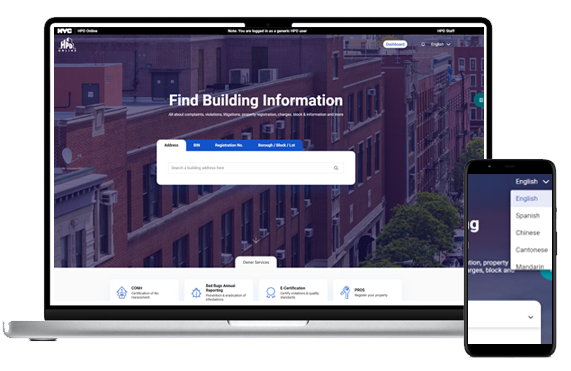
HPD Online serves as the city’s official database for Housing Preservation and Development violations. You’ll find every open violation, complaint history, and registration status for any building in NYC’s five boroughs.
The platform gives you direct access to:
- Complete violation records, including Class A, B, and C violations, with issue dates and current status
- Complaint history showing 311 reports filed against specific addresses
- Registration data confirming whether a building meets HPD’s annual registration requirements
- Litigation information tracking active court cases and hearing dates
How the Search Process Actually Works
You start by entering a building’s borough, block, and lot number or the street address if you don’t have the BBL readily available. The system pulls up a property profile showing registration status, ownership information, and a violation summary.
Click into the violations tab. You’ll see a chronological list organized by complaint number, violation class, and certification status. Each entry shows the inspection date, the specific code violated, and whether the issue remains open or has been resolved.
The catch? You repeat this process for every single building in your portfolio. Managing 10 properties means 10 separate searches. Managing 50 means you’re spending hours clicking through individual building profiles, copying data into spreadsheets, and manually checking for updates. There’s no portfolio view. No bulk export. No automated notifications when new violations appear.
What You Can’t Do with HPD Online
The platform wasn’t built for property managers overseeing multiple buildings. It lacks:
- Cross-property violation tracking across your entire portfolio
- Automated alerts when new violations get issued
- Bulk data exports for compliance reporting
- Status change notifications for pending violations
- Calendar integration for upcoming court dates
You can pull historical data going back years, which helps during due diligence reviews. But for day-to-day management, you’re stuck with manual monitoring, logging in weekly, searching each address individually, and comparing current results against your previous notes.
2. Buildings Information System (BIS)
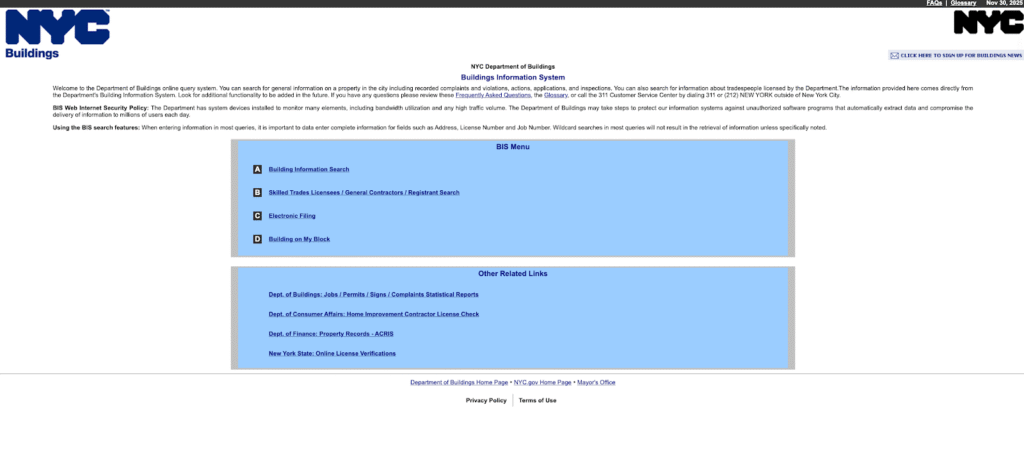
BIS operates as NYC’s comprehensive building database, covering permits, certificates of occupancy, construction applications, and yes, violations from multiple agencies, including HPD, DOB, and ECB.
The system aggregates data you won’t find on HPD Online alone:
- DOB violations running parallel to HPD issues
- Active permits showing ongoing construction work
- Certificate of Occupancy details confirming legal use
- ECB violations with hearing dates and fine amounts
- Complaint histories across multiple city agencies
Enter a building address or BBL number. BIS returns a property overview with tabs for each data category. The violations tab combines HPD housing violations with DOB construction-related issues and ECB environmental control board violations.
This cross-agency view matters when you’re dealing with interconnected compliance issues. A Class B HPD violation for inadequate heat might appear alongside a DOB violation for an expired boiler permit. You see the full picture instead of isolated agency records.
The Portfolio Management Gap
BIS provides more comprehensive data than HPD Online, but it shares the same workflow limitation. You still search one building at a time. Track 30 properties, and you’re executing 30 individual searches every time you need updated information.
The interface also requires familiarity with NYC building codes. Violation descriptions use technical language and code references. You need to know what “§27-2029” means or understand the difference between a “C4” and “C5” violation class to interpret the data correctly.
There’s no user dashboard. No saved searches. No comparison tools for tracking violation trends across your portfolio. You extract the raw data and build your own tracking system elsewhere.
3. 311 NYC Portal
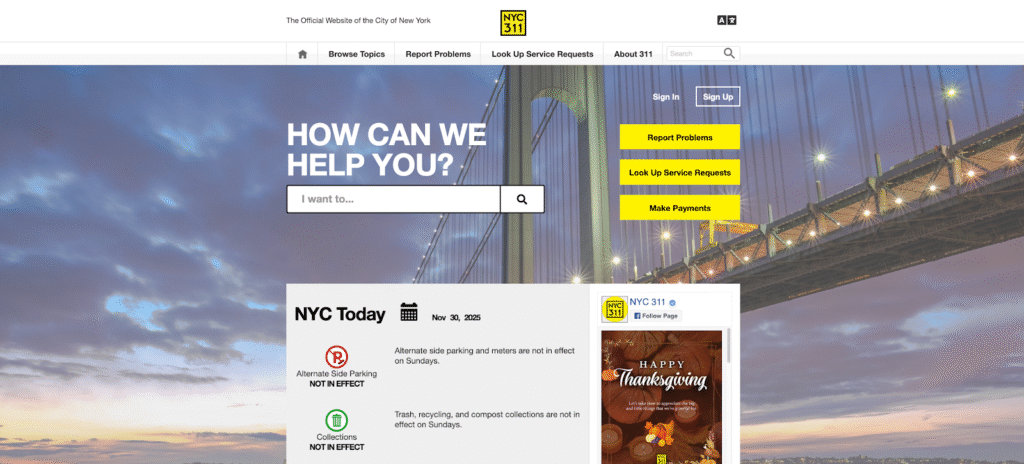
The 311 portal handles complaint submissions and service request tracking across all city agencies. Property managers use it to file complaints, track resolution progress, and monitor tenant-initiated service requests that might trigger HPD inspections.
What does the Portal handle?
You can submit new complaints about housing conditions, check the status of existing service requests, and view complaint histories tied to specific addresses. The system assigns each complaint a unique service request number for tracking.
When tenants file 311 complaints about heat, hot water, pests, or building conditions, those reports often trigger HPD inspections. The portal lets you monitor these complaints before they escalate into formal violations.
Tracking Service Requests
Search by service request number or address. The system shows:
- Complaint submission date and type
- Current status (open, in progress, closed)
- Agency assignment (HPD, DOB, FDNY, etc.)
- Resolution notes when cases close
The tracking works well for individual complaints. You can verify whether a tenant’s heat complaint resulted in an inspection or was resolved without escalation.
Where 311 Falls Short for Violation Management
The portal tracks complaints and service requests, not violations themselves. You might see that a tenant filed a heat complaint on January 15th, but the portal won’t show you if that complaint generated an HPD violation two weeks later.
You still need to cross-reference 311 complaint data with HPD Online violation records. The systems don’t communicate bidirectionally. A closed service request on 311 doesn’t mean HPD closed the violation. You’re managing two separate tracking processes.
For multi-building portfolios, the 311 portal offers no aggregated view. You search one address at a time, just like HPD Online and BIS. There’s no way to monitor service requests across all your properties simultaneously or set up alerts when new complaints get filed against your buildings.
The portal works as a complaint intake and tracking system. It doesn’t replace dedicated violation monitoring tools that property managers actually need for compliance management.
4. BCompliant
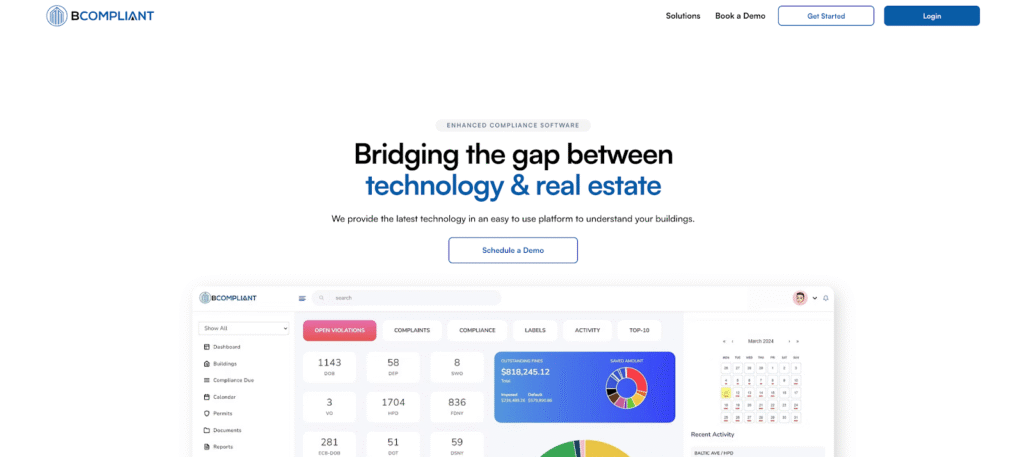
BCompliant positions itself as a comprehensive compliance platform for NYC property managers handling multiple buildings. The software centralizes violation tracking, document management, and vendor coordination into a single dashboard.
HPD Violation Monitoring Features
The platform pulls HPD violation data directly from city databases and organizes it by property. You get a portfolio-level view showing all open violations across your buildings, sorted by severity, violation class, and compliance deadlines.
BCompliant’s HPD tracking includes:
- Automated violation imports from HPD’s database to your property dashboard
- Violation status updates showing open, dismissed, and certified violations
- Class categorization separating Class A, B, and C violations by urgency
- Deadline tracking for correction timelines and certification requirements
- Document attachment linking work orders, contractor invoices, and certification photos to specific violations
The main dashboard displays violation counts across all properties. You can filter by building, violation type, or compliance status. Need to see all Class C violations across your Brooklyn portfolio? The system generates that view in seconds.
Reporting capabilities let you export violation data for ownership reviews, financing applications, or internal compliance audits. You’re not manually compiling spreadsheets from individual HPD searches anymore.
Workflow Integration
BCompliant connects violation tracking to your existing property management workflow. When a new HPD violation appears, you can assign it directly to maintenance staff or external contractors through the platform.
The system sends notifications when violations get assigned, when deadlines approach, and when certification documentation needs to be submitted. Your team works from shared violation data instead of scattered email threads and paper files.
But BCompliant requires a paid subscription, with pricing based on portfolio size and feature access. Smaller property managers might find the cost prohibitive compared to free city portals. The platform works best when your entire team adopts it as the central compliance system. If you’re only using it for HPD violation tracking while managing other tasks elsewhere, you’re not maximizing the software investment.
5. Actovia
Actovia builds property management software focused on operational efficiency and compliance tracking. The platform treats HPD violations as one component within broader building operations.
How Actovia Handles HPD Data
Actovia integrates with NYC’s open data sources to pull HPD violations into your property dashboard. The system displays violation details alongside maintenance tickets, tenant communications, and financial records.
For multi-building portfolios, Actovia provides:
- Centralized violation tracking across all properties in your account
- Automated data refreshes pulling new HPD violations as they’re issued
- Violation assignment tools linking issues to specific staff or contractors
- Status tracking from initial notice through certification
- Document storage for correction work and compliance proof
The platform’s strength lies in aggregating data across your entire portfolio. Open the violations dashboard, and you see every HPD issue across all buildings, organized by priority level and correction deadline.
You can drill down to individual properties or zoom out to portfolio-wide compliance metrics. How many Class C violations do you have citywide? Which buildings have the highest violation density? Actovia answers these questions without manual data compilation.
6. JustFix
JustFix operates differently from traditional property management tools. The platform focuses on tenant advocacy, helping renters identify housing violations and pursue repairs through legal channels.
HPD Violation Lookup for Renters
JustFix pulls HPD violation data and presents it in tenant-friendly language. Renters enter their address and see a breakdown of existing violations, complaint history, and building registration status.
Property managers encounter JustFix when tenants use the platform to:
- Document housing conditions with timestamped photos
- Generate HP Action packets for housing court
- File complaints directly with HPD
- Track violation status and correction timelines
How This Affects Property Managers
JustFix gives tenants direct access to the same HPD violation data you see through official portals. Renters can verify whether violations remain open, check correction deadlines, and monitor compliance status without contacting building management.
The platform also helps tenants organize documentation for housing court cases. If you’re facing an HP Action, there’s a strong chance the tenant used JustFix to compile violation records, inspection reports, and photographic evidence.
Limited Value for Portfolio Monitoring
JustFix wasn’t designed for property managers tracking violations across multiple buildings. The platform focuses on single-address lookups from a tenant’s perspective. You won’t find portfolio dashboards, automated alerts, or bulk violation tracking. The tool serves tenant advocacy rather than property management workflows.
That said, understanding JustFix helps you see what information your tenants can access. The platform makes HPD violation data more transparent and easier for renters to interpret. Knowing this shapes how proactively you address violations before tenants discover them through advocacy tools.
Property managers don’t use JustFix for daily violation monitoring. The platform’s value lies in understanding tenant resources and maintaining awareness of public-facing violation data. If you’re managing buildings with active HPD violations, assume tenants can access detailed violation histories through JustFix and similar advocacy platforms. That reality reinforces the need for proactive violation tracking and timely corrections before tenant complaints escalate.
7. ViolationWatch
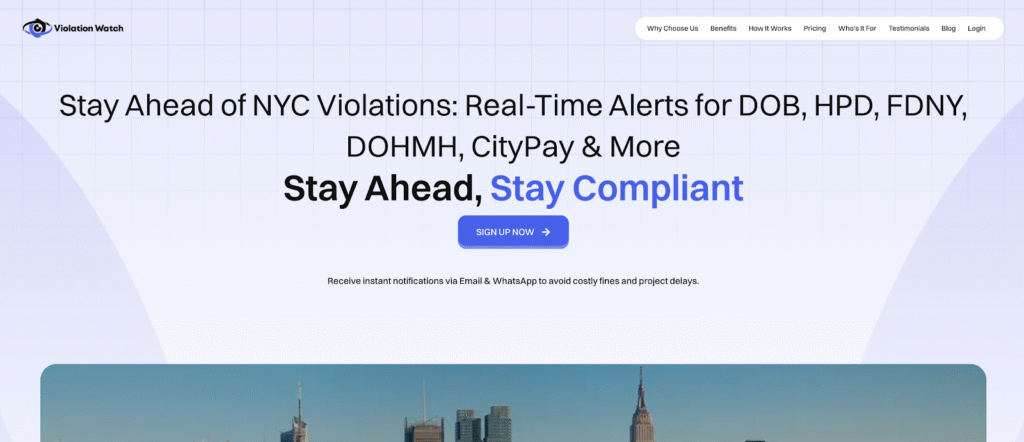
ViolationWatch approaches HPD violation monitoring from a different angle. Instead of requiring manual searches across city portals or piecing together data from multiple platforms, the system automates the entire tracking process for your entire portfolio.
You add your properties once. The platform handles everything else.
How the AI-Powered Monitoring Works
ViolationWatch connects directly to the NYC Department of Housing Preservation and Development’s database and continuously scans for new violations across all your buildings. The system runs these checks automatically, no logging in, no manual searches, no repetitive data entry.
Here’s the workflow:
- You sign up and add your properties to the dashboard using addresses or building identification number.
- The platform monitors HPD’s system around the clock for new violations and status changes.
- You receive instant alerts via WhatsApp and email when violations appear or statuses update.
- You take action before civil penalties escalate or deadlines pass.
The AI-driven monitoring engine detects new violations within hours of HPD posting them. You’re not discovering issues during your weekly manual check; you know the moment they hit the system.
Portfolio-Level Visibility You Can’t Get Elsewhere
Managing 15 buildings means tracking hundreds of potential violation points. ViolationWatch consolidates everything into a single dashboard showing:
- Total violation counts across your entire portfolio
- Open violations categorized by Class A, B, and C severity
- Closed violations with resolution dates and certification status
- Sanctioned locations flagged for elevated compliance risk
- Recent violations sorted by issue date across all properties
Click into any building. You see its complete HPD violation history, current open cases, submission dates, and compliance deadlines. The data updates automatically as HPD processes certifications and closes cases.
You’re looking at real-time compliance status across 15, 50, or 150 buildings without opening separate browser tabs or copying data into spreadsheets.
Multi-Channel Notifications That Actually Reach You
New violations don’t wait for you to check a dashboard. ViolationWatch sends immediate alerts through channels you actually use daily.
The notification system delivers alerts via:
- WhatsApp messages to multiple phone numbers
- Email notifications to multiple addresses
- Customizable alert settings based on violation severity
You can route different notification types to different team members. Building managers get alerts for their assigned properties. Compliance directors receive notifications for all Class C violations across the portfolio. You control who knows what and when.
The multi-channel approach means violations don’t get buried in email folders or missed during busy periods. A WhatsApp notification appears on your phone the same way tenant messages do; you see it immediately.
Free Violation Lookup for Quick Checks
Before committing to full portfolio monitoring, you can test the system using ViolationWatch’s free lookup tool. Enter any New York City building address and pull its complete HPD violation history instantly.
The lookup tool shows:
- All open violations with issue dates and violation classes
- Historical violations and their resolution status
- Current compliance standing
- Sanctioned location flags
Property managers use this during due diligence on potential acquisitions. Pull violation histories for target buildings before making offers. You see exactly what compliance issues you’re inheriting.
The free tool gives you the same data quality as the full platform. You’re not getting watered-down information; you’re accessing the complete HPD violation record for any building in NYC.
Who Benefits Most from Automated Monitoring
ViolationWatch works for anyone managing multiple properties who can’t afford to miss HPD violations.
The platform serves:
- Portfolio managers overseeing 10+ buildings across multiple boroughs
- Property management companies are tracking violations for client properties
- Real estate investors are monitoring compliance risks in their holdings
- Building owners managing multi-family residential building portfolios
- Compliance directors responsible for citywide property operations
Single-building owners can use the platform, but the value multiplies with portfolio size. Managing one building, you might check HPD Online weekly without major issues. Managing 30 buildings, manual monitoring becomes impossible to sustain accurately.
What Makes This Approach Different
Other platforms require you to build tracking systems around city data. You search HPD Online, export results, maintain spreadsheets, set calendar reminders, and hope nothing slips through.
ViolationWatch reverses that model. The platform watches the Department of Housing Preservation and Development’s database continuously and pushes relevant updates to you. You react to verified information instead of hunting for potential changes.
The functional difference:
- Manual monitoring: You search each building regularly and compare results against previous checks
- Automated monitoring: The system detects changes across all buildings and notifies you instantly
One approach scales with your time investment. The other scales with your portfolio size, and your time investment stays constant.
Getting Started Takes Minutes
Setting up portfolio-wide monitoring doesn’t require IT support or complex integrations. You sign up, add your building addresses, configure notification preferences, and start receiving violation alerts. The platform doesn’t replace your existing property management software. It fills the specific gap in automated HPD violation monitoring that general property management tools don’t address well.
You can run ViolationWatch alongside BCompliant, Actovia, or any other system you’re currently using. The violation data flows into your workflow through notifications you decide how to act on it using whatever tools you prefer.
Why This Matters for Compliance Management
HPD complaints and violations issued compound quickly when missed. A Class B violation for inadequate heat doesn’t just sit there; it generates daily penalties if you don’t respond within the correction timeline.
Getting notified within hours of a violation appearing gives you maximum time to coordinate repairs, schedule inspections, and submit certifications. You’re working with weeks of runway instead of discovering issues days before deadlines.
This becomes critical when managing:
- Rent-stabilized units, where housing code violations can affect rent-stabilized tenants and trigger additional scrutiny from community renewal agencies
- Immediately hazardous situations requiring emergency repairs and rapid contractor coordination
- FDNY violations that appear alongside HPD issues in search results, providing more detailed information about hazardous conditions
That time buffer translates directly into lower fines, fewer last-minute contractor callouts, and better relationships with HPD inspectors who see you responding proactively instead of reactively.
Cross-Portfolio Compliance Visibility
For a property owner managing more than one building, the dashboard provides the same information across residential units in NYCHA buildings, NYCHA properties, and other buildings in your landlord’s portfolio.
You can:
- Stay informed about official violations across all properties simultaneously
- Double-check compliance status before financing reviews or ownership transfers
- Access detailed information about non-hazardous and unsafe conditions affecting NYCHA residents and neighborhood services
- Review owner names and rent history data when relevant to the violation context
- Track local law compliance requirements across your entire portfolio
The system monitors violations that require you to act fast alongside routine compliance issues, organizing everything by priority level and correction deadline.
Automated monitoring doesn’t fix violations for you. It makes sure you know about them early enough to fix them properly. There are a few ways to track violations across multiple buildings, but ViolationWatch gives you NYC building violations monitoring that scales with your portfolio without multiplying your workload.
Stop Searching One Building at a Time
You’ve seen how each platform handles HPD violation tracking. Some require individual building searches. Others consolidate data but still demand manual monitoring. A few focus on tenant advocacy instead of property management workflows.
Here’s what actually matters for multi-building portfolios:
- Free city portals give you complete violation data, but force you to search each property separately scalability breaks down past 5-10 buildings
- BCompliant and Actovia centralize violations across portfolios, but require paid subscriptions and full platform adoption for maximum value
- JustFix serves tenant advocacy well, but offers limited utility for property managers tracking compliance across multiple addresses
- Manual monitoring works until it doesn’t miss violations compound into bigger fines and tighter correction timelines
The pattern becomes clear when you compare workflows. HPD Online, BIS, and the 311 portal require you to pull data through repeated searches. Property management platforms like BCompliant and Actovia improve efficiency but still operate within subscription models built for comprehensive operations beyond just violation tracking.
ViolationWatch flips the model. The platform continuously monitors HPD’s database and pushes relevant updates directly to you via WhatsApp and email. You’re not building tracking systems around city data or paying for broader features you don’t need. You add your properties once, configure your notification preferences, and receive alerts the moment new violations appear across your entire portfolio.That’s the functional difference between checking if violations exist and knowing immediately when they do. Start with the free lookup tool to see how the data compares to what you’re currently tracking manually, then decide if automated monitoring makes sense for your portfolio.