
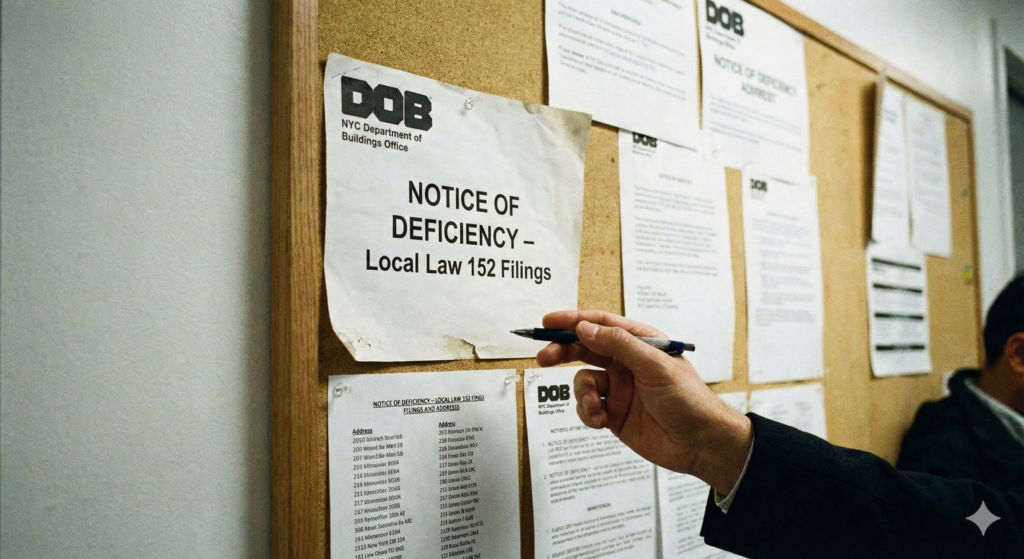
If it feels like the NYC Department of Buildings (DOB) is suddenly flagging more Local Law 152 filings, it’s not your imagination. We’re seeing a sharp uptick in Notices of Deficiency tied to periodic gas piping inspections, and many of them are preventable.
For owners and managers, a Notice of Deficiency isn’t just a nuisance. It can delay compliance, trigger penalties, and create unnecessary back-and-forth with DOB. In this guide, we walk through why this is happening, what’s most often going wrong, and how we can tighten our processes so Local Law 152 filings get accepted the first time.
Understanding Local Law 152 And Periodic Gas Inspections
Local Law 152 of 2016 requires periodic inspections of gas piping systems in most buildings throughout New York City. The intent is straightforward: reduce the risk of gas leaks and explosions by ensuring that gas piping is regularly inspected by a qualified professional.
Under Local Law 152, properties in all five boroughs must follow a rotating inspection schedule by community district, with inspections generally required once every four years. The law is part of a broader safety package that also includes Local Laws 150–154, all aimed at keeping building systems safer. You can see the statutory framework in NYC Administrative Code §28-318 and related rules issued by DOB.
Inspections must be performed by a Licensed Master Plumber (LMP) or a qualified individual working under an LMP, and results are documented on DOB-approved forms. The inspection report isn’t enough on its own: an owner (or their representative) must also submit a Gas Piping System Periodic Inspection Certification (GPS2) through DOB’s online systems by the required deadline.
DOB’s guidance on Local Law 152, including inspection cycles and forms, is available directly on the NYC Department of Buildings site. The challenge we’re seeing now isn’t just about doing the inspection, it’s about submitting a technically clean, fully compliant filing that avoids a Notice of Deficiency.
Why Notices Of Deficiency Are Increasing Now
So why is DOB issuing more Notices of Deficiency on Local Law 152 filings right now? Several trends are converging.
First, DOB has been steadily strengthening enforcement around gas safety after a series of serious gas-related incidents in the past decade, as documented by the NYC Mayor’s Office. Gas piping is now treated as a high-risk system, so the agency is less willing to overlook incomplete or sloppy paperwork.
Second, the law is now fully phased in. Earlier cycles benefited from some grace and learning curves, both for owners and for DOB staff. Those days are largely over. As more buildings fall into the recurring cycle, DOB has better benchmarks to spot inconsistencies, patterns, and red flags in filings.
Third, the move to DOB NOW and electronic submissions has made it easier for DOB to program automated checks. Missing fields, incorrect dates, and inconsistent answers are detected more reliably, triggering more Notices of Deficiency.
Finally, many owners are still relying on ad‑hoc processes, old templates, or outdated guidance instead of referencing the latest DOB bulletins and Local Law 152 rules. That gap between current standards and legacy practices is exactly where Notices of Deficiency are exploding.
The Most Common Deficiencies Triggering DOB Notices
When we review Local Law 152 Notices of Deficiency, the same issues come up again and again. A few of the most common:
- Incorrect or missing property information
Wrong BIN, incorrect block and lot, or mismatched address data will almost always trigger a deficiency. DOB cross-checks submissions against its property records.
- Improper inspection dates and cycles
Owners sometimes report inspection dates outside the allowed window for their community district or misalign the inspection year with the four-year cycle published by DOB. The DOB Local Law 152 calendar should always be the reference.
- Incomplete or inconsistent certification forms
Boxes left blank, conflicting answers (for example, “no gas piping“ while a gas meter clearly exists), or missing signatures from the LMP frequently lead to a Notice of Deficiency.
- Failure to clearly document corrections
If conditions requiring correction are identified, DOB expects clear documentation that they were corrected within required timeframes, along with any necessary permits. Vague notes like “repaired” without detail can be a problem.
- Misunderstanding “no gas” vs. “gas capped”
Buildings with capped or disconnected gas service sometimes get misclassified. DOB distinguishes between a building that has never had gas service and one where piping or meters remain in place. That nuance can make or break a filing.
We’re also seeing owners blindsided by violations they didn’t know about until they search a DOB or HPD record, or use a tool like the Violation Watch building lookup to see prior issues tied to their property.
How To Respond When You Receive A Notice Of Deficiency
A Notice of Deficiency isn’t the end of the world, but it is a countdown clock. Our approach is to treat it like a mini-audit and clean up everything, not just the one flagged item.
Here’s how we recommend responding:
- Read the notice line by line
Identify exactly which part of the submission DOB is questioning: dates, signatures, inspection findings, property details, or missing documents.
- Pull the original inspection report and certification
Confirm what the LMP actually observed and documented. If something was entered incorrectly into DOB NOW, we reconcile the paperwork with the filing.
- Coordinate promptly with your LMP
If technical or field information needs clarification, the Licensed Master Plumber should provide updated notes or an amended certification.
- Use reliable property and violation data
Before we respond, we cross-check against public records and tools like Violation Watch and its building violation lookup to make sure there aren’t related open violations or conflicting data.
- Respond within DOB’s stated timeframe
Notices typically specify a window to correct and resubmit. Missing that window can escalate the issue into violations and civil penalties.
If the notice points to a genuine safety issue, such as suspected leaks, illegal piping, or unpermitted work, we prioritize remediation and, where required, file permits before focusing on paperwork cleanup. Safety and liability come first: the paperwork follows.
Preventing Future Deficiencies In Local Law 152 Filings
The best way to deal with a Notice of Deficiency is not to get one in the first place. Over time, we’ve found a few practices that drastically reduce Local Law 152 problems:
- Start early in your inspection year
Don’t wait until Q4. Scheduling inspections early leaves room to correct conditions, pull permits, and resubmit if needed.
- Standardize your data
Maintain a single source of truth for BIN, block/lot, legal address, and managing agent information. Mismatched data across HPD, DOB, and internal systems is a prime source of deficiencies. We often confirm details against NYC Open Data building records before submitting.
- Work with an experienced LMP familiar with Local Law 152
Not every plumber is equally comfortable with DOB paperwork. We favor LMPs who regularly handle LL152 and understand the nuances in DOB NOW and the inspection rules.
- Pre-check violations and history
Before filing, we review the property’s history in DOB records and on tools like Violation Watch’s NYC building search to catch potential conflicts in advance.
- Keep organized digital records
Store inspection photos, signed reports, emails with your LMP, and prior certifications in a single, searchable location. When DOB raises a question, we can respond quickly and confidently.
Key Deadlines, Penalties, And Compliance Tips For Owners And Managers
Local Law 152 isn’t optional, and neither are its deadlines. Missing or mishandling filings can get expensive fast.
Deadlines and inspection cycles
Inspection years are assigned by community district on a four-year rotation. Owners must:
- Complete the gas inspection within the correct calendar year: and
- Submit the certification (GPS2) to DOB within 60 days of the inspection date, unless DOB provides updated guidance.
DOB occasionally issues extensions or revised schedules through service notices or bulletins, so we monitor the DOB Service Updates regularly.
Penalties
Failure to comply with Local Law 152 can lead to civil penalties per building, which mount over time and may be compounded by other DOB or HPD actions. In some cases, unresolved gas issues can lead to utility shutoffs or restrictions on permits.
Practical compliance tips
- Calendar LL152 by building and yearso deadlines are visible to your entire team.
- Tie LL152 planning to budget cycles, since some inspections uncover significant repair work.
- Verify filings posted to DOB NOW, don’t assume a consultant or LMP completed everything correctly.
- Use third-party tools wisely, including Violation Watch and similar services, to keep an eye on open violations across your portfolio.
By treating Local Law 152 as a recurring operational obligation, not a last-minute fire drill, we avoid most of the penalties and headaches that come with DOB scrutiny.
Conclusion
DOB’s increased issuance of Notices of Deficiency under Local Law 152 is a clear signal: the city expects accurate, timely, and fully documented gas inspections.
As owners and managers, we can’t control how strict DOB chooses to be, but we can control our preparation. When we align with the inspection calendar, work with seasoned LMPs, verify our data, and use tools like the Violation Watch lookup to stay ahead of violations, deficiency notices become the exception instead of the norm.
In the long run, tightening our Local Law 152 processes doesn’t just avoid fines. It gives us a defensible record of diligence on one of the highest‑risk systems in any building: gas. And in today’s enforcement climate, that level of readiness isn’t optional, it’s part of responsible property management in New York City.
Key Takeaways
- DOB is issuing more Notices of Deficiency on Local Law 152 filings as gas safety enforcement tightens, electronic checks improve, and grace periods from earlier cycles disappear.
- Most Local Law 152 filings get flagged for basic, preventable errors like wrong property identifiers, incorrect inspection dates, incomplete certifications, and poor documentation of corrective work.
- Owners should treat a Notice of Deficiency like a mini-audit: review the notice line by line, reconcile it with the original inspection report, coordinate quickly with the LMP, verify data against DOB/HPD records, and respond within the stated deadline.
- To prevent future deficiencies in Local Law 152 filings, standardize property data, start inspections early in the assigned year, work with an LMP experienced in DOB NOW and LL152, and pre-check violation history with tools like Violation Watch.
- Staying compliant with Local Law 152 means aligning inspections with the four-year district-based calendar, submitting GPS2 certifications within 60 days, tracking DOB service updates, and integrating LL152 planning into ongoing operations and budgets.
Frequently Asked Questions About Local Law 152 Filings and DOB Notices of Deficiency
Why is DOB issuing more Notices of Deficiency for Local Law 152 filings now?
DOB has tightened gas safety enforcement after serious incidents, the law is fully phased in, and DOB NOW allows automated checks for errors. Incomplete forms, wrong inspection dates, and outdated practices are caught more often, so Local Law 152 filings that might once have slipped through now trigger deficiencies.
What are the most common reasons a Local Law 152 filing gets a Notice of Deficiency?
Frequent issues include incorrect or missing property information, inspection dates outside the allowed cycle, incomplete or inconsistent certification forms, poor documentation of required corrections, and confusion between “no gas” and “gas capped.” Any missing signatures or conflicting answers on GPS2 forms are especially likely to trigger a deficiency.
How should I respond if I receive a DOB Notice of Deficiency for a gas piping inspection?
Review the notice line by line, pull the original inspection report and GPS2 certification, and reconcile all data in DOB NOW. Coordinate quickly with your Licensed Master Plumber for clarifications or amendments, cross-check property and violation records, and resubmit within DOB’s stated timeframe to avoid escalated penalties.
What is the best way to prevent future Notices of Deficiency on Local Law 152 filings?
Start inspections early in your assigned year, standardize property data, and work with an LMP experienced in Local Law 152 and DOB NOW. Pre-check DOB and HPD violations, confirm community district cycles, and keep organized digital records—photos, reports, prior filings—so submissions are clean, consistent, and easy to defend if questioned.
Which buildings are subject to Local Law 152 gas piping inspections and are any exempt?
Most NYC buildings with gas piping systems must comply with Local Law 152’s periodic inspections. One- and two-family homes that are owner-occupied may be exempt in many cases, and buildings without any gas piping are typically handled differently. Owners should confirm applicability directly in the NYC Administrative Code and DOB guidance.
How often are Local Law 152 inspections required and what are the penalties for missing them?
Local Law 152 inspections follow a four-year cycle based on community district. Owners must complete inspections in the assigned calendar year and submit GPS2 certifications within 60 days. Missing deadlines can result in per-building civil penalties, potential utility shutoffs, and complications with future DOB or HPD approvals and permits.