
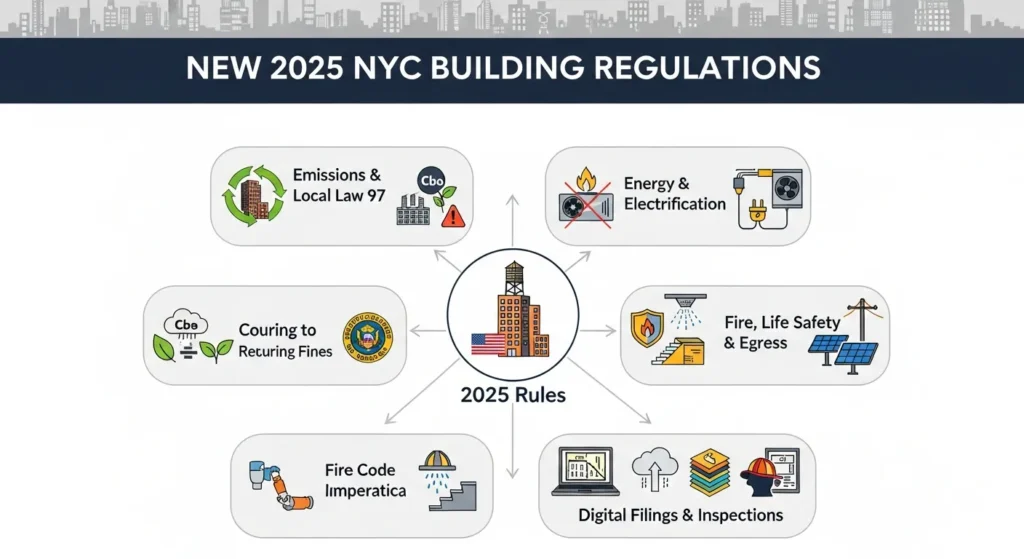
If we own or manage property in New York City, 2025 isn’t just another calendar year, it’s a hard reset for how we handle compliance.
Statewide code updates, New York City local laws, and climate policy are all converging on the same timeline. We’re seeing new emission caps, tighter energy rules, more aggressive facade and safety enforcement, and a push toward all‑electric new buildings. At the same time, DOB is moving more of the compliance and enforcement process online, which means our paper gaps and outdated records suddenly matter a lot more.
In this guide, we’ll walk through the new NYC building rules every owner must know in 2025, what’s actually changing in practice, and how we can get ahead of NYC building violations before they turn into fines, liens, or emergency repairs.
This isn’t a substitute for legal or engineering advice, many of these rules are still being clarified in DOB bulletins and rulemakings, but it’s a practical roadmap so we can ask the right questions of our architects, engineers, attorneys, and management teams.
Why 2025 Is A Pivotal Year For NYC Building Owners
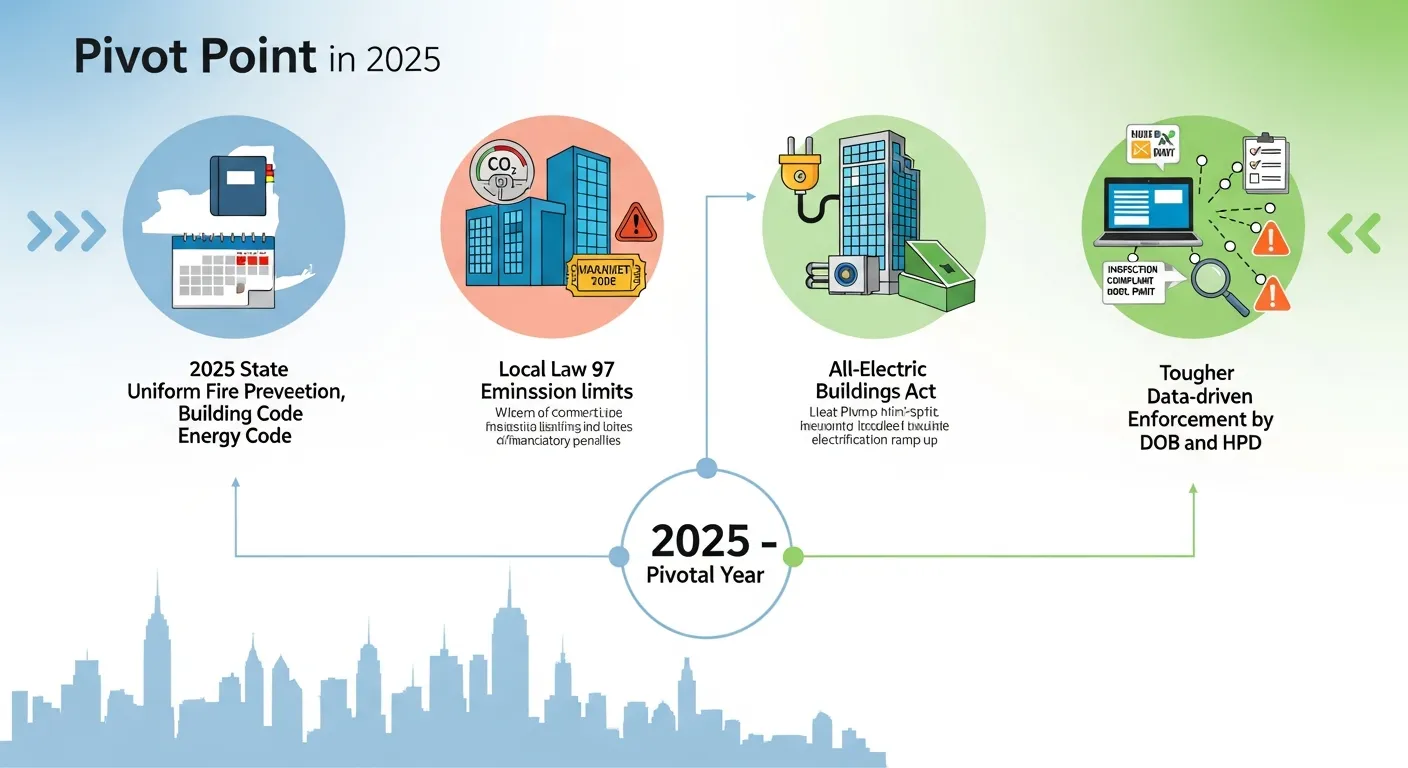
Several forces hit at once in 2025:
- New state codes take effect. New York State’s 2025 Uniform Fire Prevention and Building Code and 2025 Energy Code will govern permit applications filed on or after December 31, 2025. NYC’s own Construction Codes still control here, but they’re layered on top of those state baselines.
- First real Local Law 97 emission limits bite. The 2024–2029 compliance period is underway for most buildings 25,000+ square feet, with our first emissions reports due in the 2025–2026 window. That’s when fines start to feel real.
- Electrification ramps up. The state’s All‑Electric Buildings Act starts phasing out new fossil‑fuel systems in many new buildings, pushing us toward heat pumps and higher‑performance envelopes.
- Enforcement is tougher and more data‑driven. DOB and HPD are leaning on digital systems to spot missing filings, overdue inspections, recurring HPD complaints, and patterns of illegal work.
In short, 2025 is the year the climate and safety policies we’ve been hearing about for a decade show up as concrete design decisions, capital plans, and, if we’re not careful, DOB violations and OATH hearings.
Major Code Updates Affecting All Building Owners
The core changes in 2025 fall into three buckets: emissions, energy/electrification, and life safety.
Local Law 97: 2025 Emissions Deadlines And Compliance
Local Law 97 (LL97) applies to most buildings 25,000 square feet and up, or campus-style groups over 50,000 square feet. Starting with the 2024–2029 compliance period, each covered property has a carbon intensity cap based on use group.
Key things we need to know in 2025:
- The clock already started. Emissions from 2024 count toward this first period. Waiting until 2027 to react is a mistake: we’ll just be paying to catch up.
- Reporting deadlines. Our first LL97 emissions report is due in the 2025–2026 cycle (exact dates are set by DOB rule and may evolve). A registered design professional must sign off.
- Fines are annual, not one‑time. If we exceed our cap, we’re looking at recurring yearly penalties based on tons of CO₂ over the limit.
- Data quality matters. Bad utility data, missing meters, or incorrect space-use classifications can mean we’re “over” the limit on paper even if we’re close in reality.
At a practical level, most owners are doing three things in 2025:
- Benchmarking, confirming that our benchmarking filings are accurate and that we truly understand our energy profile.
- Quick‑hit retrofits, LEDs, controls, boiler tuning, tenant engagement, and operational fixes that cut load without major construction.
- Long‑range planning, integrating electrification, envelope upgrades, and HVAC replacement into our capital plans so we’re not swapping boilers twice.
DOB maintains Local Law 97 resources and rule updates on its site at nyc.gov/buildings.
New Energy-Efficiency And Electrification Requirements
The 2025 Energy Code and implementation of the All‑Electric Buildings Act fundamentally change how we design new residential and commercial buildings across the state.
For NYC owners and developers, that means:
- New buildings up to about seven stories will see fossil-fuel bans on most space- and water-heating systems beginning in the late‑2025/2026 window, depending on project type and start date.
- All new buildings will be pushed toward all-electric by 2028, with limited exceptions (e.g., certain industrial processes or emergency systems).
- The NYC Energy Conservation Code continues to track and often exceed state baselines, so city projects typically have to hit tougher performance targets.
In practice, our questions shift from “which gas boiler?” to “which heat pump, which refrigerant, and what envelope upgrades keep that system right-sized?” We also have to coordinate with Con Edison on electric service capacity far earlier in the design.
For alterations and retrofits, the 2025 codes don’t force us to tear out working fossil systems overnight, but they do tighten efficiency standards for replacements and major renovations. The more we touch, the more the new standards apply.
Fire Safety And Egress Changes You Cannot Ignore
Fire and life-safety rules are always evolving, but the 2025 Uniform Code and Fire Code updates focus heavily on:
- Revised fire protection system design, sprinklers, standpipes, alarms, and monitoring.
- Egress and accessibility, clarifying stair, corridor, and exit discharge requirements, especially in mixed‑use and existing buildings.
- Coordination with energy and electrification, for example, battery systems, higher electrical loads, and rooftop solar all bring their own fire code considerations.
NYC will adapt these updates through DOB rulemaking and FDNY Fire Code amendments. For us, it means:
- Any change of use or significant alteration triggers a fresh look at egress and fire protection.
- Old “grandfathered” conditions may not survive a major gut renovation.
- We need fire protection engineers involved early for complex conversions or rooftop energy projects.
FDNY’s Fire Code resources and rule summaries are posted at https://www.nyc.gov/site/fdny/codes/fire-code/fire-code.page.
DOB Filing, Inspections, And Permit Rule Changes
The 2025 rules are as much about how we deal with DOB as what we have to build.
New Digital Filing And Recordkeeping Expectations
DOB has spent the last several years moving filings into DOB NOW and related online systems. By 2025, digital filing is the norm, not the exception.
We should expect:
- More work types in DOB NOW. Many applications that once went through paper or legacy portals are now online only.
- Digital sign‑offs and professional certifications. Engineers, architects, and special inspectors file directly into DOB’s systems, cutting down on excuses when data doesn’t match reality.
- Electronic violation histories increasingly used for enforcement sweeps.
Operationally, this means we need our own centralized digital recordkeeping. At minimum, we should maintain for each property:
- Permits and job filings (past and current)
- Sign‑off and completion documents
- Inspection reports (elevators, boilers, facades, sprinklers, etc.)
- Correspondence and cure documentation for NYC building violations, DOB violations, and HPD complaints
If our data is scattered across email chains and filing cabinets, we’ll constantly be reacting instead of planning.
Inspection Cycles, Fines, And Enforcement Priorities
DOB and sister agencies are focusing 2025 enforcement on a few key risk areas:
- Facades and exterior walls (FISP/Local Law 11)
- Elevators and life-safety systems
- Illegal work without permits
- Failure to file required reports (LL97, energy benchmarking, boiler and elevator inspections)
Miss a filing date, and we’re now likely to see:
- Automatic civil penalties
- Additional DOB inspections
- In serious or repeated cases, liens or criminal referrals
To keep the field level, many owners are turning to tools that track violations and filings in real time. Platforms like ViolationWatch consolidate DOB, HPD, and ECB/OATH records so we see issues before they snowball.
For free lookups, use our NYC violation lookup tool to see what’s already on record for a building and spot gaps in our internal files.
Updated Requirements For Facades, Roofs, And Balconies
Exterior conditions have been a major focus ever since several high‑profile facade failures. The 2025 codes only sharpen that focus.
2025 Facade Inspection And Repair (FISP) Changes
NYC’s Façade Inspection & Safety Program (FISP), still often called Local Law 11, keeps its 5‑year cycles but with:
- Stricter classifications of “Safe With a Repair and Maintenance Program” (SWARMP) and unsafe conditions.
- Heavier penalties for owners who don’t address unsafe conditions promptly.
- Closer scrutiny of contractors and Qualified Exterior Wall Inspectors (QEWIs).
The 2025 state codes also strengthen exterior wall and roof detailing standards. For us, that means any new facade work or major repair has to satisfy both the updated NYC Building Code and the 2025 state standards for things like anchors, parapets, and moisture management.
Ignoring a facade condition is one of the fastest ways to pick up recurring DOB violations and six‑figure repair bills.
Green Roofs, Solar, And Rooftop Access Rules
NYC’s sustainable roof requirements, often called the “solar or green roof” mandate, are now fully baked into practice. For most new buildings and many major roof replacements, we must:
- Install solar PV, green roof systems, or a combination, unless we qualify for narrow exemptions.
- Provide compliant guardrails, access paths, and fire/egress clearances coordinated with FDNY and DOB rules.
The 2025 energy and fire codes add pressure to treat roofs as:
- Energy assets, insulation, reflectivity, and solar output.
- Life-safety systems, clear paths for firefighters, smoke venting, and safe maintenance access.
We shouldn’t approve a roof project in 2025 without asking:
- Are we maximizing the roof for energy (within payback limits)?
- Are we meeting the latest access and guardrail standards?
- Will today’s work complicate future solar or green roof retrofits?
Safety Rules For Terraces, Balconies, And Railings
Recent accidents have pushed regulators to tighten requirements for:
- Guardrail heights and loads
- Balcony slab conditions and waterproofing
- Anchorage of railings and glass systems
The 2025 codes reinforce these requirements for new work, and DOB enforcement has been more aggressive when inspectors see:
- Spalling concrete beneath balconies
- Corroded rail posts
- Loose or non‑compliant glass railing assemblies
For multi‑family and condo/co‑op buildings, a prudent 2025 plan includes a balcony and terrace condition survey, even where FISP doesn’t explicitly require close‑up inspection of every element.
Residential Buildings: New Rules For Landlords And Co-Op/Condo Boards
Residential owners, especially small landlords and co‑op/condo boards, face a dense overlay of housing maintenance, health, and zoning rules in 2025.
Habitability, Mold, Lead, And Indoor Air Quality Standards
NYC already has strict rules under the Housing Maintenance Code and related local laws on:
- Lead-based paint (especially in pre‑1960 buildings and units with young children)
- Mold and moisture (Local Law 55 of 2018 and related rules)
- Ventilation and indoor air quality (IAQ)
The 2025 energy codes intersect with these obligations. As we tighten envelopes and reduce infiltration to save energy, we must ensure:
- Kitchens and bathrooms have code-compliant exhaust.
- Mechanical ventilation is adequate in high‑performance retrofits.
- Moisture and condensation issues are managed so we don’t create new mold problems.
HPD’s enforcement approach is increasingly data‑driven, using HPD complaints and repeat violations to flag problem buildings. Their rules and guidance are available at https://www.nyc.gov/site/hpd/index.page.
For boards and landlords, the practical steps are:
- Maintain a clear lead and mold compliance program, including documentation of inspections and remediation.
- Train superintendents and porters to spot IAQ and moisture red flags.
- Coordinate energy retrofits with mechanical engineers who understand ventilation, not just insulation contractors.
Short-Term Rentals, Tenant Notifications, And Signage
NYC’s short‑term rental regime, driven by Local Law 18 and implemented by the Office of Special Enforcement, remains strict going into 2025. In most multi‑family buildings, typical “whole unit” rentals under 30 days are not allowed unless an owner‑occupant is present and several other conditions are met.
Owners and boards must:
- Understand whether their building is on the Prohibited Buildings List.
- Update house rules and proprietary leases to reflect short‑term rental prohibitions.
- Post required tenant notices and signage (for example, about housing rights, gas shutdowns, or construction).
Failure to control illegal rentals can lead to substantial fines and conflicts with lenders and insurers, not just DOB or HPD penalties.
Accessibility And Elevator-Related Requirements
Accessibility and vertical transportation are both seeing heightened scrutiny in 2025, particularly in existing building work.
Elevator Modernization, Testing, And Reporting
Elevators in NYC remain subject to:
- Periodic inspections and tests by approved agencies
- DOB filings of reports, including corrections of unsafe or “unsatisfactory” items
- Modernization requirements when equipment reaches the end of its useful life
DOB has tightened digital reporting, making it harder for recurring elevator issues to slip through the cracks. Miss an annual or periodic inspection, and we’re likely to see immediate DOB violations, daily penalties, or both.
A defensible 2025 elevator plan usually includes:
- A multi‑year modernization roadmap, especially in older pre‑war or mid‑century buildings.
- Bundling car interior work with code upgrades (door protection, emergency communication, fireman service).
- Close coordination with tenants and boards to schedule outages.
ADA And Local Accessibility Upgrades In 2025
NYC follows federal ADA requirements, state accessibility standards, and its own Building Code rules. The 2025 “Existing Building Code” emphasis means more alteration projects will trigger:
- Accessible routes from the sidewalk to key spaces
- Upgraded restrooms in lobbies, retail areas, and amenity spaces
- Improved signage and communication features
When we file substantial alteration work in 2025, DOB is increasingly asking: “What are you doing for accessibility as part of this?” If the answer is “nothing,” we should expect pushback during plan review.
The safest path is to treat accessibility as a core design constraint, not a last‑minute add‑on.
Sustainability, Resilience, And Climate Risk Regulations
Beyond Local Law 97, 2025 brings broader climate resilience and waste obligations that affect how we design and operate property.
Flood-Resilience, Stormwater, And Site Design Rules
The 2025 codes and NYC’s own resiliency zoning and DEP rules strengthen requirements for buildings in flood‑prone or coastal areas.
We should expect:
- Higher or clarified design flood elevations for new or substantially improved structures.
- More stringent dry floodproofing and wet floodproofing design standards.
- Enhanced stormwater management and on‑site retention obligations for certain projects.
For waterfront and low‑lying properties, these rules shape everything from ground‑floor layouts and mechanical room locations to materials, doors, and glazing details. They also affect insurance: failing to align design with current flood maps and code can translate into higher premiums or limited coverage.
Waste Management, Recycling, And Composting Obligations
NYC’s Department of Sanitation (DSNY) is rolling out more robust recycling and organics (composting) mandates for both residential and many commercial buildings through 2025.
Key shifts include:
- Expanded separation and set‑out requirements for recycling and organic waste.
- New containerization rules and limits on loose bags in certain districts.
- Increased fines for chronic non‑compliance.
Owners must coordinate building design (storage rooms, chutes, compactor spaces) with DSNY rules. For up‑to‑date details, DSNY publishes guidance and rule updates at https://www.nyc.gov/site/dsny/index.page.
While these may seem minor compared with LL97, they directly impact operating budgets and tenant satisfaction.
Penalties, Enforcement Trends, And How Owners Get In Trouble
The rules themselves are complex, but the ways owners get into trouble are remarkably consistent.
Common Violations Under The 2025 Rules
Across portfolios, we’re seeing the same patterns:
- Failure to file: missing FISP reports, elevator tests, boiler inspections, or LL97/benchmarking submissions.
- Unsafe facades or exterior elements: cracked masonry, loose terra cotta, deteriorated balconies.
- Work without permits: interior alterations, gas work, or change of use done without DOB approvals.
- HPD habitability issues: unresolved heat/hot water complaints, mold, pests, or lead hazards.
- Short‑term rental and illegal occupancy issues.
These quickly translate into NYC building violations across DOB, HPD, FDNY, and OATH. They also create reputational risk with lenders, investors, and prospective buyers, who increasingly review violation histories as part of due diligence.
How Fines Are Calculated And When They Escalate
Fine structures vary by agency and violation type, but the general patterns are:
- Base penalties for a first missed filing or condition.
- Daily or monthly accruals until we correct and certify the condition.
- Escalation for repeat offenses or willful non‑compliance.
- In egregious cases, additional penalties, liens, or even criminal referrals.
For example, facade violations can carry daily penalties for unsafe conditions, while elevator violations might trigger per‑device fines plus additional penalties for uncorrected hazardous items.
To avoid surprises, many owners are now using automated building violation alerts so they know as soon as DOB or HPD posts a new issue. Get instant alerts whenever your building receives a new violation, sign up for real‑time monitoring.
We can also use the NYC violation lookup tool before acquisitions, refinances, or major projects to catch legacy violations that could stall permits or COs.
Practical 2025 Compliance Checklist For NYC Building Owners
Translating all of this into action is where most portfolios stumble. A simple, prioritized checklist helps.
Action Steps For Small, Mid-Size, And Large Buildings
Regardless of size, we should tackle 2025 in layers:
- Inventory and data
- Pull a full violation history via DOB, HPD, and tools like ViolationWatch.
- Confirm we have digital copies of all permits, sign‑offs, and inspection reports.
- Verify energy benchmarking data and building use classifications.
- Life safety and envelope
- Confirm facade inspection status and next FISP cycle dates.
- Schedule or review elevator, boiler, sprinkler, and alarm inspections.
- Walk roofs, terraces, and balconies for obvious hazards (loose rails, ponding, cracks).
- Local Law 97 and energy
- Get a preliminary LL97 emissions assessment for each covered building.
- Carry out low‑cost operational improvements while we plan larger retrofits.
- For upcoming projects, test all‑electric designs and model long‑term operating costs.
- Residential health and habitability
- Review HPD histories for recurring HPD complaints.
- Refresh lead and mold compliance plans and tenant documentation.
- Align ventilation and IAQ strategies with 2025 energy code requirements.
- Short‑term rentals and tenant communications
- Update building policies to reflect Local Law 18 and related rules.
- Confirm required notices and signage are posted in lobbies and common areas.
- Flood, waste, and resilience
- For at‑risk sites, review flood maps and resiliency requirements with design professionals.
- Ensure waste rooms and collection procedures meet current DSNY recycling and organics rules.
Choosing Consultants, Contractors, And Tracking Tools
Compliance in 2025 is a team sport. We should be selective about who we trust:
- Architects and engineers: Look for firms with deep NYC code experience, especially in LL97, FISP, and existing-building work.
- Contractors: Verify licensing, insurance, DOB history, and prior experience with similar scopes.
- Elevator and life-safety vendors: Favor partners who can bundle inspections, testing, and modernization planning.
- Tracking and analytics tools: Plus to internal spreadsheets, we can lean on platforms like ViolationWatch for consolidated violation data and monitoring.
Get instant alerts whenever your building receives a new violation, sign up for real-time monitoring using our building violation alerts so we never miss a new DOB or HPD action.
We should revisit this checklist at least annually, and more often when we’re planning major projects or acquisitions.
Conclusion
2025 is not about one new law: it’s about the intersection of many: the 2025 state Uniform and Energy Codes, Local Law 97, sustainable roof mandates, FISP enforcement, accessibility upgrades, flood resilience, and stricter waste and IAQ rules.
If we try to handle each requirement in isolation, we’ll overspend and still risk non‑compliance. The owners who come out ahead will be the ones who treat 2025 as an opportunity to plan holistically, aligning LL97 retrofits with facade work, pairing accessibility and elevator upgrades, coordinating roof replacements with solar and green roofs, and building strong digital records.
We don’t have to solve everything in a single budget cycle, but we do need a clear, phased plan and reliable data. That starts with seeing our risk profile honestly. Comprehensive tools like ViolationWatch and the NYC violation lookup tool help us understand where we stand so we can talk to architects, engineers, and counsel from an informed position.
New York’s building rules will keep evolving. If we build a culture of proactive compliance now, grounded in accurate records, regular inspections, and smart capital planning, 2025 can be the year we gain control, not the year the code catches up with us.
Key Takeaways
- New NYC building rules in 2025 converge state codes, Local Law 97, and electrification mandates, making this a pivotal year for owners to reassess compliance and capital plans.
- Local Law 97 deadlines, new energy codes, and the All‑Electric Buildings Act require owners to audit emissions now, pursue quick‑hit retrofits, and integrate long‑term electrification and envelope upgrades into budgets.
- Stricter facade (FISP), roof, balcony, fire‑safety, elevator, and accessibility standards mean that major alterations will trigger deeper code reviews, higher penalties, and fewer “grandfathered” conditions.
- DOB’s shift to digital systems makes accurate records, centralized documentation, and proactive tracking of NYC building violations essential to avoid recurring fines, liens, and project delays.
- Residential landlords and boards must align habitability (lead, mold, IAQ), short‑term rental enforcement, flood resilience, and DSNY waste rules under a unified 2025 compliance checklist supported by qualified consultants and monitoring tools.
Frequently Asked Questions for NYC Building Owners in 2025
What are the most important new NYC building rules 2025 owners should focus on first?
Start with rules that carry recurring fines or affect life safety: Local Law 97 emissions limits, 2025 Energy Code and electrification requirements, facade/FISP obligations, elevator and boiler inspections, and short‑term rental restrictions. Build a digital records system so DOB/HPD filings, violations, and reports are organized and up to date.
How does Local Law 97 affect my NYC building in the 2024–2029 compliance period?
If your building is 25,000+ square feet, you likely have a carbon emissions cap starting with the 2024–2029 period. Emissions from 2024 already count, and your first report is due in the 2025–2026 window. Exceeding the cap triggers annual—not one‑time—penalties, so early benchmarking and quick energy fixes are critical.
What do the new NYC building rules 2025 mean for gas boilers and fossil‑fuel systems?
For existing buildings, you’re not forced to rip out working gas equipment in 2025, but replacements and major renovations must meet tighter efficiency standards. For many new low‑ and mid‑rise buildings, the All‑Electric Buildings Act starts to phase out new fossil‑fuel heating and hot‑water systems, pushing owners toward heat pumps and high‑performance envelopes.
How can I avoid NYC building violations under the 2025 rules?
Prevent violations by tracking all required filings and inspections: FISP facade reports, elevator and boiler tests, LL97 and benchmarking submissions, and HPD habitability issues. Conduct regular roof, balcony, and terrace condition walks, maintain a clear mold/lead program, and use violation lookup and alert tools to catch new DOB or HPD actions quickly.
What new requirements apply to roofs, terraces, and balconies in 2025?
Most new roofs and many major replacements must now include solar, a green roof, or both, unless an exemption applies. Roofs must also meet stricter access, guardrail, and fire‑safety clearances. For terraces and balconies, DOB is enforcing higher guardrail standards, sound anchorage, and repair of spalling concrete or corroded railings.
Do the 2025 NYC rules change anything for flood zones and waste management?
Yes. In flood‑prone areas, updated codes and resiliency zoning tighten design flood elevations, floodproofing standards, and where you can safely locate mechanicals. At the same time, DSNY is expanding recycling and organics mandates, containerization rules, and fines, so buildings may need redesigned waste rooms, storage, and collection procedures to stay compliant.