
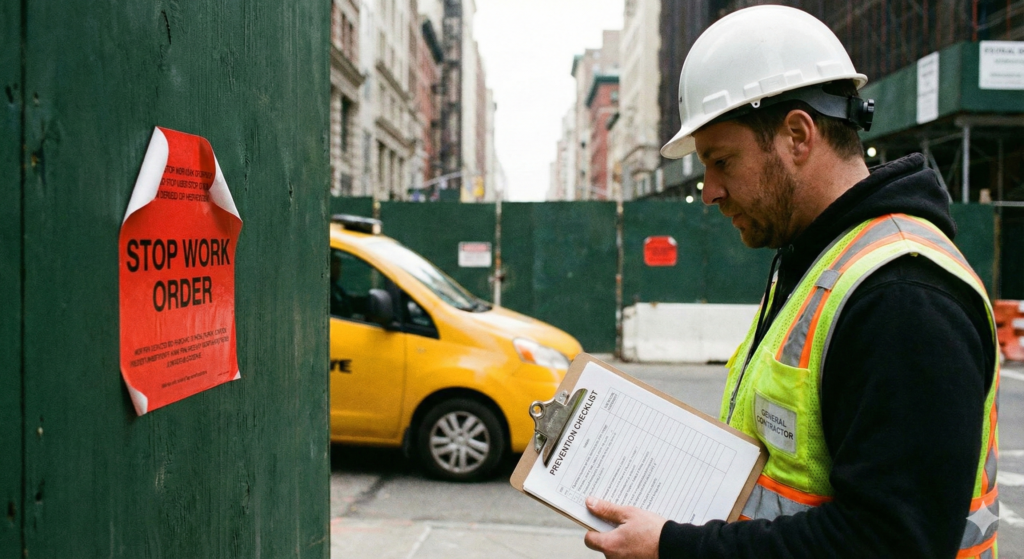
If we build in New York City long enough, we either get hit with a Stop Work Order, or we work very hard to avoid one. A single orange notice from the Department of Buildings (DOB) can freeze our job overnight, burn through contingency, and sour our relationship with an owner who doesn’t care that “everyone does it this way.”
The good news: most NYC Stop Work Orders (SWOs) are preventable. They tend to come from the same patterns, missing permits, sloppy documentation, safety shortcuts, and poor coordination. In this guide, we walk through a practical, contractor-focused checklist to keep our projects moving and our sites off DOB’s radar.
We’ll break down how stop work orders actually work, what really triggers them in the field, and the day‑to‑day systems we can put in place so compliance becomes routine instead of a scramble when an inspector shows up.
Understanding NYC Stop Work Orders And Why They Happen
Understanding NYC Stop Work Orders And Why They Happen
A NYC Stop Work Order is one of the strongest enforcement tools DOB has. When an inspector believes our work is unsafe or violates NYC Construction Codes, the Zoning Resolution, or other DOB‑enforced laws, they can order us to stop work on the spot.
According to the NYC Department of Buildings, an SWO is meant to protect workers, neighbors, and the public from immediate or ongoing hazards, not to punish us for honest mistakes. But in practice, it can feel like a hammer.
Types Of Stop Work Orders Issued By NYC DOB
DOB typically issues two types of SWOs:
- Full Stop Work Order
- All work at the site must stop.
- Only limited “make safe” work may continue if specifically allowed by DOB.
- This often follows serious safety hazards, work without any permits, or repeated non‑compliance.
- Partial Stop Work Order
- Only certain portions of the work or specific areas must stop.
- Example: shoring and excavation are stopped due to unsafe conditions, but interior non‑structural demo on another floor can continue.
- Partial SWOs are common when work is contrary to approved plans, or a particular operation (like façade work off a scaffold) is deemed unsafe.
DOB explains the basics of SWOs and penalties on its official Stop Work Orders page, and it’s worth bookmarking that resource for our project teams.
Common Triggers And Violations That Lead To Stop Work
When we look at NYC building violations and enforcement data, the same themes show up again and again. Common SWO triggers include:
- Work without a permit – Any structural, enlargement, major MEP, or change of use without proper DOB permits is a prime candidate for a full SWO.
- Work contrary to approved plans – Field changes that never made it through a revision: building something “close enough” to save time: unapproved egress or structural changes.
- Expired or missing permits – Jobs that quietly roll past permit expiration dates, or trades working off someone else’s permit scope.
- Unsafe site conditions – Missing guardrails, open shafts, unprotected excavations, unsecured loads, or overcrowded scaffolds.
- Inadequate documentation or access – Site safety plan not on site, no daily logs, missing inspection reports, or refusing inspector access.
- Licensing and insurance issues – Unlicensed subcontractors, expired general contractor registration, missing site safety professionals, or lapsed insurance.
- Lead, dust, or environmental problems – Uncontained demolition dust, unsafe lead paint work, or debris and trash creating rodent or fire hazards.
Many of these issues also surface as DOB violations, HPD complaints, or 311 calls before an SWO lands. If we’re not actively watching those signals, we’re flying blind.
Real-World Impacts Of A Stop Work Order On Your Project
On paper, a Stop Work Order just says “stop work.” On site, it does far more damage:
- Schedule shock – Crews are sent home, critical path work stalls, and resequencing becomes a puzzle. Even a short shutdown can ripple into weeks of delay.
- Hard costs and penalties – Civil penalties for violations can run from thousands into very large sums, especially if DOB discovers work continued under an SWO.
- Idle labor and overhead – We still carry supervision, rentals, and general conditions while the job is frozen.
- Owner relations and legal risk – Owners start calling attorneys or demanding liquidated damages. Disputes over who’s responsible for delays can drag on long after the SWO is lifted.
In other words, avoiding an SWO is a core part of NYC property compliance. It’s not a paperwork detail: it’s risk management.
Pre-Construction Planning To Prevent Stop Work Orders
Pre-Construction Planning To Prevent Stop Work Orders
Most Stop Work Orders are seeded long before we mobilize. The pre‑construction phase is where we either build a compliance framework or guarantee headaches later.
Verifying Zoning, Approved Plans, And Scope Alignment
In NYC, “work contrary to approved plans” is a classic SWO trigger. To avoid that, we should:
- Confirm zoning and use assumptions early – Before we finalize scope or GMP, verify that the architect’s filings match what the owner is actually trying to build.
- Cross‑check drawings and DOB filings – Compare approved plans, TR forms, and the permit application against our executed scope and trade buyouts.
- Flag constructability vs. code gaps – If our means and methods deviate from what’s on paper, resolve it before we start, not when the inspector is on site.
If we need layout tweaks, structural changes, or different materials, we push for formal revisions, not handshake agreements that leave us exposed.
Ensuring Proper Licensing, Insurance, And Registrations
DOB violations regularly come from paperwork that seemed minor at the time:
- Our GC registration and insurance expire mid‑job.
- A subcontractor operates scaffolding or a crane without the right license.
- We don’t have the required site safety manager or coordinator for a major building project.
We should build a pre‑construction checklist that includes:
- Verifying all DOB registration numbers for GC and major trades.
- Confirming insurance meets DOB minimums and specific project conditions (e.g., high‑rise, façade work, hoisting operations).
- Identifying required safety professionals (SSM, SSC, CSFSM, etc.) and locking them in before permit sign‑off.
Scheduling Required Filings, Permits, And Inspections
Nothing exposes us faster than starting work ahead of permits or missing mandatory inspections:
- Confirm permit sequence – Some phases can’t start until specific permits (or partial permits) are issued. We map this into our schedule.
- Track expirations – Calendar reminders and project management systems should flag permit expirations at least 60–90 days out.
- Coordinate inspections – Build DOB and special inspections (concrete, steel, energy, sprinklers, etc.) into the look‑ahead schedule.
We can’t assume design professionals or expediters will automatically handle everything on time. As GCs, we own the integrated schedule.
Coordination With Design Professionals And Subcontractors
Design teams think in drawings and approvals: subs think in means and methods. Where those worlds collide without coordination, SWOs flourish.
We reduce the risk by:
- Holding pre‑job coordination meetings with the architect/engineer of record and key trades.
- Reviewing shop drawings and RFIs for code implications before issuing them as field direction.
- Agreeing on a change protocol: no significant field changes without written design approval and, where required, a DOB filing.
When everyone understands that “minor” layout changes can create major NYC building violations, we’re less likely to improvise ourselves into trouble.
Site Setup And Safety Systems Before Work Begins
Site Setup And Safety Systems Before Work Begins
DOB inspectors usually form an impression within seconds of stepping onto our site. A clean, well‑organized, properly posted job reads as “under control.” A chaotic site full of missing signage and ad‑hoc protections is begging for a deeper look.
Required Signage, Posting, And Site Documentation
Before day one of serious work, we should verify that:
- Permits are posted – All DOB permits are clearly displayed at the main entrance, not buried in a locked office.
- Project information panel is installed as required, with owner, GC, and contact info.
- Safety and emergency signage – Egress routes, “No Smoking,” PPE requirements, and other mandated signs are in place.
- Plans and approvals are on site – Current stamped drawings, SWO (if any), and variances are available for inspectors.
DOB can and does issue violations when required postings are missing or outdated. It’s low‑hanging fruit we shouldn’t give them.
Site Safety Plans, Logs, And Daily Reports
For many jobs, especially major buildings, DOB requires a site safety plan and oversight by a licensed Site Safety Manager/Coordinator.
We protect ourselves by:
- Keeping the site safety plan on site and up to date, reflecting actual conditions (cranes, hoists, sidewalk sheds, etc.).
- Maintaining daily safety logs, including manpower counts, major operations, inspections, and incidents.
- Recording toolbox talks, orientations, and training sessions with sign‑in sheets.
Missing or incomplete documentation is a surprisingly common reason for DOB enforcement. When records are neat and accessible, inspectors are more inclined to see us as organized and compliant.
Protective Measures For Public, Adjacent Properties, And Workers
NYC is dense. Our job rarely exists in a vacuum, and SWOs often come from how our work affects others:
- Public protection – Sidewalk sheds, fencing, netting, and overhead protection where the public is exposed to overhead or adjacent construction.
- Adjacent property safeguards – Shoring, bracing, crack monitoring, and vibration controls when working near neighboring structures.
- Worker protections – Guardrails on all leading edges, properly covered openings, safe stairs and ladders, and controlled access zones.
DOB’s façade and construction safety campaigns frequently highlight falls and struck‑by incidents as top hazards. If an inspector sees exposed edges, improvised platforms, or no fall protection, an SWO isn’t far behind.
Managing Permits, Inspections, And Job Site Records
Managing Permits, Inspections, And Job Site Records
Even when our work is safe, paperwork can sink us. Many Stop Work Orders are triggered because inspectors can’t see proof that our job is properly permitted, inspected, and documented.
Reading And Complying With Permit Conditions
Every permit we pull has fine print, special conditions, limitations, and required inspections. We should:
- Review permit conditions at the project kickoff meeting.
- Note any special restrictions (hours, noise limitations, environmental conditions, tenant protections).
- Confirm scope boundaries – Are we limited to certain floors, areas, or systems under each permit?
When we exceed permit scope or ignore conditions, inspectors have a clear basis for issuing DOB violations or SWOs.
Preparing For And Passing DOB And Special Inspections
Inspections are not just checkpoints: they’re opportunities to demonstrate control.
Best practices include:
- Pre‑inspection walkthroughs – The superintendent and competent persons walk the area, correct visible issues, and verify access.
- Have documents ready – Drawings, permits, test reports, and equipment logs should be at hand before the inspector arrives.
- Assign a point person – A knowledgeable supervisor should escort the inspector, answer questions honestly, and avoid guessing.
We also need to track special inspections (concrete, steel, energy code, sprinklers, firestopping). Missing required special inspection reports can cause delays or, in extreme cases, enforcement.
Maintaining Organized, Accessible Job Site Paperwork
On a busy NYC project, documents pile up fast. Disorganization is our enemy.
We reduce risk by:
- Keeping a centralized job binders or digital kiosk on site with permits, drawings, inspections, daily logs, and correspondence.
- Ensuring training cards and licenses (OSHA, NYC DOB site safety, operator licenses) are readily available.
- Using digital platforms to store and back up photos, inspection reports, and safety observations.
If an inspector asks for proof of a passed inspection or a licensed operator and we can’t produce it, we’ve just created a problem that didn’t need to exist.
Safety Compliance Checklist For NYC General Contractors
Safety Compliance Checklist For NYC General Contractors
Safety is where DOB focuses much of its enforcement energy. A clear, repeatable checklist helps ensure we’re not relying on memory in the field.
Worker Training, Certifications, And Competent Persons
NYC has layered requirements:
- OSHA 10/30 and NYC‑specific site safety training for workers on many larger jobs.
- Site Safety Manager/Coordinator where required by building classification and height.
- Licensed operators for cranes, forklifts, hoists, and scaffolds.
We should:
- Verify and copy all training cards and licenses before workers hit the site.
- Designate competent persons for key operations (excavation, scaffolding, fall protection) and list them in the daily log.
- Remove or retrain individuals who repeatedly disregard basic safety rules.
Housekeeping, Access, And Fall Protection Essentials
It’s often the “small” things that trigger big enforcement:
- Blocked stairs or corridors.
- Debris piles blocking egress.
- Improperly covered floor openings.
To stay clean:
- Enforce daily housekeeping by trade or area: clutter should never survive to the next shift.
- Keep clear, lit access paths and ensure all temporary stairs, ladders, and platforms are in good condition.
- Maintain continuous fall protection at edges, roof perimeters, floor openings, and shafts.
If we treat housekeeping as non‑negotiable, we eliminate many obvious visual triggers for SWOs.
Equipment, Scaffolding, And Crane/Hoisting Controls
NYC heavily regulates scaffolds and hoisting. According to DOB’s safety campaigns and bulletins, failures in these areas often lead to serious incidents and aggressive enforcement.
Key controls:
- Use only licensed scaffold and crane companies and verify their insurance and DOB records.
- Ensure erection, inspection, and dismantling follow manufacturer instructions and NYC codes.
- Maintain inspection tags and logs on scaffolds, hoists, and critical equipment.
If we ever feel pressure to cut corners on equipment inspections or repairs to “stay on schedule,” that’s exactly where we should slow down.
Noise, Dust, And Environmental Controls
DOB isn’t the only player. The NYC Department of Environmental Protection (DEP) and Department of Health have a say in construction activities too.
To minimize HPD complaints, 311 calls, and DOB attention, we should:
- Use dust control (misting, negative air, containment) for demo and cutting.
- Follow Noise Code requirements for after‑hours work and loud operations.
- Handle waste and debris promptly to avoid rodent and sanitation issues.
DEP’s resources on the NYC construction noise rules are worth sharing with our supers and project managers.
Communication, Supervision, And Subcontractor Management
Communication, Supervision, And Subcontractor Management
Even with good plans and permits, day‑to‑day supervision makes or breaks compliance. Many SWOs stem from subcontractors improvising in the field without clear direction.
Daily Walkthroughs And Issue Escalation Procedures
We shouldn’t wait for DOB to notice problems for us. Our own teams should find them first.
We can:
- Conduct documented daily walkthroughs led by the superintendent or site safety professional.
- Use a simple hazard checklist tailored to NYC building violations: fall protection, egress, scaffolds, housekeeping, equipment, posted permits, etc.
- Establish a clear escalation process: if a hazard is found, it’s logged, assigned to a responsible party, and tracked to closure.
If something is serious enough that DOB would write it up, it’s serious enough for us to shut it down ourselves until it’s corrected.
Coordinating Trades To Avoid Unsafe Conditions
Overcrowded sites, stacked trades, and conflicting operations are classic precursors to accidents and SWOs.
To keep control:
- Use look‑ahead schedules and weekly coordination meetings to limit overlaps in tight areas.
- Avoid running high‑risk operations simultaneously (e.g., overhead steel work directly above demolition or public areas).
- Make sure temporary protections, guardrails, netting, barricades, aren’t removed by one trade and forgotten.
Our job is to orchestrate, not just to schedule. If the plan for the day creates obvious conflicts, we stop and reshuffle.
Documenting Directions, Corrections, And Meetings
When DOB asks, “What did you do after you identified this hazard?” we need more than verbal assurances.
Good practice:
- Record safety meeting minutes and issue them to subs.
- Use written directives (emails, logs, notices) when ordering corrective actions.
- Capture before‑and‑after photos when repairing or correcting unsafe conditions.
Digital tools can make this easier. Platforms that tie photos, notes, and checklists to specific locations or trades help show a clear pattern of proactive management.
Proactive Monitoring For Compliance Risks
Proactive Monitoring For Compliance Risks
NYC jobs don’t exist in a vacuum. The city tracks our sites through violations, complaints, and 311 data. Neighbors, tenants, and even passersby can trigger inspections.
Using Internal Audits And Third-Party Site Safety Checks
Internal audits are our first line of defense:
- Periodically assign someone not tied to the day‑to‑day job to walk the site and score compliance against DOB hot‑button issues.
- For complex or high‑risk projects, bring in third‑party site safety consultants to run full mock DOB inspections.
- Use findings to update our checklists, training, and procedures.
These audits often catch the “blind spots” that crews have stopped noticing.
Tracking Violations, Complaints, And 311 Activity
If someone complains about our site, we want to know before DOB is standing at the gate.
We can monitor our jobs by:
- Regularly reviewing DOB and HPD records for our project addresses and related parcels.
- Tracking HPD complaints and 311 activity to spot noise, dust, or tenant disruption issues.
- Using tools like the NYC violation lookup tool to quickly pull current and historical violations tied to our jobs.
For free lookups, use our NYC violation lookup tool. It helps us see the same data that owners, neighbors, and regulators are reviewing.
Responding Quickly To Warnings And Partial Stop Work Notices
DOB doesn’t always go straight to a full Stop Work Order. Sometimes we see:
- ECB/OATH violations or DOB violations without an SWO.
- Partial SWOs tied to a single operation or area.
- Informal warnings or correction requests from inspectors.
We protect our schedule and reputation by:
- Treating every violation as a project‑level incident, not just a formality for the expediter.
- Moving fast on Certificates of Correction, photos, and supporting documents.
- Pausing relevant work until we’re sure we’re back in compliance.
If we want to go a step further, we can sign up for automated building violation alerts so we’re notified as soon as a new violation posts for our projects. Get instant alerts whenever your building receives a new violation, sign up for real‑time monitoring by registering for building violation alerts.
Platforms like ViolationWatch centralize DOB, HPD, and other enforcement data so we can see the full picture across multiple jobs instead of checking each one manually.
What To Do If You Receive A Stop Work Order
What To Do If You Receive A Stop Work Order
Even with good systems, things can still go sideways. If we do receive a Stop Work Order, our response in the first 24–48 hours will determine how long we’re shut down and how costly the fallout becomes.
Immediate Steps To Stabilize The Site And Avoid Escalation
Once an SWO is posted:
- Stop all affected work immediately – No gray area, no “just finishing this shift.” Continuing work under an SWO can trigger major penalties.
- Clarify the scope – Is it a full or partial SWO? What exact work and areas are covered? Take photos of the posted notice.
- Secure the site – Make sure cranes, hoists, scaffolds, and excavations are safe in a stopped condition. DOB may allow limited work solely to remove imminent hazards.
- Notify stakeholders – Inform the owner, design team, and key trades. Surprises only make disputes worse.
The NYC DOB SWO guidance makes clear that safety remains the priority even after work stops: we’re still responsible for the condition of the site.
Working With Design Professionals, Attorneys, And DOB
Once the dust settles, we need a team approach:
- Design professional of record – Reviews the SWO, associated DOB violations, and plans to determine the technical fixes and any required revisions.
- Site safety professional – Assesses the safety issues that led to the order and develops corrective measures and monitoring.
- Attorney experienced with DOB matters – Helps navigate hearings, penalties, and potential OATH proceedings when stakes are high.
We should also maintain open, professional communication with DOB. Arguing in the field rarely helps: showing a concrete corrective path does.
Developing A Corrective Action Plan And Preventing Recurrence
To clear the SWO and protect future jobs, we need more than a quick patch.
A robust plan usually includes:
- Root‑cause review – Was it a one‑off human error, a training gap, a broken process, or pressure from schedule/owner demands?
- Technical corrections – Structural fixes, safety improvements, plan revisions, or environmental controls implemented by qualified trades.
- Documentation for DOB – Certificates of Correction, photos, affidavits, updated plans, and any required sign‑offs or test results.
- Process improvements – Updating our checklists, training content, and internal audits so the same issue doesn’t recur on the next project.
Once DOB reinspects, lifts the SWO, and updates its system, we document everything and review it internally as a case study. The most expensive compliance failures are the ones we don’t learn from.
Conclusion
Conclusion
Avoiding NYC Stop Work Orders isn’t about memorizing every line of the Construction Codes. It’s about building repeatable habits: clean paperwork, disciplined site setup, real supervision, and fast responses to early warning signs.
If we treat NYC building violations, DOB violations, and HPD complaints as an early‑warning system instead of background noise, we can fix most issues before they shut down our jobs. Smart tools help too: we can track enforcement history across projects with resources like ViolationWatch and use the NYC violation lookup tool to quickly see what DOB and HPD already know about our buildings.
Eventually, our reputation as general contractors in this city is tied to how well we manage risk, not just how fast we pour concrete. With the prevention checklist in this guide, we can keep inspectors engaged, owners confident, and most importantly, our projects moving without the orange Stop Work Order on the gate.
Key Takeaways
- General contractors in NYC can prevent most Stop Work Orders by aligning permits, approved plans, zoning, and actual field scope before mobilization.
- Clean site setup—with posted permits, current drawings, documented safety plans, and visible public and worker protections—reduces inspector scrutiny and Stop Work Order risk.
- Disciplined management of permits, inspections, and job site records, including special inspections and training cards, helps prove compliance on the spot and avoid shutdowns.
- Daily walkthroughs, strong subcontractor coordination, and documented corrections turn safety and compliance into a routine system instead of a scramble when DOB shows up.
- If a NYC Stop Work Order is issued, general contractors should immediately halt affected work, stabilize the site, collaborate with design and legal professionals, and implement a documented corrective action plan to prevent repeat issues.
Frequently Asked Questions About NYC Stop Work Orders
What is a NYC Stop Work Order and how does it affect a general contractor?
A NYC Stop Work Order (SWO) is a DOB enforcement tool that requires all or part of the construction work to stop immediately due to safety or code issues. For general contractors, it can halt the schedule, create penalties, increase overhead, and strain relationships with owners and subcontractors.
What are the most common triggers for a NYC Stop Work Order on construction sites?
Common triggers include work without proper permits, work contrary to approved plans, expired or missing permits, unsafe site conditions, inadequate documentation or access for inspectors, licensing or insurance problems, and uncontrolled dust, lead, or debris. Many of these issues first appear as DOB violations, HPD complaints, or 311 calls.
How can general contractors proactively avoid NYC Stop Work Orders?
To avoid NYC Stop Work Orders, contractors should build compliance into pre‑construction: verify zoning and approved plans, confirm permits and inspection schedules, keep licenses and insurance current, maintain clean, well‑posted sites, enforce daily safety walkthroughs, and monitor DOB/HPD violations and 311 complaints so risks are corrected before inspectors escalate.
What should a contractor do immediately after receiving a NYC Stop Work Order?
Stop all affected work with no exceptions, photograph and review the SWO to confirm its scope, secure cranes, scaffolds, and excavations in a safe condition, and notify the owner, design team, and key trades. Then coordinate with the design professional, site safety staff, and possibly an attorney to develop a corrective action plan.
How long does it take to get a NYC Stop Work Order lifted?
Timeframes vary widely. Simple issues corrected quickly—with clear photos, Certificates of Correction, and any required revised plans—may be resolved in days or weeks. Complex structural, safety, or permitting problems can take much longer, especially if OATH hearings or major plan revisions are required. Fast, well‑documented responses shorten delays.
Can using a violation monitoring tool really help prevent NYC Stop Work Orders?
Yes. Monitoring tools that aggregate DOB, HPD, and 311 data help contractors see violations and complaints early, across multiple projects. By treating every new violation or complaint as a project‑level incident and correcting issues promptly, GCs reduce the likelihood that unresolved problems escalate into a full or partial Stop Work Order.