
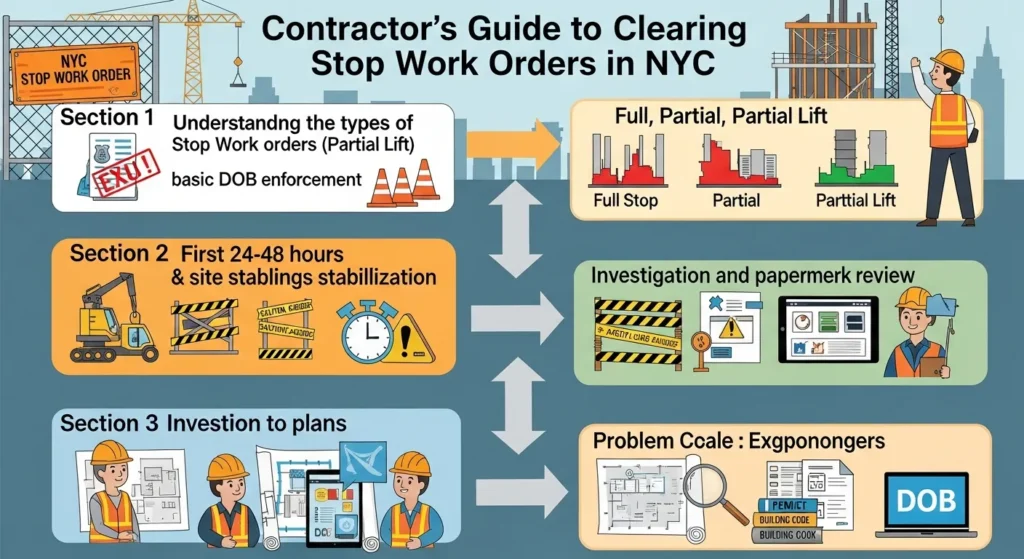
There’s nothing quite like walking onto a job and seeing that bright orange notice taped to the fence: STOP WORK ORDER.
In New York City, a Stop Work Order (SWO) from the Department of Buildings (DOB) can freeze a project overnight, trigger major cost overruns, spook owners and lenders, and put our licenses at risk. But an SWO doesn’t have to derail the entire job, if we understand the process and respond with a clear plan.
In this guide, we walk through how we, as contractors and construction managers, can quickly stabilize the site, identify what went wrong, correct NYC building violations, and work with DOB to fully (or partially) lift a Stop Work Order. We’ll also cover what happens if we ignore an SWO, and how to prevent the next one from ever being issued.
Understanding Stop Work Orders In New York City
Understanding Stop Work Orders In New York City
What Is A Stop Work Order?
In NYC, a Stop Work Order (SWO) is a formal directive from the Department of Buildings requiring us to immediately halt some or all construction activities on a site. DOB issues an SWO when work is unsafe, violates the construction codes or zoning rules, or proceeds without the right permits and approvals.
The order stays in place until we:
- Correct the unsafe or non‑compliant conditions:
- Resolve related DOB violations and HPD complaints if applicable:
- Provide documentation proving compliance: and
- Obtain confirmation from DOB that the SWO has been rescinded.
DOB explains the enforcement process, including SWOs, in detail in its own guidance and enforcement bulletins on nyc.gov/buildings.
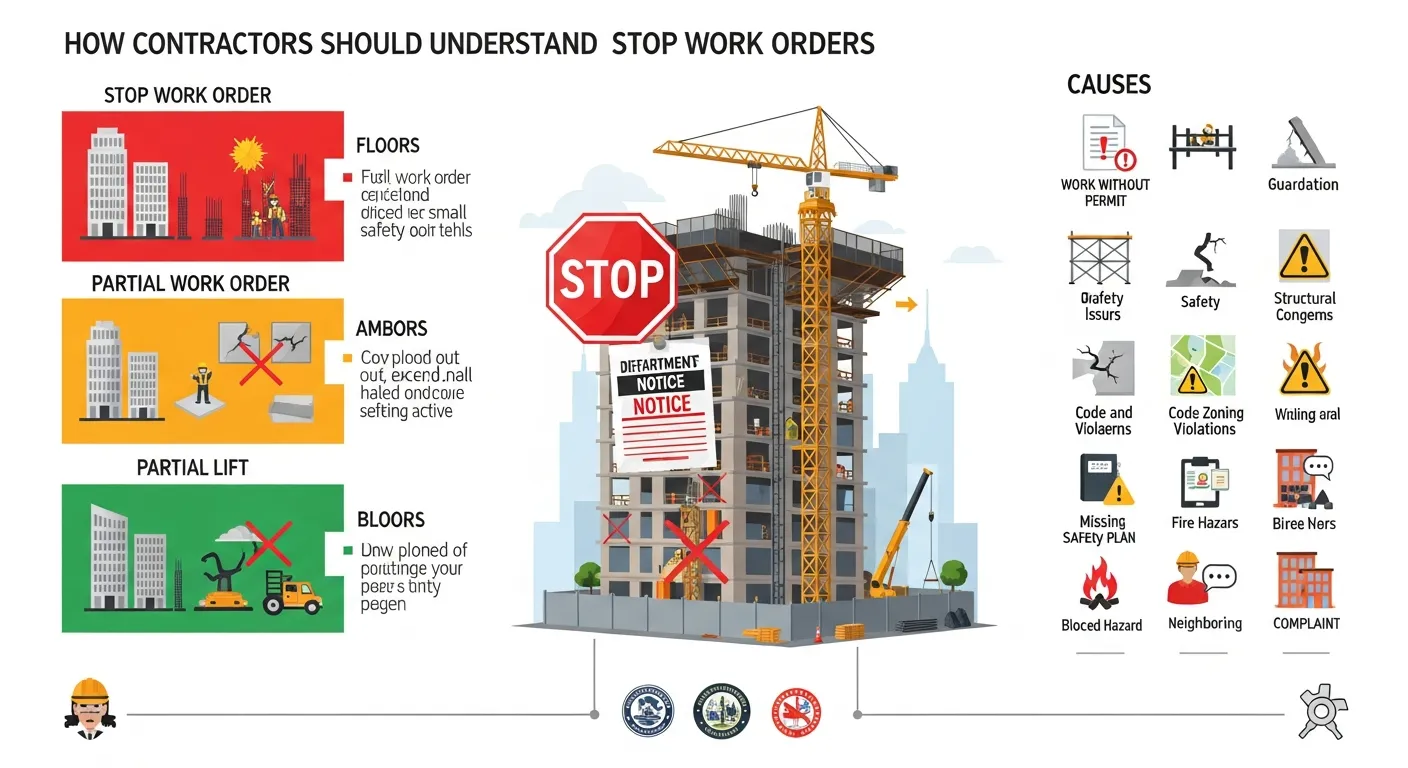
Common Types Of Stop Work Orders (Full, Partial, Partial Lift)
On most NYC jobs we’ll see one of three situations:
- Full Stop Work Order
- All construction activities must stop.
- We can only perform minimal work needed to keep the site and public safe (e.g., shoring, securing fencing), usually under DOB direction.
- Continuing any regular construction under a full SWO can lead to heavy civil penalties.
- Partial Stop Work Order
- Only certain areas (e.g., the 5th floor), scopes (e.g., structural work), or operations (e.g., crane use) must stop.
- Other approved, compliant work may continue outside the affected area, if clearly separated and allowed by DOB.
- Partial Lift of a Stop Work Order
- After we correct some, but not all, issues, DOB may partially lift the SWO.
- Limited work can resume in specific zones or trades while remaining problems stay under SWO.
- This is often critical for schedule and cash flow, especially on large projects.
Understanding exactly which portions of our work are covered is the first step in planning a response.
Typical Triggers: Why DOB Issues Stop Work Orders
SWOs rarely come out of nowhere. They’re usually tied to clear patterns DOB inspectors see across the city. Common triggers include:
- Work without a permit or outside the scope of the issued permit.
- Serious safety issues: missing guardrails, fall protection, inadequate shoring, open shafts, poor housekeeping.
- Structural concerns: unapproved structural changes, overloaded floors, compromised bearing elements.
- Violations of NYC Construction Codes or the Zoning Resolution.
- Improper or missing site safety plans on jobs that require Site Safety Plans or Site Safety Managers.
- Fire safety hazards: blocked egress, improper storage of combustibles, lack of fire watch.
- Neighbor or tenant complaints that uncover unsafe work or illegal occupancy.
Often an SWO is accompanied by DOB violations (summonses) that will later be heard at OATH. On residential properties, related conditions can also trigger HPD complaints and inspections.
Key Agencies And Players Involved
When an SWO lands, multiple parties get pulled in quickly:
- NYC Department of Buildings (DOB) – inspectors, plan examiners, and sometimes an SWO Coordinator manage enforcement, re‑inspections, and rescission.
- FDNY – may be involved where there are fire safety, egress, or emergency response issues.
- Owner / Developer – eventually responsible for the property and often driving the schedule and financing concerns.
- General Contractor / Construction Manager – coordinating the response, corrective work, and communication.
- Subcontractors – especially structural, MEP, demolition, or excavation subs whose work may be at issue.
- Design professionals (architects, engineers) – needed to design fixes, certify conditions, and update plans.
- Expediters and code consultants – help untangle filings, approvals, and NYC property compliance questions.
- Insurers and lenders – concerned about risk exposure, delays, and coverage.
Knowing who needs to be at the table early helps us avoid mixed messages and lost time.
Immediate Steps To Take When You Receive A Stop Work Order
Immediate Steps To Take When You Receive A Stop Work Order
The first 24–48 hours are where we either get ahead of the problem or fall behind for months.
How To Read And Interpret The Stop Work Notice
When DOB posts or hands us the notice, we should:
- Take photos of the SWO where it’s posted and keep a digital copy in the job folder.
- Read every line, not just the headline:
- Issuing unit or borough office.
- Violation or complaint numbers.
- Specific location (floors, apartments, areas) and scope affected.
- Reasons for the SWO (unsafe conditions, unpermitted work, etc.).
- Conditions for rescission or notes about required filings and inspections.
- Match these details against our set of permits and plans so we understand whether DOB believes this is primarily a safety, paperwork, or scope problem, or all three.
We don’t argue on the sidewalk. We document, step back, and start building a plan.
Stabilizing The Site And Securing Safety
Even with an SWO in place, DOB expects us to eliminate immediate hazards and protect the public. That typically means:
- Clearing active work in the affected zones and shutting down equipment.
- Installing or reinforcing guardrails, netting, or fall protection.
- Checking shoring, temporary bracing, or scaffolding for adequacy.
- Securing fencing, gates, and sidewalk sheds so the public can’t access danger zones.
- Removing or organizing debris, loose materials, or tripping hazards.
- Verifying that egress routes for tenants or neighbors are open and clearly marked.
We should document this stabilization work with time‑stamped photos and brief log entries: those records often help with DOB and later at OATH.
Communicating With Owners, Subs, And Insurers
Silence after an SWO is a red flag for owners and insurers. We try to do the following the same day:
- Notify the owner/developer in writing with a quick summary: what was posted, what work is affected, and what we’re doing in response.
- Alert key subcontractors so they don’t show up and inadvertently work under an SWO.
- Loop in our broker/insurer if the issue involves potential claims (collapse risk, property damage, injury, etc.).
- Adjust schedules, procurement, and staffing based on what we realistically expect over the next few weeks.
A candid update early often reduces later finger‑pointing.
Do’s And Don’ts In The First 48 Hours
Do:
- Stop all work covered by the SWO immediately.
- Clarify with DOB (through proper channels) what work, if any, can safely continue outside the affected area.
- Start assembling permits, plans, inspection reports, and safety logs.
- Engage our design professionals to review the cited conditions.
Don’t:
- Peel off, cover, or deface the SWO posting.
- Continue regular construction inside the affected area.
- Confront inspectors on site or try to debate code in the street.
- Make undocumented field fixes that can’t be clearly explained later.
Continuing work under an SWO can trigger additional violations and steep penalties, DOB guidance notes that a first offense for working under a full SWO can carry thousands of dollars in fines, and repeat offenses are worse.
Investigating The Root Cause Of The Violation
Investigating The Root Cause Of The Violation
Once the site is safe and the dust settles, we move into investigation mode. The goal is simple: figure out exactly why DOB shut us down and what it will take to get back to work.
Reviewing Permits, Plans, And Inspections
We start with the paperwork:
- Pull all active permits from DOB NOW / BIS and cross‑check against the actual work on site.
- Review approved plans and any amendments to see whether field conditions drifted away from what DOB signed off on.
- Look at recent inspection reports, DOB, special inspections, and in‑house safety walkthroughs, to spot red flags we may have missed.
This is also where a quick search on open NYC building violations is useful. Tools like the City’s Building Information Search or a dedicated NYC violation platform such as ViolationWatch help us see the full compliance picture on a property, not just the latest SWO.
Identifying Code Violations And Paperwork Gaps
From there, we map the facts to specific Construction Code, Zoning Resolution, or safety rule violations. Common gaps we see:
- Work performed without a required permit (e.g., structural, plumbing, limited alteration).
- Permits that expired mid‑project and weren’t renewed.
- Missing or incomplete site safety plans or logs.
- Unapproved changes in structural members or means of egress.
- Out‑of‑date insurance certificates or missing license information for key trades.
We document each issue as a separate line item with the relevant code section. That makes it much easier to show DOB we understand the problem and have a coherent fix.
Coordinating With Design Professionals And Expediters
Most meaningful SWOs can’t be solved by the GC alone. We usually need:
- Engineers to assess structural conditions, design shoring, or certify repairs.
- Architects to update plans, correct zoning issues, or validate egress and occupancy.
- Expediters/code consultants to prepare filings, variance requests, or amendments.
Our job is to get everyone aligned on scope and timeline. A short internal memo or meeting recap that outlines: (1) what DOB cited, (2) what we believe the root cause is, and (3) the agreed path forward, keeps the team on the same page.
Documenting Existing Conditions And Corrections
Good documentation is often the difference between a smooth rescission and a months‑long back‑and‑forth.
We should:
- Capture clear photos and videos of existing conditions before we start corrections.
- Keep daily logs describing what we did to stabilize and then correct each issue.
- Collect letters and reports from engineers/architects explaining the hazard and fix.
- Track test reports, TR forms, and inspections as they come in.
Later, when we submit to DOB and, if needed, defend ourselves at OATH, this organized record shows we treated the SWO seriously and acted in good faith.
Corrective Actions Required To Lift A Stop Work Order
Corrective Actions Required To Lift A Stop Work Order
Once we understand the root causes, we move into execution. The corrective work typically falls into four categories.
Addressing Safety And Site Protection Issues
The first priority is always life safety and protection of the public. Depending on the site, that can include:
- Upgrading fall protection: guardrails, safety nets, personal fall arrest systems.
- Improving shoring and bracing for excavations, temporary structures, or partially demolished areas.
- Installing or repairing fencing, sidewalk sheds, and overhead protection.
- Cleaning and re‑organizing the site to address housekeeping issues.
- Implementing fire safety measures: removing combustibles, adding fire extinguishers, ensuring clear egress.
We should tie these steps back to specific code requirements and reference them in our engineer’s or safety manager’s report to DOB.
Bringing Work Into Code Compliance
Once immediate hazards are controlled, we look at whether the underlying construction complies with NYC codes and approved plans:
- Structural elements match design (sizes, connections, reinforcing, anchors).
- Fire‑rated assemblies and separations are installed correctly.
- Means of egress remain compliant, no narrowed stairs, blocked exits, or reduced headroom.
- Electrical and plumbing installations meet code and manufacturer specifications.
- Any unapproved field changes are either removed or legalized through amendments.
In some cases, especially when unpermitted structural work was done, we may need to partially demolish and rebuild to satisfy DOB and our own engineers.
Fixing Permit, Licensing, And Insurance Problems
A surprising number of SWOs have a heavy administrative component:
- Permits that were never pulled for certain scopes.
- Registrations or licenses that lapsed (e.g., for a safety manager or equipment operator).
- Insurance that doesn’t meet DOB minimums.
We work with our expediters and administrative staff to:
- File for missing or amended permits.
- Renew or correct licenses and registrations.
- Update and resubmit insurance certificates showing proper coverage and endorsements.
DOB typically won’t fully lift an SWO until these compliance boxes are checked.
Handling Tenant Or Public Access And Protection Requirements
On occupied or mixed‑use buildings, DOB is especially focused on tenants, adjacent properties, and the public:
- Ensuring legal apartments remain habitable or that proper vacate orders are in place.
- Maintaining required egress and life safety systems for occupied areas.
- Protecting neighboring buildings during underpinning, façade work, or demolition.
We may need to coordinate with HPD and, in rent‑regulated situations, comply with additional tenant‑protection requirements. DOB’s Tenant Protection Plan rules and HPD enforcement pages (nyc.gov/hpd) are important references here.
Documenting how we’re protecting tenants and neighbors can go a long way toward convincing DOB to allow a partial lift.
Working With The NYC DOB To Clear The Stop Work Order
Working With The NYC DOB To Clear The Stop Work Order
Once corrections are underway or complete, we need to proactively re‑engage DOB. This is where a structured approach saves weeks.
Requesting Inspections And Re‑Inspections
We typically:
- Confirm with the DOB SWO Coordinator or borough office what specific inspections are needed.
- Use DOB NOW or the appropriate system to request re‑inspection once all pre‑conditions are met.
- Make sure our engineer, safety manager, or superintendent is present for the visit and prepared to walk the inspector through corrections.
We avoid calling DOB for an inspection until we’re truly ready. One failed revisit often makes the next one slower to get.
Submitting Certificates, Proofs, And As‑Built Updates
Parallel to inspections, we submit supporting documentation, which can include:
- Engineer/architect letters certifying that unsafe conditions have been corrected.
- Required TR forms and special inspection reports.
- As‑built drawings where field conditions differ from the original plans.
- Test and commissioning reports (sprinklers, alarms, structural tests, etc.).
We package this information cleanly, referencing the SWO and associated violations by number so DOB reviewers don’t have to hunt.
Negotiating Penalties, Civil Fines, And Compliance Schedules
To lift an SWO, DOB often requires payment of civil penalties related to work without a permit, unsafe conditions, or work performed while the SWO was in effect.
While DOB’s penalty schedule is largely fixed, there is some room to:
- Correct violations before hearings, which can influence fine amounts.
- Work with counsel to request mitigation based on documented good‑faith efforts and robust safety programs.
- Arrange practical compliance schedules for any lingering issues that can’t be solved overnight.
We make sure ownership understands that clearing the SWO may involve both construction costs and administrative penalties.
How Partial Lifts Work And When They Make Sense
On complex jobs, a partial lift is often the best way to balance safety, compliance, and schedule:
- We propose to DOB a specific set of areas or scopes where issues have been fully corrected and can safely resume.
- Our design professionals and safety team may prepare a letter explaining the rationale and ongoing protections.
- DOB then issues a written update indicating which parts of the SWO are lifted and which remain.
This approach lets us restart, for example, interior non‑structural work while we’re still resolving a structural or egress issue elsewhere. It requires trust and clear documentation, but when done correctly, it can save months on the schedule.
Dealing With Penalties, ECB/OATH Hearings, And Appeals
Dealing With Penalties, ECB/OATH Hearings, And Appeals
Even after DOB rescinds the SWO, we’re often left with open violations that need to be resolved at OATH (the Office of Administrative Trials and Hearings).
Understanding Violations, Summonses, And Penalty Ranges
SWOs are usually tied to one or more DOB violations (summonses), which are scheduled for hearings at OATH’s Environmental Control Board (ECB) division. The penalty ranges vary based on:
- The type of violation (immediately hazardous vs. lesser conditions).
- Whether work continued under an active SWO.
- Whether we’re a repeat offender on similar issues.
Some penalties can run into five‑figure amounts per violation, especially for egregious or repeated unsafe conditions. DOB’s penalty schedules are published on nyc.gov and should be reviewed with counsel or a seasoned expediter.
Preparing For OATH Hearings And Evidence Submission
Approaching OATH casually is a mistake. We should assemble:
- Copies of permits, plans, and amendments.
- Time‑stamped photos showing conditions before and after correction.
- Daily logs and safety records demonstrating regular inspections and training.
- Any professional reports or letters from engineers and architects.
- A clear timeline of when we learned of the condition, when we stopped work, and how quickly we corrected it.
Depending on the case, we may appear with counsel, an expediter, or a company representative who understands the project in detail.
Strategies To Reduce Or Contest Fines
We don’t always have to simply accept the maximum penalty. Common strategies include:
- Demonstrating immediate corrective action after the violation was issued.
- Showing that we had a robust safety program and that the issue was an outlier.
- Correcting all open items and paying related civil penalties before the hearing.
- In some cases, contesting the violation if DOB’s description doesn’t accurately reflect conditions or responsibility.
The goal isn’t just to save money, but to show regulators that we take NYC property compliance seriously and won’t repeat the same mistakes.
Consequences Of Ignoring A Stop Work Order
Consequences Of Ignoring A Stop Work Order
Trying to “work around” an SWO is one of the most expensive decisions a contractor can make in New York City.
Enforcement Actions And Escalating Penalties
If DOB finds that we continued work under an SWO, it can:
- Issue additional violations with substantially higher penalties.
- Pursue criminal enforcement in extreme or repeated cases.
- Increase oversight on all of our projects across the city.
Inspectors talk to each other. Once we’re on the radar as a contractor who disregards SWOs, every site visit tends to get tougher.
License, Insurance, And Reputation Risks
Beyond fines, ignoring an SWO can:
- Put our contractor license or registration at risk.
- Trigger questions from insurers about coverage and may increase premiums.
- Damage relationships with owners, lenders, and major subs who don’t want to be dragged into costly enforcement battles.
In a tight market, a reputation for cutting corners on DOB violations and SWOs can quietly take us off bid lists.
Impact On Project Schedules And Owner Relationships
Owners usually care about two things: time and money. Prolonged SWOs hit both:
- Extended project shutdowns with crews sitting idle.
- Remobilization costs every time we start and stop work.
- Liquidated damages, missed lease‑up dates, or delayed closings.
When we’re transparent, responsive, and proactive, owners are far more likely to stick with us. When we’re evasive or try to hide the SWO, we give them a reason to look for another contractor on the next phase.
Preventing Future Stop Work Orders On Your Projects
Preventing Future Stop Work Orders On Your Projects
The smartest SWO strategy is still prevention. A bit of discipline on the front end can save us months of disruption later.
Building A Compliance‑First Jobsite Culture
We set the tone. Crews will treat safety and compliance the way they see us treat it.
Practical moves that help:
- Empowering supers and safety managers to stop unsafe work without fear of blowback.
- Enforcing PPE, fall protection, and housekeeping standards daily, not just during audits.
- Holding quick toolbox talks when a new risk appears, excavation, façade work, crane operations.
When workers see us halt work because “this doesn’t look right,” they understand that staying on schedule never trumps keeping people alive.
Proactive Permitting, Inspections, And Recordkeeping
We reduce SWO risk significantly by being meticulous with paperwork:
- Verifying all required permits (building, electrical, plumbing, after‑hours, etc.) are in place before any trade mobilizes.
- Scheduling and documenting regular internal safety inspections.
- Keeping organized digital folders for permits, drawings, RFIs, inspections, and training records.
To stay on top of city enforcement, we can also monitor properties for new violations. For free lookups, use our NYC violation lookup tool, it’s a quick way to see recent DOB violations or HPD complaints connected to a building.
If we want to get ahead of surprises, we can go a step further: Get instant alerts whenever your building receives a new violation, sign up for real‑time monitoring using automated building violation alerts so we know about problems as soon as the city posts them.
Training Crews On NYC Construction Codes And Safety Rules
OSHA‑10 and OSHA‑30 are a baseline, not the finish line. In NYC, we also deal with:
- Site Safety Training (SST) requirements.
- DOB rules on scaffolds, cranes, suspended work, and façade access.
- Local Laws related to façade safety, energy, and other specialty areas.
Short, recurring training sessions that tie specific tasks back to NYC codes help crews understand why something is required, not just that it is.
When To Bring In Compliance Specialists Or Expediters
On certain jobs, tall buildings, deep excavations, occupied rehabs, it’s worth investing in compliance specialists:
- DOB expediters who know the borough office staff and local enforcement priorities.
- Safety consultants who conduct unannounced audits.
- Digital monitoring tools like ViolationWatch that aggregate NYC building violations, permits, and complaints into a single dashboard.
When we combine strong internal discipline with outside expertise, SWOs become rare events instead of recurring crises.
Conclusion
Conclusion
A Stop Work Order in New York City is stressful, public, and expensive, but it’s also manageable if we respond methodically.
Our roadmap is straightforward:
- Stop first, argue later. Halt covered work, stabilize the site, and keep people safe.
- Understand the why. Read the notice carefully, review our permits and plans, and pinpoint the real root causes.
- Fix and document. Correct unsafe conditions, bring the work into full code compliance, and build a clean paper trail.
- Engage DOB and OATH constructively. Request inspections when we’re ready, submit clear proofs, and handle penalties and hearings professionally.
- Invest in prevention. Build a culture where compliance is non‑negotiable, and use tools and experts to monitor NYC building violations before they become full‑blown crises.
We’re never going to eliminate every surprise in construction, especially in a city as complex as New York. But by treating SWOs as serious safety and compliance alarms, not just scheduling headaches, we protect our crews, our projects, and our company’s future.
And if we want fewer of those orange notices in our lives, we can start by keeping a closer eye on our properties and jobsites: run regular checks with the NYC violation lookup tool and set up building violation alerts so we’re not the last to know when DOB or HPD takes action.
Key Takeaways
- A Stop Work Order in NYC is a formal DOB directive that halts some or all construction until unsafe conditions, NYC building violations, and paperwork gaps are fully corrected and documented.
- The first 24–48 hours after receiving a Stop Work Order are critical: stop the covered work, stabilize the site for safety, document conditions, and communicate clearly with owners, subs, and insurers.
- Clearing a Stop Work Order in NYC requires identifying the root cause, bringing work and safety protections into full code compliance, fixing permit and licensing issues, and organizing strong documentation for DOB review.
- Contractors should proactively coordinate with architects, engineers, expediters, and safety professionals to request DOB re-inspections, submit certifications, and manage penalties and OATH hearings strategically.
- Ignoring or working under a Stop Work Order can trigger steep fines, heightened enforcement, license and insurance risks, and long-term damage to schedule, budget, and reputation.
- The best defense is prevention: build a compliance-first culture, stay on top of permits and safety inspections, and regularly monitor NYC building violations and complaints using tools like a violation lookup and real-time alerts.
Frequently Asked Questions About Clearing Stop Work Orders in NYC
What is a Stop Work Order in NYC and why does the DOB issue it?
A Stop Work Order in NYC is a formal directive from the Department of Buildings requiring you to halt some or all construction activities. DOB issues SWOs for unsafe conditions, work without permits, violations of NYC Construction Codes or zoning rules, or missing safety plans and approvals.
What are the first steps a contractor should take after receiving a Stop Work Order in NYC?
Immediately stop all work covered by the Stop Work Order, carefully read and photograph the notice, stabilize the site for safety, and notify the owner, key subs, and insurers. Then review permits, plans, and recent inspections to understand the root cause before contacting DOB for guidance.
How do you clear or lift a Stop Work Order in New York City?
To clear a Stop Work Order in New York City, you must correct unsafe or non‑compliant conditions, resolve related DOB violations and HPD complaints, bring work and permits into full code compliance, document all corrections, and request re‑inspection. DOB formally rescinds or partially lifts the SWO once satisfied.
Can you get a partial lift of a Stop Work Order so some work can continue?
Yes. After you correct certain issues, DOB may issue a partial lift that allows limited work in specific areas or trades while other zones remain under an SWO. This usually requires clear documentation from design and safety professionals demonstrating that resumed work is safe and fully compliant.
What happens if a contractor ignores a Stop Work Order and keeps working?
Ignoring a Stop Work Order can trigger steep additional fines, new violations, and potential criminal enforcement in severe cases. It can also jeopardize contractor licenses, raise insurance premiums, damage relationships with owners and lenders, and place all of the contractor’s projects under heightened DOB scrutiny citywide.