
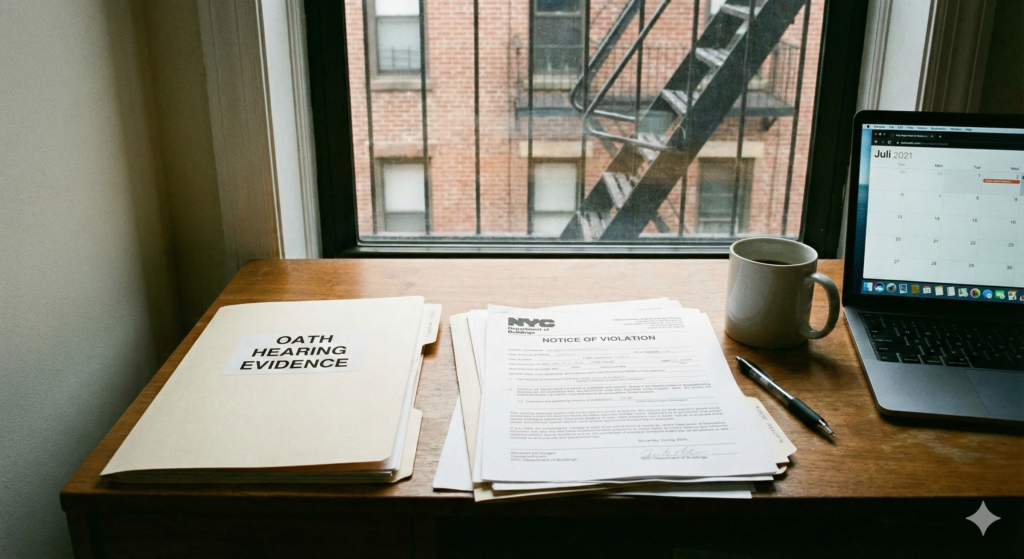
If we own or manage property in New York City long enough, we eventually meet the bright orange or yellow summons on the door. It might be a DOB violation for unpermitted work, an HPD complaint turned into a housing violation, or a fire safety issue from FDNY. Either way, it usually comes with a hearing date at OATH, the Office of Administrative Trials and Hearings.
Handled the wrong way, a single summons can turn into thousands of dollars in fines, liens that block refinances or sales, and “open” NYC building violations that keep showing up in every buyer’s due diligence report. Handled well, the same summons can be dismissed, downgraded, or at least reduced to a manageable penalty.
In this guide, we walk through how OATH hearings in NYC really work, what steps we should take the moment we’re cited, and practical strategies to dispute building violations successfully, or, when fighting doesn’t make sense, how to mitigate the damage.
Understanding OATH And NYC Building Violations
How OATH Fits Into NYC’s Enforcement System
OATH is New York City’s central administrative court. It’s independent from the city agencies that write summonses and from the state court system. When we receive a DOB violation, FDNY notice, or a sanitation ticket with a hearing date, OATH is usually where that case is decided.
At an OATH hearing, the question isn’t whether we like the rule, it’s whether the city agency can prove we violated it. A Hearing Officer (an administrative law judge) reviews the evidence from both sides and decides whether to:
- Sustain the summons (find us liable),
- Reduce or mitigate penalties, or
- Dismiss the case entirely.
Because it’s an administrative process, the rules are faster and more streamlined than state court, but the decisions still carry real financial and compliance consequences for NYC property owners.
For more detail, OATH explains the process on its official site: nyc.gov/site/oath.
Agencies That Issue Building-Related Summonses
OATH handles summonses from roughly two dozen NYC agencies. For NYC building violations, we most often see:
- Department of Buildings (DOB) – construction code issues, unpermitted work, façade, egress, safety systems.
- Fire Department (FDNY) – fire alarms, sprinklers, exits, storage of combustibles, inspections.
- Department of Housing Preservation and Development (HPD) – housing maintenance violations triggered by HPD complaints from tenants (heat, hot water, pests, lead paint, etc.).
- Department of Sanitation (DSNY) – trash storage, sidewalk and lot cleanliness, illegal dumping.
- Department of Environmental Protection (DEP) – noise, air emissions, asbestos, backflow preventers.
- Department of Health and Mental Hygiene (DOHMH) – pests, lead, public health hazards.
Each agency has its own rules, but once the summons is issued, the dispute goes through OATH’s process. That’s why understanding the hearing system is just as important as knowing the underlying code.
Common Types Of Building Violations In New York City
Class A, B, And C Violations: Severity And Consequences
In NYC, “class” or “hazard level” affects how serious the violation is and how quickly we must act.
DOB uses Class 1, 2, and 3 OATH summonses:
- Class 1 – Immediately Hazardous: Life-safety concerns (blocked egress, unsafe construction, illegal gas work). These can carry the highest penalties and strict correction requirements.
- Class 2 – Major: Significant code issues that aren’t immediately life-threatening but still serious.
- Class 3 – Lesser: Lower-level issues, often administrative or minor safety items.
HPD, by contrast, often labels housing violations as Class A, B, or C:
- Class A (Non-hazardous): Missing signs, minor repairs.
- Class B (Hazardous): Broken window guards, some leaks, or pests.
- Class C (Immediately hazardous): No heat, no hot water, lead hazards, severe mold.
Whether it’s a DOB OATH violation or an HPD housing violation, the class determines the deadline to correct, potential civil penalties, and how harshly repeat offenders will be treated.
Violation Categories: Construction, Housing, Fire, And Sanitation
Most NYC building violations we see fall into a few big buckets:
- Construction / Building Code
Unpermitted work, changed layouts, illegal cellar apartments, missing guards or handrails, open shaftways, unsafe scaffolding.
- Housing / Maintenance (often tied to HPD complaints)
Lack of heat or hot water, leaks, mold, rodents, broken intercoms, broken windows, lead-based paint conditions.
- Fire Safety
Blocked exits, locked or obstructed stairways, non-working exit signs or emergency lights, sprinkler or alarm systems not maintained or inspected, improper storage of flammables.
- Sanitation / Environmental
Trash accumulation, dirty sidewalks, overflowing dumpsters, illegal outdoor storage, dust and debris from construction.
No matter the category, an open violation can ripple through a property’s finances: it can show up in HPD and DOB records, derail a sale, or cause issues when a lender or buyer runs a NYC building violations search.
Tools like the city’s DOB violation search and HPD’s “HPDONLINE” are useful, but if we want to see our portfolio in one place, we can also use private services like ViolationWatch (https://violationwatch.nyc/) to keep track of our open items over time.
What To Do As Soon As You Receive A Summons
Penalties You May Face: Fines, Orders, And Liens
When we receive a summons with an OATH hearing date, the potential consequences go beyond just a ticket:
- Civil fines set by rule or penalty schedule.
- Orders to correct or abate a condition within a set timeframe.
- Open violations that block DOB sign‑offs, Certificates of Occupancy, or HPD clearance.
- Liens for unpaid penalties that can cloud title and complicate refinancing or sales.
For some DOB violations, missing the hearing can trigger default penalties up to $25,000, even if we later fix the problem.
Deadlines To Pay Or Contest A Summons
The summons itself is the roadmap. Typically, the hearing date is scheduled 30–45 days after the inspection. On it, we’ll usually see:
- The hearing date and time.
- A cure date or mitigation date (if available for that type of violation).
- The deadline to pay if we’re not contesting.
If we don’t appear or resolve the case, OATH can enter a default judgment with higher penalties. Once that happens, undoing it requires a motion to vacate the default, not guaranteed.
Reading The Summons Carefully: Key Details To Check
Before we decide strategy, we should read the summons line by line. We want to confirm:
- Correct property address and block/lot.
- Respondent name (owner, LLC, managing agent, tenant, etc.).
- Date and time of occurrence.
- Exact code section cited.
- Description of the condition.
- Class of the violation and whether correction is required regardless of the hearing.
Even small errors can matter. A misidentified property or wrong date could support a jurisdiction or service defense at OATH.
Preserving Evidence Right Away
Evidence is hardest to reconstruct six months later. As soon as we get the summons, we should start gathering:
- Photos and videos – wide shots and close‑ups, clearly dated.
- Maintenance logs – heat/hot water logs, pest control visits, elevator records.
- Tenant communications – emails, texts, letters showing how we responded to HPD complaints or service requests.
- Contracts and invoices – for work performed, inspections, or emergency repairs.
Ideally, we document both before and after conditions. If the city claims a broken self‑closing door, for example, we want photos showing it working correctly on the date of violation (if true), and then proof of repair if it was later fixed.
Correcting Conditions Before The Hearing
In many cases, it’s smart to fix the issue as quickly as possible, even if we fully intend to fight the summons.
Why? Because prompt correction can:
- Support a mitigation argument to reduce penalties.
- Prevent additional summonses for the same condition.
- Improve safety, which is eventually in our interest.
For DOB violations, correcting the condition is only half the battle. We also may need to certify correction through the Administrative Enforcement Unit (AEU) with a notarized statement, proof of payment, and supporting documents.
Checking For Errors Or Defects In The Summons
Before we rush to pay, it’s worth asking:
- Was the summons served properly (posted and mailed, or personally delivered as required)?
- Is the code section actually applicable to our building and use?
- Is the description accurate, or does it lump multiple, unrelated conditions into one?
- Did the inspector have access to the area described?
We’ve seen cases dismissed at OATH because the wrong party was named, the inspector misidentified the building, or the agency couldn’t prove proper service. These aren’t guaranteed wins, but they’re legitimate defenses that Hearing Officers consider seriously.
To keep track of everything that’s already on record against us, it’s also smart to periodically run a search using a NYC violation lookup tool such as https://lookup.violationwatch.nyc/lookup. That context matters when we decide how aggressively to fight.
How To Decide Whether To Fight, Mitigate, Or Admit A Violation
When It Makes Sense To Contest The Violation
We should lean toward contesting a DOB violation or HPD-related OATH summons when:
- The inspector got the facts wrong (wrong floor, wrong condition, wrong date).
- The condition never existed or was created after the inspection.
- The work was properly permitted and inspected.
- A tenant or third party caused the condition even though our reasonable systems and efforts.
- The summons has clear legal or procedural defects (improper service, incorrect respondent).
If the violation is serious or could affect financing or a future sale, we often have more to gain by fighting than by simply paying.
When To Seek Mitigation Or A Reduced Penalty
Sometimes the agency is technically right, the condition existed, but the circumstances favor leniency. Mitigation is worth pursuing when:
- We corrected the issue promptly after learning of it.
- It’s a first‑time offense or our building has a strong compliance history.
- The violation is technical (e.g., signage, expired inspection tag) rather than a blatant safety hazard.
- We can document good‑faith efforts, like scheduled contractor visits or access letters to tenants who refused entry.
At OATH, mitigation can mean a lower fine, a different penalty calculation, or, for certain agencies and classes, dismissal if cured by a specific date.
When Paying The Fine Quickly May Be Smarter
There are times when fighting isn’t worth the cost in time, risk, and professional fees. Paying quickly may be smarter when:
- The evidence against us is strong and well documented.
- The penalties are relatively modest compared to the risk of a default.
- We urgently need the violation cleared for a closing, refinance, or new loan.
- We’d spend more on an attorney or expediter than the maximum probable fine.
For certain low‑level DOB violations, resolving the issue, filing the cure, and paying the reduced fine can be the most cost‑effective path, as long as we don’t harm our record for future, more serious matters.
How Prior Violations And Building History Affect Your Choice
OATH Hearing Officers and agency reps look at patterns. A building with a clean history and strong NYC property compliance record will generally get more sympathy than one with a long list of similar violations.
Before deciding our approach, we should:
- Review prior DOB violations, ECB/OATH records, and HPD complaints for the property.
- Assess whether this summons appears to be part of a broader enforcement push (e.g., gas safety, façade, lead paint).
If the building already has a history of the same issue, a purely technical argument may be a tough sell. In that case, it may be more effective to focus on substantive improvements we’ve made and long‑term correction plans, rather than a pure “we did nothing wrong” defense.
Preparing A Strong Defense For Your OATH Hearing
Gathering Documents, Photos, And Witness Statements
A strong defense starts long before we log into a video hearing or walk into an OATH courtroom. We want a packet that tells a clear, documented story.
Key items to gather:
- Permits and sign‑offs (DOB job filings, PW1s, TR1s, TR8s, letters of completion).
- Inspection reports for boilers, elevators, sprinklers, standpipes, and alarms.
- Service contracts and invoices from licensed contractors.
- Maintenance logs (for heat, hot water, pest control, cleaning schedules).
- Email or letter trails showing how we responded to tenant complaints.
- Photos/videos, printed or organized digitally with dates and labels.
- Witness statements from supers, managers, contractors, or even tenants, dated, signed, and specific.
We should assume the Hearing Officer hasn’t seen our building and knows nothing beyond what’s in the summons and the agency’s evidence. Our job is to fill in that picture.
Using Permits, Inspections, And Expert Reports As Evidence
For construction‑related DOB violations, nothing is more persuasive than clear, official paperwork:
- A valid permit and subsequent inspections can show the work was lawful.
- A licensed engineer or architect’s report can confirm structural safety or code compliance.
- For HPD and HPD complaints, a pest control contract or lead inspection report may demonstrate we’re taking our obligations seriously.
If the agency claims a system wasn’t maintained, up‑to‑date test reports (e.g., for sprinklers or alarms) can directly undercut their case.
Legal And Procedural Defenses At OATH
Beyond facts, there are procedural defenses we shouldn’t ignore:
- Improper service – The summons wasn’t delivered or posted as required by OATH/DOB rules.
- Wrong respondent – The named party doesn’t own, manage, or control the premises.
- Incorrect statute or code – The cited rule doesn’t apply to the type of building or use.
- Condition not as described – Photos or expert testimony show the alleged condition didn’t exist or was materially different.
- Exempt or permitted work – The activity falls under a lawful exemption or was fully permitted and inspected.
We don’t need to sound like lawyers, but we should be able to say clearly: “The city charged us under Section X, but that section doesn’t apply because…” and then tie that to our evidence.
Organizing A Persuasive Story For The Hearing Officer
OATH hearings move quickly. If we show up with a shoebox of papers, we’ll waste precious minutes searching instead of persuading.
Better approach:
- Create a timeline – inspection date, complaint date, repair dates, permit filings.
- Label exhibits – Exhibit A (photos), B (permits), C (logs), etc.
- Write a short outline of what we want to say: what happened, why the summons is wrong or overly harsh, and how we responded.
We want the Hearing Officer to be able to follow our narrative in a straight line: “Here’s what the inspector says: here’s what actually happened: here’s the proof.”
Should You Hire An Attorney Or Expediter?
Not every case requires counsel. Many owners self‑represent for straightforward DOB violations or sanitation matters and achieve good outcomes.
We should strongly consider hiring an attorney or experienced expediter when:
- The potential fine is high (especially Class 1 DOB violations or multiple summonses).
- There are complex construction or zoning issues.
- The property already has a significant violation history.
- We’re dealing with sensitive allegations (e.g., illegal gas work, egress issues, lead paint with children in occupancy).
An attorney can’t change the facts, but they can:
- Spot technical defenses we might miss.
- Negotiate with agency reps more effectively.
- Frame our evidence in language Hearing Officers are used to.
For simpler matters, we can also contact the OATH Help Center (described on the OATH website) for procedural guidance, they won’t give legal advice, but they can explain forms, deadlines, and logistics.
What To Expect On The Day Of Your OATH Hearing
Remote Versus In‑Person Hearings In NYC
OATH now conducts hearings in person, by phone, or by video, depending on the case type and current policy. We can usually request a remote option in advance if it’s offered for our summons type.
Remote hearings can be more convenient, but we need to make sure:
- Our internet or phone connection is stable.
- We know how to share exhibits electronically.
- We log in or call early to handle any technical issues.
Check‑In, Waiting, And The Hearing Room Setup
Whether we appear in person or remotely, the basic flow is similar:
- Check in with the clerk or via the online system.
- Confirm our case number and that our evidence is ready to present.
- Wait until the Hearing Officer calls the case.
In person, OATH hearing rooms are small and relatively informal, more like conference rooms than traditional courtrooms. There’ll be a table for us, another for the agency representative, and the Hearing Officer at the front.
The Hearing Process Step By Step
Most OATH hearings follow the same structure:
- Appearances – The Hearing Officer states the case: both sides introduce themselves.
- Agency’s case – The inspector or agency rep testifies and introduces their evidence (inspection report, photos, prior records).
- Cross‑examination – We can ask the inspector questions about their observations, vantage point, timing, and methods.
- Our case – We testify, present documents, photos, and any witnesses.
- Closing statements – Each side gives a short summary of its position.
- Record closes – The Hearing Officer ends the hearing: no more evidence can be added.
We typically don’t get a decision on the spot. Instead, OATH mails or emails a written decision later.
How To Testify Clearly And Answer Questions Confidently
Our credibility matters as much as our paperwork. A few practical tips:
- Answer the question asked, not everything we wish we’d done differently.
- Avoid guessing: if we don’t know a detail, say so and refer to documents.
- Stay calm and respectful, even if we strongly disagree with the inspector.
- Use exhibits actively: “If you look at Exhibit B, you can see the self‑closing hinge installed three days after the inspection.”
Hearing Officers handle hundreds of NYC building violations and DOB violations every month. Clear, organized testimony stands out.
What Happens If The Inspector Does Not Appear
If the agency inspector doesn’t show up, several things can happen:
- The agency may proceed with another representative using the inspector’s written report.
- The Hearing Officer may adjourn (reschedule) the case.
- In some cases, if the agency isn’t prepared to go forward, the summons may be dismissed.
We should never assume a no‑show automatically wins the case, but we should be prepared to argue why the agency can’t prove its allegations without live testimony, especially where the inspector’s personal observations are crucial.
Strategies To Improve Your Chances Of Winning Or Reducing Penalties
Arguing Lack Of Notice, Jurisdiction, Or Service Issues
If service was defective, we should raise it at the very start of the hearing.
Common angles:
- The summons was posted at the wrong address or incorrect entrance.
- Required mailings were never sent or were sent to the wrong party.
- The named respondent doesn’t own or control the property.
We should be ready with proof: deeds, corporate records, photos of building entrances, or even mail returned as undeliverable. A valid service or jurisdiction defense can lead to dismissal regardless of the underlying facts.
Challenging The Inspector’s Observations And Evidence
Inspectors are human. They may misread a condition, visit during an unusual event, or misunderstand how a system operates.
We can challenge their account by:
- Showing contrary photos taken close in time to the inspection.
- Producing logs (heat, hot water, cleaning, pest control) that contradict their claims.
- Presenting expert reports from engineers, architects, or licensed contractors.
- Eliciting on cross‑examination that the inspector didn’t enter certain spaces, didn’t test equipment, or relied on third‑hand statements.
For example, in an HPD complaint about “no heat,” a continuous temperature log and tenant‑signed acknowledgements can be more persuasive than a single moment-in-time reading.
Using Corrections And Good‑Faith Efforts For Mitigation
Even when the facts are against us, our response can matter greatly.
We should document things like:
- Work orders issued immediately after notice.
- Contractor scheduling constraints beyond our control.
- Access letters and certified mail to tenants refusing entry.
- Capital plans to replace systems causing recurring NYC building violations.
At the hearing, we can then argue: “We recognize the condition existed: here’s what we did and when. Given these efforts and our otherwise strong NYC property compliance record, we ask for mitigation.”
Special Considerations For Owners, Tenants, And Managers
Responsibility at OATH often turns on who controls what:
- Owners and managers must show they have reasonable policies to inspect, maintain, and repair the building, plus a track record of acting quickly when issues arise.
- Tenants can often avoid liability by showing they don’t control structural or building‑wide systems and that they notified ownership promptly about issues.
For mixed situations, say, an illegal alteration done by a tenant, owners still have obligations once they become aware. Demonstrating fast action to legalize or remove the condition is critical.
To keep future risk down, many owners now sign up for building violation alerts (https://violationwatch.nyc/register/) across their portfolios. Get instant alerts whenever your building receives a new violation, sign up for real-time monitoring. That way, we can respond before issues pile up into large OATH penalty cases.
After The Hearing: Decisions, Appeals, And Compliance
Reading And Understanding The Decision
OATH’s written decision is the final word on the hearing itself. It will typically state:
- Whether the summons is sustained or dismissed.
- The violation class and description.
- The penalty amount and due date.
- Any orders to correct or certify correction (especially for DOB violations).
We should read every line carefully. Even if we’re found liable, the decision may clarify that certain allegations were not proven, useful if lenders, insurers, or buyers later ask questions.
Paying, Settling, Or Complying With Orders After The Hearing
If we’re found liable, we must:
- Pay the civil penalties by the stated deadline to avoid interest, additional fees, or liens.
- For DOB matters, certify correction with the Administrative Enforcement Unit so the violation stops showing as “open” in DOB systems.
Paying the OATH fine alone doesn’t always remove the violation from public records. That’s a frequent, and costly, misunderstanding.
To verify what’s still outstanding, especially before a refinance or sale, we can:
- Check DOB and HPD records directly, and
- Run the address through a third‑party NYC violation lookup tool such as https://lookup.violationwatch.nyc/lookup for a consolidated snapshot.
For free lookups, use our NYC violation lookup tool.
How And When To Appeal An OATH Decision
If we believe the Hearing Officer made a legal or factual error, OATH’s Rules of Practice allow an appeal to the Appeals Unit.
Key points:
- Appeals are usually due within 30 days of the mailing date of the decision (35 days for agencies).
- We must use OATH’s required appeal forms and procedures.
- We generally cannot introduce new evidence: the appeal is based on the hearing record.
Strong appeal issues might include misapplication of the law, ignoring uncontroverted evidence, or clearly erroneous credibility findings. Frustration alone isn’t enough.
More guidance is available on the city’s website: nyc.gov/site/oath.
Preventing Future Violations Through Better Compliance
The best OATH strategy is not needing OATH.
To reduce future NYC building violations, we can:
- Schedule regular inspections of roofs, façades, boilers, elevators, and life-safety systems.
- Keep up with required filings and inspections (boiler, elevator, façade Local Law 11, backflow, sprinklers).
- Maintain thorough maintenance and complaint logs.
- Train supers and managers to escalate potential code issues quickly.
- Monitor HPD complaints and 311 reports proactively, not just when a violation arrives.
Because city records live online, lenders, buyers, and even tenants now search them routinely. A habit of ongoing NYC property compliance isn’t just about avoiding fines, it protects asset value.
For larger portfolios, tools like ViolationWatch combined with automated building violation alerts (https://violationwatch.nyc/register/) can act as an early‑warning system so minor issues don’t snowball into major, multi‑summons OATH cases.
Conclusion
OATH hearings in NYC sit at the crossroads of enforcement and everyday property operations. They’re formal enough that mistakes can be expensive, but accessible enough that with preparation, we can often represent ourselves effectively.
If we remember the core playbook, act immediately when a summons arrives, document everything, fix what we can, and present a clear, organized story supported by evidence, we dramatically improve our chances of dismissals, reductions, or at least manageable outcomes.
And once the immediate crisis passes, it’s worth investing in systems that keep NYC building violations under control: better maintenance routines, closer tracking of HPD complaints and DOB violations, and reliable monitoring tools. Over time, that combination does more than win hearings: it keeps our buildings safer, our records cleaner, and our options open when it’s time to finance, refinance, or sell.
Key Takeaways
- Treat OATH hearings NYC as serious legal proceedings where a well-prepared defense can lead to dismissal, reduced penalties, or mitigation of NYC building violations.
- Act immediately after receiving a summons: read every line, calendar cure and hearing dates, gather time-stamped evidence, and correct hazardous conditions as quickly as possible.
- Decide strategically whether to fight, seek mitigation, or pay based on the strength of the evidence, violation class, potential fines, and the property’s past violation history.
- Build a strong OATH defense by organizing permits, inspection reports, photos, logs, and witness statements into a clear timeline that challenges the inspector’s account or shows good‑faith compliance.
- After any OATH decision, promptly pay penalties, complete and certify corrections, and verify that all NYC building violations are cleared in DOB and HPD records to avoid liens and blocked transactions.
- Reduce the need for future OATH hearings NYC by implementing proactive compliance: regular inspections, thorough maintenance logs, close monitoring of HPD complaints, and ongoing violation tracking tools.
Frequently Asked Questions
What is an OATH hearing in NYC for building violations?
An OATH hearing in NYC is an administrative proceeding where a Hearing Officer decides if a city agency has proven a building, housing, fire, or sanitation violation. It’s separate from state court but can result in significant fines, orders to correct, and open NYC building violations on record.
How should I prepare to dispute a DOB violation at an OATH hearing?
Start immediately by reading the summons line by line, confirming the address, respondent, code section, and class. Gather dated photos, maintenance logs, tenant communications, permits, inspection reports, and contractor invoices. Correct any unsafe conditions quickly, then organize your evidence into a clear timeline and labeled exhibits for the Hearing Officer.
When does it make sense to fight an NYC building violation versus paying it?
Contesting is worth it when the inspector is wrong, the code section doesn’t apply, the work was permitted, a tenant created the condition despite your systems, or service was improper. Paying quickly may be smarter for low-level violations with strong evidence against you and modest fines compared to legal and time costs.
Can I win or reduce penalties at an OATH hearing by fixing violations before the date?
Yes. Promptly correcting conditions often supports mitigation at OATH hearings in NYC. Showing fast repairs, good-faith efforts, access letters to uncooperative tenants, and a clean history can lead to reduced fines and, for some violation types, dismissal if cured by a specific date under the agency’s mitigation rules.
How long do OATH hearings in NYC usually take and will I get a decision the same day?
Most OATH hearings themselves are relatively short, often 15–45 minutes, though you may wait beforehand. The Hearing Officer typically closes the record at the end of the hearing, and you receive a written decision by mail or email later. Same‑day decisions are uncommon for building-related summonses.
Can I reschedule an OATH hearing or get help if I can’t attend on the scheduled date?
You can usually request a rescheduled (adjourned) date before the hearing by following the instructions on the summons or OATH’s website. If you have questions about procedure, you may contact the OATH Help Center, which can explain forms, deadlines, and options, though it cannot provide legal advice.