
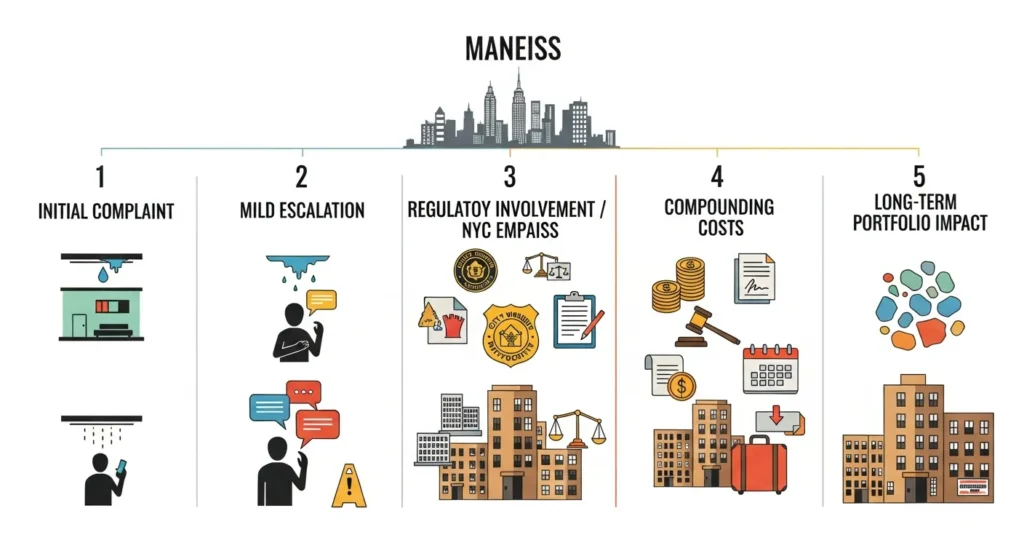
Ask most landlords what a tenant complaint costs and we’ll usually think in terms of a repair invoice or maybe a one‑off rent credit. In reality, the price tag is much bigger and more layered.
A single issue about heat, leaks, pests, or noise can ripple through years of cash flow: triggering extra repairs, vacancy, legal risk, NYC building violations, HPD complaints, higher insurance, and a quieter but very real hit to asset value.
In this piece, we break down what a tenant complaint really costs over time, how those costs compound in regulated markets like New York City, and what we can do, practically, to keep both risk and expenses under control while staying compliant.
Understanding What Counts As A Tenant Complaint
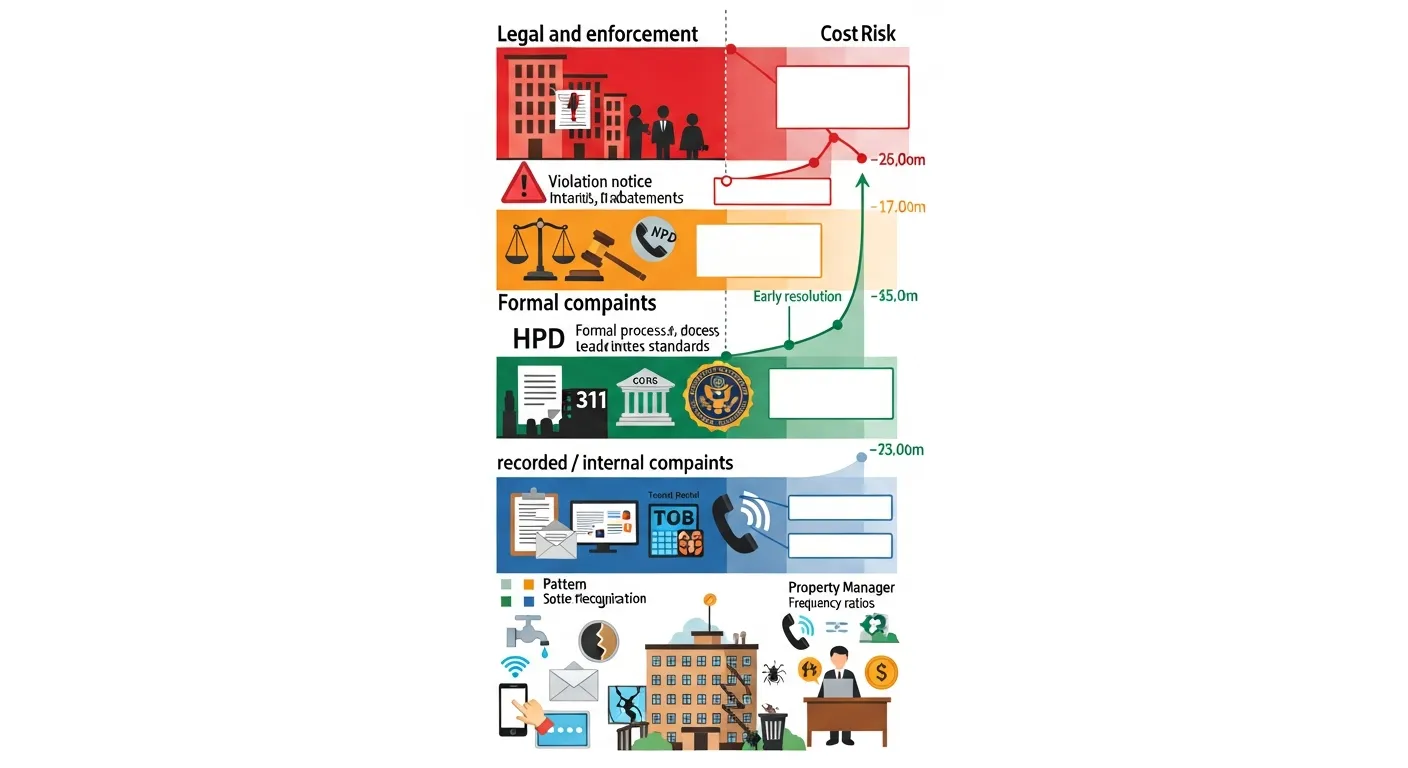
We tend to think of a “complaint” as a formal letter or an angry email. Regulators and ombudsmen define it more broadly, and that matters for risk.
A tenant complaint is any expression of dissatisfaction about the property, services, or management, whether it comes in via text, email, portal message, phone call, or through a third party like a broker, council member, or attorney. Many so‑called “maintenance requests” are, in practice, complaints if the tenant thinks we’ve failed in a legal or contractual duty.
Common Types Of Tenant Complaints
Across portfolios, the same themes keep coming up:
- Property condition and repairs – leaks, broken appliances, failing HVAC, damaged flooring, windows that don’t close properly.
- Damp and mold – particularly in older housing stock and basement units: in NYC this often overlaps with housing code issues and HPD complaints.
- Building safety – self‑closing doors, smoke/CO detectors, blocked egress, elevator outages, façade or structural concerns. These can quickly intersect with DOB violations.
- Noise and antisocial behavior – loud neighbors, smoking, short‑term rentals, or harassment within the building.
- Cleanliness and pests – trash storage, rodents, roaches, bedbugs, or inadequate common‑area cleaning.
- Service charges and fees – confusion or disputes over utilities, amenity fees, late charges, or rent increases.
- Complaint handling itself – slow responses, poor communication, or tenants feeling dismissed.
From a cost perspective, these categories differ in severity, but they share one thing: if we ignore them or respond poorly, they become more expensive.
Formal Vs. Informal Complaints
Most of what we deal with day‑to‑day is informal:
- A text about a leak
- A quick email about hallway lights
- A message in the tenant portal asking when the exterminator is coming
These issues are often 5–8 times more frequent than anything that ever gets logged in a formal complaints system. If we treat them casually and don’t record them, we lose visibility into patterns, and into mounting risk.
Formal complaints are different. These might be:
- Logged under our written complaints policy
- Escalated to a property manager or ownership
- Filed with an ombudsman, housing authority, or court
- In NYC, made via 311, which can trigger HPD or DOB inspections
Once a complaint becomes formal, we’re usually working under deadlines and standards. Miss those, and we increase the odds of:
- Adverse findings (maladministration, negligence)
- Compensation orders
- Official NYC building violations or enforcement actions
When A Complaint Turns Into A Legal Issue
The line between “annoying email” and “legal problem” is thinner than we’d like.
Complaints become legal issues when they touch on statutory duties and code compliance, such as:
- Heat and hot water standards
- Mold and indoor air quality
- Lead‑based paint
- Fire safety and means of egress
- Structural stability and façade safety
In New York City, for example:
- Habitability issues frequently show up as HPD complaints via 311, which can lead to Class A/B/C violations and fines if we don’t correct them. (See HPD’s violation search and enforcement overview at https://www.nyc.gov/site/hpd/services-and-information/hpd-online.page.)
- Safety and construction‑related issues can trigger DOB violations and stop‑work or vacate orders from the Department of Buildings (https://www.nyc.gov/site/buildings/index.page).
If disrepair or non‑compliance continues, tenants may pursue:
- Rent abatements or freeze applications (e.g., in regulated units)
- Claims for personal injury or property damage
- Rent repayment or breach‑of‑warranty‑of‑habitability cases
At that point, the “cost of a complaint” is no longer about a single repair, it’s about full legal exposure and long‑term NYC property compliance risk.
Direct Financial Costs Of Tenant Complaints
The most visible costs hit our P&L quickly: repairs, legal fees, penalties, and compensation. These are the line items we can actually point to on a statement.
Repair And Maintenance Expenses
For most landlords, repair and maintenance are the largest recurring costs linked to tenant complaints. That’s not optional spend: it’s the baseline to keep units habitable and legally compliant.
In practice, we see:
- Emergency call‑outs (plumbing leaks, no heat, power issues)
- Moisture and mold remediation
- Roof, façade, or window work
- Pest treatments
- Elevator and life‑safety system repairs
Surveys consistently show that the majority of renters report at least one repair or condition issue each year, and a large share report damp or mold. If those issues linger, they’re more likely to result in HPD complaints, violations, and, in some cases, rent abatements.
A simple example:
- Small leak caught early: $300–$600 for plumbing + paint
- Leak left unresolved: ceiling and flooring replacement, mold remediation, plus potential hotel costs or rent credits – $3,000–$10,000+ per incident
That ten‑fold jump is how one “minor” complaint quietly becomes a capital expense.
Legal Fees, Fines, And Regulatory Penalties
When complaints cross into code or legal territory, we start to see:
- Attorney consultations and representation
- Housing court appearances
- Ombudsman, tribunal, or administrative hearings
- Regulatory fines and penalties
In NYC, for example:
- HPD’s housing maintenance code violations can carry daily penalties for uncorrected Class C issues.
- DOB violations can result in stiff civil penalties, particularly for safety‑related conditions or work without permits.
Over the life of a tenancy, a pattern of unresolved NYC building violations or DOB violations can cost tens of thousands of dollars in fines, plus the indirect cost of implementing required corrective work under tight timeframes.
Compensation, Rent Credits, And Settlements
Formal complaint bodies and courts routinely order compensation where they find maladministration or serious disrepair. In practice, we see payouts in several forms:
- Direct cash compensation for distress, inconvenience, and loss of enjoyment
- Rent abatements or credits for periods where the unit was partially unusable (e.g., no heat, extended leaks, heavy construction)
- Settlement agreements to resolve potential claims before trial
The individual amounts vary, anything from a few hundred dollars for short‑term inconvenience to months of rent for sustained, proven habitability failures. But the pattern is clear: the longer a legitimate complaint drags on, the more expensive the remedy tends to be.
The Hidden And Long-Term Costs Many Landlords Miss
The visible costs are painful enough. The bigger danger for us as owners and managers is what doesn’t show up neatly in a single month’s P&L: vacancy, reputational drag, operational stress, and long‑term risk pricing.
Vacancies, Turnover, And Lost Rent
Turnover is expensive even in the best circumstances. When it’s triggered by avoidable dissatisfaction, the cost of a complaint balloons:
- Lost rent during vacancy – days or weeks with zero income
- Make‑ready costs – cleaning, paint, minor repairs, lock changes
- Leasing and marketing – listing fees, staff time, broker commissions where applicable
Suppose a tenant leaves after a frustrating year of unresolved leaks and noise complaints. The unit sits vacant for 25 days at $3,000/month. That’s roughly $2,500 in lost rent, plus $1,000–$2,000 in turnover costs. If we could have retained that tenant for another lease term with a $1,200 repair, the math is obvious.
High complaint volumes also correlate with shorter average tenancies, which means we pay these turnover costs more often across the portfolio.
Reputation Damage And Lower-Quality Applicant Pools
We operate in an era of online reviews, social media, and public complaint records. Poor complaint handling doesn’t just irritate one tenant: it shapes how future residents and even lenders view our building.
Potential impacts:
- Lower star ratings on Google, Yelp, and rental platforms
- Stories about “never getting repairs done” or “ignoring mold”
- Public records showing repeated HPD complaints or serious violations
Lower reputation tends to produce the “quality squeeze”: fewer high‑quality applicants, more vacancy days, and a higher share of applicants with weaker financials or riskier profiles.
Over time, that can push us into a cycle of:
- Higher non‑payment risk
- More complaints and conflict
- More enforcement scrutiny
We’ve seen buildings with chronic complaint issues that effectively need to discount rents to keep units filled, an invisible but very real cost of past complaint handling.
Administrative Time And Stress Load
We rarely cost this out properly, but we should.
Each complaint, especially once escalated, demands:
- Multiple emails and phone calls
- Scheduling and rescheduling of contractors
- Gathering records (photos, invoices, messages)
- Preparing for and attending inspections or hearings
If a property manager spends 10–15 hours over several months dealing with a single complex complaint, and their fully loaded cost is $45/hour, that’s $450–$675 in staff time on top of repairs and compensation.
There’s also a human toll. High complaint volume burns out staff, increases turnover, and erodes the consistency of how we manage. That inconsistency, in turn, leads to more tenant frustration and more formal complaints.
Insurance Impacts And Future Risk Exposure
Insurers watch patterns. A property with:
- Frequent water damage claims
- Documented injuries related to disrepair
- Histories of fire or safety code violations
…is likely to see tighter underwriting and higher premiums over time.
Even when we don’t file claims, a track record of serious NYC building violations, repeated HPD complaints, or high‑profile habitability disputes can make insurers nervous. They may price that risk into our premiums or coverage terms.
Over a 10‑ or 15‑year hold period, a modest annual premium increase driven by perceived risk can easily outweigh the one‑time cost of fixing systemic issues properly and early.
How One Complaint Can Snowball Over The Life Of A Tenancy
To really see the cost curve, it helps to walk through a realistic scenario. The details vary, but the pattern is remarkably consistent.
From Minor Issue To Repeated Grievance
Year 1, winter. A tenant emails: there’s a small water stain on the bedroom ceiling. No active drip visible. Maintenance does a quick patch and paint but doesn’t investigate the roof.
Six months later, the stain is back. The tenant messages again. This time maintenance is backed up: two weeks pass before anyone looks. They patch again.
By the third recurrence, the tenant is frustrated. They’ve moved their furniture twice, thrown out a damp rug, and feel unheard. What started as a $500 roof repair is now a repeated grievance with a psychological component: “They don’t care about my home.”
Escalation To City Inspections Or Legal Action
The tenant starts copying a tenant association rep on emails. They call 311 and lodge an HPD complaint about leaks and potential mold. An inspector visits, documents moisture damage, and issues a violation.
Now we’re on the clock. We:
- Pay for proper leak tracing and roof repair
- Open walls and ceilings
- Pay for mold assessment and remediation
- Potentially put the tenant in a hotel or offer a rent credit
If communication is still poor, the tenant may seek legal advice. At that point, the claim isn’t only about the leak: it’s about months of disruption and perceived neglect. We’re now facing:
- Housing court or settlement negotiations
- Requests for rent abatements for the period of impact
- Scrutiny of our documentation and repair logs
Cumulative Cost Scenario: A Multi-Year Breakdown
Let’s translate this into approximate numbers over a three‑year tenancy:
Year 1
- Initial patch repair: $250
- Staff time: 2 hours (~$90)
Year 2
- Second patch: $300
- Additional staff admin: $150
- Tenant begins leaving negative online reviews (reputation impact not yet visible in cash terms)
Year 3
- HPD complaint and inspection: staff prep and visit time ~$400
- Proper roof and plumbing repair: $3,000
- Mold remediation and restoration: $2,500
- Temporary accommodation / rent credit: $1,200
- Legal consult and response: $1,500
- Partial rent abatement in settlement: $4,000
- Increased vacancy at lease end (tenant leaves 30 days before we re‑rent): $3,000 lost rent + $1,500 turnover
Total direct and reasonably attributable costs:
Roughly $17,000–$18,000 across three years, driven by a problem that could have been fixed correctly for under $3,000 the first time.
This is what complaint snowballing looks like in real life. The cost isn’t theoretical: it’s just spread out across different budget lines and years, so we don’t always connect the dots.
Key Factors That Influence The True Cost To Landlords
Not every complaint carries the same price tag. The real cost is shaped by where we operate, how we manage, and how quickly we respond.
Property Type, Location, And Local Regulations
Several structural factors drive complaint risk:
- City and state regulation level – Highly regulated jurisdictions like NYC, with strong tenant protections and active enforcement, increase the stakes around HPD complaints and DOB violations.
- Building type – Older walk‑ups, pre‑war stock, and large multi‑unit buildings tend to see more complex repair issues than newer small properties.
- Tenant mix – Student housing, subsidized housing, and rent‑stabilized portfolios can experience higher recorded complaint rates due to both needs and awareness of rights.
In New York City specifically, staying on top of NYC property compliance is crucial. One unaddressed tenant issue can morph into a cascade of HPD and DOB enforcement actions that follow the property for years.
Landlord Response Time And Communication Style
Two buildings with identical physical issues can have radically different complaint costs purely based on how we respond.
Patterns that reduce escalation:
- Acknowledging every complaint quickly, even if the fix will take time
- Giving realistic timeframes and sticking to them
- Explaining what we’re doing and why
- Treating tenants as partners in protecting the asset, not adversaries
Patterns that increase costs:
- Delayed or no replies
- Over‑promising and under‑delivering
- Defensive or dismissive language
- No clear point of contact
The same leak, handled with prompt, transparent communication, often ends with a satisfied tenant and no formal escalation. Handled poorly, it ends in a paper trail of frustration, exactly what attorneys and regulators look at when assessing compensation.
Documentation, Policies, And Property Management Quality
From a risk lens, documentation is our best friend.
Well‑run properties typically have:
- A written complaints policy and clear escalation pathway
- Centralized logging of all tenant contacts, not just formal grievances
- Dated work orders, invoices, and photos for repairs
- Records of periodic inspections and routine maintenance
This kind of file isn’t just operationally useful: it’s what allows us to show, in any formal process, that we:
- Responded within reasonable timeframes
- Took proportionate steps to investigate and fix issues
- Didn’t ignore safety‑critical complaints
By contrast, “informal” management, where everything happens via ad hoc texts and unlogged favors, may feel friendly in the moment, but it leaves us exposed if a dispute lands before a court, ombudsman, or city agency.
Estimating The Cost Of A Tenant Complaint In Your Own Portfolio
To manage complaint risk like any other business expense, we need a way to quantify it. The goal isn’t to put a perfect dollar figure on every frustration: it’s to get close enough that we can see patterns and ROI on prevention.
Building A Simple Cost Model For Complaints
A practical approach is to create a per‑complaint cost template. For each significant issue, we log:
- Direct repair cost
- Labor, materials, contractor invoices
- Staff and admin time
- Hours spent by managers, superintendents, leasing, and accounting × hourly rate
- Legal / tribunal / ombudsman costs (if any)
- Attorney fees, filing fees, settlement discussions
- Compensation or rent credits
- Rent abatements, lump‑sum payments, hotel stays
- Vacancy / turnover impact
- Extra days vacant due to dissatisfaction × daily rent
Even rough estimates, e.g., “manager: 5 hours: building staff: 3 hours”, are enough to reveal that what we thought was a “$900 issue” was actually closer to $3,000.
Tracking Complaint-Related Metrics Over Time
At portfolio level, we want to track both volume and trajectory:
- Number of complaints per 100 units per quarter
- Percentage escalated to formal grievances, 311 calls, or legal action
- Average days to first response and to full resolution
- Total compensation paid and rent credits granted
- Turnover events that cite dissatisfaction or unresolved issues
These metrics let us answer critical questions:
- Which buildings are outliers on complaint volumes?
- Do certain contractors or systems (e.g., elevators, roofs) drive disproportionate issues?
- Are we getting faster or slower at resolving problems?
Benchmarking Against Industry Norms
Raw numbers don’t mean much without context. Benchmarking against sector data and local norms helps us see whether we’re genuinely efficient or just average.
Sources include:
- City‑level housing satisfaction or tenant survey data
- Ombudsman or housing authority annual reports (which often publish complaint volumes and outcomes)
- Major real estate publications and research reports on maintenance and turnover costs (for example, studies discussed in outlets like https://www.bisnow.com/ or regional landlord associations)
In NYC, we can also look at patterns in local enforcement records and public violation data. Tools like ViolationWatch and its free NYC violation lookup tool help us see how our buildings compare in terms of public HPD and DOB records over time.
For free lookups, use our NYC violation lookup tool to see where you stand: https://lookup.violationwatch.nyc/lookup.
Strategies To Reduce Tenant Complaint Costs Over Time
Once we see complaint handling as a long‑term cost driver rather than an annoyance, the playbook changes. We stop asking, “How do we shut this down quickly?” and start asking, “How do we prevent this from becoming expensive, in cash, time, and risk?”
Proactive Maintenance And Safety Compliance
Preventive work is rarely glamorous, but it’s almost always cheaper than crisis response.
Key practices:
- Regular inspections of roofs, basements, boiler rooms, common areas, and life‑safety systems
- Early intervention on damp and mold, including source‑tracking leaks instead of cosmetic fixes
- Scheduled testing of smoke/CO detectors, self‑closing doors, and emergency lighting
- Keeping permits and certificates up to date to avoid avoidable DOB violations
In NYC, we also recommend periodically checking public records for your buildings. A service like ViolationWatch (https://violationwatch.nyc/) makes it easier to spot emerging issues before they translate into higher complaint volumes and formal enforcement.
Clear Expectations, House Rules, And Onboarding
Many “complaints” are really misaligned expectations.
Good onboarding includes:
- A written welcome pack explaining:
- How to report repairs and expected timeframes
- House rules on noise, garbage, smoking, and guests
- Contact details for emergencies vs. routine issues
- A brief walk‑through at move‑in to note pre‑existing conditions
- Clear explanations of building‑wide projects (e.g., corridor renovations, elevator modernizations) and anticipated disruption
When tenants know what to expect and how to be heard, they’re more likely to stay collaborative, and less likely to jump straight to external channels when something goes wrong.
Communication Systems And Response Protocols
We don’t need a huge tech stack to communicate well, but we do need consistent systems.
Consider:
- A central CRM or ticketing system to log all contacts
- Standard acknowledgments (“We’ve received your request: here’s the next step.”)
- A triage system so health/safety issues get same‑day attention
- Regular progress updates for repairs that take longer than a few days
This isn’t just customer service theater. When an HPD or DOB inspector, or a judge, asks for evidence of how we handled a complaint, clear logs and timestamps can make the difference between “reasonable landlord” and “maladministration.”
Get instant alerts whenever your building receives a new violation, sign up for real‑time monitoring with our building violation alerts: https://violationwatch.nyc/register/.
Training Staff And Using Technology To Prevent Escalation
Even the best policies fail if the people on the front line don’t know how to use them.
Priorities for training:
- Recognizing when a service request is really a brewing complaint
- De‑escalation techniques for frustrated tenants
- Basic legal awareness around habitability and safety
- When to escalate internally before issues go external
On the technology side, tools that help us monitor NYC property compliance in real time can be invaluable. For example, pairing internal maintenance data with external feeds of HPD complaints, DOB violations, and 311 trends helps us see where patterns are forming.
That’s exactly why we built ViolationWatch, to give owners an early‑warning system rather than a stack of surprise notices.
The Return On Investing In Tenant Satisfaction
When we lay all the costs out, investing in satisfaction stops looking “nice to have” and starts looking like basic asset protection.
Comparing Prevention Costs To Complaint Costs
Let’s come back to the earlier leak example.
- Prevention path: $3,000 for thorough investigation and repair + a same‑day reply explaining timing and next steps.
- Complaint path: $17,000+ in cumulative costs over three years, including fines, abatements, and vacancy.
That’s a 5–6x difference on a single case. Spread across dozens of units and years, the ROI on proactive maintenance and robust communication is hard to overstate.
And it’s not just about big capital items. Even small wins, like improving first‑response times or giving tenants a clear repair schedule, can meaningfully lower escalation rates.
Long-Term Benefits: Renewals, Referrals, And Stability
Satisfied tenants:
- Renew more often, cutting our turnover and marketing costs
- Refer friends and colleagues, reducing our reliance on paid advertising
- Are less likely to take every frustration straight to 311, an ombudsman, or an attorney
In NYC, where public records make HPD and DOB histories easy to see, a reputation for prompt, fair complaint handling supports:
- Higher average occupancy
- Stronger rent growth where market conditions allow
- Better standing with lenders and insurers who check compliance histories
Over a 10‑year horizon, even a modest improvement in renewal rates and vacancy can add up to hundreds of thousands of dollars in additional net income on a mid‑size building.
Setting A Complaint-Prevention Budget And Plan
To get disciplined about this, we can treat complaint prevention like any other capital plan.
A simple framework:
- Baseline – Use the cost model we discussed earlier to estimate your current annual spend on complaint‑related issues (repairs, compensation, legal, vacancy).
- Allocate – Commit a percentage of that amount, say 25–40%, to proactive measures: inspections, upgrades, staff training, and better systems.
- Prioritize – Focus first on buildings with the highest complaint and violation rates, or where HPD complaints and DOB violations are already on record.
- Monitor – Track whether formal complaint volumes, compensation payouts, and violation counts fall over the next 12–24 months.
To support that monitoring, we can use tools that aggregate violation and complaint data across our portfolio. Setting up building violation alerts at https://violationwatch.nyc/register/ ensures we don’t miss new issues as they arise and can respond before they become costly patterns.
Conclusion
Tenant complaints are unavoidable. What’s optional is how expensive they become.
When we zoom out over the full life of a tenancy, and over the full hold period of a building, the cost of a complaint is rarely just a plumber’s invoice. It’s the sum of:
- Repairs done late instead of early
- Legal costs and compensation after issues escalate
- Lost rent and higher turnover
- Damaged reputation and weaker applicant pools
- Higher insurance and financing friction driven by poor NYC property compliance
Handled well, complaints are an early‑warning system that protects both residents and assets. Handled poorly, they’re a slow leak in our NOI and, in cities like New York, a direct pipeline to HPD complaints, DOB violations, and increasing regulatory scrutiny.
We can’t, and shouldn’t, aim for zero complaints. But we can build systems, budgets, and cultures that turn those complaints into data and action instead of recurring liabilities.
If we want fewer surprises, it starts with visibility. Use our NYC violation lookup tool at https://lookup.violationwatch.nyc/lookup to see where your buildings stand today. Then layer in portfolio‑wide monitoring through ViolationWatch so that the next complaint you hear about is a chance to fix a problem, not a sign that it’s already become expensive.
Key Takeaways
- A tenant complaint cost is rarely just a single repair bill; it compounds into legal exposure, NYC building violations, HPD complaints, and long-term hits to cash flow and asset value if mishandled.
- Ignoring or patching issues like leaks, mold, and safety defects leads to 5–10x higher expenses over time compared to early, thorough repairs and clear communication.
- Vacancies, turnover, negative reviews, and weaker applicant pools are major hidden costs of poor complaint handling, often eclipsing the original maintenance expense.
- Strong documentation, fast responses, clear policies, and centralized tracking of every tenant complaint—formal and informal—dramatically reduce escalation to 311, HPD, DOB, and the courts.
- Proactive maintenance, NYC property compliance monitoring tools like ViolationWatch, and a defined complaint-prevention budget consistently deliver a high ROI by lowering legal, insurance, and turnover costs over the life of a building.
Frequently Asked Questions About the Cost of Tenant Complaints
How much does a tenant complaint really cost a landlord over time?
A tenant complaint can start as a few hundred dollars for a simple repair, but when ignored or patched repeatedly it can snowball into $10,000–$20,000+ over several years. Costs come from repeat repairs, violations, legal fees, compensation, lost rent through vacancy, staff time, and higher long‑term risk and insurance pricing.
What types of tenant complaints are most expensive for landlords in the long run?
Complaints tied to habitability and safety tend to be most expensive: leaks, damp and mold, no heat or hot water, structural or façade issues, fire safety, pests, and elevator failures. These often trigger HPD or DOB violations, rent abatements, or legal claims, turning what looked like a minor repair into multi‑year, multi‑line‑item costs.
How do HPD complaints and DOB violations in NYC affect the cost of a tenant complaint?
In NYC, habitability complaints can become HPD violations, and safety or construction issues can trigger DOB violations. Uncorrected Class C violations can carry daily fines, and serious DOB issues may lead to vacate or stop‑work orders. Over time, this raises direct penalties, accelerates repair timelines, and increases insurance and financing friction.
What hidden costs of tenant complaints do most landlords underestimate?
Landlords often underestimate vacancy and turnover costs, reputation damage from online reviews and public records, staff time spent on escalated issues, and long‑term insurance and financing impacts. High complaint volumes can shorten average tenancies, weaken applicant quality, and force rent discounts that erode NOI over many years.
What’s the best way for landlords to reduce tenant complaint costs over time?
The most effective strategy is proactive: regular inspections, early leak and mold remediation, strict safety compliance, clear house rules, fast acknowledgment of issues, and documented processes. Using centralized logging systems and tools that monitor HPD and DOB records helps catch patterns early and prevent informal issues from becoming formal, expensive disputes.
How can I estimate the cost of a tenant complaint in my own portfolio?
Create a simple cost model for each significant complaint: add repair invoices, staff hours × hourly rate, legal/tribunal costs, compensation or rent credits, and vacancy days × daily rent. Track complaint volume, escalation rate, and resolution times by building. Over several quarters, patterns will reveal which properties and systems generate the highest per‑complaint cost.