
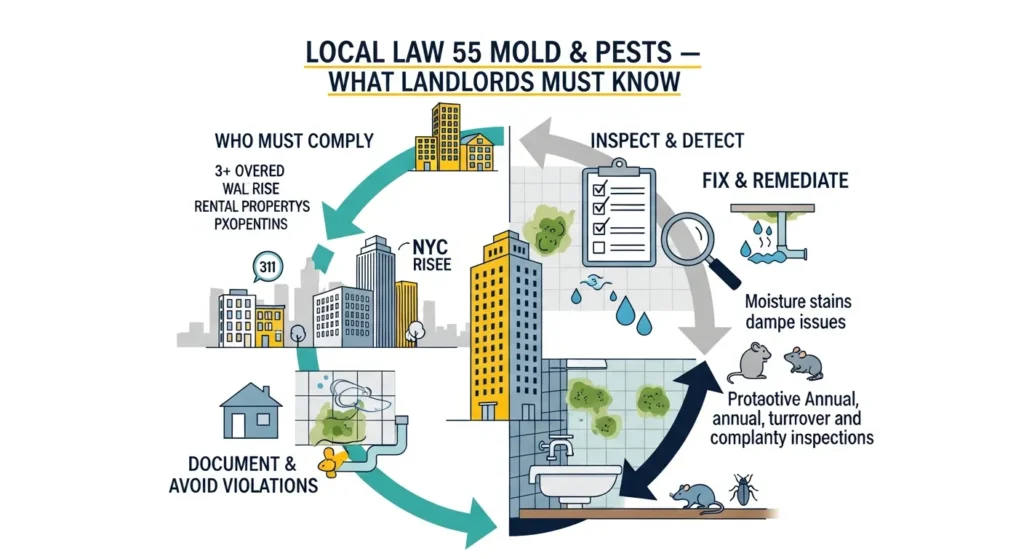
If we own or manage residential property in New York City, Local Law 55 isn’t optional fine print, it’s a daily operating rule.
The Asthma-Free Housing Act (Local Law 55 of 2018) gives HPD and other agencies real teeth to crack down on mold, mice, rats, and cockroaches, and on the leaks, gaps, and other defects that cause them. It’s now one of the core pillars of NYC property compliance, sitting alongside lead paint and fire safety.
In practice, that means any building with three or more apartments (and even many 1–2 family homes) must be proactively inspected, cleaned, and repaired. HPD complaints, 311 calls, and DOB violations can all spiral quickly into expensive enforcement if we don’t have a solid system.
Below, we break down what Local Law 55 requires, how enforcement actually works, and the practical steps we can take to stay ahead of mold and pests, and the violations that come with them.
What Is Local Law 55 And Who Must Comply?
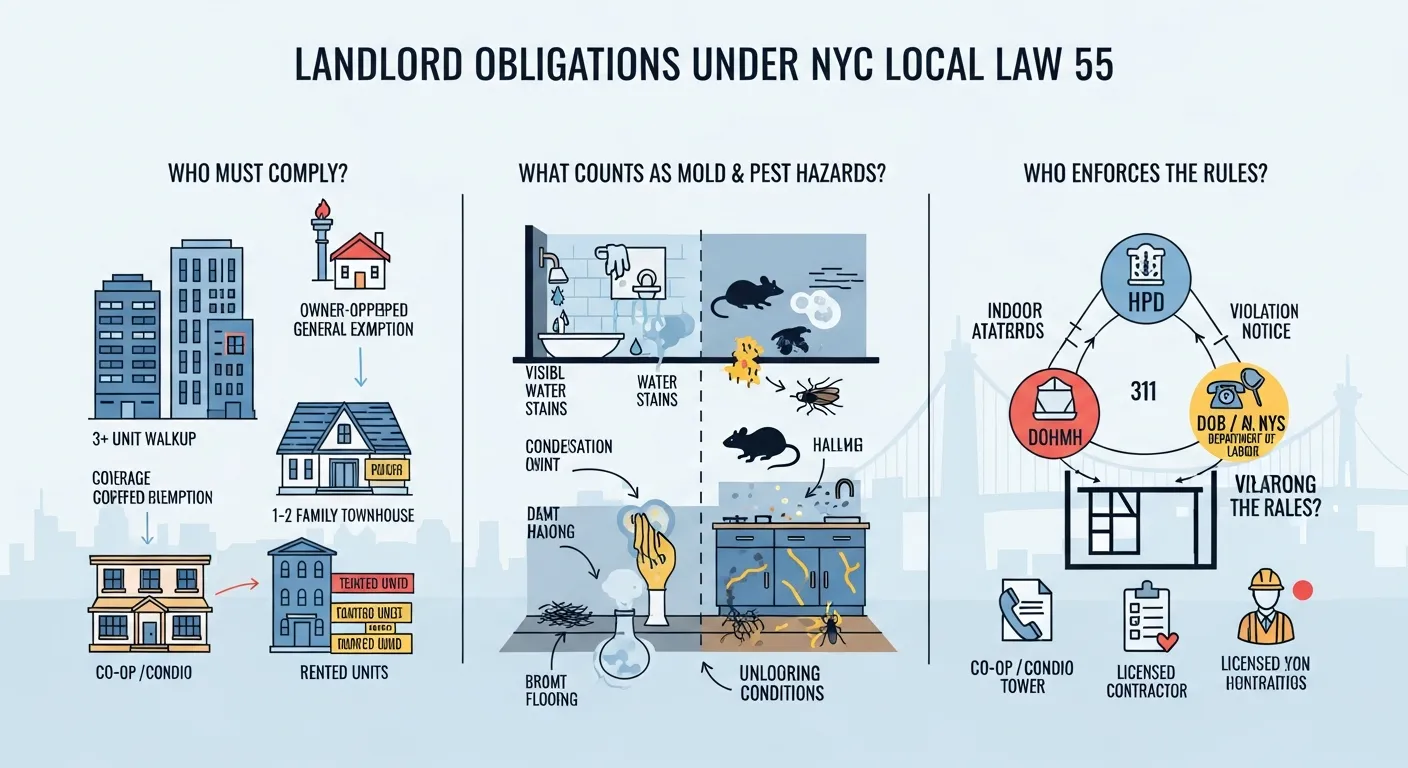
Local Law 55 of 2018, the Asthma-Free Housing Act, is designed to reduce asthma triggers in NYC housing. The law focuses on “indoor allergen hazards”: visible mold and pest infestations, plus the moisture and building defects that allow them to thrive.
Covered Buildings And Exemptions
Local Law 55 applies much more broadly than some owners realize. We must comply if we own:
- Multiple dwellings with 3 or more residential units: or
- 1- or 2-family homes where at least one unit is occupied by a tenant (not the owner).
In other words, most rental housing in the city is covered. Co-ops and condos are generally included where units are occupied by tenants under a lease: boards and individual shareholders/owners may share responsibility depending on how the building is structured.
Common misconceptions we hear:
- “It’s only for pre-war or ‘problem’ buildings.”, No. The law is building-type and occupancy based, not age based.
- “Small 3-unit walkups don’t count.”, They do. The 3+ unit threshold is clear.
- “If tenants cause the mess, it’s on them.”, Tenants have duties, but owners remain legally responsible for keeping apartments and common areas free from indoor allergen hazards.
Owner-occupied 1–2 family homes with no tenant are generally outside Local Law 55. But if we rent out a garden unit or top floor, we’re in.
How Local Law 55 Defines Mold And Pest Conditions
The law uses the term “indoor allergen hazards” for two main categories:
- Mold hazards
- Any visible mold growth on walls, ceilings, windows, bathrooms, basements, or building materials.
- Water stains, peeling paint, or damaged plaster from leaks that are likely to support mold.
- Condensation or chronic dampness on surfaces.
- Pest hazards
- Evidence of mice, rats, or cockroaches (which are treated as immediately hazardous).
- Other vermin, like certain insects, that are living or nesting indoors.
Crucially, Local Law 55 doesn’t just target the visible problem. It also covers “underlying conditions”, including:
- Leaks and plumbing defects
- Cracked or porous masonry
- Holes and penetrations in walls, floors, and ceilings
- Failed caulking and weatherstripping
- Poor ventilation and humidity problems
If HPD finds pests or mold but we haven’t fixed the leaks or entry points, we’re still in violation.
Key Agencies Involved In Enforcement
Several agencies share responsibility for mold, pests, and related NYC building violations:
- HPD (Department of Housing Preservation and Development) – The primary enforcement agency for Local Law 55 in residential buildings. HPD responds to 311 complaints, issues violations, and sets correction deadlines. Official guidance is available on HPD’s site: https://www.nyc.gov/site/hpd.
- DOHMH (Department of Health and Mental Hygiene) – Develops health-based rules and safe work practices for mold and pest remediation. DOHMH publishes the Local Law 55 fact sheet and indoor allergen materials: https://www.nyc.gov/site/doh.
- DOB (Department of Buildings) and NYS Department of Labor – Regulate licensed mold professionals and construction work that may involve disturbing mold-contaminated materials. For larger mold jobs, DOB and state licensing rules determine who can legally perform and supervise the work.
Understanding how these agencies overlap matters, because a mold or pest condition can trigger HPD violations, DOB violations, and even state labor issues if we use unlicensed contractors on large-scale remediation.
Core Obligations For Landlords Under Local Law 55
Local Law 55 is not a “wait for a complaint” law. It creates ongoing, affirmative duties for owners of covered buildings.
Providing A Safe And Healthy Indoor Environment
At the highest level, we’re required to:
- Keep all apartments and common areas free of visible mold and pest infestations.
- Identify and correct underlying conditions that cause moisture or allow pests entry.
- Use safe, approved work practices when cleaning or repairing mold and pest conditions.
This obligation applies whether or not tenants complain. If HPD walks in during a proactive inspection or a different issue (like no heat) and sees mold on a bathroom ceiling or cockroach activity in the hallway, that’s still a violation.
Requirements For Annual And Turnover Inspections
Local Law 55 builds inspection duties into the life cycle of the building.
We must:
- Annually inspect every dwelling unit and common area for mold and pests.
- Inspect at turnover, any time a unit becomes vacant and before a new tenant moves in.
During turnover, we’re expected to:
- Remove and remediate all visible mold, including behind furniture and appliances.
- Address any leaks, failed grout, or damaged surfaces.
- Perform pest inspection and treatment as needed.
- Deep clean and vacuum owner-provided carpeting and furniture.
This is where many owners fall short. A quick paint job over a moldy bathroom ceiling doesn’t meet Local Law 55. We need to fix the leak, properly clean or replace damaged materials, and confirm the area is dry.
Recordkeeping And Documentation Duties
The law doesn’t list a specific format, but in practice HPD expects owners to be able to show:
- Annual inspection logs – dates, units, conditions found, and actions taken.
- Complaint records – when tenants reported mold or pests and how we responded.
- Work orders and invoices – especially for licensed mold assessors/remediators and pest control vendors.
- Photos before and after remediation.
Good documentation helps in several ways:
- Demonstrates a history of proactive NYC property compliance.
- Supports our certification of correction when HPD issues a violation.
- Reduces disputes with tenants about whether we responded reasonably.
Many owners now pair internal logs with tools that track open HPD complaints and violations. For free lookups, we can use a NYC violation lookup tool like this one: https://lookup.violationwatch.nyc/lookup, which makes it easier to see Local Law 55-related issues across a portfolio.
Inspection Requirements For Mold And Pests
We can’t comply with Local Law 55 if we’re not in our own buildings regularly. Inspections are where everything starts.
When Inspections Are Required
Local Law 55 effectively creates three triggers for inspections:
- Annual inspections – Once a year, every unit and common area must be checked.
- Turnover inspections – When a tenant vacates a unit, before the next tenant takes possession.
- Complaint-driven inspections – When tenants report mold, leaks, or pests, or when HPD issues a violation.
HPD guidance expects that when a tenant complains, we inspect promptly, typically within 30 days at most and sooner for obvious hazards.
Remember that HPD may also inspect after a 311 call, even if the tenant never contacted us directly. Those HPD complaints can lead to on-site inspections and, if the inspector finds conditions, to immediate violations.
How To Properly Conduct Inspections
A quick peek in the lobby won’t cut it. Effective Local Law 55 inspections should:
- Be systematic – use a checklist so we inspect the same items in every unit.
- Cover wet rooms carefully – bathrooms, kitchens, boiler rooms, laundry rooms, compactor rooms, basements.
- Include tenant interviews where possible:
- Any recent leaks or floods?
- Any musty smells?
- Sightings of mice, rats, or roaches? Where and when?
Practical steps:
- Look up at ceilings and high corners.
- Move shower curtains, check tile grout, tub surrounds, and under sinks.
- Inspect window frames, sills, and any AC penetrations.
- Open cabinets where food is stored: check under stoves and refrigerators.
- Look in trash rooms and compactor chutes for droppings or harborage.
Document everything immediately, date, unit, photos, and any tenant comments.
What To Look For: Common Red Flags
We should train ourselves and staff to recognize subtle warning signs before they become full-blown NYC building violations:
Mold and moisture red flags
- Yellow or brown water stains on ceilings or walls.
- Peeling paint, bubbling, or soft plaster.
- Black, green, or dark speckled patches on caulk, grout, or drywall.
- Persistent musty odors even if we can’t yet see visible mold.
- Condensation on windows or pipes: warped wood or buckling floors.
Pest red flags
- Droppings (small black pellets for mice: larger, capsule-shaped for rats).
- Greasy rub marks along baseboards or pipe runs.
- Gnawed food packaging or baseboards.
- Live or dead roaches in cabinets, behind refrigerators, or in hallways.
- Holes around radiator risers, gas lines, or under sinks.
Catching these conditions when they’re small helps us avoid Class C violations later, and lowers the chance of HPD discovering a pattern of neglect.
Mold Remediation Standards You Must Follow
Under Local Law 55, any visible mold is a violation: the difference is how serious and what level of response is required.
Thresholds For Visible Mold And Water Damage
The City’s rules break mold conditions down by area per room:
- Less than 10 square feet of visible mold in a room – Typically a Class A (non-hazardous) mold violation.
- 10 square feet or more of visible mold in a single room – Can be a Class B or C (more serious) violation.
The bigger the area, the higher the risk and the more aggressive the response HPD expects.
For buildings with 10 or more residential units, there’s an added layer:
- If there’s more than 10 square feet of mold in a single room, we must use a New York State–licensed mold assessor and a separate licensed mold remediator. The same company can’t do both roles.
This requirement comes from state law and is enforced by the Department of Labor and DOB. Ignoring it can expose us to DOB violations and penalties beyond HPD’s fines.
Approved Methods And Prohibited Practices
DOHMH has published detailed guidance on safe mold work practices. A few core principles:
Do:
- Fix the underlying moisture source first (roof leak, pipe, failed grout, ventilation issues).
- Use containment (plastic sheeting, negative air) for larger jobs to prevent spore spread.
- Remove and properly discard porous materials that are heavily contaminated (e.g., soggy drywall, insulation, ceiling tiles).
- Clean hard surfaces with detergent and water, then dry thoroughly.
- Provide or maintain adequate ventilation during and after work.
Don’t:
- Dry scrape or sand moldy surfaces without controls, it aerosolizes spores.
- Just “bleach and paint” over mold without fixing leaks and removing damaged material.
- Use strong chemicals in occupied units without ventilation or proper PPE.
The City’s mold and moisture guidance, linked from DOHMH’s site, is worth sharing with staff and vendors so everyone is aligned on what’s acceptable.
When You Must Use Licensed Mold Professionals
We’re required to use licensed mold professionals when:
- The building has 10 or more units, and
- There is more than 10 square feet of visible mold in any single room.
In that case, we must hire:
- A licensed mold assessor – to inspect, define the scope of work, and produce a remediation plan.
- A separate licensed mold remediator – to carry out the plan and provide post-remediation documentation.
Even below those thresholds, many owners voluntarily use qualified vendors to avoid recurring problems.
To prove compliance later, keep:
- Signed assessment reports
- Remediation plans
- Final clearance or completion documentation
These documents can be vital if HPD questions our work or if an attorney later claims we mishandled a mold condition.
Pest Management And Integrated Pest Control
Local Law 55 pushes owners away from “spray and pray” extermination and toward Integrated Pest Management (IPM), a long-term strategy focused on building conditions.
Common Pests Covered By Local Law 55
The law treats some pests as more serious than others:
- Mice, rats, and cockroaches – These are classified as Class C immediately hazardous violations when found in any dwelling unit or common area.
- Other pests (certain insects or vermin) – Typically Class B, but still violations requiring correction.
A single active mouse trap catch or visible roach activity in one apartment can trigger enforcement. HPD doesn’t need to see a building-wide infestation.
Integrated Pest Management (IPM) Basics For Landlords
IPM focuses on eliminating the conditions that support pests:
- Seal entry points
- Close gaps around pipes, risers, and radiators with appropriate materials.
- Repair broken baseboards and door sweeps.
- Patch holes in walls, ceilings, and floors.
- Eliminate water and food sources
- Fix leaks and sweating pipes.
- Maintain clean compactor rooms and garbage storage.
- Provide enough trash cans and frequent removal.
- Use traps and baits strategically
- Place in known travel routes (behind appliances, along walls).
- Document where devices are placed and check them regularly.
- Limit pesticide reliance
- Use pesticides as a last resort, not a first step.
- Combine treatments with sealing and housekeeping changes.
A good pest vendor should talk as much about sealing holes and managing trash as about chemicals.
Safe Use Of Pesticides And Contractor Oversight
We remain responsible for what our vendors do in our buildings.
Basic rules:
- Most pesticide applications in multi-unit buildings must be done by licensed applicators.
- We should verify licenses and ask vendors about their IPM approach, not just cost.
- Avoid overuse of sprays or foggers, which can be unsafe and are often less effective than baits and traps.
We should also:
- Require vendors to provide service reports after each visit.
- Track treatments in a central log.
- Tie pest control visits to our inspection findings and HPD complaints.
If HPD sees repeated pest violations in the same lines of apartments, they’ll assume our program is ineffective or purely cosmetic.
Addressing Underlying Conditions: Moisture, Leaks, And Entry Points
Mold and pests are often just symptoms. Local Law 55 explicitly requires us to fix the building issues that create those symptoms.
Fixing Building Defects That Lead To Mold And Pests
Typical underlying conditions include:
- Leaks and plumbing issues – From pinhole leaks in risers to overflowing tubs and failed caulking.
- Roof and façade problems – Letting water into walls and ceilings.
- Cracks and penetrations – In foundations, cellar walls, and around utility lines.
Best practices:
- Treat any water stain as an active problem until proven otherwise.
- After a repair, schedule a follow-up inspection a few weeks later to confirm the area is dry and intact.
- Coordinate between supers, porters, and outside plumbers so information on repeat leaks doesn’t get lost.
Ignoring repetitive “minor” leaks is one of the fastest paths to large mold jobs that trigger licensing requirements and high-class violations.
Ventilation, Humidity, And Housekeeping Standards
Ventilation and humidity levels play a significant role in mold growth and pest attractiveness.
We should:
- Ensure bathroom and kitchen exhaust fans are working and properly vented.
- Keep hallway vents and louvers clear of debris and paint.
- Address chronic condensation on windows or pipes with insulation or airflow adjustments.
On the housekeeping side:
- Maintain regular trash removal schedules.
- Keep basements, boiler rooms, and storage areas free of clutter where pests can nest.
- Enforce house rules around trash disposal and storage of large items.
HPD inspectors routinely note housekeeping issues in violation write-ups because clutter and food waste directly undermine IPM.
Coordinating Repairs Inside Occupied Apartments
Working inside tenants’ homes requires coordination and legal access.
We should:
- Provide reasonable advance notice (usually at least 24 hours in writing) for non-emergency repairs.
- Explain why access is needed, e.g., Local Law 55 inspection, leak investigation, mold removal.
- Offer flexible windows where possible, especially for vulnerable tenants.
If tenants repeatedly deny access, document every attempt. HPD and courts are more sympathetic when owners show a clear paper trail of good-faith efforts. Still, we’re expected to be persistent, especially when there’s an immediately hazardous mold or pest condition affecting other units.
Tenant Notices, Education, And Cooperation
Local Law 55 recognizes that we can’t control everything inside a dwelling. Tenants’ housekeeping and reporting habits matter, which is why the law requires formal notices and education.
Required Tenant Information And Disclosure Forms
For each new lease and renewal, owners of covered buildings must provide:
- A Local Law 55 / Indoor Allergen Hazards fact sheet from DOHMH.
- A notice explaining the owner’s responsibilities and the tenant’s role in reporting leaks, mold, and pests.
These documents are available on the City’s websites and should be attached or incorporated into lease packets. Keeping a signed acknowledgment or lease rider in our files helps prove we complied.
Handling Complaints And Access Issues Legally
When tenants report mold, leaks, or pests, we should:
- Acknowledge promptly – ideally in writing or via a ticketing system.
- Schedule inspection – with clear access dates and times.
- Document tenant cooperation or refusal – including missed appointments.
If tenants refuse access or don’t prepare the unit (for example, won’t move furniture to allow repairs), we should:
- Re-notice with alternative dates.
- Explain that Local Law 55 requires the owner to inspect and remediate conditions.
- Keep all communications, which can help if HPD later questions non-compliance.
Courts and HPD generally expect us to make multiple good-faith attempts before claiming we were blocked.
Encouraging Tenant Practices That Support Compliance
Beyond the minimum legal notices, ongoing education helps prevent HPD complaints and NYC building violations.
We can:
- Share simple tips in lobby flyers, email blasts, or building apps:
- Report leaks immediately, even small drips.
- Use bathroom fans or open windows after showers.
- Store food in sealed containers and take trash out regularly.
- Avoid blocking radiators, vents, or access to plumbing walls.
- Encourage tenants to photograph emerging issues and send them to management.
Framing it as a health issue, especially for children and people with asthma, often gets better cooperation than simply citing the law.
Violations, Penalties, And How Enforcement Works
Understanding how HPD enforces Local Law 55 helps us prioritize and respond effectively when something goes wrong.
How Inspections Are Triggered And Conducted
HPD typically inspects for mold and pests when:
- A tenant calls 311 and files a housing complaint.
- HPD runs a proactive enforcement program (e.g., for buildings with many past issues).
- Inspectors are already on-site for another reason (heat, hot water, etc.) and observe mold or pests.
During an inspection, HPD will:
- Tour the complained-of unit and possibly adjacent units.
- Inspect common areas like hallways, basements, and trash rooms.
- Take photos and notes of visible mold, leaks, droppings, or live pests.
Findings become official HPD violations, which are published in city records and visible through public search tools. Monitoring our portfolio using a service like ViolationWatch (https://violationwatch.nyc/) can help us spot patterns and respond quickly across multiple properties.
Types Of Violations And Fine Ranges
While exact fine amounts can change over time and may depend on court outcomes, the structure generally follows HPD’s broader framework:
- Mold violations
- Class A (non-hazardous) – Small areas (under 10 sq ft per room). Lower fines and longer correction periods.
- Class B and C (hazardous/immediately hazardous) – Larger mold areas or serious underlying defects. Higher fines, shorter correction periods.
- Pest violations
- Class C (immediately hazardous) – Any evidence of mice, rats, or cockroaches in units or common areas.
- Class B – Other pest activity.
Fines can accrue daily if we fail to correct and certify within the deadlines. They also stack with other NYC building violations, including DOB violations if unsafe work or structural defects are involved.
For current ranges, owners should consult HPD’s official schedule or seek counsel: HPD’s site outlines penalty structures and enforcement options: https://www.nyc.gov/site/hpd/services-and-information.
Correcting Violations And Proving Compliance
Once HPD issues a violation, the clock starts.
We must:
- Correct the condition – remedy mold or pests and underlying causes.
- Use licensed professionals where required (for large mold jobs or pesticide applications).
- Document everything – photos, invoices, vendor reports, tenant access records.
- Certify correction with HPD by the stated deadline.
HPD may conduct a re-inspection to verify. If the inspector disagrees that conditions are corrected, the violation can remain open and penalties may continue.
To stay ahead of new issues, many owners now use building violation alerts tools so they’re notified as soon as HPD or DOB posts a new violation. Get instant alerts whenever your building receives a new violation, sign up for real-time monitoring using this service: https://violationwatch.nyc/register/.
Compliance Checklist And Best Practices For Landlords
Staying compliant with Local Law 55 isn’t about reacting to the latest 311 call. It’s about having a repeatable system that scales across our portfolio.
Creating A Building-Wide Mold And Pest Plan
For each covered building, we should have a written plan that includes:
- Unit inventory and risk mapping – Identify units with a history of leaks, basement apartments, top-floor units, and lines near compactor rooms.
- Annual inspection schedule – Who inspects, when, and what checklist they use.
- Turnover standards – A defined scope of work for every vacancy (mold and pest checks, deep cleaning, repairs).
- Preferred vendors – Pre-qualify licensed mold assessors/remediators and IPM-focused pest control companies.
We can use tools like the NYC violation lookup tool (https://lookup.violationwatch.nyc/lookup) to see where we’ve had Local Law 55-related issues in the past and build that into our plan.
Training Staff And Standardizing Procedures
Our supers, porters, and managers are the front line.
They should be trained to:
- Recognize early signs of leaks, mold, and pest activity.
- Log HPD complaints and tenant reports consistently.
- Follow DOHMH-safe work practices for minor cleaning and repairs.
- Escalate larger or recurring conditions promptly.
Standard forms, inspection checklists, access notices, and remediation logs, reduce the risk that a single missed visit turns into a pattern of neglect in HPD’s eyes.
Auditing Your Portfolio For Local Law 55 Risks
At least once a year, it’s smart to step back and look at the big picture:
- Review violation histories, HPD complaints, and DOB violations for each building.
- Identify properties with repeated mold or pest issues.
- Prioritize capital repairs (roofing, façades, plumbing, ventilation) that address root causes.
Services like ViolationWatch can help us monitor HPD complaints and violations across multiple buildings in one dashboard, instead of relying on scattered paper notices or tenant calls. For free lookups, use our NYC violation lookup tool here: https://lookup.violationwatch.nyc/lookup.
Once we’ve identified higher-risk properties, we can:
- Increase inspection frequency.
- Schedule proactive exterminator visits focused on IPM.
- Budget for targeted rehab of problem lines or shafts.
This kind of portfolio-level review is what separates owners who are constantly fighting HPD from those who treat NYC property compliance as part of their asset management strategy.
Conclusion
Local Law 55 has changed the baseline for what it means to manage housing in New York City. Mold on a bathroom ceiling, a few roaches in a hallway, or a slow leak behind a kitchen cabinet are no longer “minor maintenance” issues, they’re potential health hazards with clear legal consequences.
If we want to stay ahead, we need three things: regular inspections, serious attention to underlying conditions, and a paper trail that proves we’re doing the work. Paired with good communication and tenant education, those basics dramatically cut down on HPD complaints and the risk of costly NYC building violations.
We also don’t have to fly blind. Get instant alerts whenever your building receives a new violation, sign up for real-time monitoring with building violation alerts here: https://violationwatch.nyc/register/. And for quick due diligence on a new acquisition or a periodic check on our own portfolio, we can run free searches using a NYC violation lookup tool like this one: https://lookup.violationwatch.nyc/lookup.
Local Law 55 isn’t going away. But with a clear plan, trained staff, and reliable data on HPD and DOB activity, we can treat it as a manageable part of doing business in NYC, and, at the same time, provide safer, healthier homes for the people who live in our buildings.
Key Takeaways
- Local Law 55 (Asthma-Free Housing Act) requires most NYC landlords to proactively prevent and correct mold and pest hazards, not just respond to complaints.
- Owners must perform and document annual, turnover, and complaint-driven inspections for mold, leaks, mice, rats, and cockroaches in all covered units and common areas.
- Any visible mold is a Local Law 55 mold violation, and buildings with 10+ units and more than 10 sq ft of mold in a room must use separate state-licensed mold assessors and remediators.
- Integrated Pest Management (IPM)—sealing entry points, fixing leaks, managing trash, and targeted baits/traps—is required over “spray and pray” extermination for Local Law 55 pests.
- Landlords must give tenants DOHMH Local Law 55 indoor allergen notices, respond quickly to reports, and keep a strong paper trail (logs, photos, invoices) to prove NYC property compliance and close HPD violations.
- Portfolio-wide monitoring using NYC violation lookup tools and real-time building violation alerts helps owners spot patterns, avoid escalating fines, and prioritize capital repairs that address root causes.
Local Law 55 Mold & Pest Compliance FAQs
What is Local Law 55 and which NYC landlords must comply?
Local Law 55, the Asthma‑Free Housing Act, requires most NYC residential landlords to prevent and correct indoor allergen hazards like mold, mice, rats, and cockroaches. It applies to multiple dwellings with three or more units and to 1–2 family homes where at least one unit is tenant‑occupied.
What does Local Law 55 require landlords to do about mold and pests?
Landlords must keep all apartments and common areas free of visible mold and pest infestations, fix underlying conditions such as leaks and entry points, perform annual and turnover inspections, use safe work practices, and maintain documentation of inspections, complaints, and repairs to prove ongoing Local Law 55 compliance.
How should landlords inspect for mold and pests under Local Law 55?
Inspections should be systematic and documented. At least annually, at turnover, and after complaints, owners should check bathrooms, kitchens, basements, compactor rooms, and common areas for stains, musty odors, visible mold, droppings, holes, rub marks, and live pests, while interviewing tenants about leaks and sightings and photographing findings.
When are licensed mold professionals required for Local Law 55 compliance?
In buildings with 10 or more residential units, any mold condition over 10 square feet in a single room requires a New York State–licensed mold assessor and a separate licensed mold remediator. Owners must keep assessment reports, remediation plans, and completion documents to show HPD and DOB that work met legal standards.
What are common penalties for Local Law 55 mold and pest violations?
HPD can issue Class A, B, or C violations depending on severity. Any mice, rats, or cockroaches are Class C immediately hazardous. Larger mold areas or serious leaks can also be Class B or C. Fines may accrue daily until conditions are corrected and properly certified, and can stack with DOB penalties.
Does Local Law 55 apply to short‑term rentals and Airbnb‑style units in NYC?
If a unit is used as a legal rental and qualifies as a residential dwelling under NYC rules, Local Law 55 mold and pest obligations still apply. Even with frequent turnover, owners must inspect, correct moisture and entry points, and maintain a healthy environment. Illegal transient use doesn’t eliminate these responsibilities and may trigger additional enforcement.