
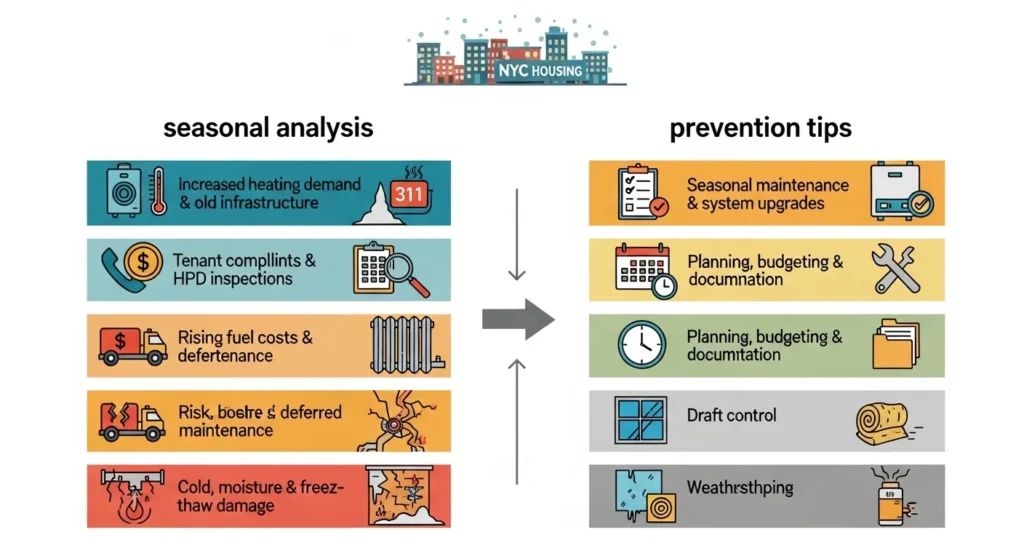
Every fall in New York City, we see the same pattern: temperatures drop, tenant 311 calls surge, and HPD violations pile up. Buildings that seemed “fine” in September suddenly rack up heat, hot water, and mold citations by January.
Winter doesn’t create problems out of thin air. It exposes everything that wasn’t maintained, upgraded, or documented during the warmer months. For owners and property managers, that can mean thousands of dollars in fines and emergency repairs. For tenants, it can mean unsafe, uncomfortable apartments right when they need stability the most.
In this guide, we break down why HPD violations spike in winter, what’s actually happening behind those HPD complaints, and the specific steps both owners and tenants can take to prevent issues before they become emergencies. We’ll also look at how to use tools like ViolationWatch and the city’s own records to stay ahead of NYC building violations and keep NYC property compliance from turning into a winter crisis.
Understanding HPD Violations And How They Work
Understanding HPD Violations And How They Work {#h2jOJTywhYgXwIWp1T1JC}
What Is HPD And What Does It Enforce?
The New York City Department of Housing Preservation and Development (HPD) is the city agency responsible for enforcing the Housing Maintenance Code in residential buildings. It’s the largest municipal housing agency in the country, and it exists for one core reason: to make sure apartments are safe, habitable, and maintained year-round.
During the heating season (October 1 to May 31), HPD’s role becomes especially visible. The agency enforces minimum standards for:
- Heat and hot water
- Structural safety
- Egress (safe ways out of the building)
- Basic services like gas, electricity, and sanitary conditions
If a building owner fails to provide these, HPD can step in, issue violations, and, in severe cases, arrange emergency repairs and bill the owner. You can see the Housing Maintenance Code and seasonal rules directly on HPD’s site at nyc.gov/hpd.
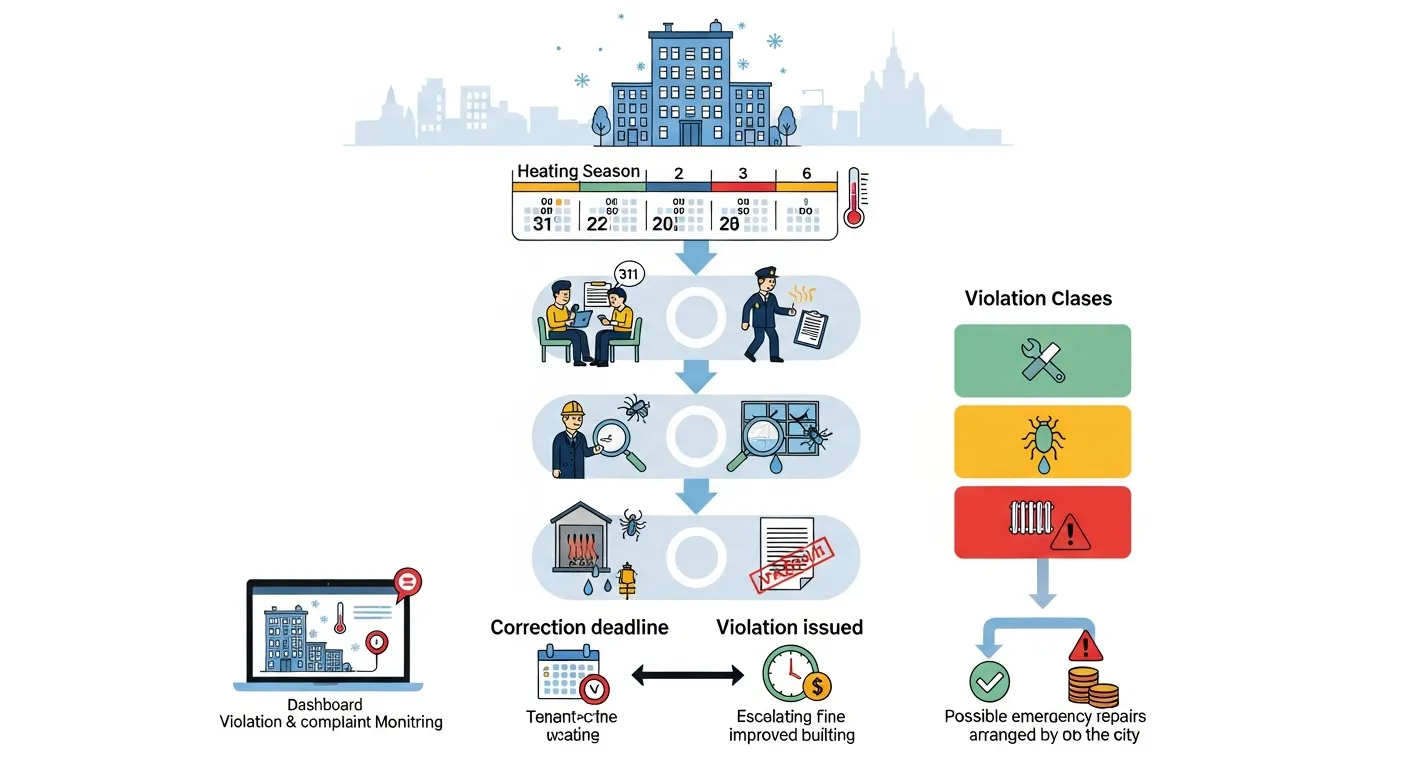
How HPD Violations Are Issued And Classified
Most HPD violations start with tenant complaints, usually made by calling 311 or using the city’s online systems. HPD also does proactive inspections, for example, through special initiatives that focus on buildings with a history of HPD complaints or significant NYC building violations.
When an inspector visits and documents a problem, HPD issues a violation and classifies it by severity:
- Class A (non-hazardous) – Lower-level issues that still need correction, such as minor peeling paint or small maintenance issues. Deadlines are more generous, and fines are lower.
- Class B (hazardous) – Conditions that could cause injury or affect health, like some leaks, pests, or broken windows.
- Class C (immediately hazardous) – Serious threats to health and safety, such as lack of heat or hot water, lead hazards, severe mold, or blocked egress. These carry the highest penalties and the shortest correction timelines.
Each violation cites a specific section of the Housing Maintenance Code, along with a date by which the owner must correct the condition. If the owner doesn’t certify correction on time, fines can escalate quickly.
To keep track of open HPD violations and even DOB violations for a property, we like to start with public data and then layer on monitoring. For free lookups, use our NYC violation lookup tool: NYC violation lookup tool. It pulls together violations and complaints into a simple, readable view so we’re not digging through multiple city databases every time a question comes up.
Common Types Of HPD Violations Seen In Winter
Common Types Of HPD Violations Seen In Winter {#uz6uSgTj6FwfUoC7MaEpy}
Winter doesn’t just increase the volume of HPD complaints, it shifts the type of problems inspectors see.
Heat And Hot Water Violations
In heating season, HPD enforces strict rules drawn from the Housing Maintenance Code:
- 6 a.m. to 10 p.m. – If it’s below 55°F outside, the apartment must be at least 68°F.
- 10 p.m. to 6 a.m. – Indoor temperature must be at least 62°F, regardless of outside temperature.
- Hot water must be provided 24/7 at a minimum of 120°F.
When boilers fail, fuel deliveries are missed, or distribution is uneven (e.g., top floors get no heat), tenants call 311. HPD inspectors usually respond quickly in cold weather, often within 24 hours. If they confirm low temperatures or lack of hot water, they issue Class C violations with steep penalties.
Window, Door, And Draft-Related Violations
Even if the boiler is working, heat can literally blow out the window. In winter, HPD frequently cites conditions like:
- Broken or missing windows
- Windows that won’t close or lock
- Damaged or missing storm windows
- Entrance doors that don’t close or latch
- Significant drafts due to gaps around frames or poorly sealed penetrations
These issues not only worsen comfort, they can tilt an otherwise compliant building into violation territory if drafts make it impossible to maintain required indoor temperatures.
Mold, Leak, And Pest Violations
Winter is peak season for hidden moisture problems to turn visible:
- Condensation builds up on cold walls and window frames.
- Freeze–thaw cycles open up roof or facade cracks, causing new leaks.
- Closed windows trap humidity from showers, cooking, and laundry.
The result is mold growth on ceilings, behind radiators, and around windows, conditions that can trigger Class B or Class C violations, especially if vulnerable tenants (children, older adults, people with asthma) are affected.
Cold weather also drives pests indoors. Mice, roaches, and other vermin take shelter inside walls and basements. If HPD finds evidence of infestations plus inadequate extermination efforts, owners can receive multiple violations in a single visit.
Elevator And Egress Issues In Cold Weather
Snow and ice don’t just make sidewalks slippery, they complicate basic building operations:
- Ice or snow blocking building entrances or stairway exits
- Accumulated snow on fire escapes that makes them unusable
- Elevators malfunctioning due to cold, moisture, or deferred maintenance
When egress routes are blocked, or elevators are repeatedly out of service, especially in buildings where elderly or disabled tenants rely on them, HPD can issue serious violations. In multifamily buildings, these issues can also overlap with Department of Buildings enforcement, making NYC property compliance even more complex.
Why HPD Violations Spike In Winter: Key Seasonal Factors
Why HPD Violations Spike In Winter: Key Seasonal Factors {#ZCO1Dof62Jra8JKtvvgUw}
Increased Heating Demand And Old Infrastructure
When temperatures plunge, heating systems run nonstop. In many NYC buildings, especially prewar walk-ups and older high-rises, boilers, distribution pipes, and controls are decades old. Minor issues that went unnoticed in October become system failures in January.
Common scenarios we see:
- Burners that were barely passing summer tests now short-cycle or shut down under full load.
- Old distribution piping doesn’t deliver even heat, so top floors call 311 while lower floors open windows.
- Automated controls or outdoor reset systems aren’t calibrated, causing under-heating during cold snaps.
This mismatch between high demand and aging infrastructure drives a large share of winter HPD violations.
Tenant Complaints And Seasonal Enforcement Cycles
HPD’s enforcement patterns closely track tenant complaints. In cold weather, calls to 311 about no heat or hot water surge.
HPD is required to give heat complaints high priority. During heating season, inspectors often:
- Respond within 24 hours for heat/hot water complaints
- Take actual temperature readings inside apartments
- Check hot water at taps
- Survey for visible mold, leaks, or safety hazards while on-site
So a single call about heat can lead to multiple discovered issues, and multiple violations. That’s one reason we view winter as enforcement season. If we aren’t ready, our buildings will be inspected under the harshest possible conditions.
Fuel Costs, Cash Flow Strain, And Deferred Maintenance
Winter is also when fuel costs spike. Buildings that rely on #2 or #4 oil, or that have poorly tuned systems, can see huge jumps in operating expenses. When cash flow tightens, some owners are tempted to:
- Delay boiler cleaning or part replacements
- Skip non-emergency repairs
- Put off roof, facade, or window work until “next spring”
That short-term thinking often backfires. A boiler that wasn’t serviced in October might fail in January, generating Class C heat violations, emergency repair costs, and potential HPD litigation. Instead of saving money, the building slides deeper into NYC building violations.
Cold, Moisture, And Freeze–Thaw Damage
Winter weather punishes buildings in ways we don’t always see from the street:
- Water seeps into tiny cracks in masonry and then freezes, expanding and widening the damage.
- Ice dams form on roofs and gutters, forcing water back under roofing membranes.
- Pipes in under-insulated areas freeze, then burst when they thaw.
This freeze–thaw cycle turns small vulnerabilities into active leaks and structural problems. By the time HPD inspects a unit for heat, they might also find:
- New ceiling leaks
- Peeling paint and potential mold
- Damaged plaster from repeated moisture
All of that can result in additional HPD violations and, where structural safety is questioned, potential DOB violations as well.
How Winter Weather Exposes Underlying Building Problems
How Winter Weather Exposes Underlying Building Problems {#O7spnSpOJTILPDydN2_kc}
Winter doesn’t invent new weaknesses: it reveals the ones already there.
How Poor Ventilation Leads To Mold And Indoor Air Issues
In warm months, tenants naturally ventilate apartments by opening windows. In winter, we shut everything tight to keep heat in. The result: humidity from showers, cooking, and even breathing has nowhere to go.
Without adequate mechanical ventilation or window venting, moisture:
- Condenses on cold surfaces (exterior walls, window frames, corners)
- Soaks into drywall and plaster
- Feeds mold behind furniture, around radiators, and in closets
HPD inspectors are increasingly focused on indoor air quality and visible mold. What might start as a few dark spots can, if ignored, turn into a fully cited condition with deadlines and fines. This is especially true in buildings already flagged for asthma-related HPD complaints.
Impact On Building Systems: Plumbing, Boilers, And Roofs
Different systems fail in different ways under winter stress:
- Plumbing – Pipes near exterior walls, basements, or unheated spaces are more likely to freeze. Once thawed, they can burst, causing major leaks that damage multiple units and trigger mold violations.
- Boilers and heating plants – Constant cycling and peak loads expose weak circulator pumps, old controls, and tired burners.
- Roofs – Snow loads and ice buildup exploit every weakness in flashing, parapets, and drains. A roof that “never leaks” suddenly does when ice dams trap melting snow.
From an HPD perspective, the visible outcome is what matters: leaks, damaged ceilings, unsafe heat levels, or compromised egress. But behind every winter violation there’s almost always a neglected system issue we could have addressed earlier.
Health, Safety, And Habitability Concerns
At the center of HPD’s mission is habitability. Winter problems hit that core directly:
- Inadequate heat and hot water threaten health, especially for children, older adults, and people with chronic illnesses.
- Mold and dampness worsen asthma and respiratory conditions.
- Blocked egress and failing elevators increase risk in emergencies.
According to multiple public health studies cited by HPD and the NYC Department of Health, chronic dampness and cold indoor environments correlate with increased ER visits and long-term health issues. HPD violations in winter aren’t just red tape, they’re often red flags for real safety concerns.
To monitor emerging issues before they become citations, many of us rely on third-party tracking like ViolationWatch (https://violationwatch.nyc/) alongside city data. Get instant alerts whenever your building receives a new violation, sign up for real-time monitoring using our building violation alerts service. That way, we can move from reactive damage control to proactive NYC property compliance.
Risks Of Ignoring Winter HPD Violations
Risks Of Ignoring Winter HPD Violations {#B0HsJzKKJFTSkxXTJ5fHs}
Fines, Penalties, And Emergency Repairs
Winter HPD violations are expensive to ignore. For heat and hot water violations, HPD can impose daily penalties that add up fast.
Public guidance from HPD and the NYC Administrative Code shows that initial penalties for heat violations can reach $250–$500 per day, per violation, with higher tiers for repeat offenders. In a large multifamily building, a single cold weekend can generate $10,000 or more in potential fines, before we even factor in emergency plumbing or boiler repairs.
If owners fail to act, HPD can:
- Place the building in the Emergency Repair Program (ERP)
- Hire contractors directly to restore heat, hot water, or address severe leaks
- Bill the owner for the work, plus administrative fees and potential tax liens
Details on ERP and penalties are laid out on HPD’s site at nyc.gov/hpd.
Legal Exposure And Tenant Claims
Chronic winter violations don’t stay administrative forever. They can evolve into:
- HP actions in Housing Court, where HPD or tenants sue to compel repairs
- Rent abatements and overcharge claims related to uninhabitable conditions
- Tenant-organized rent strikes
- Class actions or pattern-and-practice cases in the most serious situations
Once a property gains a reputation for no heat, leaks, or mold, it becomes far easier for tenants (and their attorneys) to show a pattern of neglect using HPD records. This is where good documentation, prompt corrections, and consistent NYC property compliance are worth far more than they cost.
Reputation, Vacancy Risk, And Long-Term Costs
Beyond court and fines, there’s another cost we tend to underestimate: reputation.
In a city where listings and building histories are only a Google search away, a building with recurring winter HPD complaints and DOB violations will:
- Struggle to attract quality, long-term tenants
- Face pressure on rents
- See higher turnover and vacancy
On the ownership side, persistent HPD violations and open issues can complicate financing, refinancing, and sales, as lenders and buyers increasingly review compliance history alongside physical condition. The cheapest path, ironically, is usually the one that looks expensive on the front end: proactive maintenance and rapid response in winter.
Proactive Winter Prep For Owners And Property Managers
Proactive Winter Prep For Owners And Property Managers {#OcU-H6jaH0nUupl5KRkAZ}
Winter doesn’t have to be violation season. With a structured plan, we can dramatically reduce HPD complaints and keep NYC building violations under control.
Seasonal Maintenance Planning And Budgeting
Good winter performance starts in late summer and early fall. We recommend:
- Creating a checklist that covers boilers, roofs, facades, windows, and common areas
- Budgeting for at least one comprehensive boiler service before heating season
- Reserving contingency funds for unexpected work (e.g., pipe bursts, pump failures)
We also like to review last year’s HPD complaints and violations. Patterns, like repeated leaks in the same line or chronic cold on top floors, tell us where to focus.
Boiler, Heating System, And Thermostat Checks
Before October 1, we should:
- Schedule a full boiler tune-up (cleaning, nozzle changes, combustion analysis)
- Test all pumps, controls, and low-water cutoffs
- Confirm proper operation of thermostats and outdoor reset controls
- Run test heat cycles and spot-check unit temperatures on different lines and floors
If tenants see that we’re testing early and communicating clearly (“we’ll be running heat tests between 8 a.m. and noon”), they’re more likely to reach out directly to us, before calling 311.
Insulation, Weatherproofing, And Draft Control
To keep heat where we’re paying for it to be, we focus on the envelope:
- Inspect and repair window seals, sashes, and locks
- Make sure entry doors self-close and latch properly
- Add or repair weatherstripping on lobby and stairwell doors
- Address known cold spots with insulation and air sealing where practical
Better weatherproofing not only improves comfort: it reduces fuel usage and lowers the risk that borderline apartments dip below HPD’s required temperatures during a cold snap.
Moisture Management: Roofs, Gutters, And Plumbing
Moisture control is a huge part of avoiding winter HPD violations:
- Clean gutters and roof drains before the first snow
- Inspect roof flashing, parapets, and penetrations for obvious vulnerabilities
- Insulate exposed plumbing in basements, mechanical rooms, and near exterior walls
- Identify and repair slow leaks before they show up as winter ceiling stains
When we pair this with regular internal inspections, hallways, basements, boiler rooms, we’re more likely to catch new issues early.
Documentation, Access Notices, And Vendor Coordination
HPD cares about results, but having our paperwork in order helps if something goes wrong.
Best practices include:
- Keeping maintenance logs for boiler service, inspections, and repairs
- Saving invoices and reports from licensed plumbers, boiler technicians, and roofers
- Providing clear access notices to tenants for in-unit work (and keeping proof of posting/delivery)
- Building relationships with reliable vendors before peak season so we’re not scrambling in a cold emergency
Tools like ViolationWatch help us tie all of this together by watching city systems for new entries. For ongoing monitoring, we recommend setting up building violation alerts so we’re notified the moment a new HPD or DOB issue appears. That’s often the difference between a quick fix and a winter-long dispute.
Practical Prevention Tips For Tenants During Winter
Practical Prevention Tips For Tenants During Winter {#sy1cxiDfbuHKNKm1EouFV}
Owners and managers carry the legal responsibility for code compliance, but tenants play a critical role in spotting and reporting problems early.
Recognizing Serious Conditions And When To Report
Tenants shouldn’t hesitate to report conditions that clearly cross the line from “annoying” to unsafe or uninhabitable. These include:
- No heat or indoor temperatures below HPD requirements
- No hot water, or only lukewarm water at all taps
- Active leaks, ceiling collapses, or severe water damage
- Visible mold spreading on walls, ceilings, or around windows
- Blocked exits, broken self-closing doors, or consistently nonworking elevators
We encourage tenants to contact building management first when it’s safe and reasonable to do so, but if there’s no response, or the issue is urgent, calling 311 is appropriate.
Simple At-Home Steps To Improve Comfort And Safety
There are also small steps tenants can take to reduce drafts and moisture while they wait for repairs or inspections:
- Use draft stoppers at the base of doors leading to hallways or outdoors
- Keep radiators and heaters clear of furniture and curtains so heat can circulate
- Avoid blocking supply or return vents in forced-air systems
- Run exhaust fans when cooking or showering, if available
- Wipe condensation from windowsills and frames to reduce mold risk
These actions don’t replace an owner’s legal obligations, but they can keep conditions manageable and prevent minor issues from escalating.
Communicating With Landlords And Keeping Records
Good documentation protects everyone. When tenants experience serious conditions, it helps to:
- Report the issue in writing (email, text, or maintenance portal)
- Note the date, time, and indoor temperature if heat is the problem
- Take clear photos or short videos of leaks, mold, or broken equipment
If HPD becomes involved, a written trail shows that tenants raised concerns promptly, and can also show that an owner responded in good faith, which matters if disputes arise.
Using 311 And Tracking HPD Complaints
When direct communication fails or conditions are urgent, tenants should:
- Call 311 and clearly describe the problem (e.g., “no heat,” “no hot water,” “leak through bedroom ceiling”).
- Record the complaint number provided by the operator.
- Allow inspectors access when they come, if possible, so they can see the conditions firsthand.
Both tenants and owners can later look up HPD complaints and violations using city tools or third-party services. For a quick, public check on a building’s history, our NYC violation lookup tool at https://lookup.violationwatch.nyc/lookup offers a simple way to see open HPD complaints, existing NYC building violations, and more in one place.
Working With HPD: Inspections, Corrections, And Compliance
Working With HPD: Inspections, Corrections, And Compliance {#BeepKRWW9xdxPBkTTbbXF}
When HPD shows up in the middle of winter, how we handle that interaction often determines whether a problem gets resolved quickly or turns into a season-long headache.
What To Expect During A Winter HPD Inspection
After a 311 complaint, HPD will typically:
- Visit the building and, when possible, the specific apartment reported
- Take temperature readings in rooms and at hot water taps
- Inspect visible conditions: leaks, mold, broken windows, doors, and egress
- Document findings with photos and notes
If violations are found, HPD issues a notice that lists:
- The class of violation (A, B, or C)
- The code section violated
- The deadline to correct the issue
Information about the inspection and resulting violations will appear in HPD’s public database, and often in NYC Open Data as well.
Correcting Violations Quickly And Properly
The key to minimizing damage is speed and completeness:
- Address emergency conditions (heat, hot water, major leaks) immediately, often same day.
- Use licensed professionals where required (plumbers, electricians, boiler technicians).
- Fix the underlying cause, not just the visible symptom, especially for leaks and mold.
- Once complete, certify correction with HPD following the exact instructions on the notice.
Failing to certify, even after doing the work, can keep violations open and penalties accruing. HPD explains the certification process in detail on its site: https://www.nyc.gov/site/hpd/services-and-information/hpd-violations.page.
Preventing Repeat Violations And Building A Compliance Routine
We’ve found that the buildings with the fewest winter violations aren’t perfect: they’re organized. Their teams:
- Conduct self-inspections of common areas, basements, boiler rooms, and roofs
- Review open HPD and DOB issues monthly
- Track HPD complaints so they can respond before violations escalate
- Keep a simple compliance calendar for heating season tasks
Pairing that routine with monitoring tools creates a safety net. With ViolationWatch, for instance, we can centralize HPD, DOB, and other NYC building data instead of checking multiple city portals. Setting up building violation alerts ensures that new winter violations or HPD complaints don’t sit unnoticed until the next billing cycle.
For deeper due diligence, especially if we’re evaluating a building to buy, refinance, or take over management, we complement HPD and DOB data with market insights from reputable publications like The Real Deal and Brick Underground, both of which frequently cover compliance and housing quality issues in NYC.
Conclusion
Conclusion {#fMLcRL9iZkvkGywVTEWMY}
Winter in New York City is a stress test for every multifamily building. Boilers, pipes, roofs, windows, and ventilation systems all get pushed to their limits. When those systems aren’t ready, HPD violations spike, driven by cold apartments, leaks, mold, and blocked egress.
We don’t have to accept that as inevitable. If we understand how HPD violations work, why HPD complaints rise in winter, and what inspectors look for, we can plan ahead. Owners and managers can invest in seasonal maintenance, better documentation, and faster response. Tenants can learn to recognize serious conditions early, communicate clearly, and use 311 when needed.
Data and monitoring finish the picture. Public city records are powerful, but only if we actually watch them. That’s why we built ViolationWatch and our integrated tools. For quick checks on current issues and history, start with our NYC violation lookup tool. For ongoing oversight across portfolios, use our building violation alerts to make sure no winter violation goes unnoticed.
Eventually, winter doesn’t just test buildings, it tests how seriously we take habitability and compliance. When we treat NYC property compliance as a year-round responsibility instead of a seasonal scramble, we protect our residents, our assets, and the city’s housing stock at the same time.
Key Takeaways
- HPD violations spike in winter because cold weather exposes underlying issues in heating systems, building envelopes, and moisture control that were neglected during warmer months.
- Most winter HPD violations involve lack of heat or hot water, drafts from damaged windows and doors, and moisture-related problems like leaks, mold, and pests that worsen habitability and tenant health.
- Ignoring winter HPD violations can quickly lead to steep daily fines, HPD emergency repairs, legal actions from tenants, and long‑term damage to a building’s reputation and financing options.
- Owners and property managers can reduce winter HPD violations by planning seasonal maintenance in late summer and fall, tuning boilers, sealing drafts, managing roof drainage, and documenting all work and access attempts.
- Tenants help prevent emergencies by reporting serious conditions promptly, using 311 when necessary, keeping basic records (photos, complaint numbers), and taking simple steps to reduce drafts and indoor moisture.
- Using tools like ViolationWatch, NYC’s public records, and building violation alerts allows both owners and tenants to monitor HPD complaints in real time and stay ahead of NYC property compliance during winter.
Frequently Asked Questions About Winter HPD Violations in NYC
Why do HPD violations spike in winter in New York City?
HPD violations spike in winter because cold weather exposes existing weaknesses in building systems. Aging boilers run nonstop, pipes and roofs fail under freeze–thaw cycles, drafts make it hard to maintain legal temperatures, and moisture leads to leaks and mold. Increased 311 complaints trigger more inspections and more documented HPD violations.
What are the most common winter HPD violations owners should watch for?
The most common winter HPD violations involve lack of heat or hot water, broken or drafty windows and doors, leaks and resulting mold, pest infestations driven indoors by cold, and blocked egress from snow or ice. Elevator outages also draw attention, especially in buildings with elderly or disabled tenants.
How can owners prevent HPD violations during the heating season?
To prevent winter HPD violations, owners should service boilers before October 1, test heating distribution and thermostats, seal windows and doors, clean roofs and gutters, insulate vulnerable pipes, and fix known leaks. Keeping maintenance logs, coordinating vendors in advance, and monitoring HPD records with tools like ViolationWatch helps catch issues early.
What should tenants do if they have no heat or hot water in winter?
Tenants should first contact the landlord or management in writing and record the indoor temperature and times. If there’s no prompt response, they should call 311 and report “no heat” or “no hot water,” keep the complaint number, and allow HPD inspectors access so violations can be documented and enforced.
How does monitoring NYC building violations help with winter compliance?
Active monitoring of NYC building violations lets owners and managers respond before problems escalate. Using city data and tools like a NYC violation lookup or automated building violation alerts, they can track new HPD complaints, open violations, and DOB issues, prioritize repairs, and demonstrate a consistent NYC property compliance routine.
Can HPD winter violations affect financing, sales, or long‑term building value?
Yes. A history of recurring HPD violations—especially winter heat, hot water, leaks, and mold issues—can hurt a building’s reputation, increase vacancies, and weaken rent potential. Lenders and buyers increasingly review HPD and DOB records, so poor NYC property compliance can complicate financing, refinancing, and sales, and reduce long‑term asset value.