
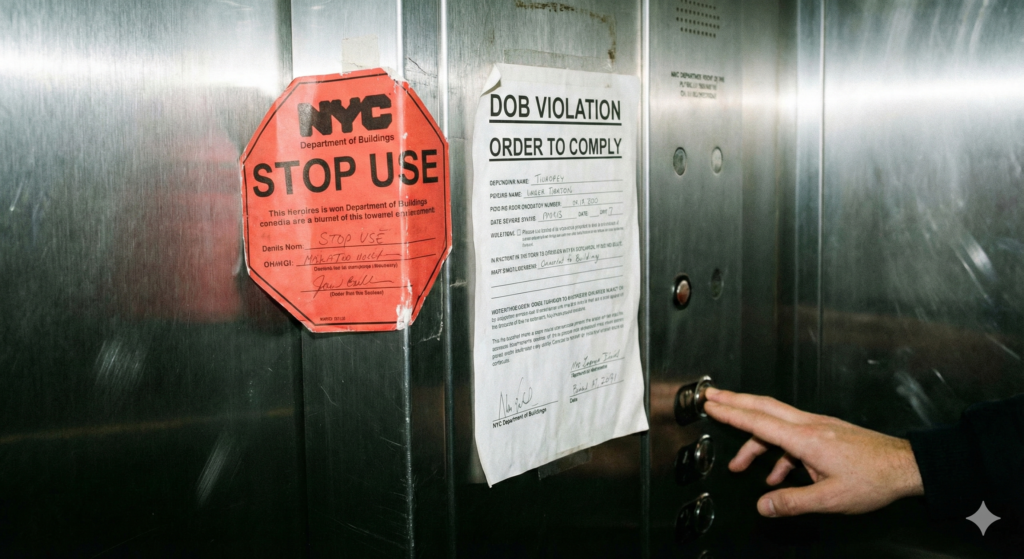
If we own or manage a building in New York City, a DOB elevator violation isn’t just a piece of paper, it’s a legal notice that our equipment isn’t in compliance and needs correction fast. It can affect tenant safety, building insurance, refinancing, and even future sales.
The good news: most DOB elevator violations are fixable if we understand what we’re dealing with and move in the right order. In this guide, we’ll walk through how NYC elevator enforcement actually works, how to read the violation, who we need on our side, and the exact steps to clear it from DOB records, and keep it from coming back.
We’ll focus on practical, real‑world guidance for owners, property managers, boards, and supers trying to stay on top of NYC building violations and broader NYC property compliance.
Understanding DOB Elevator Violations
A DOB elevator violation is an official notice from the NYC Department of Buildings that our elevator or conveying device (escalator, dumbwaiter, etc.) isn’t complying with the Building Code, DOB rules, or required inspection and filing schedules.
In plain language: the City is telling us something is unsafe, unmaintained, or undocumented, and we have to correct it and formally prove we did.
Why DOB issues elevator violations
Most DOB elevator violations fall into a few buckets:
- Unsafe or hazardous conditions – Problems that could directly affect passenger safety. Think failed brakes, faulty door restrictors, missing emergency communication, or fire service malfunctions.
- Failure to maintain – Worn parts, oil leaks, leveling issues, missing signage, or other deficiencies found during required inspections or tests.
- Missed inspections or tests – Not completing or filing the annual CAT1 test, the five‑year CAT5 test, or other periodic inspections on time.
- Failure to file required reports – The tests may have been done, but if the paperwork isn’t submitted and accepted in DOB’s systems, DOB treats it as non‑compliance.
Per DOB policy, violations remain on record until:
- All civil penalties are paid or formally waived, and
- Corrections are completed and affirmed through the correct DOB process.
Until both are done, the violation continues to appear in DOB systems like BIS and DOB NOW: Safety and can surface during financing, due diligence, or HPD complaints reviews.
For official definitions and current rules, we always cross‑check with DOB’s own resources, especially the DOB Elevators page and the DOB NOW: Safety help materials.
Common Types Of Elevator Violations
Knowing what type of DOB elevator violation we’re dealing with is half the battle. Each category has its own path to clearance and penalties.
1. Failure to maintain
These are issued when an inspection or test finds conditions that violate code or DOB rules. Examples:
- Door restrictors not working properly
- Elevator not leveling correctly at floors
- Oil leakage in the pit
- Missing or broken emergency phone
- Worn hoist ropes or chains
DOB may classify issues as hazardous or non‑hazardous. Hazardous items usually come with a tighter correction window and can trigger enforcement if we delay.
2. Failure to file CAT1/CAT5 or periodic inspections
Every NYC elevator is subject to:
- Annual CAT1 test
- Five‑year CAT5 test (full load or no‑load depending on device)
- Required periodic inspections by an approved inspection agency
If the test isn’t done, or the report isn’t filed and accepted by DOB by the deadline, we can receive a failure‑to‑file violation. These are common and can carry significant civil penalties.
3. Hazardous vs. non‑hazardous conditions
On the violation or associated reports, DOB or the inspector may flag conditions as:
- Hazardous – Items that present an immediate or serious risk to passengers. These demand quick correction, and DOB may issue separate enforcement if we don’t act.
- Non‑hazardous – Still violations, but typically given a slightly longer correction window.
Both must be cleared, but we should always tackle hazardous items first.
4. PVT (private inspection) and “no access” violations
NYC uses Private Elevator Inspection Agencies for certain inspections and tests. When they can’t gain access or find serious issues, we may see:
- No access violations – The inspector couldn’t reach the machine room, hoistway, or elevator. DOB treats this almost like a missed test.
- PVT violations for defects – Conditions identified by the private inspector that must be corrected and then affirmed.
These can be confusing because we’re dealing with both DOB and the private agency. The key is to coordinate repairs and get the agency to document corrections and, where applicable, file the ELV29 Affirmation of Correction or equivalent documentation.
If we’re unsure which violations are open on a given building, we can check the City’s systems and also run an independent search. For free lookups, use our NYC violation lookup tool, which pulls together open issues across multiple NYC data sources.
How To Read And Decode Your Violation Notice
DOB violation notices and inspection reports can look dense, especially if we don’t read them every day. But almost every document boils down to a few key data points.
The essential fields
When we get a DOB elevator violation, we want to find:
- Violation number – The unique ID DOB uses to track this case.
- Device number – The elevator or device ID, tied to DOB’s elevator database.
- BIN / address – The building identification number and street address.
- Violation type – Failure to file, failure to maintain, hazardous, non‑hazardous, etc.
- Description of defects – Short notes listing the conditions (e.g., “Door restrictor inoperative,” “No emergency phone,” “CAT1 report not filed”).
- Correction deadline – Often 10 days for certain DOB elevator violations, but can vary depending on type and severity.
- Penalty information – Base fines, daily penalties, or late fees that apply if we miss deadlines.
- Hearing or response instructions – If the matter is linked to OATH (the NYC Office of Administrative Trials and Hearings), the notice will indicate hearing options or ways to respond.
DOB’s Building Information System (BIS) and DOB NOW: Safety each show slightly different views of the same case, so we often need to check both.
Matching the violation to actual conditions
Once we’ve pulled these basics, we should:
- Walk the property with the notice in hand.
- Verify each cited condition with our elevator maintenance team.
- Clarify anything vague – For example, if the description says “machine room housekeeping,” we want concrete direction: oil cleanup, lighting, egress clearance, etc.
For paperwork‑only issues (like failure to file CAT1), the “condition” is administrative, but DOB still treats it as a violation. We still need both payment and proper filing to clear it from record.
If at any point we’re confused by the codes or abbreviations, a licensed elevator agency or code consultant can usually explain them in a few minutes. It’s worth that call up front to avoid missteps later.
Immediate Steps To Take When You Receive A Violation
The first hours and days after we receive a DOB elevator violation matter. We don’t need to panic, but we do need to move in a structured way.
Step 1: Read the notice carefully
We start by confirming:
- Is the violation hazardous or non‑hazardous?
- Is it failure to maintain, failure to file, or both?
- What are the stated deadlines for correction and for any hearings or responses?
We log those dates immediately in our compliance calendar. For larger portfolios, many owners pair this with outside tracking tools like ViolationWatch to consolidate DOB violations, HPD complaints, ECB/OATH cases, and more.
Step 2: Notify our elevator maintenance company
Next, we send the violation and any supporting reports to our licensed elevator maintenance company. Ideally, they:
- Inspect the device promptly (if they haven’t already)
- Confirm the defects DOB cited
- Flag any additional issues that should be corrected at the same time
- Give us an estimated repair scope, cost, and timeline
If the violation stems from a PVT inspection, we include the PVT agency in the conversation as well.
Step 3: Address hazardous and “no access” situations first
If the violation references hazardous conditions or “no access” findings:
- We arrange repairs or access immediately, even if quotes aren’t fully settled.
- In high‑risk situations, we may need to remove the elevator from service temporarily until issues are fixed.
- For “no access” PVT cases, we coordinate with building staff to guarantee access on a specific date and time for the re‑inspection.
Step 4: Bring in legal or code specialists when needed
We don’t necessarily need a lawyer for every DOB elevator violation. But we seriously consider counsel or a code consultant when:
- Penalties are large or stacking up over multiple years
- We’re facing an OATH hearing
- There’s a dispute about whether a violation is justified
- We’re in the middle of a sale or refinance and timelines are tight
An experienced attorney who regularly handles NYC building violations can sometimes negotiate reduced penalties or help us structure a compliance plan that satisfies DOB while minimizing disruption.
Planning And Completing The Required Repairs
Once we understand what DOB is asking for, we move into the repair phase. This is where coordination between owners, management, and elevator professionals really matters.
Use qualified, independent elevator professionals
DOB rules require that maintenance agencies and inspection/testing agencies be independent of each other. So in practice we may be working with:
- Our regular maintenance company (responsible for ongoing upkeep and many repairs)
- A separate certified elevator inspection company or PVT agency
For complex modernizations or multiple hazardous findings, we may also involve an engineer specializing in vertical transportation.
Prioritize life‑safety items
We always tackle life‑safety issues first. In the elevator world, that typically means:
- Brakes and stopping performance
- Hoist ropes and suspension means
- Door operation and door restrictors
- Emergency communication (cab phone or intercom)
- Firefighters’ service and fire recall
- Emergency lighting and alarm systems in the car
Even if the violation notice mixes minor and major items, we focus on anything that could directly compromise passenger safety.
Document everything
DOB and PVT agencies increasingly expect a clear paper trail. While our elevator company handles a lot of this, we should keep our own set of:
- Work orders and invoices
- Before/after photos (especially for visible conditions like machine room housekeeping or pit conditions)
- Test reports and logbooks
- Any manufacturer certifications for replacement equipment
If DOB questions whether a condition was actually corrected, this documentation can be the difference between a quick resolution and a drawn‑out dispute.
Coordinate repairs with tenants and operations
Elevator work can be highly disruptive, especially in walk‑ups with a single elevator or in senior housing. We try to:
- Schedule noisy or prolonged work during lower‑traffic hours
- Communicate clearly with residents or commercial tenants
- Post signage explaining outage dates and times
From a compliance standpoint, communication won’t erase a violation, but it helps prevent HPD complaints and keeps pressure down while we work through the repairs.
Filing Paperwork And Scheduling Re‑Inspections
This is the part many owners underestimate. Fixing the elevator is necessary, but it doesn’t clear a DOB elevator violation by itself. We must follow DOB’s procedures to prove correction.
Use DOB NOW: Safety – Violations
For most current violations, we:
- Create or log into a NYC.ID account.
- Access DOB NOW: Safety – Violations.
- Search by device number, address, or violation number.
- Review the open violations and their status.
DOB publishes step‑by‑step guidance on its DOB NOW: Safety page, which we refer to regularly since interface details change over time.
Different paths by violation type
1. Failure‑to‑file CAT1/CAT5 or periodic inspection
To clear these, we usually must:
- Pay the civil penalties associated with the missed filing.
- Ensure the current CAT1/CAT5 test has been performed and filed, and that DOB shows it as “accepted” in DOB NOW.
For older violations (generally pre‑2016), payment alone may dismiss the violation. For newer ones, DOB expects both payment and an accepted inspection/test report.
2. Hazardous or “no access” conditions
After repairs, a certified elevator company or the original PVT agency typically:
- Submits a correction letter describing the work.
- Requests a DOB re‑inspection if required.
Depending on DOB’s current rules, this might be done directly through DOB NOW: Safety or via specific forms.
3. Non‑hazardous conditions – ELV29 Affirmation of Correction
For many non‑hazardous elevator defects, DOB allows clearance via an Affirmation of Correction (Form ELV29). In practice:
- The approved elevator agency or inspection agency completes the ELV29.
- It’s submitted either through DOB NOW or, in some PVT contexts, as a paper filing.
Once DOB accepts the affirmation and any required tests, the violation can be updated to “dismissed” in BIS and DOB NOW.
Track status until it’s officially dismissed
We never assume a violation is cleared just because the work is done or a form was submitted. We:
- Monitor the violation status in DOB NOW and BIS
- Confirm that the status changes to “dismissed” or equivalent
- Save a dated screenshot or PDF for our records
To make this less manual, many owners register for building violation alerts so they get notified when new violations appear or existing ones change status. Get instant alerts whenever your building receives a new violation, sign up for real-time monitoring using those building violation alerts.
Working With Elevator Companies, Inspectors, And Attorneys
Clearing a DOB elevator violation is a team sport. If any one party drops the ball, owner, maintenance contractor, inspection agency, or attorney, the case can drag on.
Choosing and managing elevator agencies
We look for licensed, insured, and DOB‑approved elevator agencies with:
- A track record in our building type (walk‑up residential, high‑rise commercial, mixed‑use, etc.)
- Familiarity with NYC Building Code and DOB elevator rules
- Clear internal procedures for DOB NOW submissions and ELV29 filings
We also confirm they’re properly independent from the inspection/testing agency, as DOB requires.
It helps to designate one point of contact on our side, a property manager or portfolio compliance lead, who owns communication and deadlines.
Coordinating with private inspectors (PVTs)
For devices inspected by PVT agencies, we:
- Share violation details and repair scopes promptly
- Arrange re‑inspections as soon as work is complete
- Verify that the PVT files their part of the paperwork (such as updated inspection reports or affirmations of correction)
Remember: the PVT doesn’t have the power to dismiss a DOB violation by itself. They document conditions and corrections: DOB eventually updates the official record.
When we bring in attorneys or code consultants
Legal or code support is particularly useful when:
- We’ve accumulated multiple years of failure‑to‑file fines
- DOB disputes whether conditions were fully corrected
- We’re facing OATH hearings that could lead to additional penalties
- We’re under pressure from lenders or buyers to deliver a “clean” DOB history on a tight timetable
An experienced NYC real estate attorney, especially one who regularly appears at OATH and deals with NYC building violations, can often help structure settlements or compliance agreements that keep fines and delays under control.
Costs, Timelines, And What To Expect During The Process
Every case is different, but there are patterns in how DOB elevator violations play out.
Typical costs
Costs generally fall into three categories:
- Repairs and modernization – Anything from a few hundred dollars for minor adjustments to tens of thousands (or more) for major work like controller replacement or cab modernization.
- Civil penalties – For failure to file, failure to maintain, and late corrections. Penalties can easily run $1,000–$5,000 per violation, sometimes more depending on the building’s use group and specific test.
- Professional fees – Elevator engineers, code consultants, and attorneys where needed.
DOB updates penalty schedules periodically, so we always confirm current amounts through official resources like the DOB service notices or by speaking with our attorney or consultant.
Timelines
Realistically, we should expect:
- Repairs: From a few days for straightforward fixes to several weeks if parts need to be ordered or DOB permits are required for major work.
- Re‑inspections: Scheduling depends on PVT and DOB workloads: re‑inspections may occur within days or a few weeks after request.
- Administrative closure: Even after everything is done, BIS and DOB NOW may take time to update. We factor in processing lag when planning for closings or refinancing.
For violations tied to missed CAT1/CAT5 filings, it’s common for owners to discover older open violations when preparing for a sale. Clearing a backlog spanning several years can take months, especially if multiple devices and addresses are involved.
What happens if we ignore a violation
Leaving an elevator violation unaddressed can lead to:
- Increasing civil penalties and late fees
- Additional enforcement actions or stop‑use orders
- Problems with insurance coverage if an incident occurs
- Headaches during HPD complaints investigations
- Red flags in any lender or buyer due diligence
In the worst case, particularly if there’s an accident tied to known unsafe conditions, the legal and financial exposure can be far greater than the original repair and penalty costs.
How To Prevent Future DOB Elevator Violations
Clearing a violation is one thing: making sure it doesn’t come back is another. We treat every case as a lesson in improving our NYC property compliance overall.
1. Stay ahead on inspections and tests
We build a calendar that tracks:
- Twice‑yearly inspections and preventive checks
- Annual CAT1 tests
- Five‑year CAT5 tests
- Any additional manufacturer‑recommended checks
We confirm that our testing agency is independent from our maintenance company, and that both understand their responsibilities under DOB rules.
2. Maintain a preventive maintenance program
Instead of waiting for annual tests or HPD complaints to flag issues, we:
- Schedule regular maintenance visits
- Ask for written reports after each visit
- Prioritize recurring issues instead of repeatedly resetting them
It’s cheaper to replace a worn component on our own schedule than to rush‑order it after a failed inspection.
3. Track filings, not just work
One of the most common reasons we see NYC building violations pile up is simple: the work gets done, but no one tracks the filings.
To avoid this, we:
- Require our elevator vendors to confirm when CAT1/CAT5 and ELV29 forms are filed
- Spot‑check DOB NOW: Safety to confirm reports show as “accepted”
- Set internal reminders 60–90 days before filing deadlines
We also use digital tools to centralize tracking. If we manage multiple buildings, platforms like ViolationWatch can help us monitor open DOB violations, ECB/OATH cases, and related items across a portfolio.
Get instant alerts whenever your building receives a new violation, sign up for real-time monitoring using our building violation alerts, so we’re not blindsided months later.
4. Keep complete records
We maintain a dedicated digital folder (per building and per device) for:
- Contracts with elevator companies and inspection agencies
- All test reports and DOB filings
- Work orders, invoices, and photos
- Copies or screenshots of DOB NOW and BIS records showing dismissed violations
These records save time during future DOB reviews, insurance renewals, and property sales.
5. Monitor violations and complaints regularly
We don’t wait until we’re in contract to sell a building to learn what’s on record. We:
- Periodically check DOB and HPD systems for new issues
- Use the NYC violation lookup tool for fast, consolidated checks on open violations
- Encourage supers and managers to report early warning signs: slow doors, frequent entrapments, odd noises
Catching small problems early is the easiest way to prevent the next DOB elevator violation.
Conclusion
Clearing a DOB elevator violation in NYC isn’t glamorous work, but it’s straightforward when we tackle it methodically.
We identify the violation type, decode the notice, and move quickly on hazardous or missed‑filing issues. We bring in the right elevator agencies, document repairs thoroughly, and then follow DOB’s own processes, DOB NOW, ELV29, re‑inspections, until the status officially flips to dismissed in BIS.
From there, prevention is about habits: on‑time CAT1 and CAT5 tests, independent agencies, preventive maintenance, and tight tracking of filings and deadlines. When we treat NYC building violations as a system to manage rather than a series of emergencies, the whole portfolio runs smoother.
If we want help keeping everything centralized, we can lean on tools like ViolationWatch and register for building violation alerts so nothing slips through the cracks. And whenever we need a quick status check across agencies, we can run a fast search with the NYC violation lookup tool before the next inspection, financing, or board meeting.
The ultimate goal isn’t just clearing this one DOB elevator violation, it’s building a compliance routine that keeps our elevators safe, our records clean, and our tenants confident every time the doors close.
Key Takeaways
- A DOB elevator violation in NYC signals non‑compliance that can impact safety, insurance, financing, and sales, so you must address it quickly and systematically.
- To clear a DOB elevator violation, first decode the notice (type, hazard level, deadlines, penalties), then coordinate with your licensed elevator maintenance company and, if applicable, PVT agency.
- Hazardous conditions and “no access” findings take priority: arrange immediate repairs or access, document all work, and be prepared to temporarily remove the elevator from service if safety is at risk.
- Repairs alone do not clear a DOB elevator violation; you must complete required filings in DOB NOW: Safety, pay civil penalties, and, where applicable, submit ELV29 Affirmations of Correction or request re‑inspections until the status shows as dismissed.
- Staying ahead of future DOB elevator violations requires proactive maintenance, strict tracking of CAT1/CAT5 testing and filings, centralized record‑keeping, and ongoing monitoring of DOB, HPD, and violation alert tools.
Frequently Asked Questions About Clearing a DOB Elevator Violation
How do I clear a DOB elevator violation in NYC?
To clear a DOB elevator violation, identify the violation type, correct all cited defects with a licensed elevator company, prioritize hazardous items, pay any civil penalties, then submit the required paperwork (such as test reports or ELV29) through DOB NOW: Safety. Finally, confirm the status shows as dismissed in BIS and DOB NOW.
What are the main types of DOB elevator violations I should know about?
Common DOB elevator violations include failure to maintain equipment, failure to file CAT1 or CAT5 tests, missed periodic inspections, hazardous vs. non‑hazardous conditions, and PVT or “no access” violations. Each category has different deadlines, penalties, and clearance procedures, so decoding the violation type is the first step to resolving it properly.
How quickly must I respond to a DOB elevator violation notice?
Timeframes vary by violation type and severity, but some DOB elevator violations carry correction deadlines as short as 10 days, especially for hazardous or life‑safety items. You should log all deadlines immediately, contact your elevator maintenance company the same day, and prioritize hazardous and “no access” findings ahead of less urgent items.
What paperwork is required to prove an elevator violation has been corrected?
After repairs, you’ll typically need updated inspection or test reports, an ELV29 Affirmation of Correction for many non‑hazardous conditions, and proof of paid penalties for missed filings. These are usually submitted through DOB NOW: Safety by your elevator or inspection agency. Always retain copies, screenshots, and dated confirmations showing DOB has accepted the filings.
Can I fight or reduce penalties for a DOB elevator violation?
Yes. If you believe a violation is incorrect or penalties are excessive, you can contest the case at OATH or work with an experienced NYC real estate attorney or code consultant. They may negotiate reduced fines, clarify disputed conditions, or help structure a compliance plan that satisfies DOB while limiting financial impact.
How can I prevent future DOB elevator violations in my building?
Prevention centers on proactive compliance: maintain a strict calendar for CAT1, CAT5, and periodic inspections; use independent maintenance and testing agencies; implement a robust preventive maintenance program; verify filings are accepted in DOB NOW; keep complete records per device; and monitor DOB/HPD systems and alerts regularly to catch issues early.