

On any active NYC project, the Department of Buildings (DOB) isn’t the only authority shaping our schedule. HPD complaints, FDNY inspections, DEP violations, OATH/ECB hearings – they all feed into whether our drawings get approved, permits get issued, and jobs keep moving.
Most of us learned this the hard way. One “surprise” DOB violation discovered the morning of a filing can wipe out weeks of planning. A missed OATH hearing date can turn into a stop work order and five‑figure penalties. And when we’re juggling dozens of jobs, we simply can’t afford to live in the DOB NOW and BIS portals all day.
That’s the gap ViolationWatch was built to close. In this text, we’ll walk through how we, as architects and expediters, can use ViolationWatch to centralize NYC building violations, automate monitoring, and actually stay ahead of DOB updates instead of reacting to them at the last minute.
Why Staying Ahead Of DOB Updates Is So Critical
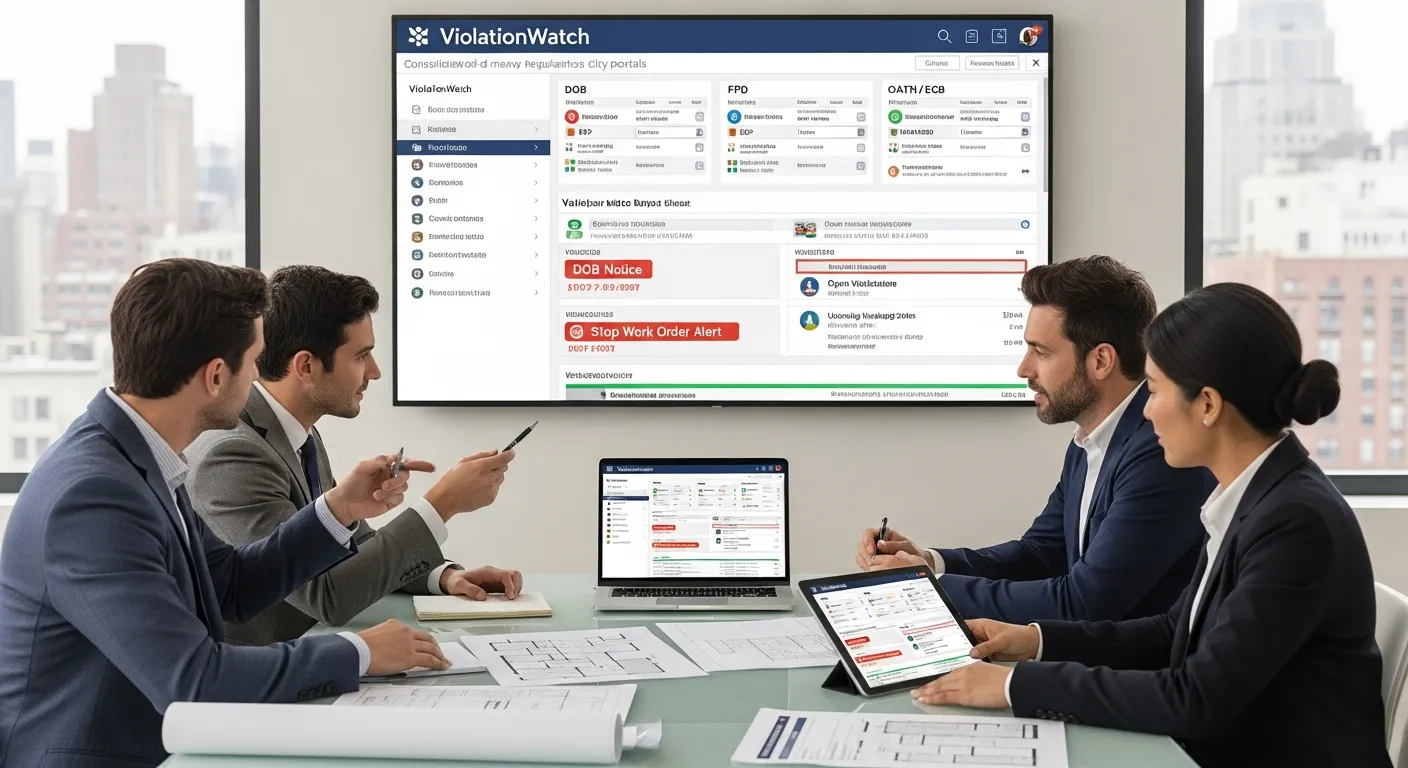
Understanding The DOB Information Overload
Staying compliant in New York City isn’t just about reading the Building Code once and calling it a day. We’re tracking:
- DOB violations and job status in BIS and DOB NOW
- HPD complaints and housing maintenance violations
- FDNY inspections and orders
- DEP environmental violations
- OATH/ECB hearings and penalties
- 311 complaints that often trigger enforcement
Each of these lives in a different portal, with different search rules and refresh cycles. On top of that, DOB constantly pushes new service notices and bulletins that change how plan reviewers interpret the same code sections we’ve been using for years.
In theory, we could check all of this manually, project by project, every week. In practice, that’s impossible once our portfolio gets past a handful of buildings.
Impact Of Missed Updates On Projects And Clients
When we miss a DOB or ECB update, the impact is rarely small:
- Stop work orders issued on the GC or owner halt our progress, even when our scope is clean.
- Permits and renewals get blocked by open DOB violations or unaddressed HPD complaints.
- Costs spike when OATH penalties escalate because nobody saw the hearing notice in time.
- Schedules slip when the plan examiner won’t sign off until a historical violation is certified or dismissed.
On a multi‑family rehab, a single undisclosed HPD or DOB violation can delay a Temporary Certificate of Occupancy (TCO) by weeks. That pushes move‑in, loan covenants, and client cash flow. From our side, it usually looks like “the architect missed something” or “the expediter didn’t flag it.”
Staying ahead of NYC building violations isn’t about being perfectionist: it’s about protecting the project’s time, money, and our reputation as trusted advisors.
Common Pain Points For Architects And Expediters
Manual DOB Monitoring And Spreadsheet Chaos
Most teams start with a very familiar system:
- Open BIS and DOB NOW in separate tabs.
- Run address or BIN searches.
- Screenshot violations, permits, and job filings.
- Paste them into Excel or Google Sheets.
- Repeat for every building, every few weeks.
Multiply that across 20, 50, or 200 properties and the wheels fall off. Spreadsheets drift out of date. Columns get added and removed. Nobody is completely sure which sheet is current. And if a junior team member leaves, half of that tracking logic leaves with them.
We see the same thing with HPD complaints, FDNY records, and OATH calendars. Different files. Different owners. Zero guarantee that the data is fresh when we’re about to submit a filing.
Last-Minute Scrambles Before Filings Or Renewals
Because manual monitoring is so painful, most of us only do deep checks when something forces our hand:
- A major filing (Alt‑1, new building, occupancy change)
- A big inspection or sign‑off push
- Key permit renewals
- TCO or C of O milestones
That’s when the “we need a clean DOB printout today” scramble starts. Someone gets tasked with running every search they can think of:
- DOB violations and ECB penalties
- Open jobs and audits
- HPD and 311 complaint history
- FDNY, DEP, and other agency issues
If a new violation popped up last week, we only catch it at this exact moment – when it’s already blocking us. Design revisions, hearings, or cure submissions get jammed into a compressed schedule. It’s stressful for us and unnerving for clients.
The core problem isn’t our diligence: it’s the lack of continuous, automated monitoring across agencies.
What ViolationWatch Is And How It Fits Into Your Workflow
Overview Of ViolationWatch’s Core Capabilities
ViolationWatch is a real‑time DOB and multi‑agency monitoring platform built specifically for New York City. Instead of jumping between portals, we use one dashboard that:
- Monitors DOB, HPD, FDNY, DEP, OATH/ECB, and more – 10‑agency coverage.
- Tracks open and historical NYC building violations, complaints, inspections, permits, and renewals.
- Continuously scans agency data every few minutes, not weekly.
- Sends instant alerts when something changes – new violation, new complaint, status update, or upcoming hearing.
Architects, expediters, owners, and managers all see the same live data. No more debating whose spreadsheet is right.
For free lookups, we can still use the NYC violation lookup tool to quickly pull data on a single building without logging into anything.
How ViolationWatch Integrates With Existing Tools And Processes
We don’t have to throw away our existing workflows to get value from ViolationWatch. It slots in where we already spend time:
- Pre‑design / feasibility: Before we even draft a proposal, we can run a full multi‑agency history through ViolationWatch and attach it to our assumptions.
- Design and code analysis: Recurring HPD complaints or DOB violations point us toward chronic issues – ventilation, egress, sprinklers, accessibility – that should shape our strategy.
- Filing and permitting: Instead of last‑minute portal sweeps, we check the building’s ViolationWatch record and confirm there are no open DOB or ECB issues that will block approvals.
- Post‑approval monitoring: While construction runs, the platform keeps watching for new complaints, inspections, and enforcement so we’re not blindsided.
Because the data is centralized, we can still export reports for internal trackers or client packages. But the system itself becomes our source of truth, not a fragile spreadsheet.
Centralizing DOB Intelligence In One Dashboard
Setting Up And Organizing Your Portfolio
The first step is simple: we add every address, BIN, or block‑lot we care about into ViolationWatch. That includes:
- Current active jobs
- Projects in pre‑design or RFP stage
- Legacy buildings we’ve touched and may be asked about again
Once they’re in, we organize them into watchlists by client, project type, or asset manager. A single asset manager might have 40 mixed‑use buildings: another list might group all DOB projects in a particular borough.
Filtering Data By Borough, Building Type, And Project Stage
On the portfolio view we can cut through noise using filters and search:
- Borough and neighborhood
- Building type or occupancy group
- Violation type (DOB, HPD, FDNY, DEP, etc.)
- Status (open, pending hearing, certified, dismissed)
- Project stage (pre‑filing, under construction, TCO/C of O)
If we’re preparing a big filing push in Brooklyn, we can instantly slice down to “Brooklyn + open DOB violations + under‑construction projects.” That gives us a focused punch list instead of pages of unrelated data.
Tracking Long-Term Compliance Across Multiple Properties
For firms with large portfolios, centralization is a game changer. We can:
- See which clients have chronic enforcement issues across their buildings.
- Spot patterns – e.g., the same inspector writing repeat violations.
- Monitor long‑term compliance trends, not just snapshot checks.
Instead of treating NYC building violations as one‑off nuisances, we start managing them as an ongoing risk profile across the portfolio. That’s extremely powerful when we’re advising large owners or institutional clients.
Real-Time Monitoring Of Properties, Permits, And Violations
Monitoring Open Violations, Complaints, And Inspections
ViolationWatch continuously polls DOB and related agency databases every few minutes. That matters because new enforcement actions don’t arrive on a neat weekly schedule.
The platform tracks:
- Open DOB and OATH/ECB violations
- HPD complaints and housing maintenance issues
- FDNY inspections and enforcement actions
- 311 complaints that can escalate into formal violations
As soon as something appears on any of these systems, it’s pulled into the dashboard and tied back to the building in our portfolio.
Keeping Tabs On Permits, Renewals, And Expiration Dates
Beyond violations, we also need to keep close watch on permit status and expirations. DOB makes this information available through its own portals, but it’s easy to miss the moment a permit flips from active to expired or a renewal window opens.
In ViolationWatch we can see:
- Active and expired permits by type
- Upcoming expirations and renewal needs
- Status changes that might affect inspections or sign‑offs
That gives expediters a real planning horizon. We can approach clients weeks in advance with a clear list of upcoming renewals instead of scrambling days before a permit lapses.
Following Code Changes And DOB Service Notice Updates
DOB communicates many policy and process changes through service notices, bulletins, and updates rather than immediate code amendments. Trying to track those across nyc.gov/buildings plus HPD, FDNY, and other sites is tedious.
By centralizing enforcement patterns and new violation types as they appear in the data, ViolationWatch helps surface how these changes show up on real projects. If we suddenly see a spike in a particular violation code across our watchlist, that’s an early signal that DOB has shifted its focus or interpretation.
We still need to read the official notices, but we’re no longer guessing where the pressure points are.
Automated Alerts That Catch Issues Before They Become Problems
Configuring Alerts Around Your Project Priorities
Real‑time monitoring only helps if we actually hear about changes. In ViolationWatch, we configure alerts around what matters most:
- New DOB violations or ECB penalties
- HPD complaints at key residential projects
- FDNY issues on buildings in active construction
- Status changes from open → hearing, or open → certified/dismissed
- New complaints on sensitive projects (e.g., high‑profile or politically visible sites)
We can choose channels – email, SMS, or WhatsApp – depending on how urgent the property is and who needs to know first.
Get instant alerts whenever your building receives a new violation, sign up for real-time monitoring with building violation alerts so nothing slips past us between portal checks.
Escalation Rules And Internal Notification Workflows
On larger teams, not every alert should hit everyone’s inbox. ViolationWatch lets us route notifications based on simple rules, such as:
- Borough or community district
- Client or asset manager
- Project type (new building vs. interior alt)
- Project stage (pre‑filing, active construction, TCO/C of O)
A new HPD complaint on a stabilized building could go directly to the housing specialist. A DOB violation on a ground‑up job might ping the project architect, expediter lead, and PM simultaneously.
This keeps alerts actionable instead of noisy. Each person receives the issues they’re actually responsible for moving forward.
Reducing Surprise Stop Work Orders And Delays
When we catch issues early, we have options:
- Coordinate a voluntary correction before DOB escalates to a stop work order.
- Prepare clients for an upcoming OATH hearing, including drawings or affidavits.
- Adjust phasing or inspections to avoid dead time while an enforcement item is resolved.
We’ll never eliminate every surprise, but we can dramatically reduce the number of “how did we not know about this?” moments that derail schedules.
Using ViolationWatch To Streamline Architect And Expediter Workflows
Using ViolationWatch For Pre-Due Diligence And Feasibility
On feasibility studies and early design work, we want to know what we’re walking into. Before we recommend a strategy, we can:
- Run a full multi‑agency history for the property in ViolationWatch.
- Review past DOB violations and OATH cases to understand enforcement history.
- Scan HPD complaints and 311 for recurring issues like leaks, mold, or heat outages.
That becomes part of our feasibility narrative. If the site is loaded with uncorrected NYC building violations, we can flag that risk before the client commits to a purchase or scope.
For quick snapshots on a single address, we can always start with the NYC violation lookup tool and then add the building into our portfolio once it becomes an active prospect.
Supporting Design Decisions With Better DOB Data
DOB violations and HPD complaints are a real‑world record of how buildings fail in practice. By looking at patterns across a client’s portfolio, we can tailor our design approach:
- Repeated egress‑related violations push us to tighten corridor layouts and exit signage.
- Chronic HPD complaints about heat and hot water influence our MEP strategy.
- Frequent FDNY issues around fire alarm or sprinkler coverage inform system upgrades.
Instead of designing in a vacuum, we’re aligning drawings with the enforcement history of that owner, that building type, and even that inspector.
Smoother Filing And Approval For Expediters
For expediters, ViolationWatch becomes the default pre‑filing checklist. Before any major DOB submission, we can:
- Confirm all known DOB violations are either dismissed or in a clear path to certification.
- Check for open OATH hearings that could block permits.
- Validate permits and renewals are in good standing for all related work.
Because we’re tracking compliance continuously, the pre‑filing check becomes a verification step rather than a full‑blown discovery mission. That cuts turnaround time and reduces the risk that plan examiners bounce our filings for avoidable compliance issues.
Improving Client Communication And Risk Management
Sharing Clear, Actionable Status Updates With Owners
Clients don’t want a raw data dump: they want to know, in plain language, whether their buildings are in trouble. With ViolationWatch, we can generate clear status reports that answer:
- Which buildings have new DOB violations this week?
- Where are HPD complaints rising or falling?
- Which permits or renewals require attention in the next 30–60 days?
Because all of this sits in one place, we can walk into a monthly meeting with a concise snapshot rather than a pile of mismatched printouts.
Building Trust By Proactively Flagging Risk
One of the fastest ways to earn trust is to surface problems before clients see them elsewhere. When we call an owner to say, “A new DOB violation just hit your property this morning – here’s what it means and how we suggest responding,” we position ourselves as risk managers, not just form‑fillers.
Over time, that proactive stance is often what separates us from competitors. Owners start to see our firm – and the tools we use, like ViolationWatch – as part of their compliance infrastructure.
Documenting Compliance Efforts For Future Defensibility
In disputes or enforcement escalations, it helps to show a record of diligence. ViolationWatch’s timeline of alerts and status changes gives us:
- Evidence that we tracked NYC building violations continuously.
- A log of when we learned about new issues and how quickly we responded.
- Documentation to support appeals or negotiations if penalties seem disproportionate.
That doesn’t replace formal legal advice, but it strengthens the story that the owner and design team are acting in good faith to maintain NYC property compliance.
Best Practices For Getting The Most Value From ViolationWatch
Structuring Watchlists By Client, Project, Or Asset Manager
How we organize the portfolio determines how usable it feels. We’ve seen three structures work especially well:
- By client: Every building under a particular owner or fund, useful for client‑facing reporting.
- By project: Grouped by phase (pre‑filing, construction, closeout) so teams focus on what’s hot.
- By asset manager or regional lead: Each internal owner gets a slice of the data they’re accountable for.
The goal is to match how we already talk about work. If our organization is client‑centric, our watchlists should be too.
Standard Operating Procedures For Your Team
To get full value, ViolationWatch should be part of our SOPs, not just a nice-to-have tab. For example:
- “Check ViolationWatch for this property before every major DOB filing.”
- “Review weekly alerts for your watchlist every Monday morning.”
- “Run a full compliance snapshot before issuing 100% CDs on complex jobs.”
These habits replace the old “somebody should probably check DOB” conversations with concrete steps that actually happen.
Training New Staff To Use ViolationWatch Effectively
Junior architects and expediters often spend hours doing manual BIS and DOB NOW sweeps. Training them on ViolationWatch does two things:
- It cuts unproductive time spent re‑keying data into spreadsheets.
- It teaches them to think in terms of risk and compliance, not just forms and drawings.
We can still give them research assignments – but now they’re working from a current, centralized source instead of piecing together half‑updated data from multiple portals.
Measuring Time Savings And Reduced Project Risk
It’s worth quantifying the impact. Over a few months, we can track:
- How many hours per week we spent on manual monitoring before vs. after.
- How many surprise violations or blocked filings we encounter.
- Whether OATH penalties and late fees decline across the portfolio.
Most firms discover that what they thought was “just a bit of admin” was actually dozens of hours per month spread across staff. Automating that with ViolationWatch frees us to focus on design, strategy, and client service instead of repetitive portal checks.
Conclusion
How ViolationWatch Helps You Stay Ahead As DOB Rules Evolve
NYC’s regulatory environment won’t get any simpler. DOB will keep adjusting its interpretations, HPD will keep responding to tenant complaints, and new enforcement priorities will keep emerging. The question for us, as architects and expediters, is whether we want to learn about those changes through official bulletins – or through surprise violations on our own projects.
By centralizing DOB intelligence, automating real‑time monitoring, and pushing targeted alerts, ViolationWatch gives us a way to stay ahead of NYC building violations instead of chasing them. It turns compliance from a reactive fire drill into a continuous, mostly automated background process that supports our design and filing work.
If we’re serious about NYC property compliance across multiple projects, it makes sense to have a system watching the portals for us. For quick one‑off checks, we can rely on the NYC violation lookup tool. When we’re ready to protect an entire portfolio, we can enroll those properties in building violation alerts and let the platform notify us whenever something changes.
In a city where one missed DOB update can derail a project, having that kind of early warning system isn’t a luxury. It’s becoming part of the basic toolkit for any NYC architect or expediter who wants to deliver reliably, even as the rules keep moving.
Key Takeaways
- ViolationWatch helps architects and expediters stay ahead of DOB updates by centralizing multi-agency NYC building violations, complaints, and permits in one real-time dashboard.
- Replacing manual DOB monitoring and spreadsheet tracking with ViolationWatch’s automated scans and alerts dramatically reduces last-minute scrambles, blocked filings, and surprise stop work orders.
- Architects and expediters can integrate ViolationWatch into every stage of their workflow—from feasibility and design through filing, construction, and closeout—to make data-driven, compliance-aware decisions.
- Custom watchlists, filters, and targeted alert rules in ViolationWatch keep each team member focused on the properties, clients, and violation types they are actually responsible for managing.
- Using ViolationWatch as a continuous monitoring and documentation tool strengthens client communication, supports risk management, and provides defensible records of NYC property compliance efforts.
Frequently Asked Questions
What is ViolationWatch and how does it help architects and expediters stay ahead of DOB updates?
ViolationWatch is a real-time NYC building violation monitoring platform that aggregates DOB, HPD, FDNY, DEP, OATH/ECB, and 311 data in one dashboard. It continuously scans these systems and sends targeted alerts, helping architects and expediters catch issues early instead of discovering them at filing or permit renewal time.
How do architects and expediters integrate ViolationWatch into their existing DOB workflows?
Most firms plug ViolationWatch into points where they already touch compliance: feasibility studies, design and code analysis, pre-filing checks, and construction-phase monitoring. It becomes the central source of truth, while spreadsheets and internal trackers are generated as exports rather than manually maintained primary records.
Can ViolationWatch reduce surprise stop work orders and blocked permits from NYC building violations?
Yes. By monitoring NYC building violations and complaints in real time and alerting users to new DOB, HPD, FDNY, or OATH issues, ViolationWatch gives teams time to cure problems, prepare for hearings, or adjust phasing before they trigger stop work orders, blocked permits, or delayed TCO/C of O sign‑offs.
What’s the difference between using the NYC violation lookup tool and ViolationWatch?
The NYC violation lookup tool is ideal for one-off checks on a single building. ViolationWatch is designed for portfolios: it tracks many properties across multiple agencies, updates every few minutes, and sends building violation alerts. It’s better suited for architects, expediters, and owners managing ongoing NYC property compliance.
How does ViolationWatch help with NYC property compliance reporting to clients?
ViolationWatch lets teams group buildings by client, project, or asset manager and generate clear status summaries: new DOB violations, HPD complaint trends, upcoming permit expirations, and open OATH hearings. Instead of raw portal screenshots, architects and expediters present concise, actionable compliance snapshots during recurring client meetings.
Is ViolationWatch only useful for large portfolios, or can small firms benefit too?
Small firms also benefit, especially if they handle several active NYC projects. Even with a handful of jobs, manually checking DOB NOW, BIS, HPD, FDNY, and OATH can lead to missed updates. ViolationWatch automates monitoring so smaller teams can offer enterprise-level DOB update tracking without extra headcount.