
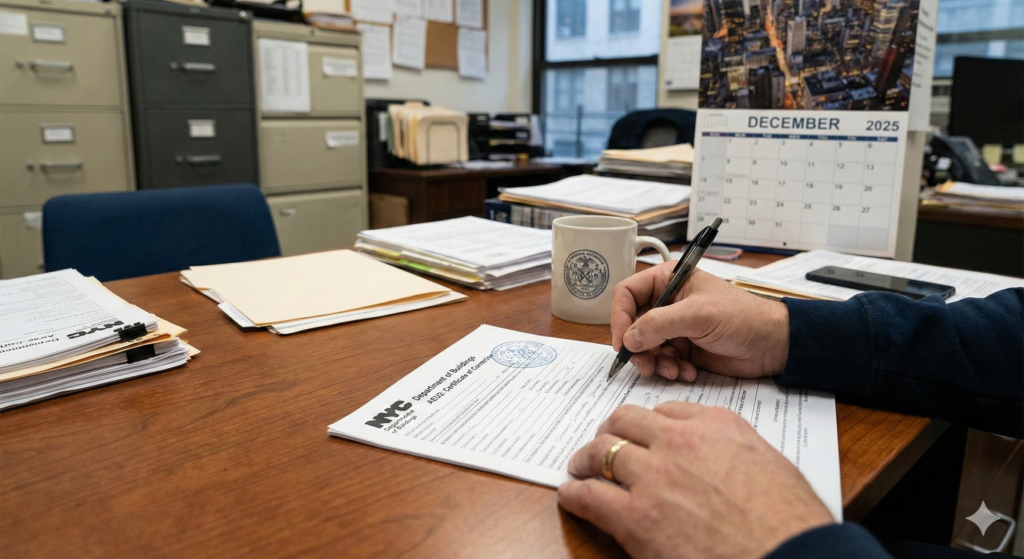
If we own or manage property in New York City long enough, it’s almost inevitable: sooner or later, a Notice of Violation (NOV) lands in our inbox or on the front door. Clearing that violation from DOB records isn’t just about doing the work, it hinges on one critical step: filing a proper Certificate of Correction, usually on Form AEU2.
In 2025, with stricter enforcement and more data-sharing between NYC agencies, sloppy or late AEU2 filings can delay closings, block permits, and trigger thousands of dollars in civil penalties. The good news is that once we understand how AEU2 filings work, and what DOB reviewers actually look for, the process becomes much more predictable.
Below, we walk through exactly what a NYC Certificate of Correction is, when we must file it, how to prepare the documents, and how to avoid the mistakes that keep NYC building violations “open” for years.
What Is A NYC Certificate Of Correction (AEU2)?
A NYC Certificate of Correction is DOB’s way of confirming that we’ve fixed the conditions cited in a Notice of Violation (NOV). For most DOB violations, that certification is made on Form AEU2, an affidavit submitted to the Department of Buildings’ Administrative Enforcement Unit (AEU).
In plain terms, here’s what the AEU2 does:
- It tells DOB what work we did to correct the violation.
- It documents when the work was completed.
- It identifies who performed the work (and, if required, their license or registration number).
- It’s signed and notarized, turning it into a legal affidavit.
Once accepted, the AEU2 allows DOB to mark the violation as “certified corrected” in its records. That matters because open DOB violations can:
- Delay property sales and refinancing.
- Hold up permit applications for new work.
- Trigger ongoing penalties or enforcement actions.
AEU2s apply to a wide range of NYC building violations, including facade, egress, boiler, construction safety, and many Local Law–related issues. Some violations use a different or additional affidavit form (like AEU3321 for site safety training), but the concept is the same: we’re telling DOB, under oath, that the dangerous or non-compliant condition has been fully resolved.
If we’re not sure which violations are open on a property, we can quickly check via BIS or DOB NOW, or use a service like ViolationWatch that consolidates DOB violations, ECB/OATH summonses, HPD issues, and other NYC building violations in one place.
When You Must File An AEU2 Certificate Of Correction
The timing rules are strict, and they differ by violation classification. Missing these windows often means automatic penalties or a mandatory OATH hearing.
Class 1 (Immediately Hazardous) Violations
Class 1 NOVs cover conditions DOB considers immediately hazardous, think blocked exits, unstable structures, serious construction safety issues, or life-safety equipment out of service.
For most Class 1 violations, DOB expects us to:
- Correct the condition immediately, and
- Certify correction as soon as it’s fixed, using the AEU2 and supporting documents.
If we don’t certify correction on time, DOB can impose minimum civil penalties of $1,500, with higher penalties or additional violations possible, depending on the specific code section.
Class 2 and Class 3 Violations
Class 2 violations are “major,” and Class 3 are “lesser” hazards, but both still affect our NYC property compliance record.
Once we’ve finished the corrective work, DOB generally requires that we:
- File the AEU2 within 40 days of the correction date.
The 40‑day clock starts when the violating condition is fully corrected, not when we receive the NOV. Waiting too long after completion can raise red flags or lead to rejected filings if dates and documentation don’t line up.
CURE Program Violations
Some lower-risk violations are labeled “CURE” on the NOV. These give us a chance to correct quickly and avoid a hearing and additional penalties, but only if we meet a hard deadline:
- We must correct all violating conditions and
- Submit the Certificate of Correction on or before the “CURE DATE” printed on the NOV.
If we miss that window, the case is usually scheduled for an OATH hearing, and we lose the benefit of the CURE program. Even if we correct the condition after the CURE date, we’ll still have to certify correction and likely appear (or be represented) at the hearing.
For current classifications and examples, DOB’s official guidance is posted on its Certificates of Correction page.
Understanding Violation Types And Their Correction Requirements
Not all NYC building violations are treated the same. Understanding the type of violation we’re dealing with helps us set realistic timelines and assemble the right documentation.
DOB Violations vs. HPD Complaints
First, it’s useful to distinguish DOB violations from HPD complaints and violations:
- DOB violations (e.g., unsafe facade, illegal occupancy, work without a permit) typically require an AEU2 and related DOB affidavits to certify correction.
- HPD complaints and violations, often related to heat, hot water, pests, mold, and basic services, follow separate processes with the Department of Housing Preservation & Development. Details are on HPD’s complaints and violations page.
AEU2 filings are specifically about clearing DOB-issued violations.
Common DOB Violation Categories
Here are a few examples where AEU2 filings are standard:
- Construction and work without a permit – We may need to legalize the work with a permit, undo it, or bring it into full compliance.
- Facade / Local Law 11 – Unsafe or SWARMP conditions usually require a professional engineer or architect’s sign-off.
- Egress and fire safety – Blocked exits, locked gates, or missing hardware often demand quick correction and photographic proof.
- Boiler, elevator, and equipment violations – These often require sign-off from licensed trades.
- Local Law safety training and site conditions – In some cases, we must submit additional forms like AEU3321.
Each category has its own expectations around permits, inspections, and who is qualified to do the work.
CURE-Eligible vs. Non-CURE Violations
As we saw above, some lower-level violations qualify for CURE. The rules are straightforward:
- CURE-eligible: If it’s marked as such on the NOV, and we correct and certify by the CURE date, we may avoid a hearing and additional penalties.
- Not CURE-eligible: We still must correct and certify, but the case may proceed to an OATH hearing regardless, especially for more serious infractions.
In every scenario, DOB expects full correction, partial fixes don’t qualify for approval, and the AEU will simply mark the submission “rejected” or “incomplete.”
Step-By-Step Process To Prepare Your AEU2 Filing
Most rejected AEU2s fail for the same reasons: missing information, poor documentation, or mismatched dates. We can avoid that by treating the filing like a mini case file.
Key Information To Gather Before You Start
Before touching the form, we should have these basics in front of us:
- NOV number and summons number (from the violation notice or OATH summons)
- Property information – address, BIN, block and lot if available
- Respondent information – usually the owner, but sometimes a responsible party named on the summons
- Our relationship to the respondent – owner, officer, property manager, managing agent, tenant, or other
- Date the violation was fully corrected – not just when work started
If we’re correcting an issue on behalf of an owner (for example, as a managing agent), we’ll also need supporting documents such as a management agreement or letter of designation.
Documenting And Verifying The Correction Work
Next, we need a clear paper trail showing what we did and when. DOB reviewers aren’t on site: they rely on documents.
Key items usually include:
- Detailed description of the corrective work – what, where, and how the condition was fixed
- Permits and sign-offs – permit numbers, job numbers, inspections, and final sign-offs where applicable
- Invoices and receipts – from contractors, engineers, or vendors involved in the correction
- Dated, labeled photographs – multiple angles, close-ups, and context shots
Each photo should be:
- Dated (camera timestamp or labeled in a caption),
- Clearly tied to the address and location (e.g., “rear yard egress door, 1st floor”), and
- Labeled with the summons or violation number.
The more obvious we make it for the reviewer, the smoother the approval.
Completing The AEU2 Form Accurately
The AEU2 itself is a relatively short affidavit, but DOB expects it to be precise and consistent with the evidence we provide.
On the form, we’ll typically need to:
- Identify the violation
Enter the NOV/summons number, date of issuance, and property address exactly as written on the violation.
- List our information
Name, mailing address, and contact details of the person submitting the certificate.
- State our relationship to the respondent
Examples: owner, member, officer, managing agent, tenant. If we’re not the owner, we should have documentation proving our authority.
- Describe who performed the work
- If a licensed professional did the work, list their license or registration number.
- If it was in-house or owner-performed work, state that clearly.
- Affirm the correction
Provide the date all violating conditions were corrected, and include a concise but clear description of the corrective actions.
- Sign in front of a Notary Public
The AEU2 must be notarized. Submissions without a proper notary seal or with incomplete notarial language are routinely rejected.
In many cases, DOB also expects a separate AEU20 form describing the method of correction. Both the AEU2 and AEU20 should tell the same story and align with the documentation.
How To File Your AEU2 Certificate Of Correction With NYC DOB
Once we’ve pulled together the forms and evidence, we have two main ways to file: online or via paper submission.
Online Portal Filing Versus In‑Person / Mail Submissions
Online (Preferred): DOB NOW / AEU2 Upload
DOB strongly encourages digital submissions via the DOB NOW portal.
Basic flow:
- Create or log in to an NYC.ID account and access DOB NOW.
- Choose BIS Options and look for “Certificate of Correction Review Request.”
- Enter the summons number and relevant property details.
- Upload:
- The completed, notarized AEU2 affidavit.
- Any required related forms (e.g., AEU3321, AEU20).
- All supporting evidence: photos, permits, invoices, letters, professional certifications.
- Submit and save a copy of the confirmation for our records.
The online route lets us track status updates and responses without mailing delays, and it’s increasingly the default method DOB staff expect.
In-Person or Mail Submission
If we prefer or are required to file by paper, submissions go to:
NYC Department of Buildings
Administrative Enforcement Unit
280 Broadway, 5th Floor
New York, NY 10007
We should include:
- Original, notarized AEU2 (and AEU3321/AEU20 if applicable)
- Hard copies of supporting documents, clearly labeled
- A cover letter listing:
- The summons/NOV number
- Property address
- Our contact information
Regardless of method, keeping a complete digital file of everything we send is crucial. We may need it later if there’s a dispute or if we’re asked to re-submit via DOB NOW.
Fees, Civil Penalties, And Payment Methods
Filing an AEU2 itself doesn’t usually carry a separate fee. The real money at stake is in civil penalties linked to the underlying violation and the timing of our correction.
Typical scenarios include:
- Base penalties for the violation – Often imposed at or after an OATH hearing, based on the violation type and classification.
- Failure-to-Certify penalties – Additional fines charged when we don’t certify correction by the deadline.
Penalties are generally paid via OATH or DOB, often through online payment portals, in person, or by mail. If we’re in doubt about balances owed, we can:
- Check the summons status via the OATH Hearings Division, and
- Review property records in DOB’s BIS or DOB NOW, or use an aggregated tool such as the NYC violation lookup tool for a quick snapshot.
Get instant alerts whenever your building receives a new violation, sign up for real-time monitoring through our building violation alerts service, so we’re not blindsided by surprise penalties.
Common AEU2 Filing Mistakes And How To Avoid Them
From DOB’s perspective, a good AEU2 filing is clear, complete, and easy to verify. Here’s where many owners and managers slip up, and how we can stay out of that pile.
Incomplete or Weak Supporting Documentation
Submitting only the form and a single photo is a recipe for rejection. Common gaps:
- No proof that required permits were pulled or closed out.
- Invoices that don’t describe the actual corrective work.
- Photos that don’t clearly show the location or condition.
How to avoid it:
- Include copies of permits, sign-offs, and inspection results where applicable.
- Use detailed descriptions on invoices and letters (e.g., “Removed illegal gas line and capped at source per DOB permit #X”).
- Attach multiple labeled photos so a reviewer can quickly follow the story.
Unnotarized or Improperly Signed Forms
AEU staff routinely reject:
- AEU2s signed but not notarized.
- Notary blocks missing signatures, stamps, or dates.
- Forms signed by people who lack authority (e.g., a supers without any documentation tying them to the owner).
How to avoid it:
- Always sign the AEU2 in front of a Notary Public.
- Double-check the notary’s seal, commission expiration date, and required wording.
- If we’re not the owner, attach proof of authority (management agreement, corporate resolution, etc.).
Partial Corrections
DOB doesn’t accept “we fixed most of it.” If any portion of the violating condition remains, the AEU2 should not say that the violation is fully corrected.
How to avoid it:
- Review the NOV line by line to confirm every cited condition was addressed.
- If a long-term repair is phased, don’t certify correction until the final condition is fully compliant.
Missing Relationship Documentation
If the respondent on the NOV is “XYZ LLC,” but the AEU2 is signed by “John Doe, Property Manager,” DOB wants to know why John is the right person to certify.
How to avoid it:
- Attach a management agreement or letter of designation.
- For newly purchased properties, include a deed or closing statement to show the change in ownership.
Mismatched Dates and Inconsistent Narratives
If we say the violation was corrected on May 1, but the permit wasn’t issued until May 10, DOB will question the accuracy of the affidavit.
How to avoid it:
- Cross‑check correction dates against permit issuance and inspection dates.
- Make sure the AEU2, AEU20, invoices, and photos all tell a consistent story.
For owners managing multiple properties or a large portfolio, these details are easy to lose track of. This is where tools like ViolationWatch, which consolidate NOVs, deadlines, and status across properties, can help keep us from missing something critical.
After You File: Status Checks, Responses, And Outcomes
Once our AEU2 package is in, our job shifts from fixing the issue to monitoring the status and responding to DOB feedback.
Typical Review Timelines And What They Mean
Processing times vary, but a few patterns hold:
- Straightforward, well-documented corrections – Frequently reviewed within a few weeks.
- Complex or professionally driven work (e.g., facade repairs, structural corrections) – May take longer, especially if DOB requests clarification.
During this time, the violation may still show as “open” or “in adjudication” in DOB’s records. That doesn’t mean our AEU2 failed, just that the review isn’t finished.
We can:
- Check status via BIS or DOB NOW, or
- Use the NYC violation lookup tool to see which violations are still marked open before a closing or refinance.
If Your AEU2 Is Rejected Or Marked Incomplete
It’s not uncommon for DOB to mark a submission as “rejected” or “incomplete” with a brief note.
Typical reasons include:
- Missing photos or insufficient proof of correction.
- No proof of permits where required by the code section.
- Signature or notary issues.
- The description of correction doesn’t actually address the cited condition.
When that happens, we should:
- Read DOB’s comments carefully. The reviewer usually spells out exactly what’s missing.
- Gather the additional documentation or revise the narrative to address the gap.
- Re‑submit via DOB NOW or mail, referencing the same summons number and clearly labeling it as a revised Certificate of Correction submission.
In tough cases, for instance, when DOB disagrees that a condition is fully corrected, it can help to involve a design professional who understands how DOB interprets the relevant code section.
How AEU2 Filings Affect Property Sales, Refinancing, And Permits
From a transactional standpoint, open NYC building violations can be deal‑breakers:
- Buyers and lenders often require all DOB violations to be corrected or at least certified before closing.
- Title companies and attorneys now routinely pull NYC violation histories as part of diligence.
- DOB permits for new or major work can be slowed if there’s a backlog of unresolved enforcement issues on the property.
A clean AEU2 record can:
- Smooth out contract negotiations (no last‑minute escrow battles over violations).
- Reduce surprises during lender or agency reviews.
- Show a pattern of proactive NYC property compliance, which is increasingly important for institutional buyers.
To avoid scrambling in the weeks before a closing, we’ve found it’s smarter to run periodic checks, and, where possible, to set up portfolio‑wide alerts. For free lookups, use our NYC violation lookup tool, and if we manage multiple buildings, consider enrolling key assets in building violation alerts.
Special Situations In 2025: Digital Filing, Penalties, And Policy Updates
The basic AEU2 rules haven’t changed dramatically, but a few 2025 realities are shaping how strictly DOB and other agencies handle NYC building violations.
Recent Changes To AEU2 Requirements And Enforcement Priorities
In recent years, DOB has:
- Expanded DOB NOW usage, pushing most Certificates of Correction into digital workflows.
- Increased coordination with HPD, FDNY, and OATH so that serious patterns of non-compliance are easier to spot.
- Placed more emphasis on life-safety violations, including egress, facade, and construction safety.
Practically, this means we’re more likely to see:
- Faster follow-up for uncorrected Class 1 violations.
- Closer scrutiny of affidavits involving structural or facade work.
- More rejections where documentation appears thin or inconsistent.
Tips For Working With Design Professionals And Expediters
For complex violations, especially those involving structure, means of egress, or Local Law compliance, it often makes sense to bring in help:
- Registered architects (RAs) and professional engineers (PEs) can:
- Design the corrective work,
- File the necessary permits, and
- Provide professional certifications or letters DOB takes seriously.
- Expediters or filing representatives can:
- Navigate DOB NOW and BIS,
- Track correction deadlines and hearing dates,
- Package AEU2 submissions in the format reviewers expect.
Working with them effectively means:
- Sharing the full NOV and any prior correspondence.
- Agreeing on who is responsible for gathering photos, invoices, and owner signatures.
- Confirming that the final AEU2 narrative matches what’s in the professional’s drawings, permits, and letters.
While it’s possible to DIY many AEU2 filings, design professionals are often essential when violations involve structural stability, fire protection, or changes to occupancy and use.
Conclusion
Conclusion
AEU2 filings are easy to underestimate. On paper, it’s just an affidavit. In practice, it’s the gatekeeper between an “open” NYC building violation and a clean compliance record.
If we do the work but fail to certify it correctly, the violation lives on, blocking permits, complicating deals, and inviting added penalties.
Key Information To Gather Before You Start
To recap the essentials we should always have ready:
- NOV/summons number and violation date.
- Correct property details (address, block, lot, BIN if available).
- Respondent information and our relationship to that party.
- The date all violating conditions were truly corrected.
Having this organized up front saves time and prevents rework later.
Documenting And Verifying The Correction Work
For DOB, documentation is everything. Our goal is to make it obvious, even to someone who’s never seen the building, that the violation is gone.
We should:
- Keep permits, inspections, and sign-offs together.
- Save contracts, invoices, and receipts tied specifically to the corrective work.
- Take clear, dated, labeled photos before and after the fix.
Completing The AEU2 Form Accurately
When we finally sit down with the AEU2:
- Fill in every field legibly and accurately.
- Make sure descriptions of the corrective work match our supporting documents.
- Confirm the signer has authority, and get the form properly notarized.
A few extra minutes here can be the difference between first-pass approval and weeks of back-and-forth.
Online Portal Filing Versus In‑Person / Mail Submissions
In 2025, DOB NOW is the default, faster, trackable, and better aligned with how staff process Certificates of Correction.
Mail or in‑person submissions still work, but they add mailing time and make it harder to respond quickly if DOB flags an issue. Whenever we can, we’re better off filing digitally and keeping a PDF archive of everything submitted.
Fees, Civil Penalties, And Payment Methods
We can’t avoid base penalties in every case, but we can avoid unnecessary ones:
- Correct conditions promptly, especially Class 1 violations.
- Certify corrections within the required timelines (CURE date or 40-day window).
- Pay assessed penalties through DOB or OATH promptly to prevent compounding issues.
When in doubt, check OATH’s online search portal and DOB records, or have our counsel or expeditor confirm what’s outstanding.
Proof Of Correction: Photos, Invoices, And Professional Certifications
DOB doesn’t just take our word for it. Strong proof often includes:
- Before-and-after photos clearly tied to the specific NOV.
- Invoices and contracts that describe the repair work.
- Letters or certifications from RAs/PEs or licensed trades, especially for structural, life-safety, or Local Law violations.
The more professional and complete our package, the less room there is for questions.
Typical Review Timelines And What They Mean
We shouldn’t panic if a violation still shows as open a week after filing. But if weeks turn into months with no movement, or if a rejection notice comes back, it’s time to dig in:
- Re‑check that all required forms were included.
- Confirm the narrative actually addresses the cited condition.
- Follow up through DOB NOW or via the AEU office if necessary.
If Your AEU2 Is Rejected Or Marked Incomplete
Rejection isn’t the end of the road: it’s feedback:
- Read the reviewer’s notes.
- Provide the missing documents or clarifications.
- Re‑submit with a clear, organized package.
For persistent issues, involving a design professional or experienced expediter can shorten the learning curve.
How AEU2 Filings Affect Property Sales, Refinancing, And Permits
Behind almost every last‑minute deal crisis, there’s an overlooked violation:
- A lender’s appraiser pulls DOB records and flags open NOVs.
- A buyer insists on credits or escrow for unresolved issues.
- DOB hesitates to move forward on new permits because enforcement history is messy.
A habit of timely, well-documented AEU2 filings turns that around. It signals that we run our buildings responsibly and treat NYC property compliance as part of routine operations, not a crisis response.
Recent Changes To AEU2 Requirements And Enforcement Priorities
As DOB relies more heavily on digital systems and inter-agency data, expectation levels are rising. Sloppy, handwritten, undocumented corrections don’t cut it anymore.
In practical terms, that means:
- Assuming our filings will be read alongside permit records and HPD/FDNY data.
- Expecting stricter scrutiny of life-safety issues.
- Staying on top of evolving guidelines through DOB’s website and industry publications.
Tips For Working With Design Professionals And Expediters
We don’t need an architect or expediter for every violation, but we should know when to call them:
- If the violation references structural work, means of egress, use and occupancy, or complex Local Laws, we’re usually better off with professional help.
- If we manage a large portfolio with frequent NOVs, having a trusted expediter can save us countless hours in DOB NOW.
Done right, they become partners in our compliance strategy, not just emergency troubleshooters.
NYC’s enforcement environment isn’t getting looser. But with clear documentation, accurate AEU2 filings, and a system for tracking NOVs across our properties, we can keep violations from snowballing.
For quick checks on open violations across our buildings, we can always start with the free NYC violation lookup tool. And if we want to stay ahead of new NOVs before they derail a closing or permit, setting up portfolio-wide building violation alerts is one of the simplest safeguards we can put in place today.
Key Takeaways
- A NYC Certificate of Correction (AEU2) is the DOB affidavit that legally clears many DOB violations from city records once you fully fix and document the cited conditions.
- Timing is critical: Class 1 violations must be corrected and certified immediately, CURE violations must be filed by the printed CURE date, and most Class 2 and 3 violations require an AEU2 within 40 days of correction.
- Strong NYC Certificate of Correction filings include consistent dates, clear narratives, required permits and sign‑offs, detailed invoices, and multiple dated, labeled photos that directly show the violation has been removed.
- Most owners should file AEU2s digitally through DOB NOW’s Certificate of Correction Review Request, keep a complete PDF record of everything submitted, and promptly address any “rejected” or “incomplete” responses from DOB.
- Accurate, timely AEU2 filings help avoid extra penalties, OATH hearings, and blocked permits, and they are increasingly essential for smooth sales, refinancings, and overall NYC property compliance in 2025.
NYC Certificate of Correction (AEU2) FAQs
What is a NYC Certificate of Correction (AEU2) and when is it required?
A NYC Certificate of Correction (AEU2) is an affidavit submitted to the Department of Buildings’ Administrative Enforcement Unit to prove you fixed conditions cited in a Notice of Violation. It’s required for most DOB violations, including construction safety, facade, egress, boiler, and many Local Law issues, before violations can be closed.
What are the filing deadlines for a NYC Certificate of Correction (AEU2) in 2025?
Deadlines depend on violation class. Class 1 (immediately hazardous) violations must be corrected and certified as soon as work is completed, or you risk significant penalties. For most Class 2 and Class 3 violations, you must file the AEU2 within 40 days of the correction date. CURE‑eligible violations must be certified by the printed CURE date.
How do I file an AEU2 Certificate of Correction with NYC DOB online versus by mail?
Online, you log into DOB NOW, select “Certificate of Correction Review Request,” enter the summons details, then upload the notarized AEU2, any related forms (like AEU20 or AEU3321), and all supporting evidence. By mail or in person, you submit originals to the Administrative Enforcement Unit at 280 Broadway, 5th Floor, with a clear cover letter.
What documentation does NYC DOB expect with an AEU2 filing?
DOB expects a complete “case file” showing what you fixed and when. Typical items: NOV and property details, permits and sign‑offs, invoices describing corrective work, professional letters, and clear dated photos labeled with location and summons number. The AEU2 must be consistent with this evidence and properly notarized, or it may be rejected.
How long does NYC DOB take to review a Certificate of Correction (AEU2)?
Review times vary, but straightforward, well‑documented AEU2 submissions are often reviewed within a few weeks. Complex violations—such as facade or structural issues—can take longer, especially if DOB requests clarification. During review, the violation usually still shows as “open” or “in adjudication” in BIS or DOB NOW until approval is recorded.
Do I need an architect, engineer, or expediter to file a NYC Certificate of Correction?
You can file an AEU2 yourself for simpler violations, provided the work complies and you have solid documentation. For complex issues—structural stability, means of egress, facade, or Local Law compliance—working with a registered architect, professional engineer, or experienced expediter is strongly recommended to handle permits, certifications, and DOB NOW submissions correctly.