
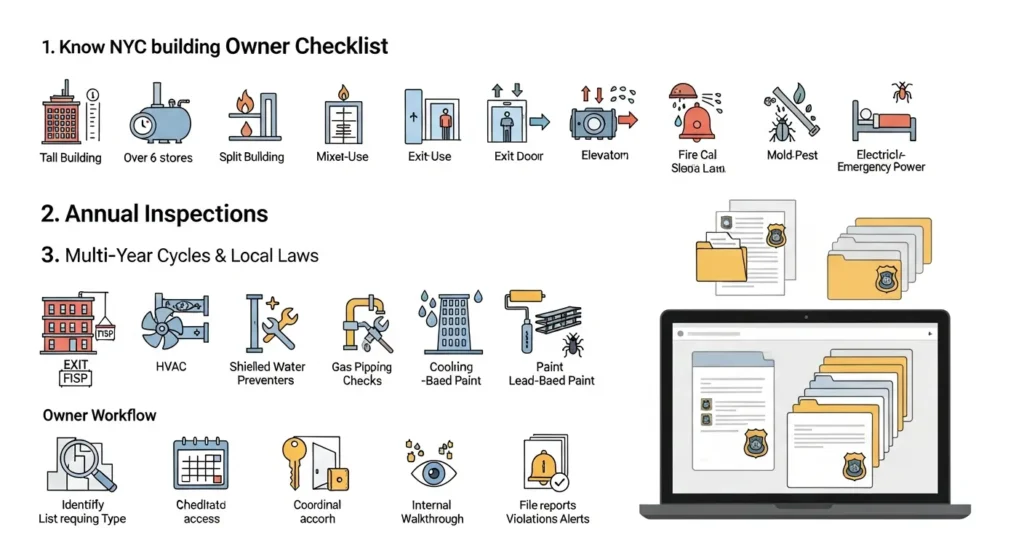
If we own or manage a building in New York City, annual inspections aren’t optional, they’re baked into how the city enforces safety, health, and NYC property compliance.
The challenge is that requirements are scattered across DOB, FDNY, HPD, DEP, and DOHMH rules, plus a stack of Local Laws with different timelines. Some are yearly, some every four or five years, and some only apply over certain heights or occupancy types. It’s easy to mix them up, and that’s when NYC building violations, DOB violations, and HPD complaints start piling up.
In this guide, we’ll walk through exactly how to figure out whether our building needs annual inspections, which ones apply, and how to organize everything into a practical, repeatable checklist we can use year after year.
Understanding NYC Building Inspection Requirements
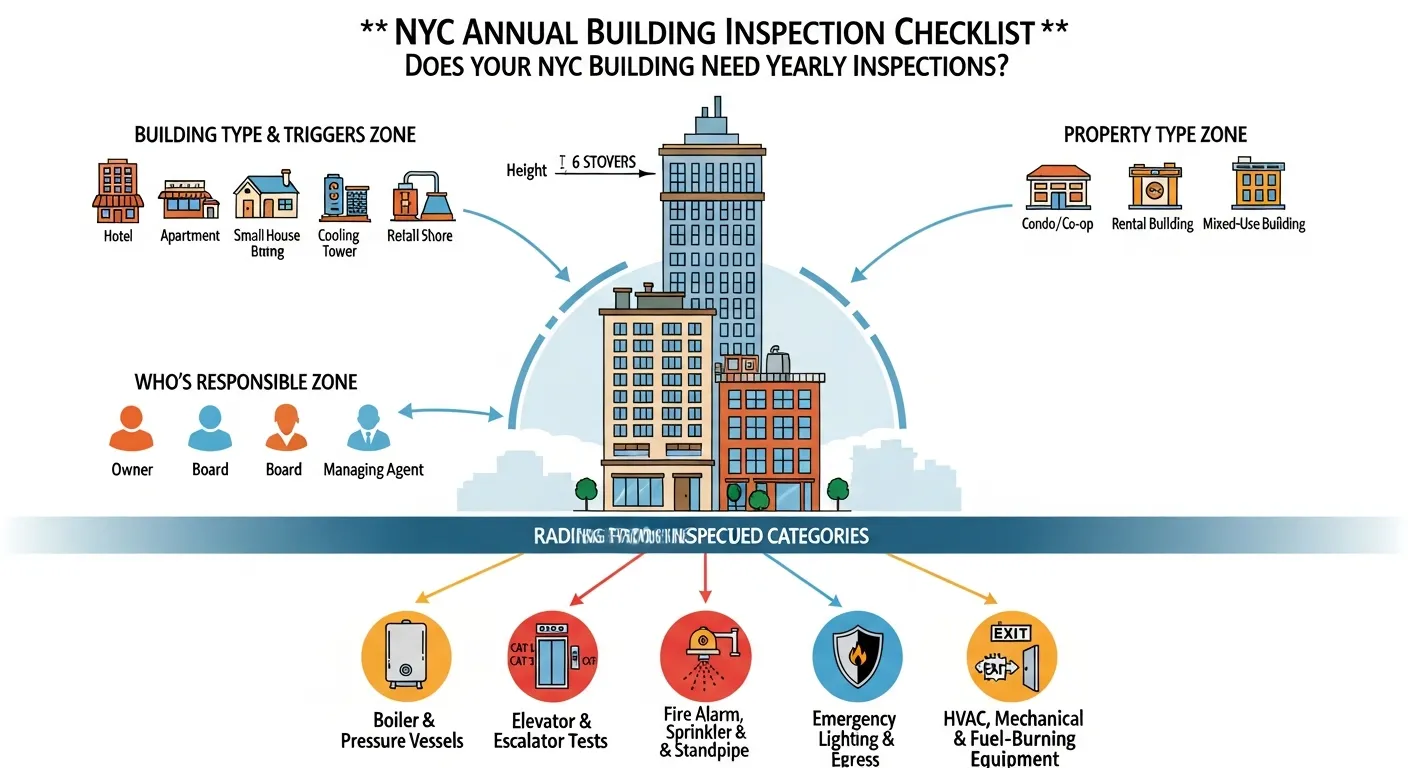
New York City’s inspection rules are built around one big idea: if a system can harm people when it fails, it gets inspected, often annually.
That includes boilers, elevators, fire protection, gas, electrical, and life-safety systems, plus housing conditions in residential buildings. These inspections show regulators that we’re maintaining the building, not just reacting when something breaks.
Below are the main inspection buckets most owners need to understand.
Building Size, Use, And Occupancy Classifications That Trigger Inspections
Our obligations start with how DOB classifies the building:
- R-1 – Hotels and transient accommodations.
- R-2 – Apartments, co-ops, and condos.
- R-3 – Small, one- and two-family homes.
- B (Business) – Offices, professional spaces.
- M (Mercantile) – Retail, stores.
Key triggers:
- Height: Buildings over six stories must comply with facade rules (Local Law 11/FISP), elevator requirements, and additional life-safety obligations.
- Use: A mixed-use building (e.g., ground-floor retail, apartments above) has to meet both the commercial and residential rules.
- Gas & systems present: If we have gas piping, a boiler, elevators, backflow devices, or a cooling tower, we inherit the matching inspection schedules.
The NYC Department of Buildings offers public code and rule references on its site if we want to dig deeper into classifications and triggers: nyc.gov/buildings.
Mixed‑Use, Condo, Co‑Op, And Rental Buildings
Most of the city’s stock falls into one of these buckets:
- Condo and co-op buildings – The board is responsible for ensuring the building complies (facade, elevators, boilers, Local Laws, etc.), usually by working through the managing agent.
- Rental buildings – The owner is on the hook for HPD housing standards (heat/hot water, pests, mold, lead, bedbugs), DOB systems, and FDNY fire protection.
- Mixed-use properties – We must comply with both commercial (e.g., retail sprinklers, egress) and residential (HPD) requirements.
In practice, that means more inspections and more filings, but also a clearer paper trail when something goes wrong.
Owner, Board, And Managing Agent Responsibilities
Responsibility isn’t shared equally:
- Owners: Legally responsible for compliance and any violations.
- Boards: Approve budgets, hire design professionals, and set policy on when and how work gets done.
- Managing agents: Coordinate vendors, schedule inspections, arrange access, and ensure filings actually get submitted.
Even with a strong management company, we still need a high-level understanding of what’s due each year. Courts and agencies rarely accept “our agent forgot” as a defense.
Annual Boiler And Pressure Vessel Inspections
If our building has a steam or hot water boiler, we almost certainly need:
- Annual inspection by a licensed boiler inspector.
- Report filed with DOB (often through an insurance company or inspection agency).
Missed boiler inspections can lead to fines and, in serious cases, boiler shutdowns during heating season, exactly when HPD complaints spike.
Annual Elevator And Escalator Inspections
For any building with elevators or escalators:
- Periodic inspections and Category 1 (CAT 1) tests are required and must be completed and filed with DOB.
- Some devices also require five-year (CAT 5) tests.
Common problems:
- Late filings.
- Tests performed but never properly submitted to DOB.
- Unaddressed defects from previous reports.
These often show up as DOB violations, which can affect refinancing, sales, and insurance.
Annual Fire Alarm, Sprinkler, And Standpipe Inspections
Fire protection is split between DOB rules and the FDNY Fire Code:
- Fire alarm systems – Must be inspected, tested, and certified yearly by qualified personnel: FDNY can ask to see documentation at any time.
- Sprinkler and standpipe systems – Require annual inspections and periodic flow tests by licensed contractors.
Reports need to be kept on-site and available for FDNY or DOB inspectors.
The FDNY provides guidance and forms on its site: nyc.gov/site/fdny.
Annual Emergency Lighting, Exit Signs, And Egress Checks
For commercial and multi-family residential buildings, we should be checking:
- Emergency lighting and exit signs – Test regularly (many owners do monthly) and document an annual inspection.
- Egress paths – Corridors, stairwells, and exits must be clear, lit, and properly marked.
Blocked egress is one of the fastest ways to end up with an immediately hazardous violation.
Annual HVAC, Mechanical, And Fuel‑Burning Equipment Checks
Under NYC Building and Fire Codes, we’re expected to maintain:
- HVAC systems – Annual maintenance and inspection, including filters, belts, and controls.
- Fuel-burning equipment – Boilers, furnaces, and water heaters must be checked for safe operation, venting, and combustion.
We don’t always file a formal report for these, but lack of maintenance often surfaces during DOB or FDNY inspections.
Annual Facade, Roof, And Exterior Conditions Walkthroughs
Even if our building is under six stories (and exempt from FISP), DOB expects us to maintain a safe exterior. Best practice is:
- At least one visual exterior walkthrough per year.
- Check parapets, coping stones, railings, fire escapes, and roofs for loose or deteriorated conditions.
For taller buildings subject to FISP, this annual walkthrough is our early warning before the formal five-year cycle.
Annual Cleaning, Pest, And Housing Maintenance Inspections (Residential)
For R-2 residential buildings, Local Law 55 of 2018 requires owners to:
- Annually inspect apartments and common areas for mold, pests, and rodents.
- Provide integrated pest management and safe mold remediation.
These inspections not only control conditions that lead to HPD complaints: they’re legally required, and HPD can issue violations for failing to conduct them.
Electrical Safety, Emergency Power, And Life Safety Systems
Electrical issues are a common source of fires and enforcement:
- Electrical systems – Periodic inspections, load checks, and panel maintenance by licensed electricians.
- Emergency power – Generators, transfer switches, and emergency circuits must be tested and maintained: logs should be kept.
- Life safety systems – Intercoms, smoke alarms, CO detectors, and other devices must meet FDNY and Building Code standards.
Many of these don’t have a single “annual filing,” but inspectors expect to see records and a clear maintenance history when they visit.
Which Buildings Are Covered Under NYC Inspection Laws?
We can safely assume most NYC buildings, beyond small one- and two-family homes, are covered by some combination of inspection laws.
In broad strokes:
- Multi-family rentals, co-ops, and condos – Subject to boiler, elevator, facade (if over six stories), fire protection, housing maintenance, and multiple Local Laws.
- Commercial buildings – Offices, stores, warehouses, and mixed-use properties are subject to DOB, FDNY, and often DEP/DOHMH rules.
- High-rise buildings (7+ stories) – Must comply with FISP (Local Law 11), stricter fire/life safety standards, and sometimes additional egress and smoke control requirements.
- One- and two-family homes (R-3) – Exempt from certain laws, like Local Law 152 gas piping inspections, but still must be structurally safe and maintain basic fire and mechanical safety.
To see what’s already on record for our building, open violations, open permits, HPD complaints, we can search the city’s public tools, then compare them to our records. For free lookups, use our NYC violation lookup tool to quickly see active issues across DOB, HPD, and other agencies.
Annual Local Law Inspections: What Owners Must Do Every Year
On top of system inspections, NYC layers in Local Laws that create recurring obligations, especially for residential buildings.
Here are the big ones most owners and boards should have on their annual checklist.
- Local Law 55 (Indoor Allergen Hazards)
We must:
- Annually inspect apartments and common areas for pests and mold.
- Provide integrated pest management (sealing cracks, eliminating moisture, reducing clutter), not just spraying.
- Use safe work practices for mold removal and repairs.
- Local Law 69 (Bedbug Reporting)
Each year we must:
- Report bedbug infestations and treatments to HPD.
- Provide disclosures to tenants and, in some cases, prospective tenants.
- Local Law 31 (Lead-Based Paint XRF Testing)
For buildings with lead-paint risk (generally pre-1960, sometimes 1960–1978):
- Conduct XRF testing of required apartments and common areas by the statutory deadlines (including the August 9 requirement for certain units).
- Maintain documentation of testing and remediation.
- Local Law 111 (Self-Closing Doors & Lead Documentation)
We need to:
- Ensure apartment and corridor doors that are required to be self-closing actually self-close and latch.
- Maintain records of lead inspections and related work.
HPD explains many of these housing-related Local Laws here: nyc.gov/site/hpd.
Local Laws don’t always generate an automatic yearly inspection notice, so it’s on us to calendar these and prove compliance if HPD or DOB comes knocking.
Periodic (Multi‑Year) Inspections Owners Commonly Confuse With Annual Requirements
A lot of confusion (and unnecessary panic) comes from mixing up multi-year inspections with annual ones. Some big-ticket items are less frequent, but carry heavier costs and more complex filings.
Facade (Local Law 11/FISP) Cycle Inspections
For buildings over six stories:
- We must undergo a Façade Inspection & Safety Program (FISP) inspection once every five years.
- A Qualified Exterior Wall Inspector (QEWI), usually a licensed engineer or architect, conducts a close-up inspection of the entire facade, including balconies and railings.
- The QEWI files a report classifying the building as Safe, SWARMP (Safe With a Repair and Maintenance Program), or Unsafe.
This is not an annual requirement, but we should still do shorter annual checkups so FISP findings don’t blindside us.
Periodic Gas Piping Inspections (Local Law 152)
For buildings with exposed gas piping:
- Local Law 152 requires gas piping inspections once every four years, on a rolling schedule by community district.
- The inspection must be performed by a Licensed Master Plumber or someone working under one.
- A certification must be filed with DOB within a tight deadline.
One- and two-family homes and R-3 buildings are exempt, but most multi-family and mixed-use buildings are not.
Cooling Tower Registration, Testing, And Inspections
If we operate a cooling tower:
- It must be registered with the NYC Department of Health and Mental Hygiene (DOHMH).
- We’re required to perform regular Legionella testing, water treatment, and inspections under detailed DOHMH rules.
Some of these tasks are monthly or seasonal, but the key point is that cooling towers aren’t “set and forget.” DOHMH violations can be steep.
Backflow Preventer Testing And Certification
Properties with backflow preventers (common in larger or more complex plumbing setups) must:
- Have each device tested annually by a DEP-approved tester.
- File a Backflow Prevention Assembly Test Report with the NYC Department of Environmental Protection (DEP).
Owners often assume this is purely a plumbing issue: in reality, DEP treats it as a high-priority compliance item.
Electrical Safety, Emergency Power, And Life Safety Systems
While not always tied to a specific four- or five-year cycle, many owners schedule deeper electrical and generator testing every 3–5 years, plus to annual checks, to align with manufacturer recommendations and insurance requirements.
The takeaway: we should map multi-year cycles (FISP, Local Law 152, parking structures under Local Law 126, deep electrical testing) separately from our annual checklist so nothing slips through a multi-year gap.
Pre‑Inspection Preparation: Documents, Access, And Safety
Even the best inspectors can’t do their jobs if they can’t get in the door or see the equipment. Good preparation saves us time, money, and headaches.
Gathering DOB, FDNY, And HPD Records For Your Building
Before the inspection season ramps up, we should pull together:
- Prior DOB inspection reports (boiler, elevator, gas, facade).
- FDNY records for sprinkler, standpipe, fire alarm, and violations.
- HPD violations and HPD complaints history.
- Any open ECB/OATH summonses.
We can cross-check those with what appears in city databases or with a service like ViolationWatch, which helps track NYC building violations across multiple agencies.
Setting Up A Central Digital Compliance Folder
Next, we organize everything in one place, ideally a shared digital folder structure such as:
/Inspections/Boiler/Year//Inspections/Elevator/Year//LocalLaws/LL55_LL69_LL31_LL111//Violations & Hearings/
Scan and upload:
- Certificates and sign-offs.
- Photos from prior inspections.
- Proposals and invoices tied to compliance work.
Over a few years, this becomes our building’s compliance “memory,” which is invaluable when boards, lenders, or regulators ask questions.
Coordinating Tenant Notices And Access
For residential inspections, we typically need access to apartments. Plan for:
- Advance written notices (mail, email, lobby postings) explaining dates, time windows, and purpose.
- Clear instructions on how residents can reschedule within the inspection window.
- Coordination with supers/porters for keys and escorts when needed.
The smoother we make access, the less likely we’ll have to pay for repeat visits.
Safety Precautions For Inspectors, Staff, And Occupants
Before inspectors arrive, we should:
- Clear mechanical rooms, basements, and roofs of clutter.
- Make sure guards, railings, and fall protection equipment are in place.
- Verify electrical rooms are dry, lit, and free of storage.
A safe environment isn’t just good practice: inspectors will walk away, or call in enforcement, if conditions are obviously dangerous.
Step‑By‑Step NYC Building Owner Annual Inspection Checklist
To turn all of this into something we can actually manage, we use a simple seven-step workflow each year.
- Confirm building type, height, and occupancy.
Validate the current C of O or DOB records so we know whether we’re R-2, R-1, mixed-use, over six stories, etc.
- List all required annual inspections.
Based on our systems and Local Laws, list: boiler, elevator, fire alarm/sprinkler/standpipe, emergency lighting and egress, HVAC/mechanical, backflow, housing/Local Law 55 inspections, and any recurring FDNY permits.
- Schedule inspections with licensed professionals.
Stagger them across the year rather than bunching everything into December. Confirm licensing and insurance for each vendor.
- Coordinate tenant access for residential inspections.
Provide notices and build a simple tracking sheet: apartment, date scheduled, result (completed, no access, reschedule).
- Conduct internal walkthroughs.
Before official inspections, do our own review of interiors, exteriors, roofs, and mechanical/electrical rooms to catch obvious issues.
- Collect and file certifications and reports.
Don’t just pay the invoice, demand the report, test form, or certification and file it centrally.
- Track deadlines and set reminders for the next cycle.
For each system, log the inspection date, filing due date, and next due date. Calendar reminders 60–90 days ahead so we never scramble at the last minute.
Get instant alerts whenever your building receives a new violation, sign up for real-time monitoring with building violation alerts so we always know when DOB, HPD, or FDNY has taken action on our property.
Working With Licensed Professionals And Filing Reports
For most NYC building systems, regulators don’t just care what we did, they care who signed off.
When You Must Hire A Licensed Engineer, Architect, Or Contractor
We must use appropriately licensed professionals when we’re dealing with:
- Structural work and facades – Including FISP reports and any structural repairs.
- Gas piping – Local Law 152 inspections and any gas work must involve a Licensed Master Plumber.
- Elevators and escalators – Inspections and repairs by approved elevator agencies.
- Fire protection systems – Sprinklers, standpipes, and fire alarms require specialized, licensed contractors.
If DOB or FDNY indicates a professional sign-off is required, we shouldn’t improvise, using an unlicensed contractor almost guarantees future DOB violations.
DOB, FDNY, HPD, DEP, And DOHMH Filing Portals
Each agency has its own digital universe:
- DOB NOW – Boilers, elevators, gas piping, facade, and many permits live here.
- FDNY Online – Fire alarm, sprinkler, and standpipe certifications and permits.
- HPD Online – Bedbug reports, lead paint documentation, and housing maintenance filings.
- DEP – Backflow preventer test reports and water-related filings.
- DOHMH – Cooling tower registration, testing reports, and other health-related filings.
Professionals often file on our behalf, but we need copies of submission receipts and final approvals in our own records.
Interpreting Inspection Reports And Classifying Defects
Inspection reports often classify findings as:
- No issues / compliant.
- Defects or violations that must be corrected by a certain date.
- Immediate hazards requiring urgent repair (for example, “Unsafe” facade conditions under FISP).
For FISP specifically, we see:
- Safe – No issues requiring immediate action.
- SWARMP – Safe with a Repair and Maintenance Program: we must complete specified repairs by a deadline.
- Unsafe – Immediate hazards: we must install protections (sidewalk shed, safety netting) and repair promptly.
Understanding these classifications helps us prioritize work and budget realistically.
Scheduling Repairs And Re‑Inspections
Once we have the report:
- Log each deficiency with its required correction deadline.
- Get proposals from licensed contractors or professionals.
- Schedule work in order of risk (life-safety first, then regulatory deadlines, then convenience items).
- Plan re-inspections or updated certifications when required.
Keep all proposals, invoices, and completion photos with the associated inspection report so we can easily prove compliance later.
Common Violations, Penalties, And How To Avoid Them
NYC’s enforcement system is relentless, but also predictable. The same issues surface across thousands of buildings each year.
Typical Violations Issued During Annual And Periodic Inspections
Most NYC building violations tied to inspections fall into a few categories:
- Missing or expired certifications – Boiler, elevator, sprinkler, standpipe, backflow.
- Blocked or inadequate egress – Storage in corridors, locked exits, broken or unlit exit signs.
- Defective fire protection – Closed sprinkler valves, impaired standpipes, missing fire-stopping.
- Unsafe facades – Loose masonry, spalling concrete, deteriorated parapets.
- Housing conditions – Mold, pests, peeling lead paint, heat/hot water failures, and bedbug issues.
Fine Structures, Cure Periods, And Default Penalties
Fines vary by agency and violation class, but a few patterns hold:
- Many violations include a cure period, fix by a set date and submit proof to reduce or avoid penalties.
- If we ignore the notice, we can get a default judgment at OATH, often with higher fines.
- Repeat offenses typically carry increased penalties and can attract additional oversight.
Some HPD and DOB penalties can climb into the thousands of dollars per violation, especially for heat/hot water or life-safety issues.
Responding To Notices, Summonses, And Hearings
When a notice or summons arrives:
- Calendar the cure and hearing dates immediately.
- Investigate the condition and fix what we reasonably can right away.
- Gather evidence – photos, invoices, inspection reports, and communications with tenants or vendors.
- Submit certificates of correction or compliance as required.
- Attend hearings (or have counsel attend) with documentation in hand.
If we need to contest a violation, clear, organized records are often the difference between dismissal and a default.
Preventive Maintenance Habits That Reduce Violations
The best way to avoid enforcement is to treat inspections as part of routine operations:
- Regular cleaning and pest control.
- Monthly or quarterly checks of fire doors, egress, and emergency lighting.
- Logging boiler pressures, elevator issues, and leak reports.
- Quick turnaround on tenant complaints before they become HPD complaints.
Consistent habits turn compliance from a yearly scramble into a manageable, predictable process.
For a live view of what agencies are seeing, NYC violation lookup tool queries open NYC building violations by address so we can confirm that our paperwork is translating into cleared records.
Staying Compliant Year After Year: Systems, Calendars, And Best Practices
Long-term NYC property compliance isn’t about memorizing every law. It’s about building a system we can run every year, even when staff or board members change.
Creating A Building Compliance Log And Inspection Matrix
We recommend maintaining a simple spreadsheet or database with columns for:
- System or law (boiler, elevator, LL55, LL69, LL31, LL152, FISP, etc.).
- Frequency (annual, 4-year, 5-year, 6-year).
- Last inspection date.
- Filing deadline.
- Next due date.
- Responsible party (managing agent, supers, specific vendor).
Over time, this becomes our “master list” for the building.
Using Reminders, Software, And Professional Support
To make the matrix actionable:
- Set calendar reminders 60–90 days before each due date.
- Use compliance software or property management platforms that track DOB and HPD data.
- Consider third-party compliance consultants for larger or more complex portfolios.
Services like ViolationWatch can help monitor new NYC building violations in one place, instead of checking multiple agency sites manually.
Training Superintendents, Porters, And On‑Site Staff
Supers and porters are usually the first to see problems. We should:
- Train them on what inspectors look for: blocked exits, missing signage, leaks, mold, pests, and trip hazards.
- Provide checklists for daily, weekly, and monthly walkthroughs.
- Encourage them to report issues early, not hide them.
Small maintenance actions, a door closer adjustment, a cleared stairwell, often prevent bigger violations later.
Budgeting For Annual And Periodic Inspection Costs
Compliance has a cost, but so do fines and emergency repairs. When we build our annual and multi-year budgets, we should include:
- Routine inspections: boiler, elevator, fire protection, housing inspections.
- Periodic big-ticket items: FISP reports and facade repairs, Local Law 152 gas work, parking structure inspections.
- Contingency funds for unexpected but critical repairs.
Treating these expenses as planned, recurring costs instead of surprises makes conversations with boards and owners much easier.
Owner’s Annual Calendar: What To Check And When
A simple way to organize the year:
- Q1 – Review compliance matrix, confirm all due dates, and schedule boiler, elevator, fire, and backflow inspections.
- Q2 – Complete inspections, file all reports, and start addressing any deficiencies.
- Q3 – Conduct internal building walkthroughs (interior, exterior, roof, mechanicals) and prep for next year’s major work.
- Q4 – Finalize Local Law filings (gas, bedbug, lead, sustainability) and confirm no outstanding DOB or HPD items.
Interior Life‑Safety Walkthrough
At least once a year, we should walk every corridor, stairwell, and common area to check:
- Fire doors and self-closing mechanisms.
- Exit signs and emergency lights.
- Fire extinguishers (present, charged, and accessible).
- Clutter or storage in egress paths.
Document issues and assign work orders with clear deadlines.
Exterior, Roof, And Site Conditions Walkthrough
For the outside and roof, look for:
- Loose or cracked masonry, parapets, and coping stones.
- Water intrusion signs, staining, efflorescence, or soft spots.
- Railings that wobble or show corrosion.
- Site drainage problems and failing retaining walls.
Photos from these walkthroughs create a record that’s helpful during future FISP cycles or DOB inspections.
Mechanical, Electrical, Plumbing, And Gas Systems Review
Once a year (often shoulder seasons), we should:
- Review boiler and HVAC logs.
- Inspect electrical panels for labeling, clearance, and signs of overheating.
- Confirm gas piping inspections are up to date and that no one has added unauthorized gas equipment.
- Check backflow devices and pumps.
Many owners bring in a trusted engineer or contractor for this review, even if it isn’t formally required.
Documentation, Photos, And Deficiency Tracking
Finally, we tie everything together by:
- Saving all inspection reports and photos in our central compliance folder.
- Maintaining a running list of open deficiencies with target completion dates.
- Marking items complete with the date and attaching supporting documentation.
This is the file we’ll reach for when an agency questions our compliance history, or when we sell or refinance the property.
Conclusion
NYC’s inspection landscape can feel overwhelming, but the underlying logic is consistent: anything that can seriously injure residents or the public gets monitored, boilers, elevators, facades, fire protection, gas, and housing conditions.
If we know our building’s type, height, and systems, we can map out which annual and periodic inspections apply, then lock them into a calendar and compliance matrix. With good records, trained staff, and reliable professionals, inspections stop being a scramble and become part of routine operations.
To stay ahead of NYC building violations, we combine planning with real-time data. Get instant alerts whenever your building receives a new violation, sign up for real-time monitoring with building violation alerts and use our NYC violation lookup tool to keep a clear picture of our violation history over time.
Staying compliant year after year isn’t about perfection, it’s about building a system we can run, refine, and rely on, no matter how complex our property becomes.
Key Terms And NYC Agencies To Know (Optional Quick Reference)
Definitions Of Common NYC Compliance Terms
- DOB (Department of Buildings) – Regulates building construction, structural safety, elevators, boilers, gas piping, and facades.
- FDNY (Fire Department of the City of New York) – Oversees fire alarm, sprinkler, and standpipe systems, plus many life-safety and hazardous materials rules.
- HPD (Department of Housing Preservation & Development) – Enforces housing quality, including heat/hot water, mold, pests, lead paint, and bedbug reporting.
- DEP (Department of Environmental Protection) – Manages backflow prevention, water systems, and environmental issues.
- DOHMH (Department of Health and Mental Hygiene) – Regulates cooling towers and broader public health concerns.
- FISP / Local Law 11 – Façade Inspection & Safety Program for buildings over six stories: requires a five-year cycle of facade inspections.
- Local Law 152 – Gas piping safety inspections, generally every four years for buildings with gas systems (excluding most one- and two-family homes).
- Local Law 55 – Indoor allergen law requiring annual inspections for mold, pests, and rodents in apartments and common areas.
- Local Law 69 – Mandates annual bedbug infestation and treatment reporting to HPD.
- Local Law 31 – Requires XRF lead paint testing in certain residential buildings by specified deadlines.
- Local Law 111 – Addresses self-closing doors and lead documentation.
- Local Law 126 – Requires parking structure inspections on a multi-year cycle.
Overview Of Major NYC Agencies Involved In Building Inspections
- NYC Department of Buildings (DOB) – Issues permits, conducts inspections, and enforces the Building Code and related rules. Home base for boiler, elevator, facade, and many DOB violations. Site: nyc.gov/buildings.
- FDNY – Enforces the Fire Code, inspects fire alarm and suppression systems, and issues permits and violations related to fire safety.
- HPD – Handles housing inspections, HPD complaints, violations, and emergency repairs tied to habitability.
- DEP – Oversees water-related infrastructure, including backflow preventers.
- DOHMH – Regulates cooling towers and other public health-related systems.
Keeping these agencies and terms straight, and tracking how they apply to our specific property, goes a long way toward staying ahead of NYC building violations and maintaining a safe, compliant building.
Key Takeaways
- NYC building inspections are mandatory for most properties beyond one- and two-family homes, and requirements depend on building type, height, occupancy, and systems like boilers, elevators, gas piping, and fire protection.
- Annual inspections should cover core systems such as boilers, elevators, fire alarm and sprinkler systems, emergency lighting and egress, HVAC and fuel-burning equipment, backflow preventers, and housing conditions under Local Law 55.
- Residential owners must also follow recurring Local Laws, including annual mold and pest checks (LL55), bedbug reporting (LL69), lead-based paint testing and documentation (LL31, LL111), and keep proof of compliance ready for HPD or DOB.
- To avoid NYC building violations, owners should maintain a central digital compliance folder, track deadlines in an inspection matrix or calendar, coordinate tenant access, and work only with properly licensed professionals for inspections and repairs.
- Multi‑year obligations like facade inspections under FISP (Local Law 11), gas piping checks under Local Law 152, cooling tower rules, and parking structure inspections must be mapped separately from annual tasks so they don’t fall through the cracks.
- Using a structured “Does My Building Need Annual Inspections? Full NYC Owner Checklist” approach—annual calendar, staff training, preventive walkthroughs, and real-time violation monitoring—turns compliance from a last-minute scramble into a predictable, repeatable system.
Frequently Asked Questions
Does my NYC building really need annual inspections, and which ones are most common?
In New York City, most buildings beyond small one- and two-family homes require annual inspections. Typical yearly items include boilers, elevators, fire alarms, sprinklers and standpipes, emergency lighting and egress, HVAC/mechanical equipment, backflow preventers, and housing-related inspections under Local Law 55, plus recurring filings with DOB, FDNY, HPD, DEP, and DOHMH.
How do I figure out which annual inspections apply to my specific NYC building?
Start by confirming your building’s DOB classification (R-1, R-2, R-3, B, M), height, and systems in place, such as gas piping, elevators, boilers, cooling towers, or backflow devices. Then map each system to its required annual and multi‑year inspections using DOB, FDNY, HPD, DEP, and DOHMH rules.
What happens if I skip required annual inspections and filings in NYC?
Missing required annual inspections often leads to NYC building violations, fines, and in serious cases equipment shutdowns, such as boilers or elevators. Violations can affect refinancing, insurance, and sales. Agencies may issue cure deadlines, and ignoring them can result in default judgments and higher penalties at OATH hearings.
What’s the best way to organize an annual NYC building inspection checklist?
Create a compliance matrix listing each system or Local Law, its frequency, last inspection date, filing deadline, and next due date. Add responsible parties and store all reports, certifications, and photos in a central digital folder. Set calendar reminders 60–90 days before each required inspection or filing.
Are one- and two-family homes in NYC subject to the same annual inspection requirements as larger buildings?
No. R-3 one- and two-family homes are exempt from some requirements, such as Local Law 152 gas piping inspections and FISP facade cycles. However, they still must maintain structural safety, basic fire and mechanical safety, and comply with applicable DOB and FDNY rules regarding boilers, fuel-burning equipment, and life-safety conditions.