
If our building has gas, Local Law 152 isn’t optional background noise, it’s one of the main ways the city checks that our gas piping is safe. And when we fail a Local Law 152 gas inspection, we’re not just looking at fines. We’re potentially looking at gas shutoffs, angry tenants, expensive emergency work, and a red flag on our NYC building violations record.
In this guide, we’ll walk through what Local Law 152 actually requires, how inspections work, and the top 10 reasons buildings fail gas inspections. We’ll also clear up some common myths and share practical steps we can take now to avoid DOB violations and HPD complaints tied to gas safety.
Our goal is simple: help us stay compliant, avoid surprises, and keep our building’s gas system safe, and documented, as required by NYC property compliance rules.
What Local Law 152 Actually Requires
What Local Law 152 Actually Requires
Local Law 152 is part of NYC’s gas safety package in the Administrative Code (§28-318). It applies to most buildings in the city, with a few key exceptions and details we need to understand.
Who must comply
We’re required to comply with Local Law 152 if our building:
- Has a gas piping system, and
- Is not a one- or two-family home, and not an Occupancy Group R-3 building.
So multifamily residential, mixed-use, and many commercial buildings are in scope.
Even if our building has no gas piping at all, we’re still required to file a certification stating there’s no gas piping in the building. That “no gas” certification trips up a lot of owners.
For the official rule framework, DOB’s Local Law 152 information is laid out on the city’s site: https://www.nyc.gov/site/buildings/property-owner/local-law-152.page.
How often inspections are required
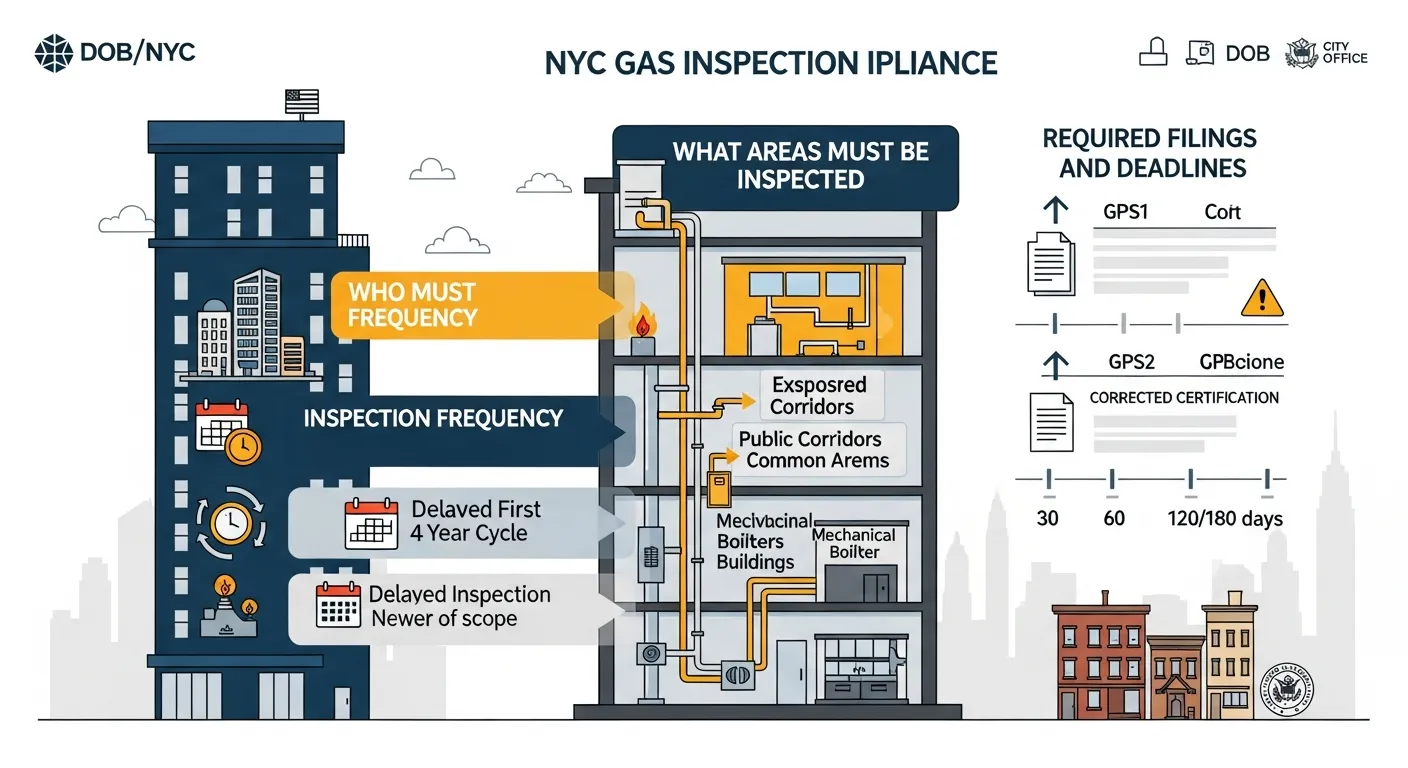
Local Law 152 requires periodic inspections at least once every four years by a qualified professional:
- A NYC Licensed Master Plumber (LMP), or
- A qualified person working under the direct supervision of an LMP.
For newer buildings:
- If the building’s Certificate of Occupancy (or temporary CO) was issued after 12/31/2019, the first inspection is due in the 10th year after the CO date, then every 4 years thereafter.
What areas must be inspected
Inspections cover all exposed gas piping in common and mechanical spaces, including:
- From the gas service point of entry
- Gas meters and associated piping
- Public corridors
- Common areas
- Mechanical and boiler rooms
Inspectors do not go inside individual apartments to open walls or inspect concealed piping. Local Law 152 is about exposed piping in accessible building spaces.
Required filings and deadlines
After the inspection, we have to file specific forms with NYC DOB:
- The LMP issues a GPS1 report to the owner within 30 days of the inspection.
- We must submit the GPS2 Inspection Certification to DOB within 60 days of the inspection date.
- If the GPS1 identified unsafe or non-compliant conditions, we must correct them and submit a corrected certification within:
- 120 days, or
- 180 days if the LMP indicated more time was required.
There’s no filing fee for the GPS2 certification, but failing to file or missing deadlines can trigger DOB civil penalties and additional NYC building violations that may show up in DOB records and HPD complaints when problems affect tenants.
How Local Law 152 Gas Inspections Work
Understanding what actually happens during a Local Law 152 gas inspection helps us prepare and avoid failing for preventable reasons.
What the Licensed Master Plumber checks
During an LL152 inspection, the LMP (or their supervised designee) will typically:
- Visually inspect exposed gas piping from the point of entry, through meter rooms, common areas, corridors, and mechanical/boiler rooms.
- Look for corrosion, rust, pitting, missing supports, and physical damage to piping.
- Check for improper materials, such as non–code-compliant piping or fittings.
- Verify that gas work appears to have been done with permits and not illegally.
- Use a combustible gas detector to check for leaks or unsafe gas levels.
- Confirm presence and accessibility of shutoff valves and check that appliances appear properly connected and vented.
If the LMP identifies an immediately hazardous condition, they’re required to follow DOB rules, which may include notifying the gas utility, recommending gas shutoff, or taking other emergency steps.
Reporting: GPS1 and GPS2
After the inspection:
- GPS1 Report – The LMP must provide us with a written report within 30 days. This lists any:
- Unsafe conditions
- Non-compliant installations
- Leaks or suspected leaks
- Areas where they couldn’t access piping or meters
- GPS2 Inspection Certification – We (the owner or our representative) must submit the certification to DOB within 60 days after the inspection, confirming either:
- No unsafe or hazardous conditions were found: or
- Conditions were found and have either been corrected or are in the process of being corrected, with a timeline.
If corrections are needed, the LMP will typically return after repairs, confirm compliance, and sign off on the final certification.
This is where a lot of buildings stumble, not on the physical gas system, but on paperwork, deadlines, and documentation. We’ll come back to that in the top 10 failure reasons.
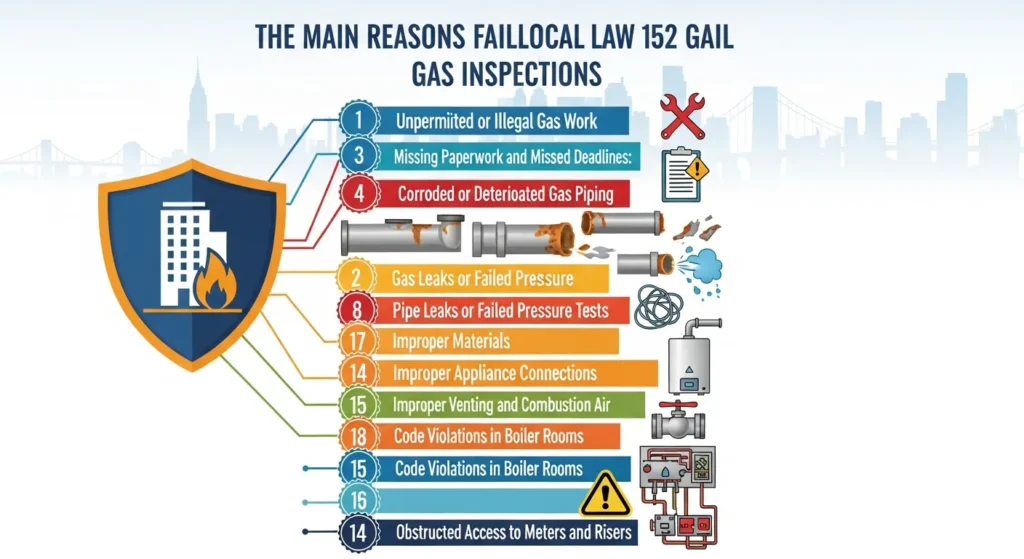
Top 10 Reasons Buildings Fail Local Law 152 Gas Inspections
Here’s where most buildings get into trouble. If we understand these patterns now, we can address them before our inspection date.
Unpermitted Or Illegal Gas Work
This is the single most common, and most serious, reason buildings fail.
Inspectors are trained to spot:
- Gas lines that were added without visible DOB permits
- “Homemade” branches feeding extra stoves or dryers
- Flexible connectors used as permanent piping
- New appliances tied into older systems without proper shutoffs
If the work wasn’t done under a DOB permit, by a Licensed Master Plumber, it’s considered illegal gas work. That’s a major safety risk, and it’s exactly what Local Law 152 is designed to uncover.
In practice, this often shows up as:
- A retail tenant who “brought in their own guy” to hook up kitchen equipment
- Prior owners adding or moving boilers or water heaters without permits
- Gas risers feeding additional units that don’t match old drawings or sign-offs
Once illegal gas work is found, the LMP must document it, and in some cases gas service may be shut down until it’s corrected under proper permits. That can spiral into new DOB violations and delays with HPD if tenants lose essential services.
Missing, Incomplete, Or Inaccurate Paperwork
We can have a reasonably safe system and still fail Local Law 152 for documentation issues.
Common paperwork problems include:
- GPS2 certification never filed with DOB within 60 days
- Wrong Building Identification Number (BIN) or address on the forms
- Owner name not matching tax records or current deed
- Failure to submit the follow-up certification after corrections
- Filing as a “no gas” building when gas piping clearly exists
DOB’s systems rely heavily on clean data. If the information doesn’t line up, or the forms simply never get filed, we’re treated as non-compliant. That can trigger fines and additional NYC building violations.
This is where a simple internal checklist or working with a professional firm that tracks compliance deadlines pays for itself.
Corroded Or Deteriorated Gas Piping
Gas piping lives in some tough environments, damp basements, boiler rooms, exterior walls. Over time we get:
- Surface rust that may be superficial
- Heavy corrosion and pitting that can compromise pipe walls
- Loose, missing, or broken supports and hangers
- Piping that’s been bumped, bent, or struck by other work
LMPs are required to flag corrosion that appears excessive or structural, or piping that’s inadequately supported. Even if we haven’t had a leak yet, visible deterioration can cause a failed inspection.
A smart move is to walk our basements and mechanical rooms annually, before the LL152 year, and note any rust, flaking, or unsupported stretches of pipe. Addressing these early, under permit, is far less painful than scrambling after a failed inspection.
Improper Or Outdated Gas Pipe Materials
Not all metal pipe is created equal. DOB requires specific materials and fittings that meet current code standards. Problems arise when we see:
- Old or non–code-compliant materials left in service
- Mixed systems where incompatible materials connect improperly
- Non-rated fittings, makeshift reducers, or questionable adapters
Sometimes these materials date back decades: other times they were installed during small renovations by people who didn’t know (or didn’t care) about current NYC code.
When an LMP flags improper materials, they’ll typically require that entire sections be replaced under a DOB permit. That can mean opening ceilings or walls in common areas and coordinating outages, another good reason to plan ahead.
Gas Leaks Or Failed Pressure Tests
Local Law 152 inspections use combustible gas detectors to check for leaks. Any detected gas leak is taken seriously:
- Even a small reading at a joint or valve must be evaluated as a potential hazard.
- Larger or persistent readings can lead to immediate shutoff by the utility.
In some projects, especially when new work is being legalized or repaired, a formal pressure test may be required. If the system can’t hold pressure to the required standard, the test is considered failed and the system can’t be put back into service until it’s leak-free.
Gas leaks don’t just create DOB violations, they can quickly become HPD complaints when tenants smell gas or lose service. And if the leak leads to an emergency response, we’re now on the radar of both DOB and the gas utility.
Improper Appliance Connections And Flex Connectors
Appliance hookups are a frequent weak point, especially in older or heavily modified buildings. Common problems include:
- Non-approved flex connectors from big-box stores used in place of code-compliant parts
- Connectors that are too long, kinked, or run through walls or cabinets
- Appliances under tension, where the connector is stretched tight when the unit is moved
- No shutoff valve within reach of the appliance (which ties to another failure reason below)
Local Law 152 focuses on exposed piping, but visible connections to appliances in boiler rooms, laundry rooms, and common kitchens are fair game. If they look improvised or unsafe, they’ll be cited.
Lack Of Required Gas Shutoff Valves Or Inaccessible Valves
Shutoff valves are our last line of defense when something goes wrong. NYC code requires valves at:
- Branch lines
- Individual appliances
- Strategic locations where sections of the system can be isolated
We fail inspections when:
- Valves simply don’t exist where they should
- Valves are buried behind finishes, locked away, or otherwise not accessible
- Valves are visibly damaged, leaking, or frozen in place
From a safety standpoint, think about how quickly we (or the fire department) could shut off gas to a specific area if we had to. If the answer is “we’re not sure” or “we’d have to break a wall,” we have a Local Law 152 problem waiting to happen.
Improper Venting, Combustion Air, Or Clearances
Gas-burning boilers, water heaters, and other appliances need proper venting and combustion air. Inspectors look for:
- Vent pipes that aren’t pitched or supported correctly
- Deteriorated or disconnected flue pipes
- Appliances crammed in spaces with inadequate combustion air
- Storage piled around equipment, blocking airflow and creating fire hazards
Improper venting can cause carbon monoxide buildup, one of the city’s biggest concerns. The NYC Department of Health has long warned about CO incidents tied to poor venting and boiler issues: https://www.nyc.gov/site/doh/health/health-topics/carbon-monoxide-poisoning.page.
Even if DOB doesn’t shut us down immediately, these issues will appear on the inspection report and must be corrected before we can file a clean certification.
Code Violations In Mechanical Or Boiler Rooms
Mechanical and boiler rooms are like a snapshot of how our building has been managed over the years. Inspectors often find:
- Improvised gas piping to temporary equipment that became “permanent”
- Multiple trades working in the same space (steam, water, electrical) with no coordination
- Gas lines too close to electrical panels or ignition sources
- Unprotected piping where it can be knocked or damaged
If the room looks chaotic, there’s a good chance there are underlying code issues. Local Law 152 gives DOB and LMPs a structured moment to call those problems out.
For a more complete matrix of boiler and mechanical room requirements, many owners cross-check with DOB’s boiler safety materials: https://www.nyc.gov/site/buildings/safety/boiler-safety.page.
Obstructed Access To Gas Meters, Risers, And Piping
This one feels minor, until it causes us to fail.
Local Law 152 inspections are visual. If the LMP can’t see or reach the piping, they can’t certify it. We fail when:
- Meter rooms are packed with storage, carts, or construction materials
- Pipe chases and risers in corridors are covered by locked panels with no access
- Boiler rooms are cluttered with junk that blocks views of gas runs
From DOB’s perspective, obstructed access is a safety problem on its own. In an emergency, gas utility crews and firefighters also need clear access to these areas.
Before our inspection window, doing a simple cleanup and access check can eliminate one of the easiest, and most frustrating, reasons to fail.
Common Misconceptions That Lead Owners To Fail Inspections
Common Misconceptions That Lead Owners To Fail Inspections
Some of the most expensive Local Law 152 failures start with misunderstandings rather than bad intent. These are the myths we hear repeatedly.
“The utility checks our gas. That’s enough.”
Gas utilities (Con Edison, National Grid, etc.) do their own safety checks and respond to leak calls. But those inspections do not replace Local Law 152.
LL152 is a DOB-enforced requirement with its own forms, deadlines, and certification rules. We can pass every utility check and still be fined by DOB if we skip or mishandle LL152 inspections.
“We don’t have active gas service, so LL152 doesn’t apply.”
This one trips up buildings that have gas piping but no active account, or that shut gas off temporarily.
- If there’s any gas piping in the building, LL152 applies.
- If there is no gas piping at all, we still have to file a no-gas certification.
Doing nothing is what leads to DOB violations.
“Inspectors have to go inside each apartment.”
Local Law 152 focuses on exposed piping in common and mechanical areas:
- Corridors
- Stairwells
- Meter rooms
- Boiler and mechanical rooms
- Other accessible common spaces
Inspectors do not open walls in apartments, and the law doesn’t require access to every unit. Owners who think they must schedule full interior access sometimes delay or avoid inspections, and then miss their deadlines entirely.
“We can fix issues whenever we get around to it.”
LL152 builds correction deadlines into the law:
- Unsafe or non-compliant conditions must be corrected under permit by a Licensed Master Plumber.
- The corrected certification must be filed within 120 days, or 180 days if the LMP indicated additional time.
Waiting too long can mean:
- Additional DOB penalties
- Open NYC building violations that complicate refinancing or sales
- More HPD complaints if tenants go without gas or hot water for extended periods
In other words, the countdown starts the day of the inspection, not whenever we get around to it.
How To Prepare Your Building And Avoid Local Law 152 Failures
We can’t control everything, but we can dramatically reduce the odds of failing a Local Law 152 inspection with some proactive steps.
1. Line up a Licensed Master Plumber early
LL152 inspections follow a rolling four‑year cycle, and LMPs book up fast as deadlines approach. Our best move is to:
- Identify a reputable Licensed Master Plumber who regularly works on LL152 inspections
- Book the inspection early in our cycle rather than in the last quarter
- Clarify what’s included: pre-survey, follow-up visit, help with GPS2 filing
Early booking also gives us time to address issues before the clock starts ticking on formal correction deadlines.
2. Do our own pre-survey of exposed piping
We don’t need to be plumbers to notice obvious red flags. Before the inspection window:
- Walk meter rooms, corridors, and boiler rooms.
- Look for rust, flaking, or pitting on gas piping.
- Check that pipes are supported and not sagging.
- Clear junk away from meters and risers.
- Note any suspicious flex connectors, improvised tees, or odd branch lines.
If something looks off, we can have our plumber do targeted repairs under permit before the formal LL152 inspection.
3. Verify permits and history for past gas work
Illegal or undocumented gas work is one of the hardest issues to clean up.
We should:
- Review our own records: invoices, permits, and sign-offs for major gas work
- Search DOB records by BIN/Block/Lot to confirm that past gas jobs were properly filed (the DOB NOW and BIS systems make this possible)
- Flag any equipment, boilers, commercial kitchens, laundry rooms, that may have been installed by tenants themselves
If we discover unpermitted work, it’s usually smarter to legalize it proactively with a new permit than to wait for Local Law 152 to catch it.
4. Clean up access to meters, risers, and boiler rooms
This is one of the easiest wins:
- Remove storage from meter rooms
- Unlock and test access panels covering gas risers
- Clear at least a three-foot working path to gas equipment where possible
Not only does this help us pass LL152, it’s consistent with fire and utility expectations during emergencies.
5. Get our building data and documentation in order
When it’s time to file the GPS2 certification, small errors can create big headaches. Before the inspection, we should confirm:
- Correct BIN, address, and block/lot
- Owner name matches deeds and tax records
- Management contact info is up to date
This is also a good moment to set up ongoing compliance tools. For example, we can use ViolationWatch to keep an eye on new DOB violations and track our NYC property compliance status over time: https://violationwatch.nyc/.
Get instant alerts whenever your building receives a new violation, sign up for real-time monitoring using building violation alerts so we’re not blindsided by enforcement actions tied to gas work or other systems.
6. Monitor open violations and complaints
DOB violations and HPD complaints often hint at underlying conditions that can hurt us on LL152 inspections, especially if they involve gas, heat, or hot water.
We can:
- Regularly check DOB and HPD databases for open issues
- Prioritize closing out anything related to gas or mechanical systems
- Document corrections so our LMP understands the full history
We can also run quick checks using a NYC violation lookup tool to see what’s on record for our property before the inspector walks in.
Staying ahead of these items doesn’t just help with Local Law 152: it makes our overall NYC building violations profile much cleaner, which matters to lenders, buyers, and tenants.
What Happens After A Failed Local Law 152 Inspection
If our building doesn’t pass the first time, it’s not the end of the world, but we do need to move fast and follow the rules.
1. Review the GPS1 report in detail
The LMP’s GPS1 report is our roadmap. It will identify:
- Unsafe or hazardous conditions
- Code violations and non-compliant work
- Leaks or suspected leaks
- Areas where access was blocked
We should go line by line, ideally with the plumber who did the inspection, to understand which items are immediate hazards and which are compliance or documentation issues.
2. Address hazardous conditions first
If the LMP identifies an immediately hazardous condition, they may:
- Advise us to shut gas off to a section or the entire building
- Notify the gas utility
- Recommend emergency repairs under permit
Our priority is always life safety. Once hazards are made safe, we can move into the more methodical phase of repair and legalization.
3. Pull permits and correct the work
Repairs or corrections to gas systems generally require DOB permits. That can include:
- Replacing corroded piping
- Removing or reconfiguring illegal branches
- Installing missing shutoff valves or supports
- Correcting venting or combustion air issues
Our LMP will typically:
- File for permits
- Perform the work
- Arrange any required tests or inspections with DOB or the utility
It’s important we don’t try to “patch” gas problems with unlicensed or off-the-books work, that’s exactly what LL152 is designed to uncover, and it can put us in a much worse position.
4. File the corrected Inspection Certification
Once all listed conditions are corrected, the LMP can sign off, and we submit the corrected GPS2 Inspection Certification to DOB.
Key deadlines:
- 120 days from the original inspection: or
- 180 days if the original GPS1 and initial certification noted that more time was needed.
Failing to file this corrected certification can lead to DOB civil penalties, ongoing NYC building violations, and additional enforcement.
5. Monitor for new violations and keep records
After we’ve closed out our Local Law 152 issues, we want to make sure the city’s records reflect that progress.
Tools like ViolationWatch can help us track the status of DOB violations, HPD complaints, and other enforcement actions tied to our property: https://violationwatch.nyc/.
For free lookups, use our NYC violation lookup tool to confirm that LL152-related violations are resolved and no new ones have appeared.
Good documentation, including permits, sign-offs, and GPS1/GPS2 copies, also helps us prove compliance during future refinancing, sales, or audits.
Conclusion
Local Law 152 has added another layer to NYC property compliance, but it’s rooted in a simple idea: gas piping should be safe, documented, and regularly inspected. When buildings fail gas inspections, it almost always comes down to a handful of recurring issues, illegal gas work, poor documentation, neglected corrosion, missing valves, improper venting, and blocked access.
If we tackle those problem areas early, working with a solid Licensed Master Plumber, verifying permits, cleaning up access, and staying on top of NYC building violations, we can turn LL152 from a crisis event into a routine checkpoint.
The inspection itself is just one day. The real work is how we manage our gas systems in the years between inspections. By building a habit of regular self-surveys, prompt repairs, and consistent monitoring, using tools like building violation alerts and ViolationWatch’s tracking tools, we put ourselves in a much better position when DOB comes calling.
In a city where gas incidents can make headlines overnight, staying ahead of Local Law 152 isn’t just about avoiding fines. It’s about protecting our residents, our buildings, and our long-term investment in New York real estate.
Key Takeaways
- Most buildings fail Local Law 152 gas inspections due to illegal or unpermitted gas work, which often leads to shutoffs, emergency repairs, and serious DOB violations.
- Documentation mistakes—such as missing or late GPS2 filings, incorrect building data, or failing to submit a no-gas certification—cause many otherwise safe systems to be flagged as non-compliant.
- Physical conditions like corroded or deteriorated gas piping, improper or outdated materials, leaks, and missing shutoff valves are core technical reasons buildings fail gas inspections under Local Law 152.
- Owners can significantly reduce failure risk by doing a pre-survey of exposed piping, verifying past gas permits, cleaning up access to meters and boiler rooms, and lining up a Licensed Master Plumber early in the inspection cycle.
- If a building fails a Local Law 152 gas inspection, owners must quickly review the GPS1 report, correct hazardous and non-compliant conditions under permit, and file a corrected GPS2 certification within the 120–180 day window to avoid escalating penalties and violations.
Frequently Asked Questions About Failing Local Law 152 Gas Inspections
What are the most common reasons buildings fail a Local Law 152 gas inspection?
Buildings most often fail Local Law 152 gas inspections due to illegal or unpermitted gas work, missing or incorrect GPS1/GPS2 paperwork, corroded or poorly supported piping, improper or outdated gas pipe materials, gas leaks, missing shutoff valves, bad appliance connections, improper venting, and obstructed access to meters or risers.
How can I prepare my building to avoid failing a Local Law 152 gas inspection?
Owners can reduce failure risk by pre-inspecting exposed piping, clearing access to meters and boiler rooms, confirming past gas work was permitted, addressing visible corrosion or questionable flex connectors, and ensuring documentation (BIN, owner info, no‑gas certifications if applicable) is accurate. Lining up a Licensed Master Plumber early is critical.
What happens after my building fails a Local Law 152 gas inspection?
After a failed Local Law 152 gas inspection, review the GPS1 report with your Licensed Master Plumber, correct hazardous conditions first, and pull DOB permits for required repairs. Once work is completed and any tests are passed, the LMP signs off and you must file a corrected GPS2 certification within the 120‑ or 180‑day deadline.
Can I fail Local Law 152 just for paperwork or filing mistakes?
Yes. Even if your gas system is relatively safe, you can be treated as non‑compliant if the GPS2 certification isn’t filed on time, the BIN or address is wrong, the owner name doesn’t match records, follow‑up certifications aren’t submitted, or you incorrectly file as a “no gas” building.
What penalties can I face for failing or ignoring Local Law 152 gas inspections?
DOB can issue civil penalties for failure to file, late filing, or unresolved hazardous conditions. In serious cases, gas service may be shut off, triggering HPD complaints and additional violations. Open Local Law 152 issues can also complicate refinancing, sales, and due diligence because they appear in NYC building violation records.
How much does a Local Law 152 gas inspection typically cost in NYC?
Costs vary by building size, complexity, and the Licensed Master Plumber’s scope. Many multifamily or mixed‑use buildings can expect anywhere from a few hundred to a few thousand dollars, especially if pre‑surveys and follow‑up visits are included. Significant additional costs arise if illegal work, corrosion, or major piping replacements are required.