
If you live in New York City, HPD violations aren’t just bureaucratic noise, they’re often the paper trail behind cold apartments, leaking ceilings, and chronically neglected buildings. And they’re not spread evenly across the city.
In Brooklyn, Queens, and the Bronx, certain neighborhoods see far higher concentrations of NYC building violations and HPD complaints than others. Those areas often overlap with lower‑income communities, older housing stock, and intense investor pressure.
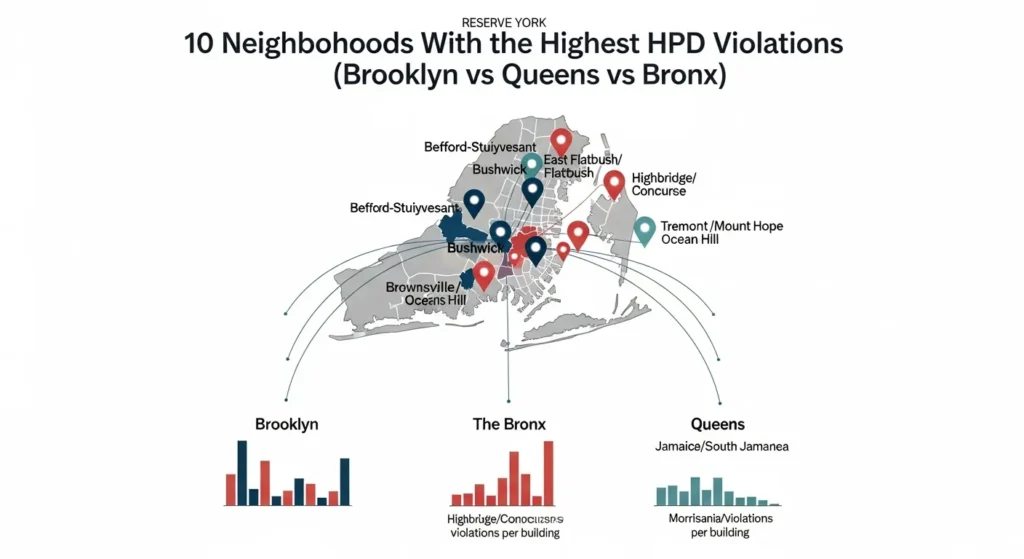
In this guide, we walk through 10 neighborhoods that repeatedly emerge as HPD “hotspots”, based on city open data, tenant advocacy maps, and public reporting, and what those patterns tell us about NYC property compliance. We’ll also show how renters and owners can use violation data to protect themselves and push for better conditions.
Why HPD Violations Matter For Renters And Owners
What HPD Violations Are And How They Work
The NYC Department of Housing Preservation and Development (HPD) enforces the Housing Maintenance Code for residential buildings. When HPD inspectors find a code violation, usually after a 311 complaint, inspection sweep, or a Housing Court order, they issue an official Notice of Violation.
Each notice becomes part of the public record and includes:
- The specific condition (for example, no heat, mold, rodents)
- The violation class (A, B, or C)
- The legal deadline to correct
- Instructions for how the owner must certify correction with HPD
If an owner doesn’t fix the problem and certify on time, HPD can impose civil penalties, bring the owner to Housing Court, or even send its own emergency repair teams and bill the owner, sometimes adding a lien to the property. The agency’s overview of this process is laid out on the city’s own HPD site: https://www.nyc.gov/site/hpd/services-and-information/hpd-online.page.
In practice, HPD violations are the city’s main enforcement tool for making sure basic conditions in rental housing are safe and habitable.
Types Of HPD Violations: Class A, B, And C
HPD classifies violations by severity:
- Class A – Non-hazardous
These are quality-of-life or administrative issues: missing signs, minor leaks, peeling paint that’s not lead-related, missing apartment numbers, small cracks. In general, owners get up to 90 days to correct them.
- Class B – Hazardous
These signal conditions that could directly affect health or safety, but aren’t immediately life-threatening: active leaks, pests, inadequate lighting, missing smoke or CO detectors, broken self-closing doors. Owners typically have about 30 days to fix them.
- Class C – Immediately hazardous
These are the most serious. No heat or hot water in winter, lead-based paint hazards, severe mold, structural instability, electrical dangers, or rodent infestations fall here. Correction timelines are much shorter, sometimes 24 hours, sometimes a few days, depending on the exact issue.
When we talk about neighborhoods with the “highest” HPD violations, we’re not just talking about a long list of minor paperwork problems. In many buildings, high counts come from clusters of Class B and Class C violations that reflect chronic neglect.
Health, Safety, And Financial Impacts On Residents
HPD violations might look like legal codes on a screen, but the lived reality is simple:
- No heat or hot water means families using ovens or space heaters to stay warm, and higher fire risk.
- Mold and leaks are tightly linked to asthma and respiratory problems, especially in children.
- Lead paint hazards can permanently affect a child’s neurological development.
- Pests and vermin don’t just look bad, they carry disease and aggravate chronic health conditions.
For tenants, a long violation history can be:
- Evidence in Housing Court or HP actions
- Support for rent abatements or court-ordered repairs
- Proof that a landlord has ignored prior complaints
For owners, uncorrected NYC building violations can snowball into:
- Daily civil penalties and emergency repair bills
- HPD liens that complicate refinancing or sale
- Greater litigation risk from tenants or city agencies
That’s why the geography of violations matters. Clusters of open HPD violations don’t just identify sloppy landlords, they mark neighborhoods where both renters and owners face higher legal and financial risk, and where basic health and safety are on the line.
How This List Was Compiled
Data Sources And Time Frame
We need to be honest up front: HPD doesn’t publish a neat, ready-made ranking of “top 10 neighborhoods by violations.” To build a picture of hotspots, we looked at:
- NYC Open Data HPD Violations: The public violations dataset with addresses, violation dates, and types: https://data.cityofnewyork.us/Housing-Development/HPD-Violations.
- HPD Online building records: To understand building-level patterns of open and closed violations.
- Tenant advocacy maps and reports that highlight buildings with extreme violation counts.
- Press reporting from outlets like The City, City Limits, and major real estate publications, which frequently call out repeat-offender buildings and corridors.
Because we don’t have a single official, final ranking, we focus on neighborhoods that consistently surface across these sources as heavy-burden areas. We also give extra weight to recent years, roughly the last 3–5 years, to avoid relying on outdated crisis buildings that have since been rehabilitated.
How Neighborhoods And Buildings Were Grouped
NYC datasets typically use borough, address, community district, or a statistical geography like Neighborhood Tabulation Areas (NTAs), not the informal names most of us use. To keep this guide readable, we:
- Group buildings into commonly used neighborhood labels (Bed-Stuy, Bushwick, Jamaica, etc.), usually approximating City Planning’s NTAs.
- Consider both violation volume (how many violations per building) and density (roughly how many violations per residential unit or per building cluster), not just raw totals.
- Focus mainly on multifamily rentals, since that’s where HPD complaints and enforcement are most intense.
This is why you’ll see combined labels like “Fordham / University Heights”, they track how HPD and many advocacy groups describe local housing conditions.
Limitations And Caveats To Keep In Mind
We want to avoid fake precision. There are some important limits:
- We can’t claim an exact rank (for example, “Bed-Stuy has exactly 23% more violations than Bushwick”) without running a live statistical analysis on the raw dataset.
- Violation counts change daily as HPD closes cases and issues new ones.
- High violation counts can reflect better reporting and organizing (tenants calling 311) as much as worse buildings.
- A single megaproblem building can skew a small area’s numbers.
So, when we say “top 10 neighborhoods,” we’re pointing to places that repeatedly show up as high-burden clusters, not declaring an immutable leaderboard carved into stone.
HPD Violations By Borough: Brooklyn vs Queens vs The Bronx
Overall Violation Volume And Density By Borough
Across NYC, Brooklyn and the Bronx typically trade places for the highest HPD violation totals, with Queens notably lower. That’s broadly consistent with:
- Older rental housing concentrated in Brooklyn and the Bronx
- Higher shares of rent-stabilized and low-income tenants in those boroughs
- Stronger histories of tenant organizing and 311 usage
The Bronx has a long reputation, backed by HPD enforcement and press investigations, for buildings with hundreds of open violations under single ownerships. Brooklyn, particularly central and eastern neighborhoods, posts similar patterns, but often with more investor turnover and gentrification pressure.
Queens, meanwhile, tends to show fewer HPD violations relative to its size, in part because much of its housing stock is smaller buildings and 1–4 family homes that fly under the radar, and in part because some tenant populations may be less likely to call 311.
Patterns In Building Age, Size, And Ownership
When we sift through HPD violations, we see some clear trends:
- Pre-war elevator buildings (1900–1939) in the Bronx and Brooklyn often carry long histories of HPD complaints, especially where maintenance has been deferred for decades.
- Mid-century walk-ups with 10–30 units are frequent violators, big enough for complex systems, small enough for thin margins and neglect.
- Scattered-site portfolios owned by the same LLC or landlord appear as violation “clusters” across multiple addresses.
In short, borough-level differences in DOB violations and HPD complaints track not just geography but who owns what, and how they run it. That’s why we now zoom in on specific neighborhoods where those patterns are most intense.
Brooklyn’s Worst HPD Violation Hotspots
#1: Bedford-Stuyvesant
Bed-Stuy sits at the intersection of older housing stock, rising rents, and heavy investor interest. That’s a recipe for HPD violations.
On many Bed-Stuy blocks, five-story walk-ups mix with subdivided brownstones. Some are meticulously maintained: others rack up dozens of open violations at a time:
- Class C violations for heat and hot water in winter
- Mold and leak complaints where roofs and plumbing haven’t been modernized
- Pests and rodents in basements and common areas
Public enforcement actions and tenant campaigns have repeatedly spotlighted Bed-Stuy as a hotspot for NYC building violations, especially in properties where long-time tenants live alongside new, higher-rent arrivals. Owners under financial pressure sometimes cut corners, and HPD’s violation log tells the story.
#2: Crown Heights (North And South)
Crown Heights, both north and south of Eastern Parkway, shares many of Bed-Stuy’s structural issues: old buildings, rising land values, and complicated ownership webs.
In large rent-stabilized buildings along Eastern Parkway, Class B and C violations often come in waves:
- Broken self-closing doors and intercoms
- Chronic elevator outages
- Water infiltration and mold in ground-floor apartments
At the same time, smaller buildings split into multiple units can be hubs for illegal conversions and overcrowding, which trigger separate HPD and DOB scrutiny.
Because Crown Heights has a strong tenant organizing infrastructure, we see a relatively high rate of documented HPD violations, tenants call 311, track case numbers, and bring HP actions when needed.
#3: Bushwick
Bushwick’s HPD profile reflects a different but related dynamic: rapid change. Formerly industrial blocks and older multifamily buildings have been targets for aggressive speculation, with some landlords accused of using neglect to drive out rent-stabilized tenants.
Typical patterns in high-violation Bushwick buildings include:
- Longstanding leak and mold issues tied to old roofs and mechanical systems
- Unsafe construction and dust during renovation in occupied buildings
- Heat and hot water failures during ownership transitions
Press investigations have repeatedly focused on Bushwick buildings with triple-digit open HPD violations. In some cases, these overlap with DOB violations for unsafe work or illegal construction, further raising safety concerns.
#4: East Flatbush / Flatbush
Flatbush and East Flatbush combine dense multifamily corridors with large frame houses and mixed-use buildings. Tenants in these areas report a familiar mix of HPD complaints:
- Rodent and roach infestations
- Peeling paint and moisture problems
- Broken entry doors and inadequate lighting in common areas
In high-violation pockets, buildings are often:
- Heavily leveraged or recently flipped to new investors
- Part of scattered-light portfolios spanning several blocks
- Under-resourced on onsite super and maintenance staff
Because these neighborhoods house many families of color and immigrant tenants, community groups have stepped in to help residents document NYC property compliance issues and push for repairs.
#5: Brownsville / Ocean Hill
Brownsville and Ocean Hill are among Brooklyn’s most persistently overburdened neighborhoods when it comes to housing quality. HPD violations here often involve:
- Serious Class C issues: no heat, broken boilers, unsafe electrical systems
- Structural problems in aging elevator buildings
- Long delays in emergency repairs
Some buildings in Brownsville have been the subject of repeated HPD enforcement and even city receivership in extreme cases. High violation counts tell a story of chronic underinvestment in basic habitability.
Tenant organizers in Brownsville frequently use HPD data to map which owners have the worst records and to push for targeted enforcement, especially in buildings housing seniors and families with young children.
Bronx Neighborhoods With The Heaviest Violation Burdens
#6: Fordham / University Heights
When we look at HPD data and press reports, Fordham and University Heights stand out for their concentration of big multifamily buildings, many built in the early 20th century and carrying decades of deferred maintenance.
Here, HPD violations often look like:
- Dozens, sometimes hundreds, of open items in a single building
- Recurring Class C violations for heat, hot water, and lead paint
- Elevator outages that drag on for weeks
Some notorious Bronx portfolios with thousands of HPD violations have key holdings in this area. For tenants, that translates into a constant grind of 311 calls, inspectors, and court dates.
#7: Highbridge / Concourse
Highbridge and the Concourse area are densely built, with a high share of rent-stabilized stock and large pre-war walk-ups. It’s not uncommon to find buildings here with shockingly long HPD histories and layers of open DOB violations as well.
Patterns we see repeatedly:
- Systemic water and sewer issues leading to mold and ceiling collapses
- Broken fire safety features, self-closing doors, alarms, lighting
- Infestations in common areas and basement spaces
Tenant groups in Highbridge have used HPD violations to document conditions in Housing Court and win building-wide repairs, but the volume of distressed buildings keeps the overall count high.
#8: Tremont / Mount Hope
Tremont and Mount Hope sit at the heart of some of the Bronx’s most heavily scrutinized housing. They often show up in city and nonprofit maps of “at-risk” buildings based on HPD and tax lien data.
High-violation buildings here frequently share:
- Aging heating systems that break down every winter
- Inadequate ventilation causing severe mold
- Poorly maintained roofs leading to active leaks on top floors
Because many residents are low-income and may be reluctant to complain, the existing HPD violation counts probably undercount real conditions. Where tenant associations do form, they’re often able to rapidly document dozens of unreported issues.
#9: Morrisania / Melrose
Morrisania and Melrose have seen major new affordable housing over the past two decades, but older stock in these neighborhoods still carries heavy burdens of HPD violations.
Common issues include:
- Lead paint hazards in pre-1960 buildings
- Chronically broken entry doors and intercoms
- Overcrowding and illegal subdivisions in smaller properties
We see a split: newer, regulated affordable developments with more proactive management, and older, privately owned buildings with long violation records. HPD data makes that divide very visible, you’ll see clean records next to buildings with dozens of open Class B and C violations.
Queens’ Top HPD Violation Cluster
#10: Jamaica / South Jamaica
In Queens, HPD violations are more dispersed, but Jamaica and South Jamaica stand out as one of the borough’s highest-concentration clusters, especially for multifamily rentals near major transit and commercial corridors.
Here, we see a mix of:
- Walk-up buildings with long-standing maintenance issues
- Mixed-use structures where residential floors sit over under-maintained retail
- Smaller multifamily homes subdivided into many units
HPD violations in this area commonly involve heat and hot water complaints, mold and moisture, and pests. Some buildings also face DOB scrutiny for illegal conversions or unsafe construction during renovation, compounding the risk.
Why Queens Sees Fewer HPD Violations Than Brooklyn And The Bronx
Even though Jamaica’s hotspot status, Queens overall tends to log fewer HPD violations than Brooklyn and the Bronx. We should be cautious interpreting that.
Contributing factors likely include:
- Housing type: More 1–4 family homes and smaller buildings, which see fewer inspections and sometimes different enforcement dynamics.
- Tenant behavior: In some immigrant-heavy areas, tenants may be less likely to call 311 or bring HP actions, even when conditions are poor.
- Building age: Large swaths of Queens were built later than the oldest Bronx and Brooklyn stock, so some systems are in better shape.
The bottom line: lower violation counts don’t automatically mean Queens tenants enjoy better conditions. They may also reflect different reporting patterns and property types.
Common Conditions Behind High Violation Counts
Chronic Maintenance Problems And Deferred Repairs
When we trace HPD violation clusters across Bed-Stuy, Brownsville, Fordham, or Jamaica, one theme jumps out: routine maintenance simply isn’t happening.
Owners delay or skip:
- Roof repairs, allowing water to infiltrate year after year
- Boiler upgrades, leading to seasonal heat and hot-water emergencies
- Pest control, until infestations become building-wide crises
Minor issues that should be fixed in days become major problems over months. HPD violations pile up, tenants get sick, and repair costs soar.
Aging Building Stock And Outdated Systems
Many buildings in these neighborhoods date from before modern building codes, energy standards, or lead laws. That doesn’t doom them to violations, plenty of pre-war buildings are beautifully maintained, but it raises the stakes:
- Old plumbing means leaks and moisture in walls and ceilings
- Outdated electrical systems can’t safely handle modern loads
- Legacy lead paint and old windows create ongoing hazards
Without consistent reinvestment, older stock becomes a factory for new DOB violations and HPD complaints.
Owner Behavior, Financial Pressure, And Speculation
We can’t explain NYC property compliance issues purely by age and bricks. Who owns the building, and how they run it, matters.
High-violation portfolios often share traits:
- Heavy debt and interest costs that squeeze maintenance budgets
- Ownership by remote LLCs with limited local presence
- Business models that rely on displacing rent-stabilized tenants and raising rents
In fast-changing neighborhoods like Bushwick or Crown Heights, some landlords have been accused of weaponizing disrepair, letting conditions deteriorate to push tenants out. HPD violations, tenant lawsuits, and media coverage have documented this tactic in multiple boroughs.
Conversely, mission-driven owners, strong co-ops, and well-run affordable housing can keep very old buildings in good shape with relatively few violations, even in the same zip code.
How Tenants Can Check And Use HPD Violation Data
Looking Up Your Building’s HPD Record
If you’re wondering whether your building is part of an HPD hotspot, the first step is to look up its record.
You can search your address directly through HPD’s own tools or via third-party resources. For free lookups, use our NYC violation lookup tool to see HPD violations, DOB issues, and related enforcement history in one place.
NYC also provides direct resources here: https://www.nyc.gov/site/hpd/services-and-information/hpd-online.page.
Beyond one-time searches, the real power is in ongoing monitoring. Get instant alerts whenever your building receives a new violation, sign up for real-time monitoring with our building violation alerts service. That way, you don’t have to constantly refresh databases to see what’s happening.
When And How To Report Problems To 311 Or HPD
Violation data is only as good as the complaints behind it. If you have heat, hot water, or serious safety problems:
- Notify your landlord or management in writing (email or text is fine) and give a short, reasonable deadline.
- If nothing changes, call 311 and clearly describe the problem. Mention if there are children, seniors, or people with disabilities in the unit.
- Keep your 311 confirmation numbers. HPD uses these to track inspections and violations.
- If conditions remain dangerous or unresolved, consider an HP (Housing Part) case in Housing Court. Legal service providers can help you gather HPD records and photos.
HPD’s guidance on heat and hot water complaints is laid out here: https://www.nyc.gov/site/hpd/services-and-information/heat-and-hot-water.page.
Working With Tenant Groups, Legal Aid, And Inspectors
In many of the hotspot neighborhoods we’ve named, tenants don’t fight these battles alone. They work with:
- Tenant associations in the building or on the block
- Legal aid and housing nonprofits that specialize in HP cases
- City inspectors and elected officials who can escalate patterns of neglect
If your building has a long violation history, it’s often more effective to organize with neighbors, compare HPD records, and push for building-wide solutions rather than handling every complaint as a one-off.
Tools like ViolationWatch can help tenants and owners track patterns across multiple addresses, identify problem portfolios, and document when NYC property compliance issues aren’t improving over time.
What These Hotspot Neighborhoods Reveal About Housing Policy
Enforcement Priorities And Resource Gaps
The simple fact that Bed-Stuy, Brownsville, Fordham, and Jamaica show up over and over in HPD violation maps tells us something about enforcement, and about its limits.
On the one hand, HPD is clearly active in these areas. Inspectors respond to 311, issue violations, and in some cases refer owners to Housing Court or emergency repair programs.
On the other hand, the persistence of high-violation buildings suggests enforcement alone isn’t enough. Some owners treat fines and violations as a cost of doing business. Others may lack the capital or capacity to make needed repairs, even under pressure.
Targeted Programs That Could Reduce Violations
These hotspots point toward policy solutions that go beyond citations:
- Targeted capital programs for distressed buildings, especially where tenants face immediate health hazards.
- Proactive inspections in high-risk corridors, rather than waiting for tenants to call 311.
- Portfolio-based enforcement, focusing on repeat-offender landlords across multiple buildings.
- Support for preservation transactions that transfer distressed buildings to stronger, mission-driven owners.
Some of this work is already happening in pieces, HPD’s preservation programs, tax incentives tied to repairs, and nonprofit purchases of distressed portfolios. But the concentrated HPD violations in Brooklyn and the Bronx show how much more is needed.
Balancing Stronger Enforcement With Preventing Displacement
There’s a real tension we have to acknowledge: strong enforcement can, in theory, accelerate displacement if owners respond by selling, converting, or pushing out rent-stabilized tenants to finance major work.
Good policy has to thread this needle:
- Aggressively enforcing against dangerous conditions and chronic noncompliance
- Protecting tenants from retaliation and illegal evictions
- Ensuring that rehab and ownership changes keep units affordable and stable in the long run
The HPD violation hotspots we’ve covered aren’t just about bad buildings, they’re about neighborhoods where housing justice, racial equity, and long-term affordability are all intertwined.
Conclusion
How HPD Violation Hotspots Should Shape Renter Decisions And City Action
For renters, knowing which neighborhoods routinely rank among the highest for HPD violations can change how we search for housing and how we respond when things go wrong.
If you’re looking in Bed-Stuy, Crown Heights, Bushwick, Fordham, or Jamaica, that doesn’t mean you should avoid those areas altogether. It does mean:
- Check the building, not just the block. Two properties on the same street can have totally different HPD histories.
- Use data before you sign. A quick search with an HPD tool or an independent resource like our NYC violation lookup tool can reveal patterns of neglect.
- Stay informed after you move in. Instead of manually checking for new issues, consider subscribing to building violation alerts so you know when HPD or DOB issues pop up.
For the city, these hotspots underline a clear message: we can’t treat HPD violations as scattered, one-off code problems. They’re clustered, predictable, and deeply tied to long-standing inequities in investment, ownership, and enforcement.
If we focus resources where violations and HPD complaints are most concentrated, while protecting tenants from displacement, we can turn some of the buildings and neighborhoods that are now symbols of neglect into examples of what real, sustained preservation looks like.
Until then, our best tools are information and organization. HPD violation records, enforcement data, and platforms like ViolationWatch give us a clearer view of where housing is failing, and a starting point for pushing it to improve.
Key Takeaways
- HPD violations cluster most heavily in specific neighborhoods across Brooklyn, the Bronx, and Queens—especially Bed-Stuy, Crown Heights, Bushwick, Brownsville/Ocean Hill, Fordham/University Heights, and Jamaica—rather than being evenly spread citywide.
- High counts of HPD violations usually signal serious Class B and Class C issues like lack of heat, mold, pests, unsafe electrical systems, and lead hazards that directly threaten tenants’ health and safety.
- Brooklyn and the Bronx consistently show far higher volumes of HPD violations than Queens due to older multifamily housing, higher shares of low-income and rent-stabilized tenants, and portfolios with long histories of deferred maintenance.
- Tenants can protect themselves by checking NYC building violation records before signing a lease, monitoring their building’s HPD violations over time, and using 311 complaints, HP actions, and tenant organizing to push for repairs.
- For policymakers, these 10 neighborhoods with the highest HPD violations highlight the need for proactive inspections, portfolio-level enforcement against repeat offenders, and capital programs that fix distressed buildings without displacing current tenants.
Frequently Asked Questions About HPD Violations in Brooklyn, Queens, and the Bronx
What are HPD violations and how do they work in New York City?
HPD violations are notices issued by NYC’s Department of Housing Preservation and Development when a building fails to meet Housing Maintenance Code standards. After a 311 complaint or inspection, HPD classifies the problem, sets a correction deadline, and can levy fines, bring Housing Court cases, or perform emergency repairs if owners don’t comply.
Which borough has the most HPD violations: Brooklyn, Queens, or the Bronx?
Brooklyn and the Bronx usually trade places for the highest HPD violation totals, especially in older, rent‑stabilized buildings and low‑income areas. Queens typically shows fewer HPD violations overall, partly due to more 1–4 family homes and different reporting patterns, but that doesn’t always mean better housing conditions.
What is the difference between Class A, B, and C HPD violations?
Class A HPD violations are non‑hazardous issues like minor leaks or missing signs, often with up to 90 days to fix. Class B are hazardous conditions, such as pests or broken self‑closing doors, usually with 30 days to correct. Class C are immediately hazardous problems—no heat, lead paint, severe mold—with very short repair deadlines.
How can tenants check if their building is in a high HPD violation neighborhood?
Tenants can search their address on HPD Online or independent NYC violation lookup tools to see open and past HPD violations, DOB issues, and enforcement history. Comparing nearby buildings in hotspots like Bed‑Stuy, Crown Heights, Fordham, or Jamaica helps reveal whether problems are building‑specific or part of a wider neighborhood pattern.
How can renters use HPD violation data before signing a lease?
Before renting, search the building’s HPD violations to see how often serious issues like no heat, mold, or pests occur and how quickly they’re corrected. A long history of open Class B and C violations, especially in HPD hotspot neighborhoods, can signal chronic neglect and higher health, safety, and legal risk for tenants.
Do HPD violations affect property value and financing for owners and investors?
Yes. Large numbers of unresolved HPD violations can lead to daily civil penalties, emergency repair bills, and HPD liens, which complicate refinancing and sales. Lenders often review violation histories as part of due diligence, and high‑violation buildings may require costly capital work, reducing net operating income and investment appeal.