
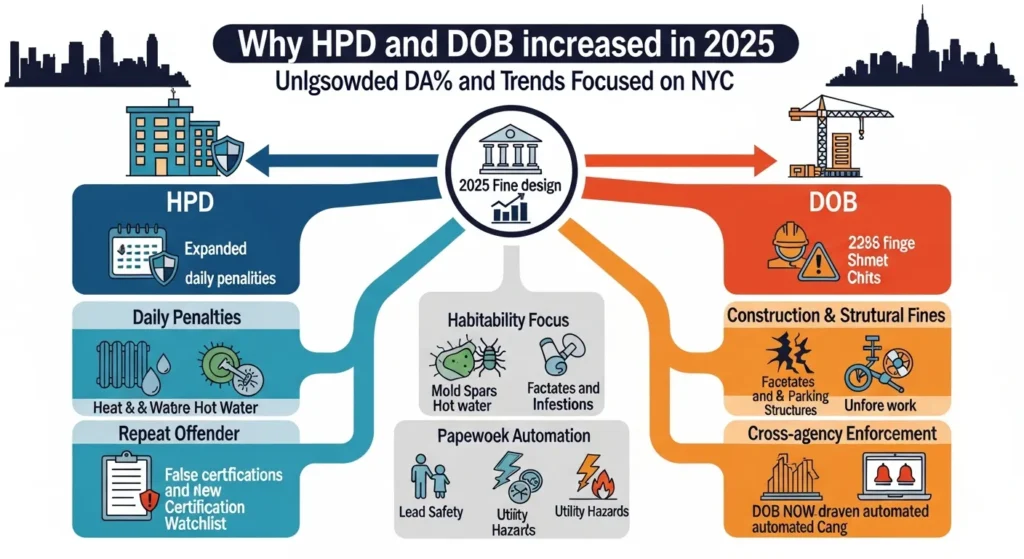
If it feels like every HPD or DOB notice in 2025 comes with a bigger price tag, that’s not your imagination. New York City quietly rewrote the math on non‑compliance this year.
Across the board, we’re seeing higher civil penalties, expanded daily fines, more automated enforcement, and tougher consequences for repeat offenders. The result: HPD and DOB fines are rising not just because owners are doing more wrong, but because the rulebook itself has changed.
In this piece, we unpack what actually shifted in 2025, why the city is doing it, and how these changes are reshaping day‑to‑day decisions for owners, managers, and contractors. We’ll also look at patterns across boroughs and property types, and share practical strategies to stay ahead of NYC building violations while the enforcement climate keeps tightening.
What Changed In 2025 For HPD And DOB Enforcement
Key 2025 Rule And Code Updates Affecting Fines
The 2025 spike in HPD and DOB fines isn’t just a product of more HPD complaints or extra inspections. The underlying rules changed.
For HPD (housing conditions and habitability):
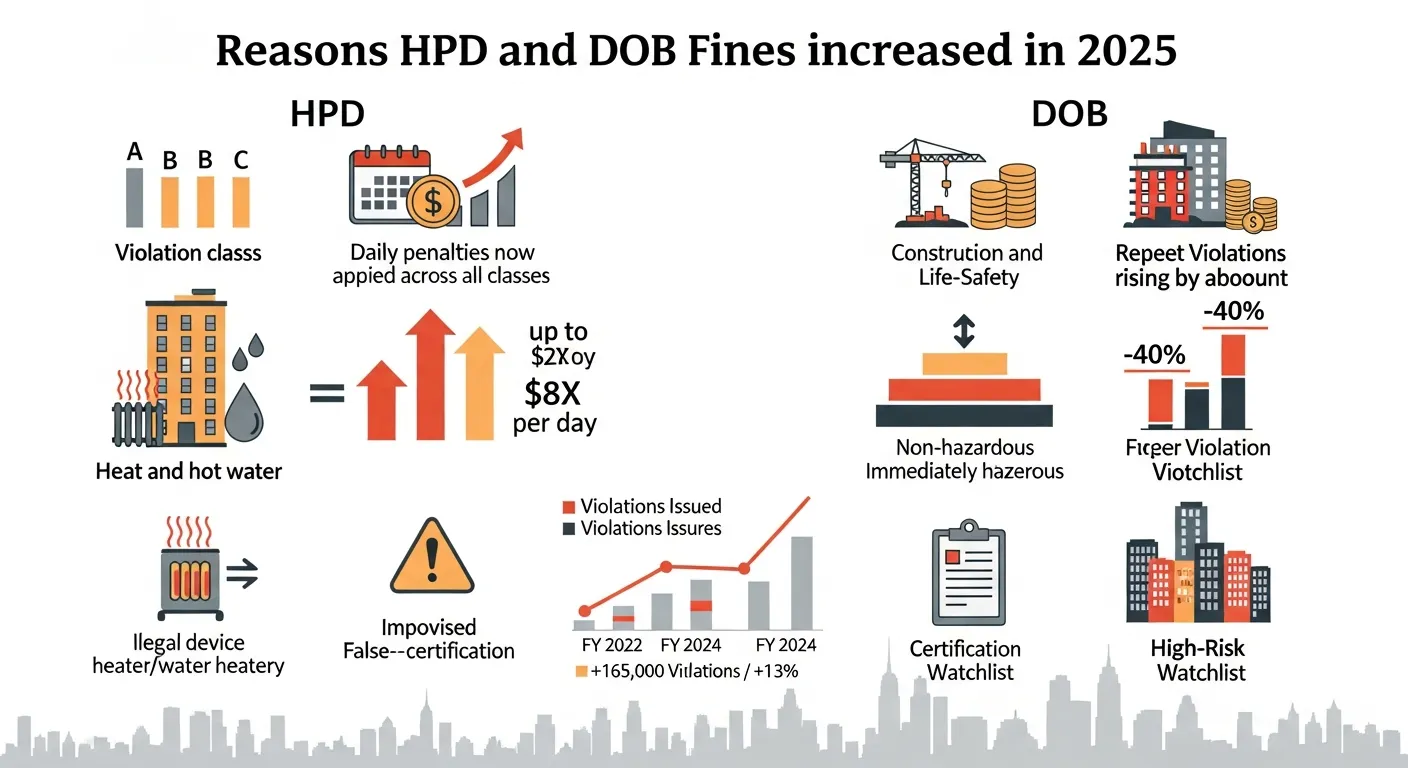
- Daily penalties now apply across all classes. Historically, daily fines were largely associated with Class C (immediately hazardous) issues. In 2025, Class A, B, and C violations can all carry daily penalties on top of the base fine. That turns a “one‑time hit” into an accumulating meter.
- Heat and hot water fines jumped sharply. For buildings with more than 5 units, Class C heat and hot water penalties now run up to $1,200 per day, and up to $1,500 per day for subsequent heat violations within the same season.
- Illegal devices get punished harder. Penalties for illegal or improper heat/hot‑water devices doubled to $50 per day or $2,000, whichever is higher.
- False certification rules tightened. Owners and agents who repeatedly certify that violations are corrected when they’re not now face tiered fines: roughly $50–$250 per non‑hazardous, $250–$500 per hazardous, and $500–$1,000 per immediately hazardous false certification.
- Certification Watchlist launched. Starting January 2025, HPD is required to publish a Certification Watchlist of 100 buildings with significant false certification histories. Those properties can expect enhanced scrutiny and repeat inspections.
The city’s own numbers back up the impact. HPD’s published statistics show a 13% increase in violations issued in the first four months of FY 2025 compared with the same period in FY 2024, on top of a roughly 165,000‑violation increase between FY 2022 and FY 2024.
For DOB (construction, structural, and life‑safety compliance):
- Code penalties escalated, especially for repeat offenders. 2025 code updates lift various civil penalty amounts, with about 40% increases for repeat violations in key categories.
- New escalating daily fines. Many DOB violations now accrue daily penalties that rise by 25% every 30 days until cured, plus 9% annual interest on unpaid balances. Ignoring a violation for six months can easily multiply the original exposure.
- DOB NOW automation. The city’s digital platform, DOB NOW, is generating violations automatically (for example, when reports or filings are missed) and feeding a public risk scoring system that flags properties for enforcement.
- Cross‑agency triggers. DOB data is now more tightly shared with HPD, FDNY, DEP and other agencies. One significant condition, say, an illegal gas setup or unstable façade, can trigger inspections and fines from multiple departments.
- Stricter façade and parking structure rules. Proposed and adopted 2025 changes toughen penalties for façade safety (Local Law 11/FISP) and parking structure reports, including recurring penalties for buildings deemed structurally compromised or non‑compliant.
Taken together, the rules make it much harder to treat NYC building violations as a manageable cost of doing business.
New Enforcement Priorities: Safety, Habitability, And Equity
The official explanation from city agencies and budget documents is consistent: the fine increases are meant to push better conditions, not just raise revenue.
We can group the 2025 priorities into three buckets:
- Life‑safety and structural stability.
- Gas safety, illegal electrical work, unstable façades, and compromised parking structures are front‑and‑center.
- DOB is leaning on higher daily penalties and stop‑work authority to prevent “work now, fix later” behavior.
- Habitability and basic services.
- HPD is especially focused on heat, hot water, mold, pests, and lead paint, all of which correlate with public health.
- Larger buildings and repeat offenders are explicitly targeted with higher daily rates.
- Equity and tenant protections.
- City Council hearings and HPD testimony have highlighted long‑standing disparities in building conditions between neighborhoods.
- The Certification Watchlist and tougher false‑certification penalties are aimed at chronic bad actors who’ve historically “papered over” dangerous conditions.
None of this is subtle. Whether we agree with the approach or not, the policy intent is clear: raise the cost of non‑compliance until it’s cheaper to maintain safe, habitable housing than to rack up fines.
How The City’s Budget And Policy Goals Shape Fine Levels
Fine schedules don’t get updated in a vacuum. They’re negotiated inside the same budget process that funds HPD inspectors, DOB engineers, shelter beds, and capital repairs.
The city’s financial plans and HPD/DOB budget documents show a few themes:
- More enforcement staff and tech require funding. If HPD and DOB are hiring inspectors and expanding tools like DOB NOW, the city expects some of that investment to be offset by fine revenue.
- Emergency repairs are expensive. HPD reports that emergency repair work, where the city steps in to fix heat, hot water, or life‑safety conditions and then bills the owner, has doubled in affected units year‑over‑year. Higher fines and liens help recover those costs.
- Revenue diversification. Post‑pandemic, the city has looked to non‑tax revenue sources, including penalties and fees. HPD and DOB fines aren’t a budget panacea, but they’re part of that broader strategy.
From a policy perspective, it’s a two‑for‑one: align fines with health and safety goals while also supporting enforcement capacity.
For those who want to dig into the city’s own data, HPD and DOB both publish annual statistics and reports on their websites:
- HPD data and reports: https://www.nyc.gov/site/hpd/about/facts-and-figures.page
- NYC Department of Buildings: https://www.nyc.gov/site/buildings/index.page
HPD Fines In 2025: What’s Driving The Spike
Top Violation Types Seeing Higher Penalties
When we look at 2025 HPD enforcement patterns, a few categories jump out as clear drivers of higher fines:
- Heat and hot water (Class C).
- These are the most aggressively penalized in 2025, especially in multi‑unit buildings.
- Daily fines up to $1,200–$1,500 make even a one‑week outage extraordinarily costly.
- Mold, leaks, and pests.
- Moisture issues and infestations are seeing more frequent reinspections and escalating penalties.
- HPD is tying these issues more directly to health conditions, which justifies Class B or C designations.
- Lead paint and child safety.
- With citywide attention on lead exposure, lead‑related violations remain a high‑priority category.
- Owners failing to do required annual inspections, XRF testing, or remediation can face compounded penalties.
- False certifications and missed deadlines.
- 2025 rules mean each false certification can carry its own fine.
- Properties on the Certification Watchlist can face accelerated follow‑ups and more violations per inspection.
The big takeaway: it’s not just that HPD is issuing more violations. Each violation is more expensive and more likely to accumulate daily penalties.
Data Snapshot: Average HPD Fine Amounts 2022–2025
Official citywide averages fluctuate by building type and borough, but we can sketch a realistic directional trend based on HPD’s reported totals and penalty schedules:
- 2022: Many non‑hazardous violations carried modest one‑time civil penalties, often in the low hundreds of dollars. Daily fines were largely reserved for immediately hazardous conditions.
- 2023–2024: We started to see expanded use of daily penalties for serious habitability issues and higher fines for repeat offenders.
- 2025: With daily penalties across all classes and higher Class C rates, it’s now common for what looks like a relatively minor condition, say, a recurring leak or no self‑closing door, to generate four‑figure exposure if left open for a month or more.
In practice, that means a small owner who once expected a $250–$500 hit for a condition could now face $3,000+ over time if it’s not corrected and cleared properly.
How Repeat Offenders And ‘Heat And Hot Water’ Cases Are Targeted
HPD’s 2025 framework is explicitly designed to change behavior among repeat offenders, especially around basic services.
Here’s how that plays out on the ground:
- Higher baseline for subsequent heat violations. Once a building has a documented heat outage, the second and third violations in a season are much more expensive.
- Pattern‑based inspections. If a building generates multiple HPD complaints about heat, hot water, or broken boilers, inspectors return more frequently, often during peak cold periods.
- Certification scrutiny. Buildings that repeatedly certify heat issues as corrected, but where tenants keep calling 311, are prime candidates for the Certification Watchlist.
- Emergency repairs with cost recovery. In worst‑case scenarios, HPD can step in, restore service, and place a lien for the work and administrative costs, on top of existing civil penalties.
Owners who manage to stay out of the “frequent flyer” category, through preventive boiler maintenance, proactive communication, and quick turnarounds, are seeing far fewer high‑ticket HPD penalties than those who treat heat season as a recurring firefight.
To keep track of patterns across a portfolio, we’re seeing more managers rely on tools like ViolationWatch to pull consolidated HPD records and spot risk buildings before they spiral. For free lookups, use our NYC violation lookup tool to see open HPD and DOB items by address or block and lot.
DOB Fines In 2025: From Construction Sites To Paperwork
Higher Penalties For Life‑Safety And Structural Violations
If HPD’s 2025 focus is habitability, DOB’s is life‑safety.
The steepest penalty jumps in 2025 show up around:
- Unpermitted or unsafe construction work. Working without a permit, ignoring means‑and‑methods requirements, or bypassing required supervision can now trigger substantial civil penalties and stop‑work orders.
- Façade and exterior wall conditions. Under expanded Local Law 11/FISP rules, failure to file, inaccurate reports, or uncorrected “unsafe” conditions can generate recurring penalties until the condition is resolved and re‑inspected.
- Parking structure safety. Owners with garages and parking decks face new periodic inspection and reporting rules, with fines for late or missing reports and for failing to address flagged structural issues.
- Gas and electrical hazards. Improper gas work, illegal taps, and overloaded or unlicensed electrical work are drawing coordinated enforcement from DOB and FDNY.
In all of these areas, DOB’s 2025 regime rewards early, documented corrections and penalizes delay.
New Filing, Permit, And Inspection‑Related Fines
Not all 2025 DOB fines arise from dramatic construction failures. A growing share come from what used to be treated as “paperwork problems”:
- Missed or late technical reports. Façade, parking structure, and certain structural or special inspection reports now carry higher late fees and recurring penalties until brought current.
- Permit expiration and renewal lapses. Letting a permit lapse while work continues, or failing to renew in time, can lead to violations issued automatically through DOB NOW.
- Failure to schedule required inspections. Many jobs now require progress inspections, special inspections, and sign‑offs. Skipping these or delaying them beyond allowed windows can generate violations even when the physical work looks clean.
- TCO/CO blocks tied to violations. Open DOB violations or unpaid fines can block Temporary Certificates of Occupancy and final COs, effectively freezing lease‑ups or sales.
In this sense, DOB’s 2025 framework turns administrative discipline into a core risk‑management function.
Data Snapshot: DOB Violations, Dismissal Rates, And Fine Totals
DOB publishes enforcement statistics annually, and while 2025 full‑year data isn’t public yet, early trends are visible in quarterly reports and in public hearing calendars:
- More violations issued, but fewer dismissed. Automation and photo documentation requirements mean a higher share of tickets are supported by clear evidence.
- Higher total penalty collections. With escalating daily fines and interest, the same number of open violations now translates into significantly larger receivables for the city.
- Clustered enforcement. When one major condition is found, for example, an unsafe façade, DOB is more likely to uncover and ticket related issues (sidewalk sheds, site safety plans, permits) during follow‑up.
For owners and contractors, the implication is simple: curing early and completely, with documentation, is the most reliable way to keep DOB penalties contained.
To see what DOB has on a building before you file for new work, it’s worth running a quick check via the NYC violation lookup tool and DOB’s official BIS and DOB NOW portals. Catching old NYC building violations before a new application can save weeks of delay.
Macro Trends Behind The 2025 Fine Increases
Post‑Pandemic Housing Conditions And Complaint Volumes
The 2025 rule changes didn’t emerge in a vacuum. They’re the latest chapter in a story that began during the pandemic.
Between 2020 and 2023, NYC saw:
- Spikes in 311 housing complaints, especially around leaks, pests, and heat.
- Deferred maintenance in many properties as cash flow dried up and access to units became more complicated.
- Higher stress on building systems as residents spent more time at home.
By 2024, city officials were pointing to this backlog as a justification for tougher HPD and DOB enforcement. If conditions aren’t improving fast enough voluntarily, the argument goes, penalties need to do more of the heavy lifting.
Climate, Energy, And Façade Safety Crackdowns
Parallel to housing complaints, the city has been rolling out a series of climate and safety mandates:
- Façade safety (Local Law 11/FISP). High‑profile façade failures and falling debris incidents have kept pressure on DOB to step up enforcement on exterior walls and protective measures like sidewalk sheds. 2025 penalties for late or missing reports reflect that.
- Gas detector and gas safety rules. State and city requirements for gas detectors and licensed gas work have created new enforcement touchpoints. Violations here often trigger follow‑ups from both DOB and FDNY.
- Energy and emissions mandates. While Local Law 97 (building emissions) is enforced through the Department of Buildings in a different way than traditional violations, it has contributed to a broader compliance culture where owners are expected to treat mechanical and envelope systems as critical infrastructure.
Climate, energy, and safety goals all point in the same direction: more inspections, more documentation, and stronger penalties for non‑compliance.
Political Pressure Around Tenant Protections And Public Safety
We also can’t ignore the political layer.
Elected officials are under steady pressure from tenant groups, advocacy organizations, and local media to:
- Crack down on “bad actors” who repeatedly ignore HPD complaints.
- Address inequities in building conditions across neighborhoods.
- Respond to tragic incidents associated with illegal construction, fires, or structural failures.
In public hearings and press conferences, higher fines are often framed as a fairness issue: compliant owners shouldn’t be undercut by landlords or contractors who cut corners.
Public reporting, whether via outlets like The Real Deal (https://therealdeal.com/) or broader citywide coverage, amplifies those narratives. Once a pattern of violations hits the news cycle, agencies are strongly incentivized to show they’re using every tool available, including stepped‑up penalties.
How Increased Fines Change Owner, Manager, And Contractor Behavior
Risk Calculus: When It’s Cheaper To Comply Than To Ignore
For years, some owners quietly treated HPD and DOB fines as a cost line, not a deterrent. In 2025, that math has changed.
Consider a mid‑size rental building with a recurring heat problem:
- Old regime: One or two fines per season, maybe a few thousand dollars total.
- 2025 regime: Daily penalties of $1,200–$1,500, plus potential emergency repair liens and false certification fines if paperwork doesn’t match reality.
The cost of a new boiler or system overhaul suddenly looks small next to a winter of HPD actions and lost rent from angry tenants.
The same logic applies on the DOB side: skimping on façade repairs, parking structure inspections, or gas safety can now block permits, refinancing, or sales. That’s real money, even before we count the fines themselves.
Operational Impacts On Small Vs. Large Property Owners
The 2025 fine environment lands differently depending on who we are:
- Smaller owners (1–20 units).
- Less likely to have in‑house compliance staff.
- More exposed to a single large HPD or DOB hit wiping out months of profit.
- Often rely on informal systems, spreadsheets, a super’s memory, that don’t catch patterns across years.
- Mid‑size and institutional owners.
- Better able to invest in preventive maintenance and compliance tracking.
- More sensitive to reputational risk, especially if they own across multiple boroughs.
- More likely to use tools like ViolationWatch or custom dashboards to track NYC property compliance.
As fines rise, we’re seeing small owners adopt some of the same discipline long used by larger operators: scheduled inspections, central tracking of HPD complaints, and rapid follow‑up on violation notices.
Insurance, Lending, And Transactional Consequences
The direct fine is only the first‑order cost. In 2025, open HPD and DOB violations increasingly show up in:
- Lender underwriting. Banks and agencies are asking for detailed HPD and DOB reports before closing. Large open balances or high‑risk violations can slow or kill deals.
- Insurance renewals. Carriers are more likely to flag properties with repeated life‑safety issues, especially fires, illegal conversions, or structural concerns, and either raise premiums or narrow coverage.
- Sales and acquisitions. Buyers are using HPD and DOB records as leverage, demanding credits or escrows to cover the cost of curing violations and upcoming capital work.
That’s why we recommend owners and managers monitor their portfolios continuously rather than waiting for a transaction to surface problems. Get instant alerts whenever your building receives a new violation, sign up for real‑time monitoring with building violation alerts so issues don’t sit unnoticed for months.
Borough‑By‑Borough And Property‑Type Patterns
Where HPD And DOB Fines Grew Fastest In 2025
We don’t yet have final 2025 borough breakdowns, but based on HPD complaint data and DOB enforcement trends, a few patterns are emerging:
- Bronx and Northern Manhattan likely show some of the largest percentage increases in HPD fines, driven by high complaint volumes and long‑standing maintenance backlogs.
- Brooklyn and Queens are seeing strong growth in both HPD and DOB penalties as older housing stock mixes with intense construction activity.
- Manhattan continues to dominate absolute dollar totals for DOB fines, especially for façade, structural, and high‑rise construction issues.
The pattern isn’t that any one borough is suddenly “worse.” It’s that high‑complaint, high‑construction areas attract more inspectors and, under 2025 rules, each enforcement action is more expensive.
Differences Between Rent‑Stabilized, Market‑Rate, And Mixed‑Use Buildings
Fine exposure also varies by regulatory status and use mix:
- Rent‑stabilized housing.
- Typically has tighter rent ceilings, which can limit capital budgets.
- HPD focuses heavily on habitability in these buildings, particularly where there’s a history of tenant harassment claims.
- Market‑rate rentals and luxury buildings.
- May have more complex mechanical systems and amenities, which can generate specialized DOB scrutiny (pools, garages, rooftop structures).
- Tenants in these buildings often have lawyers and public platforms, which can amplify HPD/DOB action.
- Mixed‑use and commercial/residential buildings.
- Must navigate both housing and commercial code requirements.
- Common trouble spots include egress issues, illegal cellar space, signage, and structural alterations to ground‑floor retail.
Understanding which regulatory regimes apply to each building, and how they intersect, is now a baseline requirement for keeping NYC property compliance costs contained.
Notable Outlier Cases And High‑Profile Crackdowns
Every year, a handful of buildings become cautionary tales:
- Properties hit with six‑ or seven‑figure DOB penalties for ignoring unsafe façade conditions or conducting major work without permits.
- Owners who land on HPD’s Certification Watchlist, triggering intense media scrutiny and accelerated enforcement.
- Illegal conversions or overcrowded buildings where fires or collapses lead to simultaneous HPD, DOB, FDNY, and, in some cases, criminal investigations.
These outliers shape how the rest of us think about risk. They’re reminders that while most NYC building violations are modest on their own, they can snowball quickly when ignored.
Practical Strategies To Reduce HPD And DOB Exposure In 2025 And Beyond
Data‑Driven Compliance: Using Violation History And Trends
In a world of higher fines, guessing isn’t a strategy. We need data.
At a minimum, we should:
- Pull a full violation history for each property at least quarterly, covering both HPD violations and DOB violations.
- Flag buildings with repeat patterns, multiple heat complaints, recurring leaks, or frequent stop‑work orders.
- Correlate violations with building age and systems. Older boilers, unrenovated façades, and aging garages often show up repeatedly in the data.
Tools like ViolationWatch help consolidate that information across agencies. For one‑off checks, our NYC violation lookup tool is a fast way to see what HPD and DOB already know about a building before the next inspection.
Preventive Maintenance, Inspections, And Documentation
The second layer is operational: preventing the problems that trigger the most expensive fines.
Focus first on high‑exposure systems:
- Heat and hot water.
- Schedule preseason boiler inspections and test runs.
- Keep logs of maintenance visits and tenant notices.
- Establish an internal rule: any heat or hot‑water complaint is treated as an emergency until we verify service.
- Façades and structures.
- Don’t wait for the FISP cycle. If we see cracking, spalling, or shifting, bring in an engineer early.
- Document conditions with photos and dated reports: it’s much easier to negotiate with DOB when we can show a clear remediation plan.
- Gas and electrical.
- Use licensed professionals and keep permits and sign‑offs organized.
- Take tenant reports of gas odors or sparking outlets seriously and respond immediately.
- Pests, leaks, and mold.
- Chase sources, not symptoms. A recurring leak that’s painted over three times will eventually attract both HPD and, potentially, DOB if structural elements are compromised.
Good documentation can also help us at hearings. Photos, work orders, and logs often make the difference between a reduced penalty and the maximum allowed fine.
When To Self‑Certify, Settle, Or Fight A Fine
Not every violation should be handled the same way. A strategic approach looks like this:
- Self‑certify when we’re absolutely sure.
- If the work is unquestionably complete and compliant, self‑certification can close the loop quickly.
- In 2025, though, the risk of false‑certification penalties means we shouldn’t use this path casually.
- Settle or correct before hearing when daily fines are piling up.
- For violations with escalating daily penalties or 9% interest at DOB, the math often favors early settlement.
- Many owners now bring documentation to the first contact with the agency to negotiate a reduced final penalty.
- Fight when the record is on our side.
- If inspection notes are inaccurate, the cited condition doesn’t exist, or the law was misapplied, it’s worth pushing back at OATH.
- Here again, detailed documentation, time‑stamped photos, and maintenance logs are our best defense.
Regardless of which path we choose, we should never let violations sit unseen. Setting up portfolio‑wide building violation alerts ensures we know about new items as soon as they’re posted and can decide quickly whether to cure, contest, or both.
Looking Ahead: Will HPD And DOB Fines Keep Rising After 2025?
Regulatory Proposals And Pilot Programs To Watch
Based on pending proposals and agency commentary, a few future developments are worth keeping on our radar:
- Expanded risk‑scoring and transparency. DOB and HPD are both experimenting with public risk scores and watchlists. Over time, those tools may influence insurance pricing and lender decisions even more.
- More automation in enforcement. Expect DOB NOW and HPD systems to auto‑generate more violations tied to missed filings, recurring complaints, or data mismatches between agencies.
- Climate and resilience mandates. As Local Law 97 penalties phase in and new flood‑resilience rules move forward, we may see additional fine categories linked to energy performance and climate adaptation.
None of this guarantees another across‑the‑board penalty hike, but the direction of travel is clear: less tolerance for chronic non‑compliance and more pressure on owners to invest in long‑term building health.
How Owners Can Plan Multi‑Year Compliance Budgets
In this environment, we can’t treat fines as random shocks. They have to be modeled.
A multi‑year compliance plan might include:
- Baseline assessment. Use three years of HPD and DOB data to identify systemic issues: boilers, roofs, façades, garages, gas risers.
- Prioritized capital plan. Rank those issues by both safety impact and fine exposure. A boiler or façade that generates HPD complaints and DOB actions should move to the top of the list.
- Reserve targets. Build annual reserves not just for known capital projects, but also for probable compliance work and unexpected violations.
- Team training. Superintendents, resident managers, and project managers should all understand the new 2025 penalty structure, at least at a high level. A foreman who knows a missed inspection can escalate fines is more likely to schedule it on time.
Owners who treat HPD and DOB rules as a planning input, not just a legal constraint, are best positioned to keep total compliance costs predictable over the next five years.
Conclusion
HPD and DOB fines didn’t just creep up in 2025, they were intentionally redesigned to change how we run buildings in New York City.
Daily penalties now sit at the center of enforcement, backed by automated systems, cross‑agency data sharing, and political pressure to deliver safer, more habitable housing. For owners, managers, and contractors, the message is blunt: it’s cheaper to comply than to gamble.
The upside is that we’re not powerless. With data‑driven tracking, stronger preventive maintenance, and smarter decisions about when to self‑certify, settle, or fight, we can navigate this tougher landscape without letting fines dictate our future.
If we stay ahead of NYC building violations instead of chasing them, the 2025 rule changes become manageable constraints, not existential threats. And that starts with knowing our exposure. A quick search in the NYC violation lookup tool and setting up portfolio‑wide building violation alerts are simple steps that can keep a single missed notice from turning into the next six‑figure headline.
Key Takeaways
- HPD and DOB fines increased in 2025 mainly because New York City expanded daily penalties, raised base fine amounts, and added automation that issues violations for missed filings and repeat problems.
- HPD fines now hit harder across all violation classes, with steep daily penalties for heat and hot water, tougher rules on false certification, and a public Certification Watchlist that targets chronic offenders.
- DOB fines in 2025 focus on life-safety and structural risks, adding escalating daily penalties, 9% interest on unpaid balances, and stricter enforcement of façade, parking structure, gas, and permit requirements.
- Rising HPD and DOB fines are driven by policy goals around safety, habitability, tenant protections, and post‑pandemic complaint backlogs, as well as the city’s need to fund more inspectors and enforcement technology.
- Owners, managers, and contractors can control exposure to HPD and DOB fines in 2025 by using violation data, preventive maintenance, better documentation, and fast decisions on whether to self‑certify, settle, or contest violations.
- Because fines can now snowball into six‑figure liabilities and block financing or transactions, multi‑year compliance planning and real-time violation monitoring have become essential parts of NYC property strategy.
Frequently Asked Questions About Rising HPD and DOB Fines in 2025
Why did HPD and DOB fines increase so much in 2025?
HPD and DOB fines rose in 2025 because New York City changed the underlying rules: higher civil penalties, daily fines across more violation classes, tougher repeat‑offender tiers, and more automation via DOB NOW. The goal is to push faster corrections, improve safety and habitability, and help fund expanded enforcement.
What are the biggest 2025 changes affecting HPD and DOB fines for owners?
Key 2025 changes include daily penalties on all HPD violation classes, sharply higher heat and hot water fines, stricter penalties for illegal devices and false certifications, new DOB daily fines with 9% interest, stronger façade and parking structure rules, and more cross‑agency enforcement triggers that can multiply NYC building violations.
How do daily penalties now work for HPD and DOB fines in 2025?
For HPD, Class A, B, and C violations can all carry accumulating daily penalties, with heat and hot water cases reaching $1,200–$1,500 per day in larger buildings. For DOB, many violations now accrue daily fines that increase about 25% every 30 days until cured, plus 9% annual interest on unpaid balances.
How can I reduce my risk of expensive HPD and DOB fines under the 2025 rules?
Prioritize preventive maintenance on heat, hot water, façades, parking structures, gas, electrical, and leak/mold issues. Run regular HPD and DOB violation lookups, track complaint patterns, and respond quickly with documented repairs. Use portfolio‑wide alerts or tools like ViolationWatch so new NYC building violations never sit unnoticed and accumulate daily penalties.
Can HPD or DOB fines be negotiated, reduced, or dismissed?
Yes. If you correct conditions quickly and bring strong documentation, you can often negotiate lower penalties or seek dismissal at OATH hearings when violations are inaccurate or unsupported. However, false certifications or long‑ignored violations with daily fines and interest are much harder to reduce, so timing and records matter.
How do I check if my New York City property has open HPD or DOB violations?
You can search HPD and DOB records online by address or block and lot. Use HPD’s public portal, DOB’s BIS and DOB NOW systems, or third‑party tools such as a NYC violation lookup platform that consolidates HPD violations and DOB violations, shows fine exposure, and can send ongoing alerts.