
How long does it actually take for an HPD complaint to turn into a formal violation in New York City? If we talk to tenants, we hear everything from “same day” to “it never went anywhere.” Owners often say they had no idea a complaint even existed until a violation showed up in the mail.
Both experiences can be true.
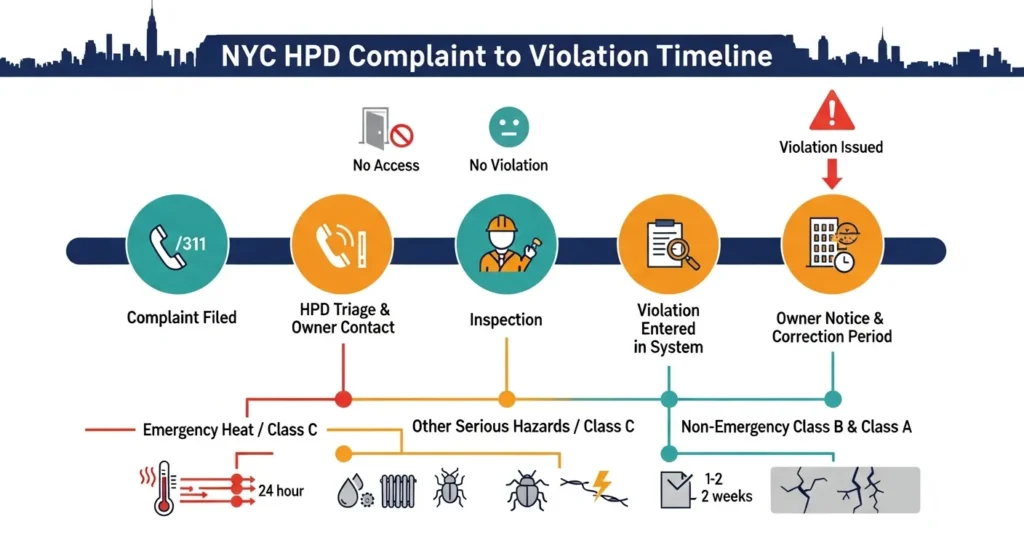
In practice, an HPD complaint can become a violation in as little as 24 hours for emergency heat cases, or it may take one to two weeks for non‑emergencies. Some complaints never become violations at all. The outcome depends on how the complaint is filed, how fast inspectors can get access, how serious the condition is, and what HPD finds on the ground.
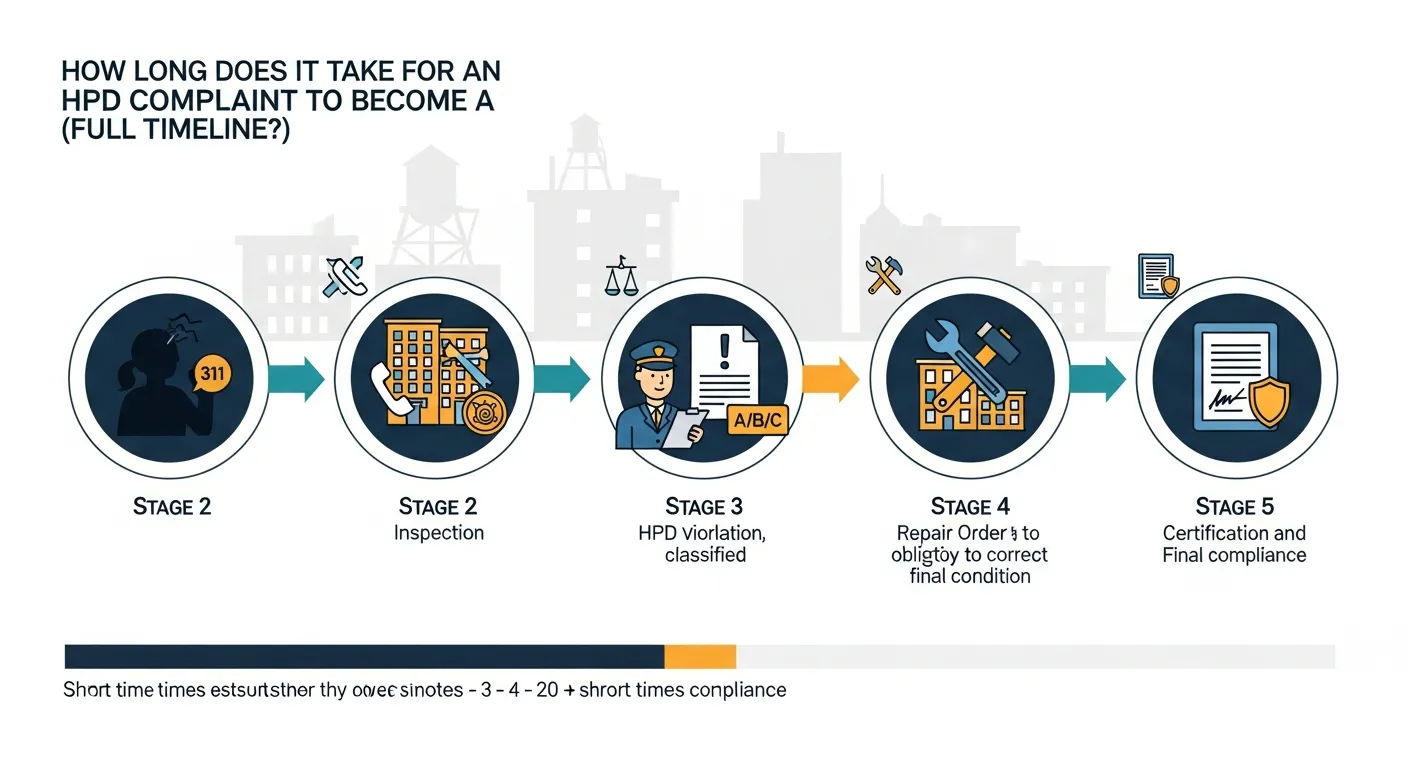
In this piece, we walk through the full timeline, from the moment a tenant calls 311 to the day a violation appears in HPD’s system and in NYC building violations databases. We’ll break down typical timeframes, legal deadlines, and real‑world delays so tenants, owners, and property managers can navigate NYC property compliance with clear expectations instead of guesswork.
Understanding HPD, Complaints, and Violations
Understanding HPD, Complaints, and Violations {#5uMNBntT4Q4TDGqTYx8iS}
What Is HPD And What Does It Do?
New York City’s Department of Housing Preservation and Development (HPD) is the city agency that enforces the Housing Maintenance Code in most residential buildings. In plain terms, HPD is responsible for making sure apartments are safe, habitable, and up to code, especially around heat and hot water, basic services, and many common safety issues.
HPD doesn’t patrol buildings at random. It works largely off HPD complaints made via 311, plus targeted enforcement programs. When a tenant reports a serious condition, no heat, leaks, pests, dangerous wiring, HPD can send an inspector and, if the problem is verified, issue a violation to the owner.
HPD violations then become part of the public record and often show up in NYC building violations searches, mortgage due diligence, and even tenant screening by advocates.
Key Terms: Complaint, Inspection, Violation, Order, and Certification
To understand the timeline, we need a few definitions:
- Complaint – The tenant’s report to 311 about a condition that may violate the Housing Maintenance Code.
- Inspection – HPD’s on‑site visit to see whether the reported condition actually exists and breaks the law.
- Violation – An official written notice that HPD issues to the owner when an inspector confirms a code violation, with a specific class (A, B, or C) and a deadline to fix.
- Order – The repair order or correction requirement contained in the violation notice.
- Certification of Correction – The owner’s sworn statement to HPD that the work has been completed and the condition corrected.
The complaint is just the starting signal. The violation, the legal document, is what creates enforceable deadlines, penalties, and long‑term records in NYC building violations databases and tools like ViolationWatch.
Step 1: Filing an HPD Complaint
Step 1: Filing an HPD Complaint {#bYgGfj4fi-sGrM53xAEYH}
How To File: 311, Online, and Through Elected Officials
Most HPD cases begin with a 311 call. Tenants can:
- Call 311 and ask to file a housing complaint with HPD.
- Use 311 Online or the 311 mobile app.
- In some cases, get help from a local council member’s office, a legal services provider, or a tenant organizer to file and follow up.
For official guidance, HPD explains complaint procedures and online access on its own site at nyc.gov/hpd.
Information You Should Include To Avoid Delays
What we tell tenants and advocates is simple: the better the information, the faster the process. When filing, it helps to include:
- Exact building address and apartment number.
- Detailed description of the problem (for example, “no heat in living room and bedroom,” not just “too cold”).
- How long the problem has been happening and when it’s worst (overnight, weekends, after rain, etc.).
- Contact phone and any access instructions (super’s number, buzzer name, language needs).
- Whether children, seniors, or people with disabilities live in the apartment.
The more precise the description, the easier it is for HPD to classify the complaint correctly, and that classification directly affects how fast inspectors are dispatched.
Confirmation, Complaint Numbers, and Tracking Status
Once the complaint is filed, 311 gives the tenant a complaint number. That number is crucial. It’s how we later track whether the city actually sent an inspector, whether access was gained, and whether any violations were issued.
Status can be checked by:
- Calling 311 and providing the complaint number.
- Looking up the building on HPD Online or other tools that pull NYC building violations data.
- Using a dedicated NYC violation lookup tool such as https://lookup.violationwatch.nyc/lookup for free lookups and monitoring.
From a timeline perspective, the clock starts on the day the complaint is logged, even if HPD can’t come out right away.
What Happens Right After You File
What Happens Right After You File {#tsrHXe5XzOUWfsAoUXOVg}
Once a complaint is in the system, HPD usually takes two quick steps, often before anyone even shows up at the building.
First, HPD typically attempts to contact the owner or managing agent. The agency calls the number on file to say: a complaint was made, HPD may inspect, and if the condition isn’t corrected, an HPD violation could be issued. In a surprising number of cases, that phone call alone prompts a quick fix.
Second, HPD may call the tenant back. If the tenant says the problem has already been corrected (for example, the heat came back on or the leak stopped), HPD sometimes closes the complaint without an inspection. In that situation, there’s no NYC building violation, only a closed complaint record.
This early phone triage is important for the timeline. If the tenant reports that the condition is ongoing, the complaint stays active and moves into the inspection queue. If the tenant can’t be reached or there’s confusion about access, the case can stall before an inspector ever arrives.
At this point, we still only have a complaint. The countdown to a violation doesn’t really begin until HPD schedules and performs an on‑site inspection.
Inspection Timelines: How Fast Does HPD Come Out?
Inspection Timelines: How Fast Does HPD Come Out? {#XSQIYYr51vKdt9i_oax1t}
How HPD Prioritizes and Classifies Complaints
HPD triages complaints by severity. Conditions that threaten health or safety get moved to the front of the line. While the official violation class (A, B, or C) is set later at inspection, the same logic is used to prioritize complaints:
- Immediately hazardous conditions (future Class C) are treated as emergencies.
- Other hazardous issues (future Class B), like leaks or pests, are serious but not life‑threatening.
- Non‑hazardous conditions (future Class A), like minor peeling paint, are at the back of the queue.
According to HPD reports, complaints across the system historically take around 11 days on average to be investigated and closed, but emergencies move much faster.
Statutory Response Times For Different Conditions
The Housing Maintenance Code sets correction deadlines after a violation is issued, not exact inspection response times. Still, HPD policy and practice mirror those deadlines. Once a violation is on the books, owners typically must correct within:
- 90 days for Class A (non‑hazardous).
- 30 days for Class B (hazardous).
- 21 days for many Class C conditions like mold, rodents, or lead hazards.
- 14 days for self‑closing doors.
- 24 hours or immediate for most other Class C, including heat and hot water.
Those same categories drive how quickly HPD tries to get inspectors out in the first place.
Heat And Hot Water Complaints
Heat and hot water sit in their own category. During heating season (October 1–May 31), HPD aims to inspect within 24 hours of a no‑heat or no hot‑water complaint. City guidance on heat enforcement, available via NYC 311, makes clear that these are treated as emergencies.
In practice, that often means:
- Complaint filed at night.
- Inspector arrives the next day (sometimes the same day, if early enough).
- If the apartment fails the temperature test, a Class C heat violation is written on the spot.
Emergency Conditions (Class C)
Other immediately hazardous issues, exposed live wiring, serious structural cracks, collapse hazards, are also supposed to be inspected quickly, usually within 1–3 days. Weather events or citywide crises can slow this down, but these cases still sit ahead of routine leaks or minor defects in the queue.
Non‑Emergency Conditions (Class B And Class A)
For common but non‑emergency issues, leaks, roaches, peeling paint, damaged plaster, tenants should expect more variation. In more typical periods, we see inspections happening within several days to about 1–2 weeks after the complaint.
That’s where seasonality, staffing, and access problems start to matter. When the city is flooded with winter heat calls or dealing with major storms, low‑priority complaints can slide toward the two‑week mark or beyond before an inspector actually reaches the unit.
How and When a Complaint Becomes an HPD Violation
How and When a Complaint Becomes an HPD Violation {#lYELS1ZtiLoU5m63y5b3t}
What Inspectors Look For During A Visit
When HPD does show up, inspectors aren’t limited to a single issue. They’ll check:
- The exact condition in the complaint: room temperature, presence of hot water, visible leaks, mold, infestations, broken doors, missing detectors, and so on.
- Related safety issues they observe while inside: missing smoke or CO detectors, non‑self‑closing doors, obvious hazards in common areas.
They measure, photograph, and document what they see. For heat cases, inspectors use a thermometer. For leaks or mold, they focus on location, size, and likely cause.
Outcomes Of An Inspection: No Access, No Violation, Or Violation Issued
Every inspection of an HPD complaint ends in one of a few outcomes:
- No Access – Nobody answers the bell, or the super refuses entry. HPD doesn’t see the condition, so no violation.
- No Violation – The condition is gone by the time the inspector arrives or doesn’t actually violate the code.
- Violation Issued – The condition exists, violates the Housing Maintenance Code, and is written up as Class A, B, or C.
Only that last outcome, confirmed condition plus code breach, creates an HPD violation.
From Observation To Official Violation: The Legal Steps
The moment the inspector confirms a violating condition, the complaint starts turning into a formal violation:
- Inspector observes and documents the condition.
- Inspector enters a violation into HPD’s system, assigning a class and a statutory correction deadline.
- HPD generates a Notice of Violation addressed to the owner and registered managing agent.
- The notice is served (often by mail) and becomes legally enforceable.
On paper, the violation date is the date of the inspection, not the date of the original complaint.
How Long It Usually Takes For A Violation To Appear In HPD’s System
The violation is created in HPD’s electronic system the day the inspector writes it. It may not show up instantly in public portals, but in practice it usually appears within a few days in HPD Online and other NYC building violation lookups.
That’s why tools like ViolationWatch and its connected NYC violation lookup tool can often display new HPD violations shortly after the inspection date, even before some owners realize what was issued.
How Long Does It Take To Receive Written Notice?
Owners and managing agents are served by mail at the address in HPD’s registration records. Mail time and internal processing mean that written notices usually arrive within several days to a week after the inspection.
This lag creates a familiar disconnect: tenants can already see the new violation online, while owners may still be waiting for the envelope. For compliance‑minded owners managing large portfolios of NYC building violations, relying only on the mail is risky.
To tighten that gap, it’s increasingly common for owners or managers to enroll in building violation alerts at https://violationwatch.nyc/register/ so they’re notified quickly when a complaint becomes a violation and the cure clock starts.
Typical Timelines by Violation Type and Season
Typical Timelines by Violation Type and Season {#RThru_VpYXhQ12UQLoSQI}
Standard Timelines For Common Complaint Types
Based on city data and on‑the‑ground reports, we can describe realistic ranges from complaint date to violation date, assuming HPD gains access and the problem qualifies as a violation:
- No heat / no hot water (Class C, heating season)
- Complaint: Day 0
- Inspection: within 24 hours in many cases
- Violation: written the day of inspection: visible in online systems within a few days.
- Serious emergency hazards (Class C) – for example, a collapsing ceiling or exposed electrical wiring:
- Complaint: Day 0
- Inspection: often within 1–3 days
- Violation: dated the day of inspection.
- Leaks, mold, pests, broken doors (Class B):
- Complaint: Day 0
- Inspection: typically several days to about 1–2 weeks
- Violation: usually written on inspection day.
- Minor non‑hazardous issues (Class A) – cosmetic defects, certain minor maintenance items:
- Complaint: Day 0
- Inspection: often 1–2 weeks or longer during busy seasons
- Violation: same‑day as inspection, if issued.
Seasonal And Weather‑Related Backlogs
HPD’s volume spikes in cold weather. In a harsh winter, heat and hot water complaints can overwhelm inspectors. When that happens, HPD has to triage. Emergency heat calls and other Class C hazards move first: routine Class B and A conditions get bumped down the list.
We’ve seen periods where non‑emergency inspections slide toward the two‑week mark or beyond, especially during sustained cold snaps or following major storms that trigger roof, leak, or structural complaints citywide.
Citywide Crises, Holidays, And Staffing Issues
Other systemic factors also stretch timelines:
- Citywide emergencies (for example, public health crises) that restrict site visits or shift staff.
- Holiday periods, when both tenants and building staff are harder to reach for access.
- Staffing constraints, which HPD has acknowledged in budget testimony and public reports.
In those stretches, tenants may feel like nothing is happening. But the complaint still exists in HPD’s system, and once inspectors reach the building, the complaint can still convert into a violation, just on a delayed schedule.
For anyone trying to track NYC building violations in real time during those periods, online portals and independent monitors are often more informative than waiting for mail or word from the super.
Delays, Missed Inspections, and Why a Complaint Might Not Turn Into a Violation
Delays, Missed Inspections, and Why a Complaint Might Not Turn Into a Violation {#QS7ridZnuPicOw3V-VFp3}
Common Reasons Inspections Get Delayed Or Cancelled
Not every HPD complaint leads to a timely inspection. Common bottlenecks include:
- High complaint volume (especially winter heat waves).
- Inspectors unable to reach the tenant by phone to coordinate access.
- Incorrect or incomplete building information in the complaint.
- Security or intercom issues that prevent entry to the building.
From HPD’s point of view, these are practical access problems. From a tenant’s point of view, they can feel like the city simply never showed up.
Why Some Complaints Never Become Violations
Even when an inspector arrives, a complaint doesn’t automatically become a violation. Reasons include:
- No access: No one answers the door, or entry is denied.
- Condition corrected: The heat is back on, the leak stopped, or the owner made quick repairs.
- No code breach: The issue is a comfort preference or a dispute with the owner rather than a Housing Maintenance Code violation.
- Duplicate cases: Multiple tenants report the same problem: HPD consolidates around an existing violation rather than issuing new ones.
So a tenant can absolutely say, “I filed an HPD complaint,” and still see no violation appear in online NYC building violations searches later.
How To Follow Up And Re‑Schedule An Inspection
If a reasonable amount of time passes and there’s no sign of an inspection, or if HPD left a No Access note, the next steps are:
- Call 311 with the complaint number and ask for the current status.
- If there was a missed or no‑access visit, ask to re‑schedule an inspection and confirm best times.
- Make sure the phone number and buzzer information on file are correct.
Tenants can also ask a local tenant group or elected official’s office to help push for follow‑up in stubborn cases. Courts have recognized the importance of HPD’s role in enforcing the Housing Maintenance Code: information on Housing Court options is available from the New York State courts at nycourts.gov.
How Tenants Can Speed Up the Process and Protect Their Rights
How Tenants Can Speed Up the Process and Protect Their Rights {#ebCdKPESuVvjIR9vUk4pt}
Documenting Conditions With Photos, Videos, And Logs
From a tenant’s standpoint, anything that makes the problem easier to prove makes it more likely that a complaint will become a violation.
We encourage tenants to:
- Keep a log of dates and times when the issue occurs, especially for intermittent heat, hot water, or leaks.
- Take photos and videos that show the condition clearly, including a timestamp or a phone screenshot with the date.
- For heat, photograph a digital thermometer under windows or next to radiators.
While HPD relies on its own inspection, these records can support follow‑up complaints, legal actions, or challenges if an owner falsely claims the condition was corrected.
Coordinating Access For Inspectors
Access is the single biggest make‑or‑break factor in turning a complaint into an HPD violation. To improve the odds:
- Answer calls from unfamiliar numbers during the days after filing a complaint, HPD often calls from blocked or generic lines.
- Arrange for someone to be home, or give the super and HPD clear instructions for entry.
- Coordinate with neighbors so the inspector can get into the building even if the lobby door is locked.
Without entry to the unit or common areas where the condition exists, HPD usually can’t issue a violation, no matter how strong the complaint.
Using Online Tools To Check HPD Records
HPD’s own portal, HPD Online, lets us see open and closed violations, complaints, and registration data for a building. That’s essential for confirming whether an HPD complaint has actually turned into a violation.
For a more streamlined view focused on NYC building violations, we can also use independent tools. For free lookups, use our NYC violation lookup tool at https://lookup.violationwatch.nyc/lookup, which pulls HPD and other agency data into one place.
Get instant alerts whenever your building receives a new violation, sign up for real‑time monitoring with building violation alerts at https://violationwatch.nyc/register/ so critical HPD violations don’t go unnoticed.
Escalating: 311, Elected Officials, And Legal Help
If conditions persist even though multiple complaints, tenants have additional options:
- Keep calling 311, referencing prior complaint numbers.
- Contact a city council member, state legislator, or borough president’s office to help flag chronic conditions.
- Reach out to legal services or tenant advocacy organizations to discuss a Housing Court repairs case, sometimes called an HP action.
In Housing Court, tenants can ask a judge to order repairs and impose penalties. Those cases often rely heavily on HPD’s inspection and violation records, so making sure the original HPD complaint turns into a documented violation, when warranted, is critical.
What Happens After a Violation Is Issued
What Happens After a Violation Is Issued {#YbAoUx9MXezaFF9AbpoU5}
Cure Periods, Deadlines, And Owner Obligations
Once an HPD violation is issued, the clock shifts from inspection timing to correction deadlines. From the date the violation is served, owners must fix the condition within the statutory time frame:
- Class A (non‑hazardous): 90 days
- Class B (hazardous): 30 days
- Class C (immediately hazardous): 21 days for many conditions: 14 days for self‑closing doors: immediate or 24 hours for heat and hot water
After repairs, owners are expected to submit a Certification of Correction to HPD, often through the agency’s online portal.
Re‑Inspections And Closing Out Violations
HPD doesn’t automatically take every certification at face value. The agency can audit corrections by sending inspectors back out. If they confirm that the condition has been fixed, the violation is marked closed in HPD’s system.
In practice, we often see a lag of 30–70 days between certification and final closure, depending on whether HPD reinspects. Lead paint and other high‑risk issues can trigger more frequent audits.
If an owner falsely certifies, claiming work was done when a dangerous condition still exists, HPD can mark the case as False Certification, keep the violation open, and seek additional penalties.
Penalties, Fines, And Housing Court
If an owner doesn’t correct and certify within the legal time frame, HPD can:
- Seek civil penalties in Housing Court.
- Impose per‑day fines for continuing Class C conditions like no heat or hot water.
- Charge inspection fees for repeated trips to the building when violations remain uncorrected.
DOB violations, from the Department of Buildings, may also be in play for structural or construction‑related issues, creating additional fines and compliance obligations on top of HPD violations. Together, these penalties can become substantial and also complicate financing, sales, and insurance.
Detailed information on HPD’s enforcement powers is available through official NYC sources like nyc.gov/hpd and related Housing Court materials.
What Tenants Should Watch For After A Violation Is Issued
For tenants, the story doesn’t end when a violation appears in HPD’s system. We should:
- Check HPD Online or an NYC building violations platform to confirm the class, the specific condition, and the correction deadline.
- Watch whether the owner files a Certification of Correction and whether HPD marks the violation closed.
- Call 311 again if the condition still exists after the deadline, referencing the violation number.
If the condition continues even though open violations, tenants and advocates can consider a Housing Court action, often relying on the violation record as objective evidence that the problem is both real and legally significant.
Conclusion
Conclusion {#sToZn-dQHYx9cqmwqAkAy}
In real life, there’s no single answer to the question, “How long does it take for an HPD complaint to become a violation?” For emergencies like no heat, the process can move from complaint to violation in about a day. For common but non‑emergency problems, we’re usually looking at several days to roughly two weeks, assuming HPD gets access and the condition qualifies under the Housing Maintenance Code.
When delays stretch longer, the culprits are familiar: heavy winter complaint volume, missed appointments, wrong contact info, or conditions that get fixed, at least temporarily, before inspectors arrive. Some HPD complaints never become violations at all because HPD can’t confirm a code breach.
For tenants, the best way to protect rights is to document problems, file precise HPD complaints through 311, coordinate access, and follow up when necessary. For owners and property managers, staying on top of NYC property compliance means watching for new HPD and DOB violations, understanding cure periods, and correcting conditions quickly.
We’ve seen that relying on paper mail alone is risky in a system where violations can appear online within days of inspection. That’s why more owners and tenant groups are turning to tools like ViolationWatch for centralized monitoring. In a city where HPD complaints, inspections, and violations shape not just daily living conditions but also property values and legal risk, having a clear handle on the full complaint‑to‑violation timeline isn’t just useful, it’s essential for everyone involved.
Key Takeaways
- An HPD complaint can become a violation in as little as 24 hours for emergency no-heat or no–hot-water cases, but non-emergency issues typically take several days to 1–2 weeks if inspectors gain access and confirm a code breach.
- The official violation date is tied to the inspection, not the original HPD complaint, and violations usually appear in HPD Online and other NYC building violations tools within a few days of that inspection.
- Many HPD complaints never turn into violations because inspectors cannot gain access, the condition is fixed before inspection, the issue doesn’t legally violate the Housing Maintenance Code, or the case is folded into an existing violation.
- Tenants can speed up the complaint-to-violation timeline by filing precise HPD complaints via 311, documenting conditions with photos and logs, promptly coordinating access for inspectors, and following up with 311 or elected officials if inspections are delayed.
- Owners and property managers should monitor NYC building violations online or with automated alert tools instead of relying only on mail, so they can respond quickly to new HPD violations and meet strict correction deadlines for Class A, B, and C conditions.
Frequently Asked Questions
How long does it take for an HPD complaint to become a violation in NYC?
An HPD complaint can become a violation in as little as 24 hours for emergency heat and hot‑water cases. For non‑emergency issues, the typical range is several days to about 1–2 weeks, assuming HPD gains access and confirms a Housing Maintenance Code violation during inspection.
Why might an HPD complaint never turn into a violation?
Many HPD complaints never become violations because inspectors can’t get access, the owner fixes the issue before the visit, the condition doesn’t legally violate the Housing Maintenance Code, or multiple tenants reported the same problem and HPD relies on an existing violation rather than issuing a new one.
When will a new HPD violation show up in NYC building violations searches?
Once an inspector confirms a problem and writes an HPD violation, it’s entered into HPD’s system the same day. It usually appears in public portals like HPD Online and independent NYC building violations tools within a few days, often before the owner receives the mailed notice.
What can tenants do to speed up the HPD complaint timeline?
Tenants can help move an HPD complaint toward a violation by giving an accurate address, detailed description, and good contact info, documenting conditions with photos and logs, answering HPD’s follow‑up calls, and making sure inspectors can easily access the apartment and building when an inspection is scheduled.
Does filing an HPD complaint affect my rent or eviction case?
Filing an HPD complaint does not legally allow a landlord to raise rent or evict you in retaliation. New York law prohibits retaliatory eviction for tenants who assert their rights or contact HPD. However, if you’re worried about possible pushback, speak with a tenant lawyer or legal services group.
What’s the difference between an HPD complaint and other NYC building violations, like DOB violations?
An HPD complaint concerns housing conditions inside residential buildings and may lead to HPD violations for issues like heat, leaks, pests, or detectors. Department of Buildings (DOB) violations typically involve structural, construction, or safety code issues. A single property can have both HPD and DOB violations at the same time.